2027 Most Affordable Online Dental Assistant to Dental Hygienist Bridge Programs

Co-Founder and Chief Data Scientist
Moving from dental assistant to dental hygienist can be one of the most practical ways to increase clinical responsibility, qualify for licensure, and pursue higher-paying roles in dentistry. The challenge is that many dental assistants do not know which “bridge” options are truly designed for assistants, which ones are actually RDH-to-bachelor’s completion programs, and which programs require in-person clinical training even when coursework is online.
This guide explains how online dental assistant to dental hygienist bridge programs work in 2027, what they cost, how long they take, what licensure and accreditation details matter, and how to compare affordable options without overlooking clinical requirements. It is written for working dental assistants, current dental hygiene students, and licensed hygienists considering bachelor’s or graduate-level advancement.
The timing matters. In 2022, staffing shortages were the top issue reported by dental practices, cutting overall capacity by 11%. Nearly 40% of practices were hiring both dental assistants and dental hygienists. For assistants who want a more advanced clinical role, bridge-style education can shorten the path—but only if the program fits their state licensing requirements, budget, and schedule.
Quick answer: Are online dental assistant to dental hygienist bridge programs worth considering?
Yes, they can be worth considering if you already have dental assisting experience, meet science prerequisites, and can complete required clinical hours at an approved site. However, students should be careful with the word “online.” Dental hygiene licensure requires hands-on clinical training, so most legitimate programs are hybrid rather than fully online. Some programs marketed as bridge options are also intended for licensed dental hygienists who already hold an associate degree, not for dental assistants entering hygiene for the first time.
What are the main benefits of earning a dental hygiene degree?
- A dental hygiene degree can qualify graduates to pursue licensure as dental hygienists, a role with broader preventive-care duties and more direct patient-care autonomy than many dental assisting positions.
- Dental hygienists earn a median annual salary of $87,530, which is substantially higher than typical dental assistant earnings.
- Online and hybrid formats may help working dental assistants complete lecture-based coursework with more schedule flexibility while using previous dental knowledge to move through training more efficiently.
What can I expect from a dental hygiene degree?
A dental hygiene bridge pathway builds on knowledge that dental assistants often already use in practice, including infection control, chairside procedures, radiographs, dental terminology, and patient communication. The new training goes deeper into assessment, prevention, periodontal therapy, oral health education, and clinical decision-making.
Typical coursework covers oral anatomy, periodontics, radiography, pharmacology, community dental health, dental materials, ethics, and clinical dental hygiene practice. Many programs also require a capstone, portfolio, research project, or community health assignment to show that students can apply evidence-based care in real settings.
Students should expect significant in-person training. Depending on state licensing rules, programs may require 1,000–1,200 clinical hours. Published tuition for online dental hygiene programs ranges from $7,000 to $25,000, with public in-state options often costing less than private or out-of-state choices. Online instruction may include recorded lectures, assigned readings, quizzes, discussion boards, and live virtual meetings, while labs and patient-care experiences must be completed through approved clinical placements.
Where can I work with a dental hygiene degree?
Most dental hygienists work in private dental practices, but the degree can also support roles in community clinics, public health programs, school-based oral health initiatives, government clinics, dental education, research support, and dental product companies. The right setting depends on degree level, licensure, experience, and any additional credentials allowed in the state.
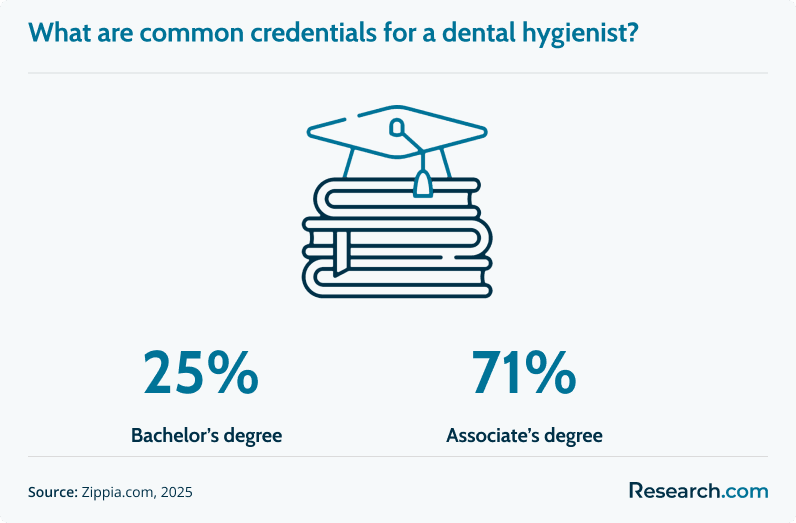
Associate-level preparation is commonly used for entry into clinical dental hygiene. Bachelor’s-level study may support public health, education, leadership, sales, or program coordination. Master’s-level training can be useful for hygienists who want to move into teaching, research, policy, advocacy, or administrative work.
According to the U.S. Bureau of Labor Statistics, employment demand for dental hygienists is projected to grow 7% through 2032, reflecting continued attention to preventive oral healthcare.
How much can I make with a dental hygiene degree?
Dental hygienists earn an average salary of $87,530 per year, or about $42.10 per hour. Entry-level professionals typically start around $65,000, while experienced hygienists can make over $100,000 annually depending on location and specialization.
Pay varies widely by state, employer type, schedule, and scope of practice. California, Alaska, and Washington are among the highest-paying areas. Hygienists in metropolitan markets or specialty practices may earn more, and added credentials in areas such as local anesthesia or restorative functions may improve access to specialized responsibilities where permitted by state law.
- Most affordable online dental assistant to dental hygienist bridge programs for 2027
- How long does a dental hygiene bridge program take?
- Online vs. campus dental hygiene bridge programs
- Average cost of a dental hygiene bridge program
- Financial aid options for dental hygiene bridge students
- Prerequisites for dental hygiene bridge programs
- Student outcomes and success metrics to review
- Advanced healthcare administration opportunities
- Common dental hygiene bridge courses
- Challenges in online dental hygiene bridge programs
- Accreditation and licensure considerations
- Dental hygiene specialization options
- How to choose the best dental hygiene bridge program
- Career paths after a dental hygiene bridge program
- Additional science credentials for dental hygiene careers
- Dental hygiene job market outlookReferences
List of the Best Online Dental Assistant to Dental Hygienist Bridge Programs for 2027
How should readers use this list?
Use this ranking as a starting point, not as a substitute for checking licensure eligibility. Some schools below offer true bridge-style pathways for dental assistants, while others offer online bachelor’s or master’s completion programs for people who are already licensed dental hygienists. Before applying, confirm whether the program accepts dental assistants, requires an existing RDH license, includes CODA-accredited clinical preparation, and meets licensing rules in the state where you plan to work.
How do we rank the programs?
Research.com evaluates programs using information from trusted education data sources, including the IPEDS database, Peterson's database, the College Scorecard database, and the National Center for Education Statistics. These sources help compare affordability, institutional quality, and student outcomes. Readers can review Research.com's ranking process on the methodology page.
| Rank | Program | Best fit | Credits | Cost | Accreditation listed |
| 1 | Massachusetts College of Pharmacy and Health Sciences | Licensed dental hygienists with an associate degree who want a direct path to graduate study | Varies based on prior education | $1,185 per credit hour | New England Commission of Higher Education (NECHE) |
| 2 | Santa Fe College | Certified dental assistants with at least one year of full-time chairside experience | Varies based on prior education | $106.77 per credit hour (in-state), $382.90 per credit hour (out-of-state) | Commission on Dental Accreditation (CODA) |
| 3 | Farmingdale State College | Students seeking a BSDH pathway with online coursework and an internship component | 124 | $295 per credit hour (in-state); $708 (out-of-state) | Middle States Commission on Higher Education (MSCHE) |
| 4 | Southern Illinois University – Carbondale | RDHs interested in management, education, and leadership-focused completion study | 120 | $322 per credit hour | Higher Learning Commission (HLC) |
| 5 | Texas Woman’s University | RDHs seeking a fully online RDH-to-BSDH option with a possible master’s pathway | 120 (with transfer credits accepted) | $345 per credit hour (in-state); $762 (out-of-state) | Southern Association of Colleges and Schools Commission on Colleges (SACSCOC) |
| 6 | University of New Mexico | Licensed hygienists who want post-licensure bachelor’s coursework in leadership, education, and public health | 128 (includes transferred credits) | $407 per credit hour (in-state); $1,157 (out-of-state) | Higher Learning Commission (HLC) |
| 7 | Wichita State University | Licensed hygienists who want a 32-credit completion pathway with asynchronous classes | 120 (32 upper-division hours required) | $228 per credit hour (in-state); $539 (out-of-state) | Higher Learning Commission (HLC) |
| 8 | Georgia Highlands College | RDHs looking for online BSDH completion coursework with a local internship | 120 | $133 per credit hour (in-state); $445 (out-of-state) | Southern Association of Colleges and Schools Commission on Colleges (SACSCOC) |
| 9 | St. Petersburg College | Working hygienists seeking a Bachelor of Applied Science with a capstone and management coursework | 120 | $122 per credit hour (in-state); $425 (out-of-state) | Southern Association of Colleges and Schools Commission on Colleges (SACSCOC) |
| 10 | Pennsylvania College of Technology | Licensed hygienists who want part-time or full-time online BSDH study | 120 | $608 per credit hour | Middle States Commission on Higher Education (MSCHE) |
Important distinction: assistant-to-hygienist vs. RDH completion programs
| Program type | Who it is for | Main purpose | Licensure impact |
| Dental assistant to dental hygienist bridge | Dental assistants with required prerequisites and clinical experience | Prepare for entry into dental hygiene practice | May support eligibility for dental hygiene licensure if it meets state and CODA requirements |
| RDH-to-BSDH completion | Already licensed dental hygienists with associate-level education | Complete a bachelor’s degree for advancement, public health, education, or leadership roles | Usually does not create initial eligibility for dental hygiene licensure because students are already licensed |
| Direct associate dental hygiene program | Students without prior dental hygiene licensure | Provide full clinical and academic preparation from the beginning | Can support licensure eligibility when properly accredited and state-approved |
How long does it take to complete a dental hygiene bridge program?
For qualified dental assistants, a bridge-style dental hygiene pathway often takes about 15 months, although timelines vary by school, course load, transfer credit, clinical placement availability, and state requirements. Students entering without dental experience usually need a longer traditional associate degree route.
Typical timeline by starting point
- Dental assistant bridge route: Many online dental assistant to dental hygienist programs run around 15 months and may require 35–40 hours per week when coursework, evening classes, lab work, studying, and clinical practice are combined.
- Traditional dental hygiene route: Students beginning without dental background commonly complete a 2- to 3-year associate degree program that covers foundational dental hygiene knowledge and clinical skills from the start.
- Licensed RDH completion route: Bachelor’s completion programs may be shorter for licensed hygienists because they usually accept prior associate-level dental hygiene credits.
If you are trying to estimate how long it takes to become a dental hygienist, start with your current credential. A working dental assistant with the right prerequisites may have a shorter path than someone entering dental hygiene with no prior dental training.
How does an online dental hygiene bridge program compare to an on-campus program?
Online dental hygiene bridge programs usually provide more scheduling flexibility for classroom content, but they cannot eliminate hands-on training. The best option depends on your work schedule, learning style, commute, clinical placement access, and need for face-to-face support.
| Factor | Online or hybrid bridge program | Campus-based program |
| Course delivery | Lecture content may be completed through recorded modules, live virtual sessions, online assignments, and discussion boards | Most instruction takes place in classrooms, labs, and campus clinics |
| Clinical training | Still required in person, usually through approved local or regional sites | Often completed through campus clinics and affiliated clinical sites |
| Schedule fit | Better suited to working students who need more control over study time | Better suited to students who prefer structured class times and direct access to faculty |
| Student support | May rely more on online advising, virtual office hours, and remote tutoring | Offers more immediate in-person access to labs, instructors, and classmates |
| Completion pace | Some programs can be completed in 15–18 months | Traditional formats may take 2–4 years depending on degree level and prerequisites |
Some accelerated healthcare programs, such as a fast-track medical assistant program, can be completed quickly because they train for entry-level assisting roles. Dental hygiene is different because licensure requires extensive supervised clinical practice. A faster dental hygiene pathway should still be evaluated for accreditation, board exam preparation, and clinical quality.
What is the average cost of a dental hygiene bridge program?
Dental hygiene bridge program costs can range from several thousand dollars to more than $40,000. The total depends on whether the school is public or private, whether you qualify for in-state tuition, how many credits transfer, whether the program is associate, bachelor’s, or master’s level, and how many fees are charged beyond tuition.
Cost factors to compare before enrolling
- Degree level: Associate-level pathways are often less expensive than bachelor’s or graduate programs.
- Institution type: Public colleges frequently publish lower rates than private institutions, especially for residents.
- Residency classification: In-state tuition can lower the cost substantially compared with out-of-state rates.
- Clinical and lab fees: Dental hygiene programs may charge additional fees for equipment, simulations, labs, background checks, immunizations, and clinical administration.
- Supplies and materials: Students should budget for textbooks, uniforms, instruments, technology, and exam-related expenses.
- Transfer credit: Credit for previous coursework can reduce the number of credits you must pay for.
Sample cost references to verify with schools
- WLAC: ~$5,200 for a 40-unit bachelor’s completion program ($130 per unit).
- Massachusetts College of the Arts: ~$41,760 per year for a dental hygiene master’s program.
Students comparing lower-cost healthcare entry points may also review affordable online medical assistant programs, but those programs prepare for different roles and should not be treated as substitutes for dental hygiene licensure training.
What are the financial aid options for students enrolling in a dental hygiene bridge program?
Students in accredited dental hygiene programs may be able to reduce upfront costs through federal aid, state grants, institutional scholarships, employer support, and dental-specific awards. The best first step is to ask the school’s financial aid office whether the program is eligible for federal student aid and whether clinical fees are included in the published cost estimate.
Common ways to pay for a dental hygiene bridge program
- FAFSA: The Free Application for Federal Student Aid is used to determine eligibility for federal grants, loans, and some school-based aid.
- Scholarships and grants: Dental organizations and education providers may offer scholarship awards for dental professionals based on need, academic performance, or career goals.
- State aid: Some states provide added support for students entering healthcare and allied health fields.
- Institutional aid: Colleges may offer departmental scholarships, completion grants, or tuition discounts.
- Work-study: Eligible students may be able to earn money through approved part-time campus or community-based jobs.
- Employer tuition assistance: Dental offices and healthcare employers may help pay for education when the employee is moving into a higher-need clinical role.
Questions to ask the financial aid office
- Is this specific dental hygiene program eligible for federal financial aid?
- Are clinical fees, instruments, uniforms, background checks, and exam costs included in the estimated cost of attendance?
- Does the school offer scholarships for dental assistants moving into dental hygiene?
- Can transfer credits lower my tuition bill?
- Are there extra charges for online courses or out-of-district clinical placements?
What are the prerequisites for enrolling in a dental hygiene bridge program?
Admissions requirements vary significantly because some programs serve dental assistants entering dental hygiene, while others serve licensed hygienists completing a bachelor’s degree. Read the admissions page closely and ask whether the pathway is designed for initial dental hygiene licensure or post-licensure degree completion.
Comparing prerequisites is just as important in dental hygiene as it is in other specialized online programs, including options such as the most affordable online master’s degree in supply chain management. The difference is that dental hygiene also carries clinical and licensure requirements that can affect whether a program is usable in your state.
Common admissions requirements
- High school diploma or GED
- Minimum GPA from high school or previous college coursework
- Entrance exam scores, such as SAT, ACT, or TOEFL for international students
- Completed prerequisite courses, including biology, chemistry, and algebra
- Personal essay and letters of recommendation
- CPR certification
- Background check
Additional application steps to expect
Some schools may require observation hours in a dental setting, proof of dental assisting certification or experience, an interview, immunization records, drug screening, or documentation of full-time chairside work. Application fees typically range from $50 to $100, depending on the institution.
What are the student outcomes and success metrics of dental hygiene bridge programs?
Outcome data can reveal whether a program prepares students well for licensure and employment. Before enrolling, ask for the most recent graduation rate, retention rate, licensure exam pass rate, employment placement rate, average time to completion, and the percentage of students who secure clinical placements on schedule.
These measures matter because dental hygiene is not only an academic program; it is a clinical licensure pathway. A low tuition price is less valuable if students struggle to finish clinical requirements, pass boards, or move into paid roles. Students interested in community oral health may also compare dental hygiene with an affordable online public health degree, especially if their long-term goal is prevention, outreach, or health education rather than chairside clinical care.
| Outcome metric | Why it matters | Question to ask |
| Licensure exam pass rate | Shows whether students are academically and clinically prepared for required exams | What percentage of recent graduates passed on the first attempt? |
| Clinical placement success | Online students need approved sites to complete hands-on requirements | Does the school arrange placements, or must students find their own? |
| Graduation rate | Signals whether students are completing the program as planned | How many students finish within the expected timeline? |
| Employment placement | Helps estimate career support and local employer demand | What percentage of graduates are employed in dental hygiene? |
| Student support services | Working students often need advising, tutoring, and scheduling help | What support is available outside normal business hours? |
Can a Dental Hygiene Bridge Degree Lead to Advanced Healthcare Administration Roles?
A dental hygiene bridge degree can support advancement beyond routine clinical care, especially when the curriculum includes leadership, communication, public health, education, research, or practice management. However, senior healthcare administration roles may require additional education or experience outside dental hygiene.
Hygienists who want broader operational leadership can use dental hygiene as a clinical foundation and later consider administration-focused credentials. Research.com’s guide to high-paying healthcare administration careers can help readers compare leadership pathways, but students should verify whether each role requires a bachelor’s degree, master’s degree, management experience, or specialized healthcare administration training.
What courses are typically in a dental hygiene bridge program?
Dental hygiene bridge programs combine science, clinical technique, patient education, ethics, and public health. Online courses usually handle theory and assignments, while labs and clinical rotations train students to provide supervised patient care.
Common dental hygiene bridge courses
- Dental Radiography: Covers image capture, radiation safety, processing, interpretation, and clinical use of dental X-rays.
- Head and Neck Anatomy: Examines oral structures, muscles, nerves, bones, and soft tissue anatomy relevant to assessment and treatment.
- Oral Pathology and General Pathology: Teaches students to recognize signs of disease in the mouth and understand links to systemic health.
- Dental Anatomy and Tooth Morphology: Focuses on tooth development, structure, function, and histology.
- Prevention of Oral Disease: Explores patient education, risk assessment, preventive strategies, and treatment planning.
- Dental Materials: Introduces materials, impressions, instruments, and clinical handling procedures used in dental settings.
- Pharmacology: Reviews medications, drug interactions, pain control, and implications for dental treatment.
- Dental Hygiene Clinical: Provides supervised practice in cleanings, screenings, patient assessment, radiographs, and preventive services.
- Law and Ethics: Covers professional conduct, legal responsibilities, scope of practice, confidentiality, and patient rights.
- Practice Management: Develops skills in dental software, documentation, patient communication, scheduling, and care coordination.
Many programs align curriculum expectations with American Dental Association standards, but applicants should still verify programmatic accreditation and state board acceptance before enrolling.
What challenges might I face in an online dental hygiene bridge program?
The biggest challenge is often workload. A student may be working as a dental assistant during the day, completing online assignments at night, and arranging clinical hours on a schedule controlled by the program or clinical site. Strong time management is essential.
Common challenges and practical fixes
| Challenge | Why it creates problems | Better approach |
| Finding clinical placements | Not every local practice or clinic is approved for student training | Ask before applying whether the school secures sites or requires students to locate them |
| Balancing work and school | Clinical schedules may conflict with paid dental assisting hours | Discuss schedule flexibility with your employer before enrollment |
| Online course discipline | Asynchronous classes require self-directed study and deadline tracking | Create a weekly study plan and use advisor check-ins early |
| Science-heavy content | Anatomy, pathology, pharmacology, and periodontics may be more demanding than expected | Review prerequisite sciences and consider tutoring before falling behind |
| Technology requirements | Unstable internet or outdated devices can affect online participation | Confirm hardware, software, webcam, and testing requirements before classes start |
Students who want to strengthen their science background before or during dental hygiene training may look at online biology programs, although a biology credential does not replace dental hygiene clinical education or licensure requirements.
Is the dental hygiene bridge program accredited and why does it matter?
Accreditation is one of the most important checks in dental hygiene education. Institutional accreditation evaluates the college or university, while programmatic accreditation is especially important for dental hygiene licensure preparation. For initial dental hygiene licensure, students should pay close attention to whether the dental hygiene program is accredited by the Commission on Dental Accreditation (CODA) and accepted by the state board where they plan to practice.
Accreditation can affect licensure eligibility, financial aid access, credit transfer, graduate school options, and employer confidence. A program may be online, affordable, and convenient, but if it does not satisfy state licensing requirements, it may not help a dental assistant become a licensed hygienist.
For hygienists who later want administrative advancement, an accelerated online healthcare administration degree may help build management knowledge. That type of degree should be viewed as a supplement to—not a replacement for—dental hygiene licensure education.
What types of specializations are available in a dental hygiene bridge program?
Specializations vary by degree level. Entry-level dental hygiene programs focus mainly on clinical preparation, while bachelor’s and master’s programs are more likely to offer electives or concentrations in leadership, education, research, and public health.
Common specialization areas
- Public Health Dental Hygiene: Focuses on prevention, outreach, community programs, and services for underserved populations.
- Pediatric or Geriatric Care: Builds knowledge for working with children or older adults who have age-specific oral health needs.
- Periodontics: Emphasizes prevention and management of gum disease.
- Dental Hygiene Education: Prepares hygienists to teach or train future dental professionals.
- Practice Management or Leadership: Supports roles involving office operations, compliance, staff training, and workflow improvement.
- Research and Writing: Develops skills in scientific literature, data interpretation, evidence-based practice, and professional publication.
Students comparing fast healthcare entry routes should understand the difference between dental hygiene and short-term assisting programs. A 6-week online medical assistant degree pathway may offer rapid exposure to clinical support work, but dental hygiene licensure requires a much more extensive dental-specific clinical education.
How to choose the best dental hygiene bridge program
The best dental hygiene bridge program is the one that matches your current credential, state licensure plan, budget, schedule, and career goal. A low tuition price should not be the only deciding factor. Clinical placement support, accreditation, board preparation, and graduate outcomes are just as important.
Step-by-step checklist for choosing a program
- Confirm the target student. Ask whether the program is for dental assistants seeking initial RDH preparation or for already licensed hygienists completing a bachelor’s degree.
- Verify accreditation. For licensure pathways, check CODA status and state board acceptance before applying.
- Map clinical requirements. Find out where labs and clinical rotations occur, who arranges placements, and whether travel is required.
- Calculate total cost. Include tuition, fees, instruments, supplies, uniforms, books, exams, technology, commuting, and lost work hours.
- Review admissions requirements early. Prerequisite science courses can delay your start date if they are missing.
- Ask for outcome data. Request licensure pass rates, graduation rates, employment placement information, and average time to completion.
- Compare schedule demands. Make sure your work and family obligations can realistically fit around clinical training.
- Talk to recent students. Ask about faculty responsiveness, clinical organization, workload, and hidden costs.
Common mistakes to avoid
- Assuming “online” means fully remote: Dental hygiene requires in-person clinical training.
- Choosing based only on tuition: Fees, supplies, travel, and unpaid clinical time can change the true cost.
- Ignoring state licensure rules: A program that works in one state may not meet requirements in another.
- Confusing RDH completion with assistant-to-hygienist training: Many online bachelor’s programs require applicants to already be licensed hygienists.
- Overvaluing rankings: Rankings are useful, but accreditation, clinical access, and outcomes should drive the final decision.
- Skipping transfer-credit review: Prior college coursework may reduce time and cost if the school accepts it.
If dental hygiene is not the right fit, compare other licensed healthcare routes carefully. For example, 12-month FNP programs serve a very different population because nurse practitioner training requires prior nursing education and advanced clinical preparation.
What career paths are available for graduates of a dental hygiene bridge program?
Dental hygiene bridge graduates can pursue patient-care roles and, with additional education or experience, nonclinical positions in education, public health, research, sales, consulting, or management. The available path depends on licensure, degree level, state scope-of-practice rules, and professional experience.
Career options after dental hygiene training
| Career path | Primary focus | When it may make sense |
| Registered Dental Hygienist (RDH) | Preventive care, cleanings, screenings, radiographs, oral health education, and disease detection | Best for students who want direct patient care and a licensed clinical role |
| Public Health Dental Hygienist | Community oral health, school programs, outreach, and access to care | Best for hygienists interested in prevention and underserved populations |
| Dental Hygiene Educator | Teaching and training future dental professionals | Best for experienced hygienists who enjoy instruction and academic settings |
| Corporate or Sales Representative | Dental products, training, demonstrations, and client support | Best for hygienists with communication strengths and interest in dental technology or products |
| Research Assistant or Coordinator | Oral health studies, data collection, and public health projects | Best for graduates interested in evidence-based practice and health outcomes |
| Practice Manager or Consultant | Operations, compliance, workflow, staffing, and patient experience | Best for hygienists who want leadership responsibilities beyond chairside care |
Bridge programs can create upward mobility in healthcare in the same broad sense that affordable online CNC machining trade school programs create mobility in skilled trades: both can help working adults build career-specific skills. The difference is that dental hygiene requires healthcare licensure and supervised patient-care training.
Students comparing online education more broadly may also review affordable online humanities degree programs to understand flexible degree formats, but humanities degrees do not prepare graduates for dental hygiene licensure.
Can additional science credentials enhance my dental hygiene career?
Additional science coursework can strengthen a hygienist’s understanding of anatomy, microbiology, pathology, research methods, and emerging oral health technologies. It may be especially useful for hygienists interested in education, research, public health, or graduate study.
A science credential is not required for every hygienist, and it does not replace dental hygiene licensure. However, students who want a stronger academic science foundation may consider a fast-track online bachelor’s in biology degree as a complementary option, especially if they are planning for research-oriented or advanced healthcare roles.
What is the job market for graduates with a dental hygiene bridge degree?
The employment outlook for dental hygienists is favorable. The U.S. Bureau of Labor Statistics projects 9% employment growth for dental hygienists from 2023 to 2033—more than double the average for all occupations.
About 16,400 dental hygienist job openings are expected each year over the next decade, mostly because of workforce turnover and retirements. Demand is supported by an aging population, increased awareness of the connection between oral and overall health, and broader use of preventive dental services.
Nearly all dental hygienists work in private dental offices, and many positions offer flexible or part-time schedules. As of May 2024, the median annual wage was $94,260, making dental hygiene a strong-paying healthcare occupation that does not require a graduate degree.
Compared with fields that may require more policy-oriented graduate training, such as programs discussed in Research.com’s guide to the most affordable online energy policy degrees, dental hygiene can offer a more direct clinical route into the healthcare workforce. The trade-off is that students must complete dental-specific clinical hours and meet state licensure rules.
References:
- U.S. Bureau of Labor Statistics. (n.d.). Dental hygienists.
- American Dental Association. (n.d.). Dental workforce shortages and labor market.
- TeethTalkGirl. (n.d.). Dental hygiene programs and requirements.
- EduMed. (n.d.). How to become a dental hygienist.
- DentalAssistantEdu.org. (n.d.). Dental assistant to dental hygienist.
- Santa Fe College. (n.d.). Dental hygiene program.
- OnlineU. (n.d.). Dental hygiene degrees online.
- Indeed Career Guide. (n.d.). Dental assistant vs dental hygienist.
- Stepful. (n.d.). Dental assistant vs dental hygienist.
Key Insights
- Online dental assistant to dental hygienist bridge programs are usually hybrid because dental hygiene licensure requires supervised clinical training.
- Not every “bridge” or online dental hygiene program is for dental assistants; many are RDH-to-BSDH completion programs for already licensed hygienists.
- Accreditation and state licensure acceptance should be checked before cost, convenience, or ranking position.
- Qualified dental assistants may complete some bridge pathways in about 15 months, while traditional associate routes often take 2 to 3 years.
- Published tuition is only part of the cost; students should also budget for instruments, clinical fees, supplies, exams, technology, and possible travel.
- Strong programs should be able to provide licensure pass rates, graduation rates, clinical placement support details, and employment outcomes.
- Dental hygiene can lead to clinical practice, public health, education, research, sales, consulting, and management roles, but advancement options depend on degree level, experience, and state scope-of-practice rules.
Other Things You Should Know about Online Dental Hygienist Bridge Programs
Graduates must pass the National Board Dental Hygiene Examination and a state or regional clinical exam, such as ADEX or CDCA-WREB. Most state dental boards require both before issuing a dental hygienist license, along with proof of an accredited degree and a criminal background check.
Affordable online dental assistant to dental hygienist bridge programs typically require completing around 60-90 credit hours in 2027. This usually includes coursework specific to dental hygiene, general education requirements, and any additional clinical practice hours needed for the program.
In 2027, ensuring the program holds accreditation from the Commission on Dental Accreditation (CODA) is essential. CODA's accreditation signifies that the program meets national industry standards and prepares students effectively for the dental hygienist licensing exams.