
2027 Most Affordable Online CNC Machining Trade School Programs

Co-Founder and Chief Data Scientist
Choosing an online CNC machining trade school is mainly a cost-and-career-readiness decision. You need a program that teaches CNC setup, safety, blueprint reading, G-code, inspection, and CAD/CAM concepts without charging more than the credential is likely to return. The challenge is that many online programs look similar, and not all offer the same level of hands-on preparation, certification alignment, instructor support, or employer value.
This guide is for students, career changers, veterans, and current manufacturing workers comparing affordable online CNC machining trade school programs. It explains what these programs teach, how long they take, what they cost, how online training compares with shop-based learning, what jobs graduates can pursue, and how to evaluate whether a program is worth the investment.
Quick answer: Is an online CNC machining trade school worth considering?
An online CNC machining trade school can be a practical choice if you want affordable, flexible training for entry-level manufacturing roles and can access hands-on practice through simulations, local shops, work experience, or internships. The strongest programs combine CNC fundamentals, programming, machining safety, measurement, quality control, and CAD/CAM exposure. Job growth for CNC machinists is projected at 2% through 2033, so the field is not expanding rapidly, but steady replacement hiring continues to create openings for trained workers.
What are the main advantages of CNC machining trade school?
- It can lead to several manufacturing career paths. Graduates may qualify for roles such as CNC machinist, CNC programmer, manufacturing engineer, tooling manager, or other production-focused positions, depending on experience and additional credentials.
- It can support stable skilled-trades earnings. The average annual salary for CNC professionals is around $82,000, while pay varies widely by role, location, industry, and specialization.
- Online study can reduce scheduling barriers. Self-paced modules, recorded lessons, simulations, and remote instructor support can help working adults train without leaving a current job.
What should you expect in a CNC machining trade school program?
A CNC machining trade school program is designed to move students from basic manufacturing concepts to job-focused machine operation and programming skills. Most programs introduce CNC machine types, shop safety, blueprint interpretation, machining math, material behavior, workholding, tooling, inspection, and quality control. More advanced lessons may cover G-code, M-code, CAD/CAM workflows, Lean manufacturing, Six Sigma, and troubleshooting production problems.
Online CNC programs usually deliver instruction through self-paced lessons, video demonstrations, quizzes, interactive simulations, digital textbooks, and virtual lab activities. Some programs also include capstone projects, internship options, or recommendations for local hands-on practice. Because CNC work is physical and precision-based, students should not judge a program by online convenience alone; they should ask how the school helps learners build real machine confidence.
Tuition for the programs reviewed here typically ranges from $1,995 to $2,694. That price range often covers the online curriculum and digital learning platform, but students should confirm whether software, tools, certification exam fees, local lab access, or optional materials cost extra.
Where can CNC machining graduates work?
CNC machining training prepares students for work in industries that make precision parts, prototypes, tools, dies, assemblies, and equipment components. Graduates are most often hired by manufacturers, but CNC skills also apply in technical services, product development, energy, aerospace, defense, electronics, and advanced manufacturing environments.
Common employment settings include:
- Manufacturing (32%): This is the largest employment area for CNC professionals and includes metal fabrication, aerospace, defense, electronics, and production shops.
- Professional Services (12%): CNC-trained workers may move into CAD/CAM programming, quality assurance, technical support, or consulting roles that support engineering and design teams.
- Fortune 500 Companies (11%): Large employers use CNC talent in production lines, tooling departments, supply chain operations, and high-volume manufacturing facilities.
- Technology (9%): CNC skills are useful in hardware prototyping, robotics, electronics, and product development settings where precise components are required.
- Energy (6%): Machining roles exist in oil, gas, and renewable energy operations that need high-tolerance parts for turbines, pipelines, drilling equipment, and related systems.
How much can you earn after CNC machining trade school?
CNC machining pay depends on the role, location, employer, industry, shift, overtime, certifications, and years of experience. Salary figures can also vary by source because some datasets separate machinists, CNC operators, CNC programmers, engineers, and managers. Treat the numbers below as planning benchmarks, not guaranteed outcomes.
- Average salary: CNC professionals in the United States earn approximately $82,000 per year on average, or about $39.44 per hour.
- Location: CNC machinists in Nome, Alaska, and Cupertino, California, average over $101,000 annually. In states such as Florida or Texas, machinists typically earn between $43,000 and $52,000 per year.
- Experience: Entry-level professionals with less than three years of experience earn around $36,650 annually, while workers with over 20 years of experience can earn up to $65,880 per year.
- Industry: Aerospace, advanced manufacturing, and defense roles often pay above general production roles. Median salaries by industry range from $43,680 to $62,860, with higher earnings possible in specialized high-tech settings.
- Specialized roles: CNC programmers and advanced machinists can earn hourly rates exceeding $30 per hour, especially in competitive labor markets or technically demanding industries.
- Most Affordable Online CNC Machining Trade School Programs for 2027
- How long does CNC machining trade school take?
- Online vs. on-campus CNC machining programs
- Average CNC machining trade school cost
- Financial aid for CNC machining students
- CNC machining program admission requirements
- Common CNC machining courses
- CNC machining specializations
- Ways to continue your CNC machining education
- Technology trends shaping CNC machining
- Certifications that can strengthen a CNC career
- How to improve the return on your CNC training
- How to choose the right CNC machining trade school
- Career paths after CNC machining training
- CNC machining job market outlook
Most Affordable Online CNC Machining Trade School Programs for 2027
How Research.com evaluates these programs
Affordability matters, but a low price is not enough. A useful CNC program should also offer relevant coursework, credible institutional recognition, career-focused training, and a structure that helps students complete the credential while building usable skills.
Research.com evaluates affordable online CNC machining trade school programs using sources such as the IPEDS database, Peterson's database, the College Scorecard database, and The National Center for Education Statistics. You can review the broader ranking approach on Research.com's methodology page.
| School | Program length | Total tuition cost | Listed accreditation or credential recognition | Best fit |
| North Carolina Central University | 12 months | $1,995 | Southern Association of Colleges and Schools Commission on Colleges (SACSCOC) | Students seeking the lowest listed tuition among the reviewed options |
| California State University - San Marcos | 12 months | $2,245 | WASC Senior College and University Commission (WSCUC) | Learners who want self-paced CNC fundamentals with process improvement content |
| Louisiana State University - Shreveport | 12 months | $2,245 | Southern Association of Colleges and Schools Commission on Colleges (SACSCOC) | Students focused on entry-level CNC operations and manufacturing readiness |
| Northwest Missouri State University | 12 months | $2,285 | Higher Learning Commission (HLC) | Learners comparing affordable programs with Lean, Six Sigma, and CAD/CAM exposure |
| University of Texas at Arlington | 12 months | $2,345 | Middle States Commission on Higher Education (MSCHE) | Students who want broad coverage of CNC programming, grinding, quality, and CAD/CAM |
| Arkansas State University | 12 months | $2,345 | National Institute for Metalworking Skills (NIMS) | Learners prioritizing industry-recognized machining skills alignment |
| Mississippi State University | 12 months | $2,395 | Southern Association of Colleges and Schools Commission on Colleges (SACSCOC) | Students who want machining, materials science, inspection, and quality systems |
| The University of Texas at El Paso | 12 months | $2,445 | Southern Association of Colleges and Schools Commission on Colleges (SACSCOC) | Students looking for self-paced CNC training with safety and Lean manufacturing content |
| San Diego State University | 12 months | $2,447 | WASC Senior College and University Commission (WSCUC) | Learners interested in G-code, CNC systems, CAD/CAM, Six Sigma, and quality control |
| Colorado State University - Fort Collins | 12 months | $2,694 | Higher Learning Commission (HLC) | Students who want exposure to Fanuc, Haas, Mazak, CAD/CAM, and CNC programming concepts |
1. University of Texas at Arlington
The University of Texas at Arlington offers an online CNC Machinist program built around advanced manufacturing fundamentals. Students study CNC programming, machining, grinding, machine safety, inspection, and quality control. The curriculum also introduces Six Sigma, Lean manufacturing, and CAD/CAM concepts, giving learners a combination of machine-level and process-level knowledge.
- Program length: 12 months
- Total tuition cost: $2,345
- Accreditation: Middle States Commission on Higher Education (MSCHE)
2. California State University - San Marcos
California State University - San Marcos provides an online CNC Machinist program for students preparing for modern manufacturing work. The course covers CNC controls, programming, safety, inspection techniques, Lean methods, and Six Sigma. Its self-paced format may appeal to working adults who need flexibility while developing entry-level CNC operating knowledge.
- Program length: 12 months
- Total tuition cost: $2,245
- Accreditation: WASC Senior College and University Commission (WSCUC)
3. Mississippi State University
Mississippi State University delivers an online CNC Machinist course covering CNC programming, machining, grinding, safety, inspection, and materials science. Students also learn machining math, workholding, metal cutting, Six Sigma, Lean, TPM, and ISO standards. The program is designed to help learners build the technical judgment needed for entry-level advanced manufacturing roles.
- Program length: 12 months
- Total tuition cost: $2,395
- Accreditation: Southern Association of Colleges and Schools Commission on Colleges (SACSCOC)
4. San Diego State University
San Diego State University offers online CNC Machinist training for learners entering automated production environments. Course topics include CNC programming, safety, inspection, quality, machining processes, G-code, CAD/CAM, Lean manufacturing, and Six Sigma. The program is especially relevant for students who want a broad introduction to CNC operations and process improvement.
- Program length: 12 months
- Total tuition cost: $2,447
- Accreditation: WASC Senior College and University Commission (WSCUC)
5. Louisiana State University - Shreveport
Louisiana State University - Shreveport teaches CNC programming, machining, safety, inspection, and quality control through its online CNC Machinist program. Students also study Lean manufacturing, Six Sigma, and CAD/CAM processes. The self-paced design supports learners who want job-focused CNC preparation without relocating or following a fixed campus schedule.
- Program length: 12 months
- Total tuition cost: $2,245
- Accreditation: Southern Association of Colleges and Schools Commission on Colleges (SACSCOC)
6. Arkansas State University
Arkansas State University provides online CNC Machinist training focused on machine operation, programming, quality control, and safety. The curriculum includes Lean principles, Six Sigma, and CAD/CAM content to help students understand both shop-floor work and production efficiency. Learners who want CNC fundamentals connected to recognized machining skill standards may find this option worth comparing closely.
- Program length: 12 months
- Total tuition cost: $2,345
- Accreditation: National Institute for Metalworking Skills (NIMS)
7. Colorado State University - Fort Collins
Colorado State University - Fort Collins offers an online CNC Machinist course covering CNC programming, metal cutting, quality control, machining processes, safety, and Lean manufacturing. Students also encounter CAD/CAM, G-code, and CNC systems such as Fanuc, Haas, and Mazak. This program may be a fit for learners who want broad brand and system exposure in a self-paced format.
- Program length: 12 months
- Total tuition cost: $2,694
- Accreditation: Higher Learning Commission (HLC)
8. Northwest Missouri State University
Northwest Missouri State University offers an online CNC Machinist program that introduces programming, shop safety, metal cutting, and inspection methods. Learners also study Lean, Six Sigma, and CAD/CAM systems. The program is structured for students seeking flexible, entry-level preparation for machining and manufacturing jobs.
- Program length: 12 months
- Total tuition cost: $2,285
- Accreditation: Higher Learning Commission (HLC)
9. The University of Texas at El Paso
The University of Texas at El Paso provides online CNC Machinist training with coursework in CNC programming, machining, quality inspection, safety, and Lean manufacturing. The self-paced format can work well for students who want to enter manufacturing or strengthen current production skills while continuing other responsibilities.
- Program length: 12 months
- Total tuition cost: $2,445
- Accreditation: Southern Association of Colleges and Schools Commission on Colleges (SACSCOC)
10. North Carolina Central University
North Carolina Central University offers a fully self-paced, 100% online CNC Machinist course. Students cover CNC controls, programming, metallurgy, machining, grinding, inspection, workholding, safety, Lean methods, Six Sigma, 5S, and total productive maintenance. The program is designed for learners preparing for CNC operator and machinist roles in automated manufacturing settings.
- Program length: 12 months
- Total tuition cost: $1,995
- Accreditation: Southern Association of Colleges and Schools Commission on Colleges (SACSCOC)
How long does CNC machining trade school take?
Most CNC machining trade school programs take 6 months to 2 years, depending on the credential, course load, and required hands-on training. Short certificate programs commonly take 6–12 months, while associate degree pathways often take 18–24 months. Full-time students may finish more quickly, while part-time learners may need more time but gain scheduling flexibility.
Program length also depends on whether the school requires in-person lab hours, internships, apprenticeships, capstone projects, or proctored skills assessments. Students with prior manufacturing experience, military training, or previous technical coursework may be able to shorten their timeline if the school offers advanced placement or transfer credit review.
When comparing timelines, look beyond the completion estimate. Ask how many hours are devoted to machine operation, programming practice, inspection, and troubleshooting. A fast program is only useful if it prepares you for the work you actually want to do. Students comparing other flexible career-oriented programs, such as an affordable online esports business degree, should use the same logic: speed matters, but practical preparation matters more.
How does an online CNC machining program compare with an on-campus program?
Online and on-campus CNC machining programs can both be useful, but they serve different learners. Online programs are usually best for students who need flexibility, already work in manufacturing, or can arrange local hands-on practice. Campus programs may be stronger for beginners who need direct supervision, immediate feedback, and regular access to industrial machines.
| Factor | Online CNC program | On-campus CNC program | Decision tip |
| Hands-on training | Often uses simulations, demonstrations, virtual labs, and sometimes at-home practice resources. | Provides scheduled shop time with physical CNC machines and related equipment. | Choose campus training if you have no way to practice on real equipment. |
| Equipment access | May require students to find local shop access or rely mainly on virtual tools. | Usually includes access to shop tools, machines, and instructor-supervised labs. | Ask the online school how physical skill development is handled. |
| Instructor feedback | Support is typically delivered through email, learning platforms, video calls, or discussion forums. | Students can receive in-person correction while setting up machines or interpreting results. | Beginners may benefit from real-time correction during machine setup. |
| Certification preparation | May teach exam concepts but may not include physical performance testing. | May include practical evaluations and guided exam preparation. | Confirm whether certification exams are included, optional, or separate. |
| Flexibility | Often self-paced and easier to fit around work or family responsibilities. | Usually follows a fixed class and lab schedule. | Online study is stronger for working adults with unpredictable schedules. |
| Cost | Can reduce commuting, housing, and campus-related expenses. | May cost more but includes direct access to machines and facilities. | Compare total cost, not tuition alone. |
What is the average cost of a CNC machining trade school program?
Online CNC machining trade school programs commonly cost between $2,000 and $2,700. The programs reviewed in this guide range from $1,995 to $2,694. These prices are generally lower than longer academic programs because many CNC trade school options are non-degree, career-training programs designed for faster workforce entry.
Cost differences may reflect program length, platform access, simulation tools, certification preparation, student support, and whether the program includes hands-on kits or other materials. Online students may save on commuting and housing, but they should still budget for any required software, safety equipment, tools, exam fees, or local lab access.
If your long-term goal is manufacturing supervision, operations leadership, or project management, CNC trade school may be only the first step. Workers who later want management training may compare options such as the cheapest online MBA programs in project management, but that type of degree should be evaluated separately from entry-level machining training.
| Cost item | Why it matters | Question to ask before enrolling |
| Tuition | This is the advertised program price, but it may not include every required expense. | Does the quoted tuition include all required learning materials? |
| Software or simulations | CAD/CAM and simulation access can affect how much practical programming experience you receive. | Are software licenses included, temporary, or purchased separately? |
| Tools and safety gear | Some programs expect students to obtain basic measuring tools or shop safety items. | Will I need to buy any tools, gauges, or protective equipment? |
| Certification fees | Industry credentials can improve employability, but exam costs may be separate. | Are certification exam fees included in tuition? |
| Hands-on access | CNC skills are best strengthened through machine practice. | Does the program include local lab placement, internships, or employer partnerships? |
What financial aid options are available for CNC machining students?
Financial aid depends heavily on the school, credential type, program approval status, and student eligibility. Some non-credit trade programs may not qualify for the same aid as degree programs, so students should verify funding options before enrolling. Similar due diligence is important in other career-change programs, including affordable online direct entry MSN programs, where eligibility rules can vary by institution and program format.
- Federal grants and loans: Eligible students may qualify for federal aid through approved institutions. About 36% of undergraduates at U.S. trade schools received federal grant aid to reduce education costs.
- Federal Work-Study: Students who qualify may earn part-time income through work-study while enrolled.
- State grants and scholarships: State workforce and education agencies may offer funding for students entering skilled trades.
- Institutional scholarships and grants: Technical colleges and trade schools may provide scholarships or need-based grants for machining and manufacturing students.
- Private scholarships: Organizations such as CNC Machines and the Gene Haas Foundation offer scholarship support for students pursuing manufacturing and machining training.
- Veterans’ benefits: Veterans and eligible dependents may be able to use GI Bill® benefits for approved CNC training programs.
- Workforce and government training programs: WIOA and similar job-training programs may help fund eligible CNC machining courses, especially for students preparing for in-demand local jobs.

What are the admission requirements for CNC machining trade school?
CNC machining programs usually have accessible admissions requirements, but students still need the academic, technical, and physical readiness to complete the training safely. Requirements vary by school and program level. Graduate-level programs in fields such as logistics or operations, including an affordable online supply chain management master's degree, have very different admissions standards, so students should compare requirements within the correct credential category.
- High school diploma or equivalent: Most programs expect applicants to have a high school diploma or GED because machining requires reading, writing, applied math, and technical comprehension.
- Minimum age requirement: Many schools require students to be at least 18 years old because of workplace safety and equipment-related expectations.
- Physical readiness: CNC work may involve standing for long periods, following safety procedures, and lifting moderate weights.
- Assessment or placement testing: Some programs use math or reading placement tests to confirm that students are ready for technical coursework.
- Mechanical interest and problem-solving ability: Students should be comfortable with machines, measurements, diagrams, troubleshooting, and step-by-step procedures.
- Math preparation: Algebra and geometry are useful for measurements, tolerances, coordinates, feeds, speeds, and programming logic. Students who want deeper quantitative preparation may consider the cheapest online math degree, although that is a broader academic path than CNC trade school.
What courses are usually included in a CNC machining program?
CNC machining programs usually combine classroom-style technical instruction with practical exercises in machine setup, programming, inspection, and shop safety. The strongest curricula help students understand not only how to run a machine, but also why a setup, toolpath, tolerance, or inspection result matters.
- CNC fundamentals: Introduces CNC machine types, basic controls, setup procedures, safety practices, print reading, and machining math.
- Manual machining techniques: Covers turning, milling, drilling, and other traditional machining methods that help students understand how material is removed before automation is added.
- CNC programming with G-code and M-code: Teaches students how machines receive instructions and how to write, read, edit, and troubleshoot common program commands.
- CAD/CAM applications: Shows how computer-aided design and computer-aided manufacturing tools are used to create parts, generate toolpaths, and simulate machining. Students interested in broader production optimization may also explore an affordable data analytics degree online later in their careers.
- Precision measurement and quality control: Covers calipers, micrometers, gauges, inspection plans, tolerances, and quality standards used to confirm that parts meet specifications.
- CNC milling and turning operations: Provides training in machine setup, tool selection, part production, and operational troubleshooting for mills and lathes.
- Workholding and tooling: Teaches students how to secure materials, select tools, reduce vibration, and improve machining accuracy.
What CNC machining specializations are available?
Specializations help CNC students focus on the type of equipment, programming, material, or production environment they want to enter. Beginners do not need to specialize immediately, but choosing electives or certifications strategically can support better job targeting.
- CNC milling and turning: Focuses on programming and operating mills and lathes, including multi-axis techniques such as 4‑, 5‑, and 6‑axis machining for complex parts.
- CAD/CAM programming: Emphasizes part modeling, toolpath generation, G-code output, and machining simulation. Learners who want broader digital skills may also compare affordable online IT training bootcamps for programming and automation foundations.
- CNC EDM: Covers electrical discharge machining for high-precision cutting and detailed cavity work.
- CNC waterjet and plasma cutting: Prepares students for cutting heat-sensitive materials with waterjets and thick metals with high-speed plasma systems.
- CNC grinding and finishing: Focuses on abrasive machining, surface finish quality, and tight dimensional tolerances.
- Quality assurance and GD&T: Trains students to inspect parts, interpret geometric dimensioning and tolerancing, and document compliance.
- Tooling and tool change systems: Covers tool selection, workholding, tool life, setup efficiency, and automated systems such as Automatic Tool Changers (ATC).
How can you continue your education after CNC trade school?
After completing a CNC machining program, graduates can continue learning in several directions: advanced machining certificates, quality assurance credentials, CAD/CAM training, apprenticeship programs, associate degrees, or broader manufacturing and engineering-related education. The best next step depends on whether you want to become a more advanced machinist, move into programming, supervise production, enter quality control, or transition toward engineering support.
Students who want an academic credential after trade school may compare options such as the best associate degree in 6 months online, especially if they already have technical credits or prior learning that may apply. Before enrolling, ask whether CNC coursework transfers, whether the degree supports your target role, and whether the added cost is justified by your career plan.
How are new technologies changing CNC machining education and careers?
CNC machining is increasingly connected to automation, robotics, digital inspection, simulation, real-time machine data, and smart manufacturing systems. As a result, modern CNC programs are expanding beyond basic machine operation to include CAD/CAM, virtual simulation, digital workflow awareness, quality systems, and process improvement methods.
This does not mean traditional machining skills are becoming irrelevant. Employers still need workers who understand setup, tooling, tolerances, materials, and safe machine operation. The difference is that stronger candidates can often combine shop-floor judgment with digital fluency. Learners who want a broader academic route into manufacturing technology, operations, or business may later consider an accelerated online bachelor degree, but they should choose one that clearly connects to their long-term manufacturing goals.
What certifications can strengthen a CNC machining career?
Certifications can help CNC professionals document specific skills in machining, programming, quality, safety, and manufacturing processes. They are most valuable when employers in your region recognize them and when the credential matches the role you want. For example, an operator may benefit from foundational machining credentials, while a programmer may prioritize CAD/CAM and G-code proficiency.
Before paying for a certification, confirm the exam format, skill level, renewal requirements, employer recognition, and whether hands-on performance is assessed. Students exploring credentials beyond CNC can also review certification courses for high paying jobs, but CNC learners should prioritize certifications that are respected in manufacturing, machining, quality assurance, or automation-related roles.
| Certification focus | What it signals | Best for |
| Machining fundamentals | Basic knowledge of setup, safety, measurement, and machine operation | Entry-level applicants and career changers |
| CNC programming | Ability to read, write, edit, and troubleshoot machine instructions | Operators moving toward programmer roles |
| CAD/CAM | Ability to convert designs into toolpaths and production-ready programs | Students targeting advanced manufacturing or prototyping work |
| Quality assurance | Inspection, tolerancing, documentation, and process control knowledge | Machinists interested in quality technician or inspection roles |
| Lean or Six Sigma | Understanding of process improvement and production efficiency | Workers aiming for lead, supervisor, or manufacturing support roles |
How can you maximize the ROI of CNC machining training?
To improve the return on your CNC education, compare total cost against the skills, credentials, support services, and job access the program provides. The cheapest program is not always the best value if it lacks hands-on practice, employer connections, certification preparation, or responsive instruction.
- Start with your target job. Identify whether you want to become a CNC operator, machinist, programmer, quality technician, or manufacturing support specialist.
- Match the curriculum to employer requirements. Review local job postings and look for repeated skills such as G-code, CAD/CAM, blueprint reading, GD&T, inspection, or specific machine brands.
- Ask about hands-on learning. Online instruction should be paired with simulations, projects, local lab guidance, work-based learning, or internship options whenever possible.
- Use aid before private debt. Check federal, state, workforce, employer, veterans, and scholarship options before choosing a payment plan.
- Build a portfolio of proof. Save projects, toolpath examples, inspection reports, and certificates that show employers what you can do.
- Plan the next credential carefully. A broader degree, such as 1 year masters programs online, may help some professionals later, but it is usually not the first step for entry-level CNC work.
How to choose the best CNC machining trade school program
The right CNC machining school should fit your budget, schedule, learning style, and career target. Students comparing skilled-trades education, including affordable construction programs online, should use the same principle: choose the program that produces job-ready skills, not just the lowest sticker price.
- Verify accreditation or industry recognition. Look for regionally accredited institutions, NIMS alignment, or other credible recognition. Ask employers in your area which credentials they respect.
- Compare the credential type. A short certificate may help you enter the workforce faster, while a diploma or associate degree may offer broader academic and technical preparation.
- Study the curriculum closely. Prioritize programs that include blueprint reading, machining math, G-code, CAD/CAM, machine setup, inspection, precision measurement, and GD&T.
- Ask how hands-on training works. Online CNC education should explain how students practice setup decisions, tooling choices, measurement, troubleshooting, and production workflow.
- Check certification pathways. Confirm whether the program prepares students for industry-recognized credentials and whether exam fees are included.
- Review career support. Ask about job placement assistance, employer partnerships, internship options, resume help, and graduate outcomes.
- Calculate the full cost. Include tuition, materials, software, tools, testing fees, transportation for any required labs, and lost work time.
- Talk to admissions and instructors. Ask specific questions about support, feedback, completion expectations, and what students can realistically do after finishing.
Common mistakes to avoid when choosing a CNC machining program
| Mistake | Why it can hurt you | Better approach |
| Choosing only by tuition | A low-cost program may offer limited hands-on practice or career support. | Compare total value, not price alone. |
| Ignoring accreditation or recognition | Employers may discount training from programs they do not recognize. | Confirm institutional accreditation, NIMS alignment, or local employer acceptance. |
| Assuming online means fully hands-on | Simulations are useful, but CNC work also requires physical machine confidence. | Ask how the program supports real equipment practice. |
| Skipping local labor market research | Skills in demand can differ by region and industry. | Review local job postings before enrolling. |
| Overlooking certification costs | Exam fees can increase your out-of-pocket cost. | Ask whether certification preparation and testing are included. |
| Expecting guaranteed salary outcomes | Pay depends on experience, location, employer, shift, and specialization. | Use salary data as a planning guide, not a promise. |
What career paths are available after CNC machining training?
CNC machining graduates may begin as operators or entry-level machinists and later move into programming, quality, tooling, manufacturing engineering support, supervision, or specialized technical roles. Advancement usually requires experience, stronger programming ability, certification, and a track record of producing accurate parts safely and efficiently.
1. CNC Applications Engineer
A CNC applications engineer helps production teams improve machining processes, machine performance, and part quality. The role may involve building custom programs, testing equipment, supporting customers, and working with engineering or product teams. In some organizations, this person collaborates with roles such as a product manager to align manufacturability with product requirements.
Median salary: $80,416 per year.
2. Manufacturing Engineer
A manufacturing engineer designs, improves, and documents production processes. In CNC-heavy environments, this can include equipment selection, machining workflow planning, CAM support, troubleshooting, quality improvement, and work instruction development. CNC training can provide useful shop-floor context for this career path, though some employers may require additional education or engineering experience.
Median salary: $85,613 per year.
3. Tooling Manager
A tooling manager oversees tools, dies, fixtures, and related production resources. Responsibilities may include coordinating tool design, managing fabrication schedules, controlling inventory, maintaining quality standards, and improving tool performance. CNC training helps build the technical foundation needed to understand tool wear, setup efficiency, and production accuracy.
Median salary: $85,974 per year.
4. Metallurgical Engineer
A metallurgical engineer studies metals and material behavior to improve strength, durability, performance, and manufacturability. This role may involve testing, analysis, material selection, and collaboration with machining teams. CNC experience can be useful in understanding how material properties affect cutting, finishing, and part quality.
Median salary: $94,030 per year.
5. CNC Programmer
A CNC programmer converts blueprints, models, and engineering requirements into machine instructions. The role requires G-code knowledge, CAM software skills, attention to detail, and the ability to troubleshoot toolpaths and production issues. This is a common advancement path for CNC operators and machinists who become strong in programming and process planning.
Median salary: $64,389 per year.
What is the job market like for CNC machining graduates?
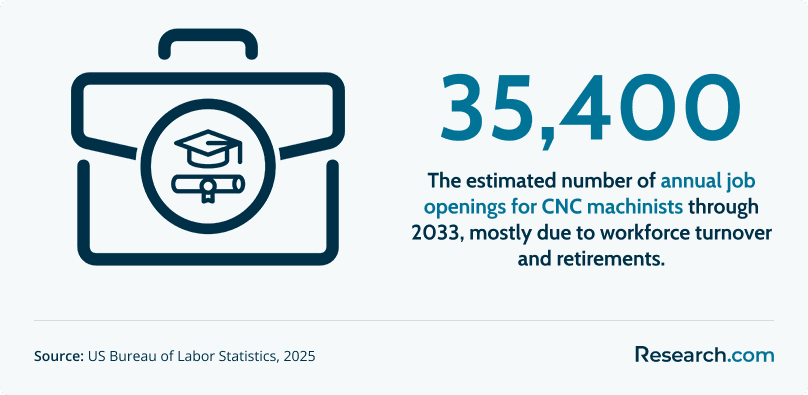
The CNC machining job market is steady rather than fast-growing. Recent data show approximately 35,400 job openings for machinists each year, largely because employers need to replace workers who retire or leave the occupation. Employment growth is projected to be nearly flat through 2033, with machinist positions expected to grow by around 2%.
That outlook means students should be realistic. CNC training can support access to skilled manufacturing jobs, but competition, local employer demand, and hands-on ability matter. Graduates who can read prints, measure accurately, follow safety procedures, troubleshoot setups, and work with CAD/CAM or quality systems may have stronger prospects than those with only basic online coursework.
The broader machining market remains active. The global machining market is estimated at roughly USD 430 billion in 2025 and is forecast to grow at a 6.7% compound annual rate through 2032. Growth is tied to automation, robotics, and the need for precision components in aerospace, automotive, medical devices, electronics, and related sectors.
For students, the practical takeaway is clear: CNC machining is not a guaranteed high-growth career, but trained workers remain important in industries that depend on accurate, repeatable production. The strongest job candidates combine trade school training with hands-on practice, certifications, and a willingness to keep learning new technologies.
What graduates say about online CNC machining trade school
The online format made it possible for me to keep my full-time job while moving through the CNC lessons on my own schedule. The virtual simulations gave me a safer way to practice before working with actual machines, and the G-code and toolpath sections were more practical than I expected. I found an entry-level machinist role within a month of completing the course. — Don
I started with no background in machining, but the online coursework broke down topics like axis movement and machine setup in a way I could follow. Instructor support and peer discussions helped me stay engaged even though the program was remote. I now program CNC mills at a local shop. — Wesley
The program fit around my family schedule, and being able to replay lessons helped me learn the harder material. The training felt connected to real shop expectations, so I was more confident talking with employers. I completed certification requirements and had interviews scheduled before the program ended. — Robert
Key Insights
- CNC machining trade school is best for learners who want focused, job-oriented manufacturing training without committing immediately to a longer degree.
- The most affordable reviewed online programs range from $1,995 to $2,694, but students should also check software, tools, certification, and hands-on practice costs.
- Most CNC machining programs take 6 months to 2 years, with many online programs in this guide listing a 12-month timeline.
- Online CNC training is flexible, but beginners should confirm how the program develops real machine skills, not just theory.
- CNC machinist job growth is projected at 2% through 2033, with about 35,400 job openings annually driven mainly by workforce turnover.
- Around 32% of CNC machinists work in manufacturing sectors such as aerospace, defense, electronics, and metal fabrication.
- The most common education level for machinists is a high school diploma, earned by about 40% of workers in the field.
- The maximum Pell Grant award for eligible trade school students is $7,395 for the 2025–2026 academic year, but aid eligibility depends on the program and institution.
- The best-value program is the one that matches your target job, teaches employer-requested skills, offers credible recognition, and gives you a realistic path to hands-on practice.
References:
- Allied Market Research. (n.d.). U.S. CNC machines market. Retrieved from Allied Market Research.
- Coherent Market Insights. (n.d.). Machining market. Retrieved from CoherentMI.
- Data USA. (n.d.). Machinists profile. Retrieved from Data USA.
- Data Bridge Market Research. (n.d.). Global CNC machine market. Retrieved from Data Bridge Market Research.
- Haas Automation. (n.d.). Learn CNC. Retrieved from Haas Learn.
- MarketsandMarkets. (n.d.). CNC market. Retrieved from MarketsandMarkets.
- National Center for Education Statistics. (n.d.). Machine tool technology/machinist (CIP Code: 48.0510). Retrieved from NCES.
- NIMS. (n.d.). Starter guide – Machining credentialing v2.1. Retrieved from NIMS.
- NTMA Pittsburgh Chapter. (n.d.). Apprentice program. Retrieved from PGH NTMA.
- U.S. Department of Education. (n.d.). Federal student aid. Retrieved from StudentAid.gov.
- ZipRecruiter. (n.d.-a). CNC applications engineer salary. Retrieved from ZipRecruiter.
- ZipRecruiter. (n.d.-b). CNC programmer salary. Retrieved from ZipRecruiter.
- ZipRecruiter. (n.d.-c). Manufacturing engineer salary. Retrieved from ZipRecruiter.
- ZipRecruiter. (n.d.-d). Metallurgical engineer salary. Retrieved from ZipRecruiter.
- ZipRecruiter. (n.d.-e). Tooling manager salary. Retrieved from ZipRecruiter.
Other Things You Should Know About CNC Machining Trade School Programs
Consider accreditation, curriculum quality, student support services, and tuition rates. Ensure the program offers practical experience opportunities and aligns with your career goals. Researching alumni outcomes can also be beneficial.
Admission requirements typically include a high school diploma or equivalent, a completed application, and sometimes a placement test or interview. Specific programs may have additional prerequisites such as particular math or technical courses. Always check the individual school's criteria.
Yes. Most programs require a Windows laptop or desktop, at least 8 GB RAM, reliable internet, and CAD/CAM software such as Fusion 360 or Mastercam student access. Many schools also require a webcam for proctored exams and, in 2027, some ask for a 3D-capable graphics card.
Yes, financial aid is available for online CNC machining trade school programs in 2027. Students can apply for federal aid through FAFSA, and many schools offer scholarships or payment plans. It's essential to check with individual schools for specific financial aid opportunities.


