
2027 Most Affordable Online Veterinary Technician Trade School Programs

Co-Founder and Chief Data Scientist
Choosing an online veterinary technician program is not just a tuition decision. You need a program that is affordable, properly accredited, accepted for licensing in your state, and realistic for your schedule because veterinary technology requires both academic study and hands-on clinical skill development. For students who want to work with animals but need a flexible route into a licensed healthcare support role, online and hybrid vet tech programs can make the career more accessible.
This guide explains what to expect from affordable online veterinary technician programs for 2027, how long they take, what they cost, how licensure works, and how to compare schools without relying on price alone. You will also find a ranked list of online vet tech programs, career and salary information, common mistakes to avoid, and practical questions to ask before enrolling.
Quick answer: Are online veterinary technician programs worth it?
Online veterinary technician programs can be worth it if they are accredited by the AVMA-CVTEA, include supervised clinical training, and meet the licensing requirements in the state where you plan to work. The career has strong labor-market demand: as of May 2024, veterinary technologists and technicians earned a median annual wage of $45,980, and employment is projected to grow 19% from 2023 to 2033, with about 15,400 openings each year.
The best fit is usually an online or hybrid associate degree that lets you complete theory courses remotely while arranging clinical experience through approved veterinary sites near you. The main trade-off is that online students must be disciplined, organized, and proactive about finding clinical mentors.
What are the benefits of getting a veterinary technician degree?
- It prepares you for credentialed animal healthcare work. A veterinary technician degree can qualify you for roles in private clinics, animal hospitals, shelters, research facilities, zoos, and other animal-care environments where technicians support veterinarians and perform essential clinical tasks.
- It leads to a career with measurable demand. Veterinary technologists and technicians had a median annual wage of $45,980 in May 2024, while the highest 10% earned more than $60,880.
- It can fit working students better than a campus-only program. Many online veterinary technician programs use a hybrid structure: lectures, assignments, and exams are completed online, while labs, externships, or mentorships are completed in person at approved clinical sites.
- It creates room for specialization. After gaining experience, vet techs may pursue focused areas such as anesthesia, emergency and critical care, dentistry, behavior, radiology, equine nursing, or zoological medicine.
What can I expect from an online veterinary technician degree?
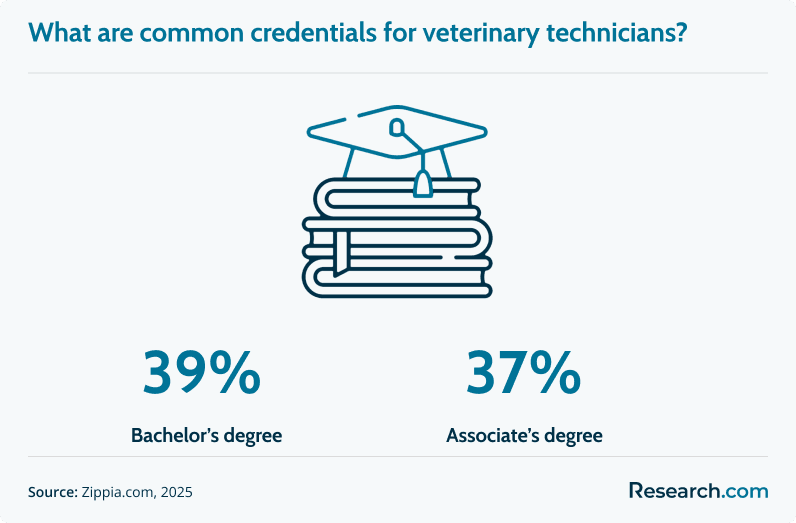
An online veterinary technician degree is usually an associate-level program designed to prepare students for entry-level veterinary technology work and, in many states, eligibility for the Veterinary Technician National Examination. Most programs take 18 to 36 months, although part-time students may need longer.
The academic portion typically covers animal anatomy and physiology, pharmacology, microbiology, diagnostic imaging, surgical nursing, laboratory procedures, animal handling, dentistry, and client communication. Because this is a clinical profession, online coursework alone is not enough. Students are normally required to complete supervised labs, externships, internships, or clinical mentorships where they demonstrate hands-on skills with animals, equipment, and veterinary teams.
Tuition can range from $4,000 to over $20,000 depending on the school, residency rules, credit requirements, and fees. Online courses are usually delivered through a learning management system with recorded or live lectures, quizzes, assignments, discussion boards, and exams. Clinical hours are commonly completed at approved veterinary clinics, hospitals, shelters, or other practice sites.
| Program feature | What it usually means for students | Why it matters |
| Degree level | Most programs award an associate degree | This is the common entry route for veterinary technician roles |
| Format | Online theory courses plus in-person clinical training | You get flexibility without skipping required hands-on skills |
| Completion time | Often 18 to 36 months, depending on pace | Part-time enrollment may be better for working students but extends the timeline |
| Clinical requirement | Externship, internship, preceptorship, or mentorship | Licensure-focused programs must document practical competency |
| Accreditation priority | AVMA-CVTEA program accreditation | Graduation from an accredited program is commonly tied to VTNE and state credentialing eligibility |
Where can I work with an online veterinary technician degree?
Graduates of accredited online veterinary technician programs most often work in private veterinary practices and animal hospitals. However, the training can also apply to emergency clinics, specialty practices, research laboratories, animal shelters, wildlife rehabilitation centers, zoos, government agencies, and veterinary pharmaceutical companies.
The setting you choose affects your daily work. A small-animal clinic may involve wellness exams, lab samples, radiographs, anesthesia monitoring, dental cleanings, and client education. Emergency hospitals may require nights or weekends and faster decision-making. Research or laboratory settings may involve stricter protocols, documentation, and animal welfare compliance.
How much can I make with an online veterinary technician degree?
The median annual wage for veterinary technologists and technicians was $45,980 in May 2024. The lowest 10% earned less than $32,120, while the highest 10% earned more than $60,880. Pay varies by industry, location, work setting, schedule, experience, and specialization.
For example, veterinary technicians working in educational services earn an average of $51,250, while those in private veterinary services earn around $45,740. Technicians who build advanced skills in areas such as anesthesia, emergency care, diagnostic imaging, dentistry, research, or regulatory environments may have access to higher-paying roles, although salary outcomes are never guaranteed.
| Factor | How it can affect earnings |
| Work setting | Emergency, specialty, research, education, and regulatory environments may pay differently than general practice |
| Experience level | Technicians with strong clinical judgment and proven reliability may qualify for senior or lead roles |
| Specialization | Advanced credentials or focused expertise can support career mobility |
| Location | Urban and coastal areas may offer higher wages, often alongside a higher cost of living |
| Schedule | Emergency, overnight, weekend, or holiday shifts may affect compensation depending on the employer |
- Best Online Veterinary Technician Programs for 2027
- How long does it take to complete an online veterinary technician program?
- Online vs. on-campus veterinary technician programs
- Average cost of an online veterinary technician program
- Financial aid options for online veterinary technician students
- Prerequisites for online veterinary technician programs
- Common courses in an online veterinary technician program
- Veterinary technician specializations
- Online vet tech programs compared with other trade school careers
- Professional certifications for veterinary technicians
- Career advancement beyond a veterinary technician degree
- How to choose the best online veterinary technician program
- Career paths for online veterinary technician graduates
- Job market for veterinary technician graduates
Best Online Veterinary Technician Trade School Programs for 2027
How do we rank the programs?
Research.com evaluates online veterinary technician trade school programs using trusted education and outcomes data from the IPEDS database, Peterson's database, the College Scorecard database, and the National Center for Education Statistics.
These sources help compare affordability, institutional quality, and student outcomes. To understand the broader ranking process and data approach, review Research.com's methodology page.
Online veterinary technician programs at a glance
| School | Credits | Cost | Accreditation | Best-fit student |
| Purdue University | 70 | $270 per credit, with a $227/credit partner discount | AVMA-CVTEA and Higher Learning Commission (HLC) | Students who want a structured online program with extensive clinical mentorships |
| SUNY Delhi | 64 | $295 per credit in-state; $353 per credit out-of-state | AVMA-CVTEA and Middle States Commission on Higher Education (MSCHE) | Students already connected to veterinary work who want small-class support |
| Penn Foster College | 66 | $8,100 - $8,600 total; $144/credit | AVMA-CVTEA and DEAC | Students seeking a fully online curriculum with established veterinary network partnerships |
| Dallas College | 60 | $79 in-county; $137 out-of-county; $200 out-of-state per credit | AVMA-CVTEA and SACSCOC | Students who want a low-credit, distance format with weekly clinical commitments |
| Colby Community College | 82 | $150–$204 per credit hour through online regional rates | AVMA-CVTEA and Higher Learning Commission (HLC) | Students interested in domestic and exotic animal care with weekend mentorships |
| Jefferson State Community College | 76 | $166 per credit in-state; $292 per credit out-of-state | AVMA-CVTEA and Southern Association of Colleges and Schools Commission on Colleges (SACSCOC) | Students working under a licensed Alabama veterinarian while studying online |
| Northern Virginia Community College | 68 | $185.50 per credit in-state; $388.25 per credit out-of-state | AVMA-CVTEA and Southern Association of Colleges and Schools Commission on Colleges (SACSCOC) | Full-time workers who can manage limited campus visits and approved clinic training |
| St. Petersburg College | 73 | $123.90 per credit in-state; $385.90 per credit out-of-state | AVMA-CVTEA; SACSCOC; American Animal Hospital Association (AAHA) | Students who want distance coursework, repeated in-clinic training, and a bachelor’s continuation option |
| San Juan College | 76–80 | $56.25 per credit in-district; $143.25 per credit out-of-district; $167.25 per credit out-of-state | AVMA-CVTEA and The Higher Learning Commission | Students seeking a flexible online program with local or Texas fast-track lab options |
| YTI Career Institute | 86 | $520 per credit | AVMA-CVTEA and Accrediting Commission of Career Schools and Colleges (ACCSC) | Students who prefer an applied associate degree with two clinical externships and no campus travel |
1. Purdue University
Purdue University offers an online veterinary technician program with 27 didactic courses and 18 clinical mentorships. The program is a strong option for students who want a recognized university setting, defined academic sequencing, and support services such as writing assistance and academic centers.
- Required Credits to Graduate: 70
- Cost: $270 per credit, with a $227/credit partner discount
- Accreditation: AVMA-CVTEA and Higher Learning Commission (HLC)
2. SUNY Delhi
SUNY Delhi’s online Veterinary Science Technology AAS mirrors the standards of its campus-based option while allowing students to study remotely. The program is designed for learners who are already working in veterinary settings or who need a flexible schedule, and it includes clinical skill development through a 240-hour preceptorship.
- Required Credits to Graduate: 64
- Cost: $295 per credit in-state; $353 per credit out-of-state
- Accreditation: AVMA-CVTEA and Middle States Commission on Higher Education (MSCHE)
3. Penn Foster College
Penn Foster College offers a fully online AVMA-CVTEA accredited veterinary technician program with partnerships involving major veterinary hospital networks. Its 66-credit curriculum includes foundational and applied coursework such as radiography and clinical pathology.
- Required Credits to Graduate: 66
- Cost: $8,100 - $8,600 total; $144/credit
- Accreditation: AVMA-CVTEA and DEAC
4. Dallas College
Dallas College’s Distance Education Veterinary Technology Program combines remote coursework with weekly clinical requirements. Students record hands-on skills for evaluation, making it a practical option for learners who need distance education without required campus visits.
- Required Credits to Graduate: 60
- Cost: $79 in-county; $137 out-of-county; $200 out-of-state per credit
- Accreditation: AVMA-CVTEA and SACSCOC
5. Colby Community College
Colby Community College offers a fully online Veterinary Technology AAS that incorporates weekend mentorships for practical training. Its 82-credit structure gives students exposure to both domestic and exotic animal care.
- Required Credits to Graduate: 82
- Cost: $150–$204 per credit hour through online regional rates
- Accreditation: AVMA-CVTEA and Higher Learning Commission (HLC)
6. Jefferson State Community College
Jefferson State Community College provides a distance-based veterinary technician pathway with limited campus obligations. Students complete online coursework while working at least 20 hours per week under a licensed Alabama veterinarian, and scholarship support may help with costs such as books, uniforms, and supplies.
- Required Credits to Graduate: 76
- Cost: $166 per credit in-state; $292 per credit out-of-state
- Accreditation: AVMA-CVTEA; Southern Association of Colleges and Schools Commission on Colleges (SACSCOC)
7. Northern Virginia Community College
Northern Virginia Community College offers veterinary technology courses in online and hybrid formats for students balancing school with employment. Instruction uses tools such as Zoom and Canvas, while students complete clinical practice at approved sites and attend only a few campus visits each term.
- Required Credits to Graduate: 68
- Cost: $185.50 per credit in-state; $388.25 per credit out-of-state
- Accreditation: AVMA-CVTEA; Southern Association of Colleges and Schools Commission on Colleges (SACSCOC)
8. St. Petersburg College
St. Petersburg College’s distance veterinary technology program combines online coursework with in-clinic practice requirements. Students also benefit from access to the school’s $11 million veterinary technology facility and may continue into a bachelor’s program in veterinary technology.
- Required Credits to Graduate: 73
- Cost: $123.90 per credit in-state; $385.90 per credit out-of-state
- Accreditation: AVMA-CVTEA; SACSCOC; American Animal Hospital Association (AAHA)
9. San Juan College
San Juan College provides a fully online veterinary technology option available to students from nearly every state. The program has flexible clinical training arrangements, no mandatory campus visits, and fast-track lab options that may be completed locally or in Texas.
- Required Credits to Graduate: 76–80
- Cost: $56.25 per credit in-district; $143.25 per credit out-of-district; $167.25 per credit out-of-state
- Accreditation: AVMA-CVTEA; The Higher Learning Commission
10. YTI Career Institute
YTI Career Institute offers an online associate degree in veterinary technology focused on applied career preparation. The program includes two required clinical externships and prepares students for roles in private practice, research settings, and zoological institutions without requiring campus travel.
- Required Credits to Graduate: 86
- Cost: $520 per credit
- Accreditation: AVMA-CVTEA; Accrediting Commission of Career Schools and Colleges (ACCSC)
How long does it take to complete an online veterinary technician program?
Most online veterinary technician programs take 2 to 4 years to finish, depending on the degree structure, transfer credits, clinical scheduling, and whether you study full time or part time. Many students pursue an associate degree because it is the standard entry-level credential for veterinary technician work.
A full-time student may complete an associate program in about two years. Students who work, care for family members, or need extra time to arrange clinical placements may take longer. Bachelor’s-level or extended programs can require additional time.
Typical pathway to becoming a veterinary technician
- Choose an accredited program. Look for an associate degree accredited by the American Veterinary Medical Association’s veterinary technology accrediting body because accreditation is often tied to VTNE eligibility.
- Complete online coursework. Expect science, clinical, diagnostic, pharmacology, surgical, and animal-care courses.
- Finish supervised clinical training. Students practice required skills in veterinary settings, often through externships, mentorships, or preceptorships.
- Take the VTNE. Graduates commonly sit for the Veterinary Technician National Examination, which is required in most states for credentialing.
- Apply for state licensure, registration, or certification. Requirements vary, so confirm rules with the state board where you plan to work before enrolling.
| Student situation | Likely timeline | Best strategy |
| Full-time student with stable clinical placement | About two years | Follow the recommended course sequence and secure clinical sites early |
| Working adult studying part time | Longer than two years | Ask whether courses are offered every term or only in fixed sequences |
| Student with transfer credits | May shorten general education requirements | Request an official transfer evaluation before committing |
| Student without a clinic connection | May face delays | Confirm how the school helps students identify approved clinical mentors |
How does an online veterinary technician program compare to an on-campus program?
Online and on-campus veterinary technician programs can both prepare students for licensure-focused careers, but the learning experience is different. The right choice depends on your schedule, learning style, location, access to clinical sites, and need for in-person support.
| Comparison point | Online or hybrid program | On-campus program |
| Course delivery | Lectures and assignments are completed remotely | Classes are held in person on a set schedule |
| Hands-on practice | Usually completed through approved local clinics or scheduled labs | Often completed in campus labs and school-arranged clinical settings |
| Flexibility | Better for working students, caregivers, and rural learners | Better for students who want fixed structure and face-to-face access |
| Clinical coordination | Students may need to help identify mentors or sites | The school may provide more direct placement support |
| Networking | Often virtual and self-directed | More natural peer, faculty, and local employer interaction |
| Best fit | Independent students with strong time management | Students who learn best through immediate in-person instruction |
Advantages of online vet tech programs
- More schedule control: Online coursework can make it easier to study while working or managing family responsibilities.
- Access for rural students: Students who live far from a campus-based veterinary technology program may be able to train without relocating.
- Workplace-based learning: Some practices use a “Grow Your Own” model, supporting employees as they complete online vet tech training while continuing to work.
- Lower indirect costs: Students may reduce commuting, parking, housing, or relocation expenses.
Challenges of online vet tech programs
- Clinical-site responsibility: You may need to locate an approved clinic and qualified mentor before you can complete required competencies.
- Less immediate feedback: Online students may wait longer for instructor responses than students in a lab or classroom.
- High self-discipline requirement: Falling behind in an online program can create problems when courses are sequenced or clinical deadlines are fixed.
- Fewer informal connections: You may need to work harder to build relationships with classmates, faculty, and employers.
Before choosing either format, verify AVMA-CVTEA accreditation and your state’s credentialing rules. This is similar to other regulated or training-based career paths, such as those explained in Research.com's guide on how to become a conservation officer, where education and eligibility requirements can affect employment options.
What is the average cost of an online veterinary technician program?
The price of an online veterinary technician program depends on school type, residency status, credit load, program length, fees, and clinical expenses. Public community colleges are often the lowest-cost option for in-state students, while private institutions may charge substantially more.
For in-state students at public community colleges, tuition usually ranges from $3,500 to $5,000 per year. Out-of-state students at the same colleges may pay double or triple that amount. Private institutions often do not use the same residency pricing structure, but annual tuition can range from $15,000 to $30,000 or more.
Tuition is only one part of the total cost. Budget for textbooks, online course fees, lab fees, uniforms, medical or vaccination requirements, equipment, background checks, transportation to clinical sites, and exam or licensing-related costs. If you are comparing animal-care careers, it can also help to understand related paths such as fish and game warden job requirements.
| Cost category | What to check before enrolling |
| Tuition | Confirm per-credit cost, total required credits, and whether residency pricing applies |
| Fees | Ask about online learning fees, lab fees, technology fees, and graduation fees |
| Clinical training | Find out whether you must pay for travel, supplies, uniforms, or site-specific requirements |
| Books and materials | Request an estimated book and supply list for the full program, not just the first term |
| Licensure and exams | Ask which exam, application, and credentialing costs are not included in tuition |
| Lost income or reduced work hours | Consider whether clinical scheduling will limit your ability to work |
What are the financial aid options for students enrolling in an online veterinary technician program?
Students in eligible online veterinary technician programs may be able to use federal, state, institutional, private, or employer-based aid. The most important first step is to confirm that the school participates in the type of aid you plan to use and that your program is eligible.
Federal financial aid options
- Federal Pell Grants: Need-based grants for eligible students that do not have to be repaid.
- FSEOG (Federal Supplemental Educational Opportunity Grant): Additional grant funding for students with significant financial need at participating schools.
- Federal Direct Subsidized Loans: Need-based loans where the government pays interest while the student is enrolled.
- Federal Direct Unsubsidized Loans: Loans that are not based on financial need and begin accruing interest after disbursement.
- Parent PLUS Loans: Federal loans available to parents of dependent students to help cover remaining educational costs.
Other ways to reduce the cost
- Institutional scholarships and grants: Ask the school’s financial aid office about awards for veterinary technology students, adult learners, online students, or students with financial need.
- Private scholarships: Veterinary organizations and foundations may offer field-specific awards. This guide to vet tech and veterinary scholarships can help you identify additional opportunities.
- State-based aid: Some states provide grants, scholarships, or workforce funds for students in technical and healthcare-related programs.
- Employer assistance: Veterinary clinics may offer tuition help, schedule flexibility, or mentorship support for employees entering accredited programs.
- Private student loans: Banks and credit unions may offer loans if federal and school-based aid do not cover the full cost, but compare rates and repayment terms carefully.
Financial aid questions to ask the school
- Is this specific online veterinary technician program eligible for federal financial aid?
- What percentage of the total program cost is not covered by tuition?
- Are clinical supplies, uniforms, books, and exam costs included in the aid estimate?
- Are scholarships renewable, or are they only available for the first term?
- What happens to my aid if I switch from full-time to part-time enrollment?
What are the prerequisites for enrolling in an online veterinary technician program?
Most online veterinary technician programs require a high school diploma or equivalent. Schools may also expect applicants to show readiness in science, math, communication, and basic computer use because the curriculum combines medical concepts, clinical calculations, online learning, and client-facing responsibilities.
High school preparation
- Science background: Biology and chemistry are especially useful for anatomy, physiology, pathology, and pharmacology.
- Math skills: Algebra and statistics can support dosage calculations, lab interpretation, and recordkeeping.
- Communication skills: English and public speaking help with client education, medical documentation, and teamwork.
- Animal-care exposure: Volunteering or working at a clinic, shelter, farm, kennel, or rescue can strengthen your application and help confirm that the work environment fits you.
Program admission requirements
- Accredited program enrollment: Prioritize AVMA-accredited associate degree options if your goal is VTNE eligibility and credentialed practice.
- Placement or prerequisite courses: Some schools may require placement testing or college-level biology, math, or English before full admission.
- Clinical readiness: Programs may require proof of immunizations, background checks, professional liability coverage, or access to an approved veterinary site.
- State-specific rules: Licensure requirements vary, so check whether the program satisfies your state’s expectations before enrolling.
Students interested in broader animal or life science careers may also compare this training with paths such as the marine biologist career path, where science preparation also plays a central role.
What courses are typically in an online veterinary technician program?
Online veterinary technician programs combine biological science, veterinary nursing, diagnostics, surgical support, animal handling, and professional communication. The goal is to prepare students to support veterinarians safely and competently in clinical environments.
Core science and medical courses
- Anatomy and Physiology: Study of animal body systems, structure, and function.
- Pharmacology: Training in veterinary medications, dosage concepts, routes of administration, and safety.
- Animal Diseases and Pathology: Instruction in disease processes, illness recognition, and diagnostic reasoning.
- Laboratory Procedures: Practice with bloodwork, urinalysis, sample handling, and diagnostic testing.
- Radiology: Training in imaging techniques, positioning, safety, and image evaluation support.
Clinical and patient-care courses
- Veterinary Nursing Techniques: Skills such as bandaging, patient monitoring, medication administration, and treatment support.
- Surgical Assisting: Preparation for sterile technique, surgical setup, anesthesia support, and post-operative monitoring.
- Animal Handling: Safe restraint and care techniques for small, large, and sometimes exotic animals.
- Dentistry and Client Communication: Dental-care support, oral health education, and communication with pet owners.
- Ethics, Law, and Professional Practice: Standards for documentation, animal welfare, confidentiality, and workplace conduct.
Students in accredited programs may also explore professional resources through AVMA membership, which can support networking and continuing education.
What types of specializations are available in an online veterinary technician program?
Most students first complete a general veterinary technology program. After graduation and experience, technicians may pursue advanced specialization through focused training and professional credentials. These specialty areas can help technicians move into more complex clinical settings and demonstrate expertise beyond entry-level practice.
Common veterinary technician specialties
| Specialization | What the work emphasizes | Best fit for |
| Anesthesia and Analgesia | Patient monitoring, anesthesia protocols, and pain management | Technicians comfortable with surgery, calculations, and high-detail monitoring |
| Emergency and Critical Care | Urgent assessment, triage support, intensive care, and fast-paced treatment | Technicians who can stay calm under pressure and work nontraditional shifts |
| Dentistry | Oral exams, dental radiography support, cleanings, and client education | Technicians interested in preventive care and procedural work |
| Internal Medicine | Support for chronic illness, diagnostics, and advanced treatment plans | Technicians who enjoy complex cases and long-term patient management |
| Behavior | Animal behavior, training support, stress reduction, and client coaching | Technicians interested in animal psychology and owner education |
| Zoological Medicine | Care for exotic or wild animals in zoos, aquariums, or similar settings | Technicians seeking work beyond traditional companion-animal practice |
| Equine Nursing | Horse health, treatment support, field care, and large-animal handling | Technicians with interest in large animals and physically active work |
| Radiology or Diagnostic Imaging | X-rays, ultrasound support, CT, MRI, and imaging safety | Technicians who enjoy technology, positioning, and diagnostic workflows |
Specializations can improve job options, but they usually require experience, additional preparation, and ongoing professional development. Students comparing animal and environmental career directions may also review Research.com's environmental biologist salary guide.
How does an online veterinary technician program compare to other lucrative trade school careers?
Veterinary technology is a strong fit for students who want healthcare-style work focused on animals, but it is not always the highest-paying trade school option. Compared with some trades, the vet tech path may require more formal credentialing, clinical competencies, and state-specific licensing steps. It also involves physically demanding and emotionally challenging work, including sick or injured animals and interactions with distressed pet owners.
Other trade school careers may lead to faster workforce entry or higher initial wages depending on the field, local labor demand, and required certifications. The better choice depends on what you value most: animal care, schedule stability, income potential, advancement opportunities, licensing requirements, or speed to employment. For a broader wage and career comparison, see Research.com's guide to the highest paying trade school jobs.
| Question | Vet tech path | Other trade school paths |
| Primary motivation | Animal health, clinical care, and veterinary support | Varies by field, often technical, mechanical, healthcare, or service-based work |
| Credentialing | Often tied to accredited education, VTNE, and state rules | May require licenses, apprenticeships, certifications, or none depending on the field |
| Hands-on training | Required with live animals and clinical procedures | Usually required, but the work environment differs widely |
| Income comparison | Stable demand, with wages affected by setting and specialization | Some fields may offer higher starting or long-term earning potential |
| Best-fit student | Someone committed to animal care and clinical responsibility | Someone prioritizing income, faster entry, or a different type of technical work |
What additional professional certifications can further enhance my veterinary technician career?
After gaining experience, veterinary technicians can strengthen their careers through advanced credentials in focused areas such as anesthesia, dentistry, emergency and critical care, behavior, internal medicine, or diagnostic imaging. These credentials can help demonstrate expertise, support movement into specialty practices, and prepare technicians for more responsibility.
Certification is most useful when it matches your actual career goals. For example, emergency and critical care may suit technicians who enjoy high-pressure environments, while dentistry may fit those who prefer procedural and preventive care. Technicians who are comparing biology-related advancement options can also explore Research.com's guide to highest paying jobs with biology degree pathways.
How can I advance my career beyond a veterinary technician degree?
A veterinary technician degree can be the starting point for several advancement routes. Some technicians become lead technicians, practice managers, specialty technicians, educators, research technicians, or supervisors. Others use the degree as a foundation for additional study in animal science, biology, public health, nutrition, business, or healthcare administration.
The best next step depends on whether you want to deepen clinical expertise, move into leadership, teach, work in research, or shift into a related field. For example, a technician interested in nutrition, wellness, and broader health education may compare graduate options such as the fastest online nutrition masters degree.
How to choose the best online veterinary technician program
The best online veterinary technician program is the one that meets credentialing requirements, fits your budget, provides credible clinical training, and supports your learning style. Do not choose based only on the lowest tuition or the most convenient course schedule.
Key factors to compare
- AVMA-CVTEA accreditation: This should be one of your first checks because it can affect VTNE eligibility and professional credibility.
- State licensure alignment: Ask whether graduates are eligible for credentialing in the state where you plan to work.
- Clinical placement process: Find out whether the school places students, approves sites, or expects you to find your own mentor.
- Total cost: Compare tuition, fees, books, supplies, travel, exam costs, and lost work time.
- VTNE and graduate outcomes: Ask for VTNE pass rates and job placement information, but remember that no school can guarantee your outcome.
- Student support: Look for tutoring, faculty access, technical support, advising, and help with clinical documentation.
- Course sequencing: Confirm whether courses are offered every term or only during specific semesters.
- Transfer credit policy: If you have prior college credits, request a formal evaluation before enrolling.
Common mistakes to avoid
| Mistake | Why it can be costly | Better approach |
| Choosing a program without checking accreditation | You may graduate from a program that does not support your licensing goals | Verify AVMA-CVTEA accreditation before applying |
| Looking only at tuition | Fees, supplies, travel, and exam costs can change the real price | Ask for a full program cost estimate in writing |
| Assuming online means fully remote | Vet tech training requires in-person clinical skills | Confirm every lab, externship, mentorship, and campus requirement |
| Ignoring state licensing rules | Requirements differ by state and may affect employability | Contact your state veterinary board before enrolling |
| Waiting too long to secure a clinical site | Delayed placements can delay graduation | Ask how soon you should identify mentors and approved clinics |
| Relying only on rankings | A highly ranked program may not fit your state, budget, or schedule | Use rankings as a shortlist, then verify fit with your goals |
Questions to ask before enrolling
- Is the program currently AVMA-CVTEA accredited?
- Does the program meet licensing or credentialing requirements in my state?
- How are clinical sites approved, and who is responsible for finding them?
- How many hours per week should I expect to spend on coursework and clinical training?
- Are any campus visits, fast-track labs, or travel requirements mandatory?
- What is the total estimated cost from enrollment through graduation?
- What support is available if I struggle in science courses or clinical skills?
- Can I work full time while enrolled, or will clinical scheduling make that unrealistic?
What career paths are available for graduates of an online veterinary technician program?
Graduates of online veterinary technician programs can work in animal care, diagnostics, surgery, emergency practice, behavior, laboratory settings, and specialty care. Some roles are direct veterinary technician positions, while others use overlapping clinical, animal-handling, or laboratory skills.
Career options and average salaries
- Dietary Technician: Supports nutrition planning and animal health guidance (avg. $48,766/year).
- Animal Technician: Provides care for animals in labs, shelters, zoos, or similar environments (avg. $40,485/year).
- Hospital Service Technician: Assists in emergency hospitals and trauma-care settings (avg. $59,433/year).
- Medical Technician: Supports internal medicine, treatment plans, and chronic illness care (avg. $54,032/year).
- Clinical Technician: Performs diagnostics, nursing tasks, and patient case support (avg. $45,162/year).
- Behavior Technician: Helps address animal training, behavior, and mental health needs (avg. $39,306/year).
- Pathology Assistant: Handles specimens, conducts tests, and supports sample analysis (avg. $55,931/year).
- Laboratory Technician: Works in research, diagnostic, or testing laboratories (avg. $45,059/year).
- Anesthesia Technician: Monitors sedation, anesthesia, and recovery during procedures (avg. $51,844/year).
- X-ray Technician: Focuses on radiology and diagnostic imaging support (avg. $52,713/year).
- Surgical Technician: Assists veterinarians during routine and complex surgical procedures (avg. $53,917/year).
- Imaging Specialist: Works with CT, MRI, ultrasound, and related diagnostic tools (avg. $49,769/year).
Technicians who move into management, training, or operations may eventually benefit from leadership-focused study. For example, Research.com's guide to the most affordable online master’s in organizational leadership may be useful for professionals planning supervisory or administrative roles.
What is the job market for graduates with an online veterinary technician program?
The job market for veterinary technologists and technicians is strong. The U.S. Bureau of Labor Statistics projects 19% employment growth from 2023 to 2033, which is much faster than the average for all occupations. About 15,400 openings are projected each year during that period.
Key labor-market details
- Median Salary: $45,980 per year
- Projected Openings: About 15,400 per year through 2033
- Projected Growth: 19% from 2023 to 2033
- Demand Drivers: Expanding veterinary services, continued pet healthcare needs, and replacement openings as workers leave the occupation
Common work environments
- Private veterinary clinics and animal hospitals
- Emergency and specialty practices
- Diagnostic laboratories and research facilities
- Animal shelters and humane organizations
- Zoos, aquariums, and wildlife care settings
The work can be rewarding, but it is not easy. Veterinary technicians may lift or restrain animals, work evenings or holidays, assist with difficult medical cases, and support clients through stressful decisions. Students should weigh both the strong job outlook and the physical and emotional demands of the role.
Here’s what people say about online veterinary technician degrees
-
: "
My veterinary technician degree helped me move from general animal-care work into a clinical role where I understood anatomy, procedures, and patient monitoring. The labs and clinical requirements were demanding, but they matched the realities of working in a busy animal hospital. — Natalie
"
-
: "
Being able to study online while keeping my full-time job made the degree possible. I still had to complete hands-on training, but the flexible coursework helped me stay employed while preparing for licensure. — Devon
"
-
: "
Passing the VTNE made the long study hours feel worthwhile. The program gave me a path into work with both large and small animals, and it confirmed that veterinary technology was the right career for me. — Keisha
"
Key Insights
- Online veterinary technician programs are best for students who need flexible coursework but can still complete required in-person clinical training.
- Accreditation is non-negotiable. Before enrolling, verify AVMA-CVTEA accreditation and confirm that the program supports licensing or credentialing in your state.
- The career has strong demand: veterinary technologists and technicians earned a median annual wage of $45,980 in May 2024, with 19% job growth projected from 2023 to 2033.
- Most students enter the field through an associate degree, complete supervised clinical training, take the VTNE, and then apply for state licensure, registration, or certification.
- Affordability should be measured by total cost, not tuition alone. Include fees, supplies, clinical travel, exam costs, and any reduction in work hours.
- Specializations in areas such as anesthesia, emergency care, dentistry, radiology, behavior, and zoological medicine can expand career options after experience.
- The best online program is not automatically the cheapest. It is the one that fits your state requirements, schedule, clinical access, budget, and long-term career goals.
References:
- U.S. Bureau of Labor Statistics. Veterinary technologists and technicians. Occupational Outlook Handbook.
- Purdue University College of Veterinary Medicine. Online vet tech school advantages and drawbacks.
- Affordable Colleges Online. Vet tech school and program information.
- Vet Tech Colleges. Online veterinary technician program guide.
- American Animal Hospital Association. Veterinary technician role overview.
- Indeed Editorial Team. Veterinary technician career explanation.
- Indeed Editorial Team. How to become a veterinary technician.
- Indeed Editorial Team. Veterinary technician career options and salaries.
- Zippia. Veterinary technician job overview.
Other Things You Should Know About Online Veterinary Technician Trade School Programs
To enroll in an online veterinary technician program in 2027, you typically need a high school diploma or GED. Some programs may require completion of specific coursework such as biology or animal science classes, though this varies by institution.
Yes. AVMA Committee on Veterinary Technician Education and Activities–accredited programs require a supervised clinical externship or skills lab, often completed at an approved local site. Students usually finish about 240–500 supervised clinical hours before graduation, along with didactic coursework and lab competencies.


