
2027 Most Affordable Online Woodworking Trade School Programs

Co-Founder and Chief Data Scientist
Choosing an online woodworking trade school is not just about finding the lowest tuition. You also need enough hands-on practice, safe access to tools, credible instruction, and a program that matches the type of woodworking work you want to do—cabinetmaking, furniture building, millwork, finish carpentry, CNC production, or custom fabrication.
This guide is for students, career changers, hobbyists moving toward paid work, and tradespeople who want structured woodworking training without committing to a fully residential campus program. It explains what online and hybrid woodworking programs usually include, how much they cost, how long they take, what careers they can lead to, and how to compare affordable options without overlooking accreditation, equipment access, materials costs, or job placement support.
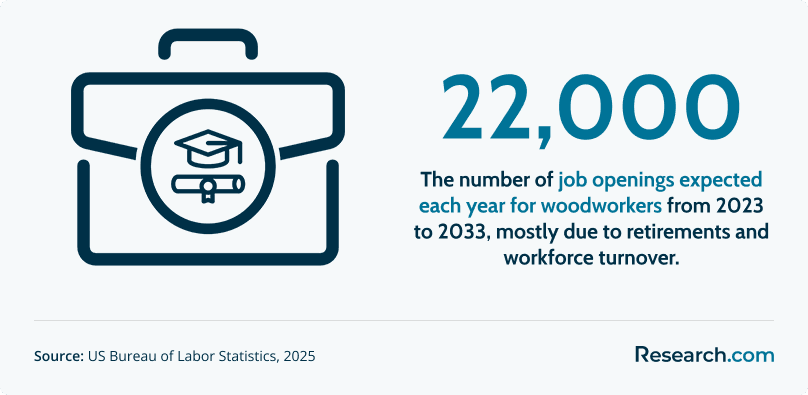
The labor market is steady but competitive. About 22,000 job openings are projected yearly from 2023 to 2033, even though some woodworker occupations face modest employment decline. That makes program choice important: the strongest training options combine flexible online theory with real shop experience and marketable skills such as blueprint reading, cabinet construction, finishing, CAD, and CNC operation.
Quick answer: Is an online woodworking trade school worth it?
An online woodworking trade school can be worth it if the program includes practical shop work, clear safety training, instructor feedback, and career-relevant projects. Fully online lessons are useful for design, drafting, tool theory, estimating, and safety, but woodworking is a hands-on trade. The best options are usually hybrid programs that let students complete academic coursework remotely while practicing in campus labs, local workshops, makerspaces, apprenticeships, or home shops.
- Woodworking graduates may qualify for roles in custom furniture production, cabinetry, architectural millwork, finish carpentry, restoration, CNC woodworking, and wood product manufacturing.
- Typical annual earnings for woodworking professionals range from $40,000 to $62,000, depending on job title, skill level, location, employer, and specialization.
- Online and hybrid formats are best for students who need flexible scheduling but can still access safe, supervised, hands-on practice.
What can I expect from an online woodworking trade school program?
An online woodworking trade school program usually blends remote instruction with hands-on training. Students may watch tool demonstrations, study safety procedures, complete design assignments, read technical drawings, and learn about wood properties through online modules. The practical portion is completed through campus labs, local workshops, employer sites, or structured home-based projects when appropriate.
Common subject areas include hand tools, power tools, joinery, cabinet construction, furniture design, wood finishing, layout, milling, shop safety, CNC machinery, and digital drafting. Many programs also require a final project or portfolio piece so students can demonstrate craftsmanship, accuracy, and design thinking to employers or clients.
Tuition typically ranges from $3,000 to $9,000, depending on the credential, school, residency status, and program length. Students should also budget for protective gear, lumber, hardware, textbooks, software, toolkits, transportation to labs, and possible workshop access fees.
Where can I work after completing an online woodworking trade school program?
Woodworking training can lead to employment in production, construction, design, repair, restoration, and custom fabrication. The best fit depends on whether you prefer precise shop-based work, installation projects, design-heavy custom builds, or machine-assisted manufacturing.
- Manufacturing (24%): The largest share of woodworkers are employed in furniture plants, cabinet shops, millwork companies, and other wood product manufacturing environments.
- Professional Services (18%): Some woodworkers support design, restoration, drafting, consulting, and project planning, often working alongside architects, designers, contractors, or preservation specialists.
- Construction (16%): Woodworkers in construction may handle framing, trim, finish carpentry, stair work, built-ins, and custom installations for residential or commercial projects.
- Retail (9%): Some graduates work in custom furniture businesses, woodworking retail, repair shops, or small studios that sell bespoke products and services.
- Technology (6%): Students with CNC, CAD, and digital fabrication skills may find opportunities in automated wood processing, precision cutting, and advanced manufacturing.
- Transportation (4%): Specialized woodworkers may build or restore wood interiors and components for boats, luxury vehicles, specialty transportation, and related niche markets.
How much can I make with an online woodworking trade school education?
Earnings vary widely in woodworking because job duties can range from entry-level machine operation to custom cabinetmaking, finish carpentry, shop supervision, or mill management. Location, union status, employer type, overtime, portfolio quality, and advanced technical skills all affect pay.
- Average Salary: The median annual salary for woodworkers in the United States is approximately $43,720, or about $21.02 per hour.
- Location: Woodworkers in Washington, Hawaii, and Pennsylvania can earn over $60,000 annually. In Oregon and California, median salaries typically range between $40,000 and $44,000.
- Experience Levels: Entry-level woodworkers commonly earn $30,000 to $32,000 annually. More experienced workers may reach $54,000 or more.
- Industry Variations: Cabinetmakers and bench carpenters average around $46,020 per year. Machine operators earn about $40,440, while government roles may pay between $56,000 and $59,000.
- Advanced Skills and Specializations: Woodworkers with CNC machining skills, supervisory experience, or advanced fabrication ability can earn $25 to $30 per hour, or $52,000 to $62,000 annually.
- Most Affordable Online Woodworking Trade School Programs for 2027
- How long does an online woodworking trade school program take?
- Online vs. on-campus woodworking trade school: which format fits you?
- Average cost of an online woodworking trade school program
- Financial aid options for online woodworking students
- Admission requirements for online woodworking trade school programs
- Common courses in online woodworking programs
- Woodworking specializations you can pursue online or in hybrid format
- Can an online woodworking program help with career advancement?
- How to choose the right online woodworking trade school
- Can advanced online education support a woodworking career?
- Career paths for online woodworking program graduates
- Job market outlook for woodworking trade school graduates
- Long-term career prospects and transferable skills
Most Affordable Online Woodworking Trade School Programs for 2027
How do we rank the programs?
Because woodworking training requires both financial investment and practical access to tools, our ranking methodology considers affordability, program structure, institutional credibility, and student-relevant data. The goal is to help readers compare programs with clearer expectations about cost, duration, accreditation, and learning format.
Program information is reviewed using established education data sources, including the IPEDS database, Peterson’s database, the College Scorecard database, and The National Center for Education Statistics.
1. Bucks County Community College
Bucks County Community College offers flexible woodworking-related coursework through its arts and communication department. The program connects studio practice with design principles, safety training, and guided technical development. Students may study structural design, joinery, turning, carving, finishing, technical drawing, tool care, and portfolio preparation through a combination of remote learning and supervised practice.
- Program Duration: 12-24 months
- Total Tuition Cost: $7,920
- Accreditation: Middle States Commission on Higher Education
2. Northwood Technical College
Northwood Technical College provides a one-year technical diploma in architectural woodworking and cabinetmaking. Students complete some theory through online modules, while much of the practical training takes place in campus shops designed for cabinetry, CNC work, and finish carpentry. The program is built for learners preparing for roles such as cabinetmaker, furniture maker, or interior finish carpenter.
- Program Duration: 12 months
- Total Tuition Cost: $4,843
- Accreditation: Higher Learning Commission
3. Northcentral Technical College
Northcentral Technical College offers a hybrid Wood Technology pathway that gives students multiple credential options. Learners can pursue a one-year wood technology technical diploma or select shorter certificates in areas such as CNC router operation or furniture design and craftsmanship. Online theory is paired with in-person lab training at the Wood Technology Center of Excellence, where students work with advanced equipment and CAD-supported projects.
- Program Duration: 12 months
- Total Tuition Cost: $6,551
- Accreditation: Higher Learning Commission
4. Red Rocks Community College
Red Rocks Community College offers fine woodworking training with flexible scheduling and in-person shop instruction supported by online theory. Students can build skills in furniture making, cabinetmaking, carving, woodturning, finishing, and CNC technologies. Day, evening, and weekend formats make the program more accessible to students balancing work, family, or part-time study.
- Program Duration: 6–24 months
- Total Tuition Cost: $7,731
- Accreditation: Higher Learning Commission
5. Fox Valley Technical College
Fox Valley Technical College delivers woodworking technology training through a hybrid model that combines online coursework with hands-on lab instruction. The curriculum covers cabinetmaking, furniture construction, architectural millwork, blueprint reading, estimating, AutoCAD, CNC machinery, tool maintenance, teamwork, and workplace readiness.
- Program Duration: 24 months
- Total Tuition Cost: $5,665
- Accreditation: Higher Learning Commission
6. Thaddeus Stevens College of Technology
Thaddeus Stevens College offers woodworking and carpentry training that combines online theory with substantial hands-on instruction. Students develop practical ability in furniture construction, millwork, blueprint interpretation, and professional woodworking technologies. The program is designed for students seeking entry into residential, commercial, and architectural woodworking roles.
- Program Duration: 24 months
- Total Tuition Cost: $9,000
- Accreditation: Middle States Commission on Higher Education
7. Eastern Maine Community College
Eastern Maine Community College offers an online-supported fine woodworking and cabinet making option within its Building Construction Technology pathway. Students may study drafting, materials, estimating, and CNC fundamentals remotely while completing required shop sessions on campus. The hybrid format supports training in cabinetry, furniture, and millwork production.
- Program Duration: 12–24 months
- Total Tuition Cost: $3,000
- Accreditation: New England Commission of Higher Education
How long does an online woodworking trade school program take?
Most online or hybrid woodworking trade school programs take 6 months to 2 years. Short certificate programs may be completed in six to nine months, while diploma and associate degree options commonly require one to two academic years. The timeline depends on credential type, course load, lab availability, and whether the student attends full time or part time.
Shorter programs can be useful for learning basic tool use, safety, joinery, and introductory cabinet or furniture work. Longer programs are better for students who want broader training in CNC technology, CAD, millwork, estimating, project planning, and portfolio development.
Apprenticeship pathways follow a different timeline. They may last up to 4 years and include 5,000 to 6,000 total hours, with 400 to 600 hours of formal instruction. This route is often stronger for students who want paid on-the-job training and deeper trade experience. Woodworkers who later move into crew leadership, operations, or shop management may also compare broader management credentials, including the cheapest online master's in organizational leadership.
Online vs. on-campus woodworking trade school: which format fits you?
The right format depends on how much flexibility you need and how easily you can access tools, instructors, and safe shop space. Online coursework works well for theory, drafting, estimating, safety, and business topics. However, students still need hands-on practice to become employable in most woodworking roles.
Use the comparison below to decide whether an online, hybrid, or campus-based program is the better match.
| Factor | Online or Hybrid Woodworking Program | On-Campus Woodworking Program |
| Course Delivery | Online lessons, recorded demonstrations, virtual modules, and scheduled lab or local practice requirements. | Face-to-face lectures, live demonstrations, supervised shop time, and structured classroom instruction. |
| Hands-On Training | May depend on campus visits, local shops, makerspaces, employer sites, or home shop projects. | Usually built into the weekly schedule with direct access to school shops and instructors. |
| Cost | Can reduce commuting, housing, and some campus-related expenses, though tools and materials still matter. | May include tuition, lab fees, supplies, housing, transportation, and campus charges. |
| Equipment Access | Varies widely; students may need personal tools or access to approved local facilities. | Typically provides easier access to industrial-grade machines, benches, dust collection, and finishing areas. |
| Career Support | Often includes virtual advising, online job boards, resume help, and remote employer connections. | May provide in-person career offices, employer visits, campus recruiting, and local apprenticeship connections. |
| Best For | Working adults, rural students, career changers, and learners with local shop access. | Students who need structured supervision, frequent shop practice, and direct instructor feedback. |
Average cost of an online woodworking trade school program
The average cost of an online woodworking trade school program depends on whether the credential is a short certificate, technical diploma, or associate-level pathway. Most certificate or diploma programs cost between $4,000 and $9,000 in total tuition.
Lower-cost options are often shorter and focused on foundational skills. Programs at the higher end may include more advanced training in CAD, CNC technologies, precision machining, estimating, and larger portfolio projects. Students who want to strengthen design and drafting skills separately may also review the cheapest online AutoCAD certificate courses.
Tuition is only part of the cost. Toolkits, protective gear, lumber, hardware, textbooks, software, certification exam fees, and shop access can add $500 to $2,000. Before enrolling, ask whether materials are included, whether you must buy tools before the first class, and whether any lab sessions require travel.
Financial aid options for online woodworking students
Students in eligible woodworking trade school programs may be able to reduce out-of-pocket costs through grants, loans, scholarships, employer benefits, or work-study. Availability depends on the school, credential type, enrollment status, and whether the program qualifies for federal aid.
- Federal Pell Grants: These need-based grants are available to eligible undergraduate students and do not have to be repaid. They may be used for tuition and qualified education-related costs.
- Federal Student Loans: Eligible students may use federal loans, including Direct Subsidized and Direct Unsubsidized Loans. Direct Unsubsidized Loans carry a fixed interest rate of 8.08%. Approximately 40–60% of trade school students use federal loans to help pay for tuition and related expenses.
- State Grants and Scholarships: Many states fund career and technical education through grants or scholarship programs. Eligibility may depend on residency, financial need, academic record, or chosen field.
- Work-Study Programs: Federal work-study can provide part-time employment while students are enrolled. When available, trade-related campus or shop roles may also build useful experience.
- Private Scholarships: Trade associations, nonprofit groups, foundations, and local community organizations may offer awards for students pursuing technical education.
- Employer Tuition Assistance: Some employers help workers pay for trade training. Read the policy carefully because repayment or continued-employment requirements may apply.

Admission requirements for online woodworking trade school programs
Admission requirements vary by school, but most woodworking programs expect students to show academic readiness, physical ability for shop work, and a willingness to follow safety standards. Some apprenticeship or employer-sponsored options may have additional screening steps.
- High School Diploma or GED: Most programs require applicants to have a high school diploma or equivalent credential.
- Minimum Age Requirement: Applicants are commonly expected to be at least 17 or 18 years old. Some apprenticeships may admit students at 17, while full-time trade school programs often require students to be legal adults.
- Skills Assessment or GPA Threshold: Some schools require a minimum GPA, typically around 2.7, or placement scores from assessments such as the GED, ACT, or Accuplacer.
- Physical Fitness and Manual Dexterity: Woodworking students must be able to handle materials, use tools safely, perform detailed handwork, and stand for extended periods.
- Basic Math and Blueprint Reading: Measurement, fractions, geometry, layout, and drawing interpretation are essential for accurate and safe work.
- Tools and Materials: Students may need personal protective equipment, hand tools, or a required toolkit before the first day of class.
Students interested in green building, sustainable materials, or environmentally responsible construction may later explore affordable BS degree in sustainability programs online to expand beyond trade-level woodworking into broader sustainability-focused roles.
Common courses in online woodworking programs
A strong woodworking curriculum should teach more than tool operation. It should build safe work habits, technical accuracy, design judgment, material knowledge, and the ability to complete projects from plan to finished product.
- Hand and Power Tool Fundamentals: Students learn safe operation, setup, maintenance, and proper use of saws, routers, planers, jointers, chisels, drills, sanders, and related tools.
- Wood Materials and Applications: Coursework covers wood species, grain direction, moisture content, adhesives, sheet goods, hardware, and material selection for specific projects.
- Blueprint Reading and Drafting: Students practice reading technical drawings, interpreting dimensions and symbols, and using measurement systems. Some learners who want broader technical design skills may compare the most affordable online software engineering bootcamps, especially if they are interested in digital tools, automation, or software-supported fabrication.
- Layout, Sawing, and Milling: This area focuses on measuring, marking, cutting, shaping, squaring, and preparing stock for assembly.
- Shaping, Molding, and Joinery: Students learn how to create profiles, edges, and joints such as dovetails, mortise and tenon joints, and finger joints.
- CNC and Digital Manufacturing: Programs may introduce CAD, CAM, CNC routers, file preparation, toolpaths, and precision digital cutting.
- Finishing and Adhesives: Students study sanding, staining, sealing, varnishing, surface preparation, glue selection, and finish durability.
- Furniture and Cabinetmaking Projects: Project courses allow students to build cabinets, tables, chairs, shelving, or other full-scale pieces that demonstrate practical skill.
- Workshop Safety and Maintenance: Safety training covers OSHA-aligned procedures, dust control, personal protective equipment, machine guarding, cleanup, and routine tool maintenance.
Woodworking specializations you can pursue online or in hybrid format
Specialization matters because woodworking careers use different tools, materials, tolerances, and jobsite expectations. A student interested in custom furniture should not choose the same program as someone planning to work in concrete formwork or production CNC machining.
- Architectural Carpentry: Focuses on doors, windows, moldings, built-ins, restoration details, and interior or exterior architectural woodwork.
- Cabinetmaking and Furniture Construction: Emphasizes custom cabinets, fine furniture, joinery, hardware, finishing, installation, CNC machining, and technical drafting.
- Timber Framing: Covers large-scale wood structures, post-and-beam methods, mortise-and-tenon joints, and traditional heavy timber construction.
- Finish Carpentry: Centers on trim, crown molding, baseboards, casing, doors, stairs, and the precise finishing details that shape interior spaces.
- Formwork Carpentry: Prepares students to build temporary wood structures and molds used for concrete placement in industrial and commercial construction.
- Specialty Crafts: Includes focused areas such as instrument making, boatbuilding, bow making, carving, restoration, and other artisan-level woodworking niches.
Can an online woodworking program help with career advancement?
An online or hybrid woodworking program can support career advancement when it adds skills employers can verify: better blueprint reading, safer tool operation, cleaner joinery, CNC familiarity, finishing knowledge, project documentation, and a portfolio of completed work. Career services, instructor recommendations, employer partnerships, and apprenticeship connections can also help students move from training into paid roles.
Students should be realistic, however. A certificate alone does not guarantee advancement. The best outcomes usually come from combining formal training with documented projects, shop experience, reliable work habits, and continuous skill development. If your goal is to compare trade options with stronger earning potential, review related trade school jobs that pay well and evaluate whether woodworking aligns with your income goals, physical stamina, and preferred work environment.
How to choose the right online woodworking trade school
Before enrolling, compare programs the way an employer would: What can you safely build, operate, read, measure, install, and finish by graduation? A low-cost program is only a good value if it gives you enough practical competence to pursue your target role.
- Clarify your career goal: Decide whether you want cabinetmaking, furniture design, finish carpentry, timber framing, CNC production, restoration, or general woodworking. The right curriculum depends on this choice.
- Review the hands-on requirements: Confirm where shop work happens, how many in-person sessions are required, what tools you will use, and whether instructors provide feedback on physical projects.
- Check accreditation and institutional credibility: Look for recognized institutional accreditation and ask whether the credential is accepted by local employers, unions, or apprenticeship partners.
- Compare the full cost, not just tuition: Add tools, materials, lumber, software, protective gear, fees, transportation, housing if needed, and lost work time.
- Ask about safety training: Woodworking involves sharp tools, dust, noise, finishes, and heavy materials. A program should teach safe machine operation before advanced projects.
- Look for career support: Ask about job placement, employer relationships, portfolio help, resume support, internships, apprenticeships, and graduate employment outcomes.
- Evaluate schedule fit: Full-time programs may help you finish faster, while part-time or evening formats can work better for employed students.
- Inspect the curriculum for modern skills: Traditional craftsmanship is valuable, but CNC, CAD, estimating, digital fabrication, and production workflow skills can broaden job options.
Questions to ask before enrolling
| Question | Why it matters |
| Is the program fully online, hybrid, or mostly campus-based? | Woodworking requires hands-on practice, so the delivery format affects skill development. |
| What tools and materials must I buy? | Required kits and supplies can significantly increase the total cost. |
| Where will I complete shop hours? | You need safe access to appropriate equipment before you can build employable skills. |
| Does the program include CNC, CAD, or digital fabrication? | These skills can improve competitiveness in manufacturing and advanced wood processing roles. |
| What projects will I finish before graduation? | Completed projects become evidence of your skill for employers or clients. |
| What career services are available? | Job leads, apprenticeships, and employer connections can make the transition into work easier. |
Common mistakes to avoid
- Choosing only by tuition: A cheaper program may cost more in the long run if it lacks shop access, tools, or employer connections.
- Assuming online means no in-person work: Most credible woodworking training still requires practical projects and supervised machine use.
- Ignoring accreditation: Accreditation affects financial aid eligibility, transfer options, and institutional trust.
- Underestimating supply costs: Lumber, hardware, blades, finishes, PPE, and toolkits can add meaningful expense.
- Skipping portfolio development: Employers and clients often want to see finished work, not just a certificate.
- Choosing the wrong specialization: Cabinetmaking, finish carpentry, CNC production, and furniture design require different training priorities.
Can advanced online education support a woodworking career?
Advanced online education can complement woodworking when it supports a clear professional goal. A woodworker who wants to open a shop may benefit from business, accounting, marketing, or project management coursework. Someone interested in sustainable construction may study materials and environmental design. A technician moving into production leadership may need operations, supervision, or organizational management skills.
The key is relevance. Broad graduate education is not necessary for most entry-level woodworking jobs, but targeted online study can help experienced tradespeople move into management, entrepreneurship, design coordination, or training roles. Students comparing accelerated adult-learning formats can also examine unrelated examples such as nutrition masters fast track programs online to understand how online programs structure intensive study for working learners.
Career paths for online woodworking program graduates
Graduates can enter shop-based, jobsite-based, design-adjacent, or supervisory roles. Some positions require additional experience beyond a trade school credential, especially management jobs. The roles below show common paths and salary reference points.
1. Cabinetmaker
Cabinetmakers build and install cabinets, storage systems, built-ins, and custom furniture. The job requires careful measuring, joinery, cutting, sanding, finishing, and the ability to follow drawings or client specifications. Precision and consistency are essential because small errors can affect fit, function, and appearance.
Median salary: $44,520 per year.
2. Wood Machinist
Wood machinists operate equipment that cuts, shapes, mills, and prepares wood components for furniture, flooring, cabinetry, or construction products. They set up machines, monitor quality, read technical drawings, and follow safety procedures. CNC knowledge can be especially useful in this path.
Median salary: $40,120 per year.
3. Mill Manager
Mill managers supervise production in sawmills or woodworking facilities. They coordinate staff, track workflow, monitor inventory, oversee maintenance, enforce safety procedures, and help meet production targets. This role usually requires significant experience and leadership ability in addition to technical knowledge.
Median salary: $105,814 per year.
4. Construction Manager
Construction managers oversee building projects, coordinate contractors, manage schedules, and monitor budgets. Woodworking experience can be useful in projects involving framing, finish carpentry, millwork, or custom interiors. Professionals who later move toward building products, materials, tools, or manufactured goods may also find overlap with a product management career path.
Median salary: $95,168 per year.
5. Finish Carpenter
Finish carpenters complete detailed interior woodwork such as trim, molding, doors, casings, stairs, and built-ins. The work demands clean cuts, accurate measurements, a strong eye for aesthetics, and the ability to produce a polished final appearance on residential or commercial projects.
Median salary: $56,107 per year.
Job market outlook for woodworking trade school graduates
The woodworking job market is stable in terms of annual openings but not uniformly growing. Students should understand both sides of the outlook: some traditional woodworker roles are projected to decline, while retirements, turnover, construction needs, customization, and advanced manufacturing continue to create openings.
According to the U.S. Bureau of Labor Statistics, woodworker employment totaled about 224,000 jobs in 2023 and is projected to decrease by 2% through 2033, a decline of roughly 4,600 positions. Even with that decrease, about 22,000 openings are expected each year because workers retire or move into other occupations.
Broader market indicators also show demand for wood products and related craftsmanship. The global wood and timber products sector was valued at $992.4 billion in 2024 and is projected to reach $1.25 trillion by 2030, with a compound annual growth rate of 4.7%. The global carpentry and joinery market is estimated at $80 billion in 2025 and forecast to increase to $100 billion by 2030 at a 4.45% CAGR.
For students, the practical takeaway is clear: general woodworking ability is useful, but specialized skills can improve competitiveness. CNC operation, CAD, finishing, installation, estimating, and portfolio-quality project work may help graduates stand out in a market where not every role is expanding.
Long-term career prospects and transferable skills
Woodworking trade school can build skills that apply beyond a single job title. Graduates practice measurement, spatial reasoning, safe equipment use, project sequencing, material planning, troubleshooting, quality control, and client communication. These abilities transfer into construction, manufacturing, design support, facilities work, production supervision, entrepreneurship, and technical training.
Long-term advancement often depends on adding business and technology skills to craftsmanship. A woodworker who learns estimating, project management, CAD/CAM, CNC programming, customer communication, and shop leadership may move from entry-level production into lead roles, custom business ownership, or supervisory positions. Transferable problem-solving and technical skills can support career mobility across fields, just as analytical and applied competencies influence opportunities in other areas such as top paying biology jobs.
What graduates say about online woodworking trade school programs
-
: "
The online format made it possible to keep my full-time job while learning new woodworking techniques. The video demonstrations helped me review difficult steps, and the project assignments gave me a reason to practice consistently. I now feel more prepared to take on custom furniture work. — Jason
"
-
: "
I started with very little tool experience, but the structured lessons and instructor guidance helped me build confidence. By the end of the program, I had completed projects I could show to potential local clients. — Gary
"
-
: "
The program covered more than cutting and assembly. I learned about design, safety, finishing, and the business side of woodworking. The online community also helped me stay motivated while I developed cabinetmaking skills. — Nelson
"
Key Insights
- Online woodworking training is most valuable when it is hybrid: remote coursework can teach theory, but employable skill requires hands-on practice with tools, materials, and finished projects.
- Most online woodworking trade school programs take 6 months to 2 years; apprenticeship routes may last up to 4 years and include 5,000 to 6,000 total hours.
- Program costs commonly include more than tuition. Students should budget for tools, PPE, lumber, hardware, software, lab fees, and possible travel to shop sessions.
- The woodworker job outlook shows a projected 2% decline from 2023 to 2033, but about 22,000 openings are still expected annually because of retirements and occupational movement.
- Manufacturing employs the largest share of woodworking graduates at 24%, making production skills, CNC familiarity, blueprint reading, and quality control especially useful.
- Federal Pell Grants, federal student loans, state aid, scholarships, work-study, and employer tuition assistance may help reduce costs; about 40% to 60% of trade school students use federal student loans.
- Do not choose a program based only on affordability. Verify accreditation, hands-on training, equipment access, safety instruction, career support, and whether the curriculum matches your target woodworking role.
References:
- Bureau of Labor Statistics. (2024, May). Occupational employment and wages: Miscellaneous woodworkers. Retrieved from BLS OES data on miscellaneous woodworkers.
- Bureau of Labor Statistics. (n.d.). Carpenters. U.S. Department of Labor. Retrieved from BLS Occupational Outlook Handbook for carpenters.
- Cognitive Market Research. (n.d.). Commercial carpentry market report. Retrieved from Cognitive Market Research commercial carpentry report.
- Future Data Stats. (n.d.). Woodwork market. Retrieved from FutureDataStats woodwork market report.
- Mordor Intelligence. (n.d.). Global builders’ joinery and carpentry of wood market. Retrieved from Mordor Intelligence joinery and carpentry market report.
- Sawing and Woodworking Professionals Guild. (n.d.). Home. Retrieved from Sawing and Woodworking Professionals Guild.
- TallWood Institute. (n.d.). Certificate programs. Retrieved from TallWood Institute certificate programs.
- Woodwork Career Alliance. (n.d.). Home. Retrieved from Woodwork Career Alliance.
- Zippia. (n.d.). Wood machinist jobs. Retrieved from Zippia wood machinist jobs.
- Zion Market Research. (n.d.). Woodworking machine market. Retrieved from Zion Market Research woodworking machine market.
- ZipRecruiter. (n.d.). Cabinet maker salary. Retrieved from ZipRecruiter cabinet maker salary.
- ZipRecruiter. (n.d.). Construction manager salary. Retrieved from ZipRecruiter construction manager salary.
- ZipRecruiter. (n.d.). Finish carpenter salary. Retrieved from ZipRecruiter finish carpenter salary.
- ZipRecruiter. (n.d.). Mill manager salary. Retrieved from ZipRecruiter mill manager salary.
Other Things You Should Know About Online Woodworking Trade School Programs
To identify the least expensive online woodworking trade schools in 2027, explore websites like College Navigator or Ed.gov. Compare tuition fees, material costs, and other related expenses. Additionally, reading reviews or testimonials about their programs can provide insights into affordability and value.
Yes, several online woodworking programs include structured apprenticeship components. These combine virtual learning with field-based mentoring under experienced professionals. Programs like the Mortise & Tenon apprenticeship offer guided hand-tool training, while others partner with registered apprenticeship platforms to match students with job-based learning. This blended approach builds skills and earns credentials, ideal for those seeking journeyperson status.
The average cost of an online woodworking trade school program in 2027 varies significantly, generally ranging from $1,000 to $5,000. Factors influencing the cost include course length and the comprehensiveness of the curriculum. Many programs offer financing options or scholarships to help reduce financial burdens for students.


