
2027 How to Become a Nurse Practitioner in San Francisco, CA: Requirements & Salary

Co-Founder and Chief Data Scientist
Becoming a nurse practitioner in San Francisco is a high-stakes education and licensing decision. The path can lead to advanced clinical responsibility, stronger earning potential, and more autonomy, but California’s requirements are specific: you need the right nursing degree, a qualifying graduate NP program, national certification, California Board of Registered Nursing approval, and additional experience before independent practice is available.
This guide is for BSN-prepared nurses, RN-to-NP applicants, and working nurses comparing San Francisco nurse practitioner programs. It explains the education route, local school options, licensing steps, timelines, salary expectations, demand, scope-of-practice rules, and common mistakes to avoid before investing time and tuition.
Quick answer: how to become a nurse practitioner in San Francisco, CA
To become a nurse practitioner in San Francisco, you generally need a BSN, an active California RN license, admission to an accredited graduate-level nurse practitioner program, completion of required clinical hours, national NP certification, and California BRN recognition as an NP. Nurses who want independent practice must also meet California’s transition-to-practice requirements under the applicable “103 NP” or “104 NP” pathways.
- Education comes first: San Francisco NP applicants typically need a BSN, a 3.0 GPA minimum, prerequisite coursework, and a graduate NP program with 500–700 clinical hours. Programs such as UCSF and SFSU cost $25,000–$30,000 per year and may be completed in as little as 15 months depending on the credential and entry point.
- California has extra practice requirements: NPs must hold an active RN license, pass a national certification exam, and complete 4,600 clinical hours or 3 years of full-time experience to pursue independent “103 NP” or “104 NP” status. Beginning January 2025, 6 of 30 CE hours must focus on elder care when more than 25% of a provider’s patients are age 65+.
- The labor market is strong, but outcomes vary: As of June 2025, San Francisco nurse practitioners earn an average of $151,329 annually, with high earners exceeding $329,888. National NP employment is projected to grow 46% from 2023 to 2033, while California employs over 15,000 NPs and reports strong need in psychiatric and occupational health specialties.
- Educational requirements for nurse practitioners in San Francisco
- San Francisco schools with nurse practitioner programs
- Skills nurse practitioners need in San Francisco healthcare settings
- California requirements for nurse practitioner practice
- Step-by-step nurse practitioner licensing process
- How long it takes to become a licensed nurse practitioner
- Continuing education and advancement options
- Complementary certifications that can support an NP career
- Mental health therapy and psychiatric practice options
- Whether a California NP license transfers to other states
- San Francisco nurse practitioner salary expectations
- Nurse practitioner demand in San Francisco
- Ethical and legal responsibilities for California NPs
- Common mistakes to avoid before choosing an NP pathway
- What licensed nurse practitioners say about working in San Francisco
- FAQ: fastest route to becoming an NP in San Francisco
- FAQ: certifications required after nurse practitioner school
What are the educational requirements to become a nurse practitioner in San Francisco, CA?
San Francisco nurse practitioners must complete advanced nursing education beyond RN preparation. The usual starting point is a BSN, followed by a graduate NP program that matches the population or specialty area the nurse wants to practice in, such as family care, adult-gerontology, pediatrics, neonatal care, acute care, or psychiatric-mental health.
The typical education checklist includes:
- Earn a BSN from an accredited college or university: A Bachelor of Science in Nursing is the common academic foundation for graduate NP admission.
- Keep an active, unrestricted California RN license: You must be legally licensed as a registered nurse before you can move into advanced practice recognition.
- Meet graduate admission standards: Many NP programs expect a minimum GPA of 3.0 or higher.
- Finish required prerequisite courses: Common prerequisites include statistics, anatomy, microbiology, and related science or research coursework.
- Build clinical RN experience: At least one year of direct patient care experience can strengthen your application and help you handle advanced clinical training.
After admission, students complete graduate-level nursing courses and supervised clinical rotations. In San Francisco, those rotations may take place in hospitals, community clinics, public health settings, specialty practices, and other Bay Area healthcare sites.
| Requirement | Why it matters | What to verify before applying |
| BSN | Provides the undergraduate nursing foundation most NP programs require. | Confirm the nursing program is accredited and accepted by your target graduate schools. |
| California RN license | Establishes your legal authority to practice as a registered nurse in the state. | Check that your license is active and unencumbered before submitting applications. |
| 3.0 GPA minimum | Many programs use GPA as an initial academic screening requirement. | Ask whether the school reviews cumulative GPA, nursing GPA, science GPA, or recent coursework. |
| Prerequisite coursework | Prepares you for advanced assessment, research, pharmacology, and pathophysiology. | Confirm course age limits, online course acceptance, and whether labs are required. |
| Clinical RN experience | Improves readiness for diagnosing, prescribing, care planning, and managing complex cases. | Ask whether the program requires a specific specialty background or number of RN practice hours. |
If income potential is part of your decision, compare specialty paths early. Research.com’s guide to the highest paid nurse practitioner specialties can help you understand how specialization may affect long-term career options after graduation.
Are there schools in San Francisco, CA that offer nurse practitioner programs?
Yes. San Francisco has several university-based nurse practitioner options, but they are not interchangeable. Some programs are designed for BSN-prepared nurses entering graduate study, while others are post-master’s certificates for nurses who already hold an MSN. Before applying, check the credential offered, specialty track, clinical placement expectations, format, tuition, and whether the program aligns with California BRN requirements.
Notable San Francisco options include:
- University of California, San Francisco (UCSF): Offers a Master of Science in Nursing (MSN) with eight NP tracks, including Family, Adult-Gerontology Acute Care, Pediatric, Neonatal, and Psychiatric-Mental Health options. Tuition for California residents ranges from $25,000 to $30,000 per year.
- University of San Francisco (USF): Offers a Doctor of Nursing Practice (DNP) Family Nurse Practitioner program for BSN- or MSN-prepared nurses, with emphasis on clinical leadership, evidence-based practice, and advanced patient care.
- San Francisco State University (SFSU): Offers a 15-month Post Master’s Family Nurse Practitioner Certificate in a hybrid format that combines online coursework with in-person clinical training throughout Bay Area healthcare sites.
| School | Program type | Best fit | Decision factor to check |
| UCSF | MSN with multiple NP tracks | Nurses who want specialty choice and a research-intensive health sciences environment. | Track availability, clinical placement process, and total annual cost. |
| USF | DNP Family Nurse Practitioner | Nurses who want a practice doctorate with leadership and advanced clinical preparation. | Whether the DNP timeline and cost align with your career goals. |
| SFSU | Post Master’s FNP Certificate | MSN-prepared nurses who want to add family nurse practitioner preparation. | Eligibility requirements and hybrid attendance expectations. |
Students interested in behavioral health roles should also review earning patterns for psychiatric NP practice. Research.com’s overview of what is PMHNP salary by state can help compare psychiatric nurse practitioner compensation across locations.
What skills do you need to become a nurse practitioner in San Francisco, CA?
San Francisco nurse practitioners need more than strong bedside nursing experience. The role requires independent clinical judgment, advanced communication, comfort with health technology, and the ability to care for patients across cultures, languages, socioeconomic backgrounds, and complex health needs.
Core competencies include:
- Advanced assessment and diagnostic reasoning: NPs must gather patient histories, perform physical exams, interpret findings, and identify appropriate diagnoses.
- Evidence-based treatment planning: Clinical decisions should be grounded in current research, practice standards, patient data, and individual patient circumstances.
- Medication and procedure competence: Depending on the setting, NPs may manage medications and perform procedures such as wound care, suturing, or urgent interventions.
- Team-based care coordination: San Francisco healthcare often requires collaboration with physicians, pharmacists, social workers, behavioral health providers, case managers, and public health teams.
- Technology fluency: NPs should be comfortable with electronic health records, telehealth platforms, clinical decision-support tools, and digital documentation workflows.
- Cultural responsiveness: Providers must adapt care plans to patient language, values, access barriers, health literacy, and community context.
- Patient education: Effective NPs explain diagnoses, medications, preventive care, and chronic disease management in ways patients can act on.
| Skill area | What it looks like in practice | How to build it |
| Clinical reasoning | Distinguishing routine symptoms from urgent or complex conditions. | Choose clinical rotations with varied patient populations and strong preceptor feedback. |
| Communication | Explaining risks, treatment choices, and follow-up steps clearly. | Practice teach-back methods and patient-centered interviewing. |
| Interprofessional teamwork | Coordinating care plans across specialties and service lines. | Seek placements in hospitals, community clinics, or integrated care settings. |
| Technology use | Documenting accurately and using telehealth safely. | Ask programs how students are trained on EHR and virtual care tools. |
| Equity-focused care | Recognizing social and structural barriers that affect patient outcomes. | Select courses or clinical experiences that address public health and underserved populations. |
What are the requirements for a nurse practitioner in San Francisco, CA?
Nurse practitioner practice in San Francisco is governed by California law and the California Board of Registered Nursing. The city does not issue a separate NP license, but nurses practicing in San Francisco must satisfy state-level requirements and follow local employer policies, facility protocols, and specialty standards.
Key requirements include:
- Active California RN license: You must first be licensed as a registered nurse in California.
- Graduate NP education: Your NP program must provide the advanced academic and clinical preparation required for your population focus.
- National board certification: You must pass a qualifying NP certification exam through an approved organization such as AANP or ANCC.
- Official transcripts: Your school must provide documentation that verifies completion of your NP education.
- Background check and fingerprinting: California requires fingerprint-based review as part of the professional licensing process.
- Transition-to-practice experience: To qualify for independent “103 NP” or “104 NP” status, NPs must complete 4,600 supervised clinical hours or three years of full-time direct patient care in California.
- Continuing education compliance: Starting Jan 1, 2025, if at least 25% of your patients are 65 or older, six of your 30 CE hours must address elder care, dementia, or geriatrics.
Applicants trying to shorten the pathway should still avoid programs that do not meet licensure or certification requirements. Research.com’s guide to the shortest time to become a nurse practitioner can help you compare accelerated options while keeping licensing rules in view.
What is the licensing process for nurse practitioners in San Francisco, CA?
The licensing process is handled at the state level through the California Board of Registered Nursing. In practice, San Francisco applicants move through three connected stages: maintain RN licensure, complete qualifying NP education and national certification, then apply for the appropriate California NP recognition and independent practice designation when eligible.
- Maintain an active California RN license: Resolve any renewal, disciplinary, or documentation issues before applying for NP recognition.
- Complete an eligible NP program: Finish the required graduate coursework and supervised clinical training for your specialty track.
- Submit the NP application and fingerprints: Apply to the California Board of Registered Nursing and complete the fingerprint background check processed through DOJ and FBI databases.
- Pass a national NP certification exam: Obtain certification from an approved national organization, such as AANP or ANCC, in your population focus.
- Document transition-to-practice experience: Complete 4,600 hours or three years of full-time direct patient care as an NP in California if you plan to pursue independent practice status.
- Apply for “103 NP” status when eligible: This designation allows limited independent practice in certain healthcare settings after transition-to-practice requirements are verified.
- Apply for “104 NP” status if it fits your career plan: After three additional years under the 103 NP license, some NPs may qualify for full independent practice without physician supervision, depending on setting and legal requirements.
California’s process is likely to keep relying more on digital documentation, electronic verification, and more precise clinical hour tracking. Even so, applicants should not assume technology will remove the need for complete records. Keep copies of transcripts, certification results, preceptor documentation, employment verification, and continuing education records.
How long does it take to become a licensed nurse practitioner in San Francisco, CA?
The full timeline depends on where you start. A student beginning with no nursing degree has a much longer route than a BSN-prepared RN or an MSN-prepared nurse pursuing a post-master’s certificate. For most BSN-prepared nurses, the graduate portion usually takes several years, followed by certification and California licensing steps.
| Stage | Typical timing stated | What happens during this stage |
| BSN | A standard four-year undergraduate degree | Students complete nursing coursework, labs, clinical rotations, and RN preparation. |
| MSN | Typically two to three years | BSN-prepared nurses complete advanced practice coursework and NP clinical training. |
| DNP | About three to four years post-BSN | Students complete doctorate-level practice preparation, leadership work, and advanced clinical requirements. |
| Clinical practicum | Usually 500 to 700 supervised clinical hours | Students apply advanced assessment, diagnosis, and care management under supervision. |
| Certification and licensure | After graduation | Candidates pass a national NP exam and apply through the California BRN. |
Hybrid, accelerated, and dual-degree formats may make the path more flexible, especially for working nurses. However, faster is not always better. A shortened schedule can be demanding, and students should confirm that clinical placements, faculty support, and certification preparation are strong enough to support success.
If program length is a major concern, reviewing the easiest nurse practitioner specialty programs to get into may help you compare admissions accessibility and program structure. Use that information as a starting point, not as the only factor in your decision.
What are the opportunities for ongoing education and career advancement in San Francisco, CA?
Career growth for San Francisco nurse practitioners often comes from specialization, leadership training, additional clinical certifications, preceptor experience, quality improvement work, and participation in interdisciplinary care models. Hospitals, clinics, public health organizations, professional associations, and universities may offer continuing education in clinical updates, population health, health equity, informatics, and leadership.
Advancement can move in several directions:
- Clinical specialization: NPs may deepen expertise in family care, adult-gerontology, psychiatry, pediatrics, neonatal care, acute care, occupational health, urgent care, or other settings.
- Leadership and administration: Experienced NPs may move into clinical management, service-line leadership, quality improvement, or policy roles.
- Teaching and precepting: Some NPs support the next generation of clinicians through adjunct teaching, clinical instruction, or preceptor roles.
- Interprofessional collaboration: Learning how other healthcare professionals train and practice can improve team-based care. For example, understanding how to become a pharmacist in San Francisco can help NPs work more effectively with pharmacy colleagues on medication safety and chronic disease management.
What complementary certifications can enhance your nurse practitioner career in San Francisco, CA?
Complementary credentials can be useful when they support your actual practice goals. They are not substitutes for NP certification or California licensing, but they may strengthen your ability to manage operations, improve documentation, lead teams, or work in specialty settings.
| Certification focus | Potential value for NPs | Best fit |
| Healthcare billing and coding | Improves understanding of documentation, reimbursement, compliance, and revenue cycle basics. | NPs in private practice, leadership, care coordination, or operations roles. |
| Quality improvement | Supports process redesign, safety initiatives, and measurable care improvements. | NPs interested in leadership, hospital systems, or population health. |
| Informatics or health technology | Builds skill with EHR workflows, data reporting, telehealth, and digital care delivery. | NPs working in technology-enabled clinics or administrative roles. |
| Specialty clinical training | Strengthens practice in focused areas such as behavioral health, acute care, or geriatrics. | NPs pursuing specialty roles or serving complex patient populations. |
For NPs who expect to handle documentation, reimbursement, or clinic operations, learning about medical biller and coder certification in San Francisco can provide helpful context for the business side of healthcare delivery.
Can nurse practitioners expand their scope to include mental health therapy roles in San Francisco, CA?
Nurse practitioners can expand their behavioral health impact, but the correct route depends on the service they want to provide. Psychiatric-mental health nurse practitioners are trained to assess, diagnose, and treat mental health conditions within their NP scope. Therapy-focused roles, however, may involve separate professional requirements depending on the credential, setting, and services offered.
NPs interested in mental health should compare three pathways:
| Pathway | Primary focus | Important caution |
| Psychiatric-mental health NP preparation | Advanced psychiatric assessment, diagnosis, medication management, and mental health treatment planning. | Must align with national certification and California NP requirements. |
| Continuing education in behavioral health | Adds skills in screening, brief intervention, trauma-informed care, and integrated care. | Does not replace a formal scope-expanding credential when one is required. |
| Therapist licensure pathway | Prepares professionals for psychotherapy roles under a counseling or therapy license. | May require a separate degree, supervised hours, and state-specific licensing steps. |
If your goal is to provide therapy services rather than only integrate behavioral health into NP practice, review licensed therapist requirements in San Francisco before choosing a program or certification.
Will a nurse practitioner license from San Francisco, CA allow you to work in other states?
No. A nurse practitioner license obtained in California does not automatically authorize practice in another state. California is not part of the Nurse Licensure Compact, and NP practice authority is regulated state by state.
If you plan to move or work across state lines, expect to complete additional steps such as:
- Licensure by endorsement: You may need to submit proof of your California RN and NP credentials to the new state board.
- State-specific documentation: The receiving state may require transcripts, certification verification, background checks, continuing education records, or other forms.
- Different scope-of-practice rules: Some states require collaborative agreements, physician supervision, or additional prescribing documentation.
- Separate prescribing authority: Controlled substance and medication furnishing rules may differ from California’s process.
Before accepting an out-of-state job, contact the destination state board directly. Do not rely only on employer statements, recruiter summaries, or assumptions based on your California credentials.
How much do San Francisco, CA nurse practitioners earn?
San Francisco nurse practitioner salaries are high compared with many markets, but pay should be evaluated alongside cost of living, commute, benefits, schedule, specialty, patient load, and practice authority. The highest compensation is not always the best job if the position has unsustainable hours, weak support, or limited clinical fit.
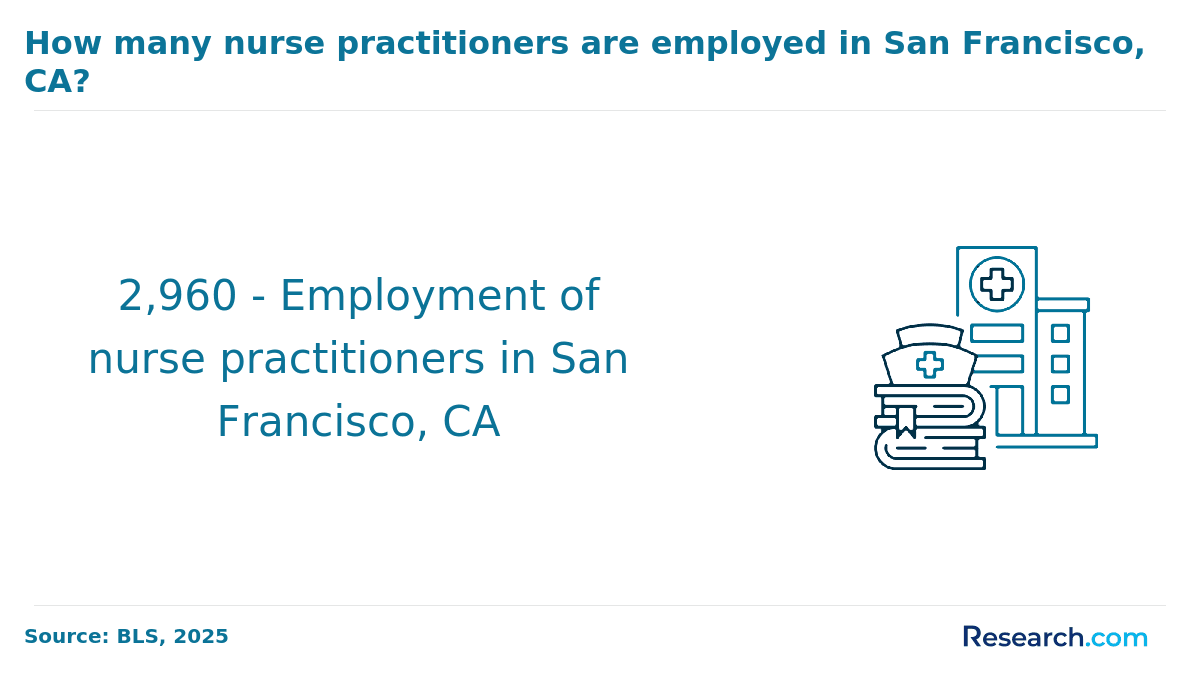
As of June 2025, the average annual salary for nurse practitioners in San Francisco is $151,329. Most earnings range from $116,600 to $151,329. Entry-level NPs are more likely to start near the lower end of the range, while experienced NPs, specialty clinicians, and those in certain high-paying roles may earn over $329,888 annually.
Specialty also affects compensation. Neurosurgery, urgent care, and home health may offer higher rates, and some contract roles pay more than $100 per hour. Contract pay should be reviewed carefully because benefits, taxes, scheduling stability, malpractice coverage, and retirement contributions may differ from salaried employment.
| Salary factor | How it can affect pay | Question to ask before accepting an offer |
| Specialty | High-acuity or hard-to-staff specialties may pay more. | Does the role match your certification and clinical training? |
| Experience | Experienced NPs may command higher salaries or leadership pay. | How does the employer define entry-level, experienced, and senior NP status? |
| Employment type | Contract work may offer higher hourly rates but fewer benefits. | Are malpractice, health insurance, retirement, and paid time off included? |
| Work setting | Hospitals, clinics, home health, urgent care, and public health roles may pay differently. | What is the patient volume, call schedule, and support structure? |
| Location and commute | San Francisco pay must be weighed against local living and transportation costs. | Is the compensation enough after housing, commuting, taxes, and student loan payments? |
Is there a demand for nurse practitioners in San Francisco, CA?
Demand for nurse practitioners remains strong. The U.S. Bureau of Labor Statistics projects 46% national growth in NP jobs from 2023 to 2033. California employs over 15,000 nurse practitioners, and San Francisco’s demand is shaped by aging patients, expanded healthcare access, physician shortages, behavioral health needs, and public health priorities.
Psychiatric/mental health and occupational health are especially active areas of hiring, with local agencies and public health departments seeking qualified clinicians. However, demand does not mean every graduate will receive the same salary or role. Specialty, certification, clinical experience, professional network, and willingness to work in high-need settings can all affect job prospects.
Students trying to reduce the cost of preparation may want to compare flexible and lower-cost FNP pathways. A cheap online RN to FNP degree program can be useful for some nurses, but only if it meets certification, clinical placement, and California licensure expectations.
What ethical and legal guidelines should you observe as a nurse practitioner in San Francisco, CA?
Nurse practitioners in San Francisco must follow California law, federal healthcare regulations, employer policies, professional standards, and ethical obligations to patients. Because NPs often diagnose, prescribe, educate, and coordinate care, documentation and scope-of-practice compliance are especially important.
Key ethical and legal responsibilities include:
- Protect patient privacy: Follow HIPAA and California privacy requirements when handling health information.
- Respect patient autonomy: Help patients make informed choices without pressure, coercion, or bias.
- Obtain informed consent: Explain benefits, risks, alternatives, and expected outcomes before treatment or procedures.
- Deliver equitable care: Avoid discrimination based on race, ethnicity, gender, age, disability, income, identity, language, or insurance status.
- Maintain current licensure and certification: Keep California BRN recognition, national certification, and continuing education current.
- Follow AB 890 practice rules: Meet the required experience and training standards before practicing independently under California’s expanded NP law.
- Use prescribing authority correctly: Furnish or prescribe medications only within California-approved authority, standardized procedures, and applicable protocols.
- Document clinical decisions carefully: Accurate records protect patient safety and support legal, billing, and continuity-of-care requirements.
Common mistakes to avoid before becoming a nurse practitioner in San Francisco
The biggest mistakes usually happen before enrollment. A program may look convenient or prestigious, but it still has to fit your licensure plan, budget, schedule, specialty goals, and clinical placement needs.
| Mistake | Why it can hurt you | Better approach |
| Choosing a program before checking accreditation and certification alignment | You may complete coursework that does not support your intended NP certification or licensing path. | Confirm accreditation, population focus, certification exam eligibility, and California BRN compatibility. |
| Looking only at tuition | Fees, travel, lost work hours, clinical requirements, books, and exam costs can change the real price. | Build a full cost estimate before enrolling. |
| Assuming online means easier | Online NP programs still require clinical hours, exams, deadlines, and intensive study. | Ask about weekly workload, faculty access, clinical placement support, and campus visits. |
| Ignoring clinical placement logistics | Weak placement support can delay graduation or force long commutes. | Ask who secures preceptors and where students typically complete rotations. |
| Picking a specialty only for salary | A high-paying specialty may not match your strengths, interests, or preferred patient population. | Compare pay with day-to-day duties, stress level, certification requirements, and long-term fit. |
| Assuming California credentials transfer automatically | Other states have separate NP licensing and scope-of-practice rules. | Check endorsement requirements before planning relocation or multistate work. |
What do licensed nurse practitioners in San Francisco, CA say about their careers?
San Francisco NPs often describe the work as clinically challenging, team-oriented, and shaped by the city’s diverse patient population. Many point to the need for strong communication skills, fast clinical judgment, and comfort serving patients with complex medical and social needs.
-
: "
Graduate training gave me the framework, but San Francisco practice taught me how quickly patient needs can change. The work requires careful listening, cultural humility, and the ability to make decisions with incomplete information while still protecting patient safety.
"
-
: "
The strongest part of practicing here is the mix of complex cases and professional support. You may care for patients dealing with chronic illness, housing instability, behavioral health needs, or language barriers, so collaboration is not optional. It is part of safe care.
"
-
: "
San Francisco can open doors for nurse practitioners who want to grow, but the pace is demanding. The NPs who thrive are the ones who keep learning, document carefully, ask good questions, and understand the communities they serve.
"
What is the fastest way to become a nurse practitioner in San Francisco, CA?
The fastest route depends on your current education. A BSN-prepared RN can usually move directly into an MSN or DNP nurse practitioner program, while an MSN-prepared nurse may qualify for a post-master’s NP certificate such as a 15-month hybrid FNP certificate. Speed should not be the only goal. Make sure the program supports national certification, California BRN requirements, and the clinical hours needed for practice.
What certifications are required after finishing nurse practitioner programs?
After completing an NP program, graduates generally need national board certification in their population focus, such as certification through AANP or ANCC when applicable. Certification must align with the NP specialty and California requirements. Employers may also require Basic Life Support, Advanced Cardiovascular Life Support, Pediatric Advanced Life Support, specialty credentials, or facility-specific training depending on the role.
Related Articles for Nearby Cities
- 2027 How to Become a Nurse Practitioner in Oakland, CA: Requirements & Salary
- 2027 How to Become a Nurse Practitioner in Fremont, CA: Requirements & Salary
- 2027 How to Become a Nurse Practitioner in San Jose, CA: Requirements & Salary
- 2027 How to Become a Nurse Practitioner in Stockton, CA: Requirements & Salary
- 2027 How to Become a Nurse Practitioner in Sacramento, CA: Requirements & Salary
- 2027 How to Become a Nurse Practitioner in Fresno, CA: Requirements & Salary
- 2027 How to Become a Nurse Practitioner in Reno, NV: Requirements & Salary
- 2027 How to Become a Nurse Practitioner in Bakersfield, CA: Requirements & Salary
- 2027 How to Become a Nurse Practitioner in Los Angeles, CA: Requirements & Salary
- 2027 How to Become a Nurse Practitioner in Long Beach, CA: Requirements & Salary
References:
- Family nurse practitioner, DNP | University of San Francisco. (n.d.). https://www.usfca.edu/nursing/programs/graduate/family-nurse-practitioner
- Careers with purpose. (n.d.). SF Careers. https://careers.sf.gov/role
- Family Nurse Practitioner (FNP) | Post-MSN Certificate | Nursing Classes | San Francisco State University | College of Professional & Global Education. (n.d.). https://www.cel.sfsu.edu/fnp
- 10 Essential nurse Practitioner Skills | Rockhurst University. (2025, April 30). https://onlinedegrees.rockhurst.edu/blog/10-essential-nurse-practitioner-skills
- 7 Essential NP Skills | Felician University Online. (2024, June 18). https://online.felician.edu/blog/7-essential-np-skills
- 5 Skills necessary to succeed as an NP | Maryville Nursing. (n.d.). https://nursing.maryville.edu/blog/5-skills-necessary-to-succeed-as-an-np
- Lee, S. (n.d.). Mastering nurse practitioner skills. https://www.numberanalytics.com/blog/mastering-nurse-practitioner-skills
- Top nurse practitioner programs in California. (n.d.). Nurse.org. https://nurse.org/education/np-programs-california/
- Post Master’s Family Nurse Practitioner Certificate (FNP) | School of Nursing. (n.d.). https://www.nursing.sfsu.edu/fnp
Key Insights
- San Francisco NP preparation is a sequence, not a single application: You need the right RN license, graduate NP education, clinical training, national certification, and California BRN recognition.
- Program fit matters more than speed: A shorter or cheaper program is only worthwhile if it supports certification, clinical placement, and California practice requirements.
- California independent practice has additional experience rules: NPs pursuing “103 NP” or “104 NP” status must meet the state’s transition-to-practice requirements.
- Salary potential is strong but not guaranteed: As of June 2025, San Francisco NPs average $151,329 annually, but specialty, experience, employment type, benefits, and workload can change the real value of an offer.
- Demand is real, especially in high-need specialties: National NP growth is projected at 46% from 2023 to 2033, and San Francisco demand is supported by aging patients, access needs, behavioral health demand, and physician shortages.
- The safest next step is verification: Before enrolling, confirm accreditation, certification eligibility, California BRN alignment, clinical placement support, total cost, and whether the specialty matches the work you actually want to do.
Other Things You Should Know About Becoming a Nurse Practitioner in San Francisco, CA
Yes, prior nursing experience is required. Candidates must have at least one to two years of clinical experience as a registered nurse before entering a nurse practitioner program in San Francisco, CA, in 2027. This experience ensures readiness for advanced practice roles.
Aspiring nurse practitioners in San Francisco, CA, must pass the National Council Licensure Examination (NCLEX-RN) to first become a registered nurse. Subsequently, the California Board of Registered Nursing requires the completion of a nurse practitioner certification exam to obtain licensure.
The California Board of Registered Nursing issues nurse practitioner recognition and approves NP education programs. To practice, you must first hold an active California RN license, complete an approved graduate NP program, and meet BRN certification requirements before applying for state recognition.


