2027 How Long Does It Take to Become a Licensed Counselor?

Co-Founder and Chief Data Scientist
Becoming a licensed professional counselor is not a quick credentialing process. It usually requires a graduate degree, supervised clinical practice, one or more licensing exams, and ongoing continuing education after licensure. The exact timeline depends heavily on the state where you plan to practice, the counseling specialty you choose, whether you study full time or part time, and how quickly you can complete supervised hours.
This guide is for students, career changers, and working human services professionals who want a realistic answer to one question: how long does it take to become a licensed counselor? You will learn the typical six- to ten-year path, what degrees qualify, how state rules differ, how clinical supervision works, which exams are commonly required, and how to evaluate counseling programs before investing time and money. According to Zippia, more than 32,941 licensed professional counselors are employed in the United States, using data sources such as the US Bureau of Labor Statistics (BLS) for accuracy.
Quick Answer: How Long Does It Take to Become a Licensed Counselor?
Most people need six to ten years to become a licensed counselor. A bachelor’s degree generally takes four years, a master’s degree in counseling or a closely related field usually adds two to three years, and supervised post-graduate clinical experience can take another two to four years. Candidates must also pass the required licensure exam or exams for their state.
Key Things You Should Know About How Long It Takes to Become a Licensed Counselor
- Some counseling-related jobs are open to bachelor’s degree holders, but full professional counseling licensure in most states requires a master’s degree in counseling, psychology, or a related discipline.
- Future licensed counselors typically complete 1,500 to 4,000 supervised clinical hours before receiving an independent license.
- Licensure is state-regulated, so exam rules, supervision standards, continuing education requirements, and accepted degree programs can differ significantly by location.
- How long does it take to become a licensed counselor for 2027?
- What degree do you need to become a licensed counselor?
- Can you become a counselor with a bachelor’s degree?
- How do counseling licensure requirements vary by state?
- What counts as supervised clinical experience for counselors?
- What exams do you need to pass to become a licensed counselor?
- What’s the pass rate for counseling licensure exams for 2027?
- What is the fastest way to become a therapist?
- Are continuing education credits necessary to maintain licensure?
- Can specialized certifications enhance my counseling career?
- What distinguishes online CACREP counseling programs from traditional programs?
- How can I evaluate the quality and affordability of online counseling programs?
- What legal and ethical responsibilities do licensed counselors have?
- How do licensed counselors differ from other mental health professionals?
- Do states offer temporary or provisional counseling licenses?
- How crucial is program accreditation for licensure success?
- Can a one-year online master's degree in psychology adequately prepare me for licensure?
- How much do licensed counselors make per year?
- What is the job outlook for licensed counselors for 2027?
- Can an online accelerated psychology degree expedite licensure?
How long does it take to become a licensed counselor for 2027?
The standard route to independent counseling licensure takes several stages. Most candidates first complete undergraduate study, then enter a graduate counseling program, complete practicum and internship requirements, work under supervision after graduation, and finally pass the required licensing examination.
| Stage | Typical time required | What happens during this stage |
| Bachelor’s degree | Four years | Students usually major in psychology, counseling-related fields, human services, social work, or another relevant area. |
| Master’s degree | Two to three years | Graduate study covers counseling theory, assessment, diagnosis, ethics, treatment planning, group counseling, and clinical skills. |
| Supervised clinical experience | Two to four years | Candidates complete 1,500 to 4,000 supervised hours, depending on state rules. |
| Licensure exam and final application | Varies by candidate | Applicants prepare for and pass the NCE, NCMHCE, state exam, ethics exam, or another required assessment. |
| Total estimated timeline | Six to ten years | The final length depends on enrollment pace, state regulations, exam timing, and access to supervised work. |
Education timeline
- A bachelor’s degree usually requires four years of full-time study.
- A master’s degree in counseling is generally expected for licensure and commonly adds two to three years.
- Students trying to manage graduate costs may compare options such as a low-cost online master’s in psychology, but they should verify that the program actually satisfies their state counseling board’s licensure standards.
Supervised experience timeline
- After graduate school, candidates usually complete 1,500 to 4,000 supervised clinical hours, which may take two to four years.
- Students considering an online clinical psychology master’s program should ask how practicum and internship placements are arranged, because in-person client-contact hours are often still required.
Licensure examination and final approval
- Exam preparation can add additional time, especially for candidates balancing work, supervision, and family responsibilities.
- The overall process commonly falls between six and ten years, but accelerated study, transfer credits, employer-supported supervision, and full-time enrollment may shorten the route for some students.
What degree do you need to become a licensed counselor?
For independent professional counseling licensure, a master’s degree is usually the minimum educational requirement. The degree must typically include specific coursework, a supervised practicum, and internship experiences that align with state counseling board rules.
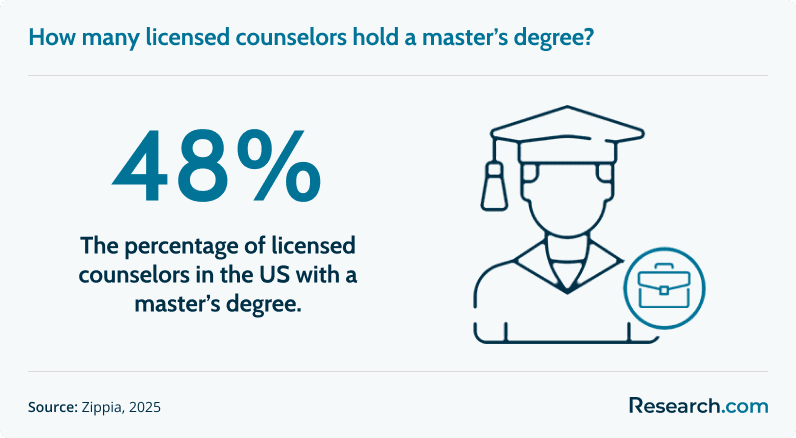
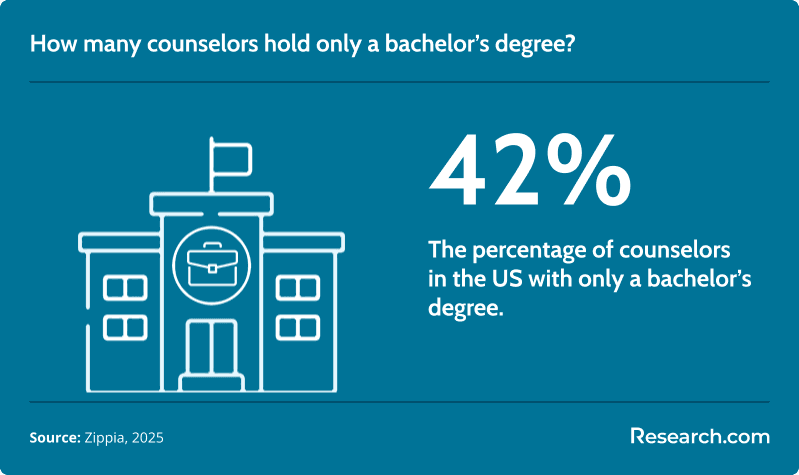
Zippia reports that about 48% of licensed counselors hold a master’s degree, 42% hold a bachelor’s degree, and 5% hold an associate degree. Those figures include people working in counseling-related positions, not only independently licensed mental health counselors.
A bachelor’s degree in psychology, social work, behavioral science, or a similar field may help you qualify for entry-level roles in case management, behavioral support, prevention services, or some substance abuse counseling settings. However, mental health counseling, school counseling, marriage and family therapy, and independent clinical practice usually require graduate-level preparation.
Common graduate degrees for counseling licensure
Completing a master’s degree gives future counselors the clinical foundation required for licensure, including assessment, counseling methods, ethics, and supervised client work. Common options include:
- Master’s in Counseling Psychology — Emphasizes psychological theory, counseling techniques, assessment, and intervention. Graduates may work in counseling centers, clinical settings, private practice, or student support roles, depending on licensure eligibility.
- Master’s in Clinical Mental Health Counseling — Often designed around professional counselor licensure requirements and commonly includes diagnosis, treatment planning, psychopathology, ethics, and psychotherapy training.
- Master’s in Marriage and Family Therapy (MFT) — Focuses on couples, families, relationship systems, conflict, and family dynamics. Graduates usually pursue LMFT licensure rather than licensed professional counselor credentials.
- Master’s in School Counseling — Prepares students for school counseling certification or licensure, with coursework in child and adolescent development, academic planning, crisis response, and student support services.
How to choose the right degree path
| If your goal is... | Consider this degree type | Important caution |
| Independent mental health counseling | Clinical mental health counseling or counseling psychology | Confirm that the curriculum meets your state board’s coursework and clinical hour requirements. |
| Couples and family therapy | Marriage and family therapy | This route usually leads to LMFT licensure, not LPC licensure. |
| Work in K-12 schools | School counseling | State education departments may have separate certification requirements. |
| Substance use treatment | Substance abuse counseling, addiction counseling, psychology, or counseling | Some roles accept less than a master’s degree, but clinical licensure rules vary. |
Before enrolling, ask the program to identify which specific licenses its graduates are prepared to pursue and in which states. A degree can be academically legitimate but still fail to meet a particular state board’s licensure checklist.
Can you become a counselor with a bachelor’s degree?
Yes, a bachelor’s degree can lead to some counseling-adjacent or support roles, especially in substance use services, behavioral health programs, community agencies, and case management. It usually does not qualify someone for independent mental health counseling licensure.
BLS notes that educational expectations vary by counseling role:
- Substance abuse counselors: Some jobs may be available to candidates with a bachelor’s degree.
- Mental health counselors: These roles typically require a master’s degree plus supervised clinical training.
- Faith-based counseling roles: People exploring how to become a Christian counselor may find ministry-based or certification-based options, although state-recognized clinical licensure generally requires graduate education.
When a bachelor’s degree may be enough
- You want an entry-level behavioral health job before graduate school.
- You plan to work under supervision in a non-independent role.
- You are interested in prevention, intake, case coordination, or community support rather than psychotherapy.
- Your state allows certain substance abuse counseling roles with a bachelor’s degree and additional certification.
When you should plan for a master’s degree
- You want to diagnose and treat mental health conditions as a licensed counselor.
- You want to open a private practice.
- You want broader insurance reimbursement opportunities.
- You want to qualify for LPC, LMHC, LPCC, LCPC, or similar state credentials.
How do counseling licensure requirements vary by state?
Counseling licensure is controlled by state boards, not by one national licensing authority. Most states require similar building blocks, but the details can differ enough that students should check requirements before choosing a graduate program.
- A qualifying master’s degree in counseling or a closely related field.
- 1,500 to 4,000 supervised clinical experience hours.
- A passing score on a national exam, state exam, or both.
- Continuing education for license renewal.
State boards may differ on which courses must appear on the transcript, whether online programs are acceptable, who may serve as a supervisor, how many direct client-contact hours are required, and whether telehealth supervision counts. The National Board for Certified Counselors (NBCC) is a useful starting point for exam and credential information, but your state licensing board is the final authority.
Questions to ask your state counseling board before enrolling
- Does the board require a CACREP-accredited counseling degree, or are other accredited programs accepted?
- Which license title applies in this state: LPC, LMHC, LPCC, LCPC, or another credential?
- How many total supervised hours are required after graduation?
- How many hours must involve direct client contact?
- Which exam is required: NCE, NCMHCE, a state exam, an ethics exam, or a combination?
- Can practicum, internship, or supervision hours be completed through telehealth or virtual supervision?
- Does the state have additional rules for addiction counseling, school counseling, grief counseling, or marriage and family therapy?
What counts as supervised clinical experience for counselors?
Supervised clinical experience is the hands-on training period where future counselors treat clients while receiving structured oversight from an approved licensed professional. This is where academic knowledge becomes clinical practice.
- Direct client counseling: Therapy sessions, intake interviews, assessment activities, crisis intervention, treatment planning, and related client services.
- Individual supervision: Regular meetings with a licensed supervisor to review cases, receive feedback, discuss ethics, and improve clinical judgment.
- Graduate practicum and internship: Many master’s programs require 600 to 1,000 hours before graduation.
- Group supervision: Case consultation and professional development in a supervised group of trainees or associate counselors.
Students researching online substance abuse counseling degree options should confirm whether remote coursework, telehealth client contact, and virtual supervision are accepted by the state where they plan to become licensed. Some boards require in-person experiences or a specific mix of direct and indirect hours.
Common supervision mistakes to avoid
- Starting supervised work before the state has approved your provisional or associate license.
- Counting hours with a supervisor who does not meet board requirements.
- Failing to document client-contact hours, supervision dates, and case review activities.
- Assuming graduate internship hours automatically count toward post-degree supervision.
- Moving to another state without checking whether completed hours will transfer.
What exams do you need to pass to become a licensed counselor?
Most counselor licensure paths require at least one exam. The required test depends on the state and license type.
- National Counselor Examination (NCE) — A multiple-choice exam that measures broad counseling knowledge, professional practice, assessment, ethics, and core counseling concepts.
- National Clinical Mental Health Counseling Examination (NCMHCE) — A case-based exam focused on clinical decision-making, diagnosis, treatment planning, and applied counseling judgment.
- State-specific exams — Some states add their own exam to test state laws, regulations, professional standards, or local practice requirements.
- Ethics or jurisprudence exams — Certain jurisdictions require a legal and ethical practice exam before full licensure.
How to prepare efficiently
- Confirm the exact exam required by your state board before buying prep materials.
- Use the official exam content outline to guide your study plan.
- Take practice exams early enough to identify weak areas.
- For the NCMHCE, practice case simulations rather than relying only on memorization.
- Schedule the exam at a point when your coursework and clinical experience are still fresh.
What’s the pass rate for counseling licensure exams for 2027?
Pass rates differ by exam, candidate preparation, and testing cohort. These exams are meant to evaluate not only knowledge but also clinical reasoning, ethics, and safe professional judgment.
| Exam | Reported first-time pass information | Why candidates may find it challenging |
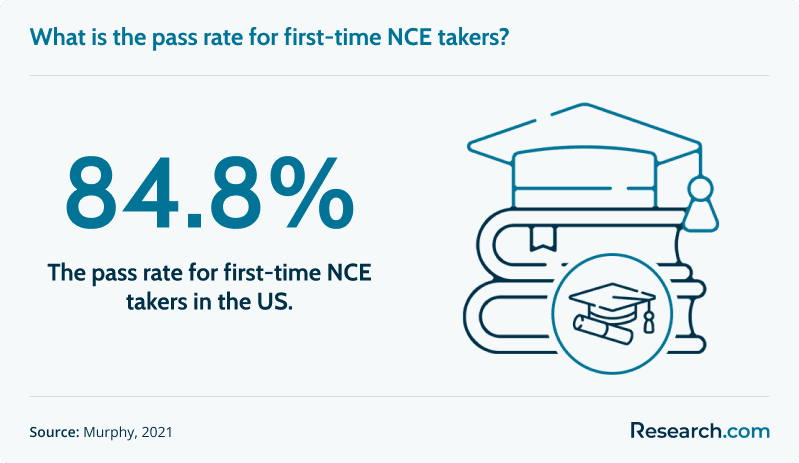
| NCE | The NCE has been described as having a first-time pass rate around 80%, and the article’s cited findings report 84.8%. | It covers broad counseling knowledge, ethics, human development, assessment, and professional practice. |
| NCMHCE | The estimated first-attempt pass rate is 60% to 70%. | Its case-based design requires applied clinical decision-making rather than simple recall. |
Many candidates use NBCC-aligned study materials, prep courses, practice exams, tutoring, or structured study groups. The best preparation strategy depends on the exam format: content review is essential for the NCE, while case analysis and treatment-planning practice are especially important for the NCMHCE.
What is the fastest way to become a therapist?
The fastest legitimate path is not the shortest program advertised online; it is the shortest path that still meets your state’s licensure rules. Students can reduce delays by choosing a licensure-aligned master’s program, enrolling full time if possible, selecting a program with strong practicum placement support, preparing early for exams, and securing approved supervision immediately after graduation.
Accelerated or condensed graduate options may help, but only if they include the required coursework, practicum, internship, and accreditation needed for licensure. A program that saves time upfront can become costly if a state board later rejects coursework or clinical hours. For a deeper look at time-saving routes, see Research.com’s guide to the fastest way to become a therapist.
Ways to shorten the timeline without risking licensure problems
- Choose a program that clearly maps its curriculum to your state’s LPC, LMHC, LPCC, or equivalent requirements.
- Ask whether practicum and internship placements are arranged by the school or left to the student.
- Use transfer credits only if the program and state board will accept them.
- Start exam preparation before your final semester or during supervised practice.
- Keep detailed supervision documentation from the first day you begin accruing hours.
Are continuing education credits necessary to maintain licensure?
Yes. Licensed counselors generally need continuing education to renew their credentials, although the number of hours, renewal cycle, approved topics, and documentation rules vary by state. Continuing education helps counselors stay current with ethical standards, treatment approaches, telehealth practices, trauma-informed care, cultural competency, and legal responsibilities.
Continuing education may include workshops, conferences, online courses, professional seminars, supervision training, or specialty courses. Counselors interested in couples and family systems may also compare programs related to the best online MFT programs, especially if they are considering an additional credential or a shift in specialization.
Can specialized certifications enhance my counseling career?
Specialty certifications can strengthen a counselor’s professional profile when they support a defined practice area. They do not replace state licensure, but they may show additional preparation in areas such as addiction counseling, trauma, grief, family systems, or behavioral interventions.
For example, professionals serving clients with substance use disorders may benefit from a substance abuse counselor certification. These credentials often require focused coursework, supervised experience, and an examination. Before pursuing any certification, verify whether it is recognized by employers, insurers, or your state licensing board.
What distinguishes online CACREP counseling programs from traditional programs?
Online CACREP counseling programs deliver counseling coursework through distance learning while still requiring supervised clinical experiences. The major difference is format, not necessarily licensure intent. A strong online program should cover the same core competencies as a campus program and provide clear support for practicum and internship placements.
The flexibility can be valuable for working adults, parents, military-affiliated students, and people who do not live near a campus-based counseling program. However, students should not assume that “online” means fully remote licensure preparation. Clinical training may require local site placements, in-person client contact, and approved supervisors. To compare cost and accreditation considerations, review Research.com’s guide to online CACREP counseling programs.
| Program format | Best for | Key risk to check |
| Online counseling program | Students needing scheduling flexibility or access from outside commuting distance | Placement support may vary, and some clinical requirements may still be in person. |
| Campus counseling program | Students who prefer face-to-face classes and local clinical networks | Less flexibility for students working full time or living far from campus. |
| Hybrid counseling program | Students who want online convenience plus some in-person connection | Campus visits may add travel, lodging, and time costs. |
How can I evaluate the quality and affordability of online counseling programs?
Start with licensure fit, not price. A low-cost program is not a good value if it does not qualify you for the license you need. Once you confirm licensure alignment, compare total cost, field placement support, faculty qualifications, student services, graduation requirements, and exam preparation resources.
Students comparing budget-conscious options can use Research.com’s resource on the most affordable online master’s in mental health counseling programs as a starting point, then verify the details with the school and state licensing board.
Questions to ask before enrolling in an online counseling program
- Is the program accredited by an agency accepted by my state board?
- Does the curriculum meet the coursework requirements for the license I want?
- Who helps students find practicum and internship sites?
- Can I complete clinical hours in my state?
- What fees are charged beyond tuition?
- Are online students eligible for the same advising, library, career, and exam-prep support as campus students?
- What happens if I move to another state during or after the program?
What legal and ethical responsibilities do licensed counselors have?
Licensed counselors must practice within legal, ethical, and professional boundaries designed to protect clients. These responsibilities include confidentiality, informed consent, accurate documentation, competence within scope of practice, proper supervision when required, and appropriate referral when a client’s needs exceed the counselor’s training.
Counselors must also follow HIPAA privacy standards and mandatory reporting laws when client safety, abuse, neglect, or harm to self or others is involved. Ethical practice also requires clear professional boundaries, avoidance of conflicts of interest, culturally responsive care, and careful management of telehealth risks. Graduate programs such as online master’s in behavior analysis programs may also address legal and ethical topics relevant to behavioral health practice.
How do licensed counselors differ from other mental health professionals?
Licensed counselors are trained to provide mental health counseling, assessment, treatment planning, and therapeutic support. Other mental health professionals may overlap in some services but differ in education, scope of practice, licensure title, and clinical emphasis.
| Professional role | Typical focus | Important distinction |
| Licensed professional counselor | Therapy, mental health counseling, client assessment, treatment planning | Usually follows a counseling-focused graduate pathway and state counselor licensure process. |
| Marriage and family therapist | Couples, families, relationship systems, family dynamics | Typically pursues LMFT licensure rather than LPC licensure. |
| Social worker | Clinical therapy, case management, resource coordination, systems-level support | Training often combines clinical practice with social services and advocacy. |
| Psychologist | Assessment, therapy, research, testing, diagnosis, advanced clinical services | Usually requires doctoral-level education for independent psychologist licensure. |
For a broader comparison of related paths, review Research.com’s guide to licensed social worker vs psychologist.
Do states offer temporary or provisional counseling licenses?
Yes. Many states issue associate, provisional, temporary, or pre-licensure credentials to graduates who have completed the educational requirement but still need supervised post-graduate hours. These licenses allow candidates to provide counseling services under approved supervision while working toward full independent licensure.
Typical provisional licensure requirements may include:
- A completed master’s degree in counseling or a related field.
- A passing score on a required exam, such as the NCE or NCMHCE.
- Supervision by a fully licensed professional approved under state rules.
These credentials usually have restrictions:
- Provisional licensees generally cannot practice independently.
- Some states limit how long candidates have to complete supervised hours, often within two to five years.
- Specialty areas, including grief counseling, addiction counseling, or school counseling, may require additional credentials.
Anyone considering grief counseling should check both licensure rules and labor market expectations. Research.com’s guide to grief counselor salary trends explains how earnings may vary by location, specialization, and experience.
How crucial is program accreditation for licensure success?
Accreditation is one of the most important checks before enrolling in a counseling-related program. State boards often use accreditation status, curriculum structure, faculty qualifications, and clinical training standards to determine whether a degree is acceptable for licensure.
A properly accredited program is more likely to include the required counseling coursework, practicum, internship, ethics training, and assessment preparation. Accreditation does not guarantee licensure, but lack of appropriate accreditation can create major obstacles. Students exploring advanced clinical psychology options can also compare pathways such as APA-accredited online PsyD programs, although psychologist licensure is a different route from professional counselor licensure.
Accreditation checks before you apply
- Confirm institutional accreditation.
- Check whether programmatic accreditation is required or preferred in your state.
- Ask the school for a written explanation of which state licenses the program is designed to support.
- Verify that online and campus students complete equivalent clinical training.
- Contact your state board directly if the program’s website is unclear.
Can a one-year online master's degree in psychology adequately prepare me for licensure?
A one-year online master’s degree in psychology may be useful for some academic or career goals, but students should be cautious if they intend to become licensed counselors. Counseling boards often require specific graduate counseling coursework, supervised practicum and internship experiences, and a degree that matches the state’s licensure categories.
Accelerated programs compress coursework into a shorter schedule. That can save time, but it can also leave little room for clinical placement, supervision, and licensure-specific training if the program is not designed for counselor preparation. Before enrolling, compare curriculum, clinical requirements, accreditation, faculty support, and state eligibility. Research.com’s guide to a one-year master’s in psychology explains how these programs differ in structure and purpose.
How much do licensed counselors make per year?
Licensed counselor pay varies by state, employer, specialization, experience, work setting, and whether the counselor is employed or self-employed. Counselors work in private practices, hospitals, schools, rehabilitation centers, community mental health agencies, correctional settings, nonprofit organizations, and telehealth platforms.
Indeed reports an average licensed counselor salary of $71,838 per year. BLS reports a median annual salary of $53,710, meaning half earn more and half earn less. BLS also reports that the top 10% earn more than $89,920 per year, while the bottom 10% earn less than $36,700 per year.
Salary factors to consider
- Specialization: Marriage and family therapists, substance abuse counselors, school counselors, and clinical mental health counselors may have different salary ranges.
- Work setting: Private rehab centers, public health programs, hospitals, schools, and private practice can pay differently.
- Location: State and local demand can strongly influence compensation.
- Experience: New associate-level counselors usually earn less than independently licensed clinicians with established caseloads.
- Advanced credentials: Students comparing doctoral options should note that doctorate in psychology salary information often reflects a different licensure path and may exceed $100,000 per year.
Private practice can create higher earning potential for some counselors, but it also adds business costs, insurance paneling decisions, marketing, billing, taxes, and client acquisition responsibilities. Salary figures should be treated as benchmarks, not guarantees.
What is the job outlook for licensed counselors for 2027?
The job outlook for substance abuse, behavioral disorder, and mental health counselors is strong. BLS projects 19% employment growth from 2023 to 2033, which is much faster than the average for all occupations. BLS also projects approximately 48,900 openings per year.
Demand is supported by several factors:
- Greater public attention to mental health and addiction treatment.
- Broader use of teletherapy and remote counseling services.
- Expanded access to behavioral health services through insurance coverage.
- Ongoing need for licensed clinicians in schools, hospitals, community agencies, treatment centers, and private practices.
Competition and opportunity can still vary by location and specialty. The article’s cited findings also note that California leads the US in employment levels for counselors, with 54,660 professionals in the field.
Current trends affecting future counselors
- Telehealth is now part of mainstream counseling practice. Future counselors should learn telehealth ethics, privacy requirements, crisis protocols, and state rules for interstate practice.
- Employers increasingly value licensure-ready graduates. Programs that provide strong field placement support and exam preparation may reduce friction after graduation.
- AI tools are changing administrative work. Counselors may encounter AI-assisted documentation, scheduling, screening, or practice-management tools, but clinical judgment, confidentiality, and ethical oversight remain essential.
- Specialized care remains important. Addiction treatment, trauma-informed counseling, school mental health, grief support, and family systems work continue to shape employment options.
What do practitioners say about how long it takes to become a licensed counselor?
-
: "
My licensure path took close to eight years. Graduate school, 3,000 supervised hours, and the NCE all required persistence, but the training gave me the confidence to support clients through serious mental health challenges. The process was demanding, but the work I do now makes that investment feel meaningful. Mary
"
-
: "
It took almost a decade from my first classes to full licensure. The combination of education, supervised practice, and state exams was intense, but it prepared me to work with clients facing anxiety, trauma, and major life changes. If you care deeply about this field, the long timeline can be worth it. Glenn
"
-
: "
The hardest part for me was balancing graduate coursework, practicum expectations, and exam preparation at the same time. Still, receiving my license confirmed that I had chosen the right profession. I now get to help people find stability, insight, and hope every day. Elena
"
Can an online accelerated psychology degree expedite licensure?
An accelerated online psychology degree may shorten the academic portion of your education, but it does not automatically shorten counseling licensure. Licensure boards care about degree level, required coursework, supervised clinical training, accreditation, exams, and post-graduate hours. If an accelerated program lacks the required clinical components, it may not help you become licensed faster.
Before choosing this route, verify whether the program includes licensure-focused coursework, approved practicum or internship experiences, and state-compliant supervision. Research.com’s guide to an online accelerated psychology degree can help you compare program formats and potential time savings.
Common Mistakes to Avoid When Planning a Counseling Career
| Mistake | Why it can hurt your timeline | Better approach |
| Choosing a program based only on tuition | A cheap program may not meet state licensure requirements. | Compare cost only after confirming accreditation and licensure alignment. |
| Assuming all online counseling programs qualify for licensure | Some online degrees may lack required clinical placements or state-approved coursework. | Ask the school and state board to confirm eligibility in writing when possible. |
| Ignoring state-specific rules | Moving states can create coursework, exam, or supervision gaps. | Check requirements in every state where you may want to practice. |
| Waiting too long to plan supervised hours | Delays in finding approved supervision can add months or years. | Research associate or provisional license rules before graduation. |
| Relying only on rankings | A high-ranked program may not fit your state, budget, schedule, or clinical goals. | Use rankings as one input, not the final decision. |
| Assuming salary outcomes are guaranteed | Pay varies by location, setting, license level, and experience. | Compare BLS, employer postings, and local job market data before estimating ROI. |
Practical Steps to Become a Licensed Counselor
- Choose your target counseling role. Decide whether you want mental health counseling, school counseling, marriage and family therapy, substance abuse counseling, grief counseling, or another specialty.
- Check your state board’s requirements. Identify the accepted degree type, accreditation expectations, coursework, exams, and supervision hours.
- Earn a relevant bachelor’s degree. Psychology, human services, social work, behavioral science, or related majors can provide a useful foundation.
- Select a licensure-aligned master’s program. Confirm that the program includes practicum and internship requirements that match your state’s standards.
- Complete graduate clinical training. Document practicum and internship hours carefully.
- Apply for an associate, provisional, or temporary license if required. Do this before beginning post-graduate supervised hours when your state requires pre-approval.
- Complete supervised post-graduate experience. Track all direct client hours, indirect hours, supervision meetings, and supervisor approvals.
- Pass the required exam or exams. Prepare specifically for the NCE, NCMHCE, state exam, ethics exam, or jurisprudence exam required in your jurisdiction.
- Apply for full licensure. Submit transcripts, supervision verification, exam scores, background checks, and fees as required.
- Maintain your license. Complete continuing education and renew your credential according to state rules.
Key Insights
- Most aspiring licensed counselors should plan for a six- to ten-year process from bachelor’s degree through full licensure.
- A master’s degree is the usual requirement for independent professional counseling licensure, even though some counseling-related roles accept a bachelor’s degree.
- Supervised clinical experience is a major part of the timeline, with states requiring 1,500 to 4,000 hours.
- Licensure rules are state-specific. Always verify degree, accreditation, exam, and supervision requirements before enrolling in a program.
- The NCE first-time pass rate is reported in the cited findings as 84.8%, while the NCMHCE is estimated at 60% to 70% because of its case-based structure.
- Indeed reports an average licensed counselor salary of $71,838 per year, while BLS reports a median salary of $53,710.
- BLS projects 19% employment growth from 2023 to 2033 and approximately 48,900 openings per year for substance abuse, behavioral disorder, and mental health counselors.
- California leads the US in employment levels for counselors, with 54,660 professionals in the field.
- The fastest path is the one that meets licensure requirements the first time. Choosing an unaligned program can delay licensure more than a longer but properly structured program.
References:
- BLS. (2024, April 3). Counselors, All Other. BLS.
- BLS. (2024, April 3). Substance Abuse, Behavioral Disorder, and Mental Health Counselors. BLS.
- BLS. (2024, August 29). Substance abuse, behavioral disorder, and mental health counselors. BLS.
- Indeed. (2025, February 11). Licensed professional counselor salary in United States. indeed.com.
- Murphy, N. (2021, April 15). ABOUT THE NCE | National Counselor’s Exam (NCE)Preparation. depaul.edu.
- Zippia. (2025, January 8). Licensed Professional Counselor Demographics and Statistics [2025]: Number of Licensed professional counselors in the US. Zippia.
Other Things You Should Know About How Long It Takes to Become a Licensed Counselor
Most states require a master’s degree in counseling or a closely related field before licensure. Programs usually include 60 semester credits, supervised practicum and internship hours, and coursework approved by the state board or CACREP standards before you can submit a license application.
In 2027, licensing requirements for counselors vary by state. Most states require a master's degree in counseling, 2,000-4,000 supervised clinical hours, and passing the National Counselor Examination. Specific additional criteria, like state-specific jurisprudence exams, can also apply depending on the state.
To become a licensed counselor by 2027, you typically need to pass the National Counselor Examination (NCE) or the National Clinical Mental Health Counseling Examination (NCMHCE), depending on state requirements. These exams assess your competence and readiness to practice professionally.