
2027 How to Become a Nurse Practitioner in Columbus, OH: Requirements & Salary

Co-Founder and Chief Data Scientist
Becoming a nurse practitioner in Columbus, Ohio, is a major step up from registered nursing because it moves you into advanced assessment, diagnosis, treatment planning, prescribing, and long-term patient management. It also changes your education requirements, licensure responsibilities, liability exposure, and career options. For nurses deciding whether the investment is worth it, the difference in earning potential is an important factor: registered nurses working in Ohio had a median hourly wage of $39.06 in May 2024, while nurse practitioners had a median hourly wage of $60.93 during the same period [US Bureau of Labor Statistics (BLS), 2025].
This guide explains how to become a nurse practitioner in Columbus, OH, from nursing education and RN licensure to graduate study, national certification, Ohio APRN licensing, salary expectations, job demand, and ethical practice. It is written for RNs planning their next career move, BSN students comparing graduate paths, and career changers who want to understand the full timeline before committing to advanced nursing education.
Quick Answer: How do you become a nurse practitioner in Columbus, OH?
To become a nurse practitioner in Columbus, OH, you generally need to earn a BSN, pass the NCLEX-RN, hold an active Ohio RN license, complete an accredited MSN or DNP nurse practitioner program, finish supervised clinical training, earn national certification in your NP specialty, complete Ohio’s advanced pharmacology requirement, pass a criminal background check, and apply for APRN licensure through the Ohio Board of Nursing.
The full pathway can take as little as six years for students who move directly from BSN study into RN experience and graduate NP education, but many nurses take longer because they work while completing graduate school.
Key Points to Know About Becoming a Nurse Practitioner in Columbus, OH
- Nurse practitioners in Ohio had a median annual wage of $126,740 in May 2024 (US BLS, 2025).
- Employment for nurse practitioners across the US has been projected to increase by 46%, a significantly faster job growth rate than the average for all US occupations (US BLS, 2025).
- Columbus offers several NP education options, a large healthcare employment base, and opportunities in primary care, acute care, psychiatric care, and community health.
- What education do you need to become a nurse practitioner in Columbus, OH?
- Which schools offer nurse practitioner programs for Columbus students?
- What skills matter most for nurse practitioners in Columbus, OH?
- What requirements must Ohio nurse practitioners meet?
- How does nurse practitioner licensing work in Columbus, OH?
- How long does it take to become a licensed nurse practitioner in Columbus, OH?
- How can nurse practitioners advance their careers after licensure?
- Which extra certifications can strengthen an NP career?
- How are nurse practitioners different from licensed therapists in Columbus, OH?
- Can an Ohio nurse practitioner license be used in other states?
- How much do nurse practitioners earn in Columbus, OH?
- Is there strong demand for nurse practitioners in Columbus, OH?
- What legal and ethical rules should Columbus nurse practitioners follow?
What are the educational requirements to become a nurse practitioner in Columbus, OH?
The education path for nurse practitioners in Columbus starts with registered nursing preparation and builds toward advanced practice. Ohio does not require a doctoral degree for entry-level NP practice, but you must complete graduate-level nurse practitioner education and meet Ohio Board of Nursing requirements before practicing as an APRN.
The standard route includes the following steps:
- Earn a Bachelor of Science in Nursing (BSN): A BSN commonly requires four years of full-time study and includes nursing fundamentals, anatomy, chemistry, nutrition, patient assessment, and clinical rotations.
- Pass the NCLEX-RN: Before entering NP practice, you must first become a registered nurse. Passing the NCLEX-RN is required for RN licensure.
- Hold an active RN license: Graduate NP programs and the Ohio Board of Nursing require an RN license before you can move into advanced practice.
- Complete an MSN or doctoral NP program: Most students pursue a Master of Science in Nursing with a specialty such as Family Nurse Practitioner, while others choose a BSN-to-DNP route.
- Choose a population focus: NP preparation is specialty-based, so you should select a track that matches your intended practice area, such as family care, acute care, psychiatric-mental health, or women’s health.
- Meet graduate admission requirements: MSN programs commonly require a BSN from an accredited school, an unencumbered Ohio RN license, a minimum GPA around 3.0, letters of recommendation with one preferably from an advanced practice nurse, and at least two years of recent full-time RN experience.
- Complete advanced pharmacology: Ohio requires 45 contact hours in advanced pharmacology for nurse practitioners.
- Finish supervised clinical practice: Instead of an informal apprenticeship, NP students complete structured clinical training with qualified preceptors as part of their graduate program.
| Education or credential | Why it matters | Decision point for students |
| BSN | Provides the nursing foundation required for most NP programs. | Students without a BSN may need an RN-to-BSN or bridge pathway before graduate study. |
| RN license | Confirms eligibility to practice as a registered nurse before advanced practice preparation. | Keep the license active and unencumbered before applying to NP programs. |
| MSN NP program | Prepares nurses for national certification and APRN licensure. | Best for nurses who want the most direct graduate route into NP practice. |
| BSN-to-DNP program | Combines advanced clinical preparation with doctoral-level leadership and systems coursework. | Best for nurses interested in leadership, academic preparation, or the highest clinical degree in nursing practice. |
| National certification | Required to demonstrate competency in the selected NP specialty. | Choose a graduate program aligned with the certification exam you plan to take. |
Before choosing a specialty, compare patient populations, work settings, and long-term salary potential. If earnings are part of your decision, reviewing the highest paid np specialties can help you understand how specialty choice may affect career direction.
Are there schools in Columbus, OH that offer nurse practitioner programs?
Columbus-area nurses can choose from local, hybrid, and online nurse practitioner programs, depending on schedule, clinical placement needs, and specialty goals. The right option is not always the most familiar school; it is the program that matches your licensure goals, clinical support needs, budget, and work schedule.
The Ohio State University College of Nursing offers a Family Nurse Practitioner specialty track designed to prepare students for advanced practice across varied clinical settings in Ohio. Its model includes consecutive clinical semesters, giving students repeated opportunities to work with preceptors and build readiness for national certification.
Mount Carmel College of Nursing offers a Family Nurse Practitioner program for registered nurses who want to move into advanced clinical practice. The program combines graduate nursing theory with applied clinical preparation for practice in healthcare settings.
Otterbein University offers a BSN to DNP program that includes an MSN and emphasizes a strong science core with a flexible curriculum. The program is also described as having a high FNP certification pass rate, which may appeal to students comparing outcomes and academic rigor.
Walsh University offers a fully online MSN-FNP program available to Columbus residents. The program includes 61 credits, can be completed in 6-7 semesters full-time, and charges $685 per credit hour. Although coursework is online, students still complete in-person clinical experiences.
| Program option | Best fit | What to verify before enrolling |
| Local campus-based NP program | Students who want face-to-face instruction, local faculty access, and regional clinical connections. | Clinical placement process, schedule expectations, tuition, accreditation, and certification exam alignment. |
| Hybrid NP program | Working nurses who want some online flexibility but still value in-person learning. | Required campus visits, clinical site rules, and whether placements can be completed near Columbus. |
| Fully online MSN-FNP program | RNs who need maximum scheduling flexibility and can manage independent learning. | State authorization, clinical placement support, in-person requirements, total credits, and per-credit cost. |
| BSN-to-DNP program | Nurses who want doctoral-level preparation and may pursue leadership or advanced systems roles. | Program length, cost, clinical requirements, and whether the extra time supports your goals. |
Students exploring specialty options beyond family practice may also compare women’s health pathways. For more context on that route, see this guide on how to become a women's health nurse practitioner.
What skills do you need to become a nurse practitioner in Columbus, OH?
Nurse practitioners need more than strong bedside nursing experience. They must make diagnostic decisions, manage medications, coordinate care, educate patients, document thoroughly, and understand when a case requires referral or collaboration.
The most important NP skills include:
- Advanced patient assessment: NPs perform detailed histories, physical exams, risk assessments, and follow-up evaluations to identify patient needs.
- Clinical reasoning: Strong NPs connect symptoms, exam findings, lab results, imaging, medication history, and patient context before making decisions.
- Pharmacology knowledge: Because prescribing is a central NP responsibility, practitioners must understand drug actions, interactions, contraindications, dosing, and patient education.
- Diagnostic interpretation: NPs need to evaluate laboratory results and diagnostic tests accurately and know when additional workup is needed.
- Electronic health record proficiency: Accurate documentation, medication reconciliation, order entry, and care team communication depend heavily on healthcare IT systems.
- Patient communication: NPs often manage chronic conditions, preventive care, and treatment adherence, which requires explaining complex information clearly.
- Quality and safety awareness: Advanced practice nurses must reduce errors, follow evidence-based protocols, and improve patient outcomes.
- Leadership and collaboration: NPs work with physicians, nurses, pharmacists, therapists, social workers, and administrative teams, especially in complex care environments.
| Skill area | How it shows up in practice | How to build it before graduation |
| Assessment | Completing exams, identifying red flags, and tracking changes in condition. | Seek clinical rotations with high patient volume and varied diagnoses. |
| Prescribing judgment | Selecting medications, monitoring side effects, and educating patients. | Take advanced pharmacology seriously and review prescribing guidelines regularly. |
| Communication | Explaining diagnoses, care plans, risks, and follow-up steps. | Practice patient teaching during RN work and graduate clinicals. |
| Documentation | Recording findings, orders, referrals, and patient instructions accurately. | Learn EHR workflows and ask preceptors for feedback on clinical notes. |
| Collaboration | Working across disciplines and escalating complex cases appropriately. | Choose clinical settings where NPs interact with multiple healthcare professionals. |
What are the requirements for a nurse practitioner in Columbus, OH?
Nurse practitioners in Columbus follow Ohio requirements because licensure is regulated at the state level. The city where you work does not issue a separate NP license, but your job setting may have additional credentialing, privileging, or employer-specific requirements.
Ohio nurse practitioner requirements include:
- Active, unencumbered Ohio RN license: You must hold valid RN licensure before obtaining APRN authority.
- Graduate NP education: You need an approved graduate-level program that prepares you for advanced practice in a defined specialty.
- National certification: Certification must come from an organization approved by the Ohio Board of Nursing and match your population focus.
- Advanced pharmacology coursework: Nurse Practitioners, Clinical Nurse Specialists, and Certified Nurse-Midwives seeking prescriptive authority must complete a Board-approved course with at least 45 contact hours taken within five years before application.
- Criminal background check and fingerprinting: Ohio uses this step to protect patients and verify applicant eligibility.
- Ohio-specific education when applicable: Applicants educated outside Ohio may need training related to Ohio laws and Schedule II prescribing rules.
- Official documentation and fees: Transcripts, national certification verification, applications, and required payments must be submitted to the Ohio Board of Nursing.
If you are still deciding on an NP population focus, compare program outcomes, clinical requirements, and certification eligibility. Acute care may be a better fit for nurses drawn to high-acuity settings; Research.com’s best online acute care nurse practitioner programs resource can help you understand that option.
What is the licensing process for nurse practitioners in Columbus, OH?
After completing graduate NP education, you must move through Ohio’s APRN licensing process before practicing as a nurse practitioner. The process is document-heavy, so delays often happen when transcripts, certification results, fees, or background checks are missing.
- Confirm RN licensure: Make sure your Ohio RN license is current and in good standing before starting the APRN application.
- Pass national certification: Complete the certification exam for your NP specialty and arrange for official verification to be sent as required.
- Apply through the Ohio Board of Nursing: Submit the APRN application through the state licensing system and pay the required fees.
- Send official transcripts: Your graduate NP program must provide documentation confirming completion of the required advanced practice education.
- Document pharmacology coursework: Provide proof that you completed the required advanced pharmacology contact hours within the required timeframe.
- Complete background check requirements: Follow Ohio’s fingerprinting and criminal background check instructions carefully.
- Monitor application status: Check your licensing account regularly and respond quickly if the Board requests additional information.
| Licensing step | Common delay | How to avoid the problem |
| Transcript submission | The school sends an unofficial or incomplete record. | Request official transcripts directly from the institution and confirm delivery. |
| Certification verification | The applicant uploads a copy when the Board requires official verification. | Follow the certifying organization’s instructions for direct reporting. |
| Background check | Fingerprinting is incomplete or submitted under the wrong process. | Use the Ohio Board of Nursing’s current instructions before scheduling. |
| Pharmacology proof | Coursework does not clearly show the required contact hours. | Keep syllabi, certificates, and program documentation in your records. |
| Application fee | The application remains pending because payment was not finalized. | Check your account for payment confirmations and unresolved fee notices. |
A practical strategy is to create a licensing folder before graduation. Include your RN license information, graduate program contacts, certification account details, pharmacology documentation, clinical hour records, and background check receipts.
How long does it take to become a licensed nurse practitioner in Columbus, OH?
The fastest route usually takes at least six years, but the timeline depends on your starting point, whether you study full time or part time, and how quickly you complete RN experience and graduate clinical requirements.
| Stage | Typical time | What happens during this stage |
| BSN | Usually four years of full-time study | Students complete nursing coursework, labs, and clinical rotations. |
| RN clinical experience | At least two years of full-time clinical experience as a licensed RN within the past five years is a common program requirement | Nurses build patient care experience before entering advanced practice training. |
| MSN-FNP program | About 6–7 semesters full-time or up to 10 semesters part-time | Students complete graduate coursework, advanced assessment, pharmacology, specialty content, and supervised clinical practice. |
| Certification and Ohio APRN licensure | Varies by application readiness | Graduates pass national certification, complete background checks, submit documentation, and apply to the Ohio Board of Nursing. |
Students comparing program lengths should look beyond advertised completion time. Clinical placement availability, work schedule, course sequencing, and certification exam timing can all affect when you are actually ready to practice. For broader planning, this guide to how long nurse practitioner school takes explains common timeline differences.
What career advancement and continuing education opportunities exist for nurse practitioners in Columbus, OH?
After licensure, nurse practitioners can expand their careers through specialty practice, leadership roles, doctoral education, clinical teaching, quality improvement, informatics, and healthcare administration. Continuing education is also essential because NP practice changes with new treatment guidelines, prescribing rules, technology, and patient care models.
Common advancement options include:
- Specialty clinical practice: NPs may move into psychiatric-mental health, acute care, women’s health, primary care, or chronic disease management depending on certification and training.
- Leadership roles: Experienced NPs can supervise clinical teams, lead care coordination efforts, or manage advanced practice groups.
- Doctoral study: A DNP can support leadership, evidence-based practice, and systems improvement roles.
- Teaching and precepting: NPs may support nursing education by mentoring students or serving as clinical preceptors.
- Interdisciplinary development: Understanding pharmacy, billing, behavioral health, and care management can make NPs stronger team leaders.
Some nurses also compare related healthcare careers before committing to advanced nursing practice. If you are considering another clinical path in Columbus, review Research.com’s guide on how to become a pharmacist in Columbus.
What additional certifications can boost your practice as a nurse practitioner in Columbus, OH?
Additional credentials can help nurse practitioners specialize, improve care coordination, or prepare for administrative responsibilities. The best certification depends on your patient population and career goal; adding credentials only makes sense when they support your practice area, employer needs, or advancement plan.
| Certification or training area | How it may help | Best fit |
| Specialty NP certification | Strengthens eligibility for roles in a defined patient population or care setting. | NPs moving into family, acute, psychiatric, or women’s health practice. |
| Healthcare leadership training | Builds skills in staffing, quality improvement, compliance, and operations. | NPs seeking management or director-level responsibilities. |
| Billing, coding, and reimbursement education | Improves understanding of documentation, claims, reimbursement, and revenue cycle processes. | NPs involved in clinic management, private practice, or productivity-based settings. |
| Quality and safety training | Supports patient safety projects and evidence-based practice improvement. | NPs working in hospitals, health systems, and population health programs. |
For NPs who want stronger knowledge of reimbursement and documentation, Research.com’s guide to medical biller and coder certification in Columbus explains a related administrative credential.
How do nurse practitioners differ from licensed therapists in Columbus, OH?
Nurse practitioners and licensed therapists both support patient health, but they are trained for different scopes of practice. Nurse practitioners are advanced practice nurses who assess patients, diagnose conditions, order or interpret tests, prescribe treatments when authorized, and manage medical care. Licensed therapists primarily provide counseling, psychotherapy, behavioral interventions, and mental health support within their professional scope.
| Role | Main focus | Typical services |
| Nurse practitioner | Medical assessment, diagnosis, treatment, prescribing, and patient management. | Physical exams, chronic disease care, medication management, diagnostic orders, referrals, and follow-up care. |
| Licensed therapist | Mental health counseling and behavioral treatment. | Therapy sessions, treatment plans, coping strategies, behavioral interventions, and mental health support. |
If you are comparing advanced nursing with counseling-focused work, review the licensed therapist requirements in Columbus to understand the education and licensure differences.
Will a nurse practitioner license from Columbus, OH allow you to work in other states?
An Ohio nurse practitioner license does not automatically authorize NP practice in every other state. Nursing licensure is state-regulated, and APRN authority must be approved by the state where you plan to practice.
If you want to work outside Ohio, you will usually need licensure by endorsement or another application process through the destination state’s nursing board. Requirements may include:
- Submitting an application to the new state’s nursing board
- Providing proof of your Ohio NP license and credentials
- Sending official transcripts and national certification verification
- Completing background check requirements
- Meeting that state’s prescribing, collaboration, or scope-of-practice rules
RN compact rules also should not be confused with APRN practice authority. Even where multistate RN privileges apply, advanced practice authorization is handled separately. Before accepting a telehealth, travel, or cross-state position, confirm the rules directly with the state board of nursing.
How much do Columbus, OH nurse practitioners earn?
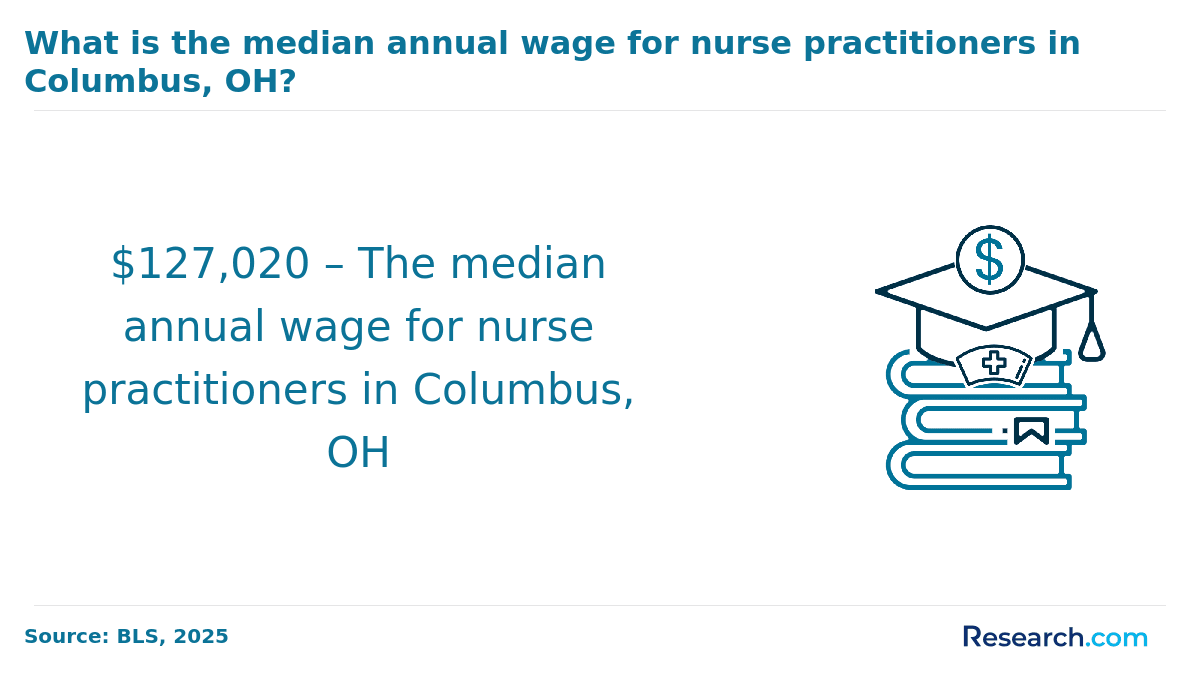
Nurse practitioner pay in Columbus varies by specialty, employer, experience, schedule, and clinical setting. The average salary here is about $123,230 annually, while many practitioners earn between $115,000 and $135,000. Some earn upwards of $144,000 depending on background and work environment.
Reported Columbus NP salary patterns include:
- Entry-level nurse practitioners usually earn between $82,000 and $111,700 in their first two years.
- Mid-career nurse practitioners with five years of experience often see salaries around $100,000 to $114,000.
- Experienced NPs with ten or more years of practice often earn above $115,000, with seasoned professionals approaching $127,500 or more.
- Specialized roles, including psychiatric or acute care nurse practitioners, can exceed the average and sometimes reach $193,000 in Columbus.
| Experience or role type | Reported Columbus salary range or figure | What may influence pay |
| Entry-level NP | $82,000 to $111,700 | Specialty, employer type, schedule, and prior RN experience. |
| Mid-career NP | $100,000 to $114,000 | Clinical productivity, certifications, care setting, and patient population. |
| Experienced NP | Above $115,000, approaching $127,500 or more | Specialization, leadership duties, and advanced clinical responsibilities. |
| Specialized NP roles | Sometimes reaching $193,000 in Columbus | Acute care, psychiatric care, high-demand settings, and advanced credentials. |
Advanced education can also affect long-term earnings and leadership options. To compare doctoral-level compensation patterns, review Research.com’s guide to DNP NP salary.
Is there a demand for nurse practitioners in Columbus, OH?
Demand for nurse practitioners in Columbus is supported by healthcare hiring needs, primary care access issues, chronic disease management, and the need for advanced clinicians in hospitals, clinics, and community settings. Healthcare remains a major employment area in Central Ohio, and nurse practitioners are often used to expand access to care.
Local demand indicators are strong. Nurse practitioner job demand in Columbus OH rose from 124 postings in September 2023 to 157 in September 2024, and the median annual salary was above $121,000. Employment growth in Columbus Ohio for nurse practitioners is projected at 30.6% between 2018 and 2028.
The strongest opportunities are often in primary care, but demand also extends to psychiatric-mental health, acute care, chronic disease management, and specialty clinics. Nurses preparing for NP practice should choose clinical rotations and certifications that match the roles they want after graduation.
| Demand factor | Why it matters for NP careers | How students can respond |
| Aging population | More patients need chronic disease care, medication management, and follow-up. | Build skills in geriatrics, primary care, and complex care coordination. |
| Physician shortages | NPs can help expand access to primary and specialty services. | Choose programs with strong clinical preparation and certification outcomes. |
| Mental health needs | Psychiatric-mental health services remain an important area of demand. | Consider whether psychiatric-mental health NP training fits your goals. |
| Hospital and acute care needs | Health systems need advanced clinicians for high-acuity patient management. | Compare acute care NP tracks if you prefer hospital-based practice. |
What ethical and legal guidelines should you observe as a nurse practitioner in Columbus, OH?
Ethical and legal practice is central to NP work because nurse practitioners make independent clinical judgments that directly affect patient safety. In Columbus, NPs must follow Ohio law, employer policies, professional standards, and specialty certification expectations.
- Maintain valid licensure: Keep your RN and APRN credentials active and comply with renewal and continuing education requirements.
- Practice within scope: Understand what Ohio allows nurse practitioners to do and avoid working beyond your legal authority or clinical competence.
- Follow prescribing rules: Comply with Ohio prescribing regulations, including controlled substance and Schedule II rules when applicable.
- Document thoroughly: Accurate documentation supports continuity of care, billing integrity, legal protection, and patient safety.
- Protect patient privacy: Follow confidentiality rules and avoid discussing patient information in public, online, or outside appropriate care contexts.
- Use evidence-based care: Base decisions on current clinical evidence, patient preferences, and appropriate standards of practice.
- Respect patient autonomy: Explain risks, benefits, alternatives, and follow-up needs so patients can make informed decisions.
- Collaborate appropriately: Work with physicians, pharmacists, therapists, nurses, and social service professionals when patient needs require team-based care.
- Address bias and access barriers: Provide respectful care across backgrounds and advocate for patients who face health disparities.
- Remain accountable: Seek consultation, refer when appropriate, and continue learning throughout your career.
Common mistakes to avoid when becoming a nurse practitioner in Columbus, OH
| Mistake | Why it can hurt your career plan | Better approach |
| Choosing a program without checking accreditation and certification alignment | You may graduate from a program that does not support your intended licensure or specialty exam path. | Confirm accreditation, state authorization, clinical requirements, and certification eligibility before applying. |
| Looking only at tuition | Total cost may include fees, books, travel, clinical compliance costs, and lost work hours. | Compare full program cost and ask about all required expenses. |
| Assuming online means fully remote | NP programs require in-person clinical experiences even when didactic coursework is online. | Ask how clinical placements are arranged and whether Columbus-area sites are available. |
| Selecting a specialty too quickly | Your NP population focus shapes certification, jobs, and long-term practice options. | Shadow NPs, compare job postings, and choose a specialty based on patient population and setting. |
| Waiting until graduation to plan licensure | Missing documents can delay APRN approval and job start dates. | Track transcripts, certification reporting, pharmacology documentation, and background check steps early. |
| Assuming salary outcomes are guaranteed | Pay varies by setting, experience, specialty, employer, and schedule. | Use salary data as a planning tool, not a promise, and compare local job offers carefully. |
Questions to ask before choosing a nurse practitioner program
- Is the program accredited and accepted for Ohio APRN licensure?
- Which national certification exam does the program prepare graduates to take?
- Does the school help secure clinical placements, or must students find their own preceptors?
- Can clinical rotations be completed in or near Columbus?
- What is the total cost, including tuition, fees, books, travel, and clinical compliance requirements?
- How many semesters does the program take for full-time and part-time students?
- What support is available for working nurses?
- What are the program’s certification pass rates and graduation outcomes?
- Does the curriculum include the required 45 contact hours in advanced pharmacology?
- How does the program support students through licensure and certification paperwork?
Key Insights
- Becoming a nurse practitioner in Columbus requires both nursing experience and graduate-level advanced practice education; it is not simply an extension of RN duties.
- Ohio does not require a doctoral degree for entry-level NP practice, but you must complete an eligible MSN or doctoral NP program, national certification, advanced pharmacology, and APRN licensure steps.
- Program choice should be based on accreditation, certification alignment, clinical placement support, schedule flexibility, cost, and specialty fit—not name recognition alone.
- Columbus NP salaries are strong compared with RN wages in Ohio, but actual earnings depend on specialty, setting, experience, and employer needs.
- Demand indicators are favorable, with Columbus NP job postings rising from 124 in September 2023 to 157 in September 2024 and projected employment growth of 30.6% between 2018 and 2028.
- Licensure portability is not automatic. If you plan to work outside Ohio, verify APRN requirements with the destination state before accepting a role.
- The best preparation strategy is to plan backward: choose your desired NP specialty, identify the certification required, select a program aligned with that certification, and organize licensure documents before graduation.
Related Articles for Nearby Cities
- 2027 How to Become a Nurse Practitioner in Cincinnati, OH: Requirements & Salary
- 2027 How to Become a Nurse Practitioner in Toledo, OH: Requirements & Salary
- 2027 How to Become a Nurse Practitioner in Cleveland, OH: Requirements & Salary
- 2027 How to Become a Nurse Practitioner in Fort Wayne, IN: Requirements & Salary
- 2027 How to Become a Nurse Practitioner in Lexington, KY: Requirements & Salary
- 2027 How to Become a Nurse Practitioner in Pittsburgh, PA: Requirements & Salary
- 2027 How to Become a Nurse Practitioner in Detroit, MI: Requirements & Salary
- 2027 How to Become a Nurse Practitioner in Indianapolis, IN: Requirements & Salary
- 2027 How to Become a Nurse Practitioner in Louisville, KY: Requirements & Salary
- 2027 How to Become a Nurse Practitioner in Chicago, IL: Requirements & Salary
References:
- Brewer, B. (2023, November 06). Which US States Have the Highest Demand for Nurse Practitioners? NP Schools. https://www.npschools.com/blog/demand-for-nurse-practitioners
- Felician University Online. (2024, June 18). 7 Essential NP Skills. https://online.felician.edu/blog/7-essential-np-skills
- Glider. (n.d.). Nurse Practitioner Job Description and Top Skills. https://glider.ai/blog/nurse-practitioner-job-description-and-top-skills
- Incredible Health. (n.d.). Average Nurse Practitioner Salary in Columbus. https://www.incrediblehealth.com/salaries/np/oh/columbus
- Maryville University. (2023, September 14). 5 Skills Necessary to Succeed as an NP. https://nursing.maryville.edu/blog/5-skills-necessary-to-succeed-as-an-np
- NursePractitionerLicense.com Staff. (2024, September 25). Ohio Nurse Practitioner Salary Guide—2025. NursePractitionerLicense.com. https://www.nursepractitionerlicense.com/nurse-practitioner-salary/ohio-nurse-practitioner-salary
- PayScale. (2025, April 04). Average Family Nurse Practitioner (NP) Salary in Columbus, Ohio. https://www.payscale.com/research/US/Job=Family_Nurse_Practitioner_(NP)/Salary/1ef9fa29/Columbus-OH
- Regis College Online. (n.d.). 10 Skills of a Nurse Practitioner. https://online.regiscollege.edu/online-doctoral-programs/msn-to-doctor-of-nursing-practice/resources/skills-of-a-nurse-practitioner
- Rockhurst University. (2025, April 30). 10 Essential Nurse Practitioner Skills. https://onlinedegrees.rockhurst.edu/blog/10-essential-nurse-practitioner-skills
- Spark Hire. (2025, June 26). Nurse Practitioners Salaries, Columbus, Ohio US. https://www.comeet.com/resources/jobs/nurse-practitioners/columbus/oh/us
- US Bureau of Labor Statistics. (2025, April 18). Nurse Anesthetists, Nurse Midwives, and Nurse Practitioners. Occupational Outlook Handbook. https://www.bls.gov/ooh/healthcare/nurse-anesthetists-nurse-midwives-and-nurse-practitioners.htm
- US Bureau of Labor Statistics. (2025). Occupational Employment and Wage Statistics, Area: Ohio. Occupational Employment and Wage Statistics Query System. https://data.bls.gov/oes/#/area/3900000
Other Things You Should Know About Becoming a Nurse Practitioner in Columbus, OH
Columbus nurse practitioner candidates must pass a national population-focused certification exam from an approved body such as the American Nurses Credentialing Center or the American Association of Nurse Practitioners. After certification, they apply for APRN licensure through the Ohio Board of Nursing and maintain it with renewal requirements.
To become a nurse practitioner in Columbus, OH, candidates need to complete a minimum of 500 hours of supervised clinical experience as part of a master's or doctoral program accredited by a recognized nursing accrediting body by 2027.


