
2027 How to Become a Nurse in Massachusetts

Co-Founder and Chief Data Scientist
Becoming a nurse in Massachusetts means choosing a licensed healthcare path with strong demand, competitive pay, strict regulatory requirements, and real workplace pressures. The state needs nurses across hospitals, long-term care facilities, outpatient clinics, community health settings, telehealth services, and advanced practice roles, but the route is not as simple as enrolling in the first program you find. You must choose the right nursing level, complete an approved education program, pass the correct NCLEX exam, apply through the Massachusetts Board of Registration in Nursing, and keep your license active after you begin working.
This guide explains how to become a nurse in Massachusetts in practical terms. You will learn the main steps, education options, license types, scope-of-practice differences, job outlook, salary considerations, financial aid options, common mistakes, and ways to compare programs before committing time and money.
Quick answer: How do you become a nurse in Massachusetts?
To become a nurse in Massachusetts, you must complete an accredited nursing education program, pass the required licensing exam, and apply for licensure through the Massachusetts Board of Registration in Nursing. Registered nurse candidates usually complete an ADN or BSN program and pass the NCLEX-RN. Licensed practical nurse candidates complete an approved practical nursing program and pass the NCLEX-PN. Advanced practice nurses need graduate-level education, national certification, and state authorization for their specialty role.
Key things to know before choosing a nursing path in Massachusetts
- Massachusetts is projected to need over 20,000 additional nurses by 2030, which creates opportunities but also raises concerns about workload, staffing, and long-term healthcare capacity.
- The average salary for registered nurses in Massachusetts is approximately $108,850 per year, which is significantly above the national average of around $75,000.
- The Bureau of Labor Statistics has projected 9% employment growth for registered nurses from 2020 to 2030.
- The core requirement is straightforward: complete an accredited nursing program, pass the NCLEX-RN if you are pursuing RN licensure, and meet Massachusetts licensing requirements.
- What are the steps to becoming a nurse in Massachusetts?
- What are the educational requirements for becoming a nurse in Massachusetts?
- What types of nurses can legally practice in Massachusetts?
- What are the licensing requirements for nurses in Massachusetts?
- What types of nursing licenses are available in Massachusetts?
- Can a Compact nurse practice in Massachusetts?
- Can you practice as a nurse without a license in Massachusetts?
- What is the state of nursing in Massachusetts?
- What opportunities exist for LPN careers in Massachusetts?
- What is the job outlook for nursing in Massachusetts?
- What are the nurse practitioner education requirements in Massachusetts?
- Are there affordable advanced nursing education options in Massachusetts?
- How can I move from RN practice to an advanced nursing role in Massachusetts?
- What are the essential steps to become an LVN in Massachusetts?
- How are technology and telehealth changing nursing practice in Massachusetts?
- What financial assistance options are available for aspiring nurses in Massachusetts?
- Is nurse-midwifery a practical advanced nursing path in Massachusetts?financial assistance optionsrelated nursing optionsjob outlook
- Can nurses benefit from complementary pharmacy career opportunities in Massachusetts?
- Can non-clinical expertise strengthen a nursing career in Massachusetts?
- How can nurses simplify the licensing process in Massachusetts?
What are the steps to becoming a nurse in Massachusetts?
As of 2022, Massachusetts had 148,518 registered nurses. If you want to join that workforce, the right first step is deciding which nursing license matches your timeline, budget, and career goals. An LPN route can be faster, an RN route offers broader clinical responsibility, and advanced practice roles require graduate education after RN preparation.
- Choose the nursing role you want. Decide whether you are aiming for CNA, LPN, RN, or APRN practice. Each role has different training requirements, legal responsibilities, and advancement options.
- Complete an approved nursing program. RN candidates usually choose between an Associate Degree in Nursing and a Bachelor of Science in Nursing. LPN candidates complete a practical nursing program. APRN candidates need graduate-level nursing education.
- Prepare for and pass the correct NCLEX exam. RN candidates take the NCLEX-RN, while LPN candidates take the NCLEX-PN. Passing the exam is required before independent licensed practice.
- Apply to the Massachusetts Board of Registration in Nursing. The application generally requires education documentation, exam results, background-related information, and fees.
- Wait for licensure before practicing as a nurse. You may not legally present yourself as a licensed nurse or perform licensed nursing duties until the state authorizes you.
- Renew your license and complete continuing education. Massachusetts nursing licenses must be renewed every two years, and nurses are expected to stay current with practice standards, safety expectations, and evolving care models.
| Step | What you need to do | Decision tip |
| Pick a nursing level | Compare CNA, LPN, RN, and APRN roles. | Start with the role that fits your desired responsibility level, not only the shortest program. |
| Choose a program | Confirm that the program is accredited or state-approved for your intended license. | Do not enroll until you verify licensure eligibility with the school and state board. |
| Pass the exam | Take the NCLEX-RN or NCLEX-PN, depending on the license. | Ask programs about pass-rate support, test-prep resources, and remediation policies. |
| Apply for licensure | Submit required documents to the Massachusetts Board of Registration in Nursing. | Incomplete paperwork is one of the easiest ways to delay approval. |
| Plan your next move | Consider specialty certification, BSN completion, graduate school, or leadership training. | If mobility appeals to you, compare options such as travel nurse salary by state. |
What are the educational requirements for becoming a nurse in Massachusetts?
Massachusetts nursing education requirements depend on the license you want. RN vacancy rates in Massachusetts acute-care hospitals doubled from 6.4% in 2019 to 13.6% in 2022, which has increased attention on nursing school capacity, graduation rates, and the need for well-prepared new nurses.
| Education option | Typical purpose | Best fit | Important consideration |
| Associate Degree in Nursing | Prepares graduates for entry-level RN practice and NCLEX-RN eligibility. | Students who want a shorter RN pathway and may later complete a BSN. | Some employers prefer or require BSN-prepared nurses for certain roles. |
| Bachelor of Science in Nursing | Provides RN preparation with broader coursework in leadership, public health, research, and population care. | Students who want stronger long-term flexibility in hospitals, specialty units, leadership, or graduate study. | Working RNs can compare flexible completion options, including RN to BSN programs with no clinicals. |
| Master of Science in Nursing | Supports advanced clinical, education, leadership, or specialist roles. | RNs seeking nurse practitioner, clinical nurse specialist, educator, or administrative pathways. | Graduate admission often requires an active RN license and prior academic preparation. |
| Doctoral nursing programs | Support advanced practice leadership, research, policy, or academic work. | Nurses pursuing high-level clinical leadership, faculty positions, or systems-level healthcare roles. | Applicants should compare clinical requirements, dissertation or project expectations, and cost. |
When comparing nursing schools, look beyond the degree name. Ask whether the program meets Massachusetts licensure standards, whether clinical placements are arranged by the school, how many students complete the program, and what support is available for NCLEX preparation. The state has seen projected growth described as 12%% through 2030, but demand alone does not guarantee admission, graduation, licensure, or a preferred job offer.
What types of nurses can legally practice in Massachusetts?
Massachusetts recognizes several nursing and nursing-related roles. The main difference is scope of practice: what the professional is legally allowed to do, how independently they may work, and what education and credentialing are required.
| Role | Legal status | Common duties | Education and exam pathway |
| Registered Nurse | Licensed nurse | Assesses patients, administers medications, coordinates care plans, educates patients, and collaborates with providers. | Complete an ADN or BSN program and pass the NCLEX-RN. |
| Licensed Practical Nurse | Licensed nurse | Provides basic nursing care, monitors patient status, assists with daily care, and reports changes to RNs or physicians. | Complete an approved practical nursing program and pass the NCLEX-PN. |
| Advanced Practice Registered Nurse | Advanced licensed nursing role | May diagnose, manage treatment, prescribe medications, or provide specialty care depending on the role and authorization. | Complete graduate nursing education and obtain national certification in the specialty area. |
| Certified Nursing Assistant | Certified support role, not a licensed nurse | Supports patients with basic care activities and assists licensed nursing staff. | Complete a state-approved training program and pass a competency exam. |
For students who want patient-care experience before committing to nursing school, CNA or medical assisting work can provide exposure to healthcare environments. If you are comparing nursing with other entry-level healthcare routes, reviewing affordable medical assistant programs can help you understand a different path into clinical support work.
What are the licensing requirements for nurses in Massachusetts?
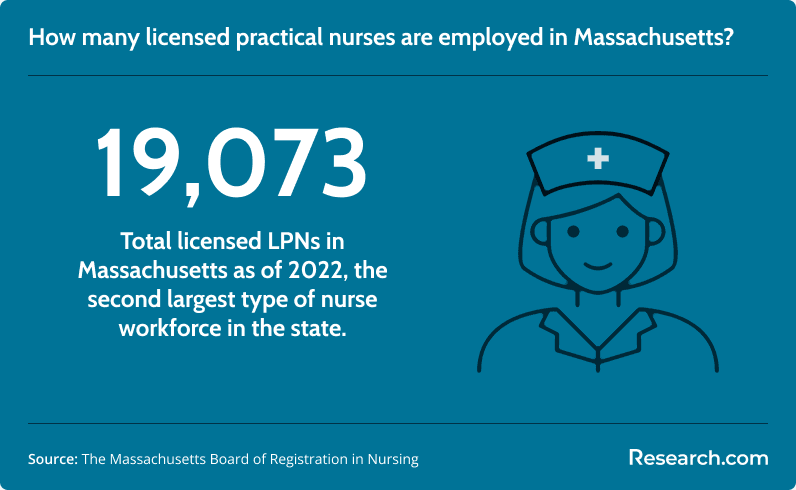
Massachusetts licenses nurses to protect patients and maintain minimum professional standards. As of 2022, there were 19,073 licensed LPNs in Massachusetts, making LPNs the second largest group in the nursing workforce described in the source data.
- Approved education: RN applicants need an eligible nursing degree, usually an ADN or BSN. LPN applicants generally complete a practical nursing diploma or certificate program.
- NCLEX exam: RN candidates must pass the NCLEX-RN. LPN candidates must pass the NCLEX-PN.
- Application to the state board: Candidates submit the licensure application, education records, exam information, and required fees to the Massachusetts Board of Registration in Nursing.
- Application fee: The non-refundable application fee is typically around $150.
- Background and eligibility review: Applicants should expect the board to review identity, education, exam eligibility, and other required disclosures.
The licensing process can feel slow, especially when documents are missing or school records are delayed. However, the requirements are tied to patient safety. Before you apply, confirm that your legal name is consistent across documents, your school has sent the correct records, and you have followed the board’s current instructions rather than relying on outdated third-party checklists.
What types of nursing licenses are available in Massachusetts?
Massachusetts nursing licenses reflect different levels of responsibility. Choosing the right license matters because it affects how quickly you can enter the workforce, what duties you can perform, and what future education you may need.
- Registered Nurse license: This license allows nurses to provide comprehensive patient care, administer medications, coordinate care, and take on broader clinical responsibilities.
- Licensed Practical Nurse license: This license supports practical nursing work under appropriate supervision. LPNs often work in long-term care, rehabilitation, physician offices, home health, and other settings that need direct patient-care support.
- Advanced Practice Registered Nurse authorization: This category includes nurse practitioners, clinical nurse specialists, certified registered nurse anesthetists, and certified nurse-midwives. These roles require graduate education and national certification.
- Licensure by reciprocity or endorsement: Nurses licensed in another state may apply for Massachusetts licensure without retaking the NCLEX if they meet state requirements.
| License type | When it makes sense | Trade-off |
| LPN | You want a faster route into licensed nursing care. | Scope of practice is more limited than RN practice. |
| RN through ADN | You want RN licensure and may prefer a shorter academic route before BSN completion. | Some employers may favor BSN-prepared candidates. |
| RN through BSN | You want broader career mobility, stronger preparation for leadership, or a path toward graduate school. | The program is typically longer than an ADN route. |
| APRN | You want advanced clinical authority, specialty practice, or more autonomy. | Graduate education, certification, and ongoing credentialing are required. |
Can a Compact nurse practice in Massachusetts?
Massachusetts is currently not a member of the Nurse Licensure Compact. That means a nurse who holds a multistate compact license from another participating state cannot simply begin practicing in Massachusetts on that compact license alone. The nurse must obtain a Massachusetts nursing license before practicing in the state.
This issue matters because Massachusetts has had over 5,100 vacant registered nurse positions, and state lawmakers have considered whether joining the compact could help with staffing flexibility. Supporters argue that compact participation could make it easier to recruit nurses, support telehealth, and respond to emergencies. Others focus on regulatory oversight, state standards, and workforce implications.
- If you are licensed in another state: Plan for Massachusetts endorsement or reciprocity procedures rather than assuming your current license is enough.
- If you want telehealth work: Confirm where the patient is located and what license is required for that patient’s state.
- If you are considering leadership: Understanding workforce policy can be useful, especially if you later pursue administration through options such as accelerated executive MHA programs in healthcare administration.
Can you practice as a nurse without a license in Massachusetts?
No. You cannot legally practice as a nurse in Massachusetts without the required nursing license. Licensure is not optional, and it is not just an administrative formality. It verifies that a nurse completed required education, passed the appropriate exam, and met state standards for safe practice.
This rule can be frustrating for students who are close to graduating or applicants waiting for paperwork. The national dropout rate for nursing programs in the United States is 20% to 25%, so the pathway is not easy for everyone. However, Massachusetts does not allow unlicensed individuals to bypass the legal credentialing process because nursing decisions can directly affect patient safety.
If your goal is the fastest legitimate route to RN eligibility, compare approved options carefully. Some students research fastest RN degree programs, but speed should never come at the expense of accreditation, clinical quality, NCLEX preparation, or licensure eligibility.
The projected 29,200 openings for advanced practice nurses in Massachusetts highlight the importance of qualified professionals at higher levels of care. Still, advanced roles begin with proper licensure and build from there; they do not replace the need for the foundational RN credential.
What is the state of nursing in Massachusetts?
Nursing in Massachusetts offers strong opportunity, but it also comes with pressure. The state has a major healthcare sector, well-known hospitals, academic medical centers, community providers, long-term care facilities, and expanding outpatient and telehealth services. At the same time, staffing shortages, burnout, and workplace safety concerns have made nursing workforce stability a major issue. The Massachusetts Nurses Association has reported on challenges and complexities affecting nurses in the state.
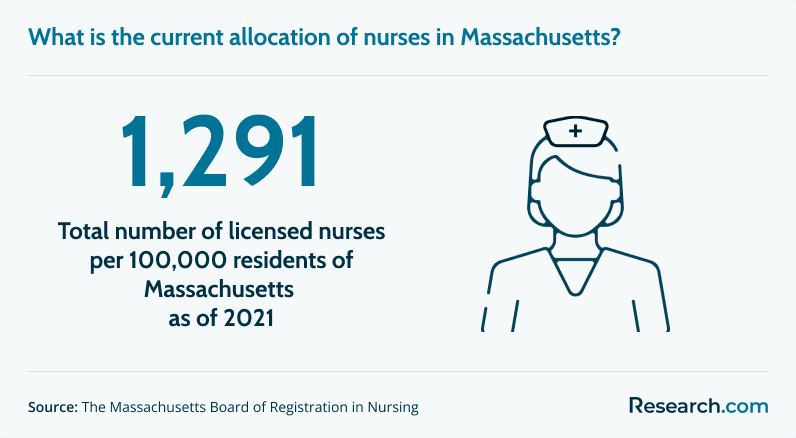
Recent data showed 1,291 nurses per 100,000 residents as of 2021. Even with a sizable workforce, demand continues to rise in many settings. The issue is not only the number of licensed nurses; it is also where nurses work, whether they remain in bedside roles, how employers manage staffing, and whether new graduates receive enough support to transition safely into practice.
Massachusetts salaries can be attractive compared with many states, but the cost of living can reduce the practical value of those earnings, especially in the Boston area. Students should compare expected wages with housing, commuting, loan payments, childcare, and schedule requirements before assuming that a higher salary automatically means a better financial outcome.
What challenges do nurses face in Massachusetts?
Prospective nurses should understand the working conditions they may encounter, not just the licensing steps. Nursing can be rewarding, but it is physically, emotionally, and administratively demanding.
- Staffing pressure: Shortages can increase patient loads and make shifts more intense.
- Burnout risk: Long shifts, emotional labor, documentation demands, and high-acuity patients can contribute to stress.
- Regulatory updates: Nurses must keep up with changing policies, documentation rules, safety requirements, and continuing education expectations.
- Workplace safety concerns: Nurses may face infectious disease exposure, patient aggression, workplace violence, and musculoskeletal strain.
- Technology demands: Electronic health records, remote monitoring, medication systems, and telehealth tools require ongoing learning.
- Resource limitations: Some workplaces face budget constraints, limited support staff, or shortages of supplies and equipment.
The best preparation is not only academic. Before choosing a program, talk with current nurses, shadow when possible, review clinical placement settings, and ask schools how they help students build resilience, communication skills, and safe clinical judgment.
What opportunities exist for LPN careers in Massachusetts?
LPN careers can be a practical entry point for students who want to begin licensed nursing work sooner than a traditional RN pathway may allow. LPNs often support patients in long-term care, rehabilitation, home health, clinics, and other care environments. They perform important hands-on duties while working within a more limited scope than RNs.
If you are considering this path, compare program approval, clinical hours, NCLEX-PN preparation, schedule format, graduation support, and local employer connections. Researching online LPN programs in Massachusetts can help you evaluate program options, but be careful: even if coursework is online, nursing programs usually include in-person labs, simulations, or clinical placements.
| LPN path may be a good fit if... | You may prefer an RN path if... |
| You want a faster route into licensed bedside care. | You want broader assessment, care planning, and leadership responsibilities. |
| You are comfortable working under RN or physician supervision. | You want more flexibility across acute care, specialty units, and graduate school pathways. |
| You plan to gain experience first and possibly bridge to RN later. | You already know you want advanced practice, management, or specialty nursing roles. |
What is the job outlook for nursing in Massachusetts?
The job outlook for nursing in Massachusetts remains strong. According to the Massachusetts Executive Office of Labor and Workforce Development, nursing jobs in the state are expected to grow 12% through 2030.
Compensation is another reason many students consider nursing in the state. One reported figure places the average annual salary for registered nurses in Massachusetts at approximately $99,730, compared with the national average of around $86,070. Another reported figure places the Massachusetts RN average at approximately $108,850 per year. Differences like these can occur because salary sources may use different years, employer samples, or occupational definitions.
Students with an ADN can also research how earnings vary by state and role through resources on associate degree in nursing salary. However, salary should not be viewed in isolation. A job with higher pay may also involve nights, weekends, overtime, commuting costs, higher patient acuity, or expensive housing nearby.
| Factor | Why it matters for Massachusetts nursing jobs |
| Cost of living | Higher wages may be offset by housing and transportation costs, particularly near Boston. |
| Work setting | Hospitals, outpatient care, home health, specialty hospitals, and long-term care may offer different schedules and stress levels. |
| Degree level | BSN-prepared nurses may have stronger access to certain employers, specialties, and advancement routes. |
| Experience | New graduates often need residency, mentoring, or structured onboarding before moving into specialty roles. |
| Specialty | Critical care, maternal health, geriatrics, mental health, advanced practice, and informatics can each offer different career trajectories. |
What are the nurse practitioner education requirements in Massachusetts?
Nurse practitioners in Massachusetts need advanced education beyond initial RN preparation. The pathway generally includes RN licensure, graduate nursing education, supervised clinical preparation, and national certification in the intended specialty. Programs should be evaluated for curriculum depth, clinical placement support, certification preparation, and whether graduates meet Massachusetts authorization requirements.
If you are planning this route, review nurse practitioner education requirements in Massachusetts before choosing a graduate program. This is especially important if you are comparing online, hybrid, and campus-based options, because clinical placement rules and state authorization can affect whether a program is practical for you.
Are there affordable advanced nursing education options in Massachusetts?
Advanced nursing education can be expensive, but nurses can reduce the burden by comparing tuition, fees, employer reimbursement, scholarships, federal aid, repayment options, and part-time formats. Online and hybrid programs may help working nurses continue earning while completing advanced coursework, but affordability should be evaluated alongside accreditation, clinical support, graduation expectations, and certification outcomes.
Nurses considering doctoral study can review most affordable BSN to DNP programs online to compare budget-conscious routes. The lowest tuition is not always the best value if a program lacks clinical placement help, has weak student support, or does not align with your intended advanced practice specialty.
How can I transition from RN to an advanced practice role in Massachusetts?
Moving from RN practice into an advanced role requires more than enrolling in graduate school. You need a clear specialty goal, relevant clinical experience, strong academic readiness, and a realistic plan for balancing work, coursework, and practicum hours.
- Confirm that your RN license is active and in good standing.
- Choose an advanced practice specialty, such as family practice, psychiatric-mental health, nurse-midwifery, anesthesia, or clinical specialization.
- Compare graduate programs for accreditation, certification alignment, clinical placement support, and state eligibility.
- Plan finances before enrolling, including tuition, fees, lost work hours, and exam costs.
- Build experience in settings related to your future specialty.
- Complete graduate education, clinical requirements, certification, and Massachusetts authorization steps.
If family practice is your target, BSN to FNP programs online can help you compare flexible pathways designed for nurses who want advanced primary care preparation while managing work obligations.
What are the essential steps to become an LVN in Massachusetts?
Massachusetts commonly uses the LPN title rather than LVN, but the basic idea is similar: practical or vocational nursing is a licensed pathway focused on direct patient care under appropriate supervision. Students interested in this level should confirm the exact state terminology and licensure route before enrolling in any program that advertises itself using LVN language.
The basic steps include choosing a state-approved practical nursing program, completing required classroom and clinical training, preparing for the NCLEX-PN, applying for Massachusetts licensure, and working within the legal LPN scope of practice. For a role-specific overview, review how to become an LVN in Massachusetts.
How are technology and telehealth changing nursing practice in Massachusetts?
Technology is now part of everyday nursing work in Massachusetts. Nurses use electronic health records, medication administration systems, patient portals, remote monitoring tools, and telehealth platforms. These tools can improve communication and access, but they also require strong documentation habits, privacy awareness, digital literacy, and the ability to assess patients when some information is gathered remotely.
Telehealth is especially relevant for chronic disease management, follow-up care, behavioral health support, triage, and patient education. Nurses who are comfortable with digital tools may be better positioned for hybrid clinical roles, care coordination, informatics, and remote patient monitoring. Students comparing flexible education options can review best online nursing programs in Massachusetts, but they should still confirm clinical placement requirements and licensure alignment.
Opportunities for specialization and career growth in Massachusetts nursing
Specialization can help nurses move beyond entry-level practice and build expertise in areas such as gerontology, neonatal care, mental health, maternal health, critical care, community health, informatics, education, or advanced practice. Massachusetts employers may value nurses who can serve complex patient populations, coordinate care across systems, and adapt to changing models of healthcare delivery.
Advanced practice is one route to specialization. Nurses interested in nurse practitioner roles can compare the best NP programs in Massachusetts to evaluate curriculum, clinical requirements, certification preparation, and program flexibility. Specialty certification can also strengthen a resume, but it should match your actual clinical experience and career goals.
| Specialization route | Best for nurses who want... | Questions to ask first |
| Clinical specialty certification | Recognition in areas such as critical care, diabetes care, oncology, or emergency nursing. | Do I have the required experience, and will my employer value this credential? |
| Graduate advanced practice degree | Greater diagnostic, treatment, prescribing, or specialty care responsibility. | Does the program meet Massachusetts requirements and prepare me for national certification? |
| Leadership or administration | Management, staffing, operations, quality improvement, or policy work. | Do I prefer systems-level work over direct bedside care? |
| Informatics or telehealth | Technology-supported care, data workflows, remote monitoring, or digital health roles. | Am I ready to develop technical, privacy, and process-improvement skills? |
What financial assistance options are available for aspiring nurses in Massachusetts?
Nursing school costs can include tuition, fees, books, uniforms, clinical supplies, testing fees, background checks, transportation, and reduced work hours during clinical rotations. Before enrolling, calculate the full cost of attendance rather than comparing tuition alone.
- Federal student aid: Complete required financial aid applications early and review loan terms carefully.
- Scholarships and grants: Look for school-based awards, community scholarships, healthcare workforce grants, and awards tied to service commitments.
- Employer tuition assistance: Hospitals, long-term care facilities, and healthcare systems may support employees who continue nursing education.
- Loan repayment or forgiveness options: Some programs may be linked to service in high-need settings, but eligibility rules must be reviewed closely.
- Part-time or bridge programs: Working while studying may reduce borrowing, though it can extend the timeline.
When comparing schools, use best nursing schools in Massachusetts as a starting point, then ask each institution for a detailed cost estimate, scholarship deadlines, NCLEX support information, and clinical placement policies.
Is nurse-midwifery a practical advanced nursing path in Massachusetts?
Nurse-midwifery can be a strong advanced practice option for nurses interested in reproductive health, pregnancy, birth, postpartum care, preventive services, and family-centered care. It requires graduate-level preparation, national certification, and compliance with Massachusetts advanced practice requirements.
This path is best for nurses who want long-term relationships with patients, comfort with both normal and complex maternal health situations, and readiness for demanding clinical responsibility. If you are considering this specialty, review how to become a nurse midwife in Massachusetts and compare programs for clinical placement quality, certification preparation, and state authorization.
Common mistakes to avoid when becoming a nurse in Massachusetts
| Mistake | Why it can hurt you | Better approach |
| Choosing a program without confirming approval or accreditation | You may complete coursework that does not lead to Massachusetts licensure eligibility. | Verify program status with the school and the Massachusetts Board of Registration in Nursing. |
| Focusing only on tuition | Fees, supplies, testing, transportation, and lost work time can change the true cost. | Request a full cost-of-attendance estimate before enrolling. |
| Assuming online means fully remote | Nursing programs usually require labs, simulations, or in-person clinical experiences. | Ask where clinicals occur and whether the school arranges placements. |
| Ignoring NCLEX support | Passing the licensing exam is essential for practice. | Ask about NCLEX preparation, practice testing, tutoring, and retake support. |
| Assuming salary averages guarantee your earnings | Pay varies by employer, setting, shift, region, experience, and specialty. | Compare local job postings and consider cost of living. |
| Waiting too long to prepare licensure documents | Missing transcripts, name mismatches, or incomplete forms can delay approval. | Create a document checklist before graduation. |
Can nurses benefit from complementary pharmacy career opportunities in Massachusetts?
Nurses do not need to become pharmacists to strengthen medication knowledge, but understanding pharmacy practice can improve patient education, medication reconciliation, safety monitoring, and interdisciplinary communication. This is especially useful in chronic disease management, geriatric care, oncology, critical care, and transitions of care.
Nurses who are curious about pharmacy as a separate professional path can review how to become a pharmacist in Massachusetts. For most nurses, the more practical move is to build medication-safety expertise within nursing through continuing education, specialty training, or collaboration with pharmacists.
Can non-clinical expertise strengthen a nursing career in Massachusetts?
Yes. Non-clinical skills can make nurses more competitive for roles in quality improvement, case management, informatics, utilization review, revenue cycle support, clinic operations, education, and leadership. These skills are especially valuable for nurses who want alternatives to full-time bedside care or who need a career path with different physical demands.
Administrative knowledge can also help nurses understand documentation, reimbursement, coding accuracy, and workflow efficiency. If this direction interests you, explore how to become a medical biller and coder in Massachusetts as a complementary healthcare skill set.
How can nurses simplify the licensing process in Massachusetts?
The licensing process becomes easier when you treat it like a project with deadlines, documents, and verification steps. Do not wait until after graduation to understand what the state requires.
- Confirm that your nursing program qualifies graduates for Massachusetts licensure.
- Use the same legal name across school records, exam registration, and the state application.
- Track transcript requests and confirm when they are sent.
- Schedule the correct NCLEX exam and follow all testing instructions.
- Keep copies of receipts, confirmations, and correspondence.
- Respond quickly if the board requests additional information.
- Review current state instructions rather than relying on old forum posts or unofficial checklists.
For a focused checklist, review the requirements for nursing licensure in Massachusetts before submitting your application.
Related Articles for Nearby States
- 2027 How to Become a Nurse in Rhode Island
- 2027 How to Become a Nurse in Connecticut
- 2027 How to Become a Nurse in New Hampshire
- 2027 How to Become a Nurse in New York
- 2027 How to Become a Nurse in Vermont
- 2027 How to Become a Nurse in New Jersey
- 2027 How to Become a Nurse in Maine
- 2027 How to Become a Nurse in Pennsylvania
- 2027 How to Become a Nurse in Delaware
- 2027 How to Become a Nurse in Maryland
References:
- Massachusetts Board of Registration in Nursing (2023)
- Massachusetts Healthcare and Hospital Association (2023). Massachusetts Healthcare Organizations Urge Passage of the Nurse Licensure Compact.
- Regis College. How to Become a Nurse in Massachusetts.
- NurseJournal.org (2022). Massachusetts Nursing License Requirements.
- U.S. Bureau of Labor Statistics. (2023). Occupational Outlook Handbook - Nurse Anesthetists, Nurse Midwives, and Nurse Practitioners.
Key Insights
- Massachusetts nursing careers offer strong opportunity, but licensure is mandatory and the process requires planning, documentation, and exam preparation.
- The best nursing pathway depends on your goal: LPN for faster licensed entry, ADN for a shorter RN route, BSN for broader mobility, and graduate education for APRN roles.
- Massachusetts is not currently part of the Nurse Licensure Compact, so out-of-state compact nurses need a Massachusetts license before practicing in the state.
- Salary figures for Massachusetts RNs are high compared with national averages, but cost of living, schedule demands, employer type, and specialty should be included in any ROI calculation.
- Before enrolling, verify accreditation or state approval, clinical placement support, NCLEX preparation, total program cost, and whether the program meets Massachusetts licensure requirements.
- Technology, telehealth, staffing pressure, and burnout are shaping nursing practice in Massachusetts, so students should prepare for both clinical competence and workplace resilience.
Other Things You Need to Know About Nursing in Massachusetts
In 2027, to become a registered nurse in Massachusetts, you need a nursing diploma from an approved program, an Associate Degree in Nursing (ADN), or a Bachelor of Science in Nursing (BSN). Additionally, you must pass the NCLEX-RN exam and obtain a Massachusetts nursing license.
To become a registered nurse in Massachusetts in 2027, earn an ADN or BSN from an accredited nursing program. Pass the NCLEX-RN exam. Apply for licensure with the Massachusetts Board of Registration in Nursing and meet continuing education requirements for ongoing license renewal.


