
2027 Average Travel Nurse Salary by State: How Much Do Travel Nurses Make?

Co-Founder and Chief Data Scientist
Travel nursing can pay well, but the headline rate rarely tells the full story. A contract that looks high at first glance may become less attractive after taxes, housing costs, licensing delays, missed stipends, cancellation terms, or gaps between assignments. For nurses comparing travel work with permanent roles, choosing an agency, or deciding which state or specialty to target, understanding total compensation is more useful than looking at salary alone.
This guide explains travel nurse pay, the states and specialties with the strongest reported earnings, how travel pay compares with staff nurse wages, what benefits are commonly included, and how to evaluate contracts before accepting an assignment. It is designed for registered nurses considering travel work, current travel nurses trying to increase earnings, and healthcare professionals planning a longer-term nursing career.
Quick answer: how much do travel nurses make?
As of April 2024, the national average salary for travel nurses is approximately $83,200 annually. Reported earnings vary widely: travel nurses in the 10th percentile earn about $67,900 annually, while those in the 90th percentile make up to $100,400 per year. Pay depends heavily on location, specialty, experience, certifications, shift, contract terms, benefits, and whether stipends are included in the quoted package.
Key takeaways about travel nurse pay
- As of April 2024, the national average salary for travel nurses is approximately $83,200 annually.
- The 10th percentile of travel nurses earns about $67,900 annually, while those in the 90th percentile make up to $100,400 per year.
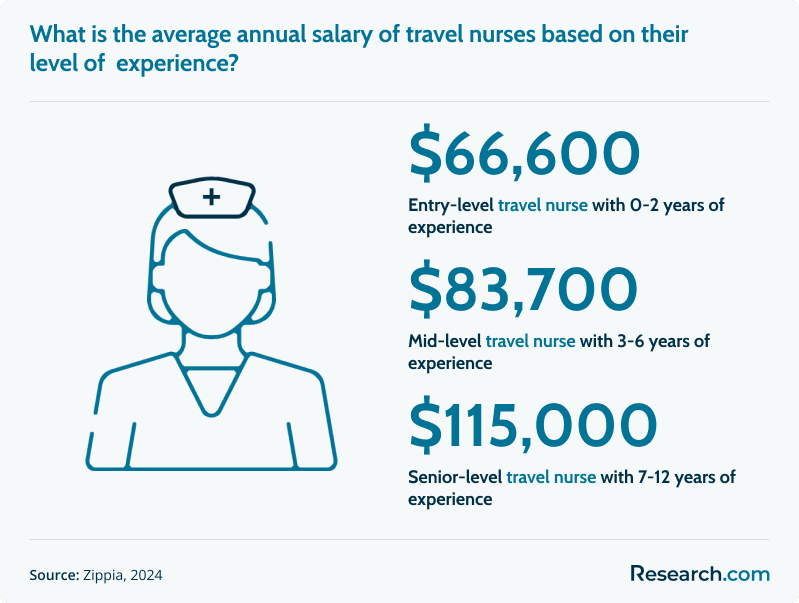
- Entry-level travel nurses with 0-2 years of experience earn 58% less than senior-level travel nurses with 7-12 years of experience.
- In early 2022, travel nurses earned nearly $3,200 per week, significantly higher than permanent staff nurses, who averaged $1,290 per week.
- New York offers the highest average annual salary for travel nurses at $112,944 annually.
- National average travel nurse salary for 2027
- Main factors that influence travel nurse compensation
- Travel nurse pay compared with permanent nurse pay
- Highest-paying states for travel nurses
- Lowest-paying states for travel nurses
- Travel nurse salary by specialization
- Common travel nurse benefits and incentives
- What to evaluate before choosing a travel nurse agency
- Highest-paying travel nurse agencies
- Travel nurse salary trends
- Ways travel nurses can increase pay
- Multi-state licensing guidance for travel nurses
- Contract clauses travel nurses should review carefully
- How travel nurses can future-proof their careers
- Balancing short-term assignments with professional development
- Mentorship and networking strategies for travel nurses
- Core skills travel nurses need to succeed
- Advanced education options for specialization
- Long-term career growth options for travel nurses
- Transitioning from paramedic to travel nurse
- Using public health expertise in travel nursing assignments
- How to select the best travel nurse agency for your goals
What is the national average travel nurse salary for 2027?
As of April 2024, travel nurses earn a national average salary of around $83,200 annually. This figure is useful as a baseline, but it should not be treated as a guaranteed outcome. A nurse’s actual take-home pay can shift significantly based on contract structure, location, specialty, taxable hourly wage, stipends, overtime, agency fees, and the number of weeks worked in a year.
The reported pay range also shows how uneven travel nurse earnings can be. Nurses at the 10th percentile make approximately $67,900 annually, which may reflect less experience, lower-paying regions, fewer premium shifts, or assignments with limited stipends. At the higher end, nurses in the 90th percentile earn up to $100,400 yearly, often because they bring stronger experience, specialty skills, certifications, or flexibility to work in harder-to-staff locations.
Travel nursing has attracted over 1.7 million professionals across the United States, but earnings are not uniform. Before accepting an assignment, compare the complete compensation package rather than focusing only on the advertised annual or weekly rate.
What factors affect travel nurse salaries?
Travel nurse compensation is shaped by several variables that work together. A high hourly rate may be offset by expensive housing, while a moderate rate can become attractive if the assignment includes strong stipends, low living costs, overtime opportunities, and reliable scheduling.
| Factor | How it affects pay | What nurses should check |
| Location | States and cities with higher living costs, staffing shortages, or urgent demand often offer stronger pay packages. | Compare the pay package against local housing, transportation, taxes, and the cost of temporary relocation. |
| Specialty | High-acuity or hard-to-staff specialties such as ICU, ER, OR, telemetry, and oncology can command higher compensation. | Confirm whether the facility requires recent experience, specialty certification, floating, call, or specific equipment skills. |
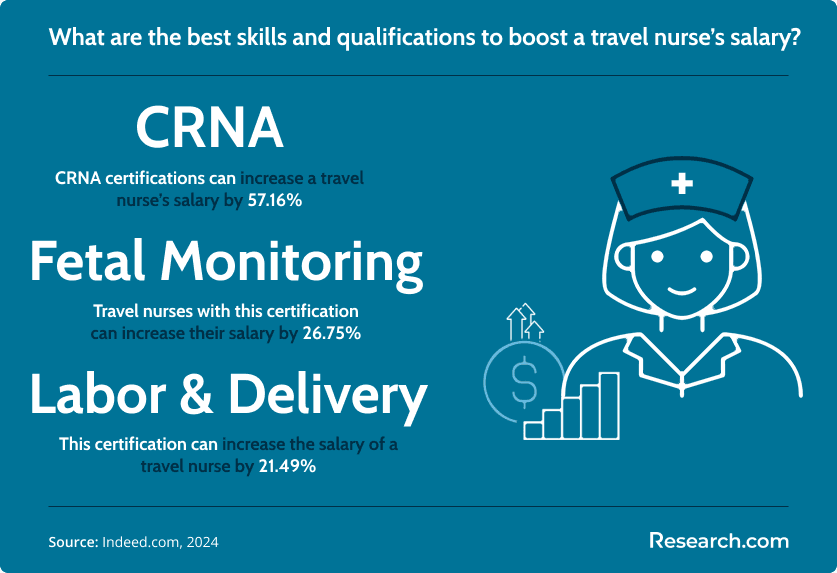
| Certifications | Additional credentials can make a nurse more competitive for premium assignments. | Ask which certifications are required, preferred, reimbursed, or tied to higher rates. |
| Experience | More experienced nurses usually qualify for more complex roles and stronger contracts. Entry-level travel nurses with 0-2 years of experience earn 58% less than senior-level travel nurses with 7-12 years of experience. | Review whether your clinical background matches the assignment’s patient acuity and independent practice expectations. |
| Contract terms | Overtime, guaranteed hours, cancellation rules, shift differentials, call pay, and completion bonuses can meaningfully change total earnings. | Read the written contract and do not rely only on recruiter summaries. |
- Location matters, but so does cost of living. A high-paying assignment in an expensive city may not produce the best net savings. Compare housing options, commute costs, parking, meals, and local taxes before accepting.
- Specialization can improve leverage. Nurses with ICU, surgical, telemetry, emergency, neonatal, oncology, or post-anesthesia experience may qualify for roles with stronger pay because these settings require specific clinical judgment and rapid adaptation. Nurses who want to move into advanced practice may consider options such as affordable MSN pathways if graduate education fits their goals.
- Certifications can make applications more competitive. Agencies and facilities may prioritize nurses who already meet specialty, life support, or unit-specific requirements because they can onboard faster.
- Experience changes earning power. Senior nurses tend to have stronger negotiating power because they can manage complex assignments with less orientation. Nurses aiming for advanced practice roles may compare options such as the most affordable online nurse practitioner programs before committing to additional education.
How do travel nurse salaries compare to permanent nurse salaries?
Travel nurses often earn more than permanent staff nurses, especially when facilities face urgent staffing needs. In early 2022, weekly earnings for travel nurses surged to nearly $3,200. That spike reflected strong demand for nurses who could relocate quickly, fill temporary gaps, and work where staffing pressure was most severe.
Permanent staff nurses earned much less during the same period, with average weekly pay of $1,290. That amount was nearly $190 less than the previous year. The comparison shows why travel nursing can be financially attractive, but it also highlights an important caution: travel pay can move with market conditions, hospital budgets, seasonal demand, and agency contracts.
| Path | Potential advantage | Potential trade-off |
| Travel nursing | Higher short-term earnings, location flexibility, varied clinical experience, and possible stipends. | Less schedule stability, frequent onboarding, changing teams, licensing complexity, and possible contract cancellations. |
| Permanent staff nursing | More predictable hours, stronger workplace continuity, employer benefits, seniority, and local stability. | Lower short-term earning spikes and less flexibility to pursue high-demand contracts in other markets. |
What are the top-paying states for travel nurses?
For nurses trying to maximize income, state-level pay data can help narrow the search. However, the highest listed salary is not automatically the best assignment. Review housing availability, state licensing rules, tax treatment, assignment length, required shifts, and whether the facility guarantees hours.
| State | Reported average annual pay | Lowest 10th percentile | Highest 10th percentile |
| New York | $112,944 | $66,000 | $190,000 |
| Connecticut | $111,005 | $65,000 | $186,000 |
| Rhode Island | $109,043 | $64,000 | $183,000 |
| Michigan | $108,277 | $64,000 | $181,000 |
| Washington | $107,658 | $73,000 | $157,000 |
| Massachusetts | $105,266 | $62,000 | $177,000 |
| Wisconsin | $98,435 | $59,000 | $162,000 |
| New Hampshire | $95,063 | $55,000 | $161,000 |
| Indiana | $93,092 | $53,000 | $162,000 |
| Maine | $90,520 | $52,000 | $155,000 |
New York leads this list with an average annual salary of $112,944 annually. Before choosing a state based on pay alone, calculate expected net income after temporary housing, travel, licensing, professional expenses, and any unpaid time between contracts.
What are the lowest-paying states for travel nurses?
Lower average salary does not always mean a poor assignment. Some lower-paying states may have lower housing costs, easier commutes, desirable schedules, less competition, or better fit for a nurse’s lifestyle. Still, these figures are useful for setting expectations during contract negotiation.
| State | Reported average annual pay |
| Iowa | $64,402 |
| Utah | $71,628 |
| West Virginia | $73,407 |
| Nebraska | $74,217 |
| Kansas | $74,871 |
| Ohio | $76,751 |
| Alabama | $77,588 |
| Mississippi | $78,188 |
| South Carolina | $78,431 |
| Oregon | $85,917 |
How much do travel nurses make in different specializations?
Specialty choice can be one of the strongest levers for travel nurse earnings. High-acuity units, surgical environments, and roles requiring rapid independent judgment often offer more competitive packages. Advanced education is not required for every specialty, but nurses considering long-term specialization may compare options such as the cheapest online masters programs if graduate study aligns with their career plan.
| Specialization | Reported annual salary range | Typical assignment focus |
| Telemetry Travel Nurse | $120,690-$168,000/year | Cardiac monitoring, rhythm interpretation, vital sign surveillance, and rapid response to changes in patient condition. |
| PACU Travel Nurse | $110,500-$147,500/year | Post-anesthesia recovery, pain management, vital signs, and post-operative complication monitoring. |
| Oncology Travel Nurse | $105,500-$144,000/year | Cancer treatment support, medication administration, patient education, and coordination with oncology care teams. |
| ICU Travel Nurse | $104,000-$143,000/year | Critical care, complex monitoring, ventilators, high-alert medications, and support for unstable patients. |
| OR Travel Nurse | $94,573-$171,500/year | Surgical preparation, sterile technique, intraoperative support, and patient safety in operating rooms. |
| NICU Travel Nurse | $93,000-$154,500/year | Care for premature or medically fragile newborns, medication administration, and neonatal monitoring. |
| ER Travel Nurse | $86,737-$156,000/year | Triage, emergency stabilization, rapid assessment, trauma response, and coordination with multidisciplinary teams. |
| Pediatric Travel Nurse | $76,348-$119,000/year | Care for children in hospitals or clinics, family education, medication administration, and age-appropriate assessment. |
Telemetry Travel Nurse ($120,690-$168,000/year)
Telemetry travel nurses care for patients who need continuous cardiac or physiologic monitoring. Their work often includes reviewing ECG data, watching for abnormal rhythms, responding to clinical changes, documenting trends, and coordinating with providers when a patient’s status shifts.
PACU Travel Nurse ($110,500-$147,500/year)
PACU travel nurses support patients immediately after anesthesia and surgery. They monitor airway status, pain control, vital signs, nausea, bleeding, and post-operative complications while helping patients move safely through the recovery phase.
Oncology Travel Nurse ($105,500-$144,000/year)
Oncology travel nurses provide care for patients receiving cancer treatment. Their responsibilities may include administering medications, monitoring treatment responses, educating patients and families, and offering emotional support during complex episodes of care.
ICU Travel Nurse ($104,000-$143,000/year)
ICU travel nurses work with critically ill patients who need close monitoring, complex medication management, specialized equipment, and rapid clinical decision-making. These assignments usually require recent intensive care experience and comfort with high-acuity workflows.
OR Travel Nurse ($94,573-$171,500/year)
Operating room travel nurses support surgical teams before, during, and after procedures. They may prepare rooms, maintain sterile environments, assist with equipment, support surgeons and anesthesiology teams, and help protect patient safety throughout the procedure.
NICU Travel Nurse ($93,000-$154,500/year)
NICU travel nurses care for premature and medically fragile newborns. Their role may include precise medication administration, feeding support, respiratory monitoring, family communication, and coordination with neonatologists and neonatal specialists.
ER Travel Nurse ($86,737-$156,000/year)
ER travel nurses work in fast-moving emergency departments where quick assessment, triage, treatment, and team communication are essential. They must be prepared for unpredictable patient volume and a wide range of urgent conditions.
Pediatric Travel Nurse ($76,348-$119,000/year)
Pediatric travel nurses care for infants, children, and adolescents in hospitals, clinics, and specialty settings. In addition to clinical care, they often educate families, advocate for young patients, and adapt communication to each child’s developmental stage.
Nurses comparing clinical paths may also want to review how much aesthetic nurses make a year. Aesthetic nursing and travel nursing can appeal to different goals, so the better choice depends on preferred work setting, schedule, patient population, and long-term career direction rather than pay alone.
What common benefits and incentives are offered to travel nurses?
Travel nurse compensation often includes more than base pay. According to Salary.com, benefits account for around 30% of total compensation. These may include Social Security contributions, retirement plan contributions such as 401K/403B options, disability coverage, health benefits, pension contributions, and paid time off.
Because agencies structure packages differently, nurses should ask for a written breakdown of taxable wages, stipends, reimbursements, insurance costs, retirement contributions, overtime rates, and any bonus conditions. A package with a lower base wage but stronger benefits may be better for some nurses, while others may prioritize cash flow and assignment flexibility.
Here is the breakdown of compensation and benefits received by travel nurses:
What are the key considerations when choosing a travel nurse agency?
The agency you choose can affect your pay, licensing timeline, housing experience, contract transparency, and support when problems arise. Do not choose an agency only because a recruiter quotes the highest number. Ask for the full pay package, contract language, onboarding support, and assignment expectations in writing.
| Agency factor | Why it matters | Questions to ask |
| Reputation | Reviews from current and former nurses can reveal whether the agency pays accurately, communicates clearly, and supports nurses during difficult assignments. | What do nurses say about payroll, recruiter responsiveness, housing help, and issue resolution? |
| Compensation package | Base pay, stipends, reimbursements, bonuses, benefits, and overtime rules all affect total earnings. | Can I see the taxable wage, stipends, overtime rate, guaranteed hours, and bonus conditions separately? |
| Assignment options | A broader assignment network can give you more control over location, specialty, shift, and facility type. | Which states, specialties, and facility types does the agency regularly staff? |
| Support services | Travel nurses may need help with housing, payroll, credentialing, scheduling issues, or emergency changes. | Is support available 24/7, and who handles problems after normal business hours? |
| Licensing and compliance | State rules and credentialing delays can postpone start dates and reduce income. | Will the agency help with state licensure, compliance documents, and renewal tracking? |
| Contract flexibility | Assignment length, extensions, cancellations, and start dates affect income stability and lifestyle. | What happens if the facility cancels, cuts hours, floats me, or asks for an extension? |
Additional education can also affect agency options over time. Nurses who want to strengthen their credentials while continuing to work may compare affordable online RN to BSN programs before choosing a long-term academic path.
Which agencies offer the highest pay for travel nurses?
Based on Indeed.com data drawn from 139,300 reported salaries, the following companies reported some of the highest average annual pay for travel nurses. These figures can be useful for comparison, but nurses should still review contract details, facility requirements, recruiter support, benefits, and assignment availability.
- GHR Healthcare ($127,850/year). GHR Healthcare provides healthcare staffing services across the US and connects medical professionals, including travel nurses, with facilities seeking short-term or long-term staffing support.
- Astrya Global ($127,666/year). Astrya Global focuses on healthcare placements across multiple medical fields, including nursing, and offers compensation packages and employment support for healthcare professionals.
- Nomad Health ($125,984/year). Nomad Health operates as an online healthcare staffing marketplace that directly connects travel nurses and other healthcare professionals with hospitals nationwide.
- TRS Healthcare ($120,195/year). TRS Healthcare places travel nurses in facilities across the country and has a 25-year history of staffing nurses in a range of specialties across all 50 states.
- RNnetwork ($113,914/year). RNnetwork, part of the CHG Healthcare family, specializes in travel nurse placements and matches nurses with assignments across the U.S.
What are the salary trends for travel nurses?
In 2024, the average travel nurse salary reached $83,961 annually, a 2.8% increase from the previous year. Over the past decade, reported annual growth has generally remained around 2-5%. From 2010 to 2024, travel nurse salaries increased from $63,008 to $83,961, representing a 33% rise during that period.
These trends reflect continued demand for nurses, including pressure connected to the ongoing nursing shortage. Still, travel nurse pay can fluctuate. Emergency demand, hospital budgets, regional staffing levels, and specialty shortages can all affect whether contracts rise, flatten, or become more competitive.
How can travel nurses increase their salary?
Travel nurses can improve earnings by being strategic about assignments, credentials, contract negotiation, and career development. The goal is not only to chase the highest posted rate, but to choose contracts that improve net income, experience, and future bargaining power.
- Negotiate with evidence. Use your specialty, years of experience, certifications, recent unit experience, and competing offers to discuss pay. Ask about base rate, stipends, overtime, guaranteed hours, completion bonuses, and reimbursement terms.
- Stay flexible when the trade-off makes sense. Nurses who can accept night shifts, weekends, crisis needs, hard-to-fill locations, or quick starts may find stronger offers. Make sure the pay premium is worth the schedule and relocation burden.
- Build a record of strong performance. Reliable attendance, quick onboarding, strong documentation, and positive facility feedback can help you secure better assignments later.
- Keep learning. Staying current with clinical practice and technology makes you more valuable across settings. Nurses with an associate degree may also explore cheap accredited online bachelor degree programs or affordable accelerated bachelor's degree programs online if a bachelor’s degree supports future advancement.
- Specialize in high-demand areas. Certifications and experience in ICU, ER, OR, telemetry, oncology, PACU, or NICU may open access to stronger contracts. Some nurses also add adjacent skills through options such as affordable online medical billing and coding schools. For nurses comparing advanced practice paths, reviewing FNP vs DNP salary can help clarify longer-term earning and role differences.
| Common mistake | Why it can hurt earnings | Better approach |
| Accepting the highest quoted weekly number without reading the contract | The offer may depend on stipends, bonuses, or assumptions that do not apply to your situation. | Request a written pay breakdown and calculate expected take-home income. |
| Ignoring housing costs | High-paying areas may also have expensive short-term rentals, parking, and commuting costs. | Research housing before signing and compare agency housing with a stipend option. |
| Assuming every assignment guarantees full hours | Cancelled shifts can reduce earnings if guaranteed hours are weak or missing. | Review guaranteed-hours language and cancellation policies. |
| Letting licenses or certifications lapse | Credentialing delays can cause missed start dates or lost contracts. | Track renewal dates and start licensure steps early. |
| Choosing agencies only by advertised pay | Poor payroll support, weak communication, or unclear contracts can create financial stress. | Compare recruiter quality, support, benefits, and contract transparency. |
How do travel nurses navigate multi-state licensing requirements?
Travel nurses need to manage licensure before it becomes a barrier to assignment start dates. State-specific rules can differ, and delayed paperwork can mean lost income. Nurses should identify whether a target state participates in a nursing licensure compact, confirm current requirements with the appropriate state board, and keep certifications and background documents organized.
Credentialing support from a reliable agency can make this process easier, but nurses should not rely entirely on recruiters. Maintain personal copies of licenses, immunization records, certifications, references, transcripts, and employment verification. Nurses who want to advance academically while keeping mobility may also consider bridge options such as ADN MSN bridge programs.
What contract clauses are critical for travel nurses to review?
A travel nurse contract should clearly explain how and when you are paid, what happens if the facility changes its needs, and what support is available if the assignment does not go as expected. Review the document before signing and ask for clarification in writing.
- Assignment dates and guaranteed hours: Confirm start date, end date, weekly hours, shift, weekend requirements, and whether hours are protected if the facility cancels shifts.
- Pay structure: Separate taxable hourly wages from housing stipends, meal stipends, travel reimbursement, overtime, call pay, holiday pay, and completion bonuses.
- Cancellation terms: Check what happens if the hospital cancels the contract, reduces hours, delays your start, or ends the assignment early.
- Floating and scope expectations: Make sure the contract explains whether you may float to other units and whether those units match your competency.
- Housing and travel terms: Understand whether housing is agency-provided or stipend-based, and confirm reimbursement rules before paying out of pocket.
- Liability and insurance: Ask what coverage is included and whether you need separate professional liability insurance.
Advanced credentials may improve negotiating leverage in specialized roles. Nurses interested in integrative or advanced-practice pathways can review what it takes to become a functional medicine nurse.
How can travel nurses future-proof their careers?
Travel nursing rewards adaptability, but long-term success requires more than being willing to relocate. Nurses should build credentials, clinical depth, digital comfort, and leadership skills that remain valuable even as staffing models, technology, and facility expectations change.
Future-proofing can include adding specialty certifications, documenting measurable achievements, maintaining strong references, learning new clinical technologies, and pursuing academic credentials when they support clear career goals. Nurses who want to move from RN-level roles toward broader opportunities may explore fast track RN to BSN programs if they need a quicker route to a bachelor’s degree.
How can travel nurses balance transient assignments with continuous professional development?
Short assignments can make professional development harder, but they do not have to stop it. The key is to choose learning formats that fit rotating schedules, travel days, night shifts, and unpredictable contract gaps.
- Set one professional goal per assignment, such as improving charting efficiency, gaining exposure to a specific patient population, or preparing for a certification exam.
- Use time between contracts for continuing education, renewal requirements, or skills labs.
- Choose online or flexible programs only after confirming accreditation, clinical requirements, transfer policies, and workload expectations.
- Keep a portfolio of competencies, evaluations, certifications, and facility feedback to support future applications.
Nurses seeking a manageable bachelor’s pathway may compare options such as easy online RN to BSN programs, while still verifying quality, accreditation, and fit.
What strategies can travel nurses use to build effective mentorship and professional networks?
Travel nurses often change teams quickly, so networking needs to be intentional. Strong professional relationships can lead to better references, early notice of strong assignments, specialty advice, and support when dealing with difficult contracts or unfamiliar units.
- Join professional nursing associations related to your specialty.
- Ask experienced charge nurses, preceptors, or unit educators for feedback during assignments.
- Participate in specialty conferences, webinars, and online nursing communities.
- Keep in touch with recruiters, managers, and peers who communicate clearly and act professionally.
- Offer help and share resources with other travel nurses; networking should not be one-sided.
Some nurses strengthen their clinical foundation through interdisciplinary study. For example, biology online programs may be relevant for professionals considering broader science-based academic goals.
What skills are essential for success as a travel nurse?
Travel nurses need excellent clinical judgment, but clinical ability alone is not enough. They must enter unfamiliar systems, learn local workflows quickly, communicate with new teams, and provide safe care with limited orientation.
- Adaptability: Travel nurses must adjust to different charting systems, protocols, unit cultures, patient volumes, and leadership styles without losing focus on patient safety.
- Clear communication: Strong handoffs, timely escalation, concise documentation, and respectful collaboration are essential when working with new teams.
- Clinical competence: Facilities expect travel nurses to contribute quickly, so nurses should accept assignments that match their recent experience and scope.
- Time management: Efficient prioritization helps nurses manage assessments, medications, documentation, admissions, discharges, and unexpected changes.
- Problem-solving: Travel assignments often involve unfamiliar resources or workflows, so nurses must think clearly under pressure.
- Cultural competence: Working in different regions and communities requires respect for varied patient backgrounds, communication styles, and care expectations.
- Self-care awareness: Frequent relocation, intense shifts, and isolation can contribute to burnout. Sustainable routines, rest, boundaries, and social support matter.
What advanced education options are available for travel nurses looking to specialize?
Advanced education can help travel nurses move into specialized clinical roles, leadership, education, public health, or advanced practice. Before enrolling, nurses should define the role they want, confirm whether the degree is required, and compare cost, accreditation, clinical placement support, schedule flexibility, and licensing implications.
Nurses evaluating graduate pathways can start by reviewing the different types of master degree in nursing. The best option depends on whether the goal is direct patient care, nurse practitioner practice, administration, education, informatics, or public health.
How can travel nurses expand their career opportunities for long-term growth?
Travel nursing can provide strong income and broad clinical exposure, but long-term growth usually requires deliberate planning. Nurses who rely only on short-term contracts may miss opportunities to build leadership credentials, specialty depth, or a stable transition plan for later career stages.
Nurses entering the profession from another background may also compare pathways such as online BSN programs for non nurses, which can help career changers understand nursing education options.
Ways to broaden travel nursing career options
- Pursue advanced certifications. Credentials in areas such as Critical Care (CCRN), Emergency Nursing (CEN), Pediatrics, or Oncology can help nurses compete for specialized assignments.
- Strengthen academic qualifications. A BSN, MSN, or Doctorate in Nursing Practice may support movement into leadership, policy, education, or advanced clinical roles.
- Consider international assignments. Working abroad may broaden cultural competence and clinical perspective, though nurses must carefully review licensing, visa, language, and regulatory requirements.
- Move into leadership. Travel nurses with broad unit exposure may later pursue roles such as nurse manager, clinical coordinator, educator, or staffing consultant.
- Diversify practice settings. Non-hospital settings, telehealth, schools, community health organizations, and consulting can expand career resilience.
How can you transition from a paramedic to a travel nurse?
Paramedics already bring emergency assessment, rapid response, and patient stabilization experience, but travel nursing requires RN licensure and nursing-specific education. The transition usually involves completing an approved nursing program, meeting state licensure requirements, passing required exams, gaining RN experience, and then applying for travel roles once clinically prepared.
Bridge programs can help some paramedics move efficiently into nursing education. Programs such as a paramedic to RN bridge program online may support this transition, but students should verify accreditation, clinical placement requirements, state approval, licensure eligibility, and whether the program meets the standards of the state where they plan to practice.
How can travel nurses integrate public health expertise into their assignments?
Travel nurses often see how staffing shortages, access barriers, chronic disease, health literacy, and social conditions affect patients across different communities. Public health knowledge can help nurses understand these patterns and contribute beyond bedside tasks.
Practical ways to apply public health expertise include supporting preventive education, participating in community outreach, identifying population-level care gaps, collaborating with local health departments when appropriate, and using evidence-based communication with patients and families. Nurses interested in this direction can explore roles connected to MSN public health jobs.
How can you choose the best travel nurse agency for your career goals?
The best travel nurse agency is not always the one with the highest advertised pay. It is the one that matches your specialty, communicates clearly, pays accurately, supports licensure and credentialing, offers suitable assignments, and provides transparent contracts.
- Check reputation and reviews. Look for consistent feedback from travel nurses about payroll accuracy, recruiter honesty, housing support, and problem resolution.
- Compare pay and benefits line by line. Ask for base pay, stipends, reimbursements, insurance costs, retirement benefits, overtime rules, bonuses, and guaranteed hours.
- Review assignment variety. Make sure the agency has real opportunities in your specialty, preferred regions, shift preferences, and facility types.
- Evaluate licensure and credentialing help. Strong agencies can help track documents, state licensing, compliance deadlines, and facility requirements.
- Ask about support during assignments. Confirm who handles urgent problems after hours, payroll issues, housing problems, or facility disputes.
- Read contract flexibility terms. Understand extensions, cancellations, floating rules, missed hours, and early termination policies.
- Consider professional growth support. Some agencies may help with continuing education or certification reimbursement. Nurses planning graduate study can compare options such as the easiest online MSN programs to get into, while still checking quality and career fit.
Questions to ask before signing with an agency
- Can you provide a complete written pay package before I submit to the facility?
- Are hours guaranteed, and what happens if the facility cancels a shift?
- Who pays for licensing, certifications, background checks, and onboarding costs?
- How are stipends handled if I miss a shift or the contract ends early?
- Will I float, and if so, to which units?
- What housing support is available if short-term rentals are limited or expensive?
- How quickly are payroll issues resolved?
- Can I speak with nurses who have worked with this agency recently?
References
- Indeed. (2024, May 27). Travel nurse salary in United States. Indeed.com. Retrieved May 30, 2024.
- Salary.com. (2024, April 24). Travel nurse salary, hourly rate (April 2024) United States. Salary.com. Retrieved May 30, 2024.
- Zippia. (2023, July 21). Traveling nurse demographics and statistics [2023]: Number of traveling nurses in the US. Zippia.com. Retrieved May 30, 2024.
- Zippia. (2024, April 5). 10 best states for traveling nurses in 2024. Zippia.com. Retrieved May 31, 2024.
- Zippia. (2024, April 25). Traveling nurse salary (May 2024). Zippia.com. Retrieved May 30, 2024.
- ZipRecruiter. (2024). 6 of the highest paying travel nurse jobs in 2024. ZipRecruiter.com. Retrieved May 31, 2024.
Key Insights
- Travel nurses earn a national average salary of approximately $83,200 annually as of April 2024, but actual income depends on specialty, state, contract terms, benefits, and weeks worked.
- New York has the highest listed average annual salary at $112,944 annually, but nurses should compare housing and living costs before assuming it offers the best net income.
- Specialized roles such as telemetry, PACU, oncology, ICU, OR, NICU, ER, and pediatric travel nursing show different salary ranges and require different clinical strengths.
- Travel nurse pay can exceed permanent staff nurse pay, as shown in early 2022 when travel nurses earned nearly $3,200 per week compared with $1,290 for permanent staff nurses, but travel pay is more sensitive to market changes.
- The strongest contracts are not always the ones with the highest advertised rate. Guaranteed hours, cancellation clauses, stipends, overtime rules, housing costs, and licensing support determine the real value of an assignment.
- To increase earnings, travel nurses should build specialty expertise, keep credentials current, negotiate based on evidence, compare agencies carefully, and avoid signing contracts they have not reviewed in detail.
- Long-term career security comes from combining travel experience with ongoing professional development, strong references, specialty certifications, and education choices that match clear career goals.
Other Things You Should Know About The Average Travel Nurse Salary by State
Travel nurses can work in compact states with one multistate RN license if their home state is in the Nurse Licensure Compact. The license must be issued by the nurse’s primary state of residence, and non-compact states still require a separate single-state license.
State legislation impacts travel nurse salaries in 2027 through varying licensing requirements and salary caps. States with higher living costs or specialized healthcare demands often offer higher pay to attract nurses, while others implement salary limits to control healthcare expenditures. These factors can significantly influence earning potential across states.
Travel nurses in 2027 may face varying state tax obligations based on their assignments. Some states impose income tax, affecting net earnings. Nurses should understand the specific tax regulations of each state they work in to optimize their financial planning.
To work as a travel nurse in 2027, you typically need an RN license and certifications like Basic Life Support (BLS) and Advanced Cardiovascular Life Support (ACLS). Some states may require additional certifications depending on patient care demands and hospital requirements.


