2027 Most Affordable Accelerated Bachelor's Degree Programs Online

Co-Founder and Chief Data Scientist
Accelerated online bachelor’s degrees are built for students who need a faster path to a four-year credential without putting work, family, or finances on hold. The trade-off is that “fast” does not always mean “cheap,” “easy,” or “right for every career.” Before enrolling, you need to compare accreditation, transfer-credit rules, tuition structure, pacing, financial aid eligibility, licensure requirements, and likely career outcomes.
This guide explains how affordable accelerated online bachelor’s programs work, which majors commonly offer fast-track options, how long they take, what they cost, how employers view them, and how to choose a reputable program. It is written for working adults, transfer students, career changers, military learners, and anyone trying to finish a bachelor’s degree efficiently while protecting long-term return on investment.
Quick Answer: Are Affordable Accelerated Online Bachelor’s Degrees Worth It?
An affordable accelerated online bachelor’s degree can be worth it if the school is properly accredited, the program accepts enough transfer credits to shorten your timeline, and the degree aligns with a realistic career goal. These programs are often most useful for adults who already have college credits, students who can manage intensive 5-, 8-, or 10-week courses, and learners pursuing fields where a bachelor’s degree is a clear hiring or promotion requirement.
They are less suitable for students who need a slower academic pace, extensive in-person mentoring, a traditional campus experience, or a program that must meet state-specific licensure rules but has not been approved for their state.
Key Facts About Accelerated Online Bachelor’s Degrees
- Tuition for accelerated BS degrees varies widely by institution, major, transfer-credit policy, and whether the program includes clinical, lab, or in-person requirements.
- Accelerated Bachelor of Science in Nursing (ABSN) programs in the USA range from approximately $82,000 for Emory University's 15-month program, $100,000 for the University of Pennsylvania's 16-month program, to $105,476 for Duke University's 16-month program.
- Business Administration and Economics majors with a Bachelor's degree can expect starting salaries in the range of $56,000 - $58,000.
- A Bachelor's degree in Accounting, Healthcare Administration, or Management can lead to a starting salary around $57,000 - $59,000.
- Nurses with a Bachelor of Science in Nursing (BSN) typically start at a strong salary of $70,000.
- A Bachelor's in Computer Science or Management Information Systems positions you for a potentially higher starting salary, ranging from $75,000 - $89,000.
- With master's degrees, graduates can reasonably expect a $10K jump in salary. MS Accounting salaries are at $69,000 compared to $59,000 with a BS Accosting degree.
- Accelerated BS and MS degrees will continue to gain popularity in various industries as more people seek quicker pathways to full degrees and more skills.
Affordable Fast Online Degree Programs With Strong Access for Applicants
The best accelerated major depends on your current credits, career target, tolerance for quantitative coursework, and whether the field requires licensure. Below are common online bachelor’s options that often work well for students seeking speed, flexibility, and practical career alignment.
1. Accounting
An accounting bachelor’s degree prepares students to interpret financial records, understand tax and audit processes, and support business decision-making. It can lead toward roles in public accounting, corporate accounting, tax preparation, auditing, and financial analysis. Some online accounting programs also include accelerated CPA-oriented pathways, though CPA eligibility depends on state rules and total credit requirements.
2. Business Administration
A business administration degree develops broad skills in management, marketing, finance, operations, leadership, and strategy. It is a flexible choice for students who want multiple career options rather than a narrowly technical major, including roles in management consulting, marketing management, entrepreneurship, operations, and executive leadership over time.
3. Computer Science
A computer science degree focuses on programming, algorithms, software development, databases, systems design, and problem-solving. Graduates may pursue work as software engineers, data scientists, systems analysts, application developers, or technology specialists, depending on their portfolio, internships, projects, and technical depth.
4. Economics
An economics degree trains students to evaluate markets, interpret data, assess policy, and understand financial and social systems. It can support careers in financial analysis, market research, policy analysis, consulting, and graduate study in economics, business, public policy, or data-focused fields.
5. Healthcare Administration
A healthcare administration degree is designed for students who want to manage healthcare operations rather than provide direct clinical care. Coursework often covers healthcare finance, compliance, ethics, systems management, quality improvement, and leadership, preparing graduates for roles in hospitals, clinics, long-term care organizations, and health services management.
6. Management
A management degree emphasizes planning, organizing, supervising teams, coordinating projects, and improving organizational performance. It can fit students seeking advancement into operations, human resources, project coordination, general management, or supervisory roles across industries.
7. Management Information Systems (MIS)
A management information systems degree connects business operations with technology. Students learn how organizations use information systems, databases, analytics, cybersecurity practices, and IT project management to improve decision-making. Common paths include systems analyst, IT manager, business analyst, and technology leadership roles.
8. Nursing
A nursing degree prepares students to deliver patient care, conduct assessments, coordinate treatment plans, and work within clinical teams. Accelerated BSN programs are often intended for students who already hold a bachelor’s degree in another field and want to transition into registered nursing. Because nursing is licensed, students must confirm that the program meets requirements in the state where they plan to practice.
9. Social Work
A social work degree prepares students for advocacy, case management, counseling support, community programs, and service coordination. Graduates may work as case workers, community organizers, social service specialists, or continue to an MSW if they want clinical social work licensure or advanced practice roles.
10. Special Education
A special education degree focuses on instructional strategies, behavior support, inclusive classrooms, learning disabilities, and individualized education plans. Students preparing for teaching roles should verify state educator licensure requirements before choosing an online program, especially if field placements occur outside the school’s home state.
- What are the top-ranked accelerated online colleges in the US for 2027?
- How long does it take to complete an accelerated online bachelor's degree program?
- How can I assess the reputation of online universities offering fast-track bachelor's degrees?
- How does an online accelerated bachelor's degree compare to an on-campus program?
- What are the prerequisites for enrolling in an online accelerated bachelor's degree program?
- What is the average cost of an online accelerated bachelor's degree program?
- What financial aid and scholarship options are available for students of accelerated online colleges?
- What courses are typically in an accelerated online bachelor's degree program?
- How do accelerated online bachelor’s degree programs prepare students for today’s dynamic job market?
- How can I transition to a graduate degree after an accelerated bachelor's program?
- What career advancement opportunities follow an accelerated online bachelor’s degree?
- What is the Return on Investment for Accelerated Online Bachelor's Degrees?
- Do Employers Value Accelerated Online Bachelor's Degrees?
- What types of specializations are available in accelerated online bachelor's degree programs?
- Can Accelerated Online Bachelor's Degrees Lead to High-Earning Careers?
- How to Choose the Right Accelerated Online Bachelor’s Degree Program
- Understanding the Importance of Accreditation for Online Degrees
- What are the average salaries of graduates with an accelerated online bachelor's degree?
- Which Student Support Services Are Critical for Success in Accelerated Online Bachelor's Degree Programs?
- What are the most affordable online bachelor’s degree options?
What Students Often Value in Accelerated Online Bachelor’s Programs
-
: "
“I had a young family and assumed finishing college would be impossible. The accelerated online format changed that. I completed my degree in two years by studying during quiet hours at home, and the credential helped me move into a marketing manager role with a promotion now within reach.” — Alvin
"
-
: "
“The online format helped me learn with instructors and classmates I would not have met in a local campus program. Discussion boards and asynchronous work gave me access to different professional perspectives, and the program expanded both my knowledge and my network.” — Simona
"
-
: "
“Working while taking full-time classes was demanding, but the 8-week structure kept me organized. I could use online resources whenever I needed them, avoid commuting, and finish with skills that helped me move into graphic design.” — Theodore
"
What are the top-ranked accelerated online colleges in the US for 2027?
The schools below are examples of institutions offering accelerated bachelor’s or bachelor’s-to-master’s pathways in different fields. Use them as starting points, not as a final shortlist. The right school for you depends on major, cost, accreditation, transfer credits, state authorization, support services, and career fit.
1. Western Governors University
Western Governors University offers an accelerated online pathway that combines a bachelor’s in Information Technology with a master’s in IT Management. The program is aimed at working adults who want a flexible schedule, industry-recognized certifications, and a route that may reduce time and cost compared with completing the two degrees separately.
2. Duke University
The Duke University School of Nursing offers an Accelerated Bachelor of Science in Nursing for students who already hold a bachelor’s degree in another discipline. The 16-month program prepares students for nursing practice with a focus on wellness, disease prevention, culturally appropriate care, and leadership. Students complete 750+ clinical practice hours and learn from faculty with applied healthcare experience.
3. Liberty University
Liberty University provides a fully online Bachelor of Science in Accounting and Data Analysis designed for adult learners who need scheduling flexibility. Courses cover accounting foundations, tax preparation, financial analysis, ethics, and data-related accounting skills. The program can be completed in as little as four semesters with 8-week courses, and the school notes undergraduate e-textbooks, frozen tuition rates, and military-related tuition benefits.
4. Florida State College at Jacksonville
Florida State College at Jacksonville offers a Bachelor of Science in Business Administration for students preparing for management roles or future MBA study. The 120-credit program includes concentrations in General Business, Human Resources, Entrepreneurship, or Marketing. Courses are offered in hybrid, online, and fully online formats, with accelerated options, financial aid eligibility, and ACBSP accreditation.
5. Concordia University
Concordia University offers an Accelerated Bachelor of Arts in Special Education that prepares students for K-12 special education teaching in Wisconsin in just three years. The program combines online coursework with in-person field experiences and covers key topics in special needs education. It is military-friendly, accepts transfer credits, and provides access to financial aid and scholarships.
Students comparing low-cost online options in other fields can also review affordable pathways such as affordable online bachelor's in journalism programs.
How long does it take to complete an accelerated online bachelor's degree program?
Most accelerated online bachelor’s programs are designed to take less time than a traditional four-year pathway, often about two to three years. The exact timeline depends on how many credits you transfer, how many courses you take at once, the length of each term, and whether the program has internships, labs, clinical hours, student teaching, or other required fieldwork.
| Factor | How it affects completion time | What to ask before enrolling |
| Transfer credits | Accepted credits can reduce the number of courses you still need to complete. | How many of my credits will apply to the major, not just electives? |
| Enrollment intensity | Full-time study can shorten the timeline but may be difficult while working. | How many hours per week should I expect for each course? |
| Term length | Shorter 5-, 8-, or 10-week terms move quickly and compress assignments. | Can I pause between terms if work or family responsibilities increase? |
| Program requirements | Clinical, practicum, lab, or teaching requirements can extend the schedule. | Where do field placements occur, and who arranges them? |
| Course availability | If required courses are not offered every term, graduation may take longer. | Is there a guaranteed course rotation for accelerated students? |
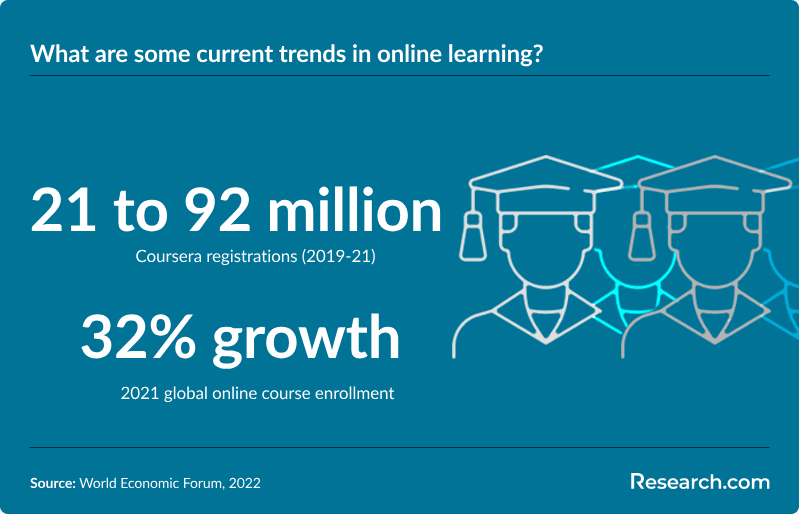
Online learning continues to grow as students seek flexible reskilling options. Platforms like Coursera saw registrations increase from 21 million to 92 million from 2019 to 2021, and global course enrollment grew by 32% in 2021, as shown in the graphic below.
Students still exploring major options can compare other low-cost programs, including affordable online history degree programs.
How can I assess the reputation of online universities offering fast-track bachelor's degrees?
The most important reputation question is not whether a program sounds convenient; it is whether the degree will be recognized by employers, graduate schools, licensing boards, and financial aid systems. Start with accreditation, then evaluate outcomes, faculty, student support, and career alignment.
- Confirm accreditation first. Accreditation signals that the institution or program has been reviewed against recognized academic standards. Look for recognized institutional accreditation and, where relevant, programmatic accreditation tied to your field.
- Check whether the university has a stable academic record. Rankings can provide context, but they should not be the only factor. Review history, student outcomes, graduation information, and whether the school has experience serving online learners.
- Review faculty qualifications. Look for instructors with relevant advanced degrees, professional credentials, current industry experience, and a track record of teaching in online formats.
- Study student outcomes carefully. Graduation rates, job placement data, licensing exam performance, and salary information can help you judge whether the program delivers value. Ask how the school defines and collects each metric.
- Use reviews and alumni feedback cautiously. Student reviews and LinkedIn alumni profiles can reveal useful patterns, but avoid relying on a few extreme comments. Look for repeated themes about advising, workload, course quality, and career support.
- Look for industry relevance. Some programs align with certifications, professional standards, or industry organizations. This matters most in fields such as accounting, IT, nursing, education, healthcare administration, and social work.
How does an online accelerated bachelor's degree compare to an on-campus program?
An accelerated online bachelor’s program is usually better for flexibility and speed, while an on-campus program may be better for structure, face-to-face interaction, campus resources, and students who learn best in person. Neither format is automatically superior; the right choice depends on your schedule, learning style, budget, and career requirements.
| Program type | Best for | Main advantages | Possible drawbacks |
| Online accelerated bachelor’s degree | Working adults, transfer students, caregivers, military learners, and self-directed students | Flexible location, faster terms, potential savings on commuting, housing, meals, and transportation | Heavy weekly workload, less in-person connection, requires strong time management and reliable technology |
| Traditional on-campus bachelor’s degree | Students who want campus life, fixed schedules, in-person support, and slower pacing | More direct classroom interaction, campus community, structured routines, easier access to some labs or facilities | Less schedule flexibility, possible relocation, and potentially higher costs for housing, meals, and transportation |
Choose the online accelerated route if you are comfortable learning independently, need to finish faster, and can manage multiple deadlines without daily in-person reminders. Choose an on-campus option if you need more structure, prefer live classroom interaction, or want the social and residential experience of college.
What are the prerequisites for enrolling in an online accelerated bachelor's degree program?
Admissions requirements vary by school and major, but accelerated online bachelor’s programs usually expect students to show readiness for a faster pace. Some programs are open to first-time bachelor’s students, while others are designed for transfer students or students who already hold a degree in another field.
- Academic background: Most programs require a high school diploma or GED. Some degree-completion programs also require previous college coursework.
- Standardized testing: Some programs may ask for GRE or GMAT scores, although this is less common for many online accelerated bachelor’s programs.
- Prior college credit: Many accelerated pathways work best when students bring transferable credits. Adult learners may also find programs that evaluate military training, professional certifications, or life experience for credit.
- Technology readiness: Students need reliable internet access, basic computer skills, and comfort using learning management systems, video tools, discussion boards, and online testing platforms.
- Time management: Accelerated courses move quickly. Students should expect regular reading, assignments, exams, discussion posts, and projects with limited downtime.
- Program-specific requirements: Nursing, education, social work, and healthcare-related programs may require background checks, immunizations, field placements, entrance prerequisites, or state-specific approvals.
What is the average cost of an online accelerated bachelor's degree program?
There is no single average cost that accurately represents all accelerated online bachelor’s programs because tuition depends on the school, degree, residency status, fees, transfer credits, course load, and whether the program includes clinical or fieldwork requirements. Online delivery can reduce costs tied to housing, commuting, meals, and relocation, but tuition itself can still vary sharply.
Below are examples of tuition information and program costs cited across several fields in the U.S. These examples should be used for comparison only; always verify current costs directly with the school before applying.
Accounting
- Liberty University
- Degree: Bachelor of Science in Accounting and Data Analysis
- Tuition: Undergraduate $390/credit; military undergraduate $250/credit
- Purdue University Global
- Degree: BS Accounting, accelerated CPA track
- Tuition: $371/credit
Information Technology
- Western Governors University
- Degree: Accelerated Information Technology Bachelor's and Master's Degree
- Tuition: $3,735 per six-month term
- University of Cincinnati
- Degree: BSIT/BSC + Masters program
- Bachelor of Science in Information Technology or Cybersecurity and a Masters degree in an accelerated time frame
- Tuition (per semester): UC Uptown $6,988, UC Blue Ash $3,857, UC Clermont $3,632
Nursing
Accelerated bachelor’s in nursing programs are often more expensive than many nonclinical online degrees because they prepare students for registered nursing and include intensive clinical requirements. As shown in the graph above, the tuition fees for accelerated Bachelor of Science in Nursing (ABSN) programs in the USA range from approximately $82,000 for Emory University's 15-month program, $100,000 for the University of Pennsylvania's 16-month program, to $105,476 for Duke University's 16-month program.
| Cost item | Why it matters | How to reduce risk |
| Tuition per credit or term | Some schools charge by credit, while others charge by term, which affects students differently depending on speed. | Calculate total program cost using your expected transfer credits and realistic course load. |
| Fees and materials | Technology fees, textbooks, software, testing, and lab costs can add up. | Ask for a full cost sheet, not just tuition. |
| Clinical or field expenses | Nursing, education, and social work may require travel, background checks, uniforms, or placement fees. | Confirm where requirements must be completed before enrolling. |
| Lost work time | Accelerated study can reduce work hours, especially in intensive terms. | Build a budget that accounts for reduced income, not only school bills. |
| Transfer-credit limits | If fewer credits transfer than expected, the program can cost more and take longer. | Request an official transfer evaluation before committing. |
What financial aid and scholarship options are available for students of accelerated online colleges?
Students in accredited accelerated online bachelor’s programs may be eligible for many of the same aid options as students in campus-based programs. The key requirement is that the school and program meet financial aid eligibility standards. Always confirm with the financial aid office before assuming a program qualifies.
- Federal financial aid: Federal grants and loans may be available to eligible students through the Free Application for Federal Student Aid (FAFSA). Pell Grants and subsidized or unsubsidized loans depend on student eligibility and enrollment status.
- State aid: Some states provide grants or scholarships for residents, including students enrolled online. Check your state education agency and the school’s financial aid office.
- Employer tuition assistance: Many working adults reduce costs through tuition reimbursement or education benefits. Ask HR whether your employer has annual caps, grade requirements, or approved-school restrictions.
- Private scholarships: Scholarships may target adult learners, online students, military students, transfer students, first-generation students, or students in specific majors.
- School-based aid: Institutions may offer merit scholarships, need-based grants, military discounts, or transfer-student awards.
Important: accreditation affects aid eligibility. If a school or program is not properly accredited, you may lose access to federal aid and face problems transferring credits or applying to graduate school.
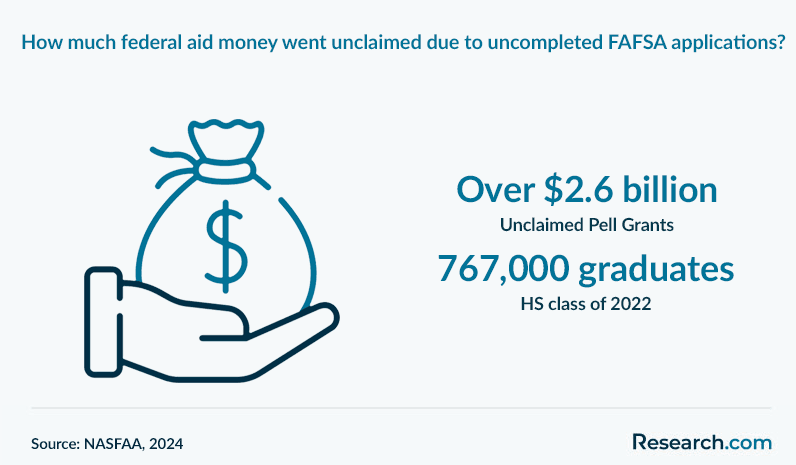
Did you know that over $2.6 billion in federal aid money in the form of Pell Grants went unclaimed due to uncompleted FAFSA applications in 2022, shown in the figure below?
Because aid deadlines and funding rules vary, complete the FAFSA early, confirm school-specific deadlines, and ask whether accelerated terms affect disbursement timing.
What courses are typically in an accelerated online bachelor's degree program?
Coursework depends on the major, concentration, transfer credits, and accreditation or licensure requirements. Accelerated programs usually include general education, major core courses, electives, and often a capstone, practicum, internship, or portfolio project. Below are examples of common course areas by field.
- Accounting:
- Auditing: Study procedures used to evaluate financial statements and internal controls.
- Cost Accounting: Learn how organizations measure costs and use accounting data to guide decisions.
- Financial Accounting: Build a foundation in recording, reporting, and interpreting financial information.
- Tax Accounting: Examine tax rules, preparation methods, and compliance responsibilities.
- Business Administration: Students comparing flexible business pathways may also review cheapest online business degree programs.
- Business Law: Understand contracts, liability, compliance, and legal issues in business.
- Human Resource Management: Learn how organizations recruit, train, support, and manage employees.
- Management Principles: Study leadership, planning, organizing, and decision-making.
- Marketing Fundamentals: Explore how companies position, promote, and deliver products or services.
- Computer Science:
- Database Management: Learn to organize, query, secure, and maintain structured data.
- Data Structures and Algorithms: Study efficient methods for solving computational problems.
- Programming Languages: Develop proficiency in languages such as Java, Python, or C++.
- Software Engineering: Learn how to design, test, document, and maintain software systems.
- Graduates who want deeper technical preparation often compare cheap Masters in Computer Science online options after finishing the bachelor’s degree.
- Economics:
- Econometrics: Use statistical methods to interpret economic data.
- Macroeconomics: Examine inflation, employment, fiscal policy, monetary policy, and national economic performance.
- Microeconomics: Study consumer behavior, firm decisions, markets, and pricing.
- Public Policy Analysis: Evaluate how government policy affects economic and social outcomes.
- Healthcare Administration:
- Healthcare Finance: Learn budgeting, reimbursement, revenue cycles, and financial planning in healthcare.
- Healthcare Law and Ethics: Study compliance, patient rights, privacy, and ethical decision-making.
- Healthcare Operations Management: Examine staffing, quality improvement, workflow, and resource allocation.
- Healthcare Systems: Understand how healthcare organizations, payers, providers, and regulators interact.
- Management:
- Organizational Behavior: Study how individuals and teams behave within workplaces.
- Operations Management: Learn how organizations design and improve production or service delivery.
- Project Management: Build skills in planning, scheduling, budgeting, and monitoring projects.
- Strategic Management: Learn how organizations set goals and respond to competition.
- Management Information Systems (MIS):
- Business Analytics: Use data to identify patterns and support organizational decisions.
- Database Management Systems: Learn how business data is stored, accessed, and protected.
- Information Security: Study methods for reducing risks to systems and data.
- Information Systems Fundamentals: Understand networks, platforms, business systems, and IT infrastructure.
- Nursing:
- Nursing Assessment: Develop methods for collecting and interpreting patient health information.
- Nursing Care Planning: Learn to design safe, evidence-informed care plans.
- Pathophysiology: Study how disease processes affect body systems.
- Pharmacology: Learn medication classifications, effects, safety, and nursing responsibilities.
- Social Work:
- Human Behavior and the Social Environment: Examine how families, communities, and systems affect people’s lives.
- Research Methods in Social Work: Learn to evaluate evidence and apply research to practice.
- Social Policy and Advocacy: Study policies that shape social services and community support.
- Social Work Practice Methods: Learn intervention, assessment, and client-support approaches.
- Special Education:
- Behavior Management: Learn strategies for supporting positive student behavior.
- Curriculum Development for Special Needs: Design instruction for learners with diverse needs.
- Inclusive Education: Study methods for supporting students with disabilities in inclusive settings.
- Learning Disabilities: Understand identification, accommodations, and instructional support.
How do accelerated online bachelor’s degree programs prepare students for today’s dynamic job market?
Strong accelerated online programs prepare students through applied assignments, case studies, collaborative projects, digital tools, and career-focused curricula. Because the format is compressed, students often practice skills employers value: meeting deadlines, working independently, communicating online, solving problems quickly, and adapting to changing expectations.
Career preparation is strongest when a program includes industry-relevant projects, internship or practicum options, portfolio development, career coaching, networking opportunities, and courses aligned with the roles students want. Students interested in business-focused routes can compare an online business degree pathway to see how curriculum structure and career outcomes differ by school.
How can I transition to a graduate degree after an accelerated bachelor's program?
An accelerated bachelor’s degree can support graduate study if it comes from an accredited institution and includes the prerequisites required by your target master’s program. Before enrolling in the bachelor’s program, check whether credits will be accepted by graduate schools, whether your GPA will be competitive, and whether the curriculum includes research, statistics, writing, or prerequisite courses needed for your next step.
If speed remains a priority after graduation, compare options such as 1-year master's programs online. Also consider whether a certification, work experience, or employer-sponsored graduate program would produce a better return than moving immediately into another degree.
What career advancement opportunities follow an accelerated online bachelor’s degree?
An accelerated online bachelor’s degree can help students qualify for promotions, career changes, management-track roles, graduate school, or specialized professional credentials. The strongest outcomes usually come when the degree builds on existing work experience or leads to a field with clear bachelor’s-level hiring requirements.
Career advancement may include supervisory roles, analyst positions, IT roles, healthcare administration jobs, accounting positions, nursing practice after licensure, or education-related roles where the program meets state requirements. Some graduates later pursue advanced credentials, including options such as the easiest online master's degree, although “easiest” should be weighed against quality, accreditation, and career relevance.
What is the Return on Investment for Accelerated Online Bachelor's Degrees?
ROI depends on total cost, time to completion, how much income you give up while studying, financial aid, credit transfer, and the salary range in your field. A faster degree can improve ROI if it helps you enter or advance in the workforce sooner. But a poorly chosen program can reduce ROI if credits do not transfer, the degree lacks recognition, or the major does not connect to a realistic career path.
| ROI factor | Positive sign | Warning sign |
| Transfer credits | The school applies most accepted credits toward graduation requirements. | Credits transfer only as electives and do not shorten the degree much. |
| Total cost | The school provides a clear estimate including fees and materials. | The program advertises low tuition but excludes major required costs. |
| Career alignment | The degree connects directly to roles you are targeting. | You are choosing the major mainly because it is fast or easy to enter. |
| Accreditation | The institution and, when needed, the program have recognized accreditation. | The school cannot clearly explain accreditation or licensure eligibility. |
| Student support | Advising, tutoring, career services, and tech support are accessible online. | Students are expected to navigate course sequencing and job preparation alone. |
For additional comparison of accelerated options and cost-saving considerations, review Research.com’s guide to fast track college programs.
Do Employers Value Accelerated Online Bachelor's Degrees?
Employers generally focus on whether the degree is from an accredited institution, whether the applicant has relevant skills, and whether the credential fits the role. The fact that a degree was completed online or on an accelerated schedule is usually less important than the school’s credibility, the student’s experience, and the applicant’s ability to demonstrate competence.
Accelerated online graduates can strengthen employer confidence by building a portfolio, completing internships or applied projects, earning relevant certifications, and clearly explaining how the program developed job-ready skills. Students considering an earlier stepping-stone credential may also compare an online accelerated associate's degree before moving into a bachelor’s pathway.
What types of specializations are available in accelerated online bachelor's degree programs?
Accelerated online bachelor’s programs may offer concentrations similar to campus programs, but availability depends on the school and field. Some specializations require in-person work, clinical placements, labs, or state approval. Always verify that the specialization is offered fully online and that it supports your intended career path.
- Accounting:
- Forensic Accounting: Learn how accounting methods are used to investigate fraud and financial misconduct.
- Government and Nonprofit Accounting: Study accounting rules for public agencies and nonprofit organizations.
- Tax Accounting: Build deeper knowledge of tax law, tax planning, and complex return preparation.
- Students comparing CPA-aligned or specialized tracks can review online accounting degree options.
- Business Administration:
- Entrepreneurship: Develop skills for launching, financing, and managing a business.
- Human Resource Management: Focus on hiring, employee relations, training, and workforce planning.
- Marketing: Study branding, promotion, consumer behavior, and digital strategy.
- Operations Management: Learn to improve processes, productivity, and service delivery.
- Students who want broad business options can compare cheapest online business degree programs by concentration and cost.
- Computer Science:
- Cybersecurity: Study methods for protecting networks, systems, and data.
- Data Science: Learn to analyze large datasets and use data to solve problems. Students planning graduate study can also explore cheapest data science masters online programs.
- Software Engineering: Focus on designing, building, testing, and maintaining software applications.
- Economics:
- Econometrics: Apply statistical tools to economic questions and forecasting.
- Financial Economics: Analyze investments, financial markets, and economic risk.
- Public Policy: Study how laws, regulations, and public programs affect economic outcomes.
- Healthcare Administration:
- Health Informatics: Learn to manage and analyze healthcare data for better operations and care quality.
- Long-Term Care Administration: Focus on management in nursing homes, assisted living, and long-term care settings.
- Medical Group Management: Develop skills for managing physician practices and medical groups.
- Management:
- Healthcare Management: Apply leadership and operations principles in healthcare settings.
- Human Resources Management: Study recruitment, training, compliance, and employee development.
- Project Management: Learn how to plan, execute, monitor, and close projects.
- Construction Management: Study planning, budgeting, coordination, and supervision of construction projects. Students can compare online and traditional accelerated construction management degree options.
- Supply Chain Management: Learn how organizations coordinate goods, services, logistics, and supplier relationships.
- Nursing:
- Adult-Gerontology Primary Care: Prepare to provide primary care for adults and older adults.
- Family Nurse Practitioner: Study primary care across the lifespan.
- Nurse Educator: Prepare for teaching and training roles in nursing education.
- Women's Health: Focus on healthcare needs across women’s lifespans.
- Social Work:
- Child Welfare: Prepare to support children and families involved with child welfare systems.
- Mental Health: Focus on services for individuals with mental health needs.
- School Social Work: Support students’ academic, social, and emotional well-being.
- Special Education:
- Autism Spectrum Disorder (ASD): Build skills for supporting learners on the autism spectrum.
- Learning Disabilities: Study assessment, accommodations, and instructional strategies.
- Visual Impairments: Learn methods for teaching and supporting students with visual impairments.
- Management Information Systems (MIS):
- Cybersecurity: Focus on technology practices that protect business systems and data.
- Health Information Systems (HIS): Learn to manage healthcare information systems and data.
- Project Management: Apply project management methods to technology initiatives.
Can Accelerated Online Bachelor's Degrees Lead to High-Earning Careers?
Yes, accelerated online bachelor’s degrees can lead to high-earning careers when the major, skills, credentials, and work experience align with labor-market demand. The degree format alone does not determine income. A computer science, MIS, nursing, accounting, or healthcare administration graduate may see different outcomes depending on location, experience, licensure, certifications, employer type, and industry conditions.
Students aiming for higher earnings should choose a program with strong career relevance, complete applied projects, pursue internships where possible, and add certifications that match the field. For a broader look at degree-to-income pathways, compare degrees that lead to 6-figure salaries.
How to Choose the Right Accelerated Online Bachelor’s Degree Program
Choosing an accelerated online bachelor’s program is a financial and career decision, not just an admissions decision. Use the checklist below before submitting a deposit.
1. Verify accreditation before anything else
Confirm institutional accreditation and, when relevant, programmatic accreditation. This is especially important for nursing, education, social work, accounting, and healthcare-related programs where licensure, certification, or graduate admission may depend on recognized credentials.
2. Request an official transfer-credit evaluation
Do not rely on informal estimates. Ask how many credits transfer, how many apply to the major, how many apply to electives, and how many credits you still need to graduate.
3. Compare total cost, not just tuition
Include fees, books, software, exams, background checks, travel, lost work time, and any clinical or field placement expenses. Students seeking cost-conscious pathways can compare accelerated degree programs online by affordability and structure.
4. Match the program format to your life
Ask whether courses are asynchronous, synchronous, self-paced, cohort-based, or competency-based. The “best” format is the one you can sustain through demanding terms.
5. Review career support and employer connections
Look for resume help, interview preparation, internship guidance, career coaching, alumni networks, and employer partnerships. These supports matter more in an accelerated format because students have less time to figure everything out alone.
6. Check faculty and curriculum relevance
Review instructor credentials, industry experience, course descriptions, technology tools, capstone requirements, and whether the program teaches current workplace skills.
7. Confirm state authorization and licensure fit
If the degree leads to licensed work, ask whether the program meets requirements in your state. Never assume an online program approved in one state automatically qualifies you for licensure elsewhere.
| Question to ask | Why it matters |
| Is the institution accredited by a recognized accreditor? | Accreditation affects financial aid, transfer credits, graduate study, and employer trust. |
| How many of my credits will apply to graduation? | This determines whether the program is truly accelerated for you. |
| What is the full estimated cost after transfer credits? | Total cost is a better planning number than tuition per credit. |
| Are there required in-person components? | Clinical, teaching, lab, or practicum work may affect schedule and location. |
| What support is available outside normal business hours? | Online adult learners often study nights and weekends. |
| What outcomes data do you publish? | Graduation, employment, salary, and licensure data help assess value. |
Understanding the Importance of Accreditation for Online Degrees
Accreditation is one of the most important safeguards when choosing an accelerated online degree. It helps verify that an institution or program has been reviewed for educational quality and that the credential is more likely to be recognized by employers, graduate schools, licensing boards, and financial aid systems.
Regional vs. National Accreditation
Regional accreditation has traditionally been associated with nonprofit colleges and universities and is widely recognized for credit transfer and graduate admission. National accreditation has often been associated with career, vocational, technical, or for-profit institutions. The best choice depends on your goals, but students who may transfer or pursue graduate school should be especially careful about how future institutions will evaluate credits.
Why Accreditation Matters
- Academic quality: Accredited institutions are reviewed against established standards and must continue meeting those expectations.
- Credit transfer: Credits from accredited institutions are more likely to be considered by other schools, though transfer is never guaranteed.
- Employer recognition: Many employers expect degrees from accredited colleges and may screen for this during hiring or promotion decisions.
- Financial aid eligibility: Federal financial aid is generally tied to attendance at eligible accredited institutions.
- Licensure and certification: Some professional pathways require graduation from an accredited or approved program.
Before enrolling, verify accreditation through official sources and ask the school directly how its accreditation affects financial aid, transfer, graduate admission, and licensure. Students seeking low-cost accredited options can review Research.com’s guide to the cheapest regionally accredited online colleges.
What are the average salaries of graduates with an accelerated online bachelor's degree?
Employers generally do not set different salaries solely because a degree was earned online or through an accelerated format. Salary depends more on field, location, experience, employer, certifications, licensure, and job responsibilities. The figures below are based solely on PayScale data and represent average salaries at the time of writing.
| Field | Bachelor’s degree salary | Master’s degree salary |
| Accounting | Bachelor of Science (BS / BSc) in Accounting: $59,000 | Master of Science (MS) in Accounting: $69,000 |
| Business Administration | Bachelor of Business Administration (BBA): $56,000 | Master of Business Administration (MBA): $87,000 |
| Computer Science | Bachelor of Science (BS / BSc) in Computer Science: $75,000 | Master of Science (MS) in Computer Science: $98,000 |
| Economics | Bachelor of Arts (BA) in Economics: $58,000 | Master of Arts (MA) in Economics: $73,000 |
| Healthcare Administration | Bachelor of Science (BS / BSc) in Healthcare Administration: $59,000 | Master of Science (MS) in Healthcare Administration: $98,000 |
| Management | Bachelor of Science (BS / BSc) in Management: $57,000 | Master of Science (MS) in Management: $98,000 |
| Management Information Systems | Bachelor of Science (BS / BSc) in MIS: $89,000 | Master of Science (MS) in MIS: $98,000 |
| Nursing | Bachelor of Science in Nursing (BSN): $70,000 | Master of Science in Nursing (MSN): $93,000 |
| Social Work | Bachelor of Social Work (BSW): $47,000 | Master of Social Work (MSW): $56,000 |
| Special Education | Bachelor of Science (BS / BSc) in Special Education: $49,000 | Master of Science (MS) in Special Education: $55,000 |
As shown in the graph above, Bachelor of Science (BS) in Computer Science offers a starting salary of $75,000, while a Bachelor of Business Administration (BBA) typically starts at $56,000. In many fields, a Master's degree can translate to nearly a $10,000 jump in salary. For example, a Master of Science (MS) in Accounting can increase your earning potential to $69,000 compared to $59,000 with a Bachelor's degree.
Graduate school can improve earning potential in some fields, but it also adds cost and time. Business students may compare Online MBA under 10k programs, while nurses interested in advanced practice can review cheapest online nurse practitioner programs. Students considering other fields can also explore options such as the cheapest online nutrition degree discussion.
Which Student Support Services Are Critical for Success in Accelerated Online Bachelor's Degree Programs?
Support services matter more in accelerated programs because students have less time to recover from confusion, technical problems, poor course sequencing, or burnout. A strong online program should offer academic, technical, career, financial, and wellness support that fits the schedule of remote learners.
- Academic advising: Advisors should help students sequence courses correctly and avoid delays caused by prerequisites or limited course availability.
- Tutoring and writing support: Accelerated students need fast help with difficult subjects, research papers, quantitative assignments, and writing-intensive courses.
- Technical support: Reliable help with learning platforms, exams, logins, software, and connectivity issues is essential.
- Library and research access: Online students need digital databases, librarian support, citation help, and research guidance.
- Career services: Resume reviews, interview preparation, job-search coaching, and networking tools can help turn the degree into career progress.
- Financial counseling: Students should understand billing, aid disbursement, loan obligations, and how accelerated terms affect costs.
- Wellness resources: Intensive programs can be stressful, especially for students balancing work and family responsibilities.
Students still building toward a bachelor’s degree can also evaluate lower-cost stepping stones such as cheapest online associate degree programs.
What are the most affordable online bachelor’s degree options?
The most affordable online bachelor’s degree is not always the program with the lowest advertised tuition. The better measure is the total cost to graduate after transfer credits, fees, financial aid, military or employer benefits, and time to completion. A higher per-credit program may cost less overall if it accepts more credits and helps you finish faster.
Affordable online bachelor’s programs are common in business, education, healthcare, technology, liberal arts, and public service fields. Some schools offer in-state rates, military discounts, tuition freezes, included e-textbooks, or competency-based pricing that can benefit students who move quickly.
To compare cost-conscious options, review Research.com’s guide to affordable online bachelor's degree programs.
Common Mistakes to Avoid When Choosing an Accelerated Online Bachelor’s Degree
- Choosing speed over accreditation: A fast degree is not useful if employers, graduate schools, or licensing boards do not recognize it.
- Looking only at tuition per credit: Fees, textbooks, transfer-credit limits, fieldwork, and lost work hours can change the real cost.
- Assuming all online programs meet licensure rules: Nursing, teaching, social work, and some healthcare roles require state-specific review.
- Overestimating how many courses you can handle: Accelerated courses can be intense. Taking too many at once may lead to poor grades or withdrawal.
- Skipping the transfer evaluation: An unofficial estimate can be misleading. Get a written evaluation before making a financial commitment.
- Ignoring support services: Advising, tutoring, and tech help are not extras in an accelerated program; they are survival tools.
- Relying only on rankings: Rankings can be helpful, but your best program is the one that fits your credits, budget, schedule, state requirements, and career goals.
Key Insights
- Accelerated online bachelor’s degrees can shorten the path to graduation, but they require strong time management and careful program selection.
- Affordability depends on total cost to graduate, not just tuition. Transfer credits, fees, financial aid, and time away from work all affect ROI.
- Accreditation is nonnegotiable. It influences financial aid, credit transfer, graduate school options, employer recognition, and licensure pathways.
- Fields such as computer science, MIS, nursing, accounting, business, healthcare administration, management, economics, social work, and special education can all offer accelerated online options, but career outcomes vary.
- Licensure-focused degrees require extra caution. Nursing, teaching, and social work students should confirm state approval before enrolling.
- Employers usually care more about accredited credentials, relevant skills, work experience, and demonstrated competence than whether the degree was completed online.
- The best accelerated program is not simply the fastest one. It is the program that helps you graduate with a recognized credential, manageable debt, usable skills, and a realistic next career step.
References:
- National Association of Student Financial Aid Administrators. (2024, April 28). NCAN report: $3.6 billion in Pell Grants went unclaimed in 2022. NASFAA.
- Payscale. (2024). Bachelor of Science (BS / BSc) in Accounting. Payscale.
- Payscale. (2024). Bachelor of Business Administration (BBA). Payscale.
- Payscale. (2024). Bachelor of Science (BS / BSc) in Computer Science. Payscale.
- Payscale. (2024). Bachelor of Arts (BA) in Economics. Payscale.
- Payscale. (2024). Bachelor of Science (BS / BSc) in Healthcare Administration. Payscale.
- Payscale. (2024). Bachelor of Science (BS / BSc) in Management. Payscale.
- Payscale. (2024). Bachelor of Science (BS / BSc) in MIS. Payscale.
- Payscale. (2024). Bachelor of Science in Nursing (BSN). Payscale.
- Payscale. (2024). Bachelor of Social Work (BSW). Payscale.
- Payscale. (2024). Bachelor of Science (BS / BSc) in Special Education. Payscale.
- World Economic Forum. (2022, January). Online learning courses to reskill and bridge the skills gap. WEF.
Other Things You Should Know About Accelerated Online Bachelor's Degree Programs
Federal Pell Grants, state grants, and many scholarships are available to students in affordable accelerated online bachelor's programs in 2027. Additionally, some schools offer institution-specific financial aid packages, which may include need-based grants and work-study opportunities. Check with individual schools for eligibility details.
Credit transfer policies for accelerated programs in 2027 can vary: most require verification of prior coursework from accredited institutions, while others may have limits on transferable credits or need departmental approval, influencing both program duration and cost-effectiveness.
Yes. Most accelerated online bachelor’s programs require 15 to 20 hours of study per week for a 6-week course, or about 30 to 40 hours during an intensive 8-week term. Many schools also require consistent logins, weekly assignments, and strict deadlines.