
2027 Best Degree Programs That Lead to 100k Salary Jobs

Co-Founder and Chief Data Scientist
A bachelor’s degree can still be one of the strongest routes to higher lifetime earnings, but the degree field you choose matters as much as the credential itself. In 2024, U.S. workers with a bachelor’s degree earned median weekly pay of $1,541, compared with $915 for workers whose highest education was a high school diploma. That advantage is significant, but it does not mean any major will reliably lead to a six-figure income.
This guide helps students, adult learners, career changers, and families compare bachelor’s degrees that are commonly connected to $100,000 salary potential. You will learn which majors have the strongest earnings upside, how quickly graduates may reach six figures, what job-market risks to watch, how online degrees compare, and how to evaluate cost, accreditation, financial aid, and return on investment before choosing a program.
Quick Answer: What Bachelor’s Degrees Are Most Likely to Lead to $100k Salary Jobs?
The bachelor’s degrees most often associated with $100,000 salary potential are in engineering, computer science, finance, actuarial science, architecture, and technical management. These fields typically reward advanced math, software skills, systems thinking, risk analysis, design ability, and leadership in complex organizations. A six-figure salary is not guaranteed at graduation, though. Many graduates reach that level only after gaining experience, completing internships, earning certifications, relocating to stronger markets, or moving into specialized or management roles.
- Most direct technical routes: computer engineering, electrical engineering, computer science, aerospace engineering, chemical engineering, and petroleum engineering.
- Strong business and quantitative routes: finance, actuarial science, and engineering management.
- High-paying service-oriented fields: physical therapy, radiation therapy, nursing science, occupational therapy, diagnostic medical sonography, and similar healthcare careers.
- Best-fit learners: students who enjoy math, science, coding, data, finance, design, engineering systems, or complex problem-solving.
- Important warning: pay varies by location, employer, industry cycle, experience level, licensure rules, and individual performance.
- Bachelor’s degrees with strong $100k salary potential
- Typical earnings for bachelor’s degree holders
- Highest-paying jobs in the United States
- Degrees that balance income and meaningful work
- Highest-paying industries in the United States
- Fastest-growing industries to watch
- Job outlook for high-paying degree fields
- Online bachelor’s degrees and high-paying careers
- Accreditation and online degree quality
- Skills and experience that raise earning potential
- When a 1-year master’s degree may help
- Financial risks to review before enrolling
- Graduate degrees and career mobility
- Average bachelor’s degree cost
- Financial aid for high-earning degree paths
- How to choose a degree with $100k salary potential
- Bachelor’s degrees compared with trade school
- Career readiness and networking value
- Online certifications and degree value
- Career strategy and salary negotiation
10 Bachelor’s Degrees That Can Lead to $100k Salary Jobs
The strongest major is not always the one with the highest advertised average salary. A smart choice accounts for starting pay, long-term salary ceiling, job availability, required exams or licenses, economic volatility, work environment, and personal fit. The degree paths below stand out because they develop specialized skills that employers pay a premium for across technology, engineering, finance, energy, construction, healthcare, and analytics.
| Degree field | Best fit for students who | Key trade-off to consider |
| Engineering management | Want to connect engineering work with budgets, operations, teams, and strategy | Senior salaries usually require several years of technical and leadership experience |
| Computer engineering | Like hardware, software, embedded systems, robotics, chips, or connected devices | The curriculum is rigorous and usually requires strong math and computing skills |
| Finance | Are drawn to investing, corporate finance, risk, valuation, banking, or markets | The highest pay is often concentrated in competitive roles, firms, and metro areas |
| Actuarial science | Have advanced quantitative ability and want structured analytical career growth | Professional exams are demanding and may take years to complete |
| Architecture | Want to combine design, building systems, planning, sustainability, and client work | Licensure and supervised experience can lengthen the path to higher earnings |
1. Engineering Management
Engineering management prepares students to supervise technical work, coordinate complex projects, manage budgets, improve operations, and communicate between engineers and business leaders. The degree is useful for people who want to move from hands-on engineering tasks into product development, project leadership, manufacturing operations, construction management, or technology management.
- Average salary: $146,868
- Salary range: $46,500 to $174,000
- Industries: Manufacturing, Technology, Construction, Aerospace
- Job growth: 6%
2. Architecture
Architecture combines creative design with technical knowledge of buildings, safety standards, materials, environmental systems, digital modeling, construction methods, and zoning or code requirements. The profession can take time to enter fully because licensure and supervised experience matter, but experienced architects can earn strong salaries in commercial design, urban development, sustainability, and large-scale planning projects.
- Average salary: $128,756
- Salary range: $46,500 to $201,500
- Industries: Architecture, Urban Planning, Construction
- Job growth: 8%
3. Computer Engineering
Computer engineering blends computing, electronics, and systems design. Students study how hardware and software work together in devices, networks, industrial systems, defense technologies, telecommunications, cybersecurity tools, robotics, and Internet of Things products. Demand for faster computing, AI infrastructure, automation, and connected systems keeps this degree relevant across many industries.
- Average salary: $121,515
- Salary range: $48,500 to $137,500
- Industries: Technology, Telecommunications, Defense, Manufacturing
- Job growth: 7%
4. Electrical Engineering
Electrical engineering focuses on circuits, electronics, communications, control systems, signal processing, power grids, semiconductors, and energy systems. Graduates may work in renewable energy, aerospace, telecommunications, manufacturing automation, infrastructure, electronics design, or defense. Because nearly every modern sector relies on electrical systems, this degree can offer broad career flexibility.
- Average salary: $111,091
- Salary range: $50,500 to $168,000
- Industries: Energy, Telecommunications, Manufacturing, Aerospace
- Job growth: 9%
5. Aerospace Engineering
Aerospace engineering is a specialized major for students interested in aircraft, spacecraft, propulsion, avionics, defense platforms, advanced materials, and high-precision testing. The work is highly technical and depends on physics, advanced math, simulation tools, and safety-driven design. Graduates often pursue roles with aviation companies, defense contractors, space organizations, government agencies, and manufacturers.
- Average salary: $108,638
- Salary range: $42,000 to $165,000
- Industries: Aerospace, Defense, Manufacturing
- Job growth: 6%
6. Actuarial Science
Actuarial science is built around measuring financial risk with probability, statistics, economics, mathematics, and business judgment. Actuaries are especially important in insurance, pensions, consulting, healthcare financing, and enterprise risk management. This path can be attractive for students who want analytical work and a defined professional exam ladder, but those exams require sustained preparation.
- Average salary: $93,525
- Salary range: $22,000 to $154,000
- Industries: Insurance, Finance, Consulting
- Job growth: 22%
7. Finance
A finance major develops skills in financial modeling, valuation, investment analysis, banking, corporate finance, risk assessment, and markets. Graduates can pursue roles as financial analysts, investment banking analysts, portfolio analysts, corporate finance associates, wealth advisors, or risk analysts. The strongest earnings usually go to students who complete internships, build advanced spreadsheet and modeling skills, network early, and pursue relevant credentials such as the Chartered Financial Analyst credential.
- Average salary: $92,631
- Salary range: $25,000 to $135,500
- Industries: Banking, Investment, Corporate Finance, Insurance
- Job growth: 9% (financial analysts)
8. Chemical Engineering
Chemical engineering applies chemistry, physics, math, process control, and engineering design to production systems. Students learn how to transform raw materials into pharmaceuticals, fuels, food products, polymers, specialty chemicals, and sustainable materials. Graduates may work in manufacturing, energy, biotechnology, environmental services, process safety, or industrial research.
- Average salary: $87,487
- Salary range: $40,000 to $140,000
- Industries: Pharmaceuticals, Energy, Manufacturing, Environmental Services
- Job growth: 10%
9. Computer Science
Computer science teaches students to write software, design algorithms, manage databases, secure systems, analyze data, and solve computational problems. It is one of the most adaptable high-earning majors because software skills are needed in technology, finance, healthcare, government, logistics, retail, and education. Graduates improve their odds of higher pay when they build portfolios, complete internships, learn cloud tools, understand AI-assisted development workflows, and keep their technical skills current.
- Average salary: $83,109
- Salary range: $56,500 to over $100,000
- Industries: Technology, Finance, Healthcare, Government
- Job growth: 11% to 26% (depending on specialization)
10. Petroleum Engineering
Petroleum engineering focuses on locating, extracting, and producing oil and natural gas. Graduates may work in reservoir engineering, drilling, production operations, energy consulting, and environmental services connected to extraction projects. The salary upside can be strong, but students should consider geographic concentration, commodity price cycles, energy transition pressures, and slower projected employment growth.
- Average salary: $80,025
- Salary range: $42,000 to $136,000
- Industries: Oil and Gas, Energy, Environmental Services
- Job growth: 2% (around 1,200 job openings per year throughout 2023 to 2033)
How Long Does It Usually Take to Reach $100k?
Most bachelor’s graduates do not move directly into six-figure roles. In many engineering, computing, finance, and technical business careers, a realistic timeline is often 3 to 5 years of relevant experience. The exact timing depends on the starting role, internship record, employer, region, industry, performance, and whether the graduate develops hard-to-find skills.
For example, the typical finance degree salary is listed at $92,631 on average, while experienced professionals in roles such as financial analyst or investment manager may exceed $135,500. Students interested in finance should compare job tracks carefully because investment banking, corporate finance, wealth management, insurance, and risk roles can have very different pay structures.
Hybrid business-technology roles can also create strong long-term earnings. Students interested in analytics, information systems, or operations should understand what a systems analyst does, since these jobs often reward people who can translate technical systems into business improvements.
The following chart shows bachelor’s degrees with some of the highest median starting salaries in 2024. Starting pay matters because it affects loan repayment, savings, housing choices, and the ability to move into higher-responsibility jobs.
How Much Do Bachelor’s Degree Holders Typically Earn?
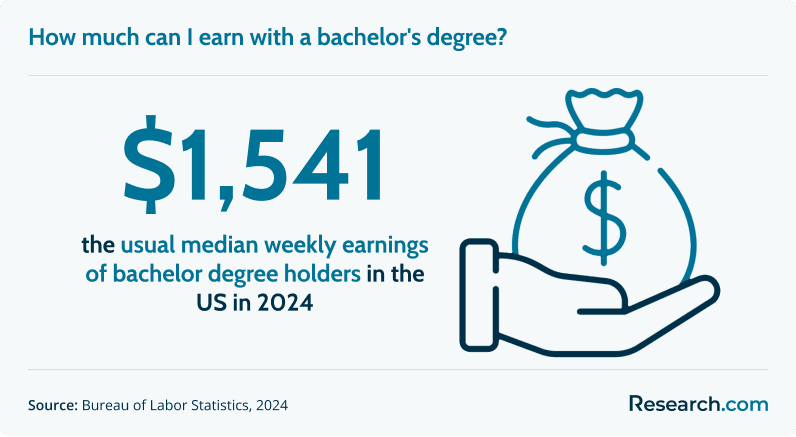
A bachelor’s degree usually increases earning power compared with a high school diploma, but the size of the payoff depends heavily on major, occupation, location, and cost of attendance. In 2024, bachelor’s degree holders earned median weekly wages of $1,541, or roughly $80,100 per year. Workers whose highest credential was a high school diploma earned $916 per week, while workers with advanced degrees earned median weekly pay of $1,897.
Those broad averages should not be used as a guarantee. Engineering, finance, computer science, and some healthcare-related majors are often listed among the college majors with the highest earning potential. Other fields may provide lower salaries but stronger personal fit, flexibility, public-service value, or graduate-school preparation. The better question is not whether college pays off in general, but whether a specific program is worth its specific cost for your target career.
| Education level or path | What the earnings figure shows | Decision point for students |
| Bachelor’s degree | Median weekly earnings of $1,541 in 2024 | Choose a field with clear demand, strong preparation, and manageable cost |
| High school diploma | Median weekly earnings of $916 in 2024 | Higher pay may require trade training, certifications, apprenticeships, or experience |
| Advanced degree | Median weekly earnings of $1,897 in 2024 | Can improve earnings in some fields, but adds cost, time, and opportunity cost |
What Are the Highest-Paying Jobs in the U.S.?
The highest-paying occupations in the U.S. are heavily concentrated in medicine and a small number of elite professional categories. Pediatric surgeons report average annual salaries of $449,320, followed by cardiologists at $423,250 and orthopedic surgeons at $378,250. Other top-paying medical roles include radiologists at $353,960, dermatologists at $342,860, and anesthesiologists at $339,470. Athletes and sports competitors also appear among the top earners, with average annual pay of $328,830.
These careers come with high barriers: extensive education, competitive admissions, licensing, residency or specialized training, and many years before full earning potential is reached. Students searching for the easiest degree to complete should be careful not to confuse academic ease with fast access to top salaries.
For many learners, a more practical path is a bachelor’s degree in technology, engineering, analytics, finance, or a high-demand healthcare support area. These fields may offer a better balance of time to employment, cost, flexibility, and salary growth than the longest professional pathways.
Which Degrees Combine Meaningful Work With High Pay?
Some careers offer both strong compensation and a clear sense of service. Healthcare occupations are the most common example because specialized training often contributes directly to patient outcomes. Physical therapy graduates can earn around $112,700 at mid-career while helping patients restore mobility, reduce pain, and improve daily function. Radiation therapy professionals, who support cancer treatment teams, report median salaries of $105,800.
Nursing science and occupational therapy can also combine patient-centered work with strong income potential, with mid-career salaries from $98,100 to $106,700. Diagnostic medical sonography and American Sign Language interpreting may also allow graduates to support patients, families, and communities while earning salaries above $90,000.
| Field | Why the work may be meaningful | Reported salary detail |
| Physical therapy | Supports mobility, pain management, recovery, and independence | About $112,700 at mid-career |
| Radiation therapy | Works with patients during cancer treatment | Median salaries of $105,800 |
| Nursing science and occupational therapy | Provides care, rehabilitation, and support for daily living | Mid-career salaries from $98,100 to $106,700 |
| Diagnostic medical sonography and American Sign Language interpreting | Improves healthcare access, diagnosis, communication, or patient support | Salaries exceeding $90,000 |
Which U.S. Industries Pay the Most?
Your major influences income, but the industry you enter can be just as important. Some industries pay more because they require rare expertise, involve high-value transactions, depend on advanced technology, or operate in highly specialized markets. Commodity contracts intermediation is listed as the top-paying industry, with average annual wages of $327,056. This sector connects closely to finance, economics, mathematics, commodities trading, and risk analysis, so students may want to compare roles among the highest-paying finance degree jobs.
Electronic computer manufacturing also shows strong earning potential, with average salaries of $319,751. This industry may fit graduates in computer engineering, electrical engineering, hardware design, manufacturing systems, and computer science. Web search portals and information services report average wages of $308,615, reflecting the market value of software, data, cloud, and AI-related expertise.
Students considering a logistics career path should also look at supply chain, warehousing, storage, freight transportation arrangement, and operations roles. These sectors may not always top wage lists, but they can provide practical entry points into management as global supply chains become more complex.
Which Industries Are Growing Fastest?
Salary potential is only part of the decision. Students should also ask whether the field is expanding, stable, shrinking, or highly cyclical. Fast-growing industries often reflect major shifts in energy, healthcare demand, technology, environmental planning, and consumer behavior.
Renewable energy is one of the most notable growth areas. Solar electric power generation is projected to grow by 276%, while wind electric power generation is projected to grow by 115% over the next decade. These industries may align with electrical engineering, environmental science, sustainable energy management, project management, construction management, and energy systems programs.
Healthcare services also show meaningful expansion. Physical, occupational, and speech therapy services are projected to grow by 26%, while offices of mental health practitioners are projected to grow by 29%. These trends may matter to students considering psychology, social work, counseling, rehabilitation, healthcare administration, or allied health pathways.
The strongest degree decisions often combine wages, demand, personal fit, and realistic access to jobs. A high-paying field with few openings can be riskier than a slightly lower-paying field with many entry points and strong promotion pathways.
What Is the Job Outlook for High-Paying Degree Fields?
The best job markets usually favor graduates with skills employers cannot easily replace. Degrees tied to software, data, infrastructure, risk modeling, engineering systems, energy, healthcare, and financial analysis often provide clearer occupational pathways than broad majors without a defined career target.
Actuarial science has one of the strongest outlooks in this guide, with projected demand growth of 22%. It can be a strong match for students with advanced math skills who are willing to complete professional exams. Computer science careers in software development are projected to grow by 17%, driven by demand for software, automation, cybersecurity, cloud systems, data platforms, and AI-enabled tools.
Several engineering and business fields also show positive growth. Chemical engineering is projected to grow by 10%, while electrical engineering and finance careers for financial analysts are each projected to grow by 9%. Architecture is projected to grow by 8%, with opportunities shaped by construction cycles, development activity, licensure, and location.
Petroleum engineering is projected to grow by 2%. That does not eliminate opportunity, but students should understand the field’s exposure to energy markets, relocation requirements, and slower hiring before making a long-term commitment.
| Degree or career area | Projected growth cited | What students should take from it |
| Actuarial science | 22% | Strong outlook for students with high-level math ability and exam persistence |
| Software development and computer science paths | 17% | Demand is strong, but portfolios, internships, and current technical skills matter |
| Chemical engineering | 10% | Useful across manufacturing, energy, pharmaceuticals, and environmental work |
| Electrical engineering and financial analysts | 9% | Solid demand in technical systems, energy, electronics, finance, and analysis |
| Architecture | 8% | Opportunities may depend on region, licensure, design specialty, and construction trends |
| Petroleum engineering | 2% | Salary potential exists, but growth is slower and tied to energy-market conditions |
Can an Online Bachelor’s Degree Lead to a High-Paying Career?
Yes. An online bachelor’s degree can support a high-paying career when the program is accredited, academically credible, and aligned with employer needs. Online formats are especially common in computer science, finance, business analytics, information technology, healthcare administration, and management. They can work well for working adults, parents, military-connected learners, and career changers who need scheduling flexibility.
Some competency-based degree programs let students advance by proving mastery instead of moving only through traditional semester credit hours. This model can benefit experienced learners who already know some of the material, but students should still verify accreditation, transfer rules, financial aid eligibility, faculty support, and whether the format matches their learning habits.
Online programs are most valuable when they include applied projects, internship or practicum access, career services, industry-standard tools, responsive faculty, and employer-recognized outcomes. Depending on the school, flexible formats may be available in engineering management, actuarial science, computer science, finance, and some of the best degrees for a career in sales.
How Does Accreditation Affect Online Degree Quality?
Accreditation is one of the first things to check before enrolling in any online degree program. It signals that a college or program has gone through an external review process covering academic standards, faculty qualifications, student services, financial stability, and institutional quality. In fields that affect licensure or professional practice, students should also check for specialized programmatic accreditation when applicable.
Before committing, confirm that the institution is properly accredited, that credits can transfer if needed, and that employers, graduate schools, or licensing boards will recognize the credential. Students who want speed should compare accredited accelerated bachelor’s degree online options carefully; a faster program is only useful if it remains credible, rigorous, and relevant to the target career.
What Skills and Experiences Help Graduates Reach Higher Salaries?
The diploma can help you get considered, but skills and experience often determine how quickly you move toward six figures. Employers in high-paying fields want proof that graduates can solve practical problems, use current tools, communicate with non-specialists, collaborate across teams, and keep learning as technology changes.
- Internships and co-ops: These provide pre-graduation experience and can lead directly to full-time offers.
- Project portfolios: Software, engineering, analytics, design, and finance students benefit from visible examples of applied work.
- Communication skills: High earners often explain technical or financial topics to clients, executives, regulators, or cross-functional teams.
- Leadership experience: Research teams, labs, student organizations, workplace projects, and volunteer roles can show readiness for responsibility.
- Targeted certifications: The right credential can validate knowledge of tools, platforms, software, regulations, or specialized methods.
Students looking for flexible programs may compare online degrees that pay well, but speed should not replace career preparation. In technology fields, credentials such as the best computer science certifications can be useful when they complement a strong portfolio, internships, and practical experience.
Can a 1-Year Master’s Program Help You Reach $100k Faster?
A 1-year master’s degree can improve earning potential for some professionals, but it is not a universal shortcut. These programs are most useful when they build on a relevant bachelor’s degree and add a specialization employers clearly value, such as analytics, cybersecurity, finance, data science, engineering management, healthcare administration, or business leadership.
Before enrolling, compare total cost, admissions standards, employer reputation, alumni outcomes, curriculum relevance, and whether the program includes hands-on projects. For professionals who already have related experience, 1 year master’s programs online may strengthen credentials without requiring a long career pause.
What Financial Risks Should Students Consider?
A degree with high salary potential can still be a bad investment if the total cost is too high or if the program has weak outcomes. Students should calculate more than tuition. Fees, books, technology, housing, transportation, lost wages, relocation, licensing costs, professional exams, and interest on loans can all affect return on investment.
Debt risk is especially important in fields with long training timelines, required licensure, volatile industries, or uncertain entry-level pay. Compare net price after aid instead of relying only on published tuition. Lower-cost options, including cheap online colleges that accept FAFSA, may reduce pressure if they are accredited, reputable, and connected to strong career outcomes.
| Financial risk | Why it matters | Better approach |
| Borrowing too much | Large loan payments can limit job choices, housing options, and financial flexibility | Compare net price, scholarships, transfer credits, public options, and lower-cost schools |
| Ignoring location | Some six-figure jobs are concentrated in expensive metro areas | Compare pay with cost of living before relocating |
| Choosing a weak program | Poor recognition or limited career support can reduce employment options | Check accreditation, outcomes, employer partnerships, faculty quality, and alumni paths |
| Assuming salary is automatic | A major does not guarantee a specific income | Build internships, projects, certifications, references, and negotiation skills |
Can an Advanced Degree Improve Career Mobility?
An advanced degree can help when it adds expertise that employers reward. Graduate study may help engineers move into management, finance graduates specialize in quantitative analysis, technology professionals shift into cybersecurity or data science, and healthcare workers qualify for advanced clinical or administrative roles.
Graduate school should be treated as an investment decision, not an automatic salary upgrade. Compare likely wage gains, total cost, time away from work, licensing requirements, employer tuition support, and opportunity cost. Reviewing the highest paying master degrees can help identify fields where graduate education is more likely to improve earnings.
What Is the Average Cost of a Bachelor’s Degree?
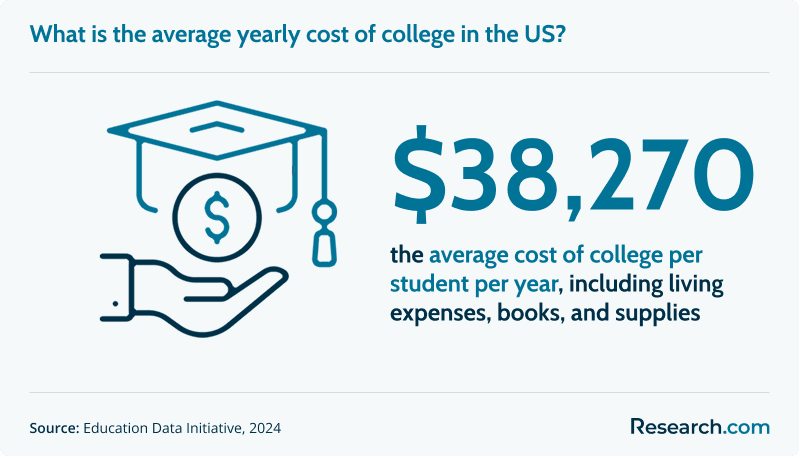
The average yearly cost of college in the U.S. is approximately $38,270 when tuition, living expenses, books, and supplies are included. Public four-year colleges are usually cheaper for in-state students, with tuition of about $9,750 per year. Private nonprofit colleges charge average tuition of $38,421 per year.
Students can reduce costs through community college transfer pathways, in-state public universities, employer tuition assistance, military benefits, part-time enrollment, scholarships, and flexible online programs. Open enrollment online colleges may provide accessible admissions and convenient scheduling, but students should still examine accreditation, graduation outcomes, transfer policies, and career services.
The strongest return usually comes from combining controlled costs with a program tied to real labor-market demand. A higher-cost degree in engineering, finance, computer science, or another high-skill field may be worth considering only if the school offers strong completion rates, employer connections, internships, and recognized academic quality.
What Financial Aid Options Are Available for High-Earning Degree Programs?
Financial aid can make a high-value degree more affordable, but students should separate gift aid from debt. The strongest funding plan usually combines grants, scholarships, work income, family resources, employer support, military benefits when available, and cautious borrowing.
- Federal grants: Need-based funding such as the Pell Grant that does not have to be repaid.
- Scholarships: Awards from colleges, employers, nonprofits, professional associations, and private organizations.
- Work-study programs: Federally supported part-time jobs that help students cover education-related expenses.
- Federal student loans: Loans that often include borrower protections and repayment options not always available with private loans.
- State grants and scholarships: Aid based on residency, financial need, academic achievement, or field of study.
- Employer tuition assistance: Employer funding for degrees tied to workforce development, retention, or promotion paths.
- Private student loans: Bank or lender-based loans that may include higher interest rates and fewer borrower protections.
- Military education benefits: Programs such as the GI Bill for eligible service members, veterans, and qualifying family members.
- Income-share agreements: Funding arrangements where graduates pay a percentage of future income for a defined period.
Apply early, compare award letters line by line, and look at the final net price instead of the largest advertised scholarship. A smaller award at a lower-cost institution may leave you with less debt than a larger award at a more expensive school.
How Should You Choose a Degree That Can Lead to $100k Salary Jobs?
The right degree is not simply the one with the highest salary estimate. It is the program that fits your strengths, prepares you for real jobs, has credible outcomes, and costs an amount you can reasonably repay. A good decision combines self-assessment, labor-market research, accreditation checks, career-readiness review, and financial planning.
| Step | What to do | Why it matters |
| 1. Match the field to your strengths | Decide whether you prefer math, coding, finance, design, science, healthcare, systems, or leadership | High-paying work is easier to sustain when the tasks fit your abilities and interests |
| 2. Check job outlook | Compare growth projections, openings, and industry stability | A strong salary is less useful if hiring is limited or unstable |
| 3. Review salary ranges | Look at entry-level, mid-career, and experienced pay rather than only averages | Some majors take longer than others to reach six figures |
| 4. Verify accreditation | Confirm institutional accreditation and program-specific accreditation when needed | Accreditation can affect financial aid, transfer credit, licensure, graduate school, and employer trust |
| 5. Calculate return on investment | Compare total cost, likely debt, expected early-career income, and repayment obligations | Net cost is more useful than tuition alone |
| 6. Evaluate career support | Ask about internships, employer partnerships, alumni outcomes, co-ops, capstones, and placement help | Career access often separates strong programs from weak ones |
| 7. Build experience before graduation | Complete projects, internships, certifications, research, leadership roles, or work experience | Evidence of ability improves competitiveness for high-paying jobs |
Questions to Ask a School Before You Enroll
- Is the institution accredited, and does this field require specialized program accreditation?
- What are the graduation, transfer, retention, and debt outcomes for students in this program?
- Which employers recruit from the department or major?
- Are internships, co-ops, labs, clinicals, studios, or capstone projects required or strongly supported?
- What is the real total cost after grants, scholarships, transfer credits, and fees?
- Does the curriculum prepare students for licensure, professional exams, or certifications when required?
- Do online students receive the same advising, tutoring, library access, and career services as campus students?
- What salary outcomes does the school report, and how were those outcomes collected?
How to Set Realistic Salary Expectations
Even a strong major does not guarantee a six-figure salary. Pay depends on role, region, employer size, industry conditions, experience, negotiation, performance, and access to opportunity. Some graduates may reach $100,000 quickly, while others may need additional years, certifications, relocation, graduate education, or a move into management.
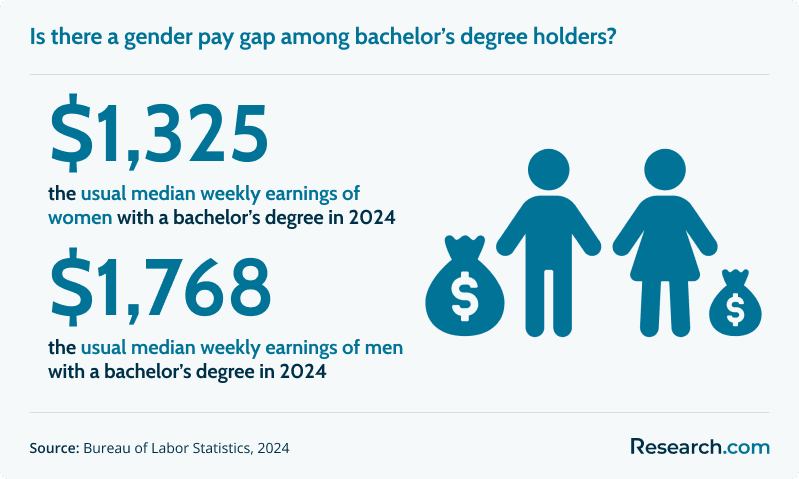
Students should also be aware of persistent equity issues. Recent data shows that gender pay gaps remain among bachelor’s degree holders, with females earning a median of $1,325 per week compared with $1,768 for males in 2024. Researching salary benchmarks, documenting achievements, negotiating offers, and choosing employers with transparent advancement policies can help graduates protect their earning potential.
Common Mistakes to Avoid
- Choosing only by average salary: A high average can hide a large gap between entry-level pay and senior-level compensation.
- Skipping accreditation checks: Unaccredited or poorly recognized programs can create problems with transfer, aid, licensure, employment, or graduate study.
- Borrowing based on best-case earnings: Build your budget around realistic early-career pay, not the top of the salary range.
- Ignoring internships: Work experience often determines who gets access to competitive entry-level roles.
- Assuming online means easier: Good online programs still require discipline, exams, projects, collaboration, and employer-relevant skills.
- Overlooking geography: Some high-paying jobs require relocation to expensive or specialized labor markets.
- Relying only on rankings: Rankings can help, but curriculum, cost, outcomes, accreditation, and fit matter more.
Bachelor’s Degree or Trade School: Which Has Better Long-Term Value?
Bachelor’s degrees and trade schools can both lead to good careers, but they are designed for different goals. A bachelor’s degree usually offers broader academic training, more mobility across industries, stronger access to management tracks, and eligibility for many graduate programs. Trade schools focus on job-specific skills, shorter training periods, and faster entry into skilled occupations.
Students who want a faster, lower-cost path into the workforce may compare high-paying trade school jobs. Students aiming for engineering, computer science, finance, architecture, analytics, healthcare administration, or leadership roles may find that a bachelor’s degree provides more long-term flexibility. The right choice depends on your target occupation, required credential, debt tolerance, learning style, and preferred work environment.
What Graduates Say About Degrees With $100k Salary Potential
- Actuarial science stood out because it mixed mathematics, business, and risk. My classes helped me prepare for certification exams, and the projects resembled the work I do now. The salary outlook was important, but I also liked using data to help organizations make better decisions under uncertainty. Dawn
- Chemical engineering gave me a structured way to solve difficult technical problems. My first process engineering job paid close to six figures, and I now work on sustainable packaging materials. The work is demanding, but it feels practical and valuable. Harry
- Finance helped me understand markets, companies, and personal money decisions. Internships and networking events made a major difference when I pursued a financial analyst role after graduation. The income matters, but I also value helping people and organizations make more informed financial choices. Ryan
How Do Degree Programs Build Career Readiness and Networks?
Strong bachelor’s programs do more than deliver lectures. They help students connect with employers, practice workplace skills, build professional references, and create evidence of ability before graduation. Career fairs, alumni networks, employer-sponsored projects, co-ops, internships, faculty mentorship, undergraduate research, and capstone projects can all improve job readiness.
Students who need both affordability and career preparation may want to review the most affordable online bachelor’s degrees. The goal should not be the cheapest program at any cost, but a credible program that combines reasonable price, academic quality, practical experience, and measurable outcomes.
Can Online Certifications Increase the Value of a Bachelor’s Degree?
Online certifications can strengthen a bachelor’s degree when they verify specific skills employers request. They are especially useful in fast-changing fields such as cloud computing, cybersecurity, data analytics, project management, coding frameworks, finance software, and digital marketing. Certifications are most effective as supplements to a degree, portfolio, internship record, and work experience.
Graduates can use online certifications that pay well to close skill gaps, prepare for promotion, or show that they are current with industry tools. The best credential is the one that appears in job descriptions for the roles you actually want.
How Can Career Strategy and Negotiation Help You Reach $100k?
Reaching a six-figure salary usually requires more than finishing a degree. Graduates should track salary benchmarks, build strong resumes, maintain professional networks, document measurable achievements, and practice negotiation. Career growth also depends on knowing when to seek promotion, change employers, add credentials, relocate, or move into a higher-paying industry.
Strategic credentials can strengthen bargaining power when they match employer demand. Comparing the most lucrative certifications can help graduates identify options that support their target roles. The strongest salary negotiations are based on market data, demonstrated results, competing opportunities, and a clear understanding of total compensation, not base salary alone.
References
- Bureau of Labor Statistics. (2024). Architects. Occupational Outlook Handbook. Retrieved March 6, 2025, from BLS architect profile.
- Bureau of Labor Statistics. (2024). Architectural and engineering managers. Occupational Outlook Handbook. Retrieved March 6, 2025, from BLS architectural and engineering managers profile.
- Bureau of Labor Statistics. (2024). Aerospace engineers. Occupational Outlook Handbook. Retrieved March 6, 2025, from BLS aerospace engineers profile.
- Bureau of Labor Statistics. (2024). Actuaries. Occupational Outlook Handbook. Retrieved March 6, 2025, from BLS actuaries profile.
- Bureau of Labor Statistics. (2024). Chemical engineers. Occupational Outlook Handbook. Retrieved March 6, 2025, from BLS chemical engineers profile.
- Bureau of Labor Statistics. (2024). Computer and information technology occupations. Occupational Outlook Handbook. Retrieved March 6, 2025, from BLS computer and IT occupations overview.
- Bureau of Labor Statistics. (2024). Computer hardware engineers. Occupational Outlook Handbook. Retrieved March 6, 2025, from BLS computer hardware engineers profile.
- Bureau of Labor Statistics. (2024). Electrical and electronics engineers. Occupational Outlook Handbook. Retrieved March 6, 2025, from BLS electrical and electronics engineers profile.
- Bureau of Labor Statistics. (2024). Financial analysts. Occupational Outlook Handbook. Retrieved March 6, 2025, from BLS financial analysts profile.
- Bureau of Labor Statistics. (2024). Petroleum engineers. Occupational Outlook Handbook. Retrieved March 6, 2025, from BLS petroleum engineers profile.
- CareerOneStop. (2025). Fastest-growing industries. Retrieved March 6, 2025, from CareerOneStop fastest-growing industry data.
- CareerOneStop. (2025). Highest-paying industries. Retrieved March 6, 2025, from CareerOneStop highest-paying industry wage data.
- Hanson, M. (2025). Average cost of college & tuition. Education Data Initiative. Retrieved March 6, 2025, from Education Data Initiative college cost data.
- Indeed. (2025, March 4). 21 jobs that pay over $100K with a bachelor's degree. Retrieved March 6, 2025, from Indeed guide to $100K jobs with a bachelor’s degree.
- Indeed. (2025, January 29). Best non-STEM majors with high-paying salaries. Retrieved March 6, 2025, from Indeed guide to high-paying non-STEM majors.
- PayScale. (2024). Highest paying jobs with a bachelor’s degree. Retrieved March 6, 2025, from PayScale bachelor’s degree salary report.
- Statista. (2024). Highest paying occupations in the United States as of May 2023, by mean annual pay (in U.S. dollars). Retrieved March 6, 2025, from Statista highest-paying occupation salary data.
- ZipRecruiter. (2025). Actuarial science salary. Retrieved March 6, 2025, from ZipRecruiter actuarial science salary data.
- ZipRecruiter. (2025). Aerospace engineering salary. Retrieved March 6, 2025, from ZipRecruiter aerospace engineering salary data.
- ZipRecruiter. (2025). Architect salary. Retrieved March 6, 2025, from ZipRecruiter architect salary data.
- ZipRecruiter. (2025). Bachelor electrical engineering salary. Retrieved March 6, 2025, from ZipRecruiter bachelor’s electrical engineering salary data.
- ZipRecruiter. (2025). Chemical engineer salary. Retrieved March 6, 2025, from ZipRecruiter chemical engineer salary data.
- ZipRecruiter. (2025). Computer engineering salary. Retrieved March 6, 2025, from ZipRecruiter computer engineering salary data.
- ZipRecruiter. (2025). Computer science degree salary. Retrieved March 6, 2025, from ZipRecruiter computer science degree salary data.
- ZipRecruiter. (2025). Finance degree salary. Retrieved March 6, 2025, from ZipRecruiter finance degree salary data.
- ZipRecruiter. (2025). Petroleum engineering salary. Retrieved March 6, 2025, from ZipRecruiter petroleum engineering salary data.
Key Insights
- A bachelor’s degree can improve earnings, but major choice, program cost, and career pathway determine the real payoff. In 2024, bachelor’s degree holders earned median weekly pay of $1,541, while high school graduates earned $915 to $916 per week depending on the cited comparison.
- The most common bachelor’s routes to $100,000 salary potential are technical, analytical, or business-focused, including engineering management, computer engineering, electrical engineering, computer science, finance, actuarial science, and related fields.
- Six-figure pay is usually a mid-career outcome, not an automatic first job. Many graduates need 3 to 5 years of experience, internships, certifications, strong projects, geographic mobility, or advancement into specialized roles.
- Job outlook should shape the decision. Actuarial science has projected demand growth of 22%, while petroleum engineering has projected growth of 2%, even though both can offer strong income potential.
- Online degrees can be worthwhile when they are accredited, rigorous, career-focused, and supported by applied projects, faculty access, internships, and employer-recognized skills.
- Cost control matters. With the average yearly cost of college at approximately $38,270, students should compare net price, transfer credits, aid packages, likely early-career income, and loan repayment before enrolling.
- The degree alone is not enough. Internships, portfolios, certifications, networking, communication skills, leadership experience, and salary negotiation can significantly affect whether a graduate reaches $100,000.
- Salary planning should include equity and transparency. In 2024, female bachelor’s degree holders earned a median of $1,325 per week compared with $1,768 for males, making salary research, negotiation, and employer evaluation important career skills.
Other Things You Should Know About the 10 Best Degree Programs That Lead to 100k Salary Jobs
Some of the top degree programs in 2027 that are likely to lead to $100,000 salaries include Data Science, Computer Science, Engineering (especially Software and Electrical), and Financial Analysis. These fields boast high demand and attractive compensation.
No, internships are not required, but they help candidates compete for high-paying roles. Many employers value 1 to 3 internships, co-ops, or 6 to 12 months of related project experience, especially in engineering, computer science, finance, and analytics, where entry-level salaries can exceed $100,000.


