2027 Highest-Paying Finance Degree Jobs & Careers

Co-Founder and Chief Data Scientist
The highest-paying finance degree jobs are not limited to Wall Street trading floors. Finance graduates can move into executive leadership, investment banking, private equity, hedge funds, financial technology, compliance, accounting, advisory services, and risk management. The right path depends on your tolerance for long hours, your interest in client-facing work, your technical skills, and whether you are willing to pursue advanced credentials such as an MBA, CFA, CPA, CFP, FRM, or CISA.
This guide is for students comparing finance majors, working professionals planning a career move, and degree holders who want to understand which finance roles offer the strongest earning potential. You will learn which jobs pay the most, what each role actually involves, what education and skills employers usually expect, which entry-level jobs can lead to higher-paying positions, and how to decide whether further education is worth the cost and time.
Quick Answer: What Are the Highest-Paying Finance Degree Jobs?
The highest-paying finance degree jobs in this guide are chief financial officer, chief compliance officer, investment banker, financial advisor, hedge fund manager, private equity associate, financial software developer, financial analyst, information technology auditor, and senior accountant. Executive roles generally pay the most, but they usually require years of experience, leadership ability, and a record of strong financial decision-making. Investment banking, private equity, hedge funds, fintech, and financial advising can also lead to high compensation, especially when bonuses, commissions, carried interest, or performance incentives are involved.
Key Things You Should Know Before Choosing a Finance Career
- A bachelor’s degree is often the starting point, not the finish line. Many high-earning finance jobs begin with a bachelor’s degree in finance, accounting, economics, or business, but senior roles often favor candidates with an MBA, specialized graduate degree, or credentials such as the CFA, CPA, CFP, FRM, or CISA.
- Compensation varies widely by role and pay structure. Some finance jobs rely mostly on salary, while others include bonuses, commissions, stock options, profit-sharing, or carried interest. Always compare total compensation, not just base pay.
- Industry choice can shape earnings. Investment banking, hedge funds, private equity, fintech, and executive finance roles often offer higher upside than some corporate finance or traditional planning roles, but they may also bring more competition, longer hours, or higher pressure.
- Experience compounds quickly in finance. Entry-level roles can lead to strong long-term earnings when they build financial modeling, valuation, regulatory, client management, data analysis, and leadership skills.
- Technology is now central to finance work. Employers increasingly value Excel, SQL, Python, financial modeling software, risk systems, cybersecurity awareness, and comfort with AI-assisted analysis.
- Salary outcomes are not guaranteed. Location, employer size, market cycles, credentials, performance, networking, and specialization all influence actual earnings.
- Highest-Paying Finance Degree Jobs for 2027
- What a Finance Degree Covers
- Finance Degree Specializations and When They Make Sense
- Typical Admission Requirements for Finance Degree Programs
- Skills Employers Look for in Finance Degree Jobs
- Entry-Level Finance Jobs That Can Lead to Higher Pay
- Benefits and Trade-Offs of Earning a Finance Degree
- Should Finance Professionals Pursue an MBA?
- How Finance Professionals Can Future-Proof Their Careers
- Can an Advanced Degree Speed Up Finance Career Growth?
- Is Leadership Education Important for Finance Professionals?
- Is Further Education a Sound Investment for Finance Professionals?
- Global Career Prospects for Finance Degree Holders
- Should Finance Professionals Consider an Affordable Online Executive MBA?
- Is an Online Finance Degree Worth It?
- Future Trends Finance Graduates Should Watch
- How Project Management Skills Can Help Finance Careers
- Common Challenges in Finance Degree Jobs
- Alternative Careers for Finance Degree Holders
- Finance Certifications That May Improve Earning Potential
10 Highest-Paying Finance Degree Jobs for 2027
The roles below represent some of the highest-paying paths available to finance graduates. Some are traditional finance jobs, while others sit at the intersection of finance, accounting, compliance, cybersecurity, and software development. Use the salary figures as reference points, not promises. Actual compensation can change based on region, employer, seniority, market performance, and bonus structure.
| Finance career | Average annual salary listed in the source data | Best fit for |
| Chief Financial Officer | $459,000 | Experienced finance leaders who want enterprise-level responsibility |
| Chief Compliance Officer | $255,401 | Professionals who understand regulation, risk, ethics, and governance |
| Investment Banker | $178,339 | Analytical, deal-oriented candidates who can handle long hours and pressure |
| Financial Advisor | $150,670 | Client-focused professionals interested in wealth planning and relationship building |
| Hedge Fund Manager | $145,949 | Investment specialists comfortable with complex strategies and performance risk |
| Private Equity Associate | $142,686 | Finance professionals skilled in valuation, due diligence, and deal execution |
| Financial Software Developer | $127,686 | Candidates who can combine programming skills with financial systems knowledge |
| Financial Analyst | $112,950 | Data-driven professionals who want a broad entry point into corporate finance or investing |
| Information Technology Auditor | $90,295 | Finance, audit, and technology professionals focused on controls and cybersecurity |
| Senior Accountant | $86,407 | Detail-oriented professionals interested in reporting, compliance, tax, and audit paths |
1. Chief Financial Officer
A chief financial officer leads the financial direction of an organization. CFOs oversee financial planning, budgeting, capital allocation, accounting, reporting, risk management, investor communication, and long-term strategy. They work closely with the CEO and board of directors, and their decisions can affect hiring, expansion, mergers, cost controls, financing, and profitability.
This role is usually the result of a long career in finance, accounting, strategy, or operations. A strong finance degree salary trajectory can help, but CFO candidates also need leadership experience, business judgment, and credibility with executives, investors, auditors, and regulators.
Salary
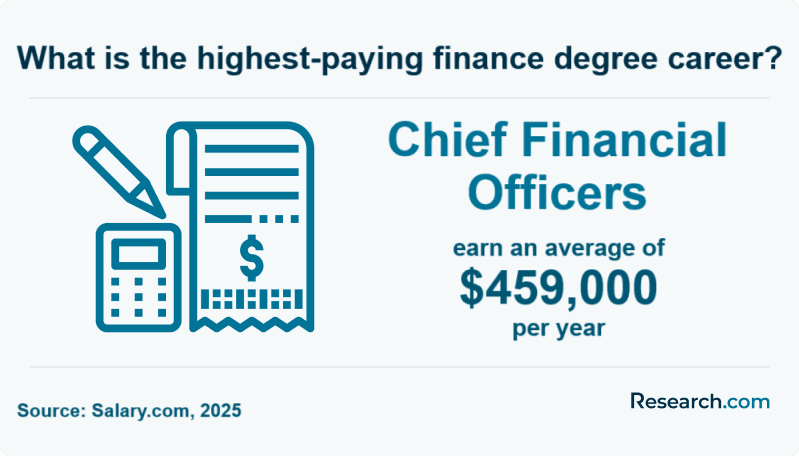
- According to Salary.com, the average annual salary for a CFO in the U.S. as of March 2025 is $459,000. Annual pay typically ranges from $351,936 to $587,676.
- The U.S. Bureau of Labor Statistics reports that the median annual wage for chief executives, including CFOs, was $206,680 in May 2023. Their average annual wage was $258,900.
Job Outlook
- Organizations continue to need senior financial leaders who can manage growth, uncertainty, capital planning, and compliance.
- According to the BLS, the overall employment of top executives is projected to grow 6% from 2023 to 2033, with an average of 343,800 openings projected each year over this 10-year period.
- CFO opportunities are often strongest for professionals who combine finance expertise with industry knowledge in areas such as healthcare, finance, and technology.
2. Chief Compliance Officer
A chief compliance officer is responsible for making sure an organization follows applicable laws, industry rules, internal policies, and ethical standards. CCOs design compliance programs, oversee audits, monitor regulatory changes, train employees, investigate potential violations, and advise senior leadership on risk exposure.
This job is especially important in highly regulated sectors such as finance, healthcare, and technology. It suits professionals who are comfortable interpreting rules, documenting controls, working with legal teams, and making decisions that may prevent costly enforcement actions or reputational damage.
Salary
- According to Salary.com, the average annual salary for a CCO in the U.S. as of March 2025 is $255,401. CCO pay typically ranges from $215,401 to $300,101.
- According to the BLS, the median annual wage for chief executives, including CFOs, was $206,680 in May 2023. Their average annual wage was $258,900.
Job Outlook
- Compliance leadership remains important as organizations respond to financial regulations, data privacy expectations, reporting requirements, and internal risk controls.
- According to the BLS, the overall employment of top executives is projected to grow 6% from 2023 to 2033, with an average of 343,800 openings projected each year over the decade. Meanwhile, the employment of compliance officers in general is projected to grow 5% from 2023 to 2033, with an average of 34,400 openings projected each year.
3. Hedge Fund Manager
A hedge fund manager directs investment strategy for a private investment fund. The work can include researching markets, building portfolios, managing risk, trading securities or derivatives, monitoring fund performance, and communicating with investors. Hedge funds may use complex strategies, so the role demands deep investment knowledge and the ability to make decisions under uncertainty.
This career can offer substantial upside, but it is also highly competitive and performance-driven. Many professionals enter hedge funds after building experience in investment banking, asset management, equity research, quantitative analysis, or trading.
Salary
- Hedge fund manager earnings can vary sharply based on fund performance, experience, and assets under management.
- The base salary typically ranges from $150,000 to $300,000 per year, but much of the compensation may come from management fees and performance-based bonuses.
- Top-performing hedge fund managers can earn millions annually, with the highest earners receiving over $1 million to $10 million+ per year, including incentives.
- According to Salary.com, the annual average salary of hedge fund managers in the U.S. is $145,949 as of March 2025. This average annual salary can go as low as $115,237 or can go up to $173,137.
Job Outlook
- Hedge fund careers remain selective because firms need professionals who can consistently identify opportunities and manage downside risk.
- Financial industry reports indicate that hedge fund assets continue to grow, which supports demand for investment talent.
- Breaking into the field usually requires strong modeling ability, market knowledge, prior investment experience, and a strong professional network.
4. Private Equity Associate
A private equity associate helps investment firms evaluate, buy, improve, and sell private companies. Common tasks include financial modeling, valuation, due diligence, industry research, deal documentation, and portfolio company analysis. Associates may also work with executives at portfolio companies to support growth plans, cost improvements, or exit strategies.
This path is best suited to candidates who like transaction work and can manage demanding deadlines. Many associates come from investment banking or consulting because those roles build the technical and deal skills private equity firms expect.
Salary
- According to Glassdoor, the annual salary for private equity associates can range from $224,000 to $419,000, with an average salary of $142,686 per year. Their base pay ranges from $107,000 to $200,000.
- Bonuses and carried interest, which is a share of firm profits, can increase total compensation.
- Total annual compensation, including performance-based incentives, can reach $250,000 to $500,000+ for top-performing associates.
Job Outlook
- The private equity industry continues to expand, with firms managing over $12 trillion in global assets as of recent estimates.
- Employers often look for candidates with investment banking, consulting, valuation, modeling, and due diligence experience.
- Competition is intense, so candidates need technical excellence, judgment, and networking skills.
5. Investment Banker
Investment bankers help companies, governments, and institutions raise capital, buy or sell businesses, issue securities, and complete complex financial transactions. The work often includes valuation, financial modeling, pitch books, market research, due diligence, client presentations, and negotiations.
This role is known for high compensation potential and demanding work schedules. It can be a strong fit for graduates who want transaction experience, are comfortable with pressure, and can produce accurate analysis quickly.
Salary
- According to Glassdoor, investment bankers can make $305,000 to $569,000 per year. Their average annual salary is $178,339. Their base pay is $134,000 to $250,000 per year.
- Performance bonuses can substantially raise total annual compensation.
Job Outlook
- Demand remains tied to capital markets, mergers and acquisitions, underwriting, and advisory activity.
- According to BLS, the employment of securities, commodities, and financial services sales agents -- which include investment bankers -- is projected to grow 7% from 2023 to 2033. An average of 41,000 job openings in this sector or specialization are projected each year over the decade.
- Automation and fintech tools can streamline some tasks, but strategic advice, negotiation, client trust, and deal judgment remain central to the role.
6. Financial Software Developer
A financial software developer builds and maintains technology used by banks, fintech firms, hedge funds, trading platforms, investment companies, and corporate finance teams. These professionals may develop risk systems, trading applications, payment tools, financial modeling platforms, reporting dashboards, or compliance technology.
This is one of the strongest paths for finance students who also enjoy programming. Common technical tools include Python, Java, C++, SQL, APIs, cloud platforms, and secure data systems. The role may involve collaboration with traders, analysts, compliance teams, cybersecurity professionals, and product managers.
Salary
- According to Glassdoor, financial software developers make anywhere from $138,00 to $250,000 per year, with a median annual pay of $183,000. The base pay is $97,000 to $168,000. The average annual salary for these professionals is $127,686.
- Compensation may also include bonuses, equity, or stock options, especially in fintech companies and large financial institutions.
Job Outlook
- According to the BLS, software developers can expect an overall employment growth rate of 18% from 2023 to 2033, with an average of 140,100 openings projected each year over the decade.
- Fintech, blockchain, algorithmic trading, AI-assisted finance tools, cybersecurity, and automation continue to shape demand.
- Career options exist in both traditional finance organizations and technology-driven finance companies.
7. Financial Analyst
A financial analyst evaluates financial data to support investment decisions, budgeting, corporate planning, valuation, and risk assessment. Analysts may review financial statements, build forecasts, create reports, monitor markets, assess revenue and expenses, and recommend actions to executives or clients.
This is one of the most common starting points for finance graduates because it builds transferable skills. Analysts can later move into corporate finance, asset management, banking, investor relations, private equity, risk management, or leadership roles.
Salary
- According to the BLS, financial analysts earn an average of $112,950 per year, or $53.30 an hour.
- Bonus opportunities can raise total compensation, especially in investment-focused firms.
Job Outlook
- The overall employment of financial analysts is projected to grow 9% from 2023 to 2033, with an average of 30,700 openings each year over this 10-year period.
- Employers continue to value financial modeling, data analysis, risk assessment, and investment strategy skills.
- ESG investing, cryptocurrency markets, automation, and AI-assisted analytics are expanding the types of analysis some employers expect.
8. Information Technology Auditor
An information technology auditor reviews an organization’s technology systems, security controls, data practices, and compliance processes. In finance, IT auditors may evaluate systems used for payments, trading, customer data, financial reporting, access controls, and cybersecurity.
This role is a strong option for finance graduates who are interested in technology risk. It combines audit thinking, regulatory awareness, cybersecurity knowledge, and business process analysis.
Salary
- According to Glassdoor, IT auditors earn anywhere from $94,000 to $134,000 per year, with a median annual salary of $111,000. Their average salary is $90,295 per year. Their base salary ranges from $78,000 to $104,000.
- Certifications such as CISA or CISSP may improve competitiveness for higher-level roles.
Job Outlook
- According to the BLS, the employment of information security analysts, including IT auditors, is projected to grow 33% from 2023 to 2033.
- Cybersecurity investment, cloud adoption, financial data protection, and compliance requirements continue to support demand.
- Professionals with knowledge of SOX, GDPR, HIPAA, cloud controls, and risk frameworks may have stronger advancement options.
9. Financial Advisor
A financial advisor helps individuals, families, and businesses plan for investments, retirement, insurance, taxes, estate goals, and long-term wealth management. Advisors evaluate a client’s financial situation, risk tolerance, goals, and time horizon before recommending strategies.
This career is well suited to finance graduates who enjoy client relationships and communication. Compensation may depend heavily on assets under management, fees, commissions, client retention, and business development.
Salary
- Financial advisors, according to the BLS, earn an average annual salary of $150,670, or an average of $72.44 per hour.
- Advisors using fee-based or commission-based models may earn more depending on their client base and assets under management.
Job Outlook
- The employment of personal financial advisors is projected to grow 17% from 2023 to 2033. An average of 27,000 job openings are projected each year over this 10-year period.
- Demand is supported by retirement planning needs, growing interest in personal finance, and the complexity of investment and tax decisions.
- Credentials such as CFP or CFA may help advisors build credibility with clients and employers.
10. Senior Accountant
A senior accountant manages financial records, prepares reports, reconciles accounts, supports budgeting, assists with tax work, and helps ensure compliance with accounting standards. Senior accountants may supervise junior staff, support audits, and advise management on financial accuracy and process improvements.
Students wondering what can you do with an accounting degree should consider how accounting and finance careers overlap. Accounting can be a stable route into corporate finance, controllership, audit leadership, and eventually executive finance roles.
Salary
- Senior accountants, according to Glassdoor, enjoy an annual salary of $89,000 to $128,000, with a median of $106,000 per year. The base pay for senior accountants is $74,000 to $101,000. Their average annual salary is $86,407.
- Industry, location, employer size, and credentials such as CPA or CA can affect pay.
Job Outlook
- The employment of accountants and auditors, according to the BLS, is projected to grow 6% from 2023 to 2033. An average of 130,800 openings for the job are projected each year over this 10-year period.
- Regulatory requirements, tax complexity, audit needs, and financial reporting responsibilities continue to support demand.
- Accountants with tax, audit, financial systems, and compliance experience may have an advantage.
What Is a Finance Degree?
A finance degree is a college program focused on how money is managed, invested, borrowed, budgeted, analyzed, and regulated. Students learn how businesses raise capital, how investors evaluate risk and return, how markets operate, and how individuals and organizations make financial decisions.
Typical coursework may include corporate finance, investments, accounting, economics, statistics, financial modeling, portfolio management, risk management, banking, business law, and financial planning. Many programs also include analytics, fintech, and data tools because finance work increasingly depends on software and quantitative decision-making.
| Degree level | Typical length stated in the source text | Common purpose |
| Associate’s Degree in Finance | 2 years | Introduces basic business and finance concepts for entry-level support roles or transfer to a bachelor’s program |
| Bachelor’s Degree in Finance | 4 years | Provides the standard preparation for many analyst, banking, corporate finance, planning, and risk roles |
| Master’s Degree in Finance or MBA with a Finance Concentration | 1–2 years | Helps professionals pursue specialized or leadership-oriented roles in areas such as investment banking, financial analysis, and corporate finance |
| Doctorate in Finance, Ph.D., or DBA | Not specified | Focuses on advanced research, teaching, consulting, or high-level analytical leadership |
If your goal is management or executive advancement, compare traditional graduate study with flexible online MBA programs. Finance is also frequently discussed among the best degrees for 100k salary roles, but the degree alone does not guarantee a six-figure income. The strongest outcomes usually come from pairing the degree with internships, technical skills, credentials, and relevant experience.
What Are the Various Finance Degree Specializations?
Finance is broad, so choosing a specialization can help you target the jobs and industries you actually want. A student interested in wealth management should not choose the same electives as someone aiming for private equity, and a fintech-focused student will need stronger technology preparation than someone pursuing traditional corporate finance.
| Specialization | What it emphasizes | Career paths it can support |
| Corporate Finance | Budgeting, capital planning, forecasting, risk management, and financial strategy inside companies | Financial analyst, treasury analyst, finance manager, CFO track |
| Investment Banking | Capital markets, securities, mergers and acquisitions, valuation, and transaction advisory | Investment banking analyst, associate, M&A advisor, equity research professional |
| Financial Planning and Wealth Management | Retirement, estate, insurance, tax, investment, and client financial planning | Financial advisor, wealth manager, certified financial planner |
| Risk Management | Credit risk, market risk, operational risk, insurance, controls, and mitigation strategies | Risk analyst, compliance officer, credit risk manager |
| FinTech | Digital finance, AI, blockchain, payments, financial software, cybersecurity, and analytics | Financial software developer, fintech analyst, blockchain analyst, cybersecurity role in finance |
| International Finance | Currency markets, global investing, international trade, and multinational financial strategy | Global financial analyst, international trade specialist, economic consultant |
| Accounting and Auditing | Financial reporting, tax, audit, internal controls, and compliance | Senior accountant, forensic accountant, auditor, controller track |
| Real Estate Finance | Property valuation, mortgage lending, development finance, and real estate investment analysis | Real estate financial analyst, mortgage broker, property investment consultant |
Students drawn to client acquisition, advisory work, and financial products may also compare finance with business development-oriented majors. Research.com’s guide on what to major in for a sales career can help if you are considering wealth management, financial services sales, or advisory roles.
Finance graduates who like systems, software, and data architecture can also explore technology-adjacent roles. Understanding what does a systems analyst do may help you decide whether business systems, enterprise software, or fintech implementation is a better fit than a traditional finance job.
Corporate finance can be a practical specialization for students aiming at senior business leadership. CFO roles sit at the top of many finance career ladders because they require technical finance ability, business strategy, communication, governance, and executive decision-making.
What Are the Typical Requirements for Pursuing a Finance Degree?
Admission requirements vary by school and degree level, but finance programs usually evaluate academic readiness, math preparation, writing ability, and evidence of interest in business or finance. Graduate programs may also consider work experience and leadership potential.
| Requirement | Undergraduate finance programs | Graduate finance programs |
| Educational background | High school diploma or GED is commonly required | Bachelor’s degree is typically required, often in finance, accounting, economics, business, or a related field |
| Helpful coursework | Algebra, statistics, calculus, economics, and business can strengthen preparation | Some programs require prerequisites in accounting, economics, statistics, or finance |
| Standardized tests | Many universities may ask for SAT or ACT scores | Some programs require GMAT or GRE scores, while others offer waivers |
| GPA | Competitive programs often expect a minimum GPA of 3.0 or higher, though requirements vary | A strong undergraduate GPA, typically 3.0–3.5+, is recommended for competitive programs |
| Experience | Internships, finance clubs, investment societies, and business competitions can help | Some MBA programs prefer 2–5 years of work experience; executive programs may require more |
| Application materials | Essays, recommendation letters, and transcripts may be required | Statements of purpose, recommendations, resumes, and interviews are common in some programs |
How to Strengthen Your Finance Program Application
- Take rigorous math, economics, accounting, or business courses when available.
- Join finance-related clubs, investment groups, business competitions, or entrepreneurship activities.
- Look for internships, part-time jobs, or volunteer roles involving bookkeeping, banking, budgeting, data analysis, or customer-facing financial services.
- Write an admissions essay that connects your academic background to a specific finance goal rather than saying only that you want a high-paying job.
- For graduate programs, document measurable work achievements, leadership experience, and analytical projects.
What Skills Do Employers Look for in Finance Degree Jobs?
Finance employers hire for more than math ability. They need professionals who can interpret financial information, use technology, communicate clearly, manage risk, and make sound decisions under time pressure. The most valuable candidates combine technical accuracy with business judgment.
- Analytical thinking: Finance professionals must interpret data, identify patterns, evaluate alternatives, and recommend decisions based on evidence.
- Financial modeling and data analysis: Excel, SQL, Python, valuation models, forecasting tools, and dashboards are useful across banking, corporate finance, investment, and fintech roles.
- Accounting and reporting knowledge: Understanding balance sheets, income statements, cash flow statements, GAAP, and IFRS helps professionals evaluate financial health and compliance.
- Risk management: Employers value candidates who can assess credit risk, market risk, operational risk, liquidity risk, and regulatory risk.
- Communication: Finance professionals must explain complex findings to executives, clients, auditors, regulators, or non-finance teams.
- Market and business awareness: Strong candidates follow economic trends, interest rates, industry changes, capital markets, and company strategy.
- Accuracy and attention to detail: Errors in models, reports, tax filings, or investment analysis can lead to poor decisions or compliance issues.
- Technology fluency: Familiarity with ERP systems, trading platforms, financial databases, cybersecurity practices, AI-assisted tools, and automation can improve career flexibility.
- Ethics and regulatory awareness: Finance professionals are trusted with sensitive information, client assets, reporting duties, and decisions that carry legal consequences.
- Leadership and teamwork: Senior finance roles require collaboration across accounting, operations, sales, technology, legal, compliance, and executive teams.
Finance careers increasingly reward professionals who can work with data and digital systems. If you want to move toward fintech, analytics, cybersecurity, or systems integration, reviewing the top certifications for computer science can help you identify technology credentials that complement a finance background.
What Are the Entry-Level Finance Degree Jobs?
Most high-paying finance careers begin with entry-level work that builds technical skills, credibility, and industry knowledge. Your first role should give you exposure to analysis, reporting, client work, financial systems, or transactions—not just a job title that sounds impressive.
| Entry-level role | What you typically do | Average salary range stated in the source text | Can lead to |
| Financial Analyst | Analyze financial data, prepare reports, and support investment or business decisions | $65,000 – $75,000 per year | Corporate finance, investment analysis, FP&A, finance manager roles |
| Investment Banking Analyst | Build models, research markets, support valuations, and assist with M&A or IPO work | $80,000 – $100,000 per year, often with large bonuses | Investment banking associate, private equity, corporate development |
| Accountant or Auditor | Prepare financial statements, support tax compliance, and review records | $55,000 – $65,000 per year | Senior accountant, audit manager, controller, CFO track |
| Risk Analyst | Evaluate financial, market, operational, or credit risk | $60,000 – $75,000 per year | Risk manager, compliance officer, banking risk leadership |
| Financial Planner or Advisor | Help clients with investments, retirement planning, and financial goals | $50,000 – $70,000 per year, with potential commissions | Wealth manager, CFP, advisory practice owner |
| Credit Analyst | Assess creditworthiness, review loan files, and evaluate default risk | $55,000 – $70,000 per year | Commercial banking, lending, risk management |
| Budget Analyst | Prepare budgets, monitor spending, and support financial planning | $60,000 – $75,000 per year | FP&A, public finance, finance management |
| Financial Operations Associate | Support transactions, reconciliations, reporting, and back-office financial processes | $50,000 – $65,000 per year | Operations management, compliance, financial systems |
| Tax Associate | Prepare tax returns, research tax rules, and support planning strategies | $55,000 – $65,000 per year | Tax manager, CPA path, corporate tax leadership |
| Insurance Underwriter | Review applications, evaluate risk, and set coverage terms or pricing | $55,000 – $70,000 per year | Risk management, insurance leadership, actuarial-adjacent roles |
The chart below compares various entry-level business and financial careers and their median annual salaries.
What Are the Benefits and Trade-Offs of Obtaining a Finance Degree?
A finance degree can be valuable because it prepares students for careers that exist across many industries. Banks, investment firms, insurance companies, fintech startups, healthcare systems, government agencies, real estate firms, nonprofits, and corporations all need people who understand money, risk, reporting, and strategy.
- High earning potential: Finance is commonly grouped with highest paying majors, especially for graduates who move into investment banking, corporate finance, financial analysis, fintech, or leadership roles.
- Broad career flexibility: A finance background can support jobs in banking, investments, accounting, risk, advisory services, real estate, insurance, fintech, and consulting.
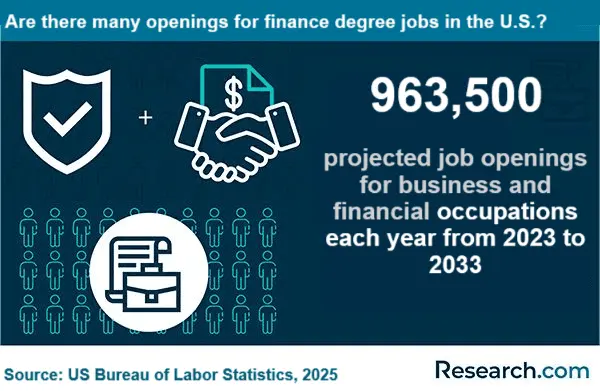
- Steady demand for financial expertise: According to the BLS, the overall employment in business and financial occupations is projected to grow faster than the average for all occupations from 2023 to 2033, with an average of 963,500 openings projected each year over this 10-year period.
- Transferable skills: Finance students develop skills in analysis, forecasting, problem-solving, budgeting, decision-making, and risk evaluation.
- Advancement potential: Many senior roles, including CFO and finance director positions, build on finance, accounting, and leadership experience.
- Entrepreneurial usefulness: Entrepreneurs benefit from understanding cash flow, capital, budgeting, pricing, and investment decisions.
- International relevance: Finance skills can apply to multinational companies, global banks, international markets, and cross-border investment work.
- Credential pathways: A finance degree can support preparation for professional credentials such as the CFA, CFP, CPA, FRM, CAIA, and CMA. The Financial Management Association also provides information on finance certifications.
When a Finance Degree May Not Be the Best Fit
- You dislike quantitative work, spreadsheets, financial statements, or data analysis.
- You want a low-pressure career with predictable hours, since some finance roles involve long deadlines, market volatility, or client demands.
- You are interested mainly in software engineering; in that case, a computer science or software-focused program may be more direct.
- You expect the degree alone to guarantee a high salary without internships, networking, certifications, or relevant experience.
Should Finance Professionals Pursue an MBA?
An MBA can make sense for finance professionals who want to move from technical work into leadership, strategy, consulting, investment banking, corporate development, or executive management. It may also help career changers build a broader business foundation.
The decision should be based on your target role, employer expectations, opportunity cost, program reputation, accreditation, format, and total cost. Working professionals who need a shorter path may compare flexible options such as the fastest online MBA, but speed should not be the only factor. A program that is fast but weak in finance recruiting, alumni access, or employer recognition may not deliver the outcome you want.
What Strategies Can Finance Professionals Adopt to Future-Proof Their Careers?
Finance careers are changing as employers adopt AI tools, automation, cloud systems, digital payments, cybersecurity controls, and advanced analytics. Professionals can stay competitive by adding skills that make them harder to replace: judgment, communication, regulatory awareness, client trust, leadership, and the ability to interpret data responsibly.
- Build advanced spreadsheet, database, and programming skills when relevant to your role.
- Learn how AI-assisted finance tools work, including their limitations and risks.
- Keep up with cybersecurity, privacy, and compliance expectations in financial environments.
- Pursue credentials only when they align with your target role, not because they look impressive.
- Develop leadership, project management, and communication skills if you want management roles.
- Consider graduate education, including an easiest MBA program, only after comparing quality, cost, flexibility, and career fit.
Can an Advanced Degree Accelerate Career Growth in Finance?
An advanced degree can help in finance when it gives you access to better recruiting channels, deeper technical knowledge, leadership preparation, or a recognized credential that employers value. It is most useful when it connects directly to your target role.
For example, a finance professional interested in executive strategy, consulting, research, or teaching may consider doctoral-level business study. Programs such as online DBA programs can offer an applied business research path, but they are not necessary for most finance analyst, banking, advisory, or accounting roles.
Is Advanced Leadership Education Essential for Finance Professionals?
Leadership education is not required for every finance job, but it can matter for professionals who want to lead teams, manage organizational change, oversee financial strategy, or influence enterprise-level decisions. Technical finance knowledge may help you get promoted early, but senior roles require communication, ethics, people management, strategic planning, and cross-functional decision-making.
Professionals interested in executive leadership, organizational strategy, or academic leadership may explore options such as a PhD in organizational leadership. Before enrolling, compare the program’s cost, time commitment, accreditation, research expectations, and relevance to your finance career goals.
Is Further Education a Sound Investment for Finance Professionals?
Further education can be a sound investment if it improves your promotion prospects, qualifies you for a desired role, expands your network, or helps you change careers. It may be a poor investment if you enroll mainly for prestige, choose a program without checking accreditation, or borrow heavily without a realistic plan for career advancement.
Compare tuition, fees, lost work time, employer reimbursement, scholarship options, and expected career outcomes. If you are considering graduate business study, resources on the average cost of MBA online can help you evaluate whether the financial commitment fits your goals.
Questions to Ask Before Paying for Another Degree
- Does my target job require this degree, prefer it, or simply accept it?
- Will the program help me access employers, internships, alumni, or leadership opportunities?
- Is the school properly accredited?
- Can I keep working while enrolled?
- What will I pay after scholarships, employer benefits, and fees?
- Could a certification, internal promotion, or job change produce a better return?
What Are the Global Career Prospects for Finance Degree Holders?
Finance degree holders can find opportunities beyond their home market because financial analysis, investment strategy, accounting, risk management, compliance, and corporate finance are needed by multinational employers. Global roles may involve currency exposure, international reporting standards, cross-border transactions, regional regulations, and culturally diverse teams.
Professionals aiming for international leadership may benefit from graduate business education with recognized accreditation and global coursework. For example, AACSB accredited MBA programs online may be worth comparing if you want flexibility while building broader management preparation.
Is an Affordable Executive MBA Online Program a Strategic Career Move for Finance Professionals?
An online executive MBA can be strategic for experienced finance professionals who already have substantial work history and want to move into senior leadership. It is less useful for recent graduates who still need entry-level experience, technical skills, or internships.
When evaluating an affordable executive MBA online program, look beyond tuition. Review admissions requirements, cohort experience, faculty background, employer recognition, accreditation, alumni outcomes, leadership curriculum, and flexibility for working professionals.
Is an Online Finance Degree a Valuable Investment?
An online finance degree can be valuable when it comes from an accredited institution, offers rigorous coursework, provides student support, and fits your schedule and budget. It can be especially helpful for working adults, transfer students, military learners, caregivers, or students who cannot relocate.
However, online learning requires discipline. Before choosing a bachelors finance online option, ask whether the program includes career services, internship support, finance software training, networking opportunities, transfer credit review, and clear information about total cost.
What Future Trends Should Finance Graduates Prepare For?
Finance graduates should prepare for a market where technology, regulation, and data quality matter as much as traditional financial theory. AI may automate portions of reporting, forecasting, compliance review, and research, but employers still need professionals who can question assumptions, explain findings, evaluate risk, and make ethical decisions.
- AI and automation: Routine spreadsheet work and reporting may become faster, making interpretation and judgment more valuable.
- Big data analytics: Finance teams increasingly use large datasets to support forecasting, investment research, fraud detection, and customer insights.
- Blockchain and digital assets: Some finance roles now require awareness of distributed ledgers, tokenization, custody, and related risks.
- Sustainable finance: ESG reporting and sustainability-focused investing are creating new analytical and compliance needs.
- Cybersecurity and privacy: Financial institutions handle sensitive data, so security and access controls are essential.
- Regulatory complexity: Compliance knowledge remains important as financial products, data systems, and reporting requirements evolve.
Students interested in the economic forces behind these shifts may compare finance study with graduate economics options such as affordable online economics masters programs.
Can Project Management Skills Enhance Career Opportunities in Finance?
Project management skills can make finance professionals more effective because many finance jobs involve budgets, timelines, cross-functional teams, system implementations, audits, reporting deadlines, and strategic initiatives. A finance employee who can manage stakeholders, scope, costs, risks, and deliverables may be better prepared for leadership.
Formal study is not always necessary, but structured programs such as an accelerated project management degree may help professionals who want to move into financial operations, transformation projects, fintech implementation, consulting, or program leadership.
What Are the Common Challenges Encountered in Finance Degree Jobs?
Finance careers can be rewarding, but they are not easy. Many of the roles associated with high compensation also involve pressure, competition, regulation, and constant learning. Finance is often discussed among the highest paying MBA concentrations, but the workload and expectations can be substantial.
| Common challenge | Why it matters | How to handle it |
| High-pressure decisions | Finance professionals may work with large budgets, client assets, investment risk, or executive decisions | Use documented assumptions, peer review, scenario analysis, and clear escalation processes |
| Changing regulations | Tax rules, reporting standards, compliance obligations, and privacy expectations can change | Follow regulatory updates, complete continuing education, and work closely with legal or compliance teams |
| Long work hours | Investment banking, transactions, audit seasons, earnings cycles, and tax deadlines can extend the workweek | Research work-life expectations before choosing a path and learn workload management early |
| Strong competition | High-paying roles attract ambitious candidates | Build internships, technical skills, credentials, and a network before graduation when possible |
| Market volatility | Investment and advisory roles can be affected by rates, inflation, global events, and investor sentiment | Develop risk frameworks and avoid overconfidence in short-term forecasts |
| Technology dependence | Finance work increasingly relies on software, automation, analytics, and cybersecurity controls | Keep learning tools such as Excel, SQL, Python, ERP systems, and financial platforms |
| Ethical dilemmas | Conflicts of interest, confidential information, and performance pressure can create risk | Follow professional standards, disclose conflicts, and document decisions |
| Work-life balance | Some finance tracks can be demanding over the long term | Choose a path that matches your personal priorities, not only the highest salary figure |
Common Mistakes to Avoid
- Choosing a finance program without checking accreditation and employer recognition.
- Comparing schools only by tuition while ignoring fees, scholarships, transfer credits, career services, and internship access.
- Assuming every online program offers the same networking and recruiting opportunities as a campus program.
- Waiting until after graduation to look for internships or build a professional network.
- Pursuing certifications without checking whether they are valued in your target role.
- Focusing only on salary and ignoring work hours, stress, travel, sales expectations, and job stability.
- Assuming AI will eliminate finance jobs rather than changing the skills employers expect.
What Are Alternative Careers for Finance Degree Holders?
A finance degree can lead to more than banking, accounting, or investment jobs. Because finance programs develop analytical thinking, business judgment, and data skills, graduates can move into adjacent fields where financial knowledge is useful.
| Alternative career | Why finance graduates may fit | Best for |
| Financial Journalism | Finance knowledge helps with coverage of markets, companies, economic policy, and investing | Strong writers who can explain complex topics clearly |
| Business Consulting | Consultants use financial analysis to improve profitability, operations, and strategy | Problem-solvers who like client work and project variety |
| Data Analytics and Business Intelligence | Finance graduates often understand metrics, forecasting, and performance analysis | Students who enjoy datasets, dashboards, and decision support |
| FinTech Roles | Financial knowledge is useful in payments, lending platforms, trading tools, and digital banking products | Professionals interested in product, risk, operations, or technology-enabled finance |
| Real Estate | Property investment, lending, valuation, and development rely on financial analysis | Graduates interested in tangible assets and market research |
| Corporate Training and Education | Finance skills can support financial literacy, employee training, and business education | Professionals who enjoy teaching and mentoring |
| Entrepreneurship and Startups | Budgeting, cash flow, capital planning, and pricing are essential for founders | Students who want to build or manage a business |
| Risk Management and Insurance | Finance graduates can evaluate probability, exposure, pricing, and loss mitigation | Analytical professionals interested in risk decisions |
| Government and Public Policy | Budgeting, economic forecasting, and financial regulation require finance knowledge | Graduates interested in public service or policy analysis |
| Supply Chain and Operations Management | Cost control, forecasting, inventory decisions, and operational efficiency depend on financial analysis | Professionals who want broader business operations roles |
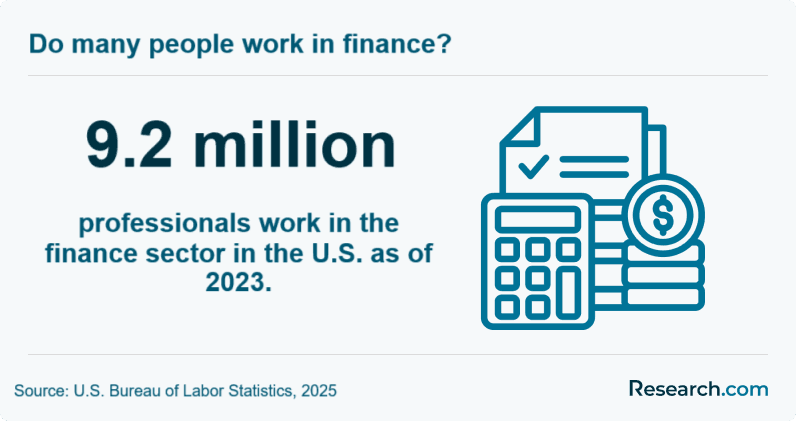
The image below shows the range of professionals working in finance-related areas. The field is flexible, but the best path depends on whether you prefer analysis, clients, operations, technology, regulation, or leadership.
Which Finance Certifications Can Boost Earning Potential?
A certification can improve credibility when it matches your role. It is not a shortcut to high pay, but it can signal specialized knowledge, ethical training, and commitment to the field. Before enrolling, confirm the exam requirements, experience requirements, continuing education obligations, employer recognition, and total cost.
| Certification | Best aligned with | Why it may help |
| Chartered Financial Analyst (CFA) | Asset management, equity research, hedge funds, investment analysis | Highly recognized for investment analysis and portfolio management |
| Certified Public Accountant (CPA) | Accounting, audit, tax, corporate finance, controllership | Often important for accounting leadership and roles involving financial reporting |
| Financial Risk Manager (FRM) | Banking risk, market risk, credit risk, enterprise risk | Shows focused preparation in risk measurement and risk management |
| Chartered Alternative Investment Analyst (CAIA) | Private equity, hedge funds, real assets, alternative investments | Useful for professionals working with nontraditional investment products |
| Certified Financial Planner (CFP) | Financial planning, wealth management, retirement planning | Builds credibility for client-facing advisory work |
| Certified Management Accountant (CMA) | Corporate finance, management accounting, financial planning and analysis | Supports strategic internal finance and management decision-making roles |
Students and professionals comparing credential options can review more information on finance certification pathways and Research.com’s discussion of easiest finance certifications. Choose based on career relevance, not just perceived difficulty.
How to Choose the Right Finance Career Path
The best finance career is not automatically the one with the highest listed salary. It is the path that fits your strengths, risk tolerance, lifestyle preferences, and willingness to keep learning. A student who wants stable reporting work may thrive in accounting or corporate finance, while someone who wants competitive deal work may prefer investment banking or private equity. A finance graduate with strong programming skills may find fintech or financial software development more rewarding than a traditional analyst path.
Decision Checklist
- If you want executive leadership: Build experience in corporate finance, accounting, strategy, operations, and people management.
- If you want high compensation upside: Research investment banking, hedge funds, private equity, and advisory roles, but understand the workload and competition.
- If you want client relationships: Consider financial advising, wealth management, insurance, or financial planning.
- If you want technology-driven work: Add programming, data analytics, cybersecurity, or systems skills to your finance education.
- If you want stability and compliance-focused work: Explore accounting, audit, risk management, compliance, and IT audit.
- If you want global work: Study international finance, foreign exchange, multinational reporting, and cross-border regulation.
Key Insights
- The top-paying finance jobs usually require more than a degree. CFO, CCO, investment banking, private equity, hedge fund, and senior advisory roles typically demand experience, technical skill, leadership, and often advanced credentials.
- Finance compensation depends heavily on structure. Base salary tells only part of the story. Bonuses, commissions, carried interest, equity, and performance incentives can significantly change total earnings.
- Entry-level roles matter because they build the foundation for higher pay. Financial analyst, investment banking analyst, accountant, risk analyst, credit analyst, and operations roles can lead to stronger opportunities when they develop modeling, reporting, compliance, and decision-making skills.
- Technology skills are no longer optional in many finance paths. Excel remains important, but SQL, Python, financial software, cybersecurity awareness, automation, and AI literacy can improve competitiveness.
- Further education should be evaluated like an investment. Compare cost, accreditation, flexibility, recruiting support, employer recognition, and the specific role you want before committing to an MBA, DBA, doctorate, or online degree.
- Certifications are useful only when they match your goal. CFA, CPA, CFP, FRM, CAIA, CMA, CISA, and CISSP can help in the right context, but unnecessary credentials can waste time and money.
- The best finance path is personal. Choose based on your preferred work style: executive strategy, analysis, investing, client advising, technology, compliance, accounting, or operations.
References:
- Glassdoor. (2024, June 6). Financial Software Developer Salaries. Glassdoor.com.
- Glassdoor. (2024, June 6). Investment Banker Salaries. Glassdoor.com.
- Glassdoor. (2024, June 6). IT Auditor Salaries. Glassdoor.com.
- Glassdoor. (2024, June 6). Private Equity Associate Salaries. Glassdoor.com.
- Glassdoor. (2024, June 6). Senior Accountant Salaries. Glassdoor.com.
- Salary.com. (2025, March 1). Chief Compliance Officer Salary in the United States. Salary.com.
- Salary.com. (2025, March 1). Chief Financial Officer Salary in the United States. Salary.com.
- Salary.com. (2025, March 1). Hedge Fund Manager Salaries in the United States. Salary.com.
- United States Bureau of Labor Statistics. (2025, March 6). Industries at a Glance: Financial Activities. BLS.
- United States Bureau of Labor Statistics. (2024, April 3). May 2023 National Occupational Employment and Wage Estimates: United States. BLS.
- United States Bureau of Labor Statistics. (2024, April 3). Occupational Employment and Wage Statistics | 11-1011 Chief Executives. BLS.
- United States Bureau of Labor Statistics. (2024, August 29). Occupational Outlook Handbook | Accountants and Auditors. BLS.
- United States Bureau of Labor Statistics. (2024, August 29). Occupational Outlook Handbook | Compliance Officers. BLS.
- United States Bureau of Labor Statistics. (2024, August 29). Occupational Outlook Handbook | Financial Analysts. BLS.
- United States Bureau of Labor Statistics. (2024, August 29). Occupational Outlook Handbook | Personal Financial Advisors. BLS.
- United States Bureau of Labor Statistics. (2024, August 29). Occupational Outlook Handbook | Securities, Commodities, and Financial Services Sales Agents. BLS.
- United States Bureau of Labor Statistics. (2024, August 29). Occupational Outlook Handbook | Software Developers, Quality Assurance Analysts, and Testers. BLS.
- United States Bureau of Labor Statistics. (2024, August 29). Occupational Outlook Handbook | Top Executives. BLS.
Other Things You Should Know About the Highest-Paying Finance Careers
Investment analyst, portfolio manager, and equity research roles often prefer the CFA charter, which requires passing three exam levels and 4,000 hours of qualifying work experience. Public accounting and corporate controller paths often require the CPA license, which usually means 150 semester credit hours plus the Uniform CPA Examination.
High-paying finance careers in 2027 that don't require a master's degree include financial analyst, budget analyst, and personal financial advisor. These roles often offer competitive salaries and growth opportunities based on performance and experience rather than advanced degrees.
Certifications like Chartered Financial Analyst (CFA), Certified Public Accountant (CPA), and Financial Risk Manager (FRM) can significantly boost earning potential in finance careers in 2027, often leading to higher salaries and advanced positions within top-paying financial firms.