2027 Entry Level Roles in Asset Management

Co-Founder and Chief Data Scientist

Asset management is the business of investing money on behalf of individuals, retirement plans, universities, charities, governments, insurance companies, and other organizations. If you are considering a finance career, the industry can be attractive because it sits close to investment decisions, uses data heavily, offers many professional tracks, and includes employers ranging from global firms to small specialist boutiques.
For job seekers, the key question is not simply “What is asset management?” It is: where can I realistically enter the field, what skills do employers expect, and which type of firm fits the way I want to work? This guide explains the main types of asset managers, how firms are structured, common entry-level roles, what the work environment can feel like, and how to improve your chances of being hired.
Asset management also matters to ordinary savers. Money set aside for retirement, a home purchase, college costs, a business, or long-term financial security may be held in a basic bank account, where deposits in the United States may be protected by the Federal Deposit Insurance Corporation (FDIC). Investors who want the possibility of higher long-term returns often use professionally managed funds or accounts, accepting that investments can also lose value.
Many people encounter asset managers through an employer retirement plan, commonly a 401(k) or 403(b), through a financial advisor, or directly through an investment platform. Asset management firms invest client money in assets such as stocks, bonds, real estate, private companies, loans, infrastructure, and more specialized financial instruments. In return, they usually charge fees tied in some way to the amount of money managed or the structure of the investment product.
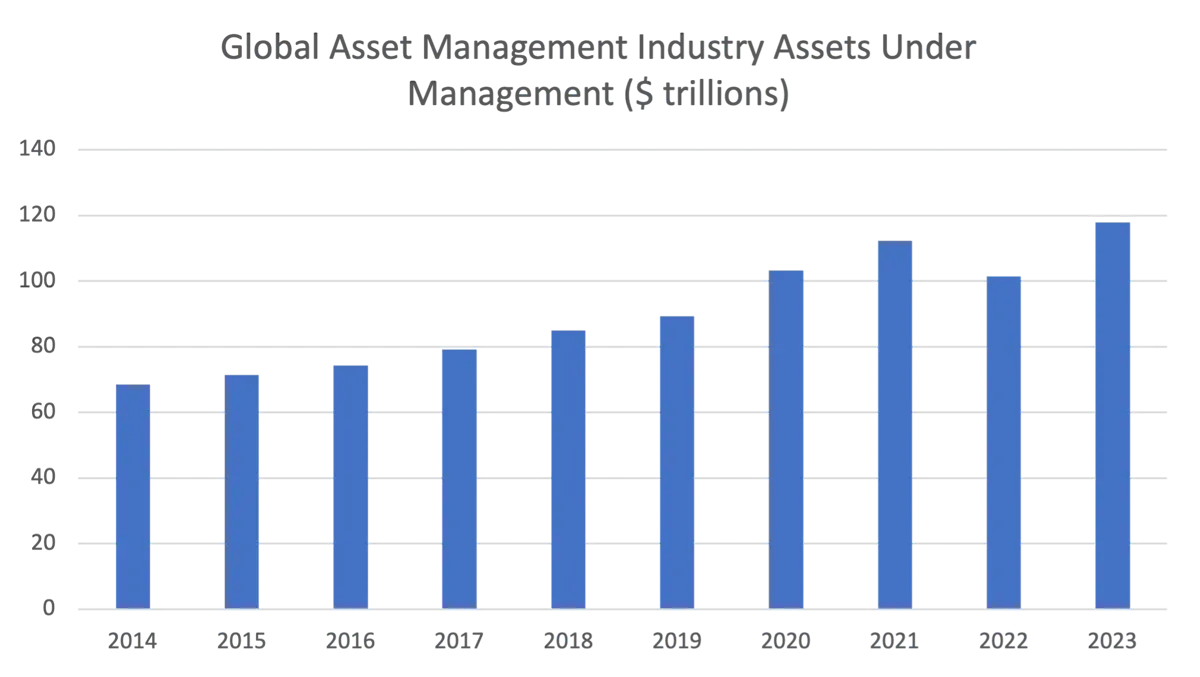
The industry is large, competitive, and global. Collectively, asset managers oversee a staggering $118 trillion in assets as of the end of 2023. The table below provides more context on the industry’s growth.
Quick Answer: Is Asset Management a Good Career Path?
Asset management can be a strong career path for people who enjoy markets, analysis, client service, technology, operations, or financial decision-making. Investment roles are usually the most competitive, but they are not the only way in. Firms also hire early-career professionals in operations, technology, data, risk, sales support, client service, marketing, compliance, finance, and administrative roles.
The best entry route depends on your background. A finance, economics, business, math, statistics, computer science, engineering, accounting, marketing, communications, or IT-related degree can all be useful, depending on the role. Candidates who combine technical skill, curiosity about markets, attention to detail, and strong communication tend to be better positioned than those who apply broadly without a clear target.
What Asset Management Firms Do
Asset managers make investment decisions for clients or provide products that clients and advisors use to build portfolios. Their job is to match an investment strategy with a client objective, such as long-term growth, income, capital preservation, inflation protection, diversification, or funding future obligations.
The work can be simple or highly complex. A traditional mutual fund may buy shares of public companies. A fixed income strategy may invest in bonds. A private equity fund may buy companies and work directly with management teams. A sovereign wealth fund may allocate capital across public markets, private markets, infrastructure projects, and external managers. The common thread is stewardship: clients entrust money to professionals who are expected to invest it according to a defined mandate.
Types of Asset Managers
Asset management is not one uniform industry. Firms differ by client type, investment style, risk level, legal structure, product design, and culture. Understanding these categories helps job seekers target the right employers and avoid applying to roles that do not match their skills or interests.
| Type of organization | What it generally does | Examples mentioned in the industry | What job seekers should know |
| Traditional asset managers | Invest mainly in public equities, fixed income, and related instruments, often through mutual funds, ETFs, separate accounts, and institutional strategies. | Blackrock, Fidelity, Schwab, Vanguard | These firms often have broader entry-level hiring across investments, operations, technology, sales, service, marketing, and corporate functions. Blackrock manages more than $10 trillion as of early 2024. |
| Hedge funds | Use more flexible and often more speculative strategies, which may include leverage, short selling, derivatives, and concentrated market views. | Bridgewater, Citadel, D.E. Shaw | Investment and quantitative roles are usually very competitive. Strong math, coding, research, and market judgment can be important. |
| Private equity firms | Buy full or partial ownership stakes in companies outside public exchanges and often work actively with management teams. | Apollo, Blackstone, Carlyle | Entry roles can be difficult to secure directly. Many candidates come from investment banking, consulting, or transaction-related backgrounds. |
| Private capital firms | Invest in private loans, real estate, infrastructure, distressed assets, and other non-public-market opportunities. | Ares, Oaktree Capital Management | These firms may value credit analysis, valuation, deal experience, legal awareness, and risk assessment. |
| Venture capital firms | Invest in early-stage or growing private companies and often advise founders or hold board seats. | Tiger Global Management, Sequoia Capital | Useful backgrounds can include finance, entrepreneurship, technology, product experience, market research, or startup exposure. |
| Insurance companies | Manage reserves and investment portfolios tied to insurance obligations and may also offer investment management services externally. | Allianz, Prudential | These employers may offer steadier environments and roles in fixed income, risk, actuarial support, operations, and corporate finance. |
| Banks with asset management arms | Operate investment management, wealth, custody, trading, or advisory businesses alongside banking services. | Goldman Sachs, Merrill Lynch, State Street Global Advisors | Large banks may offer structured analyst programs, but competition can be intense. |
| Pension funds | Invest assets for defined groups such as company employees, union members, retirees, or public employees. | General Motors, the Teamsters, CalPERS | Work may focus heavily on long-term obligations, asset allocation, manager selection, risk control, and governance. |
| Endowments and foundations | Manage nonprofit assets to support institutions such as universities, museums, charities, and research organizations. | The Gates Foundation, The Harvard University endowment, the endowment of the Smithsonian Museum | Many allocate money to outside managers rather than managing every asset internally. |
| Sovereign Wealth Funds | Invest government-owned assets for national priorities, retirement systems, social programs, infrastructure, and long-term wealth preservation. | Norges Bank, ADIA, GPIF | These organizations may invest across public markets, private companies, infrastructure, real assets, and external managers. |
| Family Offices | Manage assets, planning needs, and investment strategies for wealthy families. | Walton Enterprises, Bezos Expeditions | Roles can be broad because teams may be small. Discretion, flexibility, and relationship skills matter. |
| Investment Advisors and Wealth Managers | Advise individuals and families and may operate under structures such as Registered Investment Advisor or Broker-Dealer. | Edward Jones, Morgan Stanley Wealth Management | These roles often blend investment knowledge, planning, sales, client education, and service. |
| Hybrid firms | Operate across more than one category, such as traditional asset management, private equity, wealth management, and alternatives. | Varies by firm | Large firms may offer more internal mobility, but candidates should still apply to a specific function rather than “asset management” in general. |
For a list of the largest asset managers in the world, see the table below.

Beyond the firms most people recognize, the industry includes thousands of specialized organizations. Collectively, these firms are estimated to employ at least 1 million people around the world. Some firms have only one or two employees, while the largest have tens of thousands.
How Asset Management Firms Are Organized
Firm structures vary by size, strategy, client type, and geography, but most asset managers depend on several core functions. Job seekers should study these functions before applying because each one requires a different profile.
| Function | Main responsibilities | Common early-career roles | Best fit for candidates who... |
| Investments | Research securities, build portfolios, evaluate risk, generate investment ideas, and make or support buy, sell, and hold decisions. | Research analyst, investment analyst, quantitative analyst, trading analyst, ESG analyst, risk analyst | Like markets, data, financial statements, valuation, portfolio construction, and high-stakes analysis. |
| Distribution | Market products, support advisors and institutions, manage client relationships, explain investment strategies, and help retain assets. | Sales associate, client service associate, product associate, marketing coordinator, call center representative | Communicate well, enjoy working with people, and can explain financial topics clearly. |
| Operations | Process trades, maintain records, support fund accounting, handle cash movements, manage reporting, and ensure transactions settle correctly. | Operations analyst, fund accounting analyst, trade support analyst, reporting analyst | Are detail-oriented, organized, process-minded, and comfortable solving practical problems under deadlines. |
| Technology | Build and maintain systems for research, portfolio management, trading, accounting, cybersecurity, data, client platforms, and internal tools. | Software engineer, data analyst, service desk analyst, cybersecurity analyst, business analyst | Have technical training and want to apply coding, systems thinking, data, or security skills in finance. |
| Corporate functions | Support the business through finance, HR, legal, compliance, audit, procurement, communications, and administration. | Financial analyst, recruiting coordinator, compliance analyst, audit analyst, administrative assistant | Want a finance-adjacent role with exposure to the industry but not necessarily a front-office investment job. |
Entry-Level Asset Management Jobs
Because asset managers may oversee billions or trillions of dollars, many investment decision roles require experience. Still, early-career openings do exist. The strongest candidates usually apply with a specific role in mind and can explain why their coursework, projects, internships, certifications, or personal investing research prepare them for that job.
If you are comparing finance options more broadly, Research.com’s guide to finance careers can help you see how asset management differs from banking, corporate finance, accounting, insurance, fintech, and advisory work. Career changers may also find practical context in this external guide on how to enter finance with limited direct experience: starting a finance career with no experience.
| Entry-level role | What the role does | Typical preparation | Competitiveness |
| Research or investment analyst | Studies companies, securities, sectors, economic trends, and investment opportunities to support portfolio managers. | Business, economics, finance, math, accounting, or related study; investment club work; stock pitches; internship experience. | Very competitive because these roles can lead toward portfolio management. |
| Quantitative analyst | Uses statistical, mathematical, and programming methods to test strategies, model risk, and analyze markets. | Advanced math, statistics, data science, computer science, finance, or engineering; coding ability; often strong quantitative project work. | Very competitive, often involving coding or quantitative interview exercises. |
| ESG analyst | Evaluates environmental, social, and governance factors that may affect investment decisions, reporting, or client mandates. | Finance or economics foundation plus sustainability knowledge, ESG frameworks, data analysis, and writing skills. | Competitive because roles are limited and require both investment and sustainability understanding. |
| Trading analyst | Helps traders execute orders efficiently, analyze liquidity, evaluate transaction costs, and improve trading approaches. | Finance, math, statistics, economics, or data-related study; market awareness; quantitative skill. | Highly competitive, especially at firms with sophisticated trading operations. |
| Risk analyst | Measures investment, operational, technology, or enterprise risk and helps teams understand exposures. | Finance, economics, math, statistics, risk management, data analysis, or technology training. | Competitive, though often slightly less crowded than direct investment analyst openings. |
| Business analyst | Translates business needs into requirements for systems, processes, data tools, or operational improvements. | Computer science, IT, engineering, business, design, user experience, or operations-related study. | Moderate to competitive depending on technical complexity. |
| Operations analyst | Supports trade processing, post-trade activity, accounting, reporting, reconciliations, and operational controls. | Business, economics, finance, math, accounting, or strong analytical training; attention to detail is essential. | Often more accessible than front-office investment roles and can be a practical entry point. |
| Cybersecurity analyst | Protects firm systems, data, accounts, and infrastructure from information security threats. | Associate’s or Bachelor’s-level training in cybersecurity, computer science, engineering, or IT technology. | Competitive for strong technical candidates, with demand tied to firm security needs. |
| Financial analyst | Supports budgeting, revenue analysis, expenses, taxes, cash flow, balance sheet work, and management reporting. | Bachelor’s degree often in accounting, business, economics, finance, or math. | Moderate to competitive, especially at large firms with formal analyst programs. |
| Service or help desk staff | Provides desktop, hardware, software, network, and user support for employees. | Associate’s or Bachelor’s degree in computer science, engineering, IT technology, or related technical training. | Often a common technology entry point at larger firms. |
| Software engineer | Builds and maintains applications used for research, portfolio management, trading, operations, client platforms, and internal systems. | Bachelor’s degree in computer science, engineering, or a closely related field; strong coding portfolio. | High-volume at some firms, but technical interviews can be demanding. |
| Data scientist | Analyzes large datasets, builds models, improves decision tools, and helps teams use data more effectively. | Artificial intelligence, data science, economics, math, statistics, or related quantitative training. | Very competitive because firms increasingly rely on data-intensive processes. |
| Call center representative | Assists retail investors with account questions, transactions, service issues, and basic product guidance. | Bachelor’s degree can help but may not be required; service orientation and willingness to learn are critical. | Often one of the larger entry-level hiring areas at retail-focused firms. |
| Social media manager | Supports digital campaigns, audience engagement, brand presence, and content distribution on social channels. | Marketing background, writing ability, platform fluency, compliance awareness, and attention to detail. | Competitive because most firms have fewer social media openings than operations or service roles. |
| Content strategist or writer | Creates investment commentary, educational material, newsletters, website copy, client content, and social media assets. | Communications, English, marketing, finance writing samples, and ability to explain complex topics clearly. | Competitive for candidates who combine finance knowledge with strong writing. |
| Administrative assistant | Supports senior professionals with scheduling, coordination, documents, travel, communication, and office needs. | Degree requirements vary; maturity, organization, discretion, and reliability matter. | Can be a useful entry point for candidates seeking industry exposure. |
| Corporate function staff | Works in HR, recruiting, learning and development, legal, compliance, audit, finance, or related support areas. | Associate’s, Bachelor’s, paralegal, law, accounting, business, HR, or audit-related background depending on function. | Varies widely by department and firm size. |
Which Entry Path Makes the Most Sense?
Not every candidate needs to aim first for a portfolio manager track. In fact, many people build durable asset management careers outside direct investing. The right path depends on your strengths, tolerance for competition, and preferred work style.
| If you are strongest in... | Consider targeting... | Why this path may fit |
| Markets, valuation, financial statements, and investment ideas | Research analyst, investment analyst, ESG analyst | These roles place you closest to investment decision-making and can support a longer-term move toward portfolio management. |
| Math, statistics, coding, and modeling | Quantitative analyst, trading analyst, data scientist, risk analyst | Firms increasingly rely on quantitative tools, automation, and data-driven research. |
| People, explanation, service, and persuasion | Client service, sales support, call center, product associate, wealth management support | Distribution roles reward communication and relationship-building, not just technical market knowledge. |
| Systems, process, and accuracy | Operations analyst, fund accounting analyst, trade support, reporting analyst | Operations keeps the investment engine functioning and may offer more accessible entry points. |
| Software, infrastructure, cybersecurity, or IT support | Software engineer, cybersecurity analyst, help desk, business analyst | Technology roles allow candidates to work in asset management without following a traditional finance track. |
| Writing, education, and digital communication | Content strategist, marketing associate, social media manager | Firms need clear content to explain markets, products, and insights to clients and advisors. |
Education and Credentials for Asset Management Careers
A finance-related degree can help, but asset management employers hire from more than one academic background. The best degree depends on the function you want. Investment research often favors finance, economics, business, accounting, math, or related fields. Quantitative and data roles may favor math, statistics, computer science, engineering, artificial intelligence, or data science. Technology roles usually require technical preparation. Marketing and content roles may value communications, English, marketing, and writing samples.
If you still need an undergraduate credential, compare flexible options carefully. Accredited online programs can be useful for working adults, career changers, military learners, and students who need scheduling flexibility. Research.com’s guide to top online bachelor degree programs can help you compare program types, while students trying to reduce upfront barriers may also review online colleges with no application fee.
Professional credentials can help in some roles, but they are not magic shortcuts. The Chartered Financial Analyst (CFA) program is widely recognized in investment management and can signal commitment to investment analysis. Other credentials may be relevant for risk, data analytics, compliance, financial planning, cybersecurity, or sustainability-focused work. Before paying for a credential, check job postings for the exact roles you want and see whether employers actually request it.
Shorter learning options can also be useful when they fill a specific skills gap. For example, accredited online certificate programs may help candidates build focused knowledge in areas such as analytics, business, technology, or compliance. Marketing-oriented candidates may benefit from programs connected to digital strategy and client communication, including online degrees in marketing, if they are targeting distribution, content, or brand roles in financial services.
Advanced education can matter for certain career moves, particularly in quantitative research, senior leadership, academic research, or specialized strategy roles. If you are considering graduate school, understand the cost, time commitment, and career payoff before enrolling. Research.com’s overview of master's degree requirements can help you evaluate whether a master’s pathway fits your goals. A doctorate is not required for most asset management jobs, but candidates exploring research-heavy or academic-adjacent paths can compare options such as easiest PhD programs with caution and should prioritize quality, fit, and credibility over speed alone.
What It Is Like to Work in Asset Management
Work culture differs sharply across the industry. Hedge funds and private equity firms can be intense, performance-driven, and demanding. Teams may be small, expectations can be high, and poor decisions may be highly visible. Candidates drawn to pressure, competition, market debates, and rapid feedback may find these environments energizing.
Insurance companies, pension funds, and some long-term institutional investors may operate at a more measured pace. Risk management, governance, documentation, and long-range thinking often play a larger role. These workplaces may suit professionals who want analytical work but prefer a steadier rhythm than a trading-oriented or deal-focused environment.
Large traditional asset managers often fall somewhere between these extremes. They may offer structured training, broader functions, stronger brand recognition, and more internal mobility, but they can also be complex and competitive. Smaller boutiques may give employees wider responsibility earlier, though they may have fewer openings and less formal training.
Current Trends Shaping Asset Management Careers
Several forces are changing what employers look for. Candidates who understand these shifts can position themselves more effectively.
- Data and automation are changing workflows. Firms use data tools, models, and automation to support research, trading, reporting, operations, compliance, and client engagement. This does not eliminate the need for judgment, but it raises the value of candidates who can work with data and technology.
- AI is becoming part of research and operations. Artificial intelligence can assist with document review, pattern recognition, coding support, portfolio analytics, and client content workflows. Candidates should learn how these tools work while also understanding their limits, risks, and review requirements.
- Cybersecurity is a core business risk. Asset managers handle sensitive client, portfolio, transaction, and employee data. Security talent is valuable because breaches can create financial, regulatory, and reputational harm.
- ESG and sustainability analysis remain part of many client conversations. Demand varies by region, client type, strategy, and regulation, but professionals who can evaluate sustainability data carefully and avoid unsupported claims can add value.
- Fee pressure affects hiring and operations. Many firms must deliver more efficient products, reporting, service, and technology. That increases the importance of scalable platforms, process improvement, and operational discipline.
- Client communication is more digital. Websites, apps, social media, newsletters, webinars, and digital portals shape how firms educate and retain clients. Marketing and content roles increasingly require both financial literacy and channel expertise.
The Ecosystem Around Asset Managers
If you cannot enter an asset management firm directly, related employers can help you build relevant experience. These roles may provide exposure to the same clients, systems, data, products, or investment processes used by asset managers.
| Adjacent employer type | How it connects to asset management | Examples | How it can help your career |
| Data and analytics providers | Supply market data, indexes, analytics, risk tools, research platforms, and reporting inputs. | Bloomberg, Factset, MSCI, Refinitiv, S&P | Experience can build market knowledge, product expertise, data fluency, and client-facing credibility. |
| Consulting firms | Advise asset managers on strategy, operations, technology, regulation, risk, transformation, and cost efficiency. | Bain, Boston Consulting Group (BCG), McKinsey, Deloitte, EY, KPMG, PwC | Consulting work can develop problem-solving, presentation, project management, and industry knowledge. |
| Sell-side firms | Support buy-side investors through research, trading, capital markets, banking, and market access. | Bank of America, Citi, JP Morgan | These roles can provide strong market exposure, though they can be just as competitive as asset management roles. |
| Outsourcing and custody providers | Handle operations, custody, technology, accounting, and processing functions for investment firms. | Bank of New York (BNY), State Street, Syntel, TCS, Accenture, IBM | These jobs can be strong entry points for candidates interested in operations, technology, reporting, and fund infrastructure. |
How to Improve Your Chances of Getting Hired
Asset management hiring is competitive, especially for investment, quantitative, and analyst tracks. A stronger plan is to choose a target function, build proof of fit, and prepare for interviews before applications open.
- Pick a narrow target first. “I want to work in asset management” is too broad. Decide whether you are aiming for investment research, quant, operations, technology, client service, marketing, risk, or another function.
- Build evidence that matches the role. Investment candidates should prepare research reports or stock pitches. Quant candidates should show coding and modeling projects. Marketing candidates should show writing, campaigns, or content samples. Operations candidates should demonstrate accuracy, process thinking, and problem-solving.
- Join an investment club or create your own research routine. Whether you use real or simulated money, the discipline of forming a thesis, tracking performance, and explaining results helps you speak credibly in interviews.
- Learn relevant tools. Python can be valuable for quantitative analysis, data work, and automation. Excel, financial modeling, SQL, visualization tools, and basic accounting knowledge may also be useful depending on the role.
- Prepare investment ideas if applying to research roles. Some interviews require a pitch. You should be ready to explain the investment case, risks, valuation, catalysts, and what would change your mind.
- Use job fairs strategically. When asset management firms attend campus or professional events, research them in advance, prepare thoughtful questions, and treat every conversation as part of the interview process.
- Network before roles are posted. Informational conversations can help you learn which teams hire entry-level talent, what skills matter, and how to avoid generic applications.
- Practice interviewing. Competitive roles require more than a polished resume. Prepare behavioral stories, technical answers, role-specific examples, and questions for the interviewer. This external guide on how to prepare for an interview can help you structure your practice.
Common Mistakes to Avoid
| Mistake | Why it hurts candidates | Better approach |
| Applying to every role with the same resume | Asset management functions are too different for one generic application to work well. | Customize your resume for a specific role family, such as operations, research, technology, or client service. |
| Assuming only investment roles matter | Many durable careers in the industry are built in technology, operations, risk, distribution, data, and corporate functions. | Compare roles by your strengths, not by perceived prestige alone. |
| Talking about markets without doing real preparation | Interviewers can quickly tell when candidates follow headlines but cannot explain valuation, risk, or evidence. | Prepare specific investment examples, industry views, or project work you can defend. |
| Ignoring technical skills | Even non-technical teams increasingly use data, platforms, dashboards, and automation. | Build practical fluency in Excel, data analysis, financial concepts, or role-specific tools. |
| Choosing education without checking accreditation or fit | An unrecognized or poorly matched program may not help with hiring or graduate study. | Verify accreditation, curriculum, outcomes, cost, transfer policies, and employer relevance before enrolling. |
| Assuming certifications guarantee interviews | Credentials can help, but they do not replace experience, projects, networking, or interview performance. | Use certifications to support a targeted career plan, not as a substitute for one. |
| Relying only on online applications | Highly competitive roles often attract many qualified applicants. | Combine applications with networking, alumni outreach, career events, and direct recruiter engagement. |
Questions to Ask Before Pursuing an Asset Management Career
- Do I want to be close to investment decisions, or am I more interested in technology, operations, client work, marketing, risk, or corporate functions?
- Which asset class or client type interests me most: public equities, fixed income, private equity, venture capital, real estate, pensions, wealth management, or institutional investing?
- Am I comfortable with a highly competitive hiring process, or should I target a more accessible entry point first?
- Can I show proof of my skills through projects, internships, coding samples, investment research, writing, certifications, or work experience?
- Do I prefer an intense, performance-driven culture or a more stable, process-oriented environment?
- What education or credential would close a real gap for my target role?
- Have I spoken with people currently working in the function I want?
Military Experience and Asset Management Careers
Military experience can translate well into asset management when candidates clearly connect their background to the role. Leadership, discipline, risk awareness, mission focus, operational planning, and decision-making under pressure can be valuable in investment, operations, compliance, technology, cybersecurity, and client-facing teams.
Veterans and active-duty learners who need flexible education options should compare programs that understand military benefits, transfer credit, deployment schedules, and advising needs. Research.com’s resource on colleges for military online can be a useful starting point for evaluating military-friendly online pathways.
Is Asset Management Right for You?
Asset management may be a good fit if you are curious about how capital moves, how decisions are made under uncertainty, and how investment products serve individuals and institutions. It can also be a good fit if you like data, systems, clients, communication, or operational problem-solving and want to apply those skills in a financial setting.
It may be less appealing if you want guaranteed outcomes, dislike detail-heavy work, or are uncomfortable with competition and accountability. Investment results can be volatile, client expectations can be high, and many roles require continuous learning. The industry rewards preparation, judgment, persistence, and credibility.
Key Insights
- Asset management is broader than portfolio management. Entry-level candidates can pursue roles in investments, operations, technology, data, risk, marketing, client service, finance, HR, legal, compliance, and administration.
- The industry manages $118 trillion in assets as of the end of 2023, and firms range from small boutiques to global employers with tens of thousands of staff.
- Investment analyst, quant, hedge fund, and private equity roles are usually the most competitive. Operations, technology, client service, and corporate functions may offer more realistic entry points for many candidates.
- Degree choice should match the role. Finance and economics help for research; math, statistics, computer science, and engineering help for quant and data work; IT supports technology roles; communications and marketing support content and distribution careers.
- Credentials such as the CFA can strengthen a profile for some investment roles, but no certification replaces targeted experience, strong interview preparation, networking, and clear evidence of skill.
- AI, data analytics, cybersecurity, ESG analysis, digital client engagement, and fee pressure are reshaping how firms hire and operate.
- The smartest job-search strategy is specific: choose a function, build role-relevant proof, speak with people in the industry, prepare deeply, and apply where your strengths match the work.