
2027 Best Accredited Online Bachelor's Degree Programs

Co-Founder and Chief Data Scientist
Choosing an accredited online bachelor’s degree is not just about finding a program you can complete from home. It is a cost, time, career, and credibility decision. The right program can help you finish a bachelor’s degree while working, transfer previous college credits, qualify for graduate school, or move into a better-paying field. The wrong one can leave you with credits that do not transfer, limited employer recognition, or a program that does not meet licensure requirements.
This guide explains how accredited online bachelor’s degree programs work, what they cost, how long they take, which majors are commonly available, and how to compare schools before enrolling. It is written for first-time college students, working adults returning to school, associate degree graduates, military-connected learners, and career changers who need a practical way to evaluate online bachelor’s programs in 2026.
Quick Answer: Are Accredited Online Bachelor’s Degrees Worth It?
An accredited online bachelor’s degree can be worth it when the school is properly accredited, the program matches your career goal, the total cost is manageable, and the degree leads to roles that value bachelor’s-level preparation. Online programs are especially useful for students who need flexible scheduling, want to keep working while studying, or have transfer credits from previous college coursework.
The most important factor is accreditation. A degree from an accredited institution is more likely to qualify for federal financial aid, credit transfer, employer recognition, graduate admission, and professional licensing pathways where applicable. Students should still compare program costs, graduation requirements, support services, career outcomes, and licensure alignment before enrolling.
Key Things to Know Before Choosing an Online Bachelor’s Degree
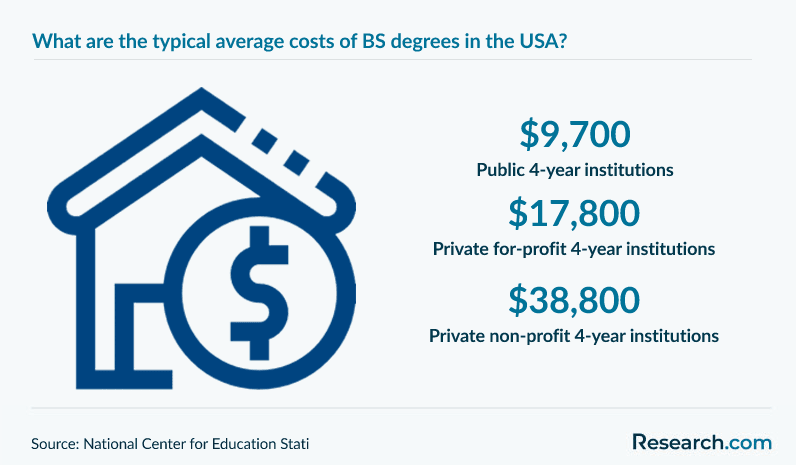
- The typical average costs of bachelor’s degrees in the USA are approximately $9,700 at public 4-year institutions, $17,800 at private for-profit 4-year institutions, and $38,800 at private non-profit 4-year institutions.
- Business was the most common field of study in 2021-22, with nearly 392,000 bachelor’s degrees awarded. Healthcare professions and related programs followed with more than 268,000 degrees.
- Economics shows the highest listed earnings potential in this guide, with median annual earning of $115,730 in 2023.
- Computer science graduates are listed with a salary range of $85,766 to $112,453 per year, while business administration and nursing fall in the $67,000 to $86,000 range.
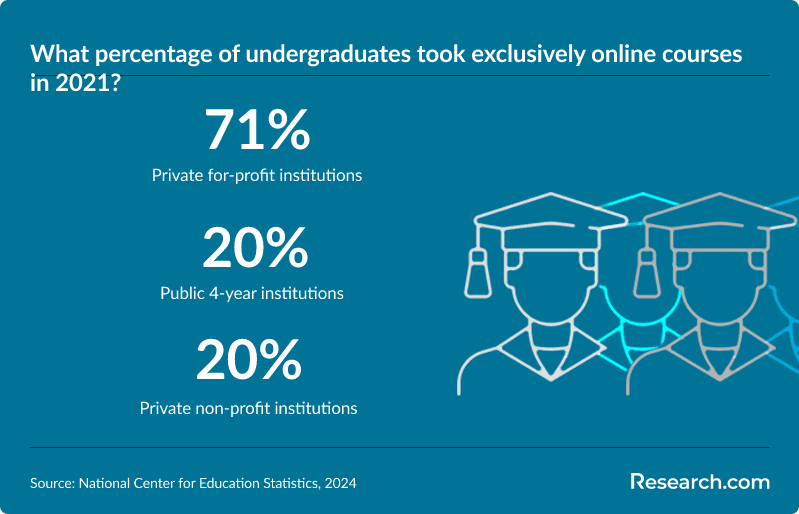
- In 2021, 71% of undergraduates at private for-profit institutions, 20% at public 4-year institutions, and 20% at private non-profit institutions took exclusively online courses.
- Online bachelor’s programs can make college more accessible for students who cannot attend campus full time, but convenience should not replace careful checks on accreditation, cost, transfer credits, and career fit.
- Students planning long-term academic growth can use an accredited bachelor’s degree as a foundation for master’s and doctoral study, provided they meet the admissions requirements of those programs.
Popular Affordable, Flexible Online Bachelor’s Degree Fields With Broad Access
The following degree fields are commonly available online and may appeal to students looking for flexible study options, career mobility, and practical skill development. “Easy” or “quick” depends on your background, transfer credits, course load, and academic strengths; no bachelor’s degree is effortless.
1. Accounting
An online accounting bachelor’s degree teaches students how to interpret financial records, prepare tax-related documents, support audits, and use accounting information for business decisions. It can lead toward roles in public accounting, corporate accounting, bookkeeping supervision, auditing support, and financial analysis.
2. Business Administration
A business administration degree gives students a broad base in management, marketing, finance, operations, business law, and organizational decision-making. It is often a good fit for students who want career flexibility across industries rather than preparation for one narrow occupation.
3. Computer Science
A computer science bachelor’s degree focuses on programming, software design, databases, algorithms, systems, and data-related problem solving. Graduates may pursue work in software development, web development, cybersecurity, systems support, and data science, depending on their coursework and project experience.
4. Economics
An economics degree trains students to study markets, evaluate incentives, analyze data, and understand financial and policy conditions. It can support careers in economic research, financial consulting, policy analysis, business analytics, and graduate study in economics, finance, or public policy.
5. Healthcare Administration
A healthcare administration bachelor’s degree prepares students to support the business, operational, and compliance side of healthcare organizations. Coursework often connects budgeting, healthcare policy, quality improvement, human resources, and healthcare information systems with leadership roles in clinics, hospitals, insurers, and care organizations.
6. Management
A management degree develops skills in supervision, team leadership, project coordination, organizational behavior, and operational problem-solving. It is useful for students who already have work experience and want to qualify for leadership or administrative roles.
7. Management Information Systems
Management information systems combines business operations with technology. Students learn how organizations use databases, networks, systems analysis, business intelligence, and IT project management to improve decisions and processes.
8. Nursing
A nursing bachelor’s degree supports preparation for registered nursing careers and, for licensed nurses, may help expand clinical, leadership, and public health knowledge. Students should verify clinical requirements, state authorization, and licensure alignment before enrolling in any online nursing pathway.
9. Social Work
A social work bachelor’s degree prepares students to help individuals, families, and communities navigate social, behavioral, economic, and health-related challenges. Graduates may work in human services, community outreach, case management support, and advocacy roles, though advanced clinical practice usually requires graduate education and licensure.
10. Special Education
A special education degree focuses on supporting students with disabilities through individualized instruction, assessment, classroom accommodations, and collaboration with families and school professionals. Prospective teachers must check whether the program meets certification or licensure requirements in their state.
- Top accredited online bachelor’s degree programs to compare
- Why accreditation matters
- How long online bachelor’s programs take
- How to judge an online university’s reputation
- Online vs. on-campus bachelor’s degrees
- Common admissions requirements
- Average cost of an accredited online bachelor’s degree
- Financial aid and scholarship options
- Typical courses in online bachelor’s programs
- Common online bachelor’s degree specializations
- Salary ranges by field
- How to evaluate return on investment
- Challenges online students should expect
- How to choose the right accredited online bachelor’s program
- Employer recognition of online bachelor’s degrees
- Using an associate degree as a transfer pathway
- How to verify accreditation
- Certifications that can strengthen a bachelor’s degree
- Online bachelor’s degrees that may feel more manageable
- Career placement and student support
- Graduate school opportunities after an online bachelor’s degree
- Ways to lower the cost of an online bachelor’s degree
- Career advancement with an online bachelor’s degree
What Online Bachelor’s Graduates Often Value Most
-
: "
My online program let me keep my full-time job while finishing the degree. The flexibility mattered, but the structure still pushed me to stay organized and meet deadlines. — Barry
"
-
: "
I expected online classes to feel disconnected, but the discussions, group assignments, and instructor feedback made the program more interactive than I assumed it would be. — Wally
"
-
: "
The biggest advantage was access. I could study around family and work responsibilities, and I still received guidance from instructors when I needed help. — Iris
"
What are the top-ranked accredited online bachelor’s degree programs in the US for 2027?
Rankings can be useful, but they should not be the only factor in your decision. Use rankings as a starting point, then compare accreditation, tuition, transfer credit rules, program format, career services, and whether the major fits your goals.
1. University of Florida
The University of Florida online bachelor’s programs offer a public university option with 25 majors through UF Online. The program portfolio is suited to students who want a structured online experience connected to a large, established institution and academically rigorous programs, including areas such as Business Administration.
2. Arizona State University
Arizona State University Online provides a very broad selection of online offerings, with over 300 programs. ASU Online may work well for students who want many major choices, flexible formats, and options in fields such as business, digital media, and sustainability.
3. Washington State University
Washington State University Global Campus offers online and hybrid options in areas such as business, criminal justice, and psychology. Students who want strong support services, career-focused curricula, and possible limited campus interaction may find WSU Global Campus worth comparing.
4. Colorado State University–Global
Colorado State University–Global is built around online education and offers focused bachelor’s options in areas such as management, healthcare administration, and information technology. It may be a practical choice for working adults seeking programs designed around applied, workplace-relevant skills.
5. Pennsylvania State University
Pennsylvania State University World Campus offers Penn State’s online degree options, with over 200 programs across fields such as engineering, information sciences, liberal arts, and more. It can be a strong option for students who value institutional reputation, broad academic choice, and online student support, although cost should be reviewed carefully.
Students interested in engineering but concerned about difficulty can also review engineering degree options that may be more accessible before choosing a major.
Why is accreditation important for online bachelor’s degree programs?
Accreditation is the quality-control system used to evaluate colleges, universities, and certain programs. For online bachelor’s degrees, it matters because the delivery format does not protect you from low-quality or poorly recognized programs. Accreditation helps confirm that an institution or program has been reviewed against academic and operational standards.
| Why accreditation matters | What it can affect | What to check before enrolling |
| Academic quality | Course design, faculty expectations, assessment, and institutional oversight | Confirm the accrediting agency is recognized by the appropriate education authorities. |
| Financial aid access | Eligibility for federal aid, including loans and grants | Ask the school whether the program qualifies for federal student aid. |
| Credit transfer | Whether another college may accept your completed coursework | Review written transfer policies, not verbal promises. |
| Employer recognition | How hiring managers, HR systems, and graduate schools view the degree | Look for evidence of alumni outcomes and employer partnerships. |
| Licensure or certification | Fields such as nursing, education, and social work may have state-specific rules | Verify state authorization and licensure alignment directly with the program and state board. |
If you want to avoid unnecessary upfront costs while still focusing on credible institutions, compare accredited online colleges with no application fee.
How long does it take to complete an accredited online bachelor’s degree program?
Most bachelor’s programs are designed around 120 credits. Completion time depends on whether you study full time or part time, how many credits you transfer, whether the program is accelerated, and whether courses are offered year-round.
- Traditional programs: 4 years, commonly structured around 120 credits.
- Accelerated programs: 18 months to 3 years, depending on credit load, transfer credits, course sequencing, and program design.
Enrollment data from fall 2021 shows different online learning patterns across 4-year institutions. Private for-profit institutions had the highest share of undergraduates taking exclusively online courses, at around 70%.
Public 4-year institutions were much lower at around 20%, and private non-profit institutions were also around 20%. The difference suggests that online delivery has been adopted differently across institutional sectors rather than uniformly across higher education.
How can I assess the reputation of online universities offering bachelor’s degrees?
A strong online university should be judged on evidence, not advertising. Look beyond broad brand recognition and evaluate the specific bachelor’s program you are considering.
- Verify accreditation: Check whether the institution has regional or national accreditation from a recognized agency. Examples named in this guide include the Southern Association of Colleges and Schools Commission on Colleges (SACSCOC) and the Higher Learning Commission (HLC).
- Review faculty qualifications: Look for instructors with relevant terminal degrees, such as a Ph.D. or Ed.D., and practical industry experience when the field requires applied expertise.
- Study student outcomes: Ask for graduation rates, job placement information, and alumni satisfaction data when available.
- Check program-level reputation: A university can be well known overall while a specific online major is newer, smaller, or less established.
- Look for professional recognition: In fields with specialized standards, see whether the program is recognized by relevant professional organizations.
- Ask employers or alumni: Alumni can explain workload, faculty responsiveness, and career support better than a brochure can.
- Use rankings carefully: Rankings can help you discover schools, but they cannot tell you whether a program fits your budget, schedule, transfer credits, or state licensure needs.
How does an accredited online bachelor’s degree compare to an on-campus program?
An accredited online bachelor’s degree can lead to the same credential as an on-campus degree when the institution and program standards are equivalent. The bigger difference is the learning experience: online programs require more independent time management, while campus programs provide more face-to-face structure.
| Factor | Online bachelor’s degree | On-campus bachelor’s degree |
| Schedule | Often includes asynchronous coursework that can be completed around work or family responsibilities. | Usually requires attendance at scheduled class times. |
| Cost considerations | May reduce commuting or housing costs, but can include technology or online course fees. | May involve campus fees, housing, transportation, and other living costs. |
| Interaction | Uses discussion boards, video meetings, group projects, email, and learning platforms. | Offers in-person class discussion, campus organizations, and direct access to facilities. |
| Best fit | Students who are self-directed, organized, and comfortable using digital tools. | Students who prefer routine, in-person support, and a traditional campus environment. |
| Employer view | Generally strongest when the school is accredited and the program is reputable. | Also depends on institution quality, major, experience, and demonstrated skills. |
In AY 2020-2021, over 2.1 million bachelor’s degrees were conferred in the United States. Business was the most popular field, with nearly 392,000 degrees awarded, followed by healthcare professions and related programs with over 268,000. Social sciences and history, biological and biomedical sciences, and psychology each exceeded 125,000 degrees granted.
Engineering and computer and information sciences each produced over 100,000 degrees. Communication, journalism, visual and performing arts, and education also exceeded 85,000 degrees awarded.
What are the prerequisites for enrolling in an online accredited bachelor’s degree program?
Admission requirements vary by school and major, but most online bachelor’s programs use a combination of general admission rules and program-specific criteria.
- High school diploma or GED: Most bachelor’s programs require proof of high school completion or an equivalent credential.
- Prior college transcripts: Transfer students usually need official transcripts from every college previously attended.
- Standardized tests: Some programs may request SAT or ACT scores, though this is becoming less common for many online programs.
- Major-specific preparation: Programs such as computer science may expect previous math coursework such as calculus or trigonometry.
- Work experience: Some professional or degree-completion programs may prefer applicants with relevant employment history.
- Technology readiness: Online students need reliable internet access, appropriate hardware, and the ability to use learning management systems.
Before applying, read the program’s admissions page and contact admissions staff for written clarification about prerequisites, transfer credits, deadlines, and required documents.
What is the average cost of an online accredited bachelor’s degree program?
The cost of an accredited online bachelor’s degree depends on institution type, residency status, tuition model, transfer credits, program length, books, fees, and available financial aid. Tuition alone does not show the full cost.
- Program type: Public universities often charge less than private institutions, though policies vary.
- Residency status: In-state tuition can be lower than out-of-state tuition at public universities.
- Per-credit pricing: Many programs charge by credit, and bachelor’s degrees commonly require around 120 credits.
- Technology and course fees: Online students may pay platform, software, proctoring, or digital resource fees.
- Transfer credits: Accepted credits can reduce both time and cost.
- Financial aid: Grants, loans, scholarships, and employer tuition assistance can change the net price substantially.
Average undergraduate tuition and fees for 2021-22, based on National Center for Education Statistics information cited in this article, were approximately:
| Institution type | Average tuition and fees | Decision note |
| Public 4-year institutions | Approximately $9,700 | Often the most affordable option, especially for in-state students. |
| Private for-profit 4-year institutions | Approximately $17,800 | May offer flexible online formats, but students should carefully check accreditation, outcomes, and transfer policies. |
| Private non-profit 4-year institutions | Approximately $38,800 | May provide strong reputation or support services, but net price should be compared after aid. |
The following graphic summarizes these cost differences.
Always request a full cost estimate from the school that includes tuition, fees, books, technology expenses, transfer credit assumptions, and expected financial aid.
If cost is your primary concern and technology is a good career fit, compare an affordable online information technology degree.
What financial aid and scholarship options are available for students of accredited online bachelor’s degree programs?
Students in accredited online bachelor’s programs may be able to use the same major categories of aid as campus students, as long as the institution and program meet eligibility rules.
- Federal financial aid: Options may include Pell Grants, Stafford Loans, Direct PLUS Loans, and Work-Study Programs.
- State aid: Some states provide grants or scholarships for eligible residents, including online students.
- Institutional scholarships: Colleges may offer scholarships based on academic performance, financial need, major, transfer status, military affiliation, or other criteria.
- Private scholarships: Foundations, community organizations, professional associations, and employers may provide awards.
- Employer tuition assistance: Some employers help pay for degrees that support professional development or business needs.
Start with the Federal Student Aid website, then check your state financial aid office, your employer’s benefits portal, and the scholarship pages of each school you are considering.
What courses are typically in an accredited online bachelor’s degree program?
Most online bachelor’s degrees combine general education, major requirements, electives, and sometimes capstone projects, internships, labs, practicums, or clinical experiences. The exact mix depends on the school and the major.
General education courses
- Communication: Builds written, spoken, and visual communication skills.
- English composition: Develops college-level writing, analysis, and argumentation.
- Humanities: Introduces literature, philosophy, culture, history, or the arts.
- Mathematics: Covers quantitative reasoning or field-specific math foundations.
- Natural sciences: Teaches scientific concepts, inquiry, and evidence-based reasoning.
- Social sciences: Examines human behavior, society, institutions, and social systems.
Major-specific course examples
| Major | Common courses | What students learn |
| Accounting | Financial Accounting, Managerial Accounting, Auditing, Tax Accounting | How to prepare, review, and interpret financial information for organizations and individuals. |
| Business Administration | Business Law, Human Resource Management, Marketing Principles, Management Fundamentals | How organizations operate, compete, manage people, and make strategic decisions. |
| Computer Science | Computer Networks, Database Management Systems, Data Structures and Algorithms, Programming Languages | How software, data, systems, and algorithms support technical problem-solving. |
| Economics | Econometrics, Economic History, Macroeconomics, Microeconomics | How markets, policy, incentives, and data shape economic decisions. |
| Healthcare Administration | Healthcare Finance and Budgeting, Healthcare Marketing, Healthcare Policy and Regulations, Healthcare Quality Management | How healthcare organizations manage money, compliance, operations, and quality. |
| Management | Human Resource Management, Operations Management, Organizational Behavior, Project Management | How to lead teams, improve processes, and coordinate organizational work. |
| Management Information Systems | Database Management Systems, Information Systems Analysis and Design, Networking and Telecommunications, Project Management for IT | How businesses use technology systems to manage information and improve performance. |
| Nursing | Anatomy and Physiology, Nursing Fundamentals, Pharmacology, Pathophysiology | How the human body works, how diseases affect patients, and how nurses deliver safe care. |
| Social Work | Human Behavior and the Social Environment, Social Welfare Policy and Services, Social Work Practice, Social Work Research | How social systems affect people and how professionals support individuals and communities. |
| Special Education | Assistive Technology, Child Development, Inclusive Education, Learning Disabilities | How to support learners with disabilities through instruction, accommodations, and collaboration. |
Students who want a dedicated accounting pathway can compare an online bachelor’s degree in accounting. Those planning graduate study in computing can review affordable online master’s in computer science programs. Healthcare-focused students can also compare the curriculum and price of the most affordable online healthcare administration degrees.
What types of specializations are available in accredited online bachelor’s degree programs?
Specializations let students focus a broad major on a more specific career direction. Availability varies by school, and some specializations may require certain electives or practicum experiences.
| Degree field | Possible specializations | When it may make sense |
| Accounting | Auditing, Forensic Accounting, Tax Accounting | Choose these if you want to work with compliance, fraud investigation, tax preparation, or financial review. |
| Business Administration | Entrepreneurship, Human Resource Management, Marketing, Operations Management | Useful for students who want broad business training with a clearer industry or function focus. |
| Computer Science | Cybersecurity, Data Science, Software Engineering, Web Development | Helpful when you want to build a portfolio and target a technical career path. |
| Economics | Behavioral Economics, Econometrics, Public Finance | Best for students interested in research, policy, data analysis, or finance-related work. |
| Healthcare Administration | Health Information Management, Long-Term Care Administration, Medical Practice Management | Fits students aiming for healthcare operations, healthcare data, facility leadership, or practice administration. |
| Management | Human Resource Management, Operations Management, Project Management, Supply Chain Management | Works well for students who want supervisory, process improvement, or project coordination roles. |
| Management Information Systems | Business Intelligence, Cybersecurity, Healthcare Information Systems, Project Management for IT | Ideal for students who want to connect business decision-making with information systems. |
| Nursing | Adult Care, Pediatric Care, Mental Health Nursing | Appropriate for students who want to align clinical interests with patient populations or care settings. |
| Social Work | Child Welfare, Family Services, Mental Health Social Work, School Social Work | Useful for students targeting human services, community programs, schools, or family support work. |
| Special Education | Learning Disabilities, Autism Spectrum Disorder, Visual Impairments, Hearing Impairments | Important for students who want to support specific learner needs, subject to state credentialing rules. |
Students interested in software careers can explore affordable online software engineering degrees. Healthcare administrators considering graduate education may compare the most affordable online MHA programs. For MIS students, cybersecurity is one specialization area that connects technical risk management with business operations. Nurses aiming for advanced practice should note that roles such as family nurse practitioner require higher education; compare affordable online FNP programs if that is your long-term goal.
If forensic accounting interests you but you are more drawn to lab-based investigation, review colleges with forensic science programs before choosing between business and science pathways.
What are the average salaries of graduates with an accredited online bachelor’s degree?
Salary depends on the job title, industry, geographic location, experience, employer, and whether the role requires licensure or graduate education. The figures below are the salary ranges and earnings cited in this article’s source list.
| Field | Listed salary or earnings figure | Interpretation |
| Accounting | $61,288 - $63,288 per year | Often tied to accounting support, staff accounting, audit, tax, and finance-related roles. |
| Business Administration | $70,000 - $75,000 per year | Can vary widely because business graduates enter many functions and industries. |
| Computer Science | $85,766 - $112,453 per year | Portfolio, internships, technical skills, and location can strongly affect outcomes. |
| Economics | $115,730 median annual earnings in 2023 | The highest listed figure in this guide, though job role and graduate education can matter. |
| Healthcare Administration | $67,900 per year | Relevant to healthcare operations, administration, and management support roles. |
| Management | $60,695 - $70,000 per year | Experience is often critical because management roles may require demonstrated leadership. |
| Management Information Systems | $65,000 - $86,646 per year | Combines business and IT skills, often improving with technical certifications and experience. |
| Nursing | $67,106 - $86,070 per year | Licensure, clinical setting, shift type, and location can affect compensation. |
| Social Work | $58,000 - $67,106 per year | Clinical and advanced roles generally require additional education and licensure. |
| Special Education | $65,910 median salary | State certification rules, district pay scales, and experience influence earnings. |
Based on the figures above, economics has the highest listed median annual earning at $115,730 in 2023. Computer science follows with a listed range of $85,766 to $112,453 per year. Business administration and nursing fall in the $67,000 to $86,000 range.
Accounting, management information systems, and management are listed between $60,695 and $75,000. Social work ranges from $58,000 to $67,106 per year, while special education shows a median salary of $65,910.
Students considering business leadership roles may later compare MBA programs under 10k, but graduate study should be evaluated against your career goals and expected debt.
What is the Return on Investment of an Online Bachelor’s Degree?
Return on investment is not just “salary after graduation.” A better ROI review compares total cost, time to completion, aid, transfer credits, lost income, job opportunities, and whether the program helps you qualify for the role you actually want.
| ROI factor | Why it matters | Question to ask |
| Total net price | The published tuition may be very different from what you pay after aid. | What is my estimated cost after grants, scholarships, transfer credits, and employer assistance? |
| Time to degree | Finishing faster can reduce cost, but overloaded schedules can increase dropout risk. | How many credits will I need after transfer evaluation? |
| Career alignment | A degree has stronger value when it maps clearly to roles you are pursuing. | What jobs do graduates from this program commonly enter? |
| Licensure fit | Some careers require state approval, exams, clinical hours, or certification. | Does this program meet requirements in my state? |
| Support services | Advising, tutoring, and career help can affect persistence and outcomes. | What online support is available outside normal business hours? |
If your priority is a flexible and manageable path to completion, compare online degrees often considered easier to complete, but do not choose a major only because it sounds simple. Choose one that matches your strengths and goals.
What Challenges Might I Encounter When Pursuing an Online Bachelor’s Degree?
Online learning removes commuting and scheduling barriers, but it adds other demands. Successful students usually need consistent routines, comfort with digital platforms, and the discipline to keep progressing without in-person reminders.
- Time management: Asynchronous courses still have deadlines, exams, projects, and discussion requirements.
- Technology issues: Students need reliable internet, backup plans, and familiarity with online platforms.
- Limited face-to-face interaction: Building relationships may require extra effort through virtual office hours, group projects, and online communities.
- Motivation dips: Working adults can struggle when job, family, and coursework deadlines collide.
- Program pacing: Accelerated terms can be efficient but demanding.
Students considering faster graduate study after a bachelor’s degree can review 1 year online master’s programs to understand how intensive accelerated formats can be.
How to Choose the Best Accredited Online Bachelor’s Degree Program
The best online bachelor’s program is the one that fits your career objective, budget, schedule, transfer credits, learning style, and state requirements. Use a decision process rather than relying on one ranking or one advertisement.
- Start with the career goal: Identify the job titles, industries, or graduate programs you want the degree to support.
- Verify accreditation: Confirm institutional accreditation and, when relevant, programmatic accreditation.
- Check licensure rules: Nursing, education, social work, and similar fields may have state-specific requirements.
- Request a transfer credit evaluation: Do this before assuming previous credits will count.
- Compare total cost: Include tuition, fees, books, software, clinical or practicum costs, and any travel requirements.
- Review course delivery: Ask whether classes are asynchronous, synchronous, accelerated, self-paced, or cohort-based.
- Evaluate support services: Look for online tutoring, advising, library access, technical support, disability services, and career coaching.
- Ask about outcomes: Request graduation rates, placement data, internship access, and alumni examples when available.
For a broader starting point, compare Research.com’s guide to the best online degrees.
Do Employers Recognize Accredited Online Bachelor’s Degrees?
Employers are generally more likely to respect an online bachelor’s degree when it comes from an accredited institution with a credible academic reputation. Many employers care less about whether courses were online and more about whether the school is legitimate, the degree is relevant, and the candidate can demonstrate the required skills.
That said, employer recognition can vary by industry. Technical fields may look closely at portfolios and certifications. Nursing, education, and social work employers may focus on licensure eligibility. Business employers may weigh experience, internships, leadership examples, and measurable results. If you are planning a long academic path, an accredited bachelor’s degree may also support later graduate study, including options such as an affordable online doctorate program.
Can an associate degree serve as a pathway to an online bachelor’s degree?
Yes. An associate degree can be one of the most efficient routes into an online bachelor’s program if the receiving school accepts your credits. Many colleges use articulation agreements, transfer pathways, or degree-completion formats that help associate degree graduates enter with advanced standing.
Before enrolling, ask for a written transfer evaluation. Do not assume every course will apply to your major. General education credits may transfer more easily than technical or career-specific courses. If you are still deciding on a starting point, review associate degree programs that may be easier to complete.
Navigating Accreditation for Online Bachelor’s Degrees
Accreditation can be confusing because different types serve different purposes. Institutional accreditation applies to the college or university. Programmatic accreditation applies to specific programs, departments, or professional fields.
Types of Accreditation
- Regional Accreditation: This is widely recognized in higher education. Institutions accredited by regional agencies such as the Higher Learning Commission (HLC) often have credits that are more easily considered for transfer by other schools.
- National Accreditation: This is often associated with specialized, career-focused, or vocational institutions. It can be appropriate in some contexts, but students should check credit transfer and employer acceptance carefully.
- Programmatic Accreditation: Some fields have specialized accreditation, such as AACSB for business schools or CCNE for nursing programs. This can be important for professional credibility, licensure, or graduate admissions.
Students who want a curated starting point can compare accredited online bachelor’s degree programs.
What supplementary certifications should complement my online bachelor’s degree?
Certifications can help translate a broad bachelor’s degree into job-specific proof of skill. They are most useful when they match your target role, employer expectations, or a technical tool used in your field.
- Business students: Consider certifications related to project management, analytics, human resources, or marketing tools.
- Computer science and MIS students: Technical credentials in cloud platforms, cybersecurity, data tools, or programming can strengthen a portfolio.
- Healthcare administration students: Credentials connected to health information, compliance, quality improvement, or medical practice operations may be useful.
- Accounting students: Tax, auditing, bookkeeping, or software-related credentials can support entry-level job readiness.
To explore credential options with strong career relevance, review certifications for high paying jobs.
What are the easiest online bachelor’s degree programs to consider?
The “easiest” bachelor’s degree depends on your strengths. A writing-heavy social science program may feel manageable for one student and exhausting for another. A math-heavy technology program may be a good fit for a student with analytical strengths but difficult for someone who dislikes quantitative work.
Instead of asking only which degree is easiest, ask which degree you are most likely to finish, afford, and use. Students who need a flexible path can review bachelor’s degrees often considered easier, but should still compare career outcomes and program requirements.
How Do Accredited Online Bachelor’s Degree Programs Enhance Career Placement and Support?
Strong online programs do more than deliver coursework. They help students connect the degree to employment through career coaching, resume support, interview preparation, virtual career fairs, internship guidance, alumni networks, and employer partnerships.
Before enrolling, ask whether online students receive the same career services as campus students. Also ask whether internships, practicums, or field placements are available in your area. Students focused on earnings can compare online degree programs that pay well.
How can an online bachelor’s degree open doors to lucrative graduate opportunities?
An accredited online bachelor’s degree can prepare students for graduate school when it includes the required prerequisites, grades, writing preparation, research experience, or professional background expected by the graduate program. This matters for fields where a bachelor’s degree is a starting point rather than the final credential.
Students interested in long-term salary growth should choose a bachelor’s major that aligns with likely graduate options. For example, business administration can support MBA study, computer science can lead to advanced computing programs, nursing can lead to advanced practice pathways, and economics can support graduate work in economics, analytics, finance, or policy. To compare advanced options, review master’s degrees associated with higher pay.
How can I save money on an online bachelor’s degree?
Cost control starts before you apply. The least expensive program is not always the best value, but students can often reduce the total price by combining transfer credits, aid, careful school selection, and realistic pacing.
- Compare public institutions first: Public universities often have lower tuition than private colleges, especially for in-state students. Start with options such as the most affordable online bachelor’s degrees.
- Use in-state tuition when available: Some online programs charge different rates based on residency.
- Transfer previous credits: Ask for a formal evaluation before committing.
- Apply for grants and scholarships: Free aid reduces debt more effectively than loans.
- Ask about employer reimbursement: Working students should check whether their employer pays part of tuition.
- Avoid unnecessary course repeats: Confirm how your credits apply to the degree plan.
- Be careful with acceleration: Faster programs can save time, but only if you can handle the workload without withdrawing or retaking courses.
Common Mistakes to Avoid When Choosing an Online Bachelor’s Program
| Mistake | Why it can hurt you | Better approach |
| Choosing a school without checking accreditation | You may face problems with financial aid, transfer credits, employer recognition, or graduate admissions. | Verify institutional and programmatic accreditation before applying. |
| Looking only at tuition | Fees, books, software, practicum travel, and lost transfer credits can change the real cost. | Compare total net price and degree-completion requirements. |
| Assuming online means self-paced | Many online courses still have weekly deadlines, live sessions, group work, or exam windows. | Ask how courses are scheduled and delivered. |
| Ignoring licensure requirements | Education, nursing, social work, and similar fields may have state-specific rules. | Confirm state authorization and licensure alignment in writing. |
| Relying only on rankings | A highly ranked school may not be affordable or suitable for your schedule, major, or location. | Use rankings as one input alongside cost, fit, support, and outcomes. |
| Assuming salaries are guaranteed | Published salaries do not account for location, experience, job title, employer, or economic conditions. | Research target jobs in your region and build experience while studying. |
Career Advancement with an Online Bachelor’s Degree
An accredited online bachelor’s degree can help workers qualify for promotions, move into roles that require a bachelor’s credential, or prepare for career changes. Its value is strongest when paired with relevant experience, internships, projects, certifications, or licensure.
For working adults, the online format can reduce opportunity cost because students may continue earning income while studying. Many programs also offer career coaching, virtual networking, employer events, and applied assignments that help connect coursework to workplace problems.
When comparing programs, focus on the connection between the major and your next career step. A flexible degree that does not build relevant skills may have limited value. A more demanding program that leads to licensure, technical competence, or a clear professional pathway may be the better long-term choice.
Current Trends Affecting Online Bachelor’s Degrees
- Employer focus on skills: Many employers evaluate degrees alongside portfolios, certifications, internships, and demonstrated workplace abilities.
- Growth of online learning options: More institutions now offer online and hybrid pathways, making comparison shopping more important.
- Rising attention to affordability: Students are increasingly weighing total cost, transfer credits, and debt before choosing a program.
- Technology expectations: Online students need comfort with learning platforms, collaboration tools, virtual advising, and digital communication.
- Licensure scrutiny: Programs in regulated fields must be checked carefully because online availability does not automatically mean the program satisfies every state’s requirements.
Questions to Ask Before Enrolling
- Is the institution accredited, and by which agency?
- Does the program have programmatic accreditation if my field expects it?
- How many of my transfer credits will apply to the degree, not just transfer as electives?
- What is the total estimated cost after fees, books, technology expenses, and aid?
- Are courses asynchronous, synchronous, accelerated, or self-paced?
- What academic and technical support is available to online students?
- Does the program meet licensure or certification requirements in my state?
- What career services are available remotely?
- What are the graduation, retention, and placement outcomes for this specific program?
- Will the diploma or transcript identify the program as online, and does that matter in my field?
Key Insights
- Accreditation is the first filter. Do not compare cost, speed, or ranking until you verify that the institution and, when needed, the program are properly accredited.
- Online degrees can be flexible, but they are not automatically easier. Successful students need time management, digital readiness, and consistent study habits.
- Cost varies widely by institution type. Average tuition and fees listed here are approximately $9,700 at public 4-year institutions, $17,800 at private for-profit 4-year institutions, and $38,800 at private non-profit 4-year institutions.
- Transfer credits can change everything. Students with an associate degree or prior college coursework should request a written transfer evaluation before enrolling.
- Career fit matters more than convenience alone. Business, healthcare, computer science, nursing, economics, social work, accounting, management, MIS, and special education can all be practical options, but the right choice depends on your goals and requirements.
- Salary figures are not guarantees. Economics is listed with median annual earning of $115,730 in 2023, and computer science is listed at $85,766 to $112,453 per year, but actual outcomes depend on job title, location, experience, and employer demand.
- Regulated fields require extra caution. Nursing, education, and social work students should confirm state licensure alignment before committing to an online program.
- The best program is the one you can finish and use. Compare accreditation, net cost, transfer credits, scheduling, support, outcomes, and career alignment before applying.
References
- Bureau of Labor Statistics. (2023). Occupational Employment and Wage Statistics: Economists. Bureau of Labor Statistics.
- DataUSA. (2023). Computer Science. DataUSA.
- Indeed. (2023). Average Management Graduate Salary in the United States. Indeed.
- Indeed. (2023). Average Management Salary in the United States. Indeed.
- National Center for Education Statistics. (2024). Online Education Market. National Center for Education Statistics.
- Payscale. (2023). Bachelor of Science (BS / BSc), Economics Salary. Payscale.
- Payscale. (2023). Bachelor of Science (BS / BSc), Nursing Degree. Payscale.
- Payscale. (2023). Bachelor’s Degree, Accounting Degree. Payscale.
- Payscale. (2023). Bachelor’s Degree, Business Administration Degree. Payscale.
- Payscale. (2023). Bachelor’s Degree, Healthcare Administration Degree. Payscale.
- Payscale. (2023). Bachelor’s Degree, Management Information Systems (MIS) Degree. Payscale.
- Payscale. (2023). Bachelor’s Degree, Social Work (SW) Degree. Payscale.
- Salary.com. (2023). Computer Science salaries in the United States. Salary.com.
- Salary.com. (2023). Business Administration salaries in the United States. Salary.com.
- Salary.com. (2023). Management salaries in the United States. Salary.com.
- Salary.com. (2023). Management Information Systems salaries in the United States. Salary.com.
- Salary.com. (2023). Nursing salaries in the United States. Salary.com.
- Salary.com. (2023). Social Work salaries in the United States. Salary.com.
- Salary.com. (2023). Special Education salaries in the United States. Salary.com.
- Statista. (2024). Number of Online Programs. Statista.
- U.S. Bureau of Labor Statistics. (2024). Most Common Fields of Study. U.S. Bureau of Labor Statistics.
- U.S. Department of Education. (2024). Online Learning Growth. U.S. Department of Education.
Other Things You Should Know About Accredited Online Bachelor's Degree Programs
Regional accreditation is the main standard for most U.S. colleges, and it is often preferred for credit transfer and graduate school admission. National accreditation usually applies to career-focused schools. The U.S. Department of Education and CHEA maintain recognized accreditor lists.
In 2027, students in accredited online bachelor's programs should be proficient in digital communication tools, learning management systems, and virtual collaboration platforms. Familiarity with AI-driven educational tools and data analysis software will also be beneficial for navigating the online learning environment effectively.
In 2027, some top-ranked accredited online bachelor's degree programs include those offered by Arizona State University, University of Florida, and Pennsylvania State University—World Campus. These programs are recognized for their comprehensive curriculum, flexibility, and strong faculty, ensuring quality education to distance learners.
Accredited online bachelor's degree programs in 2027 typically require a high school diploma or GED, standardized test scores like the SAT or ACT, and application materials such as personal statements and recommendation letters. Some programs may also require a minimum GPA or specific prerequisite courses.


