2027 Online Electrical Engineering Degrees With Communication Systems Coursework

Co-Founder and Chief Data Scientist
Choosing an online electrical engineering degree is a high-stakes decision when your goal is communications, wireless networks, signal processing, or RF systems. The U. S. Bureau of Labor Statistics projects electrical and electronics engineer employment to grow 9% from 2024 to 2034, making program quality and specialization more important.
This guide is for working adults, transfer students, military learners, and career changers who want a credible online path. You will learn how these programs work, what to check before enrolling, and how to compare cost, labs, accreditation, and career value.
Key Things You Should Know
- For bachelor's programs, ABET programmatic accreditation is the key quality signal if you may pursue engineering licensure, federal technical roles, or graduate engineering study.
- Communication systems coursework usually builds from circuits, electronics, probability, and signals into topics such as digital communications, RF systems, wireless networks, antennas, and DSP.
- BLS data places the May 2024 median annual wage for electrical and electronics engineers at $118,780, but outcomes vary by industry, location, experience, clearance eligibility, and specialization.
What is an online electrical engineering degree with communication systems coursework?
An online electrical engineering degree with communication systems coursework is a bachelor's or master's program that teaches the foundations of electrical engineering while giving students targeted exposure to how information is transmitted, received, encoded, filtered, protected, and recovered across wired and wireless channels. The communication systems part of the curriculum may cover radio-frequency design, digital modulation, antennas, satellite systems, optical communications, wireless networks, signal processing, and networked embedded systems.
The core decision is not simply whether the program is online. It is whether the degree level, accreditation, lab design, math intensity, and communications electives match your career goal. A student aiming for entry-level engineering roles usually needs a rigorous bachelor's degree. A working engineer who already has an accredited bachelor's degree may use an online master's to move into RF, signal processing, telecom, or defense-related communications work.
The table below summarizes the common online degree options and who they usually fit. Use it to avoid choosing a credential that is too broad, too advanced, or too limited for your goal.
| Program type | Typical fit | Communication systems relevance | Main caution |
| Bachelor of Science in Electrical Engineering | First-time engineering students, transfer students, and career changers seeking engineering roles | Usually includes signals, electronics, electromagnetic fields, communications electives, and capstone work | Requires strong math, science, and lab commitment; ABET status matters |
| Bachelor of Engineering or Engineering Technology | Students seeking applied technical roles, field engineering, testing, or operations | May include networks, communications hardware, instrumentation, and applied electronics | May not be treated the same as an engineering degree for some PE licensure or graduate admissions paths |
| Master of Science in Electrical Engineering | Engineers or STEM graduates seeking specialization or advancement | Often offers deeper electives in DSP, wireless, antennas, information theory, and RF/microwave systems | May require prerequisite coursework if the bachelor's degree was not in EE or a close field |
| Graduate certificate in communications or signal processing | Working professionals who need targeted upskilling | Can be useful for focused technical development | Usually does not replace a full engineering degree for entry into engineering roles |
A good program should make the communication systems pathway visible in the catalog. Look for named electives, faculty research areas, lab expectations, and a capstone or project option tied to real communications problems rather than only broad "electrical engineering" language.
How do online electrical engineering programs in communication systems compare to campus options?
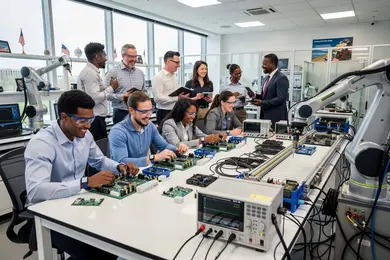
Online and campus electrical engineering programs can teach the same theory, but they differ in delivery, scheduling, lab access, peer interaction, and employer signaling. The best online programs are not watered-down versions of campus programs; they use structured lab kits, simulation platforms, remote instrumentation, scheduled support, and proctored assessments to preserve rigor.
The comparison below shows the practical trade-offs that matter most for students who want communication systems coursework. It can help you decide whether flexibility is worth the extra self-management required in an online engineering format.
| Factor | Online program | Campus program | Best fit |
| Schedule | Often asynchronous or hybrid, with deadlines and occasional live sessions | More fixed class, lab, and office-hour schedules | Online fits working adults; campus fits students who need daily structure |
| Labs | May use mailed kits, simulation software, remote labs, or short residencies | Uses campus equipment and supervised lab sections | Campus may be better for students who want frequent physical lab access |
| Communication systems projects | Can include SDR, MATLAB/Python simulations, antennas, DSP, and network modeling | May offer broader access to RF benches, fabrication tools, and research labs | Online can work well if the program documents specific hardware and software requirements |
| Networking | Relies on virtual teams, online faculty access, and intentional career outreach | Often easier to build relationships through labs, clubs, and research groups | Campus has an advantage for students seeking undergraduate research intensity |
| Cost structure | May reduce relocation and commuting costs but can add technology or lab-kit fees | May include more campus fees, housing, and transportation costs | Online can be cost-effective if tuition, fees, and lab costs are transparent |
Online education now spans many applied fields, but lab expectations vary sharply by discipline; a student comparing formats across programs may see different hands-on requirements in a sports science degree online than in electrical engineering. For EE, the online format is most convincing when the school explains exactly how students complete circuits, signals, communications, and capstone work from a distance.
Choose online if you need flexibility, already manage your time well, and can set up a reliable technical workspace. Choose campus if you learn best through in-person lab coaching, want frequent access to research facilities, or are aiming for a highly lab-intensive undergraduate experience.
Are online electrical engineering degrees with communication systems coursework properly accredited?
Yes, many online electrical engineering programs can be properly accredited, but students need to verify both institutional and programmatic accreditation. Institutional accreditation applies to the college or university as a whole and affects federal financial aid eligibility, credit transfer, and graduate school recognition. Programmatic accreditation, especially ABET accreditation for engineering programs, evaluates whether an engineering curriculum meets discipline-specific standards.
ABET accreditation is especially important for undergraduate electrical engineering degrees because some employers, graduate programs, state licensing boards, and federal technical positions use it as a quality benchmark. Not every strong master's program has separate ABET accreditation, because ABET is most commonly discussed at the bachelor's level; however, the institution should still be properly accredited, and the graduate curriculum should be technically coherent.
Before applying, students should verify accreditation directly rather than relying only on marketing pages. A careful review should include these checks:
- Confirm the institution's accreditor through the U.S. Department of Education or the Council for Higher Education Accreditation database.
- Search ABET's public database for the exact program name, degree level, campus or online designation, and accreditation dates.
- Ask whether online students receive the same diploma wording, faculty oversight, curriculum requirements, and transcript treatment as campus students.
- Check whether the degree satisfies prerequisite expectations for your target graduate programs, employers, or state engineering board.
Red flags include vague claims such as "ABET-aligned," "modeled after accredited programs," or "accreditation pending" without a clear status. Those phrases may describe curriculum intent, but they are not the same as current programmatic accreditation.
What communication systems courses are typically included in these online programs?
Communication systems coursework usually appears after students complete the math, physics, circuits, electronics, and signals sequence. This matters because communication systems is not a standalone topic; it combines probability, electromagnetics, digital logic, signal processing, and hardware design.
Students should review the catalog for both required courses and electives. A strong pathway often includes the following kinds of coursework:
- Signals and systems, including time-domain and frequency-domain analysis.
- Probability, random processes, and noise analysis for communication channels.
- Analog and digital communications, including modulation, demodulation, coding, and error performance.
- Digital signal processing, often using MATLAB, Python, or similar technical computing tools.
- Electromagnetic fields, transmission lines, antennas, and wave propagation.
- RF and microwave systems, including filters, amplifiers, mixers, and link budgets.
- Wireless networks, cellular systems, satellite communications, or optical communications electives.
- Embedded systems, software-defined radio, or Internet of Things projects that connect hardware and networks.
Current trends are changing what employers expect from communications-focused graduates. Wireless systems increasingly overlap with cybersecurity, AI-assisted signal processing, edge computing, autonomous systems, and spectrum-efficient design. Students do not need to master every subfield, but they should choose electives that build a coherent profile instead of taking unrelated technical courses.
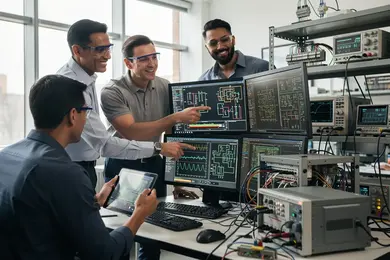
A practical way to judge the curriculum is to ask whether it helps you produce work samples. Projects involving software-defined radio, channel simulation, antenna modeling, DSP filtering, or network performance analysis can be useful in interviews because they show applied problem-solving beyond exams.
What prerequisites and admission requirements do these online programs usually have?
Admission requirements depend on degree level. Bachelor's programs usually expect high school preparation or transfer coursework in algebra, trigonometry, calculus readiness, physics, and chemistry. Master's programs often require a bachelor's degree in electrical engineering, computer engineering, physics, or a related technical field, plus prerequisite coursework in circuits, signals, probability, programming, and advanced mathematics.
Electrical engineering admissions are generally more prerequisite-driven than many non-engineering online programs. For example, an online library science degree may emphasize academic writing, information work, or professional experience, while an EE communications program will usually require demonstrated quantitative and technical preparation.
Applicants should prepare for requirements in several categories. The exact list varies by school, but these are the common items to check early:
- Calculus sequence, differential equations, linear algebra, and calculus-based physics for bachelor's transfer or graduate entry.
- Prior coursework in circuits, electronics, digital logic, signals and systems, and programming for many master's applicants.
- Official transcripts, minimum GPA expectations, and possible prerequisite grade minimums.
- Statement of purpose explaining interest in communications, signal processing, RF, telecom, or related systems.
- Letters of recommendation for graduate programs, especially from technical faculty or engineering supervisors.
- English-language proficiency documentation for applicants educated in another language.
Students coming from community college or the military should pay close attention to transfer credit rules. The most common mistake is assuming that "technical electronics" credits will automatically substitute for upper-division electrical engineering courses. Always request a course-by-course evaluation before committing financially.

How long do online electrical engineering degrees with communication systems coursework take to finish?
Completion time depends on degree level, transfer credits, course load, and whether the program is offered in a cohort, self-paced, semester, or accelerated format. A full bachelor's degree typically takes about four years of full-time study, but transfer students with completed calculus, physics, and general education credits may finish faster. Online master's programs commonly take about two to three years part time, although some full-time students finish sooner.
Time to completion also affects cost. College Board's 2024 pricing data reported average published tuition and fees of $11,610 for in-state students at public four-year institutions for 2024-2025, before housing, books, technology, and lab expenses. Online students may avoid relocation costs, but engineering programs can still include software licenses, lab kits, proctoring, and course fees.
The table below compares typical completion patterns. Use it as a planning tool, not as a promise, because engineering course sequencing can slow students who miss a prerequisite or fail to secure a required lab course on time.
| Enrollment pattern | Typical pace | Advantages | Trade-offs |
| Full-time bachelor's student | About four academic years without major transfer credit | Fastest traditional route into entry-level engineering roles | Hard to maintain with full-time work because labs and problem sets are demanding |
| Transfer bachelor's student | Often shorter if lower-division math, science, and general education credits apply | Can reduce total tuition and repeat coursework | Upper-division EE sequencing may still require multiple terms |
| Part-time bachelor's student | Often five or more years depending on course load | More realistic for working adults | Longer timeline can increase exposure to tuition changes and life interruptions |
| Part-time master's student | Often two to three years | Works well for employed engineers building specialization | Requires careful workload planning around advanced math and projects |
To shorten the timeline responsibly, students can complete approved prerequisites before enrollment, choose a program with predictable course rotations, and avoid overloading during circuits, signals, electromagnetics, and communications theory courses. Rushing through foundational material can backfire because later communication systems work depends heavily on those concepts.
What do online electrical engineering students need for labs and hands-on communication systems work?
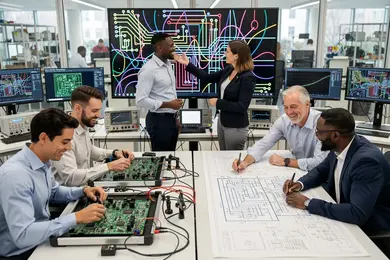
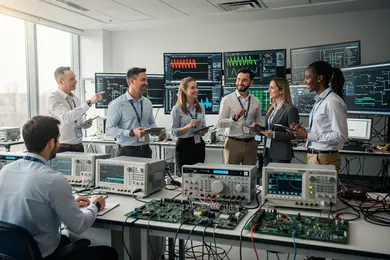
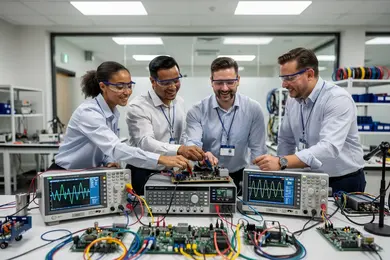
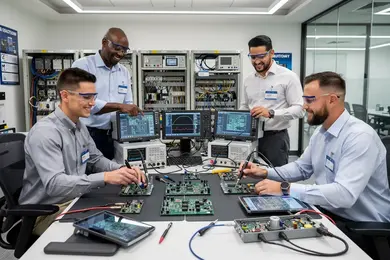
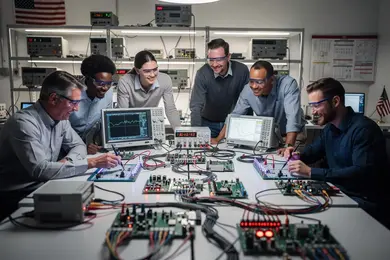
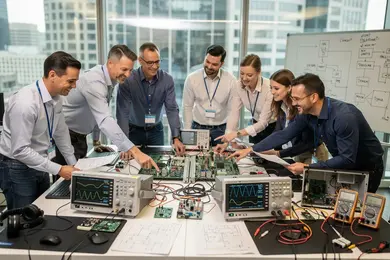
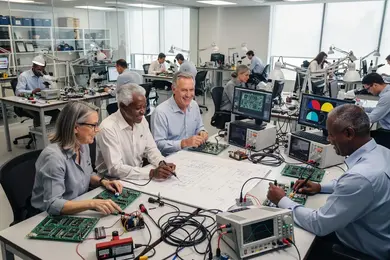
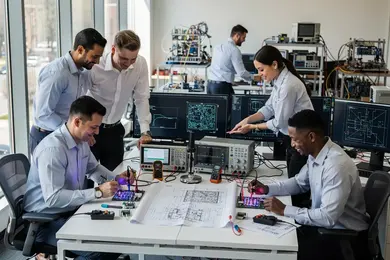
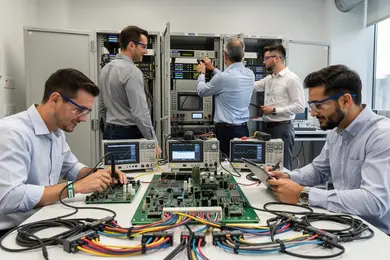
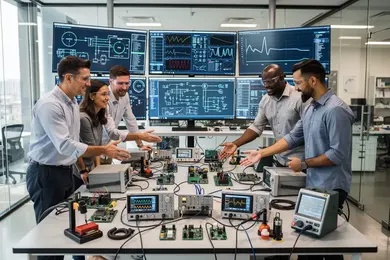
Hands-on work is essential in electrical engineering because students need to connect theory to real measurements, noise, distortion, timing, hardware limitations, and system trade-offs. In communication systems coursework, labs may involve both physical hardware and simulation. A credible online program should explain how students complete experiments, how work is verified, and what support is available when equipment or software fails.
Online EE students commonly need a mix of hardware, software, and workspace resources. Before enrolling, ask the school which items are included in tuition and which must be purchased separately:
- A reliable computer that can run engineering software, simulations, video meetings, and remote lab interfaces.
- High-speed internet for synchronous sessions, remote instrumentation, large files, and proctored exams.
- Software such as MATLAB, Simulink, Python tools, circuit simulators, electromagnetic modeling tools, or network simulation platforms.
- Electronics lab kits that may include breadboards, oscilloscopes or USB instruments, function generators, microcontrollers, sensors, RF modules, and measurement accessories.
- Software-defined radio equipment for experiments involving modulation, filtering, spectrum analysis, and wireless transmission concepts.
- A safe workspace with adequate power, ventilation, storage, and room for small electronics experiments.
Remote labs can be effective when students control real equipment over the internet or analyze real captured data, but they should not be purely passive demonstrations. For communication systems, strong programs often combine simulation, hardware measurement, and project reporting so students learn both mathematical models and real-world limitations.
Common lab-related mistakes include underestimating setup time, using an underpowered laptop, ignoring operating system requirements, and assuming every lab can be completed at any hour. If a program uses live remote lab reservations or proctored lab demonstrations, working students should confirm scheduling flexibility before enrolling.
What careers can graduates in electrical engineering and communication systems pursue?
Graduates with electrical engineering training and communication systems coursework can pursue roles in industries such as telecommunications, aerospace, defense, semiconductor design, utilities, transportation, robotics, embedded systems, satellite communications, consumer electronics, and network infrastructure. The most relevant roles depend on degree level, project experience, internships, security clearance eligibility, and whether the student has stronger hardware, software, or systems skills.
The table below connects common career paths with the kind of work graduates may encounter. It is useful for choosing electives and projects that match a real job target.
| Career direction | Typical responsibilities | Helpful communication systems preparation |
| Communications systems engineer | Designs or analyzes systems that transmit data over wired, wireless, satellite, or optical channels | Digital communications, probability, DSP, modulation, coding, and link budgets |
| RF engineer | Works on radio-frequency circuits, antennas, transmitters, receivers, and spectrum performance | Electromagnetics, antennas, RF/microwave systems, measurement labs, and SDR projects |
| Signal processing engineer | Develops algorithms for filtering, detection, estimation, compression, or sensor data interpretation | DSP, linear systems, probability, Python or MATLAB, and mathematical modeling |
| Network or wireless systems engineer | Supports wireless networks, performance modeling, reliability, and connected infrastructure | Wireless communications, networking, embedded systems, cybersecurity basics, and IoT coursework |
| Test and validation engineer | Measures product performance, documents failures, and validates equipment against requirements | Instrumentation, lab methods, communications protocols, statistics, and technical reporting |
If you are comparing engineering with science or sustainability careers, it may help to review broader career decision guides such as what can you do with an environmental science major. Electrical engineering communication systems work is typically more math-heavy and hardware/software-oriented, while environmental science paths may focus more on fieldwork, policy, resource management, or environmental data.
This degree path is strongest for students who enjoy math, systems thinking, electronics, coding, and problem-solving under constraints. It may be a poor fit for students who want minimal calculus, dislike debugging, or prefer careers centered mainly on management, writing, or policy rather than technical design.
What are typical salaries and job outlook for communication systems engineers?
Salary and job outlook are favorable for many electrical engineering roles, but students should interpret labor data carefully. BLS data reported a May 2024 median annual wage of $118,780 for electrical and electronics engineers, which is a broad category that includes many industries beyond communication systems. The number is useful as a benchmark, but it does not predict an individual graduate's salary.
The table below shows how communication systems-related roles are commonly connected to salary and outlook data. Because job titles vary by employer, students should compare postings in their target region and industry rather than relying on one title alone.
| Role family | Salary context | Outlook considerations | Factors that can change outcomes |
| Electrical and electronics engineers | BLS May 2024 median for the broad occupation was $118,780 | BLS projects 9% employment growth from 2024 to 2034 | Industry, location, clearance requirements, graduate education, and hardware specialization |
| RF and wireless engineering roles | Often benchmarked against electrical engineering salary data | Demand is influenced by wireless infrastructure, aerospace, defense, satellites, and connected devices | Hands-on RF lab experience, antenna knowledge, and test equipment fluency |
| Signal processing roles | May overlap with electrical engineering, software, defense, robotics, and data-intensive systems roles | AI-enabled sensing, autonomy, radar, medical devices, and communications can support demand | Algorithm portfolio, programming skill, advanced math, and graduate coursework |
| Network systems roles | May align with engineering, IT, or computer network occupations depending on employer | Cloud, edge computing, cybersecurity, and wireless reliability can shape hiring needs | Networking credentials, security knowledge, scripting, and systems integration experience |
Students should also consider the difference between salary potential and return on investment. A higher-cost program may be reasonable if it has strong accreditation, labs, employer relationships, and transfer-credit policies; a lower-cost program may be better if it offers the same recognized credential and fits your schedule. Neither option is automatically better without considering completion risk.
Technology trends are reshaping job expectations. AI can automate parts of simulation, optimization, anomaly detection, and test analysis, but engineers still need to define requirements, validate models, understand physics, and make design trade-offs. Graduates who combine communications theory with programming, data analysis, and hardware measurement are likely to be more adaptable than those who study only one layer of the system.
How can students choose a reputable online electrical engineering program in communication systems?
Choosing a reputable online electrical engineering program requires more than reading rankings or comparing tuition. Start by defining your target outcome: entry-level engineering employment, graduate school, RF specialization, telecom advancement, defense systems work, or a pivot from technician to engineer. Then evaluate each program against that goal.
Students who want a starting shortlist can review resources on the top online electrical engineering schools, then verify each school's accreditation, curriculum, labs, costs, and student support directly. Rankings can help organize research, but they should not replace program-level due diligence.
Use the following steps before applying or enrolling. They are designed to reduce the most common risks in online engineering education:
- Confirm institutional accreditation and, for bachelor's engineering degrees, check ABET status for the exact program name.
- Map required courses and electives to your goal, especially signals, communications, DSP, RF, antennas, wireless, and capstone options.
- Ask for a complete cost estimate that includes tuition, fees, lab kits, software, proctoring, books, and any required campus visits.
- Request transfer-credit evaluation in writing before making a deposit if you have prior coursework.
- Verify lab delivery methods, required equipment, technical support hours, and whether remote labs are synchronous.
- Ask about internship support, employer partnerships, undergraduate research access, graduate assistantships, or project-based career support.
- Review course rotation schedules to make sure required communications electives are offered often enough for your planned graduation date.
- Compare faculty expertise and recent projects to the communications subfield you want to enter.
Watch for red flags such as unclear accreditation language, missing lab details, no named communications electives, poor transfer-credit transparency, aggressive enrollment pressure, or promises about jobs and salaries. A trustworthy program should be willing to answer detailed questions before you apply.
The best choice is the program that you can finish, afford, and defend to employers or graduate schools. For most students, that means prioritizing accreditation, engineering rigor, hands-on communication systems work, predictable scheduling, and total cost over marketing claims.
Other Things You Should Know About Electrical Engineering
It can, but licensure rules vary by state. Many boards prefer or require an ABET-accredited engineering degree, plus exams and supervised experience. Check your state board before enrolling.
A communications certificate provides foundational knowledge but lacks the comprehensive curriculum of a full electrical engineering degree. For careers in communication systems and advanced engineering roles, a bachelor's degree is typically required, offering extensive coursework and hands-on experience that certificates do not cover.
Students usually need access to an oscilloscope, signal generator, spectrum analyzer, and software-defined radio tools for modulation, filtering, and digital communications labs. ABET-accredited online programs often provide remote lab kits or scheduled in-person lab sessions to meet hands-on course requirements in 2027.
References
- Can You Take Prerequisites Online? https://www.sophia.org/blog/higher-education/can-you-take-prerequisites-online/
- Online Master’s in Communication Degree Programs - OnlineEducation.com https://www.onlineeducation.com/communication/masters-in-communication-programs
- 6 Best Online Electrical Engineering Degree Programs for Future Engineers https://www.myprivatetutor.com/blog/best-online-electrical-engineering-degree-programs
- Communication Systems and Networks (Master's program) https://www.th-koeln.de/en/academics/communication-systems-and-networks-master_6840.php
- Science Prerequisites for Health Professions https://online.une.edu/science-prerequisites/
- How to become a Communications Engineer - Salary, Qualifications, Skills & Reviews – SEEK https://au.seek.com/career-advice/role/communications-engineer
- Principles of Communication Systems - Academy Europe | European Open University https://academyeurope.org/courses-4/engineering-technology/principles-of-communication-systems/
- Electronic and Electrical Engineering undergraduate courses | Brunel University of London https://www.brunel.ac.uk/electronic-and-electrical-engineering/undergraduate-courses
- Are Online Prerequisite Courses Accepted by Colleges? https://www.straighterline.com/blog/are-online-prerequisite-courses-accepted-by-colleges
- Bachelor of Science (B.S.) Major in Electrical Engineering (Networks and Communication Systems Concentration) https://mycatalog.txstate.edu/undergraduate/science-engineering/ingram-school/electrical-engineering-networks-communication-systems-specialization-bs/