
2027 Career Path for Social Workers: Everything You Need to Know

Co-Founder and Chief Data Scientist
Choosing a social work career path is not as simple as picking a job title. Social workers can work in schools, hospitals, courts, community agencies, private practice, government, behavioral health programs, child welfare, aging services, and policy organizations. Each path can require different degrees, supervised field experience, state licenses, emotional demands, and salary expectations.
This guide is for students, career changers, and early-career professionals who want to understand where a social work degree can lead. You will learn what social workers do, how licensing works, which roles are available at different education levels, how salaries compare, what skills matter most, and how to choose a path that fits your interests, values, and long-term goals.
Career Path for Social Workers Table of Contents
- What does a social worker do?
- Social worker job outlook and salary snapshot
- How to become a social worker
- Major career paths in social work
- Entry-level social work jobs and salaries
- Best education paths for aspiring social workers
- Skills social workers need to succeed
- Emerging trends shaping social work practice
- Is a social work career worth it?
- Technology and online education in social work careers
- How accessible education expands social work opportunities
- Policy and advocacy opportunities in social work
- Social workers compared with other mental health professionals
- Managing burnout in social work careers
- Using networking and mentorship to advance
- Advanced certifications and specialized training
- Financial value of advanced social work degrees
Quick Answer: What Is the Best Career Path for Social Workers?
The best social work career path depends on the population you want to serve, the setting you prefer, and the license you are willing to pursue. A BSW can prepare graduates for case management, community outreach, probation, health education, and some direct-service roles. An MSW is usually the stronger path for clinical practice, school social work, healthcare social work, specialized child welfare roles, and leadership positions. A DSW can support advancement into administration, academia, executive leadership, advanced clinical work, or policy reform.
Before choosing a path, confirm three things: whether your state requires a CSWE-accredited degree, whether the role requires supervised experience or clinical licensure, and whether the salary range supports your education costs and debt plans.
What is a social worker?
A social worker is a trained human services professional who helps individuals, families, groups, and communities respond to problems that affect safety, health, stability, and quality of life. Social workers may connect clients with housing, healthcare, food assistance, counseling, disability support, child protection services, addiction treatment, school interventions, or legal and advocacy resources.
The role is broad because social problems rarely happen in isolation. A client may be dealing with unemployment, trauma, family conflict, substance use, housing insecurity, disability, discrimination, or medical needs at the same time. Social workers are trained to look at the full environment around a person, not only the immediate crisis.
According to the Bureau of Labor Statistics (2025), employment for social workers is projected to grow by 8 percent through 2034, which reflects continued need across health, behavioral health, community, and public service settings. The BLS describes the profession as helping people cope with problems in everyday life. Many social workers work full time, and some roles require evenings, weekends, holidays, crisis response, or on-call coverage.
Social workers may serve at three levels of practice:
- Micro practice: Direct work with individuals and families, such as counseling, case planning, crisis support, and resource coordination.
- Mezzo practice: Work with groups, schools, neighborhoods, agencies, or community programs.
- Macro practice: Policy, research, advocacy, program design, administration, and systems-level reform.
The profession can be deeply meaningful, but it is not easy work. Social workers often manage complex cases, heavy documentation, ethical dilemmas, limited resources, and emotionally difficult situations. That is why education, supervised training, licensure, continuing education, and strong professional boundaries matter.
Social Worker Career Outlook
The social work career outlook remains steady in the United States. The source data reports 759,740 jobs, projected job growth of 6% by 2034, and around 74,000 job openings each year. Much of that annual hiring is expected to come from retirements and workers moving into other occupations, with employment change over the 10-year period listed at 64,000 jobs.
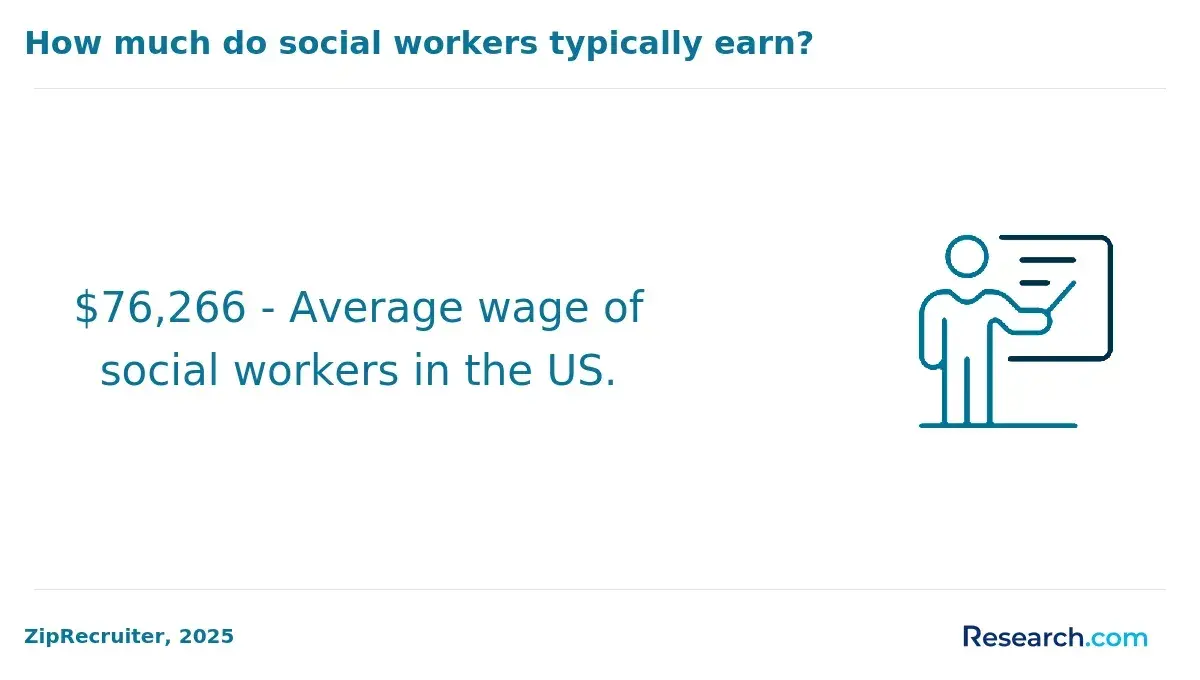
The reported annual median pay was $50,390, or $23.23 per hour. That figure is $4,630 higher than the median yearly wage for all occupations. Salaries vary widely by employer, location, license level, and specialty. Local governments, excluding hospitals and educational institutions, reported the highest annual median salary at $61,190. Ambulatory healthcare services followed at $58,700, state government excluding educational institutions and hospitals at $48,900, and individual and family services at $46,490.
Specialty also affects earnings. Healthcare social workers were listed with the highest median annual wage among the cited specialist categories at $60,940. Mental health and substance abuse social workers were listed at $49,130 per year. Readers comparing specialty options may also want to review how compensation is discussed in related areas such as forensic social work salary.
| Career factor | What the data suggests | How to use it in your decision |
| Job availability | 759,740 jobs and around 74,000 openings each year | Demand exists, but openings differ by state, employer, and specialization. |
| Growth projection | 6% by 2034, with 64,000 jobs added over the 10-year period | Look beyond national averages and check local demand for your target role. |
| Median pay | $50,390 annually, or $23.23 per hour | Compare expected earnings against tuition, debt, supervision costs, and licensing fees. |
| Higher-paying settings | Local government at $61,190 and ambulatory healthcare services at $58,700 | Employer type can matter as much as job title when planning long-term income. |
| Specialty differences | Healthcare social workers at $60,940; mental health and substance abuse social workers at $49,130 | Choose a specialty for fit first, but understand how pay may vary by field. |
How to Become a Social Worker
The path to becoming a social worker depends heavily on your state and the type of work you want to do. In general, professional social work practice requires a degree, supervised experience, and a state license. A social work degree is commonly required before applying for licensure, although exact rules differ by state.
Some states, such as Indiana, may allow social workers to qualify with a bachelor’s degree and a license. Other states, such as New York, require a completed master’s in social work degree and at least 900 social work career internship hours to apply. Because these rules can change and vary by license type, students should check the licensing board in the state where they plan to practice before enrolling in a program.
All states require clinical social workers to be licensed, and most master’s-level social work roles also involve licensing requirements. Degrees are generally expected to come from institutions accredited by the Council on Social Work Education (CSWE). In the most recent survey presented to the Council on Social Work Education (CSWE), mental health or behavioral health was the most common social work specialization, at 35.1%.
Typical Steps to Earn a Social Work License
- Complete a bachelor’s degree. Many students begin with a Bachelor of Social Work (BSW), although some enter the field through related majors such as psychology or sociology. Some states specifically require a BSW for certain licenses.
- Gain supervised field experience. Social work programs include field placements, internships, or practicum experiences. Even an accredited online bachelors degree in social work program includes in-person or community-based field requirements.
- Earn an MSW if your goal requires it. Clinical practice, independent practice, and many specialized roles require a Master of Social Work. Flexible formats, including online masters degrees in social work, can help working adults continue their education, but students still need to complete required field hours.
- Apply for the appropriate state license. Once you meet the degree and experience requirements, you can apply through your state board. Applications often include transcripts, supervised experience documentation, background checks, fees, and an exam through the Association of Social Work Boards (ASWB).
- Maintain your license. Licensure is not a one-time requirement. Social workers must renew their credentials and complete continuing education according to state rules.
Common Types of Social Work Licenses
License names and scopes of practice vary by state, but several common credentials appear across licensing systems:
- Licensed Social Worker (LSW): Often used for general social work practice, depending on state rules.
- Licensed Graduate Social Worker (LGSW): Commonly associated with MSW-level practice under supervision.
- Licensed Independent Social Worker (LISW): May allow independent general social work practice in some states.
- Licensed Independent Clinical Social Worker (LICSW): Typically connected to independent clinical services, including assessment and treatment, where permitted by state law.
- Other license titles: States may also use credentials such as Certified Social Worker (CSW), Licensed Baccalaureate Social Worker (LBSW), Licensed Clinical Social Worker (LCSW), Licensed Master Social Worker (LMSW), and Licensed Mental Health Professional (LMHP).
Requirements to Retain an Active License
Social work licenses generally expire every two years. Renewal rules differ by state and license level. Many jurisdictions require around 30 continuing education credit hours, while others require more. Alaska, for example, requires 45 continuing education hours for renewal. Fees, approved course topics, ethics requirements, and documentation rules can also vary.
| Education level | Common career use | Licensure considerations |
| Associate degree or related coursework | Assistant, aide, outreach, residential support, or human services roles | Usually not enough for licensed professional social work practice. |
| BSW | Case management, community services, child welfare support, probation-related roles, health education | Some states allow bachelor’s-level licensure; others require more education for licensed roles. |
| MSW | Clinical social work, school social work, healthcare social work, mental health, administration, specialized practice | Often required for clinical licensure and many advanced roles. |
| DSW or doctorate | Leadership, advanced practice, academia, program administration, policy reform | Does not replace state licensure where clinical practice is regulated. |
Career Path for Social Workers
The National Association of Social Workers identifies at least eight broad practice areas for social workers. These areas can overlap, and many professionals shift specialties as they gain experience.
- Aging: Supports older adults and families dealing with long-term care, caregiving, health changes, benefits, isolation, and end-of-life planning.
- Behavioral health: Focuses on mental health, substance use, addiction, crisis services, prevention, counseling, and recovery support.
- Child services: Works with children, parents, foster systems, schools, courts, and community agencies to protect children and strengthen families.
- Clinical social work: Involves assessment, diagnosis, treatment planning, therapy, and intervention for mental health and behavioral concerns. Clinical licensure is required.
- Ethnicity and race: Addresses racial inequities, discrimination, access gaps, and community-level disparities in workplaces, schools, healthcare, and public systems.
- Health: Helps patients and families navigate illness, discharge planning, treatment barriers, medical decisions, insurance, grief, disability, and community resources.
- LGBTQIA2S+: Provides affirming services, advocacy, crisis support, family education, policy work, and resource navigation for LGBTQIA2S+ individuals and communities.
- School social work: Connects students, families, educators, and community agencies to address attendance, mental health, crisis intervention, family needs, bullying, homelessness, and academic barriers.
Other specialties include forensic social work, justice system practice, custody and guardianship recommendations, mediation, testimony, and evaluations. These roles can overlap with the responsibilities found in some criminology major jobs. Social workers may also focus on adolescents, military families, disability services, domestic violence, homelessness, disaster response, private practice, or nonprofit leadership.
How to Choose a Social Work Specialty
A useful way to narrow your options is to compare the population, setting, license, and day-to-day work rather than choosing by title alone.
| If you care most about... | Consider these paths | Important trade-off |
| Direct therapy and mental health treatment | Clinical social work, behavioral health, substance use counseling | Usually requires an MSW, supervised clinical hours, and clinical licensure. |
| Helping children and families | Child welfare, school social work, family services | Can involve crisis situations, court systems, and high emotional demands. |
| Healthcare and patient advocacy | Hospital social work, hospice, medical case management, aging services | Requires comfort working with medical teams, illness, grief, and complex discharge planning. |
| Legal and justice systems | Forensic social work, probation-related roles, victim services | Requires strong documentation, legal awareness, and comfort with high-stakes decisions. |
| Systemic change | Policy, advocacy, community organizing, nonprofit administration | May involve less direct client contact and more research, coalition building, and program design. |
Entry-Level Social Worker Jobs and Salaries
Entry-level social work and human services jobs can help students gain field experience before pursuing advanced licensure. Some roles may be open to candidates with an associate degree, a bachelor’s degree, or a related major, while licensed social work titles usually require state-specific credentials.
Jobs That May Be Available Before Full Professional Licensure
| Role | Typical responsibilities | Average salary |
| Social Work Assistant | Supports licensed social workers by helping clients complete forms, find resources, schedule services, and navigate agency processes. | $44,728 |
| Residential Counselor | Works in group homes or residential facilities, helping residents build daily living skills, follow care plans, manage routines, and participate in activities. | $40,016 |
| Case Manager | Coordinates services, tracks client progress, develops care plans, and advocates for access to resources. | $46,672 |
| Community Outreach Worker | Connects individuals and neighborhoods with programs, benefits, referrals, education, and enrollment support. | $42,224 |
| Gerontology Aide | Assists older adults with daily living needs, companionship, basic support, and access to aging-related services. | $75,039 |
What jobs can you get with a BSW?
A Bachelor of Social Work can qualify graduates for many direct-service and case-support roles. However, licensure rules vary. Some states allow bachelor’s-level licensed practice, while others require an MSW for licensed roles or specific titles.
| BSW-level role | What the job often involves | Average salary |
| Caseworker | Assesses client needs, connects families with services, creates plans, documents progress, and advocates across agencies. | $47,175 |
| Marriage or Family Therapist | Provides relationship-focused counseling to couples or families using structured therapeutic approaches where legally permitted. | $76,464 |
| Addiction Counselor | Supports people experiencing substance use disorders through assessment, treatment planning, education, and individual or group support. | $53,382 |
| Probation Officer | Monitors individuals after conviction, supports reintegration, connects clients to services, and documents compliance. | $50,582 |
| Health Educator | Designs and delivers programs that teach individuals and communities about health behaviors, prevention, and available services. | $51,832 |
Specialist Social Worker Jobs and Salaries
Many specialized social work roles require an MSW because the work involves advanced assessment, intervention, program leadership, or clinical decision-making. MSW programs often allow students to focus on areas such as mental health, child welfare, healthcare, school social work, aging, community practice, or policy. Students comparing graduate options should look closely at accreditation, field placement support, licensure alignment, and affordability.
What jobs can you get with an MSW degree specialization?
| MSW-related role | Primary focus | Average salary |
| Child Welfare Specialist | Investigates safety concerns, supports children and families, works with agencies and courts, and helps protect children from abuse or neglect. | $49,320 |
| Mental Health Counselor | Provides counseling and support to people experiencing mental health challenges. | $62,660 |
| Clinical Social Worker | Assesses behavioral and emotional concerns, develops treatment plans, monitors progress, and collaborates with healthcare or mental health teams. | $59,488 |
| Community Service Manager | Leads programs, supervises staff, evaluates services, coordinates funding or partnerships, and improves community outcomes. | $60,605 |
| Forensic Social Worker | Applies social work knowledge in legal contexts involving custody, juvenile justice, elder abuse, divorce, civil disputes, criminal offending, incarceration, or victim support. The average forensic social workers salary may not be the highest, but the field can offer room for specialized growth. | $59,488 |
| School Social Worker | Supports students, families, teachers, and school systems through crisis intervention, referrals, counseling, attendance support, and community coordination. | $67,622 |
What jobs can you get with a DSW degree?
A Doctor of Social Work can help experienced professionals move into advanced practice, leadership, teaching, policy, administration, or organizational change. A DSW does not automatically replace state licensure requirements, especially for clinical practice, but it may strengthen qualifications for senior roles.
| DSW-related role | How the degree may be used | Average salary |
| Social Work Administrator | Manages social services, community programs, nonprofit operations, staff development, budgets, and quality improvement. | $56,511 |
| Professor | Teaches social work courses, mentors students, conducts research, and contributes to professional knowledge. | $67,316 |
| Executive Director | Oversees a nonprofit organization’s mission, staff, finances, partnerships, programs, and strategic direction. | $111,470 |
| Government Official | Uses advanced social work expertise to improve public systems such as child welfare agencies or psychiatric care facilities. | $98,612 |
| Clinician | Continues direct practice while applying advanced training to improve assessment, intervention, supervision, or program outcomes. | $70,995 |
What are the best educational paths for aspiring social workers?
The best education path depends on your target role. Students who want general human services experience may start with an associate degree or a BSW. Students who want clinical practice, school social work, healthcare social work, or advanced licensure should usually plan for an MSW. Those aiming for senior leadership, advanced clinical expertise, teaching, or systems reform may later consider a DSW.
Accreditation is one of the most important factors. If you plan to become licensed, confirm that the program meets state requirements and holds the appropriate CSWE accreditation. Students comparing graduate options can begin with best online MSW programs CSWE-accredited, but they should still verify licensure alignment directly with the school and state board.
| Student goal | Recommended education path | Questions to ask before enrolling |
| Enter human services quickly | Associate degree, related bachelor’s degree, or BSW | Will this qualify me for the job titles I want in my state? |
| Become a licensed social worker | BSW or MSW, depending on state rules | Is the program CSWE-accredited and accepted by my state board? |
| Practice clinically | MSW plus supervised clinical hours and exam | Does the curriculum prepare students for clinical licensure? |
| Work in schools | BSW or MSW, depending on state and district requirements | Are school placements available, and are additional state education credentials needed? |
| Move into leadership or academia | MSW plus experience; DSW or doctorate for advanced roles | Does the degree support the specific leadership, teaching, or policy path I want? |
What are the skills required for success in social work?
Social workers need more than compassion. The strongest professionals combine ethical judgment, communication, organization, cultural awareness, advocacy, documentation, and emotional resilience. These skills are especially important for students researching specialized roles such as how to become a school social worker.
- Empathy with professional boundaries: Social workers must understand clients’ experiences without becoming overwhelmed or losing objectivity.
- Clear communication: The work requires explaining services, writing case notes, documenting risk, collaborating with agencies, and communicating with clients under stress.
- Assessment and critical thinking: Social workers often make decisions with incomplete information, competing needs, and limited resources.
- Cultural competence: Effective practice requires respect for cultural, racial, ethnic, religious, gender, family, and community differences.
- Organization and time management: Caseloads, deadlines, reports, referrals, visits, and follow-ups can quickly become unmanageable without strong systems.
- Conflict resolution: Social workers may mediate between family members, schools, agencies, courts, medical teams, and clients.
- Advocacy and policy awareness: Clients often need help navigating benefits, legal rights, discrimination, healthcare access, housing systems, and education services.
- Research and data literacy: Program evaluation, evidence-based practice, grant work, and policy advocacy increasingly require the ability to interpret data.
- Self-care and resilience: Long-term success depends on supervision, boundaries, peer support, realistic workloads, and stress management.
What are the emerging trends in social work practice?
Social work is changing as communities face new pressures and service systems adopt new tools. These trends do not replace core social work values, but they do change how professionals deliver care and prepare for advancement.
- Greater demand for mental health and behavioral health support: Social workers are increasingly involved in crisis response, trauma-informed care, anxiety and depression support, addiction treatment, and integrated behavioral health services.
- Telehealth and digital service delivery: Virtual counseling, online support groups, digital documentation, and remote case management are now part of many practice settings.
- Stronger focus on equity and social justice: Social workers continue to address disparities in housing, healthcare, education, employment, justice systems, and public benefits.
- Community-based and holistic care models: More organizations are connecting social work with public health, schools, legal aid, housing programs, and community organizations.
- Environmental and disaster-related social work: Climate change, natural disasters, displacement, and environmental injustice are creating new needs for community response and policy advocacy.
- Credential-based hiring: Employers often expect clear evidence of field experience, licensure readiness, specialized training, and continuing education.
Is being a social worker worth it?
Social work can be worth it for people who want a service-oriented career with many possible specialties, but it is not the right fit for everyone. The work can offer purpose, advancement options, and stable demand, but it can also involve emotional strain, complex systems, modest entry-level pay, and significant education or licensure requirements.
To evaluate whether the path makes sense, compare education costs, expected salary, state licensing rules, supervision requirements, workload, personal resilience, and the population you want to serve. A deeper ROI discussion is available in this guide on whether is being a social worker worth it.
| Social work may be a strong fit if... | You may want to reconsider or explore alternatives if... |
| You want a career centered on service, advocacy, and problem-solving. | You want predictable emotional boundaries and minimal crisis exposure. |
| You are willing to complete supervised fieldwork and licensing steps. | You do not want to manage paperwork, documentation, and compliance requirements. |
| You can work with people facing trauma, poverty, illness, conflict, or systemic barriers. | You expect high salaries immediately after completing an entry-level degree. |
| You value flexibility across healthcare, schools, nonprofits, government, and behavioral health. | You prefer work that is primarily technical, independent, or not client-facing. |
The Role of Technology and Online Education in Social Work Careers
Technology now affects both how social workers are trained and how they serve clients. Online education has made MSW programs more accessible for working adults, rural students, caregivers, and career changers. However, online does not mean fully remote in every respect. Social work students still need supervised field placements, and licensure requirements still depend on state rules.
Accelerated formats can help some students finish faster. For example, 1 year MSW programs online may appeal to qualified students who already have relevant preparation and want a shorter graduate timeline. Before choosing this route, ask whether the schedule is realistic, whether field placements are supported, and whether the program prepares students for licensure in the intended state.
Technology has also changed practice. Clinical social workers may use telehealth platforms for therapy or crisis follow-up. Case managers may use digital systems to track referrals, benefits, progress notes, and team communication. Community programs may use data dashboards to evaluate outcomes and target services. These tools can improve access, but they also raise concerns about privacy, informed consent, confidentiality, documentation, and digital equity.
How Accessible Education Impacts Social Work Career Opportunities
More flexible education pathways can help expand who enters the profession. Online and hybrid programs may serve students who cannot relocate, stop working, or attend daytime classes. Some applicants also look for options such as the easiest MSW program, but admissions accessibility should never be the only selection factor.
A program is only useful if it supports your goal. Students should compare accreditation, field placement quality, licensure outcomes, faculty expertise, tuition, fees, transfer policies, specialization options, and student support. Accessibility matters, but so does whether the degree will be recognized by employers and licensing boards.
Questions to Ask Before Choosing a Social Work Program
- Is the program accredited by the appropriate social work accreditor?
- Does the curriculum meet licensure requirements in the state where I plan to practice?
- Who arranges field placements, and how are placements approved?
- What populations, settings, or specialties are available for practicum experience?
- What is the total cost, including fees, travel, books, technology, and lost work time?
- Can I attend part time, full time, online, hybrid, or accelerated?
- What support is available for licensure exams, supervision planning, and career placement?
- Are graduates working in the kinds of roles I want?
What are the policy and advocacy opportunities in social work careers?
Social workers are not limited to one-on-one services. Many move into policy, advocacy, program evaluation, community organizing, nonprofit leadership, legislative analysis, and public systems reform. These roles are especially relevant for professionals who want to address root causes such as poverty, discrimination, healthcare access, housing instability, incarceration, and educational inequity.
Macro practice can involve research, coalition building, grant writing, public testimony, community needs assessments, and program design. Professionals interested in large-scale change can explore macro level social work to better understand how social work skills apply to policy and community transformation.
How do social workers differ from other mental health professionals?
Social workers often overlap with counselors, psychologists, and therapists, but the profession has a distinctive person-in-environment perspective. That means social workers consider mental health needs alongside family systems, poverty, housing, healthcare access, discrimination, schools, workplaces, and public policy.
Clinical social workers may provide therapy, but many social workers also coordinate services, advocate for benefits, support court or school processes, manage cases, develop programs, and work on systems change. For readers comparing career options, this guide to social worker vs psychologist explains key differences in training and professional focus.
How can social workers effectively manage career burnout?
Burnout is a serious risk in social work because many roles involve trauma exposure, high caseloads, administrative pressure, limited resources, and emotionally intense decisions. Managing burnout requires more than personal toughness. It requires supportive supervision, realistic workloads, ethical boundaries, peer consultation, continuing education, and organizational accountability.
Practical strategies include using regular supervision, documenting workload concerns, taking breaks when possible, joining peer consultation groups, seeking therapy or employee assistance when needed, developing crisis debriefing routines, and choosing roles that fit your capacity and life stage. Compensation also affects sustainability, so professionals may benefit from reviewing resources such as an LCSW salary guide when planning career moves or negotiating offers.
How can networking and mentorship accelerate your social work career?
Mentorship can help social workers make better decisions about licensure, supervision, specialties, job changes, and graduate education. A mentor can also explain unwritten expectations in settings such as hospitals, schools, courts, nonprofits, or private practice.
Useful networking steps include joining professional associations, attending local trainings, asking field supervisors for career advice, connecting with alumni, participating in conferences, and staying in touch with practicum contacts. Education can also expand a professional network. Students comparing lower-cost undergraduate pathways may find value in researching the cheapest online bachelor's degree in social work while also evaluating accreditation and support services.
How can advanced certifications and specialized training boost your social work career?
Advanced certifications and specialized training can make a social worker more competitive for focused roles, especially in clinical practice, trauma, addiction, school services, healthcare, gerontology, forensic practice, supervision, or leadership. These credentials do not replace state licensure, but they can demonstrate expertise and commitment to a practice area.
Specialized training is most valuable when it aligns with your actual career plan. For example, a clinician may benefit from trauma-focused training, while a policy professional may benefit more from program evaluation, grant writing, or community organizing. MSW graduates exploring career options can review master of social work jobs to identify which credentials are most relevant to their target roles.
Is pursuing an advanced social work degree financially beneficial?
An advanced social work degree can increase access to licensed clinical roles, leadership positions, specialized practice, and higher-level responsibility. However, financial benefit is not automatic. Students should compare tuition, fees, debt, lost income during study, supervision costs, licensing expenses, and likely salaries in their state and specialty.
Lower-cost programs can reduce risk, especially for professionals entering public service or nonprofit roles. Students considering doctoral-level education may want to compare cheap DSW programs online while checking program quality, faculty expertise, and whether the degree supports their specific advancement goals.
Common Mistakes to Avoid When Choosing a Social Work Career Path
- Choosing a program without checking accreditation: A non-accredited or poorly aligned program can create licensure problems later.
- Assuming online programs are easier: Online programs can be flexible, but field placements, writing, exams, and supervision requirements remain demanding.
- Ignoring state licensing rules: Requirements differ by state, and moving after graduation can complicate licensure plans.
- Looking only at tuition: Fees, books, technology, commuting to field sites, reduced work hours, and exam costs can change the real price.
- Choosing a specialty only by salary: Burnout risk rises when the daily work does not match your strengths, values, or boundaries.
- Assuming all MSW tracks lead to clinical licensure: Some programs or concentrations are more focused on macro practice, administration, or policy.
- Relying only on rankings: Rankings can be a starting point, but licensure alignment, field placement quality, affordability, and outcomes matter more.
- Waiting too long to build experience: Volunteering, internships, field placements, and entry-level roles can clarify which populations and settings fit you.
Which social work career path are you going to take?
Social work offers many directions, but the right path should match your preferred population, practice level, education plan, licensing requirements, and tolerance for the realities of the work. If you want direct impact with individuals and families, micro practice may fit. If you want to strengthen programs, schools, or organizations, mezzo practice may be a better match. If you want to change policy, funding, and systems, macro social work may be the right direction.
Before committing, compare job descriptions in your state, talk with practicing social workers, review licensure requirements, and calculate the full cost of your education. Students who need graduate training can compare affordable MSW programs, while those researching state-specific options may look at online MSW programs California or requirements to become a social worker in New York.
Key Insights
- Social work is not one career: It includes clinical practice, child welfare, healthcare, schools, aging services, justice-related work, community programs, policy, and administration.
- Licensure determines your options: Clinical and independent practice require state licensure, and requirements vary significantly by state.
- Education level shapes opportunity: A BSW can open many direct-service roles, an MSW is often needed for clinical and specialized practice, and a DSW can support leadership or advanced professional roles.
- Salary varies by setting and specialty: Employer type, state, license level, and specialization can affect earnings as much as the degree itself.
- Field experience is essential: Practicum placements, internships, and supervised work often determine career fit and licensure readiness.
- Accreditation should be non-negotiable: Students planning to become licensed should verify CSWE accreditation and state board acceptance before enrolling.
- Burnout planning matters: Sustainable social work careers require supervision, boundaries, peer support, manageable workloads, and realistic expectations.
- The best path is values-aligned and practical: Choose a specialty that fits both your mission and your financial, educational, and personal capacity.
References:
- American Psychological Association. (2025). APA — Careers in Helping Professions. https://www.apa.org/careers/resources/helping
- Bureau of Labor Statistics. (2025). Social Workers: Occupational Outlook Handbook. https://www.bls.gov/ooh/community-and-social-service/social-workers.htm
- Bureau of Labor Statistics. (2025). Occupational Employment and Wages for Social Workers. https://www.bls.gov/ooh/community-and-social-service/social-workers.htm
- Council on Social Work Education. (2025). CSWE — Accreditation & Standards. https://www.cswe.org
- National Association of Social Workers. (2025). Social Work Salaries. https://www.socialworkers.org/careers/career-center/kickstart-your-job-hunt/social-work-salaries
- National Association of Social Workers. (2026). NASW Career Resources. https://www.socialworkers.org
- Occupational Information Network (ONET). (2026). Social Worker ONET Profile. https://www.onetonline.org/link/summary/21-1020.00
- U.S. Bureau of Labor Statistics. (2025). Occupational Outlook Handbook: Social Workers. https://www.bls.gov/ooh/community-and-social-service/social-workers.htm
- U.S. Bureau of Labor Statistics. (2025, April 2). Social Workers: Occupational Outlook Handbook. https://www.bls.gov/ooh/community-and-social-service/social-workers.htm
- Zippia (2025). Social Worker Job Salaries & Trends. https://www.zippia.com/social-worker-jobs/salary/
Other Things You Should Know About Career Paths for Social Workers
To become a social worker, you generally need a bachelor's degree in social work (BSW) or a related field such as sociology or psychology. For more specialized roles or to provide clinical services, a master's degree in social work (MSW) is typically required. Additionally, degrees must be earned from programs accredited by the Council on Social Work Education (CSWE).
Yes, licensure is required to practice social work in most states. The specific licensure requirements vary by state but generally include completing an accredited degree program, gaining supervised field experience, and passing a licensure exam. Clinical social workers must be licensed in all states.
The time required to become a licensed social worker can vary. It typically takes four years to complete a bachelor's degree, and an additional two years for a master's degree. After completing the educational requirements, you may need to gain supervised field experience, which can take one to two years. The entire process can take approximately six to eight years.
In 2027, social workers are required to complete at least 30 hours of continuing education every two years to maintain licensure. This includes mandatory hours in ethics and cultural competency, as stipulated by most state licensing boards in the U.S.
Most state boards require a fingerprint-based criminal background check before issuing a social work license. Applicants usually submit prints through the state licensing board or an approved vendor, and serious convictions or abuse findings can delay or block approval.
Yes, it is possible to pursue a career in social work with a degree in a related field such as psychology, sociology, or human services. However, you may need to complete additional coursework or obtain a master's degree in social work (MSW) to meet licensure requirements and qualify for certain positions.
In 2027, social workers can specialize in areas like clinical social work, school social work, healthcare social work, and substance abuse counseling. Each requires additional certifications or coursework specific to the field, enhancing career opportunities and enabling focused expertise.


