
2027 Best LPN Programs in Florida – Accredited Online LPN Programs

Co-Founder and Chief Data Scientist
Choosing an LPN program in Florida is not just a school decision. It affects how quickly you can qualify for nursing licensure, where you can complete clinical hours, how much debt you may take on, and whether the program will prepare you for the NCLEX-PN. Demand is a major reason many students are considering this path: by 2035, the Florida Hospital Association predicts that the state will require over 59,000 nurses, and for licensed practical nurses (LPNs), an average of 3,810 new job openings per year is anticipated over the decade.
This guide explains what “online LPN programs in Florida” really means, why most options are hybrid rather than fully online, how to compare programs, what costs and prerequisites to expect, and how an LPN credential can lead to work in hospitals, long-term care, home health, and future RN or advanced nursing pathways.
Quick answer: Are there fully online LPN programs in Florida?
No reputable Florida LPN program is fully online because practical nursing requires supervised lab work and clinical training with real patients. The most flexible options are hybrid LPN programs: students complete some theory-based coursework online while attending in-person labs and clinical rotations at approved healthcare sites. A good program should be approved by the Florida Board of Nursing, prepare graduates for the NCLEX-PN, clearly disclose clinical requirements, and provide realistic support for working adults.
What are the benefits of getting an online LPN program in Florida?
- Hybrid LPN programs can make nursing school more manageable for students who need some online coursework while still completing required hands-on training.
- Graduates of online LPN programs in Florida can pursue jobs in hospitals, nursing homes, long-term care facilities, clinics, and home healthcare agencies.
- The average annual salary for LPNs and Licensed Vocational Nurses (LVNs) in Florida is $57,140.
- Completing an approved online or hybrid LPN program in Florida can qualify graduates to take the National Council Licensure Examination for Practical Nurses (NCLEX-PN), which is required for practical nursing licensure.
- The LPN route is one of the shorter ways to enter nursing, and it can later support bridge options into RN, BSN, or advanced nursing education.
What can I expect from an online LPN program in Florida?
An online LPN program in Florida is usually a hybrid practical nursing program. The online portion is commonly used for didactic coursework, such as anatomy, physiology, pharmacology, nursing concepts, medical terminology, nutrition, and lifespan development. The in-person portion covers skills labs, simulations, and clinical rotations, where students practice patient care under supervision.
This format can be useful if you need flexibility, but it is not the same as an entirely remote degree. You should expect fixed clinical schedules, attendance rules, health documentation requirements, background checks, drug testing, and travel to approved clinical sites. Before enrolling, ask the school where clinicals are located, whether placements are guaranteed, and how often you must be on campus.
| Program component | Typical format | What students do |
| Lecture and theory courses | Online or hybrid | Study nursing concepts, anatomy, pharmacology, ethics, and patient care principles |
| Skills labs | In person | Practice procedures such as vital signs, wound care, injections, and documentation |
| Clinical rotations | In person | Work under supervision in healthcare settings with real patients |
| NCLEX-PN preparation | Online, in person, or blended | Review practical nursing content and practice exam-style questions |
Where can I work with an online LPN program in Florida?
After completing an approved LPN program, passing the NCLEX-PN, and receiving Florida licensure, graduates can work in several healthcare environments. Common employers include hospitals, nursing homes, assisted living facilities, rehabilitation centers, physicians’ offices, outpatient clinics, correctional health settings, and home healthcare agencies.
The work setting matters because it shapes your schedule, responsibilities, patient population, and advancement options. In hospitals, LPNs often support RNs by taking vital signs, assisting with treatments, documenting care, and monitoring patient status. In nursing homes and long-term care, LPNs frequently provide medication administration, wound care, chronic condition support, and daily resident care. In home health, LPNs may visit patients in private homes to assist with treatment plans, patient education, and ongoing care needs.
How much can I make with an online LPN program in Florida?
In 2024, the average yearly salary for LPNs and LVNs in Florida was $60,320. LPN roles are typically entry-level nursing positions, so wages are generally lower than those of RNs, nurse practitioners, and other advanced nursing roles. Students should avoid assuming that graduation automatically leads to high five-figure earnings; pay can vary by employer, location, shift, experience, certifications, and specialty area.
That said, the LPN credential can be financially practical for students who want to enter healthcare quickly and later continue into LPN-to-RN, LPN-to-BSN, or other nursing pathways while gaining paid clinical experience.
- Best online LPN programs in Florida for 2027
- How long does it take to complete an online LPN program in Florida?
- How does an online LPN in Florida compare to an on-campus program?
- What is the average cost of an online LPN program in Florida?
- What are the financial aid options for students enrolling in an online LPN program in Florida?
- What are the prerequisites for enrolling in an online LPN program in Florida?
- What courses are typically in an online LPN program in Florida?
- What types of specializations are available in online LPN programs in Florida?
- How to choose the best online LPN programs in Florida?
- What career paths are available for graduates of online LPN programs in Florida?
- What is the job market for graduates of online LPN programs in Florida?
- What additional healthcare certifications can enhance my LPN career in Florida?
- How do LPN salaries compare to advanced nursing roles in Florida?
- What job placement and career advancement resources do LPN programs offer in Florida?
- What factors affect my LPN salary and career progression in Florida?
- What challenges should I expect in an online LPN program in Florida?
- How can mentorship and professional networking accelerate my LPN career in Florida?
- What is the NCLEX pass rate for online LPN programs in Florida?
- Can an LPN advance into a nurse midwife role in Florida?
- What is the return on investment (ROI) for online LPN programs in Florida?
- What soft skills are essential for success in an LPN career in Florida?
- How can LPNs in Florida transition to RN and beyond?
- What are the continuing education opportunities for LPNs in Florida?
- What opportunities are available for advanced nursing education after completing an LPN program in Florida?
- What clinical experiences and opportunities are available to students in LPN programs in Florida?
List of the Best Online LPN Programs in Florida for 2027
How do we rank schools?
Research.com evaluates programs with the understanding that nursing education is a major investment of time, money, and effort. Rankings are designed to help prospective students compare options more clearly, not to replace direct conversations with admissions advisors, financial aid offices, and the Florida Board of Nursing.
Our team uses a structured research approach and reviews data from reputable education sources, including:
- The Integrated Postsecondary Education Data System (IPEDS) database
- Peterson's databases, including their Distance Learning Licensed Data Set
- The College Scorecard database
- National Center for Education Statistics (NCES)
When using this list, confirm the most current program length, tuition, clinical schedule, approval status, and NCLEX-PN eligibility directly with each school.
1. Herzing University
Herzing University offers a practical nursing diploma that may be completed in as little as 12 months. The curriculum covers foundational nursing content such as human growth and development, nursing fundamentals, medical terminology, and medical-surgical nursing. It can be a strong option for students seeking LPN preparation in the Orlando area and for those who may later consider LPN to BSN programs in Florida.
- Program Length: 12 months
- Cost per Credit: $295.83
- Required Credits to Graduate: 37 to 48
- Accreditation: Florida Board of Nursing
2. Chancellor Institute
Chancellor Institute provides an LPN program with hybrid or online class options for students who need more scheduling flexibility. The program combines nursing coursework with clinical rotations so students can build the practical skills required for entry-level nursing work. It may also appeal to students researching LPN to RN programs in Florida.
- Program Length: 15 months
- Cost per Credit: $422.22
- Required Credits to Graduate: 45
- Accreditation: Florida Board of Nursing
3. Santa Fe College
Santa Fe College offers a practical nursing certificate that can be completed in twelve months. Students receive classroom and clinical preparation for practical nursing responsibilities and complete clinical experiences in healthcare environments.
- Program Length: 12 months
- Cost per Credit: $122.66 (in-state); $398.79 (out-of-state)
- Required Credits to Graduate: 45
- Accreditation: Florida Board of Nursing
4. Florida Gateway College
Florida Gateway College offers a 12-month practical nursing certificate focused on preparing students for LPN roles in healthcare settings. The program combines classroom instruction with clinical practice to help students develop core nursing judgment and patient care skills.
- Program Length: 12 months
- Cost per Credit: $144.91
- Required Credits to Graduate: 45
- Accreditation: Florida Board of Nursing
5. Erwin Technical College
Erwin Technical College offers a 15-month practical nursing program designed for students who need flexible scheduling. The program includes online classes and prepares students to provide safe nursing care under the direction of a registered nurse or physician.
- Program Length: 15 months
- Cost per Credit: $131.11
- Required Credits to Graduate: 45
- Accreditation: Florida Board of Nursing
6. Charlotte Technical College
Charlotte Technical College offers an LPN program intended to prepare students for practical nursing work across healthcare settings. Graduates are eligible to take the state licensure examination, and the program is approved by the Florida Board of Nursing. Clinical hours are completed at participating community hospitals.
- Program Length: 12 to 15 months
- Cost per Credit: $161.40
- Required Credits to Graduate: 45
- Accreditation: Florida Board of Nursing
7. Traviss Technical College
Traviss Technical College offers practical nursing preparation through certificate or associate degree options. Students complete nursing coursework and hands-on training for entry-level LPN roles, and some graduates use earned credits as part of a longer-term plan toward a bachelor’s degree.
- Program Length: 12 to 15 months
- Cost per Credit: $86.40
- Required Credits to Graduate: 45
- Accreditation: Florida Board of Nursing
8. College of Central Florida
The College of Central Florida offers an LPN to ADN Bridge Nursing program for Florida-licensed LPNs who want to become registered nurses. The program spans three semesters or one calendar year.
- Program Length: 12 to 15 months
- Cost per Credit: $112.92
- Required Credits to Graduate: 45
- Accreditation: Accreditation Commission for Education in Nursing (ACEN)
9. South Florida State College
South Florida State College offers an LPN-to-RN program with on-campus and online options. Students complete theory and practical coursework aligned with nursing practice, and graduates may apply for entry-level roles connected to their preparation.
- Program Length: 11 months
- Cost per Credit: $105.42
- Required Credits to Graduate: 45
- Accreditation: Southern Association of Colleges and Schools Commission on Colleges
10. Florida State College at Jacksonville
The Practical Nursing Career Certificate at Florida State College includes classroom lectures, laboratory training, and clinical education. Students study nursing fundamentals, clinical skills, medical terminology, computer skills, and medication administration. Graduates are eligible to sit for the NCLEX and pursue LPN licensure.
- Program Length: 15 months
- Cost per Credit: $87.60
- Required Credits to Graduate: 45
- Accreditation: Florida Board of Nursing
Here’s What Graduates Have to Say About Their Online LPN in Florida
“Working and caring for my family made a traditional school schedule hard to manage. The online portion of my LPN program gave me room to study during the hours I actually had available. I still had to be disciplined, but virtual instructor access and support from classmates helped me stay on track. Finishing the program finally allowed me to enter nursing.” - Sarah
“I worried that an online nursing format would not give me enough hands-on practice. What changed my mind was the combination of realistic simulations and clinical placements at strong healthcare sites. Studying remotely reduced my commute and gave me more time to focus, while the clinicals gave me the patient care experience I needed.” - David
“As a single parent returning to school, I needed flexibility without giving up structure. Online lectures helped me fit coursework around childcare, and discussion boards made it easier to connect with classmates. The program was demanding, but each completed module brought me closer to a more stable career.” - Maria
Key Findings About Online LPN Programs in Florida
- LPN programs in Florida generally take 12 to 15 months to complete.
- Students should expect in-person clinical training even when a program markets itself as online or hybrid.
- On average, in-state tuition at LPN schools in Florida amounts to $9,461.59, while out-of-state tuition averages $10,334.16.
- Financial aid options may include Federal Pell Grants, Federal Direct Subsidized and Unsubsidized Loans, and State Grants and Scholarships, depending on eligibility and program participation.
- The LPN pathway is one of the fastest nursing entry points, but students seeking higher pay or expanded practice should plan for additional education.
- By 2030, an estimated 4,750 additional LPN positions are expected to be created, representing an 11.4% growth rate.
How long does it take to complete an online LPN program in Florida?
Most Florida LPN programs take 12 to 15 months because students must complete both coursework and supervised in-person clinical training. Length may vary depending on full-time or part-time enrollment, program calendar, clinical availability, and clock-hour requirements. In many programs, completion involves 1,350 clock hours and approximately 37 to 48 vocational credits.
After finishing the program, graduates often spend six to eight weeks preparing for the NCLEX-PN, commonly studying three to four hours per day. The exact preparation time depends on prior knowledge, test-taking ability, and consistency. The application process for an LPN license with the Florida Board of Nursing typically takes six to eight days.
| Step | Estimated timeframe |
| Completing an online LPN program | 12-15 months |
| NCLEX-PN exam preparation | 6-8 weeks |
| Processing of LPN license | 6-8 days |
How does an online LPN in Florida compare to an on-campus program?
The biggest difference is scheduling. Hybrid LPN programs can reduce the number of times students attend campus for lecture-based learning, but they still require in-person labs and clinicals. On-campus programs provide more face-to-face structure, which some students need to stay engaged and practice skills consistently.
| Factor | Hybrid or online LPN program | On-campus LPN program |
| Best for | Students who need flexible theory coursework | Students who prefer fixed schedules and in-person instruction |
| Clinical training | Required in person | Required in person |
| Interaction | Often through online discussions, virtual office hours, labs, and clinicals | More frequent face-to-face contact with instructors and classmates |
| Self-discipline required | High | Moderate to high |
| Potential trade-off | Less daily campus structure and possible isolation | Less scheduling flexibility and possible commuting costs |
Choose a hybrid program if you can manage deadlines independently and have reliable access to clinical sites. Choose an on-campus program if you learn better through direct classroom interaction, scheduled labs, and consistent in-person support.
What is the average cost of an online LPN program in Florida?
Programs described as affordable online nursing programs may deliver theory courses through an online learning platform, but accredited LPN training still requires in-person clinical work. Because of that, students should budget beyond tuition for transportation, uniforms, equipment, books, technology, background checks, drug screening, immunizations, and exam fees.
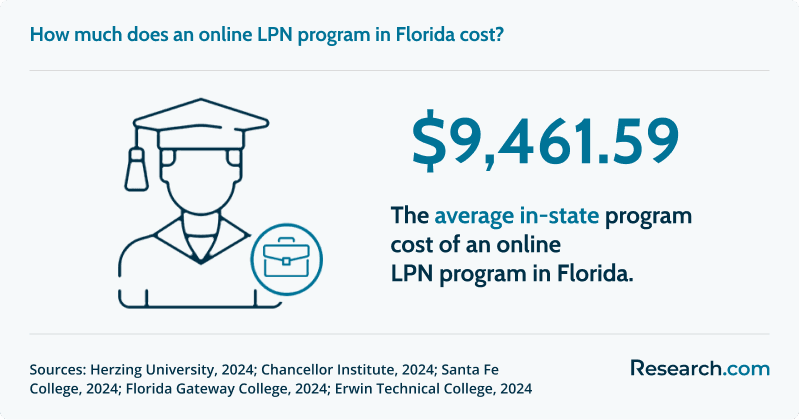
Our investigation reveals that among the leading LPN programs in Florida, tuition fees for in-state students can vary from $1,600 to $6,550, while out-of-state tuition generally begins around $5,900. On average, Florida's LPN schools charge $9,461.59 for in-state tuition and $10,334.16 for out-of-state tuition.
| Cost category | Why it matters |
| Tuition and program fees | This is the main published cost, but it may not include all required expenses. |
| Clinical-related costs | Students may need uniforms, health records, testing, transportation, and site-specific requirements. |
| Books and supplies | Nursing texts, digital platforms, lab kits, and equipment can add to the total cost. |
| Licensure and exam costs | NCLEX-PN preparation, testing, and license application costs should be included in your budget. |
What are the financial aid options for students enrolling in an online LPN program in Florida?
Financial aid depends on the school, program length, accreditation or approval status, enrollment level, and your individual eligibility. Students comparing LPN programs and affordable healthcare administration programs should confirm whether the program participates in federal aid before assuming aid will be available.
- Federal Pell Grants: These need-based awards are available to qualifying undergraduate students with significant financial need and do not have to be repaid.
- Federal Direct Subsidized Loans: These loans are based on financial need, and the government pays the interest during eligible enrollment, grace, and deferment periods.
- Federal Direct Unsubsidized Loans: These loans are not need-based, and interest begins accruing when funds are disbursed.
- State Grants and Scholarships: Florida may provide grants or scholarships for eligible students, including nursing students. Check the Florida Department of Education and your selected school for current options.
- Scholarships from private organizations: Healthcare associations, community foundations, employers, and nonprofit groups may offer scholarships for Florida nursing students.
Before borrowing, ask the financial aid office for a full cost of attendance estimate and compare it against realistic entry-level LPN wages in your area.
What are the prerequisites for enrolling in an online LPN program in Florida?
Admission requirements vary, but Florida LPN programs commonly expect applicants to meet academic, age, health, and background standards before they can begin nursing coursework or clinical rotations.
- Age: Applicants usually must be at least 18 years old.
- Diploma or equivalency: A high school diploma, GED, or higher degree is typically required.
- Entrance testing: Some programs require passing scores on assessments such as the TEAS (Test of Essential Academic Skills) or TABE (Test of Adult Basic Education), often in reading, math, and English.
- CPR certification: A current CPR card for healthcare providers may be required before clinical training.
- Background check and drug test: Students generally must pass these screenings to participate in clinical placements.
Also ask about immunizations, physical exams, health insurance requirements, transfer credit policies, and whether prior healthcare experience can strengthen your application.
What courses are typically in an online LPN program in Florida?
Florida LPN programs usually divide the curriculum between online or classroom-based theory courses and hands-on clinical education. The goal is to prepare students to provide safe basic nursing care, recognize patient changes, administer medications within scope, and communicate with the healthcare team.
Online Didactic Courses
- Foundations of Nursing: Introduces basic nursing concepts, communication, ethics, legal responsibilities, and patient-centered care.
- Anatomy and Physiology: Covers human body systems and how structure and function relate to health and illness.
- Medical Terminology: Teaches the language used in charts, diagnoses, treatment plans, and clinical communication.
- Pharmacology: Reviews medication classifications, dosage concepts, side effects, safety, and administration principles.
- Maternal-Neonatal Nursing: Focuses on care for pregnant patients, postpartum patients, and newborns.
- Pediatric Nursing: Covers nursing care for infants, children, and adolescents.
- Mental Health Nursing: Introduces care principles for patients with behavioral and mental health needs.
- Nutrition: Explains how diet, disease, and patient education affect health outcomes.
- Lifespan Development: Examines physical, cognitive, and psychosocial development across age groups.
In-Person Clinical Rotations
Clinical rotations place students under the supervision of licensed nurses, including RNs and advanced clinicians such as graduates of affordable MSN programs online. Settings may include hospitals, clinics, long-term care facilities, and nursing homes. Skills commonly practiced include:
- Measuring and documenting vital signs
- Administering medications within the LPN scope of practice
- Assisting patients with activities of daily living
- Providing wound care
- Performing catheterization and related nursing procedures
What types of specializations are available in online LPN programs in Florida?
Most LPN programs in Florida do not offer formal specializations. Practical nursing education is designed to provide broad entry-level preparation because LPNs work under the supervision of RNs, physicians, and other licensed providers across many care settings.
However, students and graduates can shape their path in two practical ways:
- Choose a patient population: Some LPNs focus their work experience on pediatrics, geriatrics, maternal-newborn care, or long-term care. Additional certifications can support these interests, but they are not usually built into the LPN program as formal majors.
- Choose a work setting: Experience in dialysis, oncology, rehabilitation, hospice, or emergency care can help an LPN build targeted skills over time.
If you want a highly specialized nursing career, an RN degree is usually the stronger next step. Students interested in advanced practice may eventually compare RN, BSN, MSN, and options such as the most affordable online FNP degree program.
How to choose the best online LPN programs in Florida?
The best LPN program is not always the cheapest, fastest, or closest. It is the program that is approved, affordable for your situation, realistic for your schedule, transparent about clinicals, and strong enough to prepare you for the NCLEX-PN.
1. Verify approval and accreditation
Start with program approval. Florida Board of Nursing approval is essential for licensure eligibility, and ACEN accreditation can be important for program quality, transferability, and future education planning. Never enroll based only on marketing language.
2. Compare total cost, not just tuition
Ask for an itemized estimate that includes tuition, fees, books, supplies, technology, background checks, drug testing, uniforms, transportation, and NCLEX-related costs. A low tuition price can be misleading if required fees are high.
3. Match the schedule to your life
Find out whether online coursework is asynchronous, live online, or blended. If you work or care for family members, ask about evening labs, weekend clinicals, attendance policies, and how much schedule flexibility actually exists.
4. Investigate clinical placements
Clinical access is one of the most important decision points. Ask whether the school assigns placements, whether sites are near you, how many hours are required, and what happens if a clinical site becomes unavailable.
5. Review student support
Strong online learners still need help. Look for tutoring, academic advising, NCLEX preparation, technology support, instructor access, career services, and early intervention for students who fall behind.
| Question to ask | Why it matters |
| Is the program approved by the Florida Board of Nursing? | Approval affects your ability to pursue LPN licensure. |
| Where will I complete clinical rotations? | Clinical location can determine whether the program is logistically possible. |
| What is the total estimated cost? | Tuition alone does not show the full financial commitment. |
| What NCLEX-PN support is included? | Licensure depends on passing the exam after graduation. |
| Can credits apply to an RN or BSN bridge program? | Transferability matters if you plan to advance beyond LPN roles. |
Common mistakes when choosing a Florida LPN program
- Enrolling before confirming Florida Board of Nursing approval.
- Assuming “online” means no campus visits or clinical travel.
- Comparing only tuition while ignoring fees, supplies, exam costs, and transportation.
- Choosing the shortest program without checking NCLEX-PN preparation and student support.
- Ignoring whether credits can transfer into future RN or BSN programs.
- Assuming salary outcomes are guaranteed after graduation.
What career paths are available for graduates of online LPN programs in Florida?
The LPN credential is often the fastest route into nursing employment. It is a practical entry point for students who want to start working, gain patient care experience, and decide whether to pursue higher nursing education later. However, it is usually not the final credential for students who want broader clinical authority, leadership roles, or advanced practice careers.
Many LPNs use bridge programs to move into RN roles, and some fully online LPN to RN programs may offer the flexibility working nurses need. Students interested in leadership outside bedside nursing may also compare options such as affordable master's in healthcare administration programs. The chart below shows the most in-demand occupations for nurses in Florida.
What is the job market for graduates of online LPN programs in Florida?
Florida offers a favorable labor market for practical nurses. By 2030, approximately 4,750 new LPN positions are anticipated to be generated, reflecting an 11.4% growth rate with an estimated average annual job openings of 3,810. Florida has a total of 36,470 LPNs.
Demand is supported by population growth, aging residents, long-term care needs, home health services, and continued pressure on the healthcare workforce. Still, job availability can vary by region. Students should compare openings in their target city or county, not just statewide projections.
What additional healthcare certifications can enhance my LPN career in Florida?
Additional certifications can help LPNs qualify for more focused responsibilities, improve competitiveness, or move into settings that value specific technical skills. Common areas include IV therapy, wound care, geriatrics, phlebotomy, EKG monitoring, and healthcare administration. These credentials do not replace nursing licensure, but they can help demonstrate readiness for particular patient care tasks or workplace needs.
Some LPNs also broaden their understanding of allied health roles. For example, reviewing the best medical assistant programs in Florida can help students understand how clinical support roles differ from practical nursing and where complementary skills may be useful.
How do LPN salaries compare to advanced nursing roles in Florida?
LPN employment can provide a stable healthcare entry point, but salary growth is typically stronger after additional education and licensure. Registered nurses, nurse practitioners, and other advanced nursing professionals have broader scopes of practice and higher levels of responsibility, which generally support higher pay. Advanced roles connected to doctoral preparation can show very different compensation patterns, as seen in resources such as the DNP psychiatric nurse practitioner salary guide.
For Florida students, the practical question is whether the LPN credential is a short-term career goal or the first step in a longer nursing plan. If you intend to pursue RN or advanced practice roles, prioritize programs with strong advising and clear bridge pathways.
What job placement and career advancement resources do LPN programs offer in Florida?
Career support varies widely by school. Strong LPN programs may offer resume help, interview preparation, employer connections, job fairs, clinical-site networking, NCLEX-PN review, and advising for LPN-to-RN bridge programs. Ask whether career services are available before graduation and after licensure.
Students considering broader healthcare pathways can also explore related career planning resources, such as guidance on how to become a nutritionist in Florida, to understand how nursing compares with other patient-focused careers.
What factors affect my LPN salary and career progression in Florida?
Your LPN salary and advancement opportunities can be shaped by location, employer type, shift differential, years of experience, certifications, specialty exposure, and willingness to work in high-need settings. Benefits also matter. A job with slightly lower hourly pay but stronger health insurance, tuition assistance, retirement contributions, or predictable scheduling may be more valuable long term.
To evaluate offers, compare base pay, overtime expectations, patient ratios, training support, career ladders, and tuition reimbursement. For broader compensation context, see Research.com’s LPN salary guide.
What challenges should I expect in an online LPN program in Florida?
Hybrid LPN programs can be demanding because students must balance online coursework with in-person clinical requirements. Common challenges include strict deadlines, early clinical shifts, commuting to clinical sites, adapting to online learning platforms, completing lab competencies, and maintaining study discipline without daily classroom structure.
Technology access is also important. Students need reliable internet, a functioning computer, and the ability to use learning management systems, virtual simulations, and online testing tools. For a step-by-step overview of licensure expectations, review this guide on how to become a certified LPN in Florida.
How can mentorship and professional networking accelerate my LPN career in Florida?
Mentorship can help new LPNs understand workplace expectations, improve clinical confidence, avoid common early-career mistakes, and identify strong bridge programs. Clinical instructors, preceptors, experienced LPNs, RNs, and nurse managers can all become valuable professional contacts.
Networking also supports career mobility. Connections made during clinical rotations, professional association events, job fairs, and employer-sponsored training can lead to interviews, references, and guidance on future roles. LPNs planning for advanced nursing careers can use mentorship to explore pathways such as how to become a nurse practitioner in Florida.
What is the NCLEX pass rate for online LPN programs in Florida?
NCLEX-PN pass rates are one of the clearest indicators of how well a program prepares students for licensure. When comparing Florida LPN programs, ask for recent pass-rate data, how many students were included, whether the rate reflects first-time test takers, and how the school supports students who need remediation.
Programs that openly discuss outcomes, provide structured NCLEX review, and monitor student progress can be stronger choices than programs that rely only on flexible scheduling as a selling point. Students comparing broader nursing options may also want to review the best nursing schools in Florida.
Can an LPN advance into a nurse midwife role in Florida?
Yes, but not directly from LPN licensure alone. Nurse midwifery is an advanced nursing role that requires additional education, RN licensure, graduate-level preparation, and specialized clinical training. An LPN who wants to become a nurse midwife would typically need to progress through RN and advanced nursing education first.
If maternal and newborn care is your long-term goal, review nurse midwife education requirements in Florida early so you understand the full academic and clinical pathway before selecting an LPN program.
What is the return on investment (ROI) for online LPN programs in Florida?
ROI depends on program cost, time to completion, financial aid, borrowing, NCLEX-PN success, job placement, local wages, and whether you plan to advance beyond the LPN credential. A lower-cost program with strong licensure outcomes may offer better value than a more expensive program with limited support or inconvenient clinical locations.
Hybrid programs may reduce commuting for lecture courses, but students still need to budget for clinical travel and required in-person activities. To evaluate value, compare total cost against realistic starting wages in your region, ask about employer partnerships, and review future bridge options. For broader program comparisons, see the best online nursing programs in Florida.
What soft skills are essential for success in an LPN career in Florida?
Technical competence matters, but LPNs also need interpersonal and organizational skills to provide safe, respectful, and efficient patient care.
- Communication: LPNs must explain information clearly to patients, families, RNs, physicians, and other care team members.
- Empathy: Compassionate care helps patients feel heard, respected, and supported during stressful health situations.
- Time management: Practical nurses often balance medications, documentation, patient needs, and changing priorities during busy shifts.
- Teamwork: LPNs work closely with RNs, physicians, nursing assistants, therapists, and administrative staff.
- Adaptability: Patient conditions, technologies, staffing levels, and care plans can change quickly.
Developing these skills can improve patient care, supervisor trust, and long-term career opportunities.
How can LPNs in Florida transition to RN and beyond?
LPNs who want broader responsibilities, higher earning potential, or advanced practice options can continue their education through several pathways.
- LPN-to-RN Bridge Programs: These programs help licensed LPNs move toward registered nursing in a shorter format than starting from the beginning. Students comparing admissions options may find it useful to review the easiest nursing schools to get into.
- Specialty certifications: Certifications in areas such as wound care, geriatrics, pediatrics, or IV therapy can help LPNs strengthen their skills while working.
- Advanced nursing degrees: After becoming an RN, nurses may pursue BSN, MSN, or doctoral education for leadership, education, advanced practice, or specialized clinical roles.
What are the continuing education opportunities for LPNs in Florida?
Continuing education helps Florida LPNs maintain licensure and stay current with nursing practice. The Florida Board of Nursing mandates that LPNs complete 24 continuing education (CE) hours during each two-year renewal period. These CE hours include courses on topics such as medical error prevention, domestic violence, and laws and rules governing the nursing practice in Florida.
Beyond required CE, LPNs can pursue additional training in areas such as IV therapy, geriatric care, wound care management, patient safety, infection control, and chronic disease care. Many CE options are offered online, which can be useful for working nurses who need flexible scheduling.
LPNs who want to move up the nursing ladder can also consider bridge programs such as LPN-to-RN or LPN-to-BSN. These pathways can lead to registered nursing roles and later to advanced positions. Research.com’s guide on how to become a registered nurse in Florida explains the transition in more detail.
What opportunities are available for advanced nursing education after completing an LPN program in Florida?
After completing an LPN program and becoming licensed, Florida nurses can pursue LPN-to-RN, LPN-to-BSN, and eventually graduate-level nursing education. Students with long-term goals in advanced practice can compare the best nurse practitioner programs in Florida once they understand the RN and graduate education requirements involved.
The best advanced pathway depends on your current credential, work schedule, finances, transfer credits, and target role. If you know you want to become an RN or nurse practitioner eventually, ask LPN programs about articulation agreements and credit transfer before enrolling.
What clinical experiences and opportunities are available to students in LPN programs in Florida?
Clinical training is the part of an LPN program where classroom learning becomes patient care. In Florida, students usually complete supervised rotations in approved healthcare facilities and must meet attendance, competency, and professional conduct standards.
- Diverse healthcare settings: Students may rotate through hospitals, nursing homes, long-term care facilities, outpatient clinics, and related care environments.
- Specialized clinical exposure: Some programs may include experiences in pediatrics, geriatrics, mental health, hospice, or maternal-newborn care.
- Simulation labs: Many schools use simulation to let students practice skills and clinical decision-making before working with patients.
- Accelerated options: Students who want a shorter timeline may compare accelerated LPN programs, but they should confirm that compressed schedules still meet clinical requirements.
- Mentorship and preceptorship: Clinical placements often allow students to learn from experienced LPNs and RNs, build confidence, and receive feedback on patient care skills.
Current trends affecting LPN students in Florida
- Hybrid learning is now common, but clinicals remain in person. Students should expect more online learning tools, virtual simulations, and digital testing, but patient care training cannot be fully remote.
- Healthcare employers value readiness. Programs with strong clinical partnerships, professional conduct expectations, and NCLEX-PN preparation may better support job entry.
- Bridge pathways matter. Many students use the LPN credential as a stepping stone, so transfer credit and LPN-to-RN options should be part of the enrollment decision.
- Cost pressure is real. Comparing total program cost, financial aid, and local wages is essential before committing.
- Technology skills are part of nursing work. LPNs increasingly use electronic health records, online training systems, and digital communication tools in clinical environments.
Key Insights
- Florida LPN programs advertised as online are usually hybrid because nursing licensure requires hands-on clinical training.
- Program approval is the first filter. Confirm Florida Board of Nursing approval before evaluating cost, schedule, or convenience.
- Most programs take 12 to 15 months, with additional time commonly needed for NCLEX-PN preparation and licensure processing.
- Costs vary widely, and students should compare total expenses, not tuition alone.
- The average yearly salary for LPNs and LVNs in Florida was $60,320 in 2024, but pay depends on employer, region, shift, experience, and credentials.
- The LPN credential can lead directly to patient care jobs, but students seeking higher pay or broader practice should plan for RN or advanced nursing education.
- Strong programs clearly explain clinical placements, NCLEX-PN outcomes, student support, financial aid, and bridge options.
Related Articles for Nearby States
- 2027 Best LPN Programs in Georgia – Accredited Online LPN Programs
- 2027 Best LPN Programs in Alabama – Accredited Online LPN Programs
- 2027 Best LPN Programs in South Carolina – Accredited Online LPN Programs
- 2027 Best LPN Programs in Mississippi – Accredited Online LPN Programs
- 2027 Best LPN Programs in Tennessee – Accredited Online LPN Programs
- 2027 Best LPN Programs in North Carolina – Accredited Online LPN Programs
- 2027 Best LPN Programs in Kentucky – Accredited Online LPN Programs
- 2027 Best LPN Programs in Arkansas – Accredited Online LPN Programs
- 2027 Best LPN Programs in Virginia – Accredited Online LPN Programs
- 2027 Best LPN Programs in West Virginia – Accredited Online LPN Programs
References:
- Projections Central. (n.d.). Labor Market Projections. PMP.
- U.S. Bureau of Labor Statistics. (2025, August 28). Licensed Practical and Licensed Vocational Nurses. BLS
- U.S. Bureau of Labor Statistics. (2024). Occupational Employment and Wage Statistics. Area: Florida. BLS.
Other Things You Should Know About Online LPN Programs in Florida
The Florida Board of Nursing approves practical nursing programs and issues Licensed Practical Nurse licenses. Applicants must complete a board-approved program and pass the NCLEX-PN exam. The board operates under the Florida Department of Health and sets licensure rules for nursing education and practice.
In 2027, students in Florida's online LPN programs can access federal financial aid like Pell Grants, state scholarships, and school-specific grants. Eligibility often requires FAFSA completion and maintaining satisfactory academic progress, aligning with each institution’s financial aid guidelines.


