
2027 Best Medical Assistant to RN Online Bridge Programs

Co-Founder and Chief Data Scientist
Ever wonder what it takes to move from medical assistant to registered nurse—and why it’s worth considering right now? With RNs earning significantly more and the nursing job market growing steadily, this article breaks down the benefits of online bridge programs, what to expect in terms of salary and demand, and how to choose the best route. You’ll walk away with clear, actionable info to advance your career.
What are the benefits of completing a medical assistant to RN online bridge program?
- Registered Nurses earn around $93,600/year, significantly more than the $44,200 median for medical assistants.
- RN employment is projected to grow 6% from 2023 to 2033, with approximately 194,500 annual openings.
- RNs can work in specialties like pediatrics, emergency care, leadership, public health, and education.
What can I expect from a medical assistant to RN online bridge program?
These programs typically offer flexibility through fully online coursework paired with local clinical placements. Expect an accelerated—but rigorous—curriculum that builds on your medical assistant background. You'll gain RN-level pharmacology, patient care, and leadership courses. Support often includes academic advising, NCLEX‑prep, financial aid, and career services to help transition from MA to entry-level RN roles.
Where can I work with a medical assistant to RN online bridge program?
Graduates become eligible for RN roles across healthcare settings including hospitals, outpatient clinics, long‑term care facilities, home health agencies, and public health organizations. Here are the top industries employing RNs:
- General Medical and Surgical Hospitals: 1,729,200 employed
- Offices of Physicians: 192,300 employed
- Home Health Care Services: 169,630 employed
- Outpatient Care Centers: 150,380 employed
- Nursing Care Facilities (Skilled Nursing Facilities): 143,250 employed
Geographically, the highest-paying states for registered nurses—making these bridge grads especially competitive—include:
- California: 307,060 employed
- Texas: 219,330 employed
- Florida: 183,130 employed
- New York: 178,550 employed
- Pennsylvania: 146,640 employed
How much can I make with a medical assistant to RN online bridge program?
According to the U.S. Bureau of Labor Statistics, the median annual wage for registered nurses was $93,600 in May 2024, with about 194,500 job openings annually projected through 2033.
Current platforms report similar figures:
- Zippia: $73,349/year average for RNs
- Salary.com: $66,100–$117,430/year range, with average ~$91,770 (as of July 2025)
- ZipRecruiter: average RN pay $42/hour (~$87,868/year)
- Indeed: average RN hourly pay $43.93 (~$93,747/year)
- Payscale: average RN hourly rate $35.83 (~$76,700/year)
- Glassdoor: average RN salary ~$99,000/year; range $83K - $119K
These estimates show most RN graduates from an MA-to-RN bridge program can expect salaries between $75,000 and $100,000 per year, with regional and experience-based variation.
- Best Medical Assistant to RN Online Bridge Programs for 2027 List of Programs
- How long does it take to complete a medical assistant to RN online bridge program? Program Duration
- How does a medical assistant to RN online bridge compare to an on-campus program? Online vs Campus
- What is the average cost of a medical assistant to RN online bridge program? Program Cost
- What are the financial aid options for students enrolling in a medical assistant to RN online bridge program? Financial Aid
- What are the prerequisites for enrolling in a medical assistant to RN online bridge program? Admission Requirements
- What courses are typically in a medical assistant to RN online bridge program? What courses are typically in a medical assistant to RN online bridge program?
- What types of specializations are available in a medical assistant to RN online bridge programs? What types of specializations are available in a medical assistant to RN online bridge programs?
- How do you choose the best medical assistant to RN online bridge program? How do you choose the best medical assistant to RN online bridge program?
- What career paths are available for graduates of a medical assistant to RN online bridge programs? What career paths are available for graduates of a medical assistant to RN online bridge programs?
- What is the job market like for graduates of medical assistant to RN online bridge programs? Job Outlook
- How do online MA‑to‑RN bridge programs compare with accelerated BSN nursing programs? How do online MA‑to‑RN bridge programs compare with accelerated BSN nursing programs?
- Are MA‑to‑RN Online Bridge Programs Accredited and Why Is It Important? Are MA‑to‑RN Online Bridge Programs Accredited and Why Is It Important?
Best Medical Assistant to RN Online Bridge Programs for 2027
Medical assistants who want more responsibility, higher clinical authority, and a clearer long-term nursing path often compare bridge programs before deciding whether to pursue RN licensure. The challenge is that “medical assistant to RN online” can mean several different routes: some programs lead directly toward an associate nursing degree, some first bridge to practical nursing, and some accelerated BSN options are designed for students who already have substantial college credit.
This guide explains how MA-to-RN online bridge pathways work, which programs stand out, how long they take, what they cost, what prerequisites to expect, and how to choose a program that supports licensure and employment goals. It is written for certified medical assistants, registered medical assistants, and allied health workers deciding whether nursing is the right next step. If speed is your main priority, compare bridge options carefully with Research.com’s guide to the quickest way to become a nurse, because the fastest route depends on prior credits, state rules, and clinical placement access.
Quick answer: What is the best online path from medical assistant to RN?
The best online medical assistant to RN bridge program is one that is properly accredited, accepted for RN licensure in your state, transparent about clinical requirements, and willing to evaluate your medical assisting certification, prior science courses, and work experience for credit or advanced standing. Most “online” nursing bridge programs are hybrid: lectures may be online, but labs, simulations, and clinical rotations must be completed in person at approved healthcare sites.
For many medical assistants, the most practical route is either an MA-to-ADN/ASN pathway or an MA-to-LPN/LVN bridge followed by an LPN-to-RN program. Students with significant prior college credit may also consider an accelerated BSN. The right choice depends on cost, admission competitiveness, transfer credits, commute distance for labs, clinical placement support, and whether the program satisfies state board of nursing requirements.
How we evaluate schools
Selecting an online medical assistant-to-RN bridge program is not just a tuition decision. It affects licensure eligibility, transferability, clinical placement access, and long-term nursing career options. Our rankings are built using a structured methodology that considers institutional quality, affordability, student support, online learning access, and available outcome indicators.
We review public higher education data from the U.S. Department of Education’s IPEDS database and other National Center for Education Statistics resources, along with cost and student outcome information associated with the College Scorecard database. We also consider distance learning data and institutional information from Peterson’s database where relevant. For readers who want more context on this program category, Research.com also provides a related resource on accelerated medical assistant to RN online bridge programs.
What to know before using this ranking
Not every program below is a direct MA-to-RN route. Some are practical nursing bridges that can become part of a longer RN pathway, while others are accelerated BSN options for students with eligible transfer credits. Before applying, confirm the exact credential awarded, whether graduates are eligible for the NCLEX-RN or NCLEX-PN, and whether your state board of nursing recognizes the program.
| Program route | Best for | Licensure outcome | Main trade-off |
| MA-to-ADN/ASN bridge | Medical assistants who want a direct associate-degree path to RN eligibility | Typically prepares graduates for NCLEX-RN eligibility when approved by the state | Admissions may be competitive and prerequisites are often strict |
| MA-to-LPN/LVN bridge | Students who want a shorter nursing step before pursuing RN advancement | Typically prepares graduates for practical nursing licensure, not RN licensure | Requires an additional LPN-to-RN bridge to become an RN |
| Accelerated BSN | Students with prior college credits or a previous degree who want a bachelor’s-level RN pathway | Can prepare graduates for NCLEX-RN eligibility if the program meets state requirements | Often intensive, expensive, and less compatible with full-time work |
1. Allegany College of Maryland – CMA to Nursing (RN) Program
Allegany College of Maryland is a public community college founded in 1961 in Cumberland, Maryland. Its CMA to Nursing pathway is designed for certified medical assistants who want to move into registered nursing while building on prior healthcare training. Students should review admission requirements closely because nursing programs commonly require science prerequisites, clinical documentation, and selective application materials.
- Program cost: $136/credit (in-state); $392/credit (out-of-state)
- Program duration: 12–18 months
- Total credits needed: 70 credits
- Accreditation: ACEN (Accreditation Commission for Education in Nursing)
2. Herzing University – Medical Assistant to RN Program
Herzing University is a private university founded in 1965 with campuses across 8 states and an online division. Its medical assistant to RN pathway is structured for allied health workers seeking a nursing degree with flexible learning support. Because program availability and clinical placement rules can vary by campus and state, applicants should verify their location’s requirements before enrolling.
- Program cost: $515/credit
- Program duration: ~2 years 4 months
- Total credits needed: 120 credits
- Accreditation: ACEN
3. L.E. Fletcher Technical Community College – MA to LPN Bridge Program
Fletcher Technical Community College in Schriever, Louisiana, is a public technical college established in 1948. Its MA to LPN Bridge Program is not a direct RN program, but it may be useful for medical assistants who want to become Licensed Practical Nurses first and later continue through an LPN-to-RN pathway. This route can make sense for students seeking an intermediate nursing credential before committing to an associate or bachelor’s RN program.
- Program cost: $83/credit (LA resident); $139/credit (non-resident)
- Program duration: 2 years
- Total credits needed: 62 credits
- Accreditation: ACEN
4. Lakeshore Technical College – Medical Assistant Bridge to Practical Nursing Pathway
Lakeshore Technical College in Cleveland, Wisconsin, is a public community college founded in 1967 within the Wisconsin Technical College System. Its Medical Assistant Bridge to Practical Nursing pathway is built for certified medical assistants who want to enter practical nursing through an accelerated curriculum. Students whose final goal is RN licensure should ask how graduates can later transition into an LPN-to-RN program.
- Program cost: $185/credit
- Program duration: ~1 year
- Total credits needed: 33 credits
- Accreditation: ACEN
5. Green River College – MA-C to PN Pathway
Green River College is a public community college in Auburn, Washington, established in 1963. The college serves over 13,000 students and offers a Medical Assistant–Certified to Practical Nursing pathway for Washington State certified medical assistants. Its credit-for-prior-learning option can be valuable for experienced MAs, but applicants should confirm how prior learning credit affects progression and future RN plans.
- Program cost: $88/credit
- Program duration: 17 months
- Total credits needed: 90 credits
- Accreditation: ACEN
6. Ivy Tech Community College – Medical Assistant to ASN Transition Track
Ivy Tech Community College is Indiana’s public community college system, founded in 1963, and is described as the largest singly accredited statewide community college in the U.S.en.wikipedia.org. Its Medical Assistant to Associate of Science in Nursing transition track recognizes the CMA (AAMA) credential and helps eligible students move toward an ASN and NCLEX-RN preparation. This is a strong example of why credential type matters: not every medical assisting certification is treated the same by every nursing school.
- Program cost: $149.55/credit (in-state); $292.57/credit (out-of-state)
- Program duration: ~2 years
- Total credits needed: 61 credits
- Accreditation: ACEN
7. Northeast Wisconsin Technical College – Medical Assistant to Practical Nursing Bridge
Northeast Wisconsin Technical College in Green Bay, Wisconsin, is a public two-year technical college founded in 1912. Its Medical Assistant to Practical Nursing Bridge is a technical diploma for experienced medical assistants who want to move into practical nursing. Because admission is selective and requires documented MA work experience, applicants should prepare employment verification early.
- Program cost: $236.83/credit
- Program duration: ~1 year
- Total credits needed: 24 credits
- Accreditation: ACEN
8. Tennessee College of Applied Technology – Jackson: CMA to LPN Bridge Program
TCAT Jackson is a public technical college in Jackson, Tennessee, under the Tennessee Board of Regents. Founded in 1965 as a state vocational school, it offers workforce-oriented training, including a Certified Medical Assistant to Licensed Practical Nursing bridge. This option is best viewed as a practical nursing route that may later support RN advancement through a separate bridge program.
- Program cost: $5,725 total program cost
- Program duration: 10 months
- Total credits needed: N/A (1,080 clock hours)
- Accreditation: COE (Council on Occupational Education)
9. Grand Canyon University – Accelerated BSN Program
Grand Canyon University is a private Christian university in Phoenix, Arizona, founded in 1949. Its Accelerated BSN is designed for students with prior college credits or degrees, which may include medical assistants who have completed prerequisite coursework. The program combines online coursework with in-person labs and clinical rotations, so applicants should confirm site availability and schedule intensity before choosing this route.
- Program cost: $340/credit (approximate; $40,800 total tuition / 120 credits)
- Program duration: 16 months
- Total credits needed: 120 credits (includes transferred credits)
- Accreditation: HLC (Higher Learning Commission)
10. University of Texas at Arlington – Accelerated Online BSN Program
The University of Texas at Arlington is a public research university in Arlington, Texas, established in 1895. Its Accelerated Online BSN delivers didactic coursework online while requiring supervised clinical rotations at partner hospitals. This option can be appropriate for students with the right prerequisites and location fit, but it is competitive and should be evaluated against direct ADN/ASN bridge options.
- Program cost: ~$425/credit (estimated from $21,675 total tuition/51 credits)
- Program duration: 15 months
- Total credits needed: 51 credits (nursing curriculum only)
- Accreditation: SACSCOC (Southern Association of Colleges and Schools Commission on Colleges)
How long does it take to complete a medical assistant to RN online bridge program?
Completion time depends on the credential you pursue, how many prerequisites you have already completed, whether your MA certification is accepted for credit, and whether the program leads directly to RN eligibility or first to practical nursing. Students comparing timelines should think the same way they would when reviewing the best online biotechnology graduate certificate programs: the advertised program length is only useful if you know what credits and prerequisites you are bringing in.
| Pathway | Typical timeline stated in the guide | Who it fits best | Important caution |
| MA-to-LPN/LVN bridge | 12 to 18 months | Medical assistants who want a faster step into practical nursing | This is not the same as becoming an RN; you may need a later LPN-to-RN bridge |
| MA-to-ADN/ASN bridge | 18 to 24 months | Certified MAs with eligible coursework, experience, and prerequisites | Transfer credit policies can significantly change your actual timeline |
| Traditional ADN from scratch | 2–3 years | Students without usable prior healthcare or college credit | May include repeated content already covered in medical assisting training |
| BSN route | 3 to 4 years | Students seeking a bachelor’s-level nursing credential | Longer unless you qualify for an accelerated format |
| Accelerated BSN | 12–18 months | Students with prior college credits or a previous degree | Often demanding and may be difficult to combine with full-time work |
The most efficient route is not always the shortest advertised program. A 10-month practical nursing bridge may still require another program before RN licensure, while a longer ASN route may lead more directly to NCLEX-RN eligibility. Ask each school for a written transfer evaluation and a term-by-term plan before you commit.
The chart below helps place these pathways in context by showing how commonly different RN credentials are awarded. Associate and bachelor’s nursing degrees remain the main academic routes for registered nursing preparation.
How does a medical assistant to RN online bridge compare to an on-campus program?
An online MA-to-RN bridge program usually means online theory courses paired with required in-person clinical training. Nursing cannot be completed entirely online because students must demonstrate patient care skills, medication safety, assessment techniques, and clinical judgment under supervision. The key question is not whether the lectures are online; it is whether the program is accredited, approved for your state, and able to place you in appropriate clinical experiences.
Drexel’s discussion of online vs traditional learning notes that online credentials are generally viewed more favorably when they come from accredited institutions with established reputations. This same logic applies when students compare flexible nursing pathways, including the best online direct entry MSN programs for non-nurses: format matters, but accreditation, outcomes, and clinical quality matter more.
| Factor | Online or hybrid bridge program | Campus-based program |
| Course delivery | Often online for lectures, discussions, and assignments | Usually scheduled in person on campus |
| Clinical training | Completed in person at approved healthcare sites | Completed in person through school-arranged sites |
| Flexibility | Often better for working medical assistants or caregivers | More structured but less flexible |
| Peer and faculty access | Requires proactive communication and strong online habits | More immediate face-to-face interaction |
| Best fit | Self-directed students who can manage deadlines and clinical scheduling | Students who prefer a fixed schedule and in-person support |
Online bridge programs can reduce commuting and make nursing education more realistic for working adults. However, they also require discipline, reliable technology, and comfort communicating with faculty remotely. If you struggle with self-paced learning, a campus or highly structured hybrid format may be a better fit.
What is the average cost of a medical assistant to RN online bridge program?
Costs vary widely because MA-to-RN pathways may lead to an ADN/ASN, an LPN credential, or a BSN. Published tuition is also only part of the total cost. Students should budget for books, uniforms, background checks, drug screening, immunizations, lab fees, simulation fees, testing fees, transportation to clinical sites, and licensure-related expenses.
National estimates place ADN bridge programs at roughly $10,000–$30,000, while accelerated BSN tracks often exceed $40,000 in tuition only. Public community colleges usually sit at the lower end of the range, while private and four-year accelerated programs tend to cost more.
The average tuition and fees for undergraduate registered nursing programs are reported as $9,235 for in-state students and $26,401 for out-of-state students.
IPEDS data show the average net price after grants and scholarships for full-time undergraduates at public 2‑year schools is around $8,000–$10,000 annually, while private nonprofit institutions often average $20,000–$25,000.
For planning purposes, many students should expect bridge credit-bearing study to total $15,000–$25,000 at community colleges and $30,000–$45,000+ at private or four-year accelerated programs. These figures do not include living costs or every program fee, so always request a full cost-of-attendance estimate rather than relying on per-credit tuition alone.
| Cost item | Why it matters | Question to ask |
| Tuition per credit or clock hour | This is the most visible cost but not the total cost | What is the total tuition for the full pathway after transfer credits? |
| Clinical and lab fees | Nursing programs often require hands-on training resources | Are simulation, lab, and clinical fees included in tuition? |
| Books, supplies, and uniforms | These expenses can arrive early in the program | What must I buy before the first term starts? |
| Travel to clinical sites | Online students may still need to commute for labs and rotations | How far are typical clinical sites from my home? |
| Licensure and testing costs | Graduation is not the final step; licensure exams follow | Which exam and state board fees should I budget for? |
The chart below compares average tuition and fees for registered nursing programs in 2024–2025, including vocational, undergraduate, and graduate levels as well as in-state and out-of-state rates. Use it as a benchmark when deciding whether a bridge program is priced reasonably.
What financial aid is available for medical assistant to RN online bridge students?
Many students in medical assistant to RN bridge pathways can use financial aid if they enroll at a Title IV-eligible institution and meet aid requirements. As with students comparing the best online early childhood development degree programs, the goal is to evaluate net cost, not just sticker price.
- Federal Pell Grants and other need-based grants: These can reduce out-of-pocket cost for eligible undergraduate students at qualifying institutions.
- Federal student loans: Direct Subsidized and Unsubsidized Stafford Loans may be available, with annual undergraduate borrowing limits up to $12,500.
- Institutional scholarships: Colleges may offer nursing-specific awards, merit aid, need-based grants, or renewable scholarships.
- State grants and workforce funds: Some states support healthcare workforce development, especially in areas facing nursing shortages.
- Employer tuition reimbursement: Clinics, hospitals, and health systems may help medical assistants advance into nursing roles.
- Federal work-study: Eligible students may use part-time campus-based employment to offset educational costs.
Students searching for cheap online nursing programs should compare total cost after grants, transfer credit, and employer benefits. A program with higher tuition may be manageable if it awards more transfer credit or offers strong employer reimbursement options, while a low-tuition program may become expensive if it requires repeated prerequisites or long-distance clinical travel.
How to reduce your bridge program cost
- Request a transfer credit review before enrolling, not after admission.
- Ask whether your CMA, RMA, or state medical assisting credential qualifies for advanced standing.
- Complete prerequisites at an approved lower-cost institution only if the nursing school confirms they will transfer.
- Compare in-state and out-of-state tuition rules carefully.
- Ask your employer about tuition assistance, schedule flexibility, and post-graduation RN hiring pathways.
What are the prerequisites for enrolling in a medical assistant to RN online bridge program?
Admission requirements vary by school, but nursing bridge programs usually expect applicants to prove both academic readiness and healthcare preparation. Before applying, review the school’s admission checklist alongside Research.com’s guide on necessities for nursing school, because missing one prerequisite can delay entry by a full term or more.
| Requirement | What it usually means | Why it matters |
| Medical assistant credential | A Certified Medical Assistant (CMA/RMA) credential or equivalent state certification | Bridge credit or advanced standing may depend on the exact credential |
| High school diploma or GED | Proof of secondary education and a minimum cumulative GPA, commonly around 2.5–3.0 | Establishes baseline academic eligibility |
| Science prerequisites | Anatomy & Physiology I & II with labs, Microbiology, and Chemistry at the college level | These courses support RN-level clinical reasoning |
| Entrance exam | TEAS or HESI A2 scores may be required | Programs use these exams to compare applicants and assess readiness |
| Application documents | Application, fee, essay or personal statement, possible healthcare experience, recommendation letters, and background check if required | Selective nursing programs often evaluate more than grades alone |
Medical assisting experience can help, but it does not automatically replace nursing prerequisites. Always ask whether your prior courses are recent enough, whether labs must be completed in person, and whether online science labs are accepted.
What courses are typically included in a medical assistant to RN online bridge program?
MA-to-RN bridge coursework builds on basic clinical experience but shifts students into RN-level decision-making. Registered nurses are expected to assess patients, interpret clinical changes, plan care, administer medications safely, communicate with interprofessional teams, and apply legal and ethical standards. Research.com’s overview of the nursing major provides broader context on how nursing curricula are structured.
- Transition to Nursing or MA-to-RN Bridge Course: Introduces the nursing process, RN scope of practice, clinical judgment, and professional role expectations.
- Anatomy & Physiology I & II with labs: Covers human body systems with laboratory work tied to clinical care.
- Microbiology with lab: Emphasizes infection control, pathogens, immune response, and healthcare safety.
- Pharmacology for Nursing: Focuses on medication classes, dosage safety, administration principles, and adverse reactions.
- Nursing Fundamentals and Health Assessment: Develops core patient care, assessment, documentation, and communication skills.
- Medical-Surgical Nursing: Covers adult acute and chronic conditions, prioritization, and complex care planning.
- Mental Health Nursing: Introduces psychiatric nursing concepts, therapeutic communication, and behavioral health care.
- Pediatric and Maternal Nursing: Addresses care for newborns, children, childbearing patients, and families.
- Nursing Ethics, Law, and Practice Issues: Reviews professional accountability, scope of practice, regulation, and patient rights.
- General education and electives: May include English composition, psychology, statistics, humanities, or communication courses required for the degree.
Course sequence matters. Some nursing classes must be taken in a fixed order, and clinical placement may depend on completing specific theory courses first. Before enrolling, ask for the exact curriculum plan, clinical hour requirements, and policies for repeating failed nursing courses.
What specializations are available after a medical assistant to RN online bridge program?
Most MA-to-RN bridge programs do not make students specialists during the bridge itself. They prepare graduates for entry-level nursing practice and licensure eligibility. Specialization usually begins after RN licensure through clinical experience, employer training, continuing education, specialty certification, or graduate study. This is similar to how professionals in other fields use targeted credentials, such as the best online CISM training bootcamps, after building foundational experience.
- Medical-surgical nursing and critical care: Hospital-based roles involving adult acute care, surgical recovery, and higher-acuity units.
- Pediatric nursing: Care for infants, children, and adolescents in clinics, hospitals, or specialty settings.
- Mental health and psychiatric nursing: Support for patients with behavioral health, substance use, and psychiatric conditions.
- Geriatric nursing: Care for older adults, including chronic illness management, dementia care, and long-term care coordination.
- Obstetric and neonatal nursing: Labor, delivery, postpartum, nursery, and newborn care roles.
- Community and public health nursing: Preventive care, population health, education, outreach, and health promotion.
Later, some RNs continue into graduate-level roles such as Family Nurse Practitioner, Nurse Educator, or Nursing Leadership. The best specialization depends on your clinical placements, local hiring needs, preferred patient population, and willingness to pursue additional education or certification.
The chart below shows why specialization planning matters. Some healthcare sectors employ far more registered nurses than others, with hospitals representing a major employment setting and outpatient care or home health offering alternative career directions.
How to choose the best medical assistant to RN online bridge program
The best bridge program is the one that fits your licensure goal, schedule, finances, and location without creating avoidable barriers. Do not choose based only on speed or the word “online.” Nursing education is regulated, clinical-heavy, and state-specific.
- Verify accreditation and state approval. Look for recognized institutional accreditation and nursing program accreditation such as ACEN or CCNE when applicable. Also confirm state board of nursing approval.
- Confirm the credential awarded. Ask whether the program leads to an LPN/LVN credential, ADN/ASN, BSN, NCLEX-PN eligibility, or NCLEX-RN eligibility.
- Review NCLEX outcomes and completion data. A strong online nursing school should be transparent about student outcomes where available.
- Ask how clinical placements work. Find out whether the school arranges placements or whether students must locate sites themselves.
- Get a transfer credit evaluation in writing. Your MA certification and prior coursework only help if the program officially applies them.
- Compare total cost, not just tuition. Include fees, supplies, travel, lost work hours, prerequisite courses, and licensure costs.
- Match the format to your life. Online lectures may be flexible, but labs and clinicals can still require daytime, evening, or weekend availability.
| Question to ask the school | Why the answer matters |
| Will this program make me eligible for the NCLEX-RN in my state? | This is the core licensure question and should be confirmed before enrollment |
| Is the program direct MA-to-RN or MA-to-LPN first? | The pathway affects time, cost, and the number of programs required |
| How many of my credits will transfer? | Transfer credit can shorten the program and lower tuition |
| Who arranges clinical placements? | Self-placement can be difficult, especially in competitive healthcare markets |
| What happens if I fail a nursing course or clinical component? | Progression policies can affect graduation timeline and financial aid |
| Are online science prerequisites accepted? | Some programs require in-person labs or recent coursework |
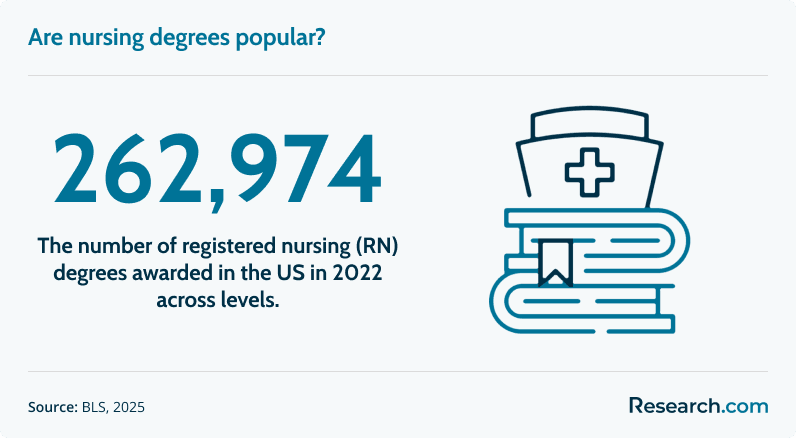
Nursing remains a heavily pursued academic field. The image below shows that nearly 263,000 RN degrees were awarded in 2022 alone, which helps explain why admissions can be competitive and why applicants should prepare prerequisites early.
What career paths are available after a medical assistant to RN online bridge program?
Graduates who earn RN licensure can move into roles with broader patient care responsibility than medical assisting. They may assess patient conditions, develop care plans, administer medications within scope, educate patients, coordinate with providers, and supervise certain care activities depending on state law and employer policy.
| Career stage | Possible role | Typical focus |
| Entry level | Registered Nurse | Direct patient care in hospitals, clinics, long-term care, or community settings |
| Early advancement | Charge Nurse or Team Lead | Shift coordination, patient flow, and support for other nursing staff |
| Specialized clinical role | Specialty RN | Areas such as med-surg, pediatrics, psychiatric nursing, or critical care |
| Training-focused role | RN Preceptor or Clinical Educator | Mentoring new nurses and supporting clinical skill development |
| Leadership role | Nurse Manager or Supervisor | Unit operations, staffing, quality improvement, and administrative oversight |
| Advanced education path | Advanced practice or graduate nursing role | Family Nurse Practitioner, Clinical Nurse Specialist, Nurse Educator, or related paths after further education |
This progression is similar to other bridge-based nursing routes, including LPN to RN online pathways, where prior clinical experience can support continued advancement. Medical assistants who become RNs may later pursue BSN completion, graduate nursing education, specialty certification, or leadership roles depending on their goals.
What is the job market like for medical assistant to RN bridge graduates?
The registered nursing labor market remains broad because RNs work across hospitals, ambulatory care, long-term care, home health, public health, and specialty settings. According to the U.S. Bureau of Labor Statistics, employment of registered nurses is projected to grow 6 percent from 2023 to 2033, faster than the average for all occupations. About 194,500 annual openings are projected over that decade because of growth and replacement needs.
Healthcare occupations overall are expected to add roughly 1.9 million openings per year through 2033. Demand is influenced by aging populations, chronic disease, and retirements among current healthcare workers. With over 3.17 million RNs employed nationwide as of 2023 and median income around $86,070–$93,600/year, bridge graduates enter a large occupation with multiple practice settings.
Job opportunities still vary by state, specialty, employer, and willingness to work nights, weekends, long-term care, rural facilities, or high-demand units. Salary is never guaranteed by a degree alone. Experience, credentials, location, union status, shift differentials, and employer type all affect earnings.
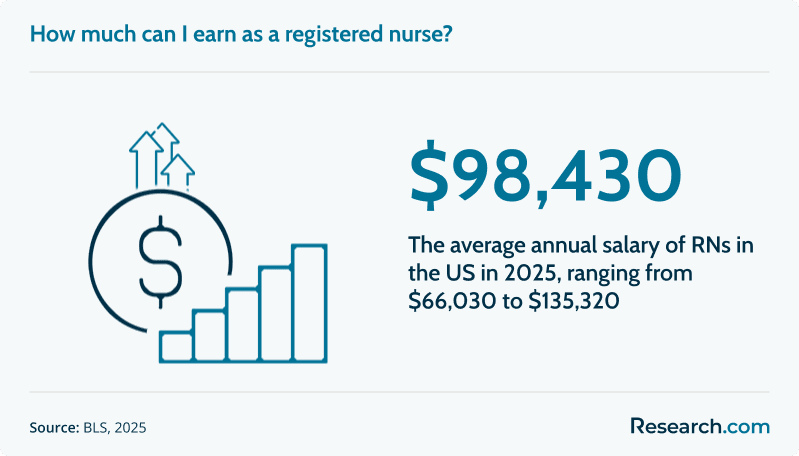
The image below illustrates the national average salary for registered nurses in 2025 and shows a wide earning range based on location, specialization, and experience, with top earners exceeding $130,000 annually.
What graduates say about online medical assistant to RN bridge programs
- Marisol: "The online bridge format made nursing school possible while I kept working as a medical assistant. I completed lectures after shifts, planned around weekend study blocks, and finished clinical requirements at a local hospital. The schedule was still demanding, but the flexibility helped me stay employed and prepare for the NCLEX."
- Keanan: "I chose the online option because relocating was not realistic. The coursework was structured, and the clinical rotations gave me the hands-on practice I needed. I finished in under two years and moved into a nursing role where I could participate more directly in patient care planning."
- Briony: "Balancing family responsibilities with nursing school was difficult, but the hybrid setup helped. Online theory gave me room to manage my schedule, while local clinicals helped me build confidence with real patients. The transition from medical assistant to RN felt challenging but achievable with support."
How do online MA-to-RN bridge programs compare with accelerated BSN programs?
Online MA-to-RN bridge programs are designed around prior medical assisting experience and may reduce repeated coursework when a school grants advanced standing. Accelerated BSN nursing programs, by contrast, usually target students who already have significant college credit or a previous degree and want an intensive bachelor’s-level route to RN eligibility.
| Factor | MA-to-RN bridge | Accelerated BSN |
| Typical applicant | Certified or experienced medical assistant | Student with prior college credits or a previous degree |
| Credential goal | May lead to ADN/ASN, RN eligibility, or practical nursing first depending on program | BSN with RN licensure preparation when state requirements are met |
| Use of prior experience | May grant credit or advanced placement for MA training and work history | Usually relies more heavily on academic prerequisites and transfer credits |
| Program intensity | Varies widely by pathway | Often compressed and academically demanding |
| Best fit | MAs seeking a structured transition into nursing | Students who want a bachelor’s credential quickly and can handle an intensive schedule |
Neither route is automatically better. Choose the MA-to-RN bridge if your medical assisting background will reduce time or cost and the program leads to your intended license. Choose an accelerated BSN if you have the prerequisites, can manage the pace, and want the broader bachelor’s-level credential from the start.
Are MA-to-RN online bridge programs accredited, and why does accreditation matter?
Accreditation is one of the most important checks before enrolling. It helps indicate that a school or nursing program has been reviewed for educational quality, faculty qualifications, curriculum standards, and student support. Accreditation can also affect financial aid eligibility, credit transfer, employer recognition, and access to future education such as the easiest nursing RN to BSN pathway.
Students should verify two separate issues. First, confirm the institution’s regional or national accreditation. Second, confirm whether the nursing program itself has recognized nursing accreditation, such as ACEN or CCNE where applicable, and whether it is approved by the state board of nursing in the state where you plan to seek licensure.
Common mistakes to avoid
- Assuming “online” means fully remote: Nursing programs still require in-person labs, simulations, and clinical practice.
- Choosing a program without checking state approval: A program that works for one state may not satisfy another state’s licensure rules.
- Focusing only on tuition: Fees, supplies, travel, prerequisites, and lost work hours can change the real cost.
- Assuming every MA credential counts: Some schools require a specific credential such as CMA, RMA, or state certification.
- Ignoring clinical placement responsibilities: If the school expects you to find your own site, your timeline may be harder to control.
- Relying only on rankings: Rankings can narrow your list, but licensure fit, accreditation, transfer credit, and local clinical access should drive the final decision.
References
- Allegany College of Maryland. CMA to Nursing Application.
- Bureau of Labor Statistics (BLS). Occupational Employment and Wage Statistics – Registered Nurses.
- Bureau of Labor Statistics (BLS). Registered Nurses – Occupational Outlook Handbook.
- College Tuition Compare. Registered Nursing/Registered Nurse Program Tuition.
- Glassdoor. Registered Nurse Salaries.
- Grand Canyon University. Accelerated Bachelor of Science in Nursing (ABSN).
- Green River College. Medical Assistant-Certified to Practical Nursing.
- Herzing University. MA to RN Pathway.
- Indeed. Registered Nurse Salaries.
- Ivy Tech Community College. Medical Assisting to Nursing Bridge Program.
- Lakeshore Technical College. Medical Assistant Bridge Students.
- National Center for Education Statistics (NCES). IPEDS Data Table.
- Northwest Technical College. Medical Assistant to Practical Nursing Bridge.
- Payscale. Registered Nurse (RN) Hourly Rate.
- Salary.com. Registered Nurse (RN) Salary.
- South Louisiana Community College – Fletcher Campus. MA to LPN Program.
- University of Texas at Arlington. Bachelor of Science in Nursing Online.
- Zippia. Registered Nurse Salaries.
- ZipRecruiter. Registered Nurse Salary.
Key Insights
- The phrase “medical assistant to RN online bridge” can describe different pathways, including direct ADN/ASN routes, practical nursing bridges, and accelerated BSN options. Always confirm the credential and licensure outcome.
- Online nursing bridge programs are usually hybrid. Expect online lectures but in-person labs, simulations, and clinical rotations.
- Accreditation and state board approval should be checked before cost, speed, or convenience. Without the right approvals, licensure and transfer options may be limited.
- Program length depends heavily on transfer credits, prerequisites, certification type, and whether you are moving directly to RN eligibility or first becoming an LPN/LVN.
- Community college pathways often cost less, but private or accelerated BSN programs may fit students who already have substantial college credit and want a bachelor’s-level route.
- Before enrolling, request a written transfer evaluation, full cost estimate, clinical placement explanation, and NCLEX eligibility confirmation for your state.
- Becoming an RN can open broader clinical, leadership, specialty, and graduate education opportunities, but salary and job outcomes depend on location, employer, experience, and licensure status.
Other Things You Should Know About the Best Medical Assistant to RN Online Bridge Programs
No. Online bridge coursework can cover theory, skills lab preparation, and exam review, but RN clinical hours must be completed in person at approved healthcare sites. Most state boards of nursing require supervised clinical practice before eligibility for the NCLEX-RN.
Medical Assistant to RN bridge programs in 2027 usually include specialized courses like pharmacology, advanced patient care, and health assessment. These courses are designed to build on the existing skills of medical assistants, preparing them for RN-level responsibilities.


