2027 Best LPN Programs in Wisconsin – Accredited Online LPN Programs

Co-Founder and Chief Data Scientist
Choosing an LPN program in Wisconsin is not just a school decision. It affects whether you can qualify for licensure, pass the NCLEX-PN, manage clinical requirements, control education costs, and enter the type of healthcare setting that fits your life. Wisconsin practical nurses work across extended care, ambulatory care, hospitals, home health, and community/public health settings, so the right program should prepare you for both licensure and the workplace you want.
This guide is for prospective practical nursing students, medical assistants considering nursing, and current LPNs thinking about advancement. It explains how Wisconsin LPN licensure works, what programs typically cost, how long training takes, whether online options are realistic, how to compare schools, and how an LPN credential can connect to other nursing courses and degrees later.
Best LPN Programs in Wisconsin Table of Contents
- How to Become an LPN in Wisconsin
- What is the typical cost of LPN programs in Wisconsin?
- How long does it take to become an LPN in Wisconsin?
- Can you become an LPN in Wisconsin with an online degree?
- Online LPN Programs in Wisconsin for 2027
- Is Wisconsin good for LPNs?
- What can I do with an LPN degree in Wisconsin?
- What are the work-life balance considerations for LPNs in Wisconsin?
- Are there MA-to-LPN bridge programs for LPNs in Vermont?
- What Opportunities Exist for Advanced Nursing Education in Wisconsin?
- How can you evaluate the quality of LPN programs in Wisconsin?
- What affordable advanced nursing education options are available for LPNs?
- How does the nursing shortage affect LPN opportunities in Wisconsin?
- Advancing Your Career Beyond an LPN Role in Wisconsin
- Can LPNs Leverage Their Healthcare Skills to Transition into Nutrition Roles in Wisconsin?
- How Can LPNs Bridge to Advanced Degrees for Career Growth?
- Can LPNs Progress Toward Becoming a Nurse Midwife in Wisconsin?
- How Do State Licensure Regulations Influence LPN Practice in Wisconsin?
- What Continuing Education and Certification Opportunities Are Available for LPNs in Wisconsin?
- Can LPNs Directly Transition to Becoming a Nurse Practitioner in Wisconsin?
- What Are the Benefits of Accredited Online LPN Programs in Wisconsin?
- What Are the Future Career Prospects and Salary Trends for LPNs in Wisconsin?Nurse practitioner pathwaycontinuing educationlicensure rulesadvanced degreesnutrition transitioncareer advancementnursing shortage
Quick Answer: What Should You Know Before Applying?
To become an LPN in Wisconsin, you must complete a state-approved practical nursing program, pass the NCLEX-PN, and apply for licensure through the Wisconsin Department of Safety and Professional Services. A fully online LPN degree is not enough because practical nursing requires in-person labs and supervised clinical training. Some Wisconsin programs use a hybrid format, allowing selected classroom courses online while requiring campus skills work and clinical placements.
Most practical nursing programs take one to two years, depending on full-time or part-time enrollment. Program costs vary by school, but examples in Wisconsin include technical diploma programs around $7,000+. The best choice is usually an approved, accredited program with transparent NCLEX-PN outcomes, accessible clinical sites, clear fees, and a realistic schedule for your work and family obligations.
How to Become an LPN in Wisconsin
Wisconsin follows a familiar practical nursing pathway: complete approved education, pass the national licensure exam, and satisfy state application requirements. The details matter because finishing a program that does not meet state standards can delay or block licensure.
- Complete an approved practical nursing program. Applicants for Wisconsin practical nurse licensure must graduate from an approved nursing program and earn the required degree, diploma, or certificate.
- Consider a temporary permit if you are eligible. Candidates may submit a Temporary Permit application along with the regular license application. The permit is valid for three months or until NCLEX-PN results are available. A permit holder becomes a Graduate Practical Nurse (GPN) and may work under RN supervision.
- Register for and pass the NCLEX-PN. Wisconsin LPN programs should prepare students for the National Council Licensure Examination for Practical Nurses. Registration is completed through Pearson Vue.
- Submit the Wisconsin practical nurse license application. Typical requirements include an official transcript, proof of passing the NCLEX-PN, digital fingerprints, and authorization for release of FBI information for a criminal history check. The Wisconsin Department of Safety and Professional Services regulates LPN licensure in the state.
- Renew your license on schedule. Wisconsin LPN licenses expire every April 30th of every odd year. Renewal may be completed online or by requesting a renewal form. Wisconsin also requires the Nursing Workforce Survey during renewal so the State Board can better track LPN supply, demand, and skill levels.
| Step | What to verify before moving forward | Why it matters |
| Program selection | The program is approved for Wisconsin practical nursing licensure | Only eligible education can lead to licensure |
| Clinical placement | Labs and clinical rotations are available at workable times and locations | LPN training cannot be completed entirely online |
| Exam preparation | The curriculum includes NCLEX-PN preparation and practice testing | Passing the NCLEX-PN is required before practice |
| Application readiness | You can provide transcripts, fingerprints, and background-check documents | Missing documents can delay licensing |
| Renewal planning | You understand the April 30th odd-year renewal cycle | Practicing with an expired license can create professional consequences |
What is the typical cost of LPN programs in Wisconsin?
LPN program costs vary by institution, residency status, credit load, required supplies, clinical fees, testing expenses, background checks, uniforms, transportation, and whether you need housing near campus or clinical sites. Students comparing practical nursing with RN pathways may also want to review broader nursing education costs, including how much it costs to become a RN.
As a Wisconsin example, online or hybrid LPN programs may cost around $7,000+. That figure should be treated as a starting point, not a complete budget. Ask each school for a full cost sheet that includes tuition, mandatory fees, textbooks, nursing kits, immunization requirements, CPR certification, exam costs, and any expenses connected to clinical placement.
| Cost category | Questions to ask the school | Why students overlook it |
| Tuition and fees | Is the listed price total program cost or tuition only? | Mandatory fees can change the real cost |
| Books and supplies | Are textbooks, scrubs, lab kits, and equipment included? | Nursing programs often require program-specific materials |
| Clinical expenses | Will I pay for background checks, drug testing, immunizations, or travel? | Clinical sites may set additional requirements |
| Licensure and testing | Does the estimate include NCLEX-PN registration and state application costs? | Graduation costs are not the same as licensure costs |
| Schedule-related costs | Will I need childcare, reduced work hours, or transportation? | Lost wages can be a major part of the real investment |
How long does it take to become an LPN in Wisconsin?
Most Wisconsin practical nursing programs can be completed in one to two years. Full-time students may finish faster, while part-time students often need more time because of course sequencing, clinical schedules, and prerequisite requirements.
A typical Wisconsin LPN curriculum combines classroom instruction, lab practice, and clinical experience. Coursework may include Introduction to Clinical Care Practice, General Anatomy & Physiology, Nursing Fundamentals, Nursing Skills, Nursing Pharmacology, Clinical Care Across the Lifespan, and Developmental Psychology.
| Enrollment option | Typical timeline | Best for | Trade-off |
| Full-time practical nursing program | One to two years | Students who can prioritize school and clinical hours | Less flexibility for work or caregiving |
| Part-time practical nursing program | Often closer to the longer end of the timeline | Working adults and students with family responsibilities | Slower entry into the workforce |
| Hybrid practical nursing program | Depends on campus and clinical requirements | Students who want some online coursework | Still requires in-person labs and clinical rotations |

Can you become an LPN in Wisconsin with an online degree?
No. You cannot qualify as a Wisconsin LPN through a completely online degree because practical nursing requires direct patient-care preparation. Skills labs, simulations, competency checks, and supervised clinical rotations must be completed in person.
What you may find are hybrid LPN programs. These programs may deliver selected theory courses online, such as medical terminology, nursing concepts, or general education requirements. However, students still attend campus-based labs and complete clinical rotations in approved healthcare settings.
Before enrolling in any program advertised as online, confirm three things: the program is approved for Wisconsin practical nursing licensure, clinical placements are available within a realistic travel distance, and the schedule is compatible with your work obligations. Flexibility is useful, but licensure eligibility is non-negotiable.
Online LPN Programs in Wisconsin for 2027
The following Wisconsin options include online, hybrid, or pathway features, but students should read each school’s current program page before applying. Delivery formats, tuition, clinical availability, and admissions policies can change. The strongest program for you is the one that matches your licensure goal, budget, location, schedule, and future plan for RN or BSN study.
1. Herzing University, Diploma in Practical Nursing
Herzing University offers a Diploma in Practical Nursing that combines online general education classes with core courses completed on campus. The curriculum introduces students to human growth and development, medical terminology, nursing foundations, medical surgical nursing, and related practical nursing content. The program does not use application deadlines, allowing applicants to apply when ready. Graduates may also use the diploma as a foundation for later ASN, BSN, or MSN study.
- Program Length: 12 months
- Tuition: N/A
- Required Credits to Graduate: 37 to 48
- Accreditation: ACEN
2. Madison Area Technical College, Practical Nursing Technical Diploma
Madison Area Technical College offers a Practical Nursing Technical Diploma at the Fort Atkinson and Goodman South campuses. The program is primarily in person but includes some online delivery. It uses Clock to Credit Conversion for financial assistance status. Students should also expect background-check requirements, documentation of immunizations, Healthcare Provider CPR certification, and possible drug testing for clinical placements.
- Program Length: 1.5 years
- Estimated Program Cost: $7,042.20
- Required Credits to Graduate: 33
- Accreditation: ACEN
3. Chippewa Valley Technical College, Technical Diploma in Practical Nursing
Chippewa Valley Technical College offers a Technical Diploma in Practical Nursing that emphasizes nursing knowledge, clinical skills, and professional values. The program also supports a pathway into ADN study for students who want to continue after earning the diploma. Transfer agreements may help students move more efficiently into additional education. Reported employers of graduates include Chippewa County, Dove Healthcare, HSHS Sacred Heart Hospital, Eau Claire Fire Department, Tomah Health, and Mayo Clinic Health System.
- Program Length: 1 year
- Estimated Program Cost: $7,081
- Required Credits to Graduate: N/A
- Accreditation: ACEN
4. Fox Valley Technical College, LPN to ADN Program
Fox Valley Technical College offers an LPN to ADN pathway for licensed practical nurses who want to become registered nurses. Students may apply 19 credits from prior LPN education toward the associate degree. The program includes training in health assessment, clinical skills, medication administration, and electives. Fox Valley also uses a health simulation facility to support hands-on preparation. Graduates are eligible to take the National Council of State Board’s exam.
- Program Length: N/A
- Estimated Program Cost: $9,758,10
- Required Credits to Graduate: 66
- Accreditation: ACEN
5. Milwaukee Area Technical College Practical Nursing Program
Milwaukee Area Technical College offers a Practical Nursing technical diploma with clinical experiences designed to prepare students for a range of healthcare environments. Coursework includes nursing pharmacology, health alterations, clinical management, and related practical nursing topics. The program also connects to an LPN-to-ADN pathway for licensed LPNs who plan to advance.
- Program Length: 2 semesters
- Cost per Credit: $164.65 (in-state); $237.75 (out-of-state)
- Required Credits to Graduate: 32
- Accreditation: ACEN
| Program | Best fit | Important consideration |
| Herzing University | Students seeking a diploma with online general education courses | Core nursing courses require campus participation |
| Madison Area Technical College | Students near Fort Atkinson or Goodman South who want a technical diploma | Clinical requirements may include background checks, immunizations, CPR, and drug testing |
| Chippewa Valley Technical College | Students interested in practical nursing with a possible ADN pathway | Transfer planning should begin early |
| Fox Valley Technical College | Current LPNs moving toward RN preparation | This is an LPN-to-ADN pathway rather than an entry-level LPN program |
| Milwaukee Area Technical College | Students seeking a Milwaukee-area practical nursing route | Compare in-state and out-of-state credit costs before estimating total price |
Is Wisconsin good for LPNs?
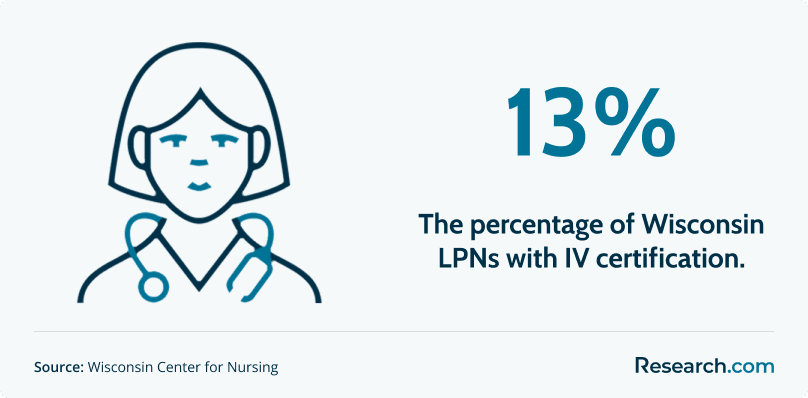
Wisconsin can be a strong state for practical nurses, especially for students who want varied employment settings and an affordable route into nursing. According to the Wisconsin Center for Nursing, almost 35% of Wisconsin LPNs worked in extended care settings, while 30% worked in ambulatory care settings. Other common work environments included hospitals, home health, and community/public health settings.
- Pay is competitive. The average yearly pay for LPNs and LVNs is $62,340. According to the U.S. Bureau of Labor Statistics (2025), the LPN salary Wisconsin employers pay is around $62,410.
- Employment is substantial. Wisconsin has 10,880 LPNs and LVNs, according to the U.S. Bureau of Labor Statistics (2025).
- Demand is tied to broader nursing needs. Students often ask, is there a nursing shortage affecting Wisconsin? Healthcare employers in Milwaukee, Green Bay, Madison, and smaller communities continue to need nurses across many settings.
- Cost of living may support take-home value. Recent data indicates that the cost of living in Wisconsin is 6% lower than the national average, which can affect how far wages go for housing, food, and transportation.
- Student support exists. Wisconsin nursing students may explore scholarships, loan repayment options, and incentives connected to nursing education and advancement.
That said, “good for LPNs” depends on your priorities. If you want the fastest nursing entry point and are comfortable with supervised practice, LPN training can make sense. If your long-term goal is independent clinical judgment, leadership, or advanced practice, plan early for an RN, BSN, or graduate pathway.
What can I do with an LPN degree in Wisconsin?
With an LPN credential in Wisconsin, you can pursue practical nursing roles focused on basic patient care under the supervision of registered nurses or physicians. Your exact responsibilities depend on employer policy, setting, experience, and Wisconsin scope-of-practice rules.
| Work setting | Common LPN duties | Who it may fit |
| Long-term care and extended care | Monitor residents, administer allowed medications, document changes, assist with daily care | Students who want ongoing relationships with patients and steady care routines |
| Ambulatory care and clinics | Room patients, record vital signs, support physicians and RNs, assist with patient education | Students who prefer outpatient care and potentially more predictable hours |
| Hospitals | Support bedside care, communicate patient observations, assist with treatment plans | Students who want a faster-paced environment |
| Home health | Provide care in patient homes, reinforce care plans, educate families, document progress | Students who prefer community-based work and local travel |
| Community/public health | Support screenings, outreach, preventive care, and health education activities | Students interested in population health and community access |
An LPN diploma can also become a stepping stone. Many practical nurses later enter LPN-to-RN or LPN-to-BSN bridge programs to expand their scope, qualify for more roles, and pursue higher-level nursing responsibilities.
What are the work-life balance considerations for LPNs in Wisconsin?
LPN work can be meaningful, but the schedule can be demanding. Before choosing a program or job setting, think honestly about shift expectations, overtime, emotional workload, commute time, and whether you can sustain the pace long term.
- Shift structure differs by workplace. Nursing homes, extended care facilities, and hospitals may use day, evening, night, weekend, or rotating shifts. Clinics and ambulatory care settings may offer more predictable schedules.
- Overtime can affect burnout risk. During staffing pressure, LPNs may be asked to cover additional shifts. Students should learn early how to set boundaries, communicate availability, and protect rest.
- Home health and community-based roles may offer flexibility. These roles can involve local travel, independent scheduling, and patient education, although they also require strong documentation and time-management skills.
- Benefits matter as much as hourly pay. Paid time off, health benefits, tuition reimbursement, wellness resources, and staffing ratios can strongly affect job satisfaction.
- Continuing education requires planning. LPNs who want to advance should look for employers that support online coursework, evening classes, flexible scheduling, or tuition assistance.
| If you value... | Consider looking at... | Ask this before accepting a role |
| Predictable hours | Clinics, ambulatory care, some community health roles | How often are evenings, weekends, or holidays required? |
| Higher patient continuity | Long-term care, extended care, home health | What are typical patient loads and documentation expectations? |
| Fast clinical exposure | Hospitals or rehabilitation settings | What support is available for new LPNs? |
| Education advancement | Employers with bridge-program support | Is tuition reimbursement available for LPN-to-RN or BSN study? |
Are there MA-to-LPN bridge programs for LPNs in Vermont?
This question is outside the main Wisconsin focus of this guide, but it often comes up because medical assistants compare bridge options across states. For Medical Assistants in Vermont, an MA-to-LPN bridge can be a practical route into nursing if the program meets Vermont licensure expectations and includes the required clinical training.
Why medical assistants consider MA-to-LPN bridge programs
- Prior healthcare experience can help. Medical assistants often bring familiarity with medical terminology, patient intake, basic clinical tasks, and office workflows.
- The LPN role expands clinical responsibility. Moving from MA to LPN can open access to nursing roles with a broader patient-care scope.
- Demand can make the pathway attractive. Vermont faces nursing workforce needs connected to an aging population and retirements.
What to verify before enrolling
Bridge programs may combine online coursework with in-person clinical training. Students researching this route can compare flexible options such as the MA to LPN Bridge Program Online, but the key issue is state eligibility: the program must prepare the student for the NCLEX-PN and meet the state’s licensure requirements.
Career prospects for LPNs in Vermont
LPNs in Vermont earn an average salary of $57,150 annually. Vermont’s participation in the Nurse Licensure Compact may also affect mobility for eligible nurses. Students should confirm current state rules before using any out-of-state or online bridge option.
What Opportunities Exist for Advanced Nursing Education in Wisconsin?
Wisconsin LPNs who want more responsibility can use practical nursing as a first step toward RN or advanced practice roles. Common advancement routes include LPN-to-ADN, LPN-to-BSN, BSN, MSN, and graduate nursing pathways. Students interested in provider-level roles can also compare the best nurse practitioner programs in Wisconsin once they understand the RN and graduate requirements that come first.
The key is sequencing. LPNs do not jump directly into most advanced practice roles. They usually need RN preparation, licensure, additional clinical experience, and graduate-level education before pursuing APRN credentials.
How can you evaluate the quality of LPN programs in Wisconsin?
A good LPN program should do more than offer a convenient schedule. It should prepare you for licensure, clinical practice, and safe patient care. Accreditation, approval status, clinical partnerships, student support, and transparent outcomes all matter.
| Quality factor | What to look for | Red flag |
| State approval | The program qualifies graduates for Wisconsin practical nurse licensure | The school cannot clearly explain licensure eligibility |
| Accreditation | Recognized nursing accreditation, such as ACEN where applicable | Vague claims such as “industry aligned” without recognized accreditation |
| Clinical access | Established clinical sites with clear placement expectations | Students must find clinical placements on their own without support |
| NCLEX-PN preparation | Exam review, practice testing, and faculty support | No published or easily available exam-performance information |
| Student services | Academic advising, tutoring, career support, and transfer guidance | Limited support after enrollment |
| Pathway options | Clear LPN-to-RN or transfer routes if you want advancement | Credits do not transfer or are difficult to evaluate |
Students comparing practical nursing with other allied health routes may also find it useful to review the best medical assistant programs in Wisconsin. That comparison can clarify whether you want a nursing license or a shorter allied health pathway with a different scope of practice.
What affordable advanced nursing education options are available for LPNs?
Affordable advancement depends on your starting point. An LPN who wants to become an RN may look first at LPN-to-ADN or LPN-to-BSN programs. An RN with a BSN who wants advanced practice may compare graduate options, including flexible programs designed for working nurses.
When evaluating affordability, do not look only at tuition. Consider transfer-credit acceptance, employer tuition assistance, clinical travel, course repeat policies, and whether the program’s schedule allows you to keep working. LPNs exploring long-range advanced practice options may eventually compare specialized graduate routes such as online AGNP programs, but they should first map the required RN and BSN steps.
How does the nursing shortage affect LPN opportunities in Wisconsin?
The nursing shortage affects LPNs in two ways. It can create more openings and stronger employer interest, but it can also increase workload pressure in understaffed settings. This makes program quality and job-setting choice especially important.
For new LPNs, staffing demand may improve access to entry-level roles in long-term care, home health, clinics, hospitals, and smaller communities. Employers may also use benefits, scheduling options, tuition reimbursement, or other incentives to recruit and retain nurses.
At the same time, shortage conditions can mean heavier assignments, more overtime requests, and higher stress. LPNs should ask employers about staffing ratios, orientation length, mentorship, overtime expectations, and support for continuing education. Those who want to move into RN roles can explore LPN to BSN online options as part of a longer career strategy.
Advancing Your Career Beyond an LPN Role in Wisconsin
The LPN credential can be an entry point into nursing, but it does not have to be the endpoint. Many Wisconsin practical nurses advance by becoming registered nurses, earning a BSN, moving into leadership roles, or eventually pursuing graduate nursing specialties.
The most common next step is an LPN-to-RN pathway. These programs build on practical nursing knowledge while adding the broader clinical judgment, assessment, leadership, and care-planning responsibilities expected of registered nurses. Some employers support advancement through tuition reimbursement or flexible scheduling, especially when nursing demand is high.
If you are planning this route, compare prerequisites, transfer-credit rules, clinical schedules, program approval, and NCLEX-RN preparation. A detailed overview of RN requirements is available in Research.com’s guide on how to become a registered nurse in Wisconsin.
LPN: A Shorter Entry Point Into Nursing, Not a Shortcut Around Standards
For many students, practical nursing is a more accessible first nursing credential because it usually requires less time than longer RN pathways. That can be especially helpful if you want to enter patient care sooner, begin earning healthcare experience, or test whether nursing is the right long-term profession before committing to additional education.
However, LPN training is not “easy” in the sense of low expectations. Students still study anatomy, pharmacology, lifespan care, nursing skills, and clinical safety. They must also complete hands-on training and pass the NCLEX-PN. If your long-term plan includes becoming an RN, BSN-prepared nurse, or advanced practice nurse, review the time commitment required by nursing school before choosing your first program.
Can LPNs Leverage Their Healthcare Skills to Transition into Nutrition Roles in Wisconsin?
Yes, but the move usually requires additional education or certification outside the LPN credential. Practical nurses already understand patient care, chronic conditions, medication routines, and health education, which can be useful in nutrition and wellness settings. Still, nutrition roles may require training in dietary science, counseling, wellness planning, and state-specific requirements.
LPNs considering this route should compare scope of practice, credential requirements, and whether they want a clinical nutrition role, wellness coaching role, or public health education role. Research.com’s guide on how to become a nutritionist in Wisconsin explains the steps in more detail.
How Can LPNs Bridge to Advanced Degrees for Career Growth?
LPNs can bridge toward advanced degrees, but the path is staged. A practical nurse typically advances first to RN preparation, then may complete a BSN, and later may pursue graduate education depending on the desired role. This sequence matters because advanced nursing roles generally require RN licensure and higher-level academic preparation.
Online and hybrid programs can help working nurses continue their education, but clinical requirements still apply. Students should verify accreditation, state authorization, transfer-credit policies, clinical placement expectations, and total program cost. For nurses who eventually qualify for doctoral-level pathways, comparing options such as the most affordable BSN to DNP programs online can help with long-term planning.
Can LPNs Progress Toward Becoming a Nurse Midwife in Wisconsin?
Yes, but not directly from the LPN credential alone. Nurse midwifery is an advanced practice nursing role, so an LPN would first need to become an RN, gain relevant experience, complete the required graduate-level education, and meet certification and state practice requirements.
LPNs interested in this specialty should seek clinical exposure to obstetrics, women’s health, maternal care, and patient education as they advance. They should also verify that each future program is accredited and aligned with Wisconsin requirements. For a more specific roadmap, see Research.com’s guide to nurse midwife education requirements in Wisconsin.
How Do State Licensure Regulations Influence LPN Practice in Wisconsin?
Licensure rules shape what LPNs can do, how they renew their credentials, and how they remain in good professional standing. Wisconsin practical nurses should stay current on renewal deadlines, application procedures, documentation requirements, and scope-of-practice expectations.
Rules can also affect career mobility, employer onboarding, and eligibility for advancement programs. Before enrolling in any nursing program or accepting a role with unfamiliar duties, review current Wisconsin nursing license requirements and confirm details with the appropriate state licensing authority.
What Continuing Education and Certification Opportunities Are Available for LPNs in Wisconsin?
Continuing education can help LPNs stay current, strengthen patient-care skills, and prepare for specialized responsibilities. Common areas of professional development may include IV therapy, geriatric care, wound management, medication safety, infection control, and chronic disease support.
Before paying for a course, confirm whether it is recognized by your employer, relevant to your role, and aligned with licensure or renewal expectations. LPNs who want a broader overview of the credentialing pathway can review Research.com’s guide on how to become a certified LPN in Wisconsin.
Can LPNs Directly Transition to Becoming a Nurse Practitioner in Wisconsin?
No. LPNs do not move directly into nurse practitioner practice. Nurse practitioners are advanced practice registered nurses, which means an LPN must first become an RN, typically complete BSN-level preparation or an approved pathway, and then enter graduate nurse practitioner education.
The nurse practitioner route also includes advanced coursework in assessment, diagnostics, pharmacology, patient management, evidence-based practice, and supervised clinical training. Candidates must meet state-specific certification and licensure rules. For the full sequence, review how to become a nurse practitioner in Wisconsin.
What Are the Benefits of Accredited Online LPN Programs in Wisconsin?
Accredited hybrid or online-supported LPN programs can help students manage theory coursework more flexibly while still completing required in-person training. The main benefits are scheduling flexibility, potentially reduced commuting for selected courses, structured licensure preparation, and clearer quality standards when accreditation is recognized.
Accreditation does not remove the need for labs or clinical rotations. It also does not guarantee licensure, employment, or salary. Students should compare program approval, NCLEX-PN preparation, clinical sites, faculty support, and graduate outcomes. For broader nursing education comparisons, see Research.com’s guide to the best online nursing programs in Wisconsin.
What Are the Future Career Prospects and Salary Trends for LPNs in Wisconsin?
Wisconsin LPN prospects are shaped by patient-care demand, long-term care needs, outpatient growth, home health services, and the broader nursing workforce shortage. LPNs who are willing to work in high-need settings may find more opportunities, while those seeking predictable hours may need to be more selective.
Salary depends on setting, region, shift, experience, benefits, and employer type. The U.S. Bureau of Labor Statistics (2025) reports Wisconsin LPN and LVN pay around $62,410, while the average yearly pay for LPNs and LVNs is $62,340. Students should compare wages with total cost of attendance, debt, commute, benefits, and advancement potential rather than relying on salary alone.
If you are still comparing nursing routes, use program-level evidence rather than reputation alone. Reviewing the best nursing schools in Wisconsin can help you compare options beyond practical nursing and understand how different credentials connect to long-term career goals.
Common Mistakes to Avoid When Choosing an LPN Program in Wisconsin
| Mistake | Why it can hurt you | Better approach |
| Choosing a program because it is advertised as online | A fully online option cannot replace required clinical training | Confirm state approval, lab requirements, and clinical placement details |
| Looking only at tuition | Fees, supplies, testing, and travel can change the real cost | Ask for a complete program budget before applying |
| Ignoring accreditation and approval | Licensure eligibility may be affected | Verify approval with Wisconsin licensing authorities and check recognized accreditation |
| Assuming clinicals will fit your schedule | Clinical rotations may require fixed days, evenings, weekends, or travel | Ask when and where clinical placements usually occur |
| Not planning for advancement | Credits may not transfer smoothly into RN or BSN programs | Ask about LPN-to-RN pathways before enrolling |
| Relying only on rankings | A highly ranked program may not fit your location, budget, or schedule | Compare outcomes, costs, clinical access, and student support |
Questions to Ask Before You Apply
- Is this program approved for Wisconsin practical nursing licensure?
- Is the program accredited, and by which organization?
- What is the total estimated cost, including fees, books, supplies, testing, background checks, and clinical expenses?
- Where are clinical rotations located, and who arranges them?
- Can I complete any coursework online, and which courses must be completed on campus?
- What support is available for NCLEX-PN preparation?
- What happens if I fail or need to repeat a course?
- Does the school offer transfer pathways into ADN, BSN, or other nursing programs?
- Are evening, weekend, part-time, or accelerated options available?
- What student support services are available for working adults?
Related Articles for Nearby States
- 2027 Best LPN Programs in Minnesota – Accredited Online LPN Programs
- 2027 Best LPN Programs in Iowa – Accredited Online LPN Programs
- 2027 Best LPN Programs in Illinois – Accredited Online LPN Programs
- 2027 Best LPN Programs in Michigan – Accredited Online LPN Programs
- 2027 Best LPN Programs in Indiana – Accredited Online LPN Programs
- 2027 Best LPN Programs in Missouri – Accredited Online LPN Programs
- 2027 Best LPN Programs in Ohio – Accredited Online LPN Programs
- 2027 Best LPN Programs in South Dakota – Accredited Online LPN Programs
- 2027 Best LPN Programs in Nebraska – Accredited Online LPN Programs
- 2027 Best LPN Programs in Kentucky – Accredited Online LPN Programs
References:
- U.S. Bureau of Labor Statistics. (2025). Occupational Employment and Wages, May 2025: Licensed Practical and Licenses Vocational Nurses. BLS.
- Incredible Health. (n.d.). Average Licensed Practical Nurse Salary in Wisconsin. Incredible Health.
- Wisconsin Center for Nursing. (n.d.). Wisconsin LPN Survey. Wisconsin Center for Nursing.
- Nightingale College. (2024). Nursing Shortage: 2026 US Statistics. Nightingale College.
Key Insights
- You cannot become a Wisconsin LPN through a fully online program. Hybrid coursework may be available, but labs and clinical rotations must be completed in person.
- Licensure depends on program approval, NCLEX-PN success, and state application requirements. Always verify eligibility before enrolling.
- Most practical nursing programs take one to two years. Full-time study may be faster, while part-time study can make school more manageable for working adults.
- Costs vary beyond tuition. Budget for supplies, fees, background checks, immunizations, transportation, testing, and possible income changes while in school.
- Wisconsin offers varied LPN work settings. Extended care and ambulatory care are especially common, but hospitals, home health, and community/public health also employ LPNs.
- The LPN credential can be a career starting point. If you want RN, BSN, nurse practitioner, nurse midwife, or other advanced roles later, choose a program with clear transfer or bridge options.
- Work-life balance depends heavily on setting. Clinics may offer more predictable hours, while long-term care, hospitals, and shortage-affected workplaces may involve more shift variability or overtime.
Other Things You Should Know About LPN Programs in Wisconsin
To enroll in online LPN programs in Wisconsin, candidates typically need a high school diploma or GED, a minimum GPA, and completion of specific prerequisite courses such as biology or chemistry. Some programs may also require entrance exams or certain healthcare experience.
Wisconsin LPN graduates must pass the NCLEX-PN to receive licensure from the Wisconsin Board of Nursing. After graduation, candidates apply through Pearson VUE, submit fingerprints for a background check, and wait for Authorization to Test before scheduling the exam.
LPN programs in Wisconsin typically take one to two years to complete, depending on whether you attend full-time or part-time. The program includes both classroom instruction and clinical practice.
Yes, you can become an LPN in Wisconsin through an online program. Many accredited institutions offer online LPN programs that combine virtual coursework with in-person clinical practice at healthcare facilities, ensuring comprehensive training that meets licensure requirements in the state.
Wisconsin offers numerous scholarships, loan repayment programs, and other financial incentives for nursing students. Organizations like the Wisconsin League for Nursing provide scholarships, and the state offers loan repayment programs for those advancing their nursing careers.