
2027 Online Ph.D. Programs With No Dissertation: Specializations, Cost & Period of Study

Co-Founder and Chief Data Scientist
A note from Imed Bouchrika, Ph.D., career planning expert:
Choosing a doctoral program is not only an academic decision. It affects your workload, finances, career options, research expectations, and personal well-being for several years. For many working adults and graduate students, the dissertation is the biggest concern because it requires sustained independent research, extensive writing, faculty approval, and often multiple revisions.
The pressure is real. The 2024-2025 Healthy Minds Study indicates that 37% of college students reported moderate to severe depressive or anxiety symptoms, while 27% of faculty and staff reported high or very high burnout. For doctoral students balancing employment, family responsibilities, and advanced coursework, a dissertation-free path can be appealing.
This guide explains what “online Ph.D. programs with no dissertation” usually means, which doctoral fields commonly use capstones or applied projects instead of traditional dissertations, how much these programs may cost, how long they take, what employers may think, and how to decide whether this route fits your goals.
Quick answer: Can you earn an online Ph.D. with no dissertation?
Yes, some online doctoral programs do not require a traditional dissertation. However, many of these programs are professional doctorates rather than research-focused Ph.D. programs. Instead of a dissertation, students may complete a capstone project, applied research project, professional portfolio, comprehensive exam, clinical project, or practice-based doctoral study.
Online doctoral programs without dissertations may be a strong fit for experienced professionals who want career advancement, leadership preparation, or applied expertise. They may be less ideal for students whose goals include tenure-track faculty roles, postdoctoral research, or careers that require extensive original research and peer-reviewed publication experience.
What are the benefits of an online Ph.D. program with no dissertation?
- More applied learning: Many dissertation-free doctoral programs focus on practical projects, leadership challenges, clinical improvement, policy analysis, or organizational problem-solving rather than a traditional research manuscript.
- Potential access to advanced roles: Depending on the field, a doctorate can support movement into senior leadership, teaching, research support, consulting, administration, or specialized professional practice.
- Flexible scheduling: Online formats can make doctoral study more realistic for working adults who cannot relocate or attend campus-based classes regularly.
- Career-focused assessment: Capstones, portfolios, and applied projects may allow students to solve a problem connected to their workplace or professional field.
- Possible salary upside: According to 2026 data, Ph.D. graduates may earn over $120,000 a year, depending on the industry they choose to work in.
What should you expect from an online Ph.D. program with no dissertation?
An online doctoral program without a dissertation usually replaces the traditional dissertation with another doctoral-level assessment. The curriculum still tends to be demanding, but the final requirement is often more practice-based.
- Coursework: Students complete advanced courses in theory, methods, leadership, ethics, analytics, policy, clinical practice, or field-specific specialization.
- Alternative final requirement: Programs may require a capstone, applied research project, professional portfolio, doctoral project, or comprehensive examination.
- Time to completion: Online Ph.D. programs with no dissertation programs may take 3 to 5 years to complete. Some students finish faster with an accelerated course load, while part-time students may need longer.
- Cost: On average, tuition for these programs may fall within $20,000 to $50,000 per year.
- Rigor: “No dissertation” does not mean “easy.” You may still need to complete research methods courses, data analysis, written projects, oral defenses, practicum hours, or field-based work.
Where can graduates of online Ph.D. programs with no dissertation work?
Graduates can work across education, healthcare, business, technology, public service, nonprofit leadership, social services, and consulting. The best opportunities depend heavily on the degree type, accreditation, professional license requirements, prior experience, and whether the program develops skills that employers in your field value.
Common settings include universities and colleges, healthcare systems, school districts, corporate training departments, government agencies, research organizations, consulting firms, nonprofit organizations, and private companies.
How much can you make with an online Ph.D. program with no dissertation?
Salaries vary widely by occupation, industry, location, experience, license status, and employer. As a broad estimate, salaries for individuals with doctoral degrees can range from around $50,000 to over $100,000 per year. Some fields pay more, especially in healthcare, technology, business, and specialized leadership roles.
Salary should not be evaluated from the degree title alone. Before enrolling, compare the total cost of the program with realistic job titles, salary ranges in your region, licensing requirements, and whether your target employers recognize the credential.
- Doctoral degrees that may not require a dissertation
- How long online doctoral programs without dissertations take
- Online versus campus doctoral programs
- Average cost of an online doctoral program without a dissertation
- Financial aid options for doctoral students
- Common admission requirements
- How to choose the right program
- Affordability comparison for dissertation-free online doctoral programs
- Student support and networking
- How programs are adapting to workforce needs
- How alternative assessments maintain academic rigor
- Career paths after a dissertation-free online doctorate
- Job market considerations
- Whether skipping a dissertation affects academic careers
- Lifelong learning and skill diversification
- Choosing between dissertation and non-dissertation doctoral programs
- Accreditation and quality assurance
- Employer perceptions of online doctoral programs
- Cost-effectiveness compared with other advanced degrees
- Challenges to consider before enrolling
What doctorate degrees do not have dissertation requirements?
Most traditional Ph.D. programs require a dissertation. However, some online doctoral programs, especially professional doctorates, use a capstone, doctoral project, portfolio, or applied research study instead. These alternatives are designed to prove advanced competence without requiring the same format as a traditional dissertation.
The distinction matters. A dissertation-free doctorate can be useful for professional advancement, but students planning research-intensive academic careers should confirm whether the degree will meet expectations in their field. If you are still comparing doctoral formats, review the broader considerations when choosing a doctoral program.
Common dissertation-free online doctoral options
| Doctoral field | Typical completion time stated | Typical cost information stated | Best fit |
| Psychology | Usually five to six years or even seven years | 60 to 90 credits at $240 to $640 per credit; about $14,000 to $58,000 in total annual tuition | Students pursuing advanced psychology practice, research, or specialized mental health roles, depending on licensure rules |
| Curriculum and Instruction | Three to five years | 60 to 66 credits at $350 to $775 per credit; around $21,000 to more than $55,000 | Educators interested in curriculum design, instructional leadership, academic research, or teaching |
| Nursing Practice | Three to five years | Some affordable DNP programs are under $12,000; expensive programs can exceed $60,000 | Licensed nurses seeking advanced clinical, administrative, or leadership responsibilities |
| Public Health | Three to four years | $12,000 to $31,000 total per year | Professionals interested in public health leadership, policy, epidemiology, or community health |
| Business Administration | Possible in three years | NCES data indicates annual average graduate tuition at public institutions to be $11,554; some top universities charge more than $43,000 | Experienced managers, executives, consultants, and business leaders |
| Information Technology | About three to five years | 55 to 64 credits at around $500 to $1,000 per credit; about $28,000 to $64,000 in tuition | IT professionals targeting senior technology, cybersecurity, data, or systems leadership roles |
Online doctoral programs in psychology
Online doctoral programs in psychology may support advanced study in clinical, counseling, forensic, educational, sports, or industrial-organizational psychology. A Psy.D. is usually more practice-oriented, while a Ph.D. traditionally emphasizes research. Licensure outcomes vary, so students should confirm whether an online program meets state requirements before enrolling.
Courses differ by concentration, but common subjects include cognitive development, neuroscience, and psychology ethics. Most doctoral degrees in psychology can require 60 to 90 credits at $240 to $640 per credit, which brings the total annual tuition to about $14,000 to $58,000. These programs often take longer than other online doctorates, usually five to six years or even seven years, depending on the capstone, enrollment status, and program design.
- Forensic Psychology
- Industrial-organizational psychology
- Educational Psychology
- Clinical Psychology
- Sports Psychology
Online doctoral programs in curriculum and instruction
A doctorate in curriculum and instruction focuses on how learning is designed, assessed, improved, and delivered across diverse educational settings. Students often study educational theory, instructional technology, psychology, ethics, law, and educational statistics.
This path can support careers in curriculum leadership, educational administration, postsecondary teaching, academic research, and private education services. Depending on coursework and the student’s capstone project, the degree can be completed in three to five years. Programs typically include 60 to 66 credits, with cost-per-credit at $350 to $775, placing tuition around $21,000 to more than $55,000.
- Higher Education Teaching
- Learning, Design, and Technology
- Urban and Multicultural Education
- Learning and Development
- Early Childhood Education
Online doctoral programs in nursing practice
A doctor of nursing practice, or DNP, is a practice-based doctoral degree for nurses who want to strengthen clinical judgment, leadership, health policy, informatics, or healthcare administration skills. Unlike traditional research-heavy doctoral routes, DNP programs often emphasize improving patient care and healthcare systems.
Typical coursework may include health policy implementation, statistical analysis, organizational leadership, social ethics, health technology, and direct patient care. Some programs also include spirituality and health. A DNP degree can take three to five years to complete. Most programs require 65 to 95 credits and around 1,000 hours of clinical practice. Some of the most affordable DNP programs are under $12,000; the most expensive can be over $60,000. Chief nursing executives with a DNP degree can earn annual salaries of up to $109,000.
- Nursing Informatics
- Educational Leadership/Nurse Educator
- Adult-Gerontology Primary Care Nurse Practitioner
- Psychiatric-Mental Health Nurse Practitioner
- Clinical Nurse Specialist
Online doctoral programs in public health
A doctoral degree in public health, sometimes called a DPh, is designed for professionals who want to lead public health programs, shape policy, manage population health initiatives, or apply research to community health problems.
Coursework typically centers on leadership and practice. Common classes include health management, vaccinology, issues in global public health, data and analysis, and public health ethics. It can take three to four years to complete a DPh program, and some schools do not offer extended timelines. Tuition is from $12,000 to $31,000 total per year.
- Public Health Policy
- Environmental Health
- Epidemiology and Infectious Disease
Online doctoral programs in social work
Online doctoral programs in social work are built for professionals who want to deepen their leadership, research, analysis, communication, presentation, and organizational management skills. These abilities are important in clinical, community, nonprofit, policy, and administrative settings.
Course topics vary by specialization, but students often study human rights, human behavior, clinical theory, research methods, and grant writing. Earning this doctoral degree can lead to senior roles in social work, community leadership, nonprofits, and academia. It will take about four to six years to complete a doctoral program in social work. Some programs can be shorter, and a student’s capstone project type will also affect the length of study. Programs often require 45-60 credits, and the cost for this type of degree ranges from $28,000-$40,000.
- Social Work Administration
- Medical Social Work
- Disaster, Crisis, and Intervention
- Children, Families, and Couples
- Forensic Populations and Settings
Online doctoral programs in accounting
An online doctoral program in accounting can help experienced accounting professionals, educators, auditors, consultants, and finance leaders build advanced expertise. It may be especially attractive to working adults who need distance learning instead of scheduled campus attendance.
Coursework often includes specialized doctoral courses, research methods, statistical analysis, behavioral accounting research, capital markets research, empirical research, written or oral exams, and sometimes teaching practicums. A typical online Ph.D. accounting degree can take four to seven years. The average is $92,200 and $127,100 from public and private universities respectively.
- Forensic Accounting
- Public Accounting
- Finance
- Audit Accounting
- Accounting Information Systems
Online doctoral programs in business administration
A Doctor of Business Administration, or DBA, is usually designed for experienced professionals who want to apply advanced business theory to organizational problems. Since business administration offers a long list of career options, this degree can be relevant to executives, consultants, entrepreneurs, analysts, and senior managers.
Students may build skills in transformational leadership, business analysis, organizational communication, presentation, and advanced management. It is possible to complete a DBA program, like a doctorate degree in organizational leadership, in three years, but timelines vary because internships, doctoral projects, and capstones differ by school.
- Business Intelligence and Data Analytics
- Strategic Leadership
- Information Technology Management
- International Finance
- Advanced Production and Operations Analysis
Online doctoral programs in management
A doctorate in management develops advanced analytical, research, leadership, and organizational decision-making skills. It may support careers in government, private-sector leadership, consulting, and higher education teaching.
Programs without a traditional dissertation often emphasize research methods applied to real business problems. Students should expect quantitative and qualitative research, data analysis, organizational theory, and management strategy. A typical doctorate degree in management requires 40 to 60 credits, which full-time students can complete within four to five years. Tuition usually starts from $20,000 to $51,000.
- Information Systems Management
- Leadership and Organizational Change
- Organizational Design and Innovation
- Human Resource Management
Online doctoral programs in adult and career education
Adult and career education doctorates prepare education professionals to teach, train, coach, and lead adult learners in colleges, workforce programs, vocational environments, and corporate settings.
Courses may include adult learning theory, leadership in adult education, current issues in adult learning, cognitive coaching, and teaching diverse learners. Students interested in broader school or district leadership may also compare online educational leadership programs. Full-time students can usually finish this degree in three to five years. Most programs require 60 to 66 credits, and per-credit-cost is from $350 to $775, so tuition may be from $21,000 to $55,000.
- Adult Learning & Leadership
- Higher & Adult Education
- Educational Leadership: Adult Education
Online doctoral programs in behavioral health
A doctorate in behavioral health, or DBH, is designed for clinical professionals who want to improve integrated care by understanding how mental and behavioral factors affect physical health. Students may study behavioral intervention, counseling, healthcare systems, psychosocial determinants of health, and advanced behavioral healthcare issues.
Students can complete a typical DBH program in approximately 12 months. Cost-per-credit for DBH degrees can range from $400 to more than $600. Ph.D. programs can require anywhere from 60 to 120 credits, so students should confirm the total credit load before enrolling.
- Psychopharmacology
- Population Health Management
- Clinical Specialization
Online doctoral programs in criminal justice
A doctoral degree in criminal justice can support advanced roles in higher education, private organizations, public agencies, and federal employers such as the Department of Homeland Security. The median annual pay for professionals in this field may range from $85,000, depending on the industry.
Students usually examine crime causation, policy impacts, justice systems, research design, demography, statistics, psychology, and sociology. Most Ph.D. programs in criminal justice take three years to complete, though part-time study and capstone requirements can extend the timeline. Tuition can range from $22,000 to more than $66,000, depending on the institution and student fees.
- Organizational Leadership
- Homeland Security
- Investigative Science
- Policing and Law Enforcement
- Criminal Behavior
Online doctoral programs in educational administration
Ph.D. programs in educational administration prepare students to address institutional challenges, manage budgets, analyze finances, develop curricula, mentor teachers, and implement education policies.
The curriculum is often interdisciplinary, combining education courses with management, finance, and budgeting. It takes three to four years to complete a Ph.D. in Educational Administration, though part-time students may need longer and fast-track options may be shorter. Tuition costs can be between $20,000 and $55,000. Students may also explore student financial aid options to help manage costs.
- Higher Education Leadership
- Special Education
- Community Colleges
- Instructional Design
- P-12 System Level School Leadership
Online doctoral programs in finance
A Ph.D. in finance can help students develop advanced skills in banking, accounting, asset management, economics, data analysis, financial planning, and policymaking. It may also support careers in postsecondary teaching.
Common coursework includes analysis, research methods, empirical methods in finance, and wealth management. A typical Ph.D. in finance can take five years to complete, and some students may finish in six years, especially if they continue working while enrolled. Tuition can be from $20,000 to more than $50,000 on average.
- Financial Management
- Public Finance/Finance Administration
- Finance
- Financial Planning
- Accounting
Online doctoral programs in grief counseling
An online doctoral program in grief counseling is designed for professionals who work with bereavement, trauma, loss, resilience, and counseling. It can help practitioners deepen their clinical knowledge and may support teaching or training roles in the field.
Students often study individual and group counseling, stages of grief, trauma response, psychotherapy, and support for survivors of traumatic events. This is one of the shortest online doctoral programs available online. Full-time students can complete this program within 12 months. The average tuition per semester is $4,000 to $5,000.
- Human Services Counseling
- Addiction Counseling
- Trauma and Crisis Counseling
Online doctoral programs in healthcare administration
Healthcare administration doctorates prepare professionals to improve healthcare quality, manage organizations, lead policy initiatives, and oversee financial and operational decisions. Graduates may pursue roles as medical and health services managers, university professors, social service managers, or private-sector executives.
Coursework often includes health policy, leadership strategies for healthcare organizations, health informatics, healthcare economics, and financial management. This program can be completed in as short as two years and as long as seven years, depending on course load and capstone project. The cost range can run from $20,000 to $60,000.
- Healthcare Law and Policy
- Health Leadership and Administration
- Healthcare Management and Economics
- Healthcare Informatics
Online doctoral programs in human resources
Doctoral programs in human resources are usually intended for experienced HR professionals who want to move into senior leadership, research, consulting, or teaching. Students learn to evaluate workforce systems, improve performance, manage people, and address organizational challenges.
Courses may include compensation and benefits, human capital management, labor laws, organizational communication, diversity and inclusion, and employee development. Most doctoral programs for human resources require between 58 and 66 credits and can be completed in two to four years for full-time students. Cost-per-credit is usually between $420 and $995, placing tuition from $24,000 to $66,000.
- Organizational Leadership
- Human Resource Management
- Compensation and Benefits
- Training and Development
Online doctoral programs in information technology
A doctorate in information technology is best suited for IT professionals pursuing advanced expertise in computing, cybersecurity, systems, data, and technology leadership. It can support senior roles in private companies, government agencies, and higher education.
Coursework often includes artificial intelligence, cloud computing, data science, and cybersecurity. 60% of surveyed organizations said cybersecurity staffing shortage is placing their organizations at risk. Online Ph.D. programs for information technology usually require 55 to 64 credits and take about three to five years for full-time students. Cost-per-credit is around $500 to $1,000, so tuition may total between $28,000 and $64,000.
- Data Science
- Cybersecurity
- Multimedia Information Systems
- Internet and Information Infrastructure
Online doctoral programs in occupational therapy
An online occupational therapy doctorate, or OTD, is generally intended for licensed occupational therapists who want advanced clinical, leadership, professional practice, or policy skills.
Coursework often emphasizes advanced research skills and the application of research methods to a capstone project. Common courses include occupational science, theory development for models of practice, leadership development, and qualitative and quantitative research. It can take three to five years to finish an OTD degree for full-time students. Tuition can cost from $22,000 to more than $60,000, depending on school, residency status, and program structure.
- Rehabilitation and Health
- Entrepreneurship
- Post-Acute and Chronic Care
- Policy/Administration
- Adult Rehabilitation, Community, and Wellness
Online doctoral programs in physical therapy
Online doctoral programs for physical therapy, or DPT programs, prepare students for clinical practice and licensure. Because licensure requirements vary by state, students should verify that any out-of-state online program meets their state’s requirements.
Programs often include research methods, data analysis, statistics, radiology, clinical coursework, and prerequisite classes before capstone work. DPT programs usually take three years to finish, though some schools offer a fast-track path. This type of program can cost from $18,000 to more than $37,000 per year.
- Electrophysiologic Clinical Specialist (ECS)
- Oncology Specialist
- Neurology Clinical Specialist (NCS)
- Geriatric Clinical Specialist (GCS)
- Women’s Health Specialist (WCS)
Online doctoral programs in public administration
A doctoral program in public administration, or DPA, helps students apply advanced research, analysis, leadership, and communication skills to government, nonprofit, healthcare, education, criminal justice, and private-sector problems.
Common courses include public administration, quantitative methods, ethics and social justice, and strategic public management. Students enrolled full-time typically finish within two to three years. The cost-per-credit for DPA is $500 to $900, so students can expect to pay $25,000 to $49,000 per year for tuition.
- Policy Analysis & Program Evaluation
- Organizational Leadership & Management
- Data Modeling & Analytics
Key findings for students comparing dissertation-free online doctorates
- Online Ph.D. programs with no dissertation typically take 3 to 5 years to complete, with tuition ranging from $20,000 to $50,000 per year.
- Doctoral degree holders can expect salaries ranging from $50,000 to over $100,000 per year, though outcomes depend on field, employer, location, and experience.
- Individuals with doctoral degrees generally have better job prospects and higher salaries, particularly in fields like healthcare, technology, and business.
- Ph.D. graduates in organic chemistry and biology can find opportunities with annual median salaries of $77,240 and $78,191.
- Recent findings revealed that up to 50% of graduate students encountered symptoms of burnout, depression, or anxiety, which helps explain interest in flexible online options.
- Psychology is the most popular major for students pursuing online Ph.D. programs, comprising 13% of enrollments.
How long does it take to complete an online Ph.D. program with no dissertation?
Most online Ph.D. programs with no dissertation take 3 to 5 years to complete. The exact timeline depends on transfer credits, enrollment intensity, program length, professional or clinical requirements, and the final assessment format.
Accelerated programs may allow faster completion for students who can take heavier course loads. Part-time students, working professionals, and students in programs with clinical hours or extensive capstones may need more time.
How does an online Ph.D. program with no dissertation compare to an on-campus program?
The main difference is not only location. Online and campus doctoral programs may differ in schedule flexibility, access to faculty, networking format, research infrastructure, and how students complete applied work.
| Factor | Online program with no dissertation | On-campus doctoral program |
| Schedule | Often better for working adults because coursework may be asynchronous or low-residency | Usually requires set class times, campus presence, or in-person activities |
| Learning format | Uses virtual classrooms, learning platforms, multimedia content, discussion boards, and remote meetings | Relies more on face-to-face seminars, labs, campus libraries, and in-person meetings |
| Networking | May include online cohorts, virtual events, alumni groups, and remote faculty mentoring | Often provides more spontaneous interaction through campus events, seminars, and faculty offices |
| Research access | Best for applied, workplace-based, or field-based projects | May offer stronger access to laboratories, archives, research centers, and funded faculty projects |
| Best fit | Professionals who need flexibility and want applied advancement | Students seeking intensive academic research immersion or campus-based collaboration |
What is the average cost of an online Ph.D. program with no dissertation?
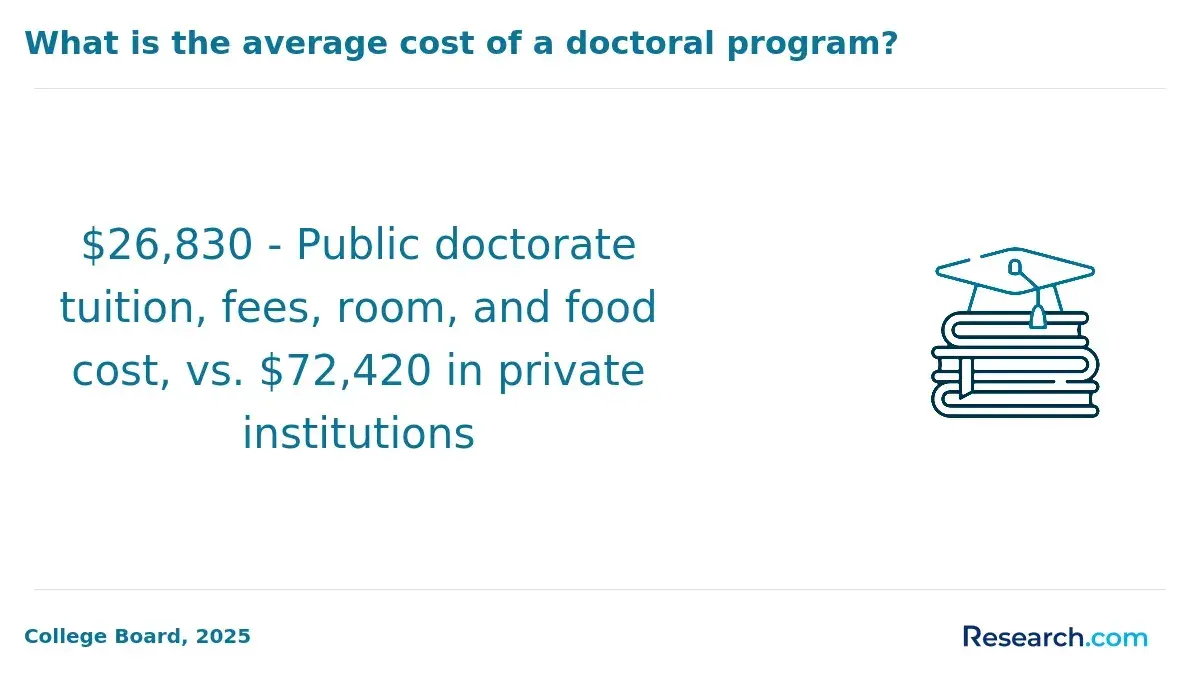
On average, tuition for online Ph.D. programs without dissertations may range from $20,000 to $50,000 per year. Some programs cost less, especially at public institutions, while others cost more because of specialization, clinical requirements, technology fees, residency requirements, or project expenses.
Do not compare programs by tuition alone. Ask for the full cost of attendance, including books, technology fees, travel for residencies, clinical placement costs, graduation fees, and any expenses tied to capstone or portfolio completion.
What are the financial aid options for students enrolling in an online Ph.D. program with no dissertation?
Doctoral students may be able to combine several funding sources. Availability depends on citizenship status, enrollment level, institutional policies, academic field, employer benefits, and military eligibility.
- Federal aid: Eligible students can submit the FAFSA to apply for federal loans, grants, and work-study opportunities where available.
- Scholarships: Universities, foundations, professional associations, and private organizations may offer awards based on field, merit, need, identity, service, or career goals.
- Assistantships: Some doctoral programs provide teaching or research assistantships with tuition remission, stipends, or both. These are often competitive.
- Employer tuition assistance: Working professionals should ask HR whether tuition reimbursement, professional development funding, or education benefits apply to doctoral study.
- Military benefits: Active-duty service members, veterans, and eligible dependents may qualify for GI Bill, Yellow Ribbon Program, or military tuition assistance benefits.
- Private loans: Alternative loans may fill funding gaps, but students should compare interest rates, repayment terms, and borrower protections carefully.
What are the prerequisites for enrolling in an online Ph.D. program with no dissertation?
Admission requirements vary by school and discipline, but most online doctoral programs expect applicants to show academic readiness, professional direction, and the ability to complete advanced independent work.
- Master’s degree: Most programs require a master’s degree in a related field from an accredited institution. Some may consider bachelor’s-prepared applicants with strong professional experience.
- Minimum GPA: Many programs set a minimum GPA between 3.0 and 3.5 on a 4.0 scale, though some review applicants holistically.
- Professional experience: Practice-oriented doctorates often prefer or require relevant work experience.
- Standardized test scores: Some programs request GRE or GMAT scores, but many have reduced or waived this requirement.
- Letters of recommendation: Applicants typically submit academic or professional references who can speak to their preparation and potential.
- Statement of purpose: This essay explains your goals, field interests, reasons for doctoral study, and fit with the program.
- Writing sample: Some schools require scholarly writing, professional work, or a portfolio sample.
- Interview: A program may use an interview to assess motivation, communication skills, and alignment with faculty or program outcomes.
How to choose the best online Ph.D. program with no dissertation?
The best program is not always the fastest or cheapest. It is the one that is accredited, respected in your field, affordable for your situation, aligned with your career goal, and honest about what its non-dissertation pathway can and cannot do.
| Question to ask | Why it matters |
| Is the institution accredited by a recognized accreditor? | Accreditation affects credibility, credit transfer, financial aid eligibility, and employer acceptance. |
| What replaces the dissertation? | A capstone, portfolio, comprehensive exam, or applied project develops different skills from a traditional dissertation. |
| Does the program meet licensure rules in my state? | This is critical for fields such as psychology, nursing, physical therapy, occupational therapy, and counseling. |
| Who teaches the courses? | Faculty expertise affects mentoring, applied learning, and professional relevance. |
| What is the total cost, not just tuition? | Fees, residencies, technology, clinical requirements, and materials can change affordability. |
| What support do online students receive? | Advising, writing help, library access, career services, technical support, and faculty availability affect completion. |
| What do graduates do after finishing? | Career outcomes help you judge whether the degree is useful for your intended path. |
Online Ph.D. programs are growing in visibility among students pursuing advanced degrees. Psychology stands out as the most favored major at this level, accounting for 13% of enrollments. The chart below shows the most popular online Ph.D. programs.
How do online Ph.D. programs with no dissertation compare in affordability?
Dissertation-free online doctoral programs can reduce some costs associated with relocation, commuting, and campus attendance. However, affordability depends on far more than delivery format. Credit requirements, per-credit tuition, residencies, clinical placements, capstone fees, technology charges, and available aid can change the total price significantly.
Students in healthcare fields should be especially careful because clinical requirements and professional licensing expectations can affect both cost and program choice. For example, students comparing pharmacy options may want to review the cheapest pharm d programs as part of a broader affordability search.
A lower-cost program is only a good value if it is accredited, recognized by employers, and aligned with your professional requirements. If you are comparing many online options across fields, a broader list of accredited online degrees can help you understand how format, cost, and credential level differ.
What kind of support and networking opportunities do online Ph.D. programs with no dissertation provide?
Strong online doctoral programs provide more than course access. Look for structured advising, faculty mentoring, writing support, online library access, cohort interaction, research or project guidance, career services, and alumni connections.
Networking may happen through virtual residencies, online seminars, professional association partnerships, discussion-based courses, collaborative projects, and faculty-led events. These supports matter because doctoral students often need feedback, accountability, and field connections to complete advanced projects and translate the degree into career movement.
How are online Ph.D. programs with no dissertation evolving to meet industry demands?
Many dissertation-free doctoral programs are shifting toward applied projects, analytics, digital transformation, healthcare improvement, educational technology, strategic leadership, and organizational problem-solving. This reflects employer interest in professionals who can use research-informed methods to solve practical problems.
This trend also appears across online education more broadly, including accelerated and career-focused formats such as fast online degrees. For doctoral students, the key question is whether the program teaches advanced thinking and evidence-based decision-making rather than simply replacing a dissertation with a lighter requirement.
How do alternative assessments uphold rigorous academic standards?
Alternative assessments can be rigorous when they require doctoral-level analysis, research literacy, evidence-based decisions, formal writing, faculty review, and a clear contribution to professional practice. Common alternatives include comprehensive exams, capstone projects, doctoral projects, professional portfolios, and applied research studies.
These formats differ from a dissertation, but they can still test advanced competencies. Some programs use accelerated learning principles similar to the practical focus found in a 1 year master program, but doctoral-level work should still involve deeper analysis, independent judgment, and defensible conclusions.
What career paths are available for graduates of online Ph.D. programs with no dissertation?
Career options depend on the field of study and whether the degree is academic, clinical, administrative, or professional. Common paths include leadership, teaching, consulting, administration, policy, workforce development, technology, and specialized practice.
- Higher education administration: Graduates may work as academic deans, department chairs, program directors, or university administrators.
- Corporate training and development: Doctoral graduates may design training programs, lead employee development, or manage learning strategy.
- Consulting: Some graduates advise organizations on leadership, curriculum, policy, evaluation, operations, or workforce improvement.
- Government and nonprofit organizations: Career options may include policy analyst, program manager, research director, or organizational leader.
- Educational technology: Graduates may work as instructional designers, e-learning specialists, or educational technology consultants.
- Private practice: Depending on licensure, some graduates may provide coaching, counseling, consulting, or professional development services.
What is the job market for graduates of online Ph.D. programs with no dissertation?
Doctoral degree holders often have access to advanced roles, but the job market varies by discipline. Healthcare, technology, and business may offer stronger prospects for some graduates, while research-heavy academic roles may still prefer candidates with dissertation experience, publications, and traditional research preparation.
In organic chemistry, where the average salary is $77,240 annually, opportunities for Ph.D. graduates exist in pharmaceuticals, biotechnology, and chemical manufacturing. Job prospects are influenced by research funding, drug discovery advancements, and demand for sustainable processes.
Ph.D. in biology graduates, with an average salary of $78,191 annually, find careers in healthcare, research, government, and biotech sectors. Factors affecting job outlook include biotech advancements, environmental efforts, and public health initiatives.
Does forgoing a dissertation hinder future academic and research opportunities?
It can, depending on your goal. A traditional dissertation gives students experience in original research, scholarly writing, literature review, methodology, data analysis, faculty review, and sometimes publication. These experiences can be important for postdoctoral positions, tenure-track faculty searches, and research-intensive jobs.
A non-dissertation doctorate may be better for applied leadership, professional practice, administration, consulting, or workplace improvement. If you want an academic research career, ask programs how graduates build publication records, whether faculty support scholarly work, and whether the capstone can lead to conference presentations or journal submissions. Students balancing cost and work schedules may also compare the cheapest online universities for working adults.
How can an online Ph.D. without a dissertation support lifelong learning and skill diversification?
A dissertation-free online doctorate can help professionals broaden leadership, research literacy, analytical thinking, and applied problem-solving skills while continuing to work. Because many programs use workplace-based projects, students may be able to connect doctoral learning directly to current responsibilities.
Some professionals also combine doctoral study with targeted credentials in adjacent areas. For example, someone seeking fast technical, business, or healthcare-related skill development may compare options such as an associate degree in 6 months online accredited. The goal should be strategic skill building, not collecting credentials without a career plan.
What should I consider when choosing between an online Ph.D. with and without a dissertation?
The right choice depends on what you want the doctorate to do for you. A dissertation is valuable if your future depends on original research, academic publishing, or research faculty roles. A non-dissertation path may be more practical if your goal is leadership, applied expertise, clinical improvement, consulting, or administrative advancement.
| Choose a dissertation-based doctorate if... | Choose a non-dissertation doctorate if... |
| You want a research-intensive academic career | You want to solve applied professional problems |
| You need strong preparation in methodology and scholarly publishing | You prefer capstone, portfolio, clinical, or practice-based assessment |
| Your target employers or faculty roles expect a traditional Ph.D. | Your target roles value leadership, applied research, and advanced practice |
| You are comfortable with a long independent research project | You need a structured final project tied to workplace or industry needs |
What are the accreditation and quality assurance in online Ph.D. programs without dissertations?
Accreditation is one of the most important checks before enrolling. It helps confirm that an institution meets recognized educational standards and may affect federal financial aid, employer acceptance, transfer credit, and professional certification eligibility.
In some fields, institutional accreditation is not enough. Education and business programs may pursue specialized accreditation through organizations such as the Council for the Accreditation of Educator Preparation (CAEP) or the Association to Advance Collegiate Schools of Business (AACSB). Clinical and licensed professions may have their own programmatic requirements.
Before applying, verify the school’s accreditation directly through recognized accreditor or government resources, confirm whether the program meets professional standards, and review accredited online universities when comparing flexible doctoral pathways.
Do employers view online Ph.D. programs without a dissertation favorably?
Employer perception depends on the institution, accreditation, field, role, and how clearly the graduate can demonstrate skills. Many employers care more about whether the degree is legitimate, relevant, and connected to measurable expertise than whether the final requirement was a traditional dissertation.
For applied leadership roles, a capstone or professional portfolio can be persuasive if it shows real problem-solving, data-informed decisions, and practical impact. For academic research roles, the absence of a dissertation may raise questions. Students comparing career-focused online credentials can also review online degree programs to understand how employers may weigh different credentials.
Is an online Ph.D. without a dissertation a cost-effective alternative to other advanced degrees?
It can be cost-effective if the program is affordable, accredited, aligned with your career goal, and likely to improve your employment options. It may not be cost-effective if you enroll mainly for the title, choose an unrecognized school, borrow heavily without a salary plan, or need a different credential for your target role.
Compare the total cost and opportunity cost of the doctorate with alternatives such as master’s degrees, graduate certificates, professional certifications, licensure pathways, or employer-sponsored training. For salary-focused comparisons, review options such as the top paying master's degrees before committing to a doctoral program.
What are the challenges of pursuing an online Ph.D. program with no dissertation?
A non-dissertation online doctorate can be useful, but it is not the right choice for every student. Consider these risks before enrolling.
- Fewer traditional research opportunities: Students may have less experience conducting original, independent research than they would in a dissertation-based program.
- Possible limits in academia: Some universities may prefer candidates with dissertation experience for tenure-track or research-heavy positions.
- More applied than theoretical: Students who enjoy theory-building, methodology, and scholarly publication may find the practical focus too narrow.
- Less exposure to advanced methods: Capstones and exams may not provide the same depth in research design as a traditional dissertation.
- Career mismatch risk: A dissertation-free doctorate may not fit careers that require research credentials, licensure-specific training, or discipline-specific recognition.
- Online learning demands discipline: Flexibility can become a disadvantage if you struggle with self-paced work, limited in-person accountability, or remote collaboration.
If your primary goal is leadership and management rather than doctoral-level research, an online MBA in leadership and strategy may also be worth comparing before choosing a doctorate.
Common mistakes to avoid when choosing a dissertation-free online doctorate
- Assuming “no dissertation” means low effort: Capstones, clinical projects, and comprehensive exams can still be demanding.
- Ignoring accreditation: An unaccredited or poorly recognized program can limit financial aid, employer acceptance, and professional mobility.
- Looking only at tuition: Fees, residencies, books, technology, clinical placements, and travel can increase the real cost.
- Overlooking licensure requirements: Online programs in clinical, counseling, nursing, therapy, and education fields may not meet every state’s rules.
- Choosing speed over fit: A short program is not valuable if it does not support your target role.
- Relying only on rankings: Rankings can help, but they should not replace accreditation checks, curriculum review, and career outcome research.
- Assuming salary outcomes are guaranteed: Doctoral salaries vary by field, employer, location, experience, and market conditions.
Practical steps before you apply
- Define your goal: Write down the exact job title, promotion, license, teaching role, or consulting path you want after graduation.
- Check accreditation: Verify institutional and programmatic accreditation before speaking with admissions.
- Confirm the final requirement: Ask whether the program uses a capstone, doctoral project, portfolio, exam, clinical project, or applied research study.
- Ask about career outcomes: Request examples of where graduates work and whether alumni enter your target field.
- Calculate total cost: Include tuition, fees, materials, travel, lost work time, and loan interest.
- Review faculty fit: Look for faculty with expertise in your intended specialization or professional problem area.
- Evaluate support: Confirm access to advising, writing help, library databases, technical support, career services, and project mentoring.
- Compare alternatives: Consider whether a master’s degree, certificate, license, MBA, or professional credential would meet your goals with less cost and time.
References
- CollegeData. (2025). Transition to College: 13 thihngs students say about it. https://www.collegedata.com/resources/transition-to-college/transition-to-college-survey-results
- Education Dynamics. (2025). Engaging the Modern Learner: Preferences & Behaviors Shaping Higher Ed. https://insights.educationdynamics.com/modern-learner-report-2025.html
- Gatta, M., Kahn, J., Koncz, A. J., Galbraith, A., Patil, S., & Longenberger, A. (2025, November). 2026 Job Outlook. National Association of Colleges and Employers. https://www.naceweb.org/research/reports/job-outlook/2026
- Indeed. (2025). 20 of the Highest Paying PhD Degrees (Plus Salaries). Indeed.
- U.S. Bureau of Labor Statistics. (2025, August 28). Fastest Growing Occupations. Occupational Outlook Handbook. https://www.bls.gov/ooh/fastest-growing.htm
Key Insights
- “Online Ph.D. with no dissertation” often refers to a professional doctorate or applied doctoral pathway that uses a capstone, portfolio, exam, or doctoral project instead of a traditional dissertation.
- This route is best for experienced professionals seeking applied leadership, clinical advancement, consulting, administration, or practice-based expertise.
- Students aiming for tenure-track faculty roles, postdoctoral research, or research-intensive careers should be cautious because the dissertation remains important in many academic settings.
- Costs and timelines vary widely, but many online dissertation-free doctoral programs take 3 to 5 years and may cost $20,000 to $50,000 per year.
- Accreditation, licensure alignment, total cost, faculty support, and employer recognition matter more than whether the program is simply fast or dissertation-free.
- Before enrolling, compare the doctorate with master’s degrees, certificates, professional licenses, and employer-funded training to make sure the credential offers a realistic return on investment.
Other Things You Should Know About Online Ph.D. Programs With No Dissertation
Most programs require a master’s transcript, a 3.0 or higher GPA, a curriculum vitae, a statement of purpose, and two to three letters of recommendation. Some also ask for a writing sample, research proposal, and proof of English proficiency such as TOEFL or IELTS scores.
In 2027, online Ph.D. programs with no dissertation often cost less than traditional programs due to reduced overhead and flexible structures. Tuition can vary widely, but online programs tend to offer more affordable rates, making them a cost-effective choice for many students seeking advanced education.
In 2027, online Ph.D. programs without dissertations often require students to complete a capstone project or comprehensive exams. These alternatives are designed to demonstrate mastery of the subject and applied research skills, providing practical insights and solutions related to the student's field of study.


