
2027 4-Week College Courses Online: Fast-Track Your Education

Co-Founder and Chief Data Scientist
Online education is expanding quickly, giving students faster and more flexible ways to learn. One popular option is 4-week college courses online, which condense a semester’s work into just one month. These accelerated programs are designed for students who want to gain skills, earn credits, or advance their careers without long delays.
With online learning expected to reach 57 million users by 2027, fast-track courses are becoming an important pathway for both working adults and career changers. This article explores what these programs offer, their benefits, and the opportunities they can lead to.
What are the benefits of completing 4-week college courses online?
- Short-term college courses online can prepare students for roles in business, healthcare, information technology, and other fast-growing industries.
- Graduates of accelerated programs often qualify for positions with a median annual salary of around $50,000, depending on the field and level of study.
- Completing 4-week courses allows learners to earn credits quickly, save time, and move faster toward a degree or professional certification.
What can you do with 4-week college courses online?
Completing 4-week college courses online can open doors to new educational and career opportunities. These accelerated classes often serve as building blocks toward associate, bachelor’s, or even graduate-level degrees, while also offering valuable standalone credentials. Students can use them to complete general education requirements, strengthen professional skills, or transition into new industries without committing to a long-term program right away.
Employers value these courses because they demonstrate adaptability, time management, and the ability to succeed in high-pressure learning environments. By taking advantage of short-term online classes, students gain a fast and efficient way to expand their qualifications in the currently competitive job market.
Where can you work after completing 4-week college courses online?
Graduates of 4-week college courses online often find opportunities across diverse industries. In healthcare, accelerated programs can help prepare students for roles such as medical office assistants, billing specialists, or entry-level technicians. Business and finance are also common fields where employers value candidates who have quickly gained foundational knowledge in accounting, marketing, or project management.
Beyond traditional industries, accelerated coursework also supports careers in information technology, education, and social services. Companies in both the private and nonprofit sectors frequently hire individuals who demonstrate the ability to learn quickly and apply skills immediately. From hospitals to startups, and from community organizations to large corporations, these short-term programs provide entry points into fields where ongoing learning is essential.
How much can you earn after completing 4-week college courses online?
Earnings for those who complete college courses online in an accelerated format vary depending on the industry and role. Entry-level positions in healthcare and business may start around $35,000 to $40,000 annually, with opportunities for growth as students continue their education. In technology-focused roles, salaries often begin higher, ranging from $50,000 to $65,000 for positions such as support specialists or analysts.
Over time, the skills gained through accelerated programs can contribute to career advancement and higher earning potential. According to labor market data, professionals who complete short-term programs and continue into advanced training or degree pathways may reach salaries above $70,000 annually. The ability to quickly complete 4-week courses gives students a head start, whether they are seeking immediate employment or long-term progression in their chosen field.
- What are 4-week college courses online? Course Overview
- What programs offer 4-week college courses online? Programs
- How common are 4-week college courses? Popularity
- What are the advantages of taking 4-week accelerated courses online? Benefits
- Are 4-week college courses from online schools accredited? Accreditation
- Which colleges offer 4-week online college courses for 2027? Colleges
- How much do 4-week college courses online typically cost? Cost
- How many hours per week do 4-week online courses require? How many hours per week do 4-week online courses require?
- What platforms or learning management systems are used for accelerated courses? What platforms or learning management systems are used for accelerated courses?
- Can 4-week online courses count toward a college degree? Can 4-week online courses count toward a college degree?
- What financial aid options are available for 4-week online courses? What financial aid options are available for 4-week online courses?
What are 4-week college courses online?
Four-week online college courses are condensed, credit-bearing classes that compress a longer academic term into a one-month schedule. They are built for students who need to finish prerequisites, complete general education credits, improve job-related skills, or stay on track for graduation without waiting for a full semester.
The main trade-off is speed versus intensity. A 4-week course can help you move faster, but it usually requires frequent logins, steady reading, weekly assignments, discussion participation, and quick turnaround on exams or projects. This guide explains how these courses work, what they cost, whether credits transfer, how accreditation affects your decision, and when a 4-week format is a smart choice compared with a traditional online class.
Students exploring short-format technical training may also compare credit courses with intensive nondegree options, such as the fastest online data analytics bootcamps. The right choice depends on whether you need transferable college credit, a career-focused certificate, or a faster way to build a specific skill.
Quick answer: Are 4-week online college courses worth it?
Four-week online college courses can be worth it if you are disciplined, already comfortable learning online, and need credits quickly for a degree, transfer plan, career move, or prerequisite deadline. They are less suitable if you need a slower pace, are taking several demanding courses at once, or are entering a subject that requires extensive practice, labs, clinical hours, or tutoring support.
| Best fit | Use caution if | What to check first |
| You need one or two credits or requirements completed quickly. | You plan to take multiple intensive courses at the same time. | Confirm credit value, transferability, and weekly workload. |
| You are a working adult with a predictable study schedule. | Your work or family schedule changes frequently. | Ask whether assignments are asynchronous or require live attendance. |
| You already have college experience or strong self-management skills. | You struggle with deadlines, reading volume, or online learning platforms. | Review tutoring, advising, tech support, and withdrawal policies. |
| You need a prerequisite before the next academic term. | You need a course for licensure, clinical placement, or professional certification. | Verify that the course meets program, transfer, or licensing requirements. |
What programs offer 4-week college courses online?
Four-week online courses are most common in subjects that can be taught through readings, recorded lectures, discussion boards, written assignments, quizzes, and projects. They are less common in courses requiring extensive lab access, clinical training, studio time, fieldwork, or supervised practice.
- General education: English composition, college algebra, psychology, sociology, history, communications, and humanities courses are often easier to adapt to accelerated online formats.
- Business and management: Introductory accounting, marketing, management, entrepreneurship, business communication, and organizational behavior may be available in short sessions.
- Healthcare support and prerequisites: Some schools offer accelerated health science, medical terminology, nutrition, ethics, or informatics-related coursework online, although clinical requirements usually follow separate rules.
- Information technology: Foundational courses in databases, cybersecurity concepts, programming basics, cloud tools, data literacy, or software applications may be offered in compressed terms.
- Criminal justice and public service: Introductory criminal justice, corrections, policing, public administration, and legal studies electives can be suitable for 4-week delivery.
Not every fast online learning option is a college-credit course. For example, an accelerated data science online course with certificate may be designed for quick workforce preparation rather than degree transfer. Before enrolling, ask whether the course appears on an official transcript, how many credits it carries, and whether those credits apply to your intended program.
College-credit courses vs. bootcamps vs. certificate courses
Many students search for 4-week online college courses because they want speed, but not all short programs serve the same purpose. The biggest distinction is whether you need accredited college credit or a skill credential.
| Option | Primary purpose | Best for | Main limitation |
| 4-week online college course | Earn transcripted academic credit in a compressed term. | Students completing degrees, prerequisites, electives, or transfer plans. | Workload can be intense, and not all credits transfer automatically. |
| Online certificate course | Build a focused skill or document training in a specific area. | Learners seeking short-term career development or continuing education. | May not carry college credit unless offered as part of an accredited program. |
| Bootcamp | Prepare for practical job skills in a concentrated format. | Career changers or professionals targeting technical skills quickly. | Usually not equivalent to a college degree and may vary widely in recognition. |
How common are 4-week college courses?
Four-week online college courses are increasingly visible, but they are still not the default format at most institutions. Traditional semesters, quarters, 8-week terms, and 5- to 10-week summer sessions remain more common. The 4-week model is most likely to appear in adult-focused programs, summer terms, continuing education divisions, competency-based pathways, and schools designed around monthly starts.
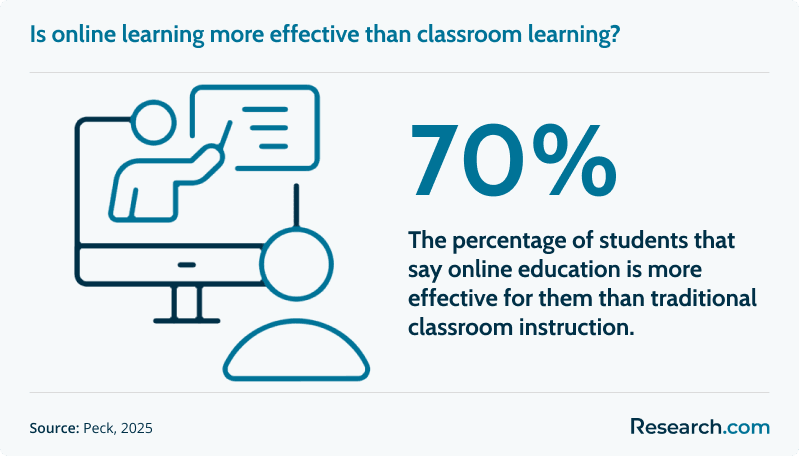
The rise of flexible online education has made shorter academic terms easier to deliver. Students are more accustomed to online platforms, remote advising, recorded lectures, digital textbooks, and mobile learning tools. Survey data cited in online learning research reports that nearly 70% of students say online education is more effective for them than traditional classroom instruction. That broader acceptance helps explain why colleges continue experimenting with compressed formats.
Short-format learning is also expanding in practical and technical fields. For instance, fast-track online autocad certificate programs show how career-oriented skills can be taught in shorter blocks when the curriculum is structured around focused outcomes.
What are the advantages of taking 4-week accelerated courses online?
The main advantage of a 4-week online course is momentum. Instead of stretching one requirement across several months, you focus on one subject, complete it quickly, and move to the next academic step. That can be especially helpful for students returning to college, transferring credits, trying to graduate on time, or meeting a deadline for admission into another program.
Faster credit completion
A 4-week class can help students finish degree requirements faster when it fits into a well-planned academic schedule. This does not mean the course is easier. In most cases, the same credit value is compressed into fewer weeks, so the weekly workload is heavier.
The long-term value of completing college credits depends on the student’s goals and the credential being pursued. The U.S. Bureau of Labor Statistics reports a clear relationship between education and earnings, with median weekly earnings in 2024 ranging from $2,363 for professional degree holders to $930 for those with only a high school diploma. A short course alone will not guarantee higher pay, but it can help students move more efficiently toward credentials that employers may value.
More flexibility for working adults
Online delivery can make it easier to study around work, caregiving, military service, or unpredictable commuting schedules. Many 4-week courses use asynchronous lectures and discussion boards, allowing students to complete coursework at different times of day. However, flexibility does not eliminate deadlines. Accelerated courses often require several assignment submissions each week.
Useful for testing a field before committing
Short courses can help students explore a subject before choosing a major or longer program. A student considering humanities, theology, ministry, nonprofit leadership, or education might start by researching what can you do with a religious studies degree and then use a short elective to test interest before committing to a full path.
Access to creative and technical subjects
Some accelerated options extend beyond general education. Students exploring creative careers may compare short-format courses with the shortest audio and music programs online. The key is to check whether the course provides academic credit, portfolio development, professional training, or all three.
Stronger time-management habits
Students who succeed in a 4-week course often become better at planning study sessions, prioritizing assignments, communicating with instructors, and avoiding last-minute work. Those habits can carry over into longer degree programs and professional roles where deadlines are frequent.
| Advantage | Why it matters | Best use case |
| Speed | You can complete a requirement in weeks instead of months. | Finishing prerequisites, electives, or summer credits. |
| Focused schedule | You may study one subject intensively instead of juggling several. | Students who prefer concentrated learning blocks. |
| Online access | You can study without relocating or commuting. | Working adults, caregivers, and remote learners. |
| Career exploration | You can test a subject before committing to a degree. | Students comparing majors or career paths. |
| Academic momentum | Quick completion can help prevent long gaps between courses. | Adult learners returning to college. |
What are the drawbacks of 4-week online college courses?
Accelerated online courses are not automatically better than traditional courses. They work best when the subject, instructor design, student schedule, and academic goal match the compressed timeline.
- Heavy weekly workload: Missing even a few days can put students behind because the course moves quickly.
- Limited time for difficult concepts: Math, science, writing-intensive, and technical courses may require more practice than a 4-week term comfortably allows.
- Less room for life disruptions: Illness, work emergencies, childcare changes, or travel can be harder to manage in a short course.
- Potential transfer issues: Credits may not apply to another institution unless the receiving school approves them.
- Higher risk when taking multiple classes: Two accelerated courses at once can feel like a full-time academic load or more.
Are 4-week college courses from online schools accredited?
Accreditation should be one of the first things you verify before enrolling in any 4-week online college course. Accreditation indicates that a school or program has been reviewed against recognized quality standards. The U.S. Department of Education explains that accreditation helps determine whether institutions meet established quality standards, which can affect credit transfer, employer recognition, and eligibility for some forms of financial aid.
For most students, institutional accreditation is the starting point. If you are taking a course for nursing, education, counseling, social work, engineering, accounting, or another regulated field, program-level accreditation or state approval may also matter. A course can be offered by an accredited college and still fail to meet a specific licensure or transfer requirement if it is not the right course for your destination program.
How to check accreditation before enrolling
- Find the school’s official accreditation page, usually listed under consumer information, institutional effectiveness, or academic catalog sections.
- Confirm the accreditor through an official government or recognized accreditation database rather than relying only on marketing pages.
- Ask whether the specific course is credit-bearing and appears on an official transcript.
- If you plan to transfer, get written confirmation from the receiving school before paying tuition.
- If the course supports licensure or certification, confirm acceptance with the licensing board, certification body, or academic department.
Which colleges offer 4-week online college courses for 2027?
Colleges that offer 4-week online courses often do so through adult learning divisions, summer sessions, online campuses, continuing education units, or programs with frequent start dates. Course availability changes by term, so students should search the current academic catalog and schedule of classes rather than assuming every subject is available every month.
Some institutions also offer accelerated programs in creative or applied fields. Students comparing visual arts training, for example, may review the shortest digital photography online programs while checking whether courses are credit-bearing, portfolio-based, or certificate-focused.
Examples of institutions associated with online or accelerated course options include:
Before choosing a school, compare more than course length. Look at accreditation, tuition, start dates, transfer rules, student support, refund policies, instructor access, and whether the course applies to your degree plan.
| Question to ask the school | Why it matters |
| Is this course worth college credit? | Some short online options are continuing education or certificate courses rather than transcripted credits. |
| How many credits does the course carry? | A 4-week course may still carry the same credit weight as a semester course, affecting workload and tuition. |
| Will this satisfy my requirement? | Course titles can be similar even when degree applicability differs. |
| Can I transfer this credit? | The receiving institution makes the final transfer decision. |
| Are exams proctored? | Proctoring may require scheduling, identity verification, webcam access, or added fees. |
| What happens if I withdraw? | Refund and withdrawal windows may be much shorter in accelerated terms. |
How much do 4-week college courses online typically cost?
Tuition for a 4-week online course depends on the school, credit level, residency status, fees, textbooks, technology requirements, and whether the course is part of a degree program or a standalone enrollment. The short calendar does not always mean a lower price. If the course carries the same number of credits as a semester-long class, the tuition may be similar.
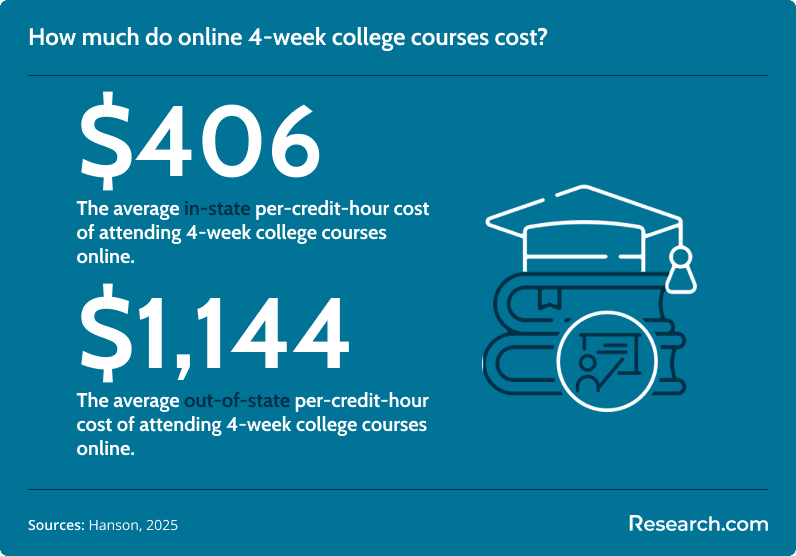
According to the Education Data Initiative, the average public, four-year university charges in-state residents about $406 per credit hour, but when room and board are included, the cost rises to around $933 per credit hour. Out-of-state students typically pay more, averaging $1,144 per credit hour, or close to $1,655 per credit when living expenses are included.
Specialized online programs can use different pricing models. For example, the fastest online animation degree programs may include program fees, software expectations, portfolio requirements, or course materials that differ from a standard general education class. Always calculate the full cost, not just the advertised tuition.
| Cost factor | What to look for | Why it matters |
| Tuition per credit | Resident, nonresident, online-only, undergraduate, or graduate rates. | The credit rate is usually the largest cost driver. |
| Fees | Technology, online course, proctoring, registration, or lab fees. | Fees can make a low-tuition course more expensive than expected. |
| Books and materials | Digital textbooks, access codes, software, or supplies. | Accelerated courses may require materials before the first day. |
| Transfer value | Whether the credits apply to your target degree. | A cheap course is costly if it does not count toward your goal. |
| Withdrawal policy | Refund deadlines and academic penalty dates. | Short courses often have very brief refund windows. |
How many hours per week do 4-week online courses require?
Because a 4-week course compresses a larger amount of academic work into a short term, the weekly time commitment is substantial. Students can expect to spend anywhere from 15 to 25 hours per week per course, depending on the subject, credit load, assignment design, reading volume, and assessment schedule.
That pace can work well for motivated students who can protect study time. It can be difficult for learners working overtime, managing unpredictable caregiving responsibilities, or taking multiple demanding classes at once. If you are considering healthcare coursework, reviewing the best health science majors to pursue can help you decide whether an accelerated class supports your long-term plan or simply adds pressure.
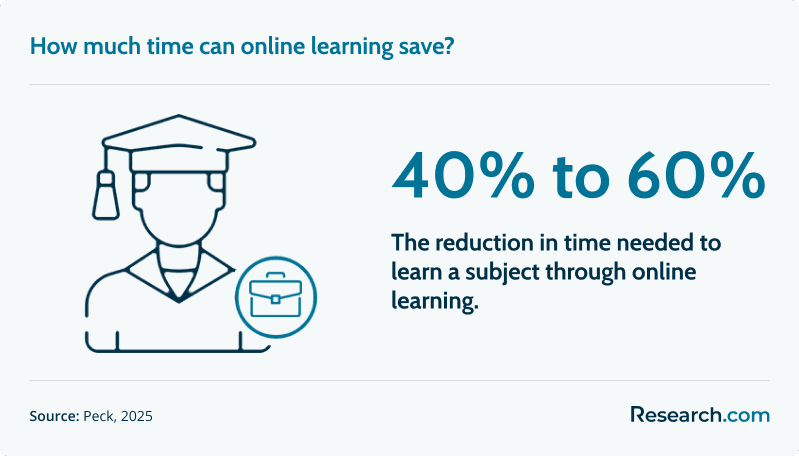
Online learning research reports that online instruction can reduce the time needed to master a subject by 40% to 60% compared to face-to-face instruction. Even so, a shorter course is not a shortcut around learning. Students still need time to read, practice, write, participate, study, and ask questions. For nurses or healthcare professionals considering specialized credentials, it may be useful to explore what can you do with a nursing informatics graduate certificate before deciding whether an accelerated format is appropriate.
| Weekly study habit | Recommended approach for a 4-week course |
| Course login | Check the course site daily or nearly daily. |
| Reading | Finish assigned readings early in the week to leave time for assignments. |
| Discussions | Post initial responses early and return for replies before the deadline. |
| Assignments | Break papers, projects, or problem sets into smaller daily tasks. |
| Instructor communication | Ask questions immediately; waiting several days can cost a large share of the course. |
| Exam preparation | Study throughout the week instead of cramming at the end. |
What platforms or learning management systems are used for accelerated courses?
Most accelerated online college courses are delivered through a learning management system, often called an LMS. Common platforms include Canvas, Blackboard, Moodle, and Brightspace. These systems organize lectures, readings, quizzes, assignments, grades, announcements, and discussion boards in one online space.
Some instructors also use Zoom, Microsoft Teams, Google Classroom, publisher homework systems, plagiarism detection tools, remote proctoring software, or discipline-specific applications. In a 4-week class, technology readiness matters because there is little time to recover from access problems.
Technology checklist before the first day
- Log in to the LMS before the course starts, if access is available.
- Confirm your school email, password, and multifactor authentication are working.
- Check whether the course requires webcam access, a microphone, or proctored exams.
- Download required software and test it before assignments are due.
- Review mobile access, but do not rely only on a phone for writing papers or taking exams.
- Save instructor contact details and technical support information.
Can 4-week online courses count toward a college degree?
Many 4-week online college courses can count toward an associate, bachelor’s, or graduate program when they are offered for credit by an accredited institution and fit the student’s degree requirements. These courses may satisfy general education categories, electives, prerequisites, major requirements, or transfer credits, depending on the school and program.
Credit is not automatic across all institutions. The school receiving the credit decides whether to accept it and how it applies. A course that counts as an elective at one college may not satisfy a major requirement at another. Students should get approval before enrolling, especially if they are taking a course outside their home institution.
Degree completion can affect employment outcomes over time. According to BLS, individuals with a bachelor’s degree or higher have significantly better employment outcomes than those with only a high school diploma. As of July 2025, over 65 million people with a bachelor’s degree or more were employed, compared to about 34 million with only a high school diploma.
For students pursuing advanced healthcare pathways, the value of a course depends on whether it supports the next credential. For example, learners comparing careers with a women's health NP graduate certificate should confirm prerequisite, clinical, and licensure requirements rather than assuming every accelerated course will apply.
What financial aid options are available for 4-week online courses?
Financial aid for 4-week online courses depends on the school, the student’s enrollment status, the academic program, and whether the course is part of an eligible degree or certificate. A standalone course may not qualify for the same aid as a course embedded in an approved program.
- Federal student aid: Students enrolled in eligible programs may be able to use federal aid, but enrollment intensity and term structure can affect disbursement.
- Institutional scholarships: Some colleges offer scholarships or grants for online, adult, transfer, military, or degree-completion students.
- Employer tuition assistance: Working adults should ask whether their employer reimburses accredited courses related to their role or career path.
- Payment plans: Monthly or term-based payment plans can help spread tuition, although short courses may have faster payment deadlines.
- Workforce or military benefits: Eligible students may qualify for workforce development funding, veterans benefits, or military tuition assistance, depending on program approval.
Students comparing short graduate-level options may also review affordable graduate certificate programs online to understand how cost, credential value, and program length interact. The cheapest course is not always the best choice if it does not count toward a credential or professional goal.
Who should choose a 4-week online college course?
A 4-week course is best for students who have a clear academic reason, a realistic schedule, and the discipline to keep up with fast deadlines. It is especially useful when the course is familiar, elective, or required for a near-term goal.
| Choose a 4-week course if | Consider a longer course if |
| You need to complete a general education requirement quickly. | The subject is difficult for you or builds toward advanced coursework. |
| You can study most days of the week. | You can only study once or twice per week. |
| You are taking one accelerated course at a time. | You plan to take several intensive courses while working full time. |
| You have confirmed the credit applies to your degree. | You are unsure whether the course transfers or satisfies a requirement. |
| You are comfortable with online learning tools. | You need substantial in-person support, labs, or hands-on instruction. |
How to choose the right 4-week online college course
The best course is not simply the fastest one. It is the course that helps you meet a verified academic or career requirement at a cost and workload you can manage.
- Start with your goal. Decide whether you need transfer credit, a prerequisite, degree progress, career training, or personal enrichment.
- Confirm accreditation and credit status. Make sure the course is offered by an accredited institution and appears on an official transcript if you need college credit.
- Check degree applicability. Ask your advisor or receiving institution whether the course satisfies the exact requirement you need.
- Review the syllabus before enrolling. Look for assignment frequency, exam dates, required books, discussion rules, and proctoring expectations.
- Calculate total cost. Include tuition, fees, books, software, exam proctoring, and any materials.
- Protect study time. Block 15 to 25 hours per week per course before the term begins.
- Use support early. Contact instructors, tutoring services, library support, and technical help before small problems become course-threatening.
Common mistakes to avoid
Most problems with 4-week online courses come from unclear expectations. Students often focus on the short timeline and overlook transfer rules, workload, accreditation, or cost details.
| Mistake | Why it causes problems | Better approach |
| Choosing only by speed | The fastest course may not fit your learning style or academic goal. | Choose based on credit value, course fit, support, and schedule. |
| Skipping accreditation checks | Credits from unrecognized providers may not transfer or qualify for aid. | Verify institutional and, when needed, program-level accreditation. |
| Assuming all online credits transfer | Transfer decisions are made by the receiving institution. | Get written confirmation before enrolling. |
| Taking too many accelerated courses | Compressed deadlines can overlap and become unmanageable. | Start with one 4-week course unless an advisor confirms the load is realistic. |
| Ignoring refund deadlines | Short terms often have short withdrawal and refund periods. | Review academic calendar dates before the first day. |
| Waiting to ask for help | A delay of several days can represent a large portion of the course. | Contact the instructor or support services as soon as confusion starts. |
| Looking only at tuition | Fees, textbooks, software, and proctoring can change the real cost. | Compare the full cost of attendance for the course. |
Current trends affecting 4-week online college courses
Several trends are shaping how colleges design and deliver accelerated online courses. Students should understand these shifts because they affect workload, support, and the value of short-format credentials.
- More adult-focused scheduling: Colleges are expanding shorter terms to serve working adults, transfer students, and learners returning to finish degrees.
- Greater use of online platforms: LMS tools, video conferencing, digital assessments, and mobile access make compressed courses easier to manage, but they also require stronger technology readiness.
- Employer attention to skills: Short courses can support career development when they build documented competencies, but employers may still distinguish between a single course, a certificate, and a full degree.
- Closer scrutiny of value: Rising college costs make students more likely to compare tuition, time to completion, transferability, and return on investment before enrolling.
- Continued importance of accreditation: As more providers offer online learning, students need to separate accredited college courses from noncredit training that may not apply to degrees or aid eligibility.
Here’s what graduates have to say about 4-week college courses online
- : "A 4-week online class helped me finish the credits I still needed for my associate degree. The pace was demanding, but it forced me to plan my week carefully and stay ahead of deadlines. I later used those credits when applying for an office administrator position that required college coursework. Being able to study online also made it possible to keep my part-time job while finishing the class. — Jessica"
- : "I took accelerated online courses while preparing to move into healthcare support work. The short format was practical because I could connect the assignments to what I expected to do on the job. Soon after finishing, I entered an entry-level role and started earning more than $40,000 annually. The biggest benefit was being able to keep up with family responsibilities while studying. — Michael"
- : "As a full-time IT support specialist, I needed a way to complete general education requirements without pausing my career. The 4-week online format helped me finish credits quickly and stay on track for my bachelor’s degree. The experience also prepared me for future technology certifications by improving my study routine. My employer noticed the effort, and I was promoted within a year. — Renee"
References
- BLS. (2025). THE EMPLOYMENT SITUATION — JULY 2025. bls.gov.
- BLS. (2025, April 18). Education pays. bls.gov.
- Hanson, M. (2025, February 13). Average cost per credit hour & college class: 2024 data. Education Data Initiative. educationdata.org.
- Hanson, M. (2025, January 15). Educational Attainment Statistics [2025]: Levels by Demographic. Education Data Initiative. educationdata.org.
- Peck, D. (2025). Online Learning Statistics: The Ultimate list in 2025. devlinpeck.com.
Key Insights
- Four-week online college courses are legitimate options when they are credit-bearing, offered by accredited institutions, and approved for your academic plan.
- The format is fast, not easy. Students should expect anywhere from 15 to 25 hours per week per course.
- Cost depends on credit rate, fees, materials, residency, and program type; a shorter course does not automatically mean cheaper tuition.
- Transfer approval is essential. The receiving school decides whether credits count and how they apply.
- Accelerated courses are strongest for general education, electives, prerequisites, and focused skill-building; they may be harder for lab-heavy, clinical, or highly technical subjects.
- The best candidates are organized learners with protected study time, reliable technology, and a clear reason for taking the course.
- Before enrolling, verify accreditation, credit value, workload, financial aid eligibility, refund deadlines, and whether the course supports your degree or career goal.
Other Things You Should Know About 4-Week College Courses Online
Yes, students need a reliable internet connection and a computer with specifications that support video conferencing software and online learning platforms. Specific software or browser recommendations may vary by institution. Check with your chosen college for detailed requirements before enrollment.
Many 4-week online college courses do require proctored exams, especially for math, science, and general education classes. Proctoring may use a live online service or an approved testing center, and the syllabus usually lists the exact exam dates and proctoring rules before the course starts.


