2027 Most Affordable Online Bachelor's for Veterans Degree Programs

Co-Founder and Chief Data Scientist
A remarkable 47% of veterans complete their college degree, a rate significantly higher than that of other independent students. This potential for success, however, raises the stakes of your decision. The fear of wasting your one-time educational benefits on a program that fails to provide a valuable career outcome is a real and valid concern.
Prepared by career planning experts with more than 10 years of experience, provides the insights you need to select the right affordable online bachelor’s for veterans program. Our objective is to help you achieve a high-value degree, successfully launch your career.
What are the benefits of getting an online bachelor’s for veterans degree?
- An online bachelor's degree translates your military experience into a credential that civilian employers immediately understand, opening doors to leadership roles.
- Veterans pursuing degrees at IPEDS institutions reported average earnings of $44,700, providing a strong financial foundation for a new career.
- The online format offers unmatched flexibility to study on your schedule, which is essential for balancing work, family, and the realities of military life.
What can I expect from an online bachelor’s for veterans degree programs?
You can expect a learning environment that is just as academically rigorous as an on-campus program. Courses are delivered through digital platforms where you access lectures, submit assignments, and interact with professors. The degree you earn is identical to the one awarded to on-campus students.
Success in this environment requires a different kind of discipline. It's less about direct supervision and more about proactive time management and self-motivation. You are in command of your own schedule, which demands personal accountability to stay on track.
Where can I work with an online bachelor’s for veterans degree programs?
Your degree, combined with your military background, makes you a prime candidate for roles in the federal government, defense contracting, logistics, and corporate management. These sectors specifically value the discipline, leadership, and technical skills inherent in military service, and a bachelor's degree makes you highly competitive for these positions.
This credential formalizes your expertise for civilian employers. It acts as a bridge, translating your extensive military experience into a language that hiring managers understand and seek, positioning you as a subject matter expert with a verified academic qualification.
How much can I make with an online bachelor’s for veterans degree programs?
Veterans pursuing degrees at IPEDS institutions reported average earnings of $44,700. This figure provides a strong baseline for your financial planning as you transition into a civilian career, demonstrating a clear return on the time invested in your education.
However, the most critical financial impact comes from graduating with zero debt. An affordable online bachelor’s for veterans program funded by your benefits is a powerful wealth-building tool. This insulates you from the national student debt crisis, providing a significant head start in financial freedom compared to civilian peers.
- List of the Most Affordable Online Bachelor’s for Veterans Degree Programs for 2027 List of Programs
- How long does it take to complete an online bachelor’s for veterans degree programs? Completion Time
- How does an online bachelor’s for veterans program compare to a traditional on-campus program? How does an online bachelor’s for veterans program compare to a traditional on-campus program?
- What is the average cost of an online bachelor’s for veterans degree programs? Program Cost
- What are the financial aid options for students enrolling in an online bachelor’s for veterans degree programs? Financial Aid
- What are the prerequisites for enrolling in an online bachelor’s for veterans degree programs? What are the prerequisites for enrolling in an online bachelor’s for veterans degree programs?
- What courses are typically offered in an online bachelor’s for veterans degree programs? What courses are typically offered in an online bachelor’s for veterans degree programs?
- What types of specializations are available in an online bachelor’s for veterans degree programs? What types of specializations are available in an online bachelor’s for veterans degree programs?
- How to Choose the Best Affordable Online Bachelor’s for Veterans Degree Programs How to Choose the Best Affordable Online Bachelor’s for Veterans Degree Programs
- What career paths are available for graduates of an online bachelor’s for veterans degree programs? Career Paths
- Can additional certifications enhance my career prospects? Can additional certifications enhance my career prospects?
- What is the job market for graduates of an online bachelor’s for veterans degree programs? Job Market
Most Affordable Online Bachelor’s Degree Programs for Veterans in 2027
Choosing an online bachelor’s program as a veteran is not just about finding the lowest tuition. The better question is: which accredited program will accept the most military credit, work smoothly with VA benefits, offer real academic support, and lead to a credential that fits your civilian career plan?
This guide is built for veterans, active-duty service members, reservists, National Guard members, military spouses, and dependents comparing affordable online bachelor’s programs. It explains how to evaluate tuition, GI Bill coverage, transfer credit, accreditation, online flexibility, career outcomes, and veteran support services. It also highlights programs that may fit students moving into fields such as business, healthcare, technology, criminal justice, education, public service, or graduate pathways that may later involve requirements such as average GMAT scores for MBA programs.
Quick Answer: What Is the Best Affordable Online Bachelor’s Program for Veterans?
The best affordable online bachelor’s program for veterans is usually a regionally accredited program that accepts military training for credit, is approved for GI Bill benefits, offers dedicated veteran support, and has a total cost that your benefits can cover without unnecessary borrowing. The lowest advertised tuition is not always the best deal if the school accepts few transfer credits, has limited student support, or does not align with your career goal.
For many veterans, public universities with strong online divisions and clear military credit policies provide the best balance of affordability and recognition. Private or out-of-state schools may also be worth considering when they participate in the Yellow Ribbon Program or offer military tuition discounts.
How to Use This Ranking
This list should be a starting point, not the final decision. Compare each school by cost per credit, required credits, accreditation, military benefits support, online format, and whether the specific major matches your intended career. A program that is affordable for one veteran may be less affordable for another depending on transfer credits, residency rules, GI Bill eligibility, and out-of-pocket fees.
| Decision Factor | Why It Matters for Veterans | What to Verify Before Applying |
| Accreditation | Accreditation affects employer recognition, transferability, graduate school admission, and financial aid eligibility. | Confirm the institution is accredited by the listed accreditor and approved for VA education benefits. |
| Military transfer credit | Credit for training and experience can shorten your time to graduation and reduce total cost. | Ask how the school evaluates the Joint Services Transcript or Community College of the Air Force transcript. |
| GI Bill and Yellow Ribbon participation | Benefits may cover tuition, fees, housing, books, and costs above standard GI Bill limits. | Use the VA’s official tools and the school’s veterans office to confirm benefit coverage. |
| Online course format | Asynchronous courses may work better for students balancing work, family, deployments, or relocation. | Ask whether classes require live attendance, campus visits, proctored exams, or scheduled meetings. |
| Career fit | The right major should translate military experience into civilian employment opportunities. | Review curriculum, internships, career services, certification alignment, and alumni outcomes where available. |
How We Rank Schools
Research.com evaluates online bachelor’s programs for veterans using available education data and program-level information so readers can compare schools with more context than tuition alone. The ranking draws from sources such as the IPEDS database, Peterson's database, the College Scorecard database, and The National Center for Education Statistics.
These sources help assess affordability, institutional profile, and other factors relevant to online learners and military-affiliated students. To understand how Research.com evaluates schools and programs, review the Research.com methodology page.
Affordable Online Bachelor’s Programs for Veterans: School List
1. Daytona State College - B.S. in Engineering Technology, B.A.S. in Supervision & Management, B.S. in Information Technology
Daytona State College is a practical option for veterans looking for low tuition and applied bachelor’s programs connected to workforce needs. Its "Purple Star School of Distinction" designation signals a formal commitment to military-affiliated learners, while its student-led transition program gives incoming veteran students peer support as they adjust to college expectations and civilian career planning.
- Program Length: 4 years
- Required Credits to Graduate: 120
- Cost per Credit: $120.32
- Accreditation: Southern Association of Colleges and Schools Commission on Colleges (SACSCOC)
2. University of Florida - B.S. in Business Administration, B.A. in Criminology, B.S. in Health Education
The University of Florida may appeal to veterans who want a widely recognized public university with strong online offerings. U.S. News & World Report ranked it No. 1 for Best Online Programs for Veterans, and its Yellow Ribbon Program participation can be especially important for eligible students facing out-of-state or higher-cost tuition gaps.
- Program Length: 4 years
- Required Credits to Graduate: 120
- Cost per Credit: $129.00
- Accreditation: Southern Association of Colleges and Schools Commission on Colleges (SACSCOC)
3. Fort Hays State University - B.S. in Computer Science, B.A. in Psychology, B.S. in Nursing (RN to BSN)
Fort Hays State University is worth reviewing if you want a school that explicitly recognizes military training. Its Associate of Applied Science in Technology and Leadership is built to maximize military credit, allowing service members to transfer up to 36 credit hours for eligible training and experience.
- Program Length: 4 years
- Required Credits to Graduate: 120
- Cost per Credit: $265.05
- Accreditation: Higher Learning Commission (HLC)
4. Florida State University - B.S. in Social Science, B.A. in Criminology, B.S. in Computer Science
Florida State University is best suited for students who already have 60 or more credits and want a degree-completion pathway from a major public university. Its online diplomas do not identify the delivery format, which can help students feel confident that the credential carries the same institutional identity as an on-campus degree.
- Program Length: 4 years
- Required Credits to Graduate: 120
- Cost per Credit: $180.49
- Accreditation: Southern Association of Colleges and Schools Commission on Colleges (SACSCOC)
5. Georgia Southern University - B.S. in Information Technology, B.S. in Criminal Justice, B.A. in Modern Languages
Georgia Southern University combines online bachelor’s options with veteran-focused support through Military Resource Centers and Online Student Success Navigators. Its program mix may be useful for veterans targeting technology, cybersecurity, data science, criminal justice, cybercrime, or language-related career paths.
- Program Length: 4 years
- Required Credits to Graduate: 124
- Cost per Credit: $250.00
- Accreditation: Southern Association of Colleges and Schools Commission on Colleges (SACSCOC)
6. University of Central Florida - B.S. in Nursing (RN to BSN), B.S. in Health Services Administration, B.A. in Communication and Conflict
The University of Central Florida offers a veteran-friendly online environment backed by its Collegiate Purple Star Campus designation. A personal success coach is assigned to every online student, which can be valuable for veterans who want guided support from application through graduation.
- Program Length: 4 years
- Required Credits to Graduate: 120
- Cost per Credit: $179.19
- Accreditation: Commission on Colleges of the Southern Association of Colleges and Schools (SACS)
7. North Carolina Central University - B.S. in Criminal Justice, B.S. in Nursing (RN to BSN), B.S. in Early Childhood Education
North Carolina Central University may be a strong fit for veterans seeking an HBCU with online programs, structured academic planning, and individualized support. Its "Flight Path Programs" are designed to help students stay on schedule, while its "Military Friendly School" recognition reflects services such as one-on-one academic guidance and career placement support.
- Program Length: 4 years
- Required Credits to Graduate: 120
- Cost per Credit: $185.00
- Accreditation: Commission on Colleges of the Southern Association of Colleges and Schools (SACSCOC)
8. Florida International University - B.A. in Psychology, B.S. in Hospitality Management, B.S. in Public Policy & Service
Florida International University brings over 25 years of online education experience to its programs for military-affiliated learners. Its Office of Veteran and Military Affairs can help students navigate benefits, academic planning, and priority course registration so they can build schedules around work, family, and service-related obligations.
- Program Length: 4 years
- Required Credits to Graduate: 120
- Cost per Credit: $235.57
- Accreditation: Southern Association of Colleges and Schools Commission on Colleges (SACSCOC)
9. American Public University System - B.S. in Homeland Security, B.A. in Management, B.S. in Cybersecurity
American Public University System is designed around affordability, frequent starts, and flexibility for adult and military-connected students. Its preferred military tuition rate, monthly course starts, no-cost textbooks, no application fees, and no-cost transfer credit evaluations can reduce friction for students trying to begin quickly and control expenses.
- Program Length: 4 years
- Required Credits to Graduate: 120
- Cost per Credit: $250.00
- Accreditation: Higher Learning Commission (HLC)
10. University of North Carolina Wilmington - B.S. in Clinical Research, B.A. in Interdisciplinary Studies, B.S. in Elementary Education
The University of North Carolina Wilmington offers a dedicated Military Affairs Wing where military-affiliated students can study, connect, and access support. Its accelerated online programs and multiple start dates can be helpful for veterans and military families who need more scheduling flexibility than a traditional academic calendar allows.
- Program Length: 4 years
- Required Credits to Graduate: 120
- Cost per Credit: $185.13
- Accreditation: Southern Association of Colleges and Schools Commission on Colleges (SACSCOC)
Program Comparison: Cost, Credits, and Accreditation
| School | Sample Online Bachelor’s Options | Required Credits | Cost per Credit | Accreditation |
| Daytona State College | B.S. in Engineering Technology; B.A.S. in Supervision & Management; B.S. in Information Technology | 120 | $120.32 | Southern Association of Colleges and Schools Commission on Colleges (SACSCOC) |
| University of Florida | B.S. in Business Administration; B.A. in Criminology; B.S. in Health Education | 120 | $129.00 | Southern Association of Colleges and Schools Commission on Colleges (SACSCOC) |
| Fort Hays State University | B.S. in Computer Science; B.A. in Psychology; B.S. in Nursing (RN to BSN) | 120 | $265.05 | Higher Learning Commission (HLC) |
| Florida State University | B.S. in Social Science; B.A. in Criminology; B.S. in Computer Science | 120 | $180.49 | Southern Association of Colleges and Schools Commission on Colleges (SACSCOC) |
| Georgia Southern University | B.S. in Information Technology; B.S. in Criminal Justice; B.A. in Modern Languages | 124 | $250.00 | Southern Association of Colleges and Schools Commission on Colleges (SACSCOC) |
| University of Central Florida | B.S. in Nursing (RN to BSN); B.S. in Health Services Administration; B.A. in Communication and Conflict | 120 | $179.19 | Commission on Colleges of the Southern Association of Colleges and Schools (SACS) |
| North Carolina Central University | B.S. in Criminal Justice; B.S. in Nursing (RN to BSN); B.S. in Early Childhood Education | 120 | $185.00 | Commission on Colleges of the Southern Association of Colleges and Schools (SACSCOC) |
| Florida International University | B.A. in Psychology; B.S. in Hospitality Management; B.S. in Public Policy & Service | 120 | $235.57 | Southern Association of Colleges and Schools Commission on Colleges (SACSCOC) |
| American Public University System | B.S. in Homeland Security; B.A. in Management; B.S. in Cybersecurity | 120 | $250.00 | Higher Learning Commission (HLC) |
| University of North Carolina Wilmington | B.S. in Clinical Research; B.A. in Interdisciplinary Studies; B.S. in Elementary Education | 120 | $185.13 | Southern Association of Colleges and Schools Commission on Colleges (SACSCOC) |
How Long Does an Online Bachelor’s Degree Take for Veterans?
Most online bachelor’s degrees require 120 credits and are commonly planned as 4 years of full-time study. Veterans may finish faster when schools award transfer credit for prior college coursework, military training, professional education, or documented learning from service.
The most important document for many applicants is the official military transcript. Depending on branch and background, this may include the Joint Services Transcript or the Community College of the Air Force transcript. Schools review these records to determine whether military training can satisfy general education, elective, or major-related requirements. In some cases, this can reduce the timeline by one to two years.
Students who want a faster path should look for programs with clear transfer policies, generous credit evaluation, multiple start dates, accelerated terms, and degree-completion options. Veterans comparing timelines may also want to explore accelerated military studies degree programs online if their goal is to convert service experience into academic progress as efficiently as possible.
| Student Situation | Likely Timeline Impact | What to Ask the School |
| No prior college credit | The program will likely follow the full 120-credit degree plan. | Can I study year-round or take accelerated sessions to finish sooner? |
| Military training documented on official transcripts | Some training may apply to electives, general education, or major requirements. | How many credits have students with similar military backgrounds typically received? |
| Prior college coursework | Transfer credits may reduce the number of remaining courses. | Which credits transfer, and will they apply to my major or only to electives? |
| Already completed 60 or more credits | A degree-completion program may be more efficient than starting over. | Can I receive a formal degree audit before enrolling? |
Online vs. On-Campus Bachelor’s Programs for Veterans
An accredited online bachelor’s degree can carry the same academic value as an on-campus degree from the same institution. Employer acceptance of online learning has grown: 87.4% of employers hired new graduates with an online degree, and 61% of HR leaders viewed online learning quality as equal to or better than traditional formats.
When an Online Bachelor’s Program Makes Sense
An online format is often the better choice for veterans who are working full time, raising children, relocating, managing medical appointments, supporting a spouse’s military career, or living far from campus. It can also work well for active-duty students who need access from different locations. The main advantage is control: you can choose when and where to study if the program is designed with flexible online delivery.
When an On-Campus Program May Be Better
A campus-based program can be useful if you want a daily academic routine, in-person faculty access, labs or facilities, local internships, and a physical veteran center. Some students also prefer the accountability and social environment of face-to-face classes. For veterans transitioning from structured military life, the campus setting can provide a familiar rhythm.
| Format | Best For | Potential Trade-Off |
| Online bachelor’s program | Veterans needing flexibility, relocation-friendly coursework, and access from home or work. | Requires strong self-management and comfort with digital learning platforms. |
| On-campus bachelor’s program | Students who want in-person services, fixed schedules, campus community, and direct networking. | Less flexible for employment, family responsibilities, relocation, or long commutes. |
| Hybrid bachelor’s program | Students who want online convenience but occasional campus interaction. | May still require travel, scheduled sessions, or location-based commitments. |
Veterans planning for healthcare careers should check whether the online format meets any clinical, licensure, or graduate admission requirements. For example, students exploring advanced nursing may compare long-term career considerations such as family nurse practitioner benefits before choosing an undergraduate route.
What Is the Average Cost of an Online Bachelor’s Degree for Veterans?
The average tuition for an online bachelor’s degree can range from approximately $24,000 to $69,000 for a complete 4-year program. Veterans should treat that range as a starting point because actual out-of-pocket cost depends on GI Bill eligibility, residency status, Yellow Ribbon funding, transfer credits, fees, textbooks, technology expenses, and how long it takes to finish.
For a veteran with full Post-9/11 GI Bill benefits attending a public, in-state university, tuition and required fees may be covered in full. Eligible students may also receive a monthly housing allowance, book stipend, and other benefit-related support depending on their service record, enrollment status, and program choice.
Affordability also depends on the degree’s purpose. A lower-cost program that does not lead toward your intended career may not be a good investment. Veterans considering administrative, management, or policy roles in healthcare can compare options such as easiest healthcare administration degrees if they want a practical route into healthcare leadership.
| Cost Item | Why It Can Change Your Final Price | How Veterans Can Reduce It |
| Tuition | Rates vary by school, residency, and program. | Compare public in-state options, military tuition rates, and Yellow Ribbon participation. |
| Credits required after transfer | More accepted credits can mean fewer classes to pay for. | Request a written evaluation of military and prior college credits before committing. |
| Fees | Online programs may include technology, course, or distance-learning fees. | Ask for a full cost estimate, not just tuition per credit. |
| Books and supplies | Course materials can add recurring expenses. | Check whether the school offers no-cost textbooks, book stipends, or open educational resources. |
| Time to completion | Extra semesters may increase tuition, fees, and living costs. | Choose a program with strong advising and a clear degree map. |
Financial Aid and Military Education Benefits for Online Bachelor’s Students
Veterans usually begin with earned military education benefits rather than traditional aid alone. In fiscal year 2024, 66% of beneficiaries were undergraduates, showing how central these benefits are for bachelor’s-level study. The key is understanding which benefits apply to your school, enrollment status, and remaining eligibility.
- The Post-9/11 GI Bill (Chapter 33): This benefit is the primary funding source for many veterans and is designed to cover in-state tuition and required fees at public universities.
- The Yellow Ribbon Program: This VA-school partnership can help eligible students cover costs above standard GI Bill limits at participating private or out-of-state institutions.
- Monthly Housing Allowance (MHA): Students enrolled more than half-time may qualify for a monthly housing payment tied to the school’s location and enrollment circumstances.
- Book and Supply Stipend: GI Bill benefits may include annual support for textbooks and required course materials.
- Veteran-Specific Scholarships: Universities, nonprofit groups, professional associations, and private organizations may offer scholarships for veterans, service members, spouses, and dependents.
Some students also combine a bachelor’s degree with targeted credentials. For example, a veteran entering accounting, auditing, fraud examination, or financial investigations may look at a CRFAC certification for forensic accountants as a later career-building step.
Questions to Ask the Veterans Benefits Office
- Is this exact online program approved for GI Bill benefits?
- How will my enrollment status affect tuition coverage, housing allowance, and book stipend eligibility?
- Does the school participate in the Yellow Ribbon Program for my program and student category?
- Will my benefits cover online fees, technology fees, course materials, or proctored exams?
- How much GI Bill eligibility do I have remaining, and will it cover the full degree plan?
Admission Requirements for Online Bachelor’s Programs for Veterans
Most online bachelor’s programs for veterans require proof of high school completion or the equivalent, official transcripts, and a completed application. Military-friendly institutions often focus more on your full academic and service record than on standardized test scores from years earlier.
Typical application materials include the following:
- High School Diploma or GED: Schools use this to confirm that you meet the baseline requirement for undergraduate admission.
- Military Transcripts: The Joint Services Transcript or Community College of the Air Force transcript allows the school to review military training for possible college credit.
- Official College Transcripts: Any previous college enrollment must usually be documented, even if you did not complete a degree.
- Online Application Form: This provides your personal details, education history, intended major, and other required information.
- Standardized Test Scores: Many military-friendly schools waive SAT or ACT requirements for veteran applicants, but policies vary by institution.
Common Courses in Online Bachelor’s Programs for Veterans
An online bachelor’s degree usually combines general education, major courses, electives, and possible transfer credit from prior learning. The exact curriculum depends on the major, but most programs are designed to build communication, analytical, technical, and leadership skills that support career mobility.
- General Education Courses: These courses cover areas such as English, math, science, history, and social science. Students trying to complete broad requirements efficiently may compare the fastest online humanities degree programs.
- Core Major Courses: These classes provide the main body of knowledge for fields such as business, information technology, criminal justice, healthcare administration, psychology, education, or public service.
- Specialization Courses: Some majors let students focus on a defined area such as cybersecurity, supply chain management, leadership, data science, public policy, or homeland security.
- Elective Courses: Electives can help students explore new subjects, complete a minor, or apply transfer credits that do not fit directly into the major.
- Credit for Military Experience: Military transcript credit is often applied to electives or general education, though some training may align with major requirements depending on the program.
Best Bachelor’s Specializations for Veterans
The strongest specialization is the one that connects your military background to a civilian labor market. Veterans with logistics, communications, leadership, security, healthcare, technical, training, or operations experience should look for majors that help translate those skills into language employers understand.
| Specialization | Why It Can Fit Veterans | Possible Career Direction |
| Logistics and Supply Chain Management | Military logistics experience can transfer naturally into civilian supply chain, transportation, procurement, and operations roles. | Logistics management, inventory control, distribution, operations planning. |
| Project Management | Veterans often bring experience coordinating teams, timelines, resources, and mission-critical tasks. | Project coordination, program support, operations management, IT project work. |
| Information Technology (IT) Management | Service members with technical backgrounds can formalize systems, cybersecurity, networking, or technology leadership skills. | IT management, cybersecurity operations, systems administration, technical project management. |
| Homeland Security | Security, emergency management, intelligence, and public safety experience may align with federal, state, or local roles. | Emergency management, security analysis, public safety administration, federal service. |
| Business Administration | Business programs can convert leadership and operational experience into management, finance, strategy, and organizational skills. | Management, consulting, entrepreneurship, operations, graduate business study. |
Veterans who want to continue into graduate study can choose a bachelor’s specialization that supports later credentials. For example, business-focused students may eventually compare options such as the shortest online master degree in business law.
How to Choose the Best Affordable Online Bachelor’s Program for Veterans
Start with accreditation and benefit eligibility, then compare cost, credit transfer, support, curriculum, and career fit. Do not choose a program only because it advertises military friendliness or low tuition. Ask for specific answers in writing before enrolling.
- Confirm regional accreditation: Accreditation helps protect the value of your degree for employment, graduate school, transfer credit, and financial aid.
- Verify VA approval: Make sure the exact program, delivery format, and school location are eligible for GI Bill use.
- Request a military credit evaluation: Submit your military transcript early and ask how credits apply to your degree plan.
- Calculate total cost, not only tuition: Include fees, books, technology requirements, transfer credit, and time to graduation.
- Review veteran services: Look for benefits counseling, priority registration, deployment policies, academic advising, tutoring, and career support.
- Check flexibility policies: Students managing relocation, duty changes, or family responsibilities should ask about withdrawals, leaves of absence, and asynchronous coursework. Military families may also compare online schools for military spouses.
- Match the major to a career: Choose a program that supports the jobs, certifications, graduate programs, or promotions you actually want.
Common Mistakes Veterans Should Avoid
| Mistake | Why It Can Be Costly | Better Approach |
| Choosing the cheapest tuition without checking fees | Extra fees can raise the total cost beyond the advertised rate. | Ask for a full cost-of-attendance estimate for online students. |
| Assuming all military credit will transfer | Schools may accept credits differently, and some may apply only as electives. | Get a degree audit before making an enrollment decision. |
| Ignoring accreditation | A poorly recognized credential can affect employment, licensure, transfer, and graduate admission. | Verify the institution’s accreditation and program-level requirements where relevant. |
| Using GI Bill benefits before comparing schools | Benefit months are limited, so inefficient programs can waste eligibility. | Compare degree plans, transfer policies, and expected graduation timelines first. |
| Assuming online means self-paced | Some programs have fixed deadlines, live sessions, or proctored exams. | Ask whether courses are asynchronous, synchronous, accelerated, or cohort-based. |
| Relying only on rankings | A highly ranked school may not be the best fit for your major, benefits, location, or schedule. | Use rankings as one input, then evaluate your personal cost and career fit. |
Current Trends Affecting Veterans in Online Bachelor’s Programs
Online education is now more accepted by employers, especially when the degree comes from an accredited institution and the student can demonstrate relevant skills. The employer data showing that 87.4% of employers hired new graduates with an online degree and that 61% of HR leaders view online learning quality as comparable or better supports this shift.
Veterans should also pay attention to skills-based hiring, cybersecurity demand, healthcare administration needs, artificial intelligence tools in the workplace, and employer interest in leadership, discipline, and adaptability. A bachelor’s degree can help translate military experience into civilian language, but graduates still need current technical skills, strong communication, and a clear resume strategy.
Career Paths for Graduates of Online Bachelor’s Programs for Veterans
A bachelor’s degree can help veterans qualify for civilian roles that require both formal education and leadership experience. The right path depends on your major, military background, location, certifications, and professional network. The following examples show common directions veterans may consider.
1. Logistics Manager
Logistics managers coordinate purchasing, inventory, transportation, warehousing, and supply chain operations. Veterans with logistics or operations experience may already understand high-pressure coordination, resource planning, and mission-focused execution.
Median Salary: $77,030 per year.
2. IT Project Manager
IT project managers guide technology projects from planning through completion, balancing scope, deadlines, budgets, and team communication. This path may fit veterans with technical training, systems experience, cybersecurity exposure, or leadership roles.
Median Salary: $95,370 per year.
3. Federal Law Enforcement Agent
Federal law enforcement agents investigate violations of federal law and often need strong judgment, discipline, ethics, communication, and analytical ability. A bachelor’s degree is a standard requirement for many competitive federal roles.
Median Salary: $74,740 per year.
4. Management Consultant
Management consultants help organizations diagnose problems, improve performance, and implement better systems. Veterans who have led teams, managed change, or solved operational challenges may find their experience relevant to consulting work.
Median Salary: $95,290 per year.
5. Operations Manager
Operations managers oversee processes, people, budgets, and performance across organizations. This role can be a strong civilian parallel for veterans who managed units, schedules, equipment, logistics, or mission execution.
Median Salary: $97,970 per year.
Some veterans use the bachelor’s degree as a foundation for graduate study or specialized training. Students interested in education careers, for instance, may compare fast track special education graduate programs online as a possible next step.
Can Certifications Improve Career Options After an Online Bachelor’s Degree?
Yes. Certifications can strengthen a veteran’s resume when they match the target career field. A bachelor’s degree may satisfy education requirements, while certifications can show job-specific ability in areas such as project management, cybersecurity, healthcare administration, accounting, data analysis, human resources, logistics, or education.
The best certification depends on the role you want. Do not collect credentials randomly. Instead, review job postings, identify repeated requirements, and choose certifications that employers actually request. Veterans looking for affordable post-bachelor’s credentials can compare the cheapest graduate certificates online.
Job Market Outlook for Online Bachelor’s Graduates Who Are Veterans
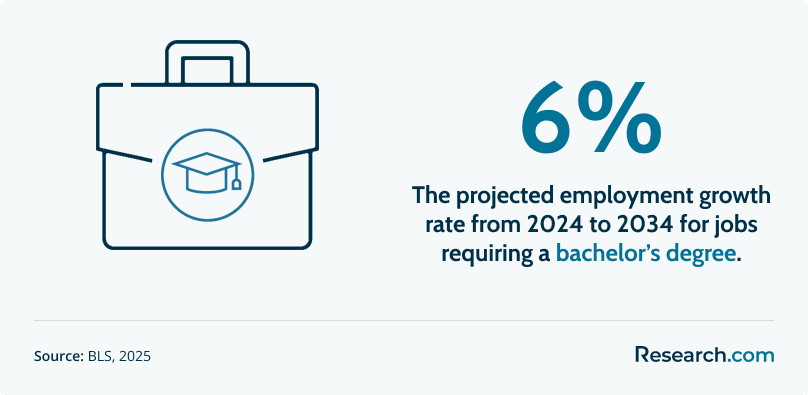
The labor market is generally favorable for workers with bachelor’s degrees. The Bureau of Labor Statistics projects a 6% employment growth rate for occupations requiring a bachelor’s degree between 2022 and 2032. Veterans may be especially competitive when they can combine the degree with leadership, technical skills, security clearance history where applicable, operational experience, and strong references.
Still, a degree does not guarantee a specific salary or job title. Outcomes vary by major, region, industry, experience, and how well you translate military accomplishments into civilian terms. Veterans should use career services early, build a civilian resume, connect with veteran hiring initiatives, and pursue internships or projects when possible.
What Graduates Say About Online Bachelor’s Programs for Veterans
- : "Using my GI Bill for an online program helped me finish without student loan debt. A lot of people I know are worried about repayment, but I was able to start the next stage of my career with a degree and more financial breathing room. — Jessie"
- : "I expected online classes to feel disconnected, but the opposite happened. Group projects and discussion boards introduced me to veterans in different states, and we ended up trading study advice, career ideas, and job leads. — Amiel"
- : "As a military spouse with two young children, flexibility mattered more than anything. I could complete lectures and assignments after bedtime, which would not have been possible with a fixed campus schedule. — Thony"
Key Insights
- The best program is not always the cheapest per credit. Veterans should compare total cost after GI Bill benefits, Yellow Ribbon funding, transfer credits, fees, and expected time to graduation.
- Accreditation is nonnegotiable. A regionally accredited institution is usually the safer choice for employer recognition, graduate school, transfer credit, and financial aid eligibility.
- Military credit can change the value of a program. A school that accepts more applicable military credit may be more affordable than one with a lower tuition rate but stricter transfer rules.
- Online programs work best for students who need flexibility. Veterans balancing work, family, relocation, or service obligations should ask whether courses are asynchronous, accelerated, or schedule-dependent.
- GI Bill planning should happen before enrollment. Confirm that the exact program is approved, understand how enrollment status affects benefits, and ask whether fees and materials are covered.
- Career fit should guide the major. Logistics, business, IT, cybersecurity, criminal justice, healthcare administration, and public service can align well with many military backgrounds, but the right choice depends on your goals.
- Use rankings as a filter, not a final answer. The strongest choice is the school that fits your benefits, credits, schedule, support needs, and career plan.
References:
- Bureau of Labor Statistics. (2024). Employment projections: Education pays. Retrieved from BLS.
- CollegeBoard. (2024). Trends in college pricing and student aid 2024. Retrieved from CollegeBoard.
- EducationData.org. (2024). Number of college graduates. Retrieved from EducationData.org.
- Ithaka S+R. (2023). Veterans’ enrollment: What do the data show? Retrieved from Ithaka S+R.
- National Center for Education Statistics. (2020). Persistence and attainment of 2011–12 first-time postsecondary students as of spring 2017 (NCES 2020-488rev). Retrieved from NCES.
- U.S. Department of Labor, Veterans’ Employment and Training Service. (2021). Veteran education and employment programs, 2016–2021. Retrieved from DOL.
Other Things You Should Know About Online Bachelor’s for Veterans Degree Programs
The U.S. Department of Veterans Affairs, through its Post-9/11 GI Bill, and the Department of Defense's Tuition Assistance Program are key organizations. Each offers funding specific to veterans enrolling in online bachelor's degree programs in 2027, subject to eligibility requirements.
Yes. Veterans can use GI Bill benefits for online bachelor's degrees if the school is VA-approved and the program leads to a degree. Post-9/11 GI Bill benefits may also include a monthly housing allowance, but fully online enrollment is paid at the national average rate, not the local campus rate.