
2027 Fastest Online Military Studies Degree Programs

Co-Founder and Chief Data Scientist
For individuals drawn to leadership, strategy, and the study of national security, an online military studies degree offers a structured path toward understanding how defense, diplomacy, and intelligence intersect. These programs attract active-duty personnel, veterans, and civilians who want to deepen their grasp of military history, organizational tactics, and global conflict while building credentials quickly for roles in government, defense, or consulting.
In this guide, I will outline what to expect from today’s online military studies degree programs, including how long they typically take to complete and how some students shorten their timelines through transfer credits or accelerated tracks.
I will also cover tuition structures, common admission requirements, and the types of careers available after graduation, from federal service to private security roles, so you can map a faster route to your goals.
What are the benefits of getting an online military studies degree?
- Military studies graduates can work in sectors like the Department of Defense, FEMA, FBI, and the UN, with online and flexible degree tracks and transfer credits allowing entrance in as little as two years.
- Graduates can earn $60,375–$93,935 as military officers, $111,789 as FBI agents, or $105,893 as security consultants, with accelerated programs enabling faster access to these salaries.
- Online military studies are often asynchronous, which lets students manage coursework alongside full-time jobs, deployments, or family responsibilities.
What can I expect from an online military studies degree?
An online military studies degree blends historical analysis, leadership theory, and strategic planning with coursework in intelligence, logistics, and defense policy. Students gain a multidisciplinary perspective by studying topics such as military history, homeland security, and organizational leadership, while also exploring how global politics and conflict shape defense strategies. The curriculum is designed to build critical thinking and decision-making skills applicable to careers in government, defense, or private-sector roles.
Most programs use asynchronous delivery, so students complete lectures, discussions, and research projects on flexible schedules. Many also feature capstone projects, internships, or simulated exercises where learners apply their skills in strategy and operations.
To support steady progress, schools often structure courses in shorter sessions and allow transfer credit for prior college, professional, or military experience. This structure enables a faster way for students to advance toward their degree and career goals.
Where can I work with an online military studies degree?
A military studies degree, online or otherwise, opens opportunities across government, defense, and civilian sectors. These programs prepare students for positions in organizations that address national security, emergency response, and global operations.
Common employment settings include:
- U.S. Military Branches: Active-duty and reserve components across the Army, Navy, Air Force, Marine Corps, and Space Force provide opportunities for leadership, planning, and operations.
- Federal Intelligence Agencies: Organizations such as the Defense Intelligence Agency and Central Intelligence Agency employ graduates to support intelligence collection, threat analysis, and global operations.
- Department of Defense and Civilian Agencies: Civilian offices within the Department of Defense hire for policy, logistics, and operational planning across domestic and international bases.
- Homeland Security and Emergency Management: Agencies like the Department of Homeland Security and the Federal Emergency Management Agency (FEMA) coordinate disaster response, infrastructure protection, and continuity planning.
- Federal Law Enforcement: Institutions such as the Federal Bureau of Investigation (FBI) and U.S. Marshals Service integrate military studies expertise into protective services and national security initiatives.
- International and Humanitarian Organizations: Groups such as the United Nations and the American Red Cross employ graduates to support crisis response, humanitarian relief, and global stability efforts.
- Educational and Training Institutions: Military academies, civilian universities, and defense-related training centers hire professionals to teach, develop, and manage programs in leadership, strategy, and security studies.
These sectors offer diverse paths for graduates to apply their education toward roles that impact security, policy, and international collaboration. The combination of flexible learning formats and credit-transfer opportunities allows many to transition efficiently into these settings.
How much can I make with an online military studies degree?
Earnings vary significantly depending on sector, rank, and role. Overall, pay for graduates of online military studies degree programs is often influenced by experience, location, and advancement potential.
Typical salary figures for commonly pursued positions include:
- Commissioned Military Officers: Base pay ranges from about $60,375 annually for an O-1 with over four years of service to roughly $93,935 for an O-3, excluding allowances and bonuses (Defense Finance and Accounting Service, 2025).
- FBI Special Agents: Average annual salary is approximately $111,789, based on federal pay scales (Indeed, 2025).
- Homeland Security Specialists: Earn about $31.03 per hour, or roughly $64,542 annually (ZipRecruiter, 2025).
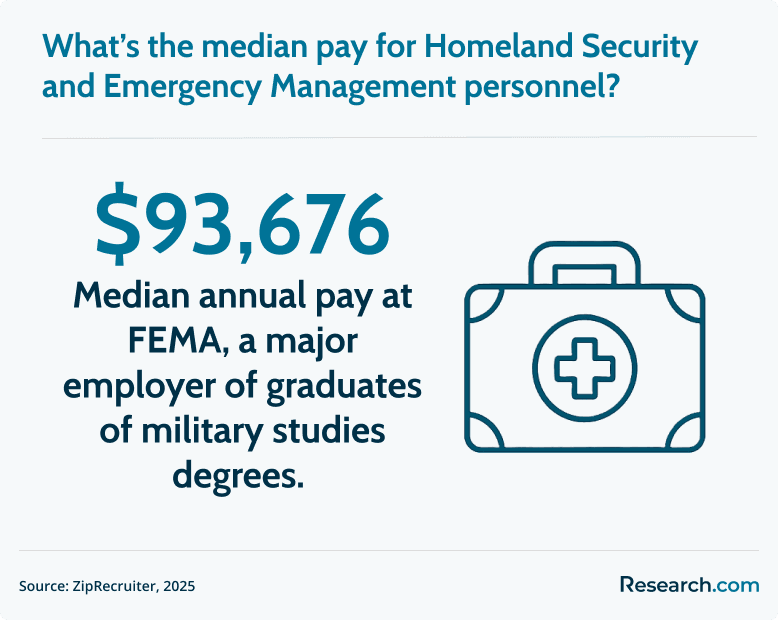
- Emergency Management Specialists (FEMA): Average salary is around $93,676 per year (ZipRecruiter, 2025).
- Deputy U.S. Marshals: Entry-level marshals in the GL-07 pay grade earn $38,511–$48,708 annually, depending on locality (Federal Law Enforcement, 2025).
- Defense and Security Consultants: Consultants with firms such as Booz Allen Hamilton earn an average of $73,117 annually (Indeed, 2025).
- Management Analysts: Median annual salary is about $101,190 (Bureau of Labor Statistics, 2024).
- Security Consultants: Average rate is $50.91 per hour, or about $105,893 annually (ZipRecruiter, 2025).
Accelerated degree options can help graduates qualify for these roles sooner, supporting faster access to higher earning potential.
- List of Online Military Studies Degree Programs for 2027 List of Programs
- How long does it take to complete an online military studies degree? Completion Time
- How do online military studies degree programs compare to on-campus programs? How do online military studies degree programs compare to on-campus programs?
- What is the average cost of an online military studies degree? Average Cost
- What are the financial aid options for students enrolling in online military studies degree programs? Financial Aid
- What are the prerequisites for enrolling in online military studies degree programs? Prerequisites
- What courses are typically in online military studies degree programs? What courses are typically in online military studies degree programs?
- What types of specializations are available in online military studies degree programs? Specializations
- How to choose the best online military studies degree programs? How to choose the best online military studies degree programs?
- Can Complementary Certifications Enhance Career Prospects? Can Complementary Certifications Enhance Career Prospects?
- What career paths are available for graduates with an online military studies degree? Career Paths
- What is the job market for online military studies degree graduates? Job Outlook
- How Can Advanced Intelligence Training Bolster Your Military Studies Career? How Can Advanced Intelligence Training Bolster Your Military Studies Career?
- What Is the Return on Investment of an Online Military Studies Degree? What Is the Return on Investment of an Online Military Studies Degree?
Best Online Military Studies Degree Programs for 2027
Choosing an online military studies degree is usually a practical decision, not just an academic one. Many students in this field are active-duty service members, veterans, military spouses, defense employees, or adults preparing for roles in security, intelligence, emergency management, policy, or public service. The right program should respect your schedule, evaluate prior military learning fairly, and connect your coursework to realistic career options.
This guide explains which online military studies programs offer flexible formats, what they cost, how long they may take, how online study compares with campus-based learning, and what career paths graduates commonly pursue. It also shows how to evaluate accreditation, transfer credit, military tuition benefits, specializations, and return on investment before enrolling.
Quick answer: What is the best online military studies degree?
The best online military studies degree is the one that matches your career target, accepts the most relevant transfer or military credits, holds recognized accreditation, and offers a course format you can complete consistently. Many bachelor’s programs require 120 credits and take about four years full time, but students with substantial transfer credit or military training may finish much faster. Programs with five-, seven-, or eight-week terms can be especially useful for working adults and service-connected students who need predictable pacing.
How these schools were evaluated
Research.com reviewed online military studies and closely related defense, strategy, security, and military-affiliated programs using our methodology. The review emphasized flexible online delivery, accelerated or condensed terms, military transfer-credit policies, tuition information, relevant concentrations, and institutional accreditation.
Program and institutional information was checked against current education data sources, including the Integrated Postsecondary Education Data System (IPEDS), Peterson’s Distance Learning database, the U.S. Department of Education’s College Scorecard, and the National Center for Education Statistics (NCES). Students should still confirm tuition, transfer policies, military rates, and program availability directly with each school before applying.
| School | Online program | Best fit | Credits | Listed cost per credit |
| Columbia Southern University | BS in Military Studies | Students seeking many concentration options and rolling starts | 120 | $278 |
| University of Arizona Global Campus | BS in Military Studies | Learners who prefer one five-week course at a time | 120 | $350 standard rate; $250 military grant rate |
| Arizona State University Online | BA in Applied Military and Veteran Studies | Veterans and public-service-focused students | 120 | Approximately $270 per credit |
| Liberty University | BS in Military Studies | Students seeking multiple annual start dates and military support | 120 | $390 |
| Uniformed Services University | Online graduate and certificate programs | Military and defense health professionals | 12 for certificate; 42 for master’s | Federal tuition rates apply |
| American Public University System | BA in Military History and related programs | Students with substantial transfer credit | 120 | $350 standard; $250 Preferred Military Rate |
| American Military University | BA in Military Studies | Service members and working adults needing monthly starts | 120 | $350 standard; $250 Preferred Military Rate |
| Ohio University | War and Peace Studies Undergraduate Certificate | Students seeking a short credential rather than a full bachelor’s | 18 | $315 |
| Hawai‘i Pacific University | BS in Diplomacy and Military Studies | Students interested in defense, diplomacy, and international security | 120 | Approximately $337 |
| Norwich University Online | BS in Strategic Studies and Defense Analysis | Students pursuing security strategy and defense analysis | 120 | $375 standard; $250 active-duty military rate |
1. Columbia Southern University
Columbia Southern University offers an online Bachelor of Science in Military Studies with eight-week terms and rolling start dates. This structure can help students move through courses steadily while balancing military, work, or family responsibilities.
The school provides a complimentary transfer-credit evaluation for service members, which is important for students hoping to apply military training or prior coursework toward degree requirements. The curriculum includes leadership, logistics, homeland security, and related defense-focused subjects.
- Program Length: 4 years full-time, or as few as 18 months with maximum transfer credit
- Tracks/concentrations: Criminology, Cybersecurity, Forensic Psychology, Homeland Security, Information Technology, Intelligence, International Management, Leadership, Logistics, Supply Chain Management
- Cost per Credit: $278
- Required Credits to Graduate: 120
- Accreditation: Distance Education Accrediting Commission (DEAC)
2. University of Arizona Global Campus
University of Arizona Global Campus offers an online Bachelor of Science in Military Studies built around five-week courses. Students typically take one course at a time, which can be useful for learners who want a focused format rather than juggling several classes simultaneously.
The program includes a Military Alliance team and allows students to seek credit for eligible military training. Coursework covers leadership, ethics, military history, and security policy for students preparing for defense, public safety, or homeland security roles.
- Program Length: 4 years full-time, or as few as 18 months with maximum transfer credit
- Tracks/concentrations: Military Studies
- Cost per Credit: $350 standard rate; $250 military grant rate
- Required Credits to Graduate: 120
- Accreditation: WASC Senior College and University Commission (WSCUC)
3. Arizona State University Online
Arizona State University Online offers a Bachelor of Arts in Applied Military and Veteran Studies through seven-week modules. The format supports concentrated study and may appeal to students who prefer shorter academic sessions.
The program focuses on military culture, veteran experience, leadership, and public service. It may be a strong fit for veterans, military-connected students, and learners planning careers that require an understanding of military communities and institutions.
- Program Length: 4 years full-time (120 credits)
- Tracks/concentrations: Applied Military and Veteran Studies
- Cost per Credit: Approximately $270 per credit (based on $32,394 annual tuition at 120 credits)
- Required Credits to Graduate: 120
- Accreditation: Higher Learning Commission (HLC)
4. Liberty University
Liberty University offers an online Bachelor of Science in Military Studies in eight-week courses with six annual start dates. This can help students begin without waiting for a traditional semester cycle.
The university provides military-focused support for prior-learning assessment and portfolio credit. Students may be able to apply eligible professional or service experience toward degree requirements. The curriculum includes military history, strategy, operations, and leadership topics.
- Program Length: 4 years full-time, or as few as 18 months with maximum transfer credit
- Tracks/concentrations: History, International Security, Leadership, Professional, Resiliency
- Cost per Credit: $390
- Required Credits to Graduate: 120
- Accreditation: Southern Association of Colleges and Schools Commission on Colleges (SACSCOC)
5. Uniformed Services University
Uniformed Services University of the Health Sciences is different from many programs on this list because it offers online graduate and certificate options for military and defense health professionals rather than a standard military studies bachelor’s degree.
Its seven-week modules emphasize applied knowledge in public health, policy, epidemiology, operational readiness, and health professions education. These programs are most relevant for students already connected to military medicine or defense health systems.
- Program Length: 7-week modules (certificate); 2 years typical (master’s)
- Tracks/concentrations: Global Health Engagement, Preventive Medicine, Biostatistics, Health Professions Education
- Cost per Credit: Federal tuition rates apply (military-sponsored)
- Required Credits to Graduate: 12 for certificate; 42 for master’s
- Accreditation: Middle States Commission on Higher Education (MSCHE)
6. American Public University System
American Public University System offers online bachelor’s programs with monthly start dates and no-cost e-textbooks for eligible military students. Its Bachelor of Arts in Military History allows up to 90 semester hours of transfer credit.
That transfer policy can be especially valuable for students who have prior college coursework, military learning, or other eligible credit. The program combines history, leadership, and security-related study for students interested in defense, public service, and related fields.
- Program Length: 4 years full-time, or 18–24 months with maximum transfer credit
- Tracks/concentrations: Military History, Intelligence Studies, Homeland Security, Emergency Management
- Cost per Credit: $350 standard; $250 Preferred Military Rate
- Required Credits to Graduate: 120
- Accreditation: HLC
7. American Military University
American Military University offers an online Bachelor of Arts in Military Studies with monthly start dates. The fully online format is designed for students who need scheduling flexibility because of work, deployment, relocation, or family obligations.
The program accepts up to 90 transfer credits, including eligible military training and certifications. Students study leadership, military operations, and strategic studies, which can support career goals in defense, intelligence, homeland security, or related public-sector roles.
- Program Length: 4 years full-time, or as few as 18 months with maximum transfer credit
- Tracks/concentrations: Military Studies
- Cost per Credit: $350 standard; $250 Preferred Military Rate
- Required Credits to Graduate: 120
- Accreditation: HLC
8. Ohio University
Ohio University offers an online War and Peace Studies Undergraduate Certificate rather than a full military studies bachelor’s degree. The certificate may work well for students who already have a degree plan and want focused study in conflict, diplomacy, and security.
The asynchronous format gives students flexibility, and the certificate can be completed in less than a year. The curriculum draws from multiple disciplines and can help students build a foundation for defense, policy, international affairs, or graduate study.
- Program Length: As few as 6 months full-time
- Tracks/concentrations: War and Peace Studies
- Cost per Credit: $315
- Required Credits to Graduate: 18
- Accreditation: HLC
9. Hawai‘i Pacific University
Hawai‘i Pacific University offers an online Bachelor of Science in Diplomacy and Military Studies. The program combines asynchronous online coursework with the option to engage through HPU’s military campus locations across Oahu.
Students may be able to receive transfer credit for prior military training, which can shorten the time needed to graduate. The curriculum blends historical, ethical, strategic, diplomatic, and international security perspectives.
- Program Length: 4 years full-time (48 months)
- Tracks/concentrations: Diplomacy and Military Studies
- Cost per Credit: Approximately $337
- Required Credits to Graduate: 120
- Accreditation: WSCUC
10. Norwich University Online
Norwich University Online offers a Bachelor of Science in Strategic Studies and Defense Analysis through seven-week modules. The program is designed for students interested in defense strategy, regional security, military operations, and applied analysis.
Students may transfer up to 90 credits, including eligible military training and professional certifications. The curriculum includes independent research projects on regional security and strategy, supported by faculty with defense and leadership experience.
- Program Length: 4 years full-time; as few as 18 months with maximum transfer credit
- Tracks/concentrations: Strategic Studies and Defense Analysis
- Cost per Credit: $375 standard; $250 active-duty military rate
- Required Credits to Graduate: 120
- Accreditation: HLC
How Long Does an Online Military Studies Degree Take?
Most online military studies bachelor’s degrees require 120 credits, which usually equals about four years of full-time study for students starting without prior college credit (National Center for Education Statistics, 2024). However, many military-affiliated students do not start from zero. Prior college courses, military training, professional certifications, CLEP or DSST exams, and portfolio credit can all affect the timeline.
Students entering with 60 transferable credits may be able to complete remaining requirements in roughly 23 months. Some competency-based or highly accelerated formats allow motivated students to finish in as few as 18–30 months. Students comparing accelerated security-related degrees may also want to review a fast-track homeland security master's degree online if they already hold a bachelor’s degree or plan to continue into graduate study.
| Path | Typical timeline stated | Who it fits best | Main caution |
| Traditional full-time bachelor’s route | About four years | Students with little or no prior college credit | Longest and often most expensive path |
| Year-round eight-week sessions | 24–36 months | Students who can maintain continuous enrollment | Short terms can feel intense |
| Competency-based learning | 18–30 months | Self-directed learners with strong discipline | Not every student thrives without fixed weekly structure |
| Transfer-credit route | 18–24 months | Students with military training or prior academic credit | Credit acceptance varies by school and program |
The fastest option is not always the best option. A shorter timeline only helps if the pace is realistic, the credits apply to your degree plan, and the format works with your service, job, and family responsibilities.
Online vs. Campus Military Studies Programs: Which Format Makes Sense?
Online and campus-based military studies programs can cover similar core topics, including strategy, leadership, military history, national security, civil-military relations, and defense policy. The main difference is how students interact with faculty, classmates, resources, and applied learning activities.
Online programs are often better for active-duty service members, veterans, military spouses, and working adults who cannot relocate or attend daytime classes. Students seeking flexible military-connected education may also find useful comparisons in guides to the best online schools for military spouses.
Campus programs may offer more direct access to physical archives, ROTC facilities, in-person leadership labs, military history collections, live tactical exercises, and face-to-face networking. These features can be valuable for students who want a traditional academic setting and can attend on a fixed schedule.
| Factor | Online military studies | On-campus military studies |
| Schedule | Often asynchronous or built around short modules | Usually tied to fixed class meeting times |
| Best for | Working adults, service members, veterans, spouses, relocated students | Students who want regular face-to-face interaction |
| Learning tools | Digital simulations, discussion boards, virtual case studies, webinars | Classroom debate, physical archives, ROTC-linked activities, live exercises |
| Networking | Remote classmates from many locations and professional backgrounds | Local peer groups, campus events, direct faculty access |
| Main risk | Requires self-management and reliable technology | Less flexible for deployment, relocation, or shift work |
Choose online if flexibility is essential. Choose campus if you value in-person learning, local networking, and physical training or research resources enough to justify the schedule and location requirements.
What Is the Average Cost of an Online Military Studies Degree?
Online military studies programs usually charge tuition by the credit. A 120-credit bachelor’s degree typically costs between $30,000 and $72,000, not including fees or materials. The final price depends on tuition rate, transfer credits, military discounts, textbook costs, technology fees, and how long you remain enrolled.
Students who can apply military training, prior college credit, or exam-based credit may reduce both time and total cost. Those interested in pairing military studies with technical geospatial skills may also compare options such as a shortest GIS degree online before committing to a single academic path.
| Cost factor | What to check before enrolling | Why it matters |
| Public university tuition | Whether you qualify for in-state or online tuition rates | Public Universities: Tuition has an average of $315 to $420 per credit for in-state students |
| Private institution tuition | Military rates, institutional grants, and total fee structure | Private Institutions: Tuition generally ranges from $600 to $850 per credit |
| Transfer credit | How many credits apply directly to your major, not just electives | Accepted credits can reduce the number of courses you pay for |
| Course materials | Whether textbooks, e-textbooks, or digital resources are included | Materials can raise the real cost beyond tuition |
| Program pace | Whether accelerated terms increase or reduce your out-of-pocket cost | Finishing sooner may reduce fees, but heavy course loads can be difficult |
The U.S. Department of Defense is a common employer for graduates with military studies-related backgrounds. The chart below shows aggregate and historical satisfaction ratings for Department of Defense careers based on over 6,000 reviews.
Financial Aid and Military Education Benefits for Online Military Studies Students
Students in online military studies programs may qualify for standard federal financial aid as well as military-specific benefits. The most cost-effective approach is usually to combine funding sources carefully while avoiding unnecessary borrowing.
- Federal Aid and Grants: Eligible undergraduate students may use Pell Grants, Direct Loans, and work-study programs through Federal Student Aid (Federal Student Aid, 2025).
- Department of Defense Tuition Assistance (TA): Tuition Assistance may cover up to $250 per credit hour, with annual limits that vary by service branch (Military OneSource, 2025).
- Defense Activity for Non-Traditional Education Support (DANTES): DANTES provides no-cost career planning, exam funding, and DSST® test vouchers for military members (DANTES, 2024).
- Yellow Ribbon Program: Participating schools and the VA may help cover tuition costs beyond the standard GI Bill® cap (U.S. Department of Veterans Affairs, 2025).
- Military Spouse Career Advancement Account (MyCAA): Eligible spouses may receive up to $4,000 in tuition assistance for associate’s degrees or certificates.
- Service-Specific Scholarships: Programs such as the Pat Tillman Foundation Scholarship and Army Education Foundation Grants provide merit-based support for service members and veterans (Pat Tillman Foundation, 2025; Army Education Foundation, 2024).
- Institutional Military Grants: Some schools offer reduced tuition, military grant rates, or flat-fee pricing for service members, veterans, and eligible family members.
Before using benefits, ask the school’s military or veteran services office to produce a written cost estimate. It should show tuition, fees, transfer credits, expected aid, remaining out-of-pocket cost, and what happens if you withdraw, deploy, or pause enrollment.
Admission Requirements for Online Military Studies Degree Programs
Admissions requirements for online military studies programs are generally similar to other bachelor’s degrees, though many schools are experienced in evaluating military records and nontraditional learning. Students considering public policy, civic leadership, or government-focused roles may also compare an accelerated online political science bachelor's degree before deciding.
- High School Diploma or Equivalent: Most bachelor’s programs require a recognized high school diploma, GED, or equivalent credential.
- Minimum Academic Standing: Many schools expect a cumulative GPA of at least 2.0 on a 4.0 scale.
- Transcripts and Military Records: Official transcripts and military training documentation help schools evaluate transfer credit.
- Age and Citizenship: Some benefits and admissions processes may require applicants to be at least 18 years old and U.S. citizens or permanent residents.
- Technology Access: Online students need reliable internet, a computer that can support required platforms or simulations, and comfort using learning management systems.
- Placement Assessments: Some institutions use English or mathematics placement tests to determine starting course levels.
- Application Materials: Schools may ask for an online application, personal statement, résumé, or recommendation letter showing leadership, military, or professional experience.
Common Courses in an Online Military Studies Degree
Military studies programs are interdisciplinary. They typically combine history, strategy, leadership, policy, security studies, ethics, and applied analysis. The goal is not only to understand military institutions but also to interpret conflict, manage information, assess risk, and make decisions under pressure.
- Military History and Regional Warfare: Students study conflicts in American, European, East Asian, and Middle Eastern contexts to understand how strategy and operations changed over time.
- Strategic Theory and Joint Operations: Coursework examines how land, air, and naval forces coordinate in broader campaigns.
- Intelligence Analysis and Counterinsurgency: Students learn about threat assessment, intelligence processes, non-state actors, and irregular conflict.
- Leadership, Ethics, and Civil–Military Relations: Courses focus on ethical decision-making, democratic institutions, and military leadership, often overlapping with concepts found in organizational leadership in management.
- Military Geography and Operational Planning: Students evaluate terrain, logistics, mobility, and planning factors that affect operations.
- Capstone or Applied Research Project: Many programs end with an independent project, practicum, or research assignment that applies program concepts to a real-world issue.
Military Studies Specializations: How to Choose the Right Focus
Specializations help students align a military studies degree with a specific career direction. A student interested in intelligence analysis needs a different academic plan than one preparing for diplomacy, logistics, emergency management, or defense consulting. Students who want to add workplace behavior, personnel strategy, or leadership science to their background may also consider a shortest master's in industrial organizational psychology online.
| Specialization | What you study | Career direction it may support |
| Intelligence and Cybersecurity | Threat analysis, intelligence operations, cyber defense, and security assessment | Intelligence, cybersecurity support, security analysis |
| Joint Warfare and Strategic Operations | Coalition operations, command structures, campaign planning, and operational coordination | Defense planning, operations support, military analysis |
| Logistics and Operational Planning | Resource movement, supply chains, mobility, and mission support | Logistics, defense contracting, operations management |
| Military History and Cultural Contexts | Conflict history, regional studies, cultural factors, and ethical questions in warfare | Research, education, policy support, historical analysis |
| Diplomacy and Civil–Military Engagement | Governance, diplomacy, humanitarian operations, and military-policy coordination | International affairs, public service, security cooperation |
| Special Operations and Irregular Warfare | Counterinsurgency, hybrid conflict, scenario analysis, and unconventional operations | Specialized defense support, intelligence, security consulting |
Many programs use eight-week terms or self-paced modules, similar in structure to some of the fastest online master’s in emergency management programs. Before choosing a specialization, review job postings in your target field and note which skills, software, clearance expectations, certifications, or graduate degrees appear most often.
How to Choose the Best Online Military Studies Degree Program
The strongest program for you is not necessarily the one with the shortest timeline or the lowest tuition. It is the program that fits your career goal, accepts meaningful credit, keeps total costs manageable, and has the academic credibility employers and graduate schools recognize.
When comparing the top online military studies degree programs, use the following criteria.
- Accreditation and Recognition: Confirm that the institution is accredited by an agency recognized by the U.S. Department of Education or the Council for Higher Education Accreditation.
- Transfer-Credit Policy: Ask how military training, certifications, prior college work, DSST® exams, and other credits will apply to your specific degree requirements.
- Relevant Specializations: Choose a program with coursework in your target area, such as intelligence, diplomacy, homeland security, logistics, or strategic operations.
- Faculty Background: Look for instructors with academic expertise and practical experience in military, defense, intelligence, security, or public-sector fields.
- Course Format: Compare asynchronous classes, live sessions, five-week terms, seven-week modules, and eight-week courses to see which pacing style you can sustain.
- Military and Veteran Services: Strong programs provide benefits advising, deployment support, transcript evaluation, academic coaching, and career guidance.
- Career Outcomes: Ask where graduates work, what roles they pursue, and whether the school supports federal résumé preparation, internship searches, or graduate school planning.
Questions to ask before applying
- How many of my credits will apply to major requirements rather than only electives?
- Will my military benefits cover tuition and fees, or will I still owe a balance?
- Is the program fully online, or are there campus visits, labs, or synchronous sessions?
- Does the degree support my target role, or would a different major such as cybersecurity, political science, emergency management, or intelligence studies be more direct?
- Can I pause or adjust enrollment if I deploy, relocate, or change duty stations?
- Are there extra costs for technology, books, graduation, proctoring, or portfolio assessment?
Can Certifications Strengthen a Military Studies Degree?
Certifications can make a military studies degree more practical when they add a specific skill employers request. A degree may build broad knowledge in strategy, leadership, history, and security, while a credential can document ability in a technical, legal, compliance, emergency management, intelligence, or project-focused area.
The best certification depends on your target role. For example, students interested in compliance, investigations, government support, or administrative legal work may explore the shortest paralegal certificate program as a complementary credential. The key is to avoid collecting credentials randomly. Choose certifications that appear in job postings you actually plan to pursue.
Career Paths With an Online Military Studies Degree
Graduates with online military studies degrees may work in government, defense contracting, homeland security, intelligence support, emergency management, public policy, education, and international affairs. The degree is most useful when paired with relevant experience, writing ability, analytical skill, leadership experience, technical tools, or a security clearance when required for specific roles.
Students asking what jobs can you get with a military science degree should compare roles by required education, clearance expectations, technical skills, and whether the employer prefers military or government experience.
| Career path | What the work involves | How military studies helps |
| Defense Policy Analyst | Researching force readiness, resource allocation, security threats, and defense policy options | Builds knowledge of military institutions, strategy, and national security issues |
| Military Instructor or Trainer | Teaching leadership, strategy, history, operations, or international security topics | Combines subject knowledge with communication and leadership development |
| Homeland Security Specialist | Supporting risk assessment, preparedness, emergency planning, or security coordination | Connects military planning concepts to civilian security and resilience work |
| Defense Contractor or Consultant | Supporting Department of Defense projects, operations, program development, or risk management | Provides context for defense systems, operations, and organizational needs |
| International Relations and Security Specialist | Working on foreign policy, conflict resolution, peacekeeping, or security cooperation | Strengthens understanding of conflict, diplomacy, civil-military issues, and regional dynamics |
Job Market for Military Studies Graduates
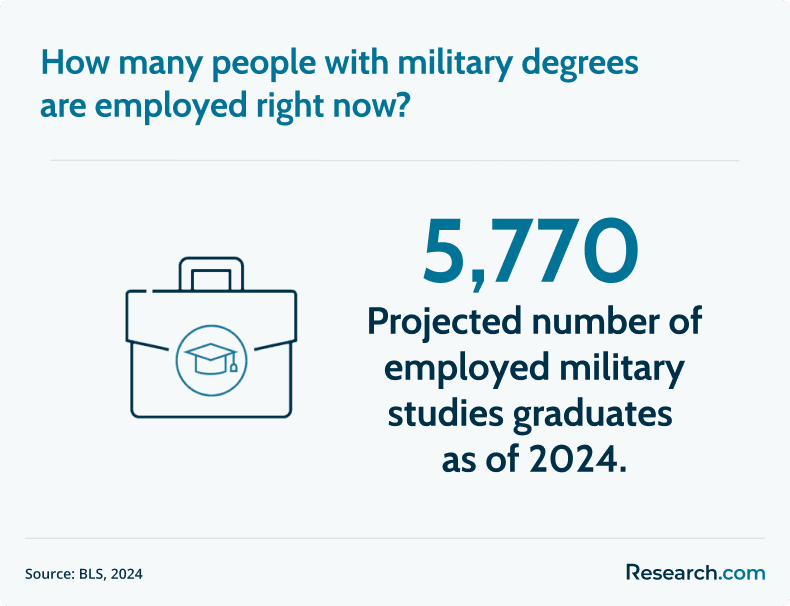
The job market for military studies graduates is tied to defense, homeland security, intelligence, public safety, emergency management, education, and government contracting. As of 2023, 5,770 professionals were employed in roles connected to this field, and the Bureau of Labor Statistics reported a median annual wage of $76,000.
Online military studies graduates may also compete for civilian roles that value strategic thinking, leadership, research, policy knowledge, risk assessment, and operational planning. Students who want to add scientific and technical problem-solving to their profile may compare a fast track physics degree online with more security-focused technical options before choosing an academic direction.
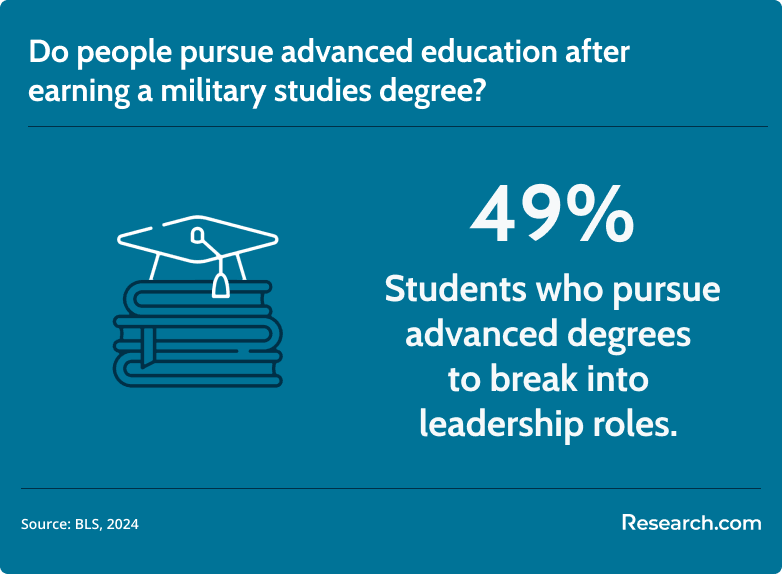
Civilian demand extends beyond one job title. Over 23,000 job postings for military studies–related positions appear on job boards, including roles in intelligence, policy, homeland security, contractor support, and technical defense areas such as cybersecurity. Nearly 49% of degree holders earn advanced degrees, which may support movement into senior management, policy, research, or specialist roles.
The chart below shows Bureau of Labor Statistics data on the shares of Standard Occupation Classification (SOC) categories among graduates of military studies degrees.
How Advanced Intelligence Training Can Support a Military Studies Career
Military studies graduates who want to work in intelligence, investigations, cyber threat analysis, or national security may need more specialized training than a general bachelor’s degree provides. Courses or graduate programs in intelligence analysis, cyber intelligence, threat assessment, geospatial analysis, research methods, or foreign policy can help students build a more targeted profile.
Students interested in federal intelligence careers should review role requirements carefully because eligibility, background investigations, clearance processes, language skills, and experience expectations vary by agency and position. A career guide such as how to become a CIA case officer can help clarify how intelligence career paths differ from general defense or homeland security roles.
Is an Online Military Studies Degree Worth It?
An online military studies degree may be worth it if it helps you convert military experience into academic credit, qualify for promotion or civilian roles, prepare for graduate study, or move into defense, security, policy, emergency management, or intelligence-related work. It is less likely to pay off if the program is expensive, poorly aligned with your career goal, or does not accept credits you expected to transfer.
Return on investment depends on total cost, time to completion, existing experience, employer requirements, and whether you need additional credentials. Some graduates may later pursue specialized graduate education, such as masters intelligence studies online, to move toward senior analysis, intelligence, or national security roles.
| Choose this degree if... | Consider another path if... |
| You want a broad defense, strategy, military history, or security studies foundation | You need a highly technical job and would be better served by cybersecurity, data science, GIS, or engineering |
| You have military credits or experience that can shorten the degree | The school accepts few of your credits or applies them mostly as electives |
| You plan to work in public service, defense support, security policy, homeland security, or graduate study | Your target job clearly requires a different major, license, or certification |
| You need online flexibility because of service, relocation, work, or family duties | You want in-person labs, ROTC experiences, campus networking, or physical archives |
Common Mistakes to Avoid When Choosing an Online Military Studies Program
- Assuming all credits will transfer: A school may accept credits but not apply them to your major or graduation requirements. Ask for a degree audit before enrolling.
- Looking only at tuition: Fees, books, proctoring, technology requirements, and lost transfer credit can change the real price.
- Ignoring accreditation: Accreditation affects financial aid eligibility, transfer options, graduate school admission, and employer perception.
- Choosing speed over fit: Accelerated terms help only if you can keep up without withdrawing or lowering your performance.
- Assuming the degree guarantees a federal job: Government, intelligence, and defense roles may require clearance, experience, exams, location flexibility, or specialized skills.
- Skipping career research: Review job postings first. If employers want cybersecurity tools, data analysis, foreign language ability, or project management credentials, build those into your plan early.
What Graduates Say About Online Military Studies Programs
- : "My online military studies program helped me understand how my service background could translate into homeland security work. The leadership and international security courses gave me stronger language for federal applications, and the online format let me keep studying without leaving home. — Alicia"
- : "I used the degree as part of my transition from active duty into emergency management. Because the classes were online, I could continue after relocating for my first civilian job. Employers could see that I had both military experience and formal academic preparation. — Malcolm"
- : "The program helped me move into strategic planning at a federal agency. Short terms made it possible to finish faster, but the biggest value was learning how to connect my experience with research, policy, and project management. — Schaeffer"
Key Insights
- Most bachelor’s programs require 120 credits, but students with transfer credit, military training, or accelerated course loads may finish much sooner than four years.
- Total cost depends heavily on transfer credit and military benefits. A 120-credit online bachelor’s degree typically costs between $30,000 and $72,000 before fees and materials.
- Accreditation is nonnegotiable. It affects financial aid, transferability, graduate school options, and employer confidence.
- Online programs work best for students who need flexibility, including active-duty service members, veterans, military spouses, and working adults.
- Military studies is broad. For technical defense roles, students may need additional coursework or credentials in cybersecurity, GIS, intelligence, emergency management, data analysis, or a related field.
- The best program is the one that fits your end goal. Compare degree plans, credit evaluations, tuition after benefits, faculty experience, career services, and specialization options before committing.
References:
- Army Scholarship Foundation. (2024). About scholarships. Retrieved from https://armyscholarshipfoundation.org/about-scholarships/
- BOS Security. (2024). How to transition from military to security jobs. Retrieved from https://www.bossecurity.com/2024/11/11/how-to-transition-from-military-to-security-jobs-for-veterans/
- Bureau of Labor Statistics. (2023). Field of degree: Military. Retrieved from https://www.bls.gov/ooh/field-of-degree/military/military-field-of-degree.htm
- Defense Finance and Accounting Service. (2025). Military pay tables. https://www.dfas.mil/MilitaryMembers/PayTables/
- Defense Intelligence Agency. (2025). Careers at DIA. https://www.dia.mil/Careers/
- Indeed. (2025). Average FBI special agent salaries. https://www.indeed.com/cmp/Federal-Bureau-of-Investigation-%28fbi%29/salaries
- Federal Bureau of Investigation. (2025). FBI career paths. https://fbijobs.gov/
- Federal Emergency Management Agency. (2025). Careers. https://www.fema.gov/careers
- Military OneSource. (2025). Need Money for Higher Education? Retrieved from https://www.militaryonesource.mil/education-employment/for-service-members/need-money-for-higher-education/
- National Center for Education Statistics. (2024). Distance education in IPEDS. U.S. Department of Education. Retrieved from https://nces.ed.gov/ipeds/use-the-data/distance-education-in-ipeds
- United Nations. (2025). Work for the United Nations. https://careers.un.org/home?language=en
- U.S. Department of Defense. (2025). Civilian and military careers. https://www.dodciviliancareers.com/DOD-Careers
- U.S. Department of Education. (2025). Accreditation in the United States. Retrieved from https://www.ed.gov/laws-and-policy/higher-education-laws-and-policy/college-accreditation
- U.S. Department of Veterans Affairs. (2025). Yellow Ribbon Program. Retrieved from https://www.va.gov/education/about-gi-bill-benefits/post-9-11/yellow-ribbon-program/
- ZipRecruiter. (2025). Emergency management specialist salary. https://www.ziprecruiter.com/Salaries/Emergency-Management-Specialist-Salary
Other Things You Should Know About Online Military Studies Degree Programs
In 2027, an online military studies degree provides valuable knowledge in areas like conflict resolution and security policy, facilitating a smooth transition to civilian security roles. The skills learned are directly applicable to roles in defense contracting and homeland security.
Yes, military training can often be credited toward a military studies degree. Many institutions offer credit for experience and courses completed during military service, significantly reducing the time needed to finish an online degree, and acknowledging the practical skills acquired during service.


