2027 Best Online Associate’s Degree Programs in Criminal Justice

Co-Founder and Chief Data Scientist
Choosing an online associate’s degree in criminal justice is not just a question of convenience. You need to know whether the program is accredited, whether credits will transfer, how much the degree will really cost, and what kinds of jobs it can realistically support. This guide is for students comparing online criminal justice associate programs, working adults looking for a flexible credential, and learners who may later transfer into a bachelor’s degree, law enforcement academy, legal studies pathway, homeland security program, or forensic science track.
Below, you will find a practical breakdown of program expectations, costs, timelines, financial aid, specializations, career paths, salary data, job market factors, and questions to ask before enrolling. The goal is simple: help you choose a credible program that fits your schedule, budget, and career plan.
Quick Answer: Is an Online Associate’s Degree in Criminal Justice Worth Considering?
An online associate’s degree in criminal justice can be worthwhile if you want an affordable, flexible starting point for careers in law enforcement support, corrections, private security, legal support, victim services, or transfer into a bachelor’s degree. It is not a guaranteed path to becoming a police officer, detective, lawyer, judge, or federal agent, because many roles require academy training, work experience, a bachelor’s degree, graduate education, licensure, or agency-specific hiring requirements.
| Best fit | Use caution if | What to verify first |
| You want a two-year credential that can support entry-level criminal justice or legal support roles. | You assume the degree alone will qualify you for every law enforcement or federal role. | Institutional accreditation, transfer agreements, internship options, and hiring requirements in your state or agency. |
| You need online flexibility because you work full-time or have family responsibilities. | You need frequent in-person coaching, campus labs, or direct access to local agency networks. | Online student support, field placement availability, career services, and technology requirements. |
| You plan to transfer into a bachelor’s program in criminal justice, legal studies, homeland security, cybersecurity, or forensic science. | You choose an applied degree without checking whether credits transfer to a four-year school. | Articulation agreements, general education requirements, and transfer-credit limits. |
What Are the Main Benefits of an Online Associate’s Degree in Criminal Justice?
- Career flexibility: The degree can support entry-level opportunities across public agencies, corrections, private security, legal offices, corporate compliance teams, and other justice-related settings.
- Lower attendance costs: Online students may avoid some campus-related expenses such as room and board, commuting, and certain on-campus fees, while continuing to work while enrolled.
- Foundation for further study: Associate coursework can help prepare students for bachelor’s programs, legal studies, paralegal studies, forensic science, homeland security, criminology, or cybersecurity-related pathways.
- Salary range depends heavily on role: Legal and criminal justice occupations vary widely, from security guard roles with an average salary of $40,440 to higher-level legal occupations such as judges at $139,000 and lawyers at $176,470.
What Should You Expect From an Associate’s Degree in Criminal Justice?
An associate’s degree in criminal justice introduces the structure, purpose, and operation of the justice system. Students typically study policing, criminal law, courts, corrections, ethics, criminology, investigations, and the social factors connected to crime and public safety. The degree is usually designed either for workforce entry, transfer to a bachelor’s program, or both.
Most programs emphasize practical thinking rather than legal theory alone. You should expect assignments that ask you to analyze cases, interpret laws and procedures, apply ethical standards, write reports, evaluate justice policies, and understand how agencies interact with communities. Some programs also include internships, field experiences, virtual simulations, or scenario-based assignments.
| Common learning area | What students usually study | Why it matters professionally |
| Criminal law and procedure | Basic legal concepts, due process, rights, court processes, and criminal offenses. | Helps graduates understand the legal boundaries of enforcement, corrections, and investigations. |
| Law enforcement | Patrol functions, community policing, investigation basics, and agency operations. | Supports roles connected to policing, public safety, and law enforcement support. |
| Corrections | Jails, prisons, supervision, rehabilitation, inmate management, and corrections law. | Prepares students for correctional settings and offender supervision environments. |
| Courts and legal support | Court systems, documentation, legal research basics, and case processing. | Useful for students considering paralegal, legal assistant, court clerk, or legal support roles. |
| Ethics and decision-making | Professional conduct, discretion, civil rights, and accountability. | Critical in roles where decisions affect public trust, safety, and individual rights. |
| Forensics and investigation | Evidence handling, crime scene concepts, digital evidence, and investigative reasoning. | Helpful for students interested in forensic science, crime scene support, or fraud investigation. |
Where Can You Work With an Online Criminal Justice Degree?
An online criminal justice associate degree can lead to different starting points depending on your location, employer, background, physical requirements, and whether you pursue additional training. Graduates may seek positions in law enforcement support, corrections, private security, courts, legal offices, corporate compliance, nonprofit victim services, or public agencies.
Law firms may hire graduates for legal support roles, especially if the student has paralegal or legal studies coursework. Corporate legal departments may use compliance assistants, contract support staff, or legal operations personnel. Courts and public agencies may need clerks, records staff, legal assistants, analysts, and administrative support workers. Security companies, correctional facilities, and community organizations may also value applicants with formal training in criminal justice systems.
How Much Can You Earn With an Online Criminal Justice Degree?
Criminal justice and legal salaries vary widely because the field includes entry-level security roles, sworn law enforcement, correctional positions, legal support jobs, forensic roles, judges, and attorneys. An associate degree can help with some entry-level paths, but the highest-paying legal occupations typically require advanced education, licensure, or substantial experience.
| Occupation or group | Reported annual salary | Important context |
| Paralegals and Legal Assistants | $66,460 | May require paralegal-specific coursework, employer training, or additional credentials. |
| Legal Support Workers | $67,290 | Includes support roles that may vary by court, law firm, agency, or corporate department. |
| Judicial Law Clerks | $64,880 | Often requires higher legal education depending on the employer and court level. |
| Administrative Law Judges, Adjudicators, and Hearing Officers | $119,940 | Typically requires significant education, legal knowledge, and professional experience. |
| Lawyers and Judicial Law Clerks | $174,280 | Lawyer roles require law school and bar admission. |
| Judges, Magistrate Judges, and Magistrates | $139,000 | These positions generally require extensive legal experience and formal selection or appointment processes. |
- 2027 ranked online associate’s programs in criminal justice
- Key findings from the data
- How long does an associate’s in criminal justice take?
- Online vs. on-campus criminal justice programs
- Average cost of an associate’s in criminal justice
- Financial aid options for criminal justice students
- Common admission requirements
- Available criminal justice specializations
- How to choose the right program
- Other degree options if you want a more flexible academic path
- Career support services for online students
- Using a fast-track master’s later in your career
- How to verify program quality
- Using an associate degree toward an accelerated bachelor’s
- Certifications that can strengthen your résumé
- Employer views of online associate degrees
- Experiential learning in online programs
- Salary factors to consider experiential learning employer perception
- Moving from criminal justice into forensic studies
- How student and graduate success is measured
- Homeland security pathways
- Accelerated associate options
- Whether criminal justice is an “easy” online degree
- How industry partnerships affect outcomes
- Using an associate degree for advanced study
- Transitioning into intelligence programs
- Career paths for associate degree graduates
- Job market outlook and salary context
- Career advancement after an associate degree
- Trends shaping criminal justice education advancement options
- How to evaluate ROI career advancement labor market context
2027 List of the Best Online Associate’s Degree Programs in Criminal Justice
How This Ranking Was Prepared
An associate degree is a meaningful investment of time and money, especially for students who plan to work while enrolled or transfer later. This ranking was built to help readers compare options using available institutional data, program information, and affordability signals.
The list below was developed through Research.com’s research methodology and data analysis from the following sources:
- IPEDS database
- Peterson's database, including the Distance Learning Licensed Data Set
- The College Scorecard database
- The National Center for Education Statistics
| Rank | School and program | Length | Credits | Tuition information | Accreditation |
| 1 | Kansas City Kansas Community College — Associate of Applied Science in Corrections | Typically 2 years | 61 credits | $119.50 per credit hour (in-state); $119.50 per credit hour (out-of-state) | Higher Learning Commission (HLC) |
| 2 | Chemeketa Community College — Associate of Applied Science in Criminal Justice | 2 years | 92 credits | Oregon resident and border state students $141/credit; Out-of-state and international students $312/credit | Northwest Commission on Colleges and Universities |
| 3 | Tallahassee Community College — Associate of Science in Criminal Justice Technology | 2 years | 60 credits | $6,049.80 total | Southern Association of Colleges and Schools Commission on Colleges (SACSCOC) |
| 4 | Fayetteville Technical Community College — Associate in Applied Science in Criminal Justice Technology | 5 semesters | 65 credits | $76.00 per in-state credit hour; $268.00 per out-of-state credit hour | Southern Association of Colleges and Schools Commission on Colleges (SACSCOC) |
| 5 | Forsyth Technical Community College — Associate in Applied Science in Criminal Justice Technology | 2 years | 58 credits | average annual tuition and fees: $2,152 in-state; $7,168 out-of-state | Southern Association of Colleges and Schools Commission on Colleges (SACSCOC) |
| 6 | Coastal Carolina Community College — Associate in Applied Science in Criminal Justice Technology | 2 years | 76 credits | In-state $81.00 per credit; Out-of-state $273.00 per credit | Southern Association of Colleges and Schools Commission on Colleges (SACSCOC) |
| 7 | Wayne Community College — Associate in Applied Science in Criminal Justice Technology | 2 years | 70-71 credits | In-state $1,216.00 per credit; Out-of-state $4,288.00 per credit | Southern Association of Colleges and Schools Commission on Colleges (SACSCOC) |
| 8 | Holmes Community College — Associate of Applied Science in Criminal Justice Administration Technology | 2 years | 60 credits | Full-time tuition $1,450 | Southern Association of Colleges and Schools Commission on Colleges (SACSCOC) |
| 9 | Fox Valley Technical College — Associate in Applied Science in Criminal Justice | 2 years | 63 credits | $149.50 per credit | Higher Learning Commission (HLC) |
Program Notes
- Kansas City Kansas Community College: The corrections-focused AAS includes study in law enforcement, criminal law, corrections, and justice system operations. Tracks/concentrations include Law Enforcement and Corrections.
- Chemeketa Community College: The AAS emphasizes criminal justice theory and applied skills in areas such as investigation, ethics, and community policing. Tracks/concentrations: None specified.
- Tallahassee Community College: The AS in Criminal Justice Technology introduces criminal law, criminology, investigations, law enforcement, and the court system. Tracks/concentrations: None specified.
- Fayetteville Technical Community College: The AAS covers courts, corrections, law enforcement, criminal law, investigation, and ethics. Tracks/concentrations: None specified.
- Forsyth Technical Community College: The AAS prepares students for criminal justice, corrections, and court-related roles with coursework in criminology, criminal law, and the judicial system. Tracks/concentrations: None specified.
- Coastal Carolina Community College: Students can choose Criminal Justice Technology or Criminal Justice Technology- Forensic Science, depending on whether they want a general pathway or a forensic emphasis.
- Wayne Community College: The AAS introduces law enforcement, courts, corrections, criminology, and forensic science. Tracks/concentrations: None specified.
- Holmes Community College: The AAS includes criminal law, juvenile justice, ethics, and several technical electives for students exploring entry-level work or transfer.
- Fox Valley Technical College: The AAS includes criminal law, investigation, ethics, and practical preparation for law enforcement, corrections, and private security. Tracks/concentrations: None specified.
New criminal justice online degree accredited programs continue to appear, so students should always verify the most recent catalog, tuition schedule, accreditation status, and transfer policies before applying.
What Graduates Often Value in Online Criminal Justice Programs
-
: "
My online associate program helped me keep my full-time job while studying policing, courts, and corrections. The format was flexible, but the coursework still required discipline and regular writing. I finished with a clearer plan for moving forward in law enforcement. Emily
"
-
: "
I was returning to college as a working adult with family responsibilities, so schedule flexibility mattered. The online classes gave me practical knowledge I could connect to my current security role, especially in report writing, ethics, and procedure. Michael
"
-
: "
The degree gave me a broad introduction to criminal law, investigations, and corrections. Being able to work through assignments online helped me stay consistent, and I now feel more prepared to pursue roles connected to correctional services. Samantha
"
Key Findings
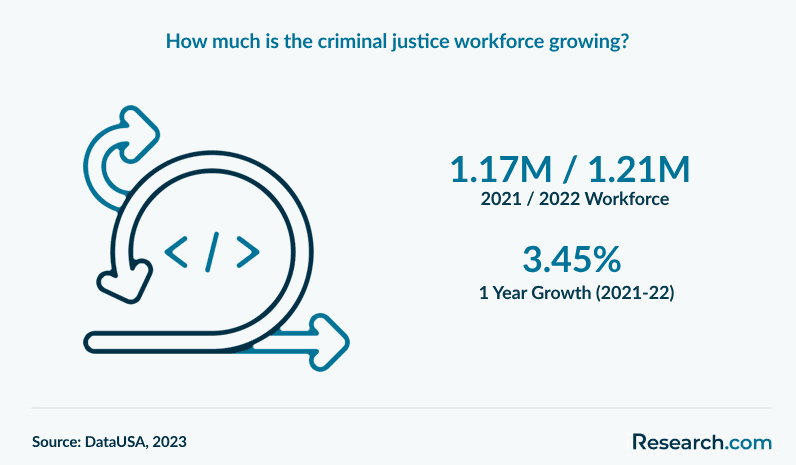
- The criminal justice and related areas workforce grew by 3.45% from 2021 to 2022, increasing from 1.17 million to 1.21 million workers.
- Police officers represent the largest single share of that workforce at 10.8%.
- Law enforcement workers earn an average salary of $72,370, while detectives and criminal investigators earn $95,930.
- Police officers earn an average annual salary of $76,550, while security guards earn $40,440.
- Lawyers earn an average salary of $176,470, but this career path requires advanced legal education and licensure rather than only an associate degree.
How Long Does It Take to Complete an Associate’s Degree in Criminal Justice?
Most associate’s degrees in criminal justice are designed to take about two years of full-time study. The actual timeline depends on the number of credits required, course availability, whether you enroll year-round, whether you study part-time, and whether transfer credits apply.
| Enrollment path | Typical timeline | Best for | Trade-off |
| Full-time | About two years | Students who can take a standard course load and want a predictable completion plan. | Requires more weekly study time and may be harder while working full-time. |
| Part-time | Three or even four years | Working adults, parents, and students balancing school with other responsibilities. | Slower completion can increase the time before transfer or career change. |
| Accelerated | As little as 18 months | Students who can handle intensive terms and frequent deadlines. | Less breathing room for work, family, internships, and difficult courses. |
| With transfer credits | Varies by accepted credits | Students with previous college coursework, military credits, or dual-enrollment credits. | Not all credits apply to degree requirements, especially in applied programs. |
The criminal justice and related areas workforce grew by 3.45% from 2021 to 2022, rising from 1.17 million to 1.21 million workers. The largest single share of workers is employed as police officers at 10.8%, as shown below.
How Does an Online Criminal Justice Degree Compare to an On-Campus Program?
Online and campus-based criminal justice programs can cover similar academic content, but the student experience is different. The better option depends on your schedule, learning style, location, technology access, and need for in-person networking or field training.
| Factor | Online program | On-campus program | Decision tip |
| Schedule | More flexible, often suitable for working adults. | Usually follows fixed class times. | Choose online if scheduling flexibility is essential. |
| Interaction | Uses discussion boards, video meetings, email, and digital collaboration. | Offers more immediate face-to-face interaction. | Choose campus if you learn best through live discussion and direct instructor access. |
| Networking | May require extra effort to build local professional contacts. | Can provide easier access to campus events and local agency relationships. | Ask online programs how they support internships in your area. |
| Learning environment | Requires self-direction, time management, and reliable technology. | Provides more physical structure and routine. | Be honest about how well you manage independent deadlines. |
| Costs | May reduce transportation, housing, and some campus-related expenses. | May involve commuting, housing, and additional campus costs. | Compare total cost, not tuition alone. |
What Is the Average Cost of an Associate’s Degree in Criminal Justice?
The price of an associate’s degree depends on whether the school is public or private, whether you qualify for in-state tuition, how many credits are required, and what fees are charged for online learning, technology, books, proctoring, and supplies.
- Community colleges: Public community colleges commonly offer associate degrees, with average tuition and fees ranging from $3,500 to $8,000 per year for in-state students. Out-of-state students may pay between $8,000 and $15,000 per year.
- Private institutions: Private colleges and universities often cost more, with annual tuition ranging from $15,000 to $30,000 or more.
- Online programs: Online associate’s programs in criminal justice typically range from $6,000 to $15,000 for the full program, though pricing structures vary by school.
- Additional expenses: Books, supplies, technology fees, background checks, testing fees, and online course fees can add several hundred to a few thousand dollars.
- Net cost matters: Grants, scholarships, employer aid, military benefits, and federal student aid can reduce the amount you actually pay.
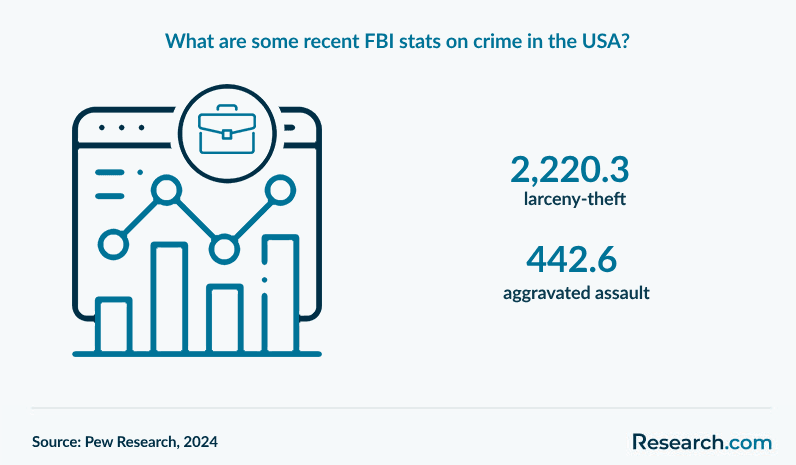
FBI data on U.S. crime rates per 100,000 people shows that in 2022, property crimes outpaced violent crimes. Larceny-theft was 2,220.3, motor vehicle theft was 244.7, and burglary was 424.9. Among violent crimes, aggravated assault was 442.6, robbery was 144.7, rape was 46.2, and murder/non-negligent manslaughter was 6.9 incidents per 100,00 people. These figures help explain why communities continue to need trained criminal justice personnel across public safety, prevention, investigation, corrections, and support roles.
What Financial Aid Options Are Available for Criminal Justice Associate Degree Students?
Financial aid can change the true cost of a degree, so students should compare net price instead of sticker price. Start by confirming that the school is eligible for federal student aid, then review federal, state, institutional, private, military, and employer-based options.
- Federal financial aid: Students may qualify for Pell Grants, federal student loans, and work-study after completing the Free Application for Federal Student Aid (FAFSA).
- State aid: Many states offer grants or scholarships for residents attending eligible in-state institutions. Deadlines and rules vary.
- Institutional scholarships: Colleges may award scholarships based on need, merit, program of study, service background, or academic performance.
- Private scholarships: Criminal justice students can search for awards from professional and nonprofit organizations, including the Women in Federal Law Enforcement (WIFLE) Scholarship and the National Organization of Black Law Enforcement Executives (NOBLE) Scholarship.
- Military education benefits: Veterans and active-duty military personnel may be eligible for GI Bill benefits, tuition assistance, housing support, or school-based military discounts.
- Employer tuition assistance: Some employers reimburse job-related education, especially for workers already in security, corrections, legal support, public safety, or government roles.
- Work-study: Federal work-study may allow eligible students to earn money through part-time employment while enrolled.
Even students comparing the cheapest online criminal justice degree options should complete the FAFSA and ask each school for a full financial aid estimate.
What Are the Admission Requirements for an Associate’s Degree in Criminal Justice?
Most associate programs are designed to be accessible, but requirements vary by school and by whether the program includes field placement, internships, or agency-based learning. Always review both general college admissions requirements and program-specific requirements.
- High school diploma or GED: Most colleges require proof of high school completion or an equivalent credential.
- Minimum GPA: Some programs may expect a GPA around 2.0 to 2.5 on a 4.0 scale, although community college admission policies can differ.
- Placement or standardized testing: SAT or ACT scores are not always required, but some schools use test scores or placement assessments for English and math course placement.
- Background check: Programs connected to internships, corrections settings, law enforcement agencies, or legal environments may require a background check.
- Recommendations: Some schools request letters from teachers, counselors, supervisors, or community leaders.
- Personal statement: A short essay may be used to understand your interest in criminal justice, career goals, and readiness for college-level work.
What Specializations Are Available in Associate’s Criminal Justice Programs?
Specializations allow students to focus on a career direction before transferring or entering the workforce. Not every associate program offers formal concentrations, but many provide electives or certificate add-ons that help shape your path.
| Specialization | What it emphasizes | Potential fit |
| Law Enforcement | Policing, investigation, patrol procedures, and community policing. | Students interested in public safety or police-related pathways. |
| Corrections | Correctional facilities, inmate supervision, rehabilitation, security, and corrections law. | Students considering jails, prisons, detention centers, or supervision roles. |
| Forensic Science | Evidence collection, crime scene concepts, scientific methods, and analysis. | Students drawn to investigations and evidence-based work. |
| Juvenile Justice | Youth offenders, rehabilitation, detention, probation, and prevention programs. | Students who want to work with youth populations. |
| Homeland Security | Emergency management, border security, counterterrorism, and risk assessment. | Students interested in public safety, preparedness, or security agencies. |
| Criminal Psychology | Behavioral factors, offender treatment, profiling, and mental health in justice settings. | Students considering behavioral science or graduate study; later options may include the cheapest online doctorate in psychology programs. |
| Cybersecurity | Cybercrime, information systems protection, data breaches, and digital investigations. | Students interested in technology-driven investigations. |
| Private Security | Corporate security, loss prevention, security operations, and risk prevention. | Students who want private-sector security roles. |
| Paralegal Studies | Legal research, writing, documentation, and case management. | Students considering law firms, courts, or corporate legal departments; compare options through this list of ABA approved paralegal programs. |
| Victim Advocacy | Support services, counseling resources, legal navigation, and victim rights. | Students interested in nonprofit, court, or public agency support roles. |
The Bureau of Justice Statistics' National Crime Victimization Survey shows that in 2022, respondents reporting moderate to severe stress as socio-emotional consequences of violent crime were highest for rape/sexual assault (63.3%), followed by robbery (59.2%) and aggravated assault (52.3%). Simple assault had the lowest percentage at 40.4%. These figures highlight the importance of victim-centered services, trauma-informed practice, and ethical decision-making in criminal justice education.
These percentages do not mean every victim has the same response. People experience violent crime differently, and some may need little support while others may face severe and long-lasting emotional distress.
How Should You Choose the Best Online Criminal Justice Associate Degree?
The best program is the one that matches your career goal, transfer plan, budget, and learning needs. Do not choose based only on a low tuition number or a school’s marketing language. Use the checklist below before applying.
| Factor | Question to ask | Why it matters |
| Accreditation | Is the institution accredited by a recognized accrediting body? | Accreditation affects credit transfer, employer recognition, and financial aid eligibility. |
| Transfer pathway | Will this associate degree transfer into a bachelor’s program without losing credits? | Applied degrees may not transfer as smoothly as transfer-focused degrees. |
| Curriculum | Does the program cover law, courts, corrections, policing, ethics, writing, and research? | A balanced curriculum supports more career options. |
| Faculty experience | Do instructors have academic credentials, field experience, or both? | Experienced faculty can connect theory to agency practice and real-world scenarios. |
| Internships | Can online students complete internships or field projects near where they live? | Hands-on experience can improve confidence and employability. |
| Student support | Are tutoring, advising, library access, technology help, and career services available online? | Online flexibility is less useful without strong support. |
| Total cost | What is the full cost after fees, books, technology, and financial aid? | The cheapest tuition rate may not be the lowest net cost. |
| Career fit | Does the program align with your intended role or next degree? | A corrections-focused program may not be ideal for a student planning legal studies transfer. |
Common Mistakes to Avoid When Comparing Programs
- Choosing without checking accreditation: An unaccredited or poorly recognized school can create problems with transfer credits, financial aid, and employer trust.
- Looking only at tuition: Fees, books, technology requirements, proctoring costs, and travel for any field experience can change the final price.
- Assuming online means easier: Online programs often require strong reading, writing, discussion participation, and self-management.
- Ignoring transfer rules: If you plan to earn a bachelor’s degree, confirm course-by-course transferability before enrolling.
- Assuming the degree guarantees law enforcement employment: Sworn roles may require academy training, background checks, physical standards, psychological evaluation, age requirements, citizenship requirements, or agency-specific hiring processes.
- Skipping career services questions: Ask whether online students receive the same internship support, résumé help, and employer connections as campus students.
What Else Can You Study If You Want a More Flexible Degree Path?
Some students are interested in criminal justice because it is practical and career-focused, while others are comparing it with programs they believe may be more manageable academically. If your priority is flexibility, transferability, or a less technical curriculum, you may want to compare criminal justice with social science, humanities, business, public administration, legal studies, or general studies pathways. Researching easy degrees can help you understand how different majors fit your strengths, but “easy” should never be the main criterion. The better question is whether the degree supports your goals and keeps you motivated enough to finish.
What Career Support Services Should Online Criminal Justice Students Expect?
Strong online programs do more than post lectures. They help students prepare for employment through résumé reviews, interview coaching, internship support, job boards, transfer advising, and networking opportunities with legal, law enforcement, corrections, or public safety professionals. When comparing schools, ask whether online learners can access the same career staff as campus students and whether the program has relationships with local agencies near your residence. You can also compare related options in Research.com’s guide to the easiest criminal justice degree programs.
Can a Fast-Track Master’s Program Help Later in a Criminal Justice Career?
An associate degree is an early credential, not the endpoint for every career. If you later want leadership, policy, intelligence, forensic, administrative, or specialized roles, graduate study may become relevant after completing a bachelor’s degree. Some students eventually compare accelerated graduate options such as 1 year online masters programs. Before pursuing that path, confirm prerequisites, professional experience expectations, accreditation, course intensity, and whether the degree aligns with your intended role.
How Can You Verify the Quality and Credibility of an Online Criminal Justice Program?
Start with accreditation, then go deeper. Review the school catalog, faculty credentials, transfer agreements, career outcomes, internship policies, student support, graduation information, and employer or agency partnerships. Be cautious with programs that make broad career promises without explaining requirements. Students considering long-term academic advancement can also explore how advanced credentials compare by reviewing Research.com’s discussion of the most valuable masters degrees.
Can an Online Associate’s Degree Help You Move Into an Accelerated Bachelor’s Program?
Yes, but only if credits transfer cleanly. Many online associate programs are built around articulation agreements that allow graduates to apply completed credits toward a four-year degree. This can reduce both time and cost, especially for students who later enroll in an accelerated bachelor degree. Before enrolling, ask the associate program and the intended bachelor’s program which credits count toward major requirements, electives, and general education.
Can Supplementary Certifications Improve Criminal Justice Career Options?
Certifications can strengthen a résumé when they match the role you want. Examples may include training in forensic analysis, cyber investigations, victim advocacy, legal technology, corrections procedures, security operations, or criminal psychology. Credentials are not substitutes for required degrees, licenses, or academy training, but they can demonstrate focused skill development. Students interested in behavioral pathways may also review information on criminal psychology salary to understand how specialization can affect career planning.
How Do Employers View Online Associate’s Degrees in Criminal Justice?
Employers are generally more concerned with accreditation, relevant coursework, communication skills, professionalism, background requirements, and job readiness than with whether a degree was earned online or on campus. An accredited online degree can signal discipline and digital communication skills, especially when combined with internships, volunteer work, security experience, military service, or agency training. Students comparing flexible credentials may also review degrees you can get online to see how criminal justice compares with other online options.
How Do Online Criminal Justice Programs Include Experiential Learning?
Because criminal justice is an applied field, practical learning matters. Online programs may use virtual simulations, scenario-based assignments, case studies, mock investigations, report-writing exercises, video discussions, and local internships. Some schools arrange field experiences with agencies, courts, correctional facilities, nonprofits, or security organizations near the student’s home. If you need federal aid eligibility in an online setting, Research.com’s resource on online colleges in oklahoma that accept FAFSA may help you think through school credibility, affordability, and aid access.
What Factors Influence Criminal Justice Salary?
Salary depends on the role, employer, location, shift requirements, risk level, union or government pay scales, overtime availability, education, certifications, academy completion, years of experience, and supervisory responsibility. Specialized skills can also matter. Digital evidence, fraud investigation, forensic analysis, cybersecurity, compliance, and intelligence analysis may create different earning opportunities than general entry-level roles. For broader context, compare role-specific outcomes in Research.com’s guide to criminology salary.
How Can You Transition From an Associate Degree in Criminal Justice to Advanced Forensic Studies?
Students interested in forensics should choose associate courses carefully. Prioritize criminal investigation, evidence handling, biology or chemistry where required, statistics, writing, digital evidence, and research methods. Then verify which credits transfer to forensic science, biology, chemistry, cybersecurity, or criminalistics programs. Some students later explore graduate-level options such as the cheapest masters in forensic science degree, but advanced forensic roles often require science-heavy preparation beyond general criminal justice coursework.
How Is Student and Graduate Success Measured in Online Criminal Justice Programs?
Useful success indicators include retention, graduation, transfer outcomes, job placement information, internship participation, employer feedback, student satisfaction, and alumni career progression. Also ask how many online students use tutoring, advising, and career services. Programs serving nontraditional students should have strong scheduling flexibility and support systems. Research.com’s guide to the best colleges for working adults can help you evaluate whether a school is built for adult learners.
Can an Associate’s Degree in Criminal Justice Lead to Homeland Security Careers?
An associate degree can provide a starting foundation for homeland security-related pathways, especially when coursework includes emergency management, risk assessment, law enforcement, border security, cybersecurity, or public safety operations. However, many homeland security roles have employer-specific requirements, and advancement may require a bachelor’s degree, federal hiring qualifications, security clearances, or specialized training. Students interested in this direction should compare dedicated homeland security degrees.
Can an Accelerated Online Program Fast-Track a Criminal Justice Career?
An accelerated associate program can shorten the time to graduation, but speed should not be the only deciding factor. The right accelerated option must still provide accredited coursework, adequate advising, realistic weekly workload expectations, and enough time to complete internships or field-based assignments if needed. Students considering faster programs can compare options in Research.com’s guide to an accelerated associates degree online.
Is an Online Criminal Justice Degree One of the “Easiest Degree to Get” Options?
Criminal justice may feel more approachable than highly technical majors for students who enjoy reading, writing, public policy, social issues, and applied case analysis. That does not make it effortless. Strong students must understand legal concepts, write clearly, analyze ethical problems, and apply procedures to realistic situations. If you are comparing programs mainly by difficulty, review Research.com’s discussion of the easiest degree to get, then weigh academic fit against career value.
How Do Industry Partnerships Strengthen Career Outcomes for Online Criminal Justice Graduates?
Partnerships with local agencies, courts, correctional institutions, security firms, nonprofits, and training centers can make a major difference for online students. These relationships may support internships, guest speakers, mentorship, job leads, field projects, and curriculum updates based on current practice. Partnerships are especially useful when they connect students to employers in their own region. For students exploring adjacent paths, Research.com also covers fast online options such as masters in psychology online fast.
Can an Associate’s Degree in Criminal Justice Lead Directly to Advanced Studies?
An associate degree can be the first step toward advanced study, but it does not usually lead directly to graduate programs without a bachelor’s degree in between. The practical route is to complete the associate degree, transfer into a bachelor’s program, build experience, and then consider graduate or doctoral options if they support your goals. Students looking far ahead can learn how accelerated graduate structures work through Research.com’s resource on 2 year PhD programs.
Can You Move From an Associate’s Degree in Criminal Justice to Intelligence Programs?
Yes, but you should plan your coursework strategically. Intelligence-related study often values research, writing, statistics, international security, cybersecurity, geospatial tools, language skills, and analytical methods. A criminal justice associate degree can provide a foundation, but students should use transfer advising to select courses that support future intelligence or national security study. Later, some students may pursue an online masters in intelligence after completing the required bachelor’s-level preparation.
What Career Paths Are Available With an Associate’s Degree in Criminal Justice?
Graduates can pursue several entry-level or pathway roles, though requirements vary by state, employer, and agency. Some roles may require additional academy training, certification, physical testing, background checks, or experience.
| Career path | Typical responsibilities | Important requirements or cautions |
| Police Officer | Responding to calls, enforcing laws, writing reports, protecting the public, and supporting investigations. | Often requires academy training, background checks, physical standards, and agency-specific hiring steps. |
| Correctional Officer | Supervising incarcerated individuals, maintaining safety, enforcing facility rules, and managing conflict. | May require training academy completion, shift work, and strong stress management. |
| Paralegal | Conducting legal research, preparing documents, organizing case files, and supporting attorneys. | Paralegal-specific coursework or credentials may improve competitiveness. |
| Private Security Officer | Protecting people, property, facilities, and assets in private-sector settings. | Licensing, background checks, and employer training may apply. |
| Probation Officer | Monitoring individuals on probation, supporting compliance, and connecting clients with services. | Some positions require a bachelor’s degree or agency-specific qualifications. |
| Crime Scene Technician | Collecting evidence, documenting scenes, and supporting investigations. | Forensic science or science-based training may be required or preferred. |
| Juvenile Counselor | Working with young offenders, supporting rehabilitation, and coordinating services. | Human services, psychology, or counseling coursework may help. |
| Border Patrol Agent | Supporting border security, preventing smuggling, and enforcing immigration-related laws. | Federal hiring standards and training requirements apply. |
| Victim Advocate | Helping crime victims access counseling, legal resources, safety planning, and court support. | Trauma-informed training and community service experience are valuable. |
| Fraud Investigator | Reviewing suspicious activity, documenting evidence, and supporting financial or cybercrime investigations. | Cybersecurity, accounting, or investigative training can help; many online cybersecurity courses update content as cyberattacks evolve. |
These examples are starting points, not a complete list. Research local job postings before enrolling so you understand which credentials employers in your region actually request.
What Is the Job Market for Associate Degree Graduates in Criminal Justice?
The criminal justice job market is broad but uneven. Some areas are growing quickly, while others are stable or declining. Graduates should compare the outlook for specific roles rather than assuming the entire field has the same demand.
- Law enforcement: Police officers, detectives, and related professionals remain part of a steady public safety workforce. The Bureau of Labor Statistics (BLS) projects employment for police and detectives to grow by 3% from 2022 to 2032. These roles may be among the highest paying jobs criminal justice degree pathways, but requirements vary by agency.
- Corrections: Correctional officer and jailer jobs exist at federal, state, and local facilities. The BLS projects a slight decline in correctional officer jobs because of efforts to reduce incarceration rates, although openings can still occur through turnover and local demand.
- Private security: Security guard and surveillance officer roles are projected to grow by 4% from 2022 to 2032, reflecting continued demand for property, facility, and public-facing security.
- Legal services: Paralegal and legal assistant employment is projected to grow by 14% from 2022 to 2032. Students interested in this path may also compare a legal studies online degree.
- Cybersecurity: Criminal justice students interested in digital evidence and cybercrime may eventually pursue a cybersecurity career path. The BLS projects 32% growth for information security analysts from 2022 to 2032.
- Victim advocacy: Demand exists in nonprofits, legal services, courts, and public agencies, especially where victim rights and support services are emphasized.
- Homeland security: Border security, transportation security, emergency management, and public safety roles can be stable options, but requirements differ. Students asking what degree do you need for homeland security should compare job postings by agency.
- Juvenile justice: Juvenile counselors, probation-related staff, and youth program workers remain important in rehabilitation and prevention systems.
- Forensic science: The field of forensic science is projected to grow by 14% from 2022 to 2032 as forensic evidence remains important in investigations.
- Fraud investigation: Financial crimes and cyber fraud have increased demand for professionals who can identify suspicious activity, document evidence, and support investigations.
Salary data also shows wide variation. Law enforcement workers earn an average salary of $72,370. Detectives and criminal investigators earn $95,930. Police officers earn $76,550 annually, while security guards earn $40,440. Lawyers earn $176,470, judges, magistrate judges, and magistrates earn $139,000, paralegals and legal assistants earn $66,460, forensic science technicians earn $71,540, and bailiffs, correctional officers, and jailers earn $58,790.
Higher pay is usually tied to advanced education, specialized skills, sworn status, experience, supervisory authority, geographic location, or legal licensure. An associate degree can be a useful starting point, but salary outcomes are never guaranteed.
Career Advancement Opportunities With an Associate’s Degree in Criminal Justice
An associate degree can help you enter the field, but advancement usually requires a mix of education, experience, agency training, strong performance, and specialization. Use the degree as a platform rather than a finish line.
- Transfer into a bachelor’s degree: Many students continue into criminal justice, criminology, legal studies, forensic science, cybersecurity, public administration, or homeland security programs. A bachelor’s degree may support detective, supervisory, analyst, federal, or administrative pathways.
- Build field experience: Experience matters in policing, corrections, security, legal support, and public agencies. Strong evaluations, reliable attendance, good writing, and leadership potential can support promotion.
- Specialize: Training in digital investigations, forensic analysis, emergency management, fraud, victim advocacy, or compliance can help you compete for more focused roles.
- Move into related fields: Criminal justice knowledge can transfer into paralegal work, legal administration, private security, compliance, cybersecurity support, social services, and public sector operations.
- Use internships and professional networks: Internships, volunteer work, professional associations, and mentors can help you understand hiring standards and identify realistic next steps.
If you want a flexible way to continue studying, compare easy associate degrees online while keeping transferability, accreditation, and career fit at the center of your decision.
Emerging Trends in Criminal Justice Education
Criminal justice education is adapting to changes in crime, technology, public expectations, and agency operations. Students should look for programs that update coursework rather than relying only on traditional policing and corrections content.
- Technology and digital forensics: Cybercrime, digital evidence, mobile devices, and online investigations are pushing programs to add cybersecurity and digital forensics content.
- Restorative justice: Some curricula now include restorative approaches that focus on accountability, victim needs, community repair, and alternatives to purely punitive responses.
- Diversity and community policing: Courses increasingly emphasize cultural awareness, communication, ethics, public trust, and working with diverse communities.
- Interdisciplinary study: Criminal justice programs often draw from psychology, sociology, public administration, legal studies, and data analysis to explain crime and system responses.
- Career-connected online learning: More online programs use simulations, field projects, and local placements to make remote study more practical.
For a broader view of potential outcomes, review Research.com’s guide to what can you do with a criminal justice degree.
How to Evaluate the Return on Investment (ROI) for an Online Criminal Justice Degree
ROI is not just salary after graduation. It includes total cost, transfer value, time to completion, career fit, employability, and whether the degree helps you reach the next credential or job requirement.
1. Calculate the full program cost
Include tuition, fees, books, technology requirements, background checks, proctoring, and any travel for field experiences. Then subtract grants, scholarships, military benefits, employer aid, and other funding. To compare broader associate pricing, review Research.com’s resource on associate degree online cost.
2. Match the degree to realistic earnings
Associate-level criminal justice roles may start far below higher-level legal or investigative careers. Entry-level roles such as paralegals or law enforcement officers typically earn salaries between $40,000 and $60,000 annually, while more advanced positions may require additional degrees, licensure, or years of experience.
3. Compare labor demand by role
Do not rely on a broad statement that criminal justice is “in demand.” Compare job outlook and postings for the specific role you want, such as paralegal, police officer, correctional officer, security officer, victim advocate, forensic technician, fraud investigator, or cybersecurity analyst.
4. Check transfer and advancement value
If a bachelor’s degree is likely, the associate program’s transferability may be the most important ROI factor. Losing credits can increase both cost and time. Ask for written transfer information before enrolling.
5. Consider nonfinancial value
Some students value schedule flexibility, public service, community impact, or advancement in a current job. These benefits matter, but they should still be weighed against debt, opportunity cost, and realistic hiring requirements.
Questions to Ask Before You Enroll
- Is the institution accredited, and is the program eligible for federal financial aid?
- How many credits are required, and how many can transfer into a bachelor’s degree?
- Does the program offer internships, field placements, simulations, or local agency connections for online students?
- What is the total cost after tuition, fees, books, technology, and financial aid?
- Are courses asynchronous, synchronous, or a mix of both?
- Will the degree meet requirements for the jobs or agencies you are targeting?
- What career services are available to online students?
- Does the curriculum include writing, ethics, law, courts, corrections, policing, and modern topics such as digital evidence or community policing?
- What happens if you need to pause enrollment or switch from full-time to part-time study?
- Can the school provide transfer agreements or outcome data in writing?
References
- Bureau of Labor Statistics. (2024). Correctional officers and jailers. U.S. Bureau of Labor Statistics.
- Bureau of Labor Statistics. (2024). Legal occupations. U.S. Bureau of Labor Statistics.
- Bureau of Labor Statistics. (2024). Occupational employment and wage statistics. Bureau of Labor Statistics.
- Data USA. (2024). Criminal justice & corrections. Data USA.
- Pew Research Center. (2024, April 24). What the data says about crime in the U.S. Pew Research Center.
- USA Facts. (2023). State of the Union: Crime & justice. USA Facts.
Key Insights
- An online associate’s degree in criminal justice is best used as a flexible starting credential for entry-level work, transfer, or specialization—not as a guaranteed route to every law enforcement, federal, or legal career.
- Accreditation, transferability, total cost, internships, and career services matter more than marketing claims or tuition alone.
- Most full-time students finish in about two years, but part-time students may need three or even four years, while accelerated options can take as little as 18 months.
- Salary outcomes vary sharply by role: security guards earn $40,440, police officers earn $76,550, detectives and criminal investigators earn $95,930, and lawyers earn $176,470, but higher-paying roles often require more education, licensure, training, or experience.
- Students planning a bachelor’s degree should verify credit transfer before enrolling, especially when comparing applied associate degrees with transfer-focused programs.
- The strongest online programs combine flexible coursework with practical learning, advising, internship support, and updated topics such as digital forensics, cybercrime, ethics, diversity, and community policing.
Other Things You Should Know About Associate’s in Criminal Justice Degrees
Yes. Many online associate’s degree programs in criminal justice accept up to 45 transferable quarter credits, or 60 semester credits, from regionally accredited colleges. Most schools require official transcripts and a minimum transfer GPA, often 2.0, before applying those credits toward graduation.
Yes, some online associate's degree programs in criminal justice for 2027 offer virtual or local internship opportunities. These provide hands-on experience in the field, typically requiring 100-150 hours of work at a law enforcement agency or legal firm.