
2027 Fastest Online Bachelor’s in Emergency Management Programs

Co-Founder and Chief Data Scientist
Choosing a fast online bachelor’s in emergency management is usually a time-sensitive decision: you may already work in public safety, the military, healthcare, logistics, security, or government, and you want a degree that can help you qualify for higher-responsibility roles without stepping away from work. The need is real. Between 2020 and 2023, the average number of billion-dollar disasters in the United States increased to 1.8 per month from 0.3 per month in 1980-1989, according to FEMA’s 2024 National Preparedness Report.
An accelerated online bachelor’s in emergency management is designed to shorten the path to a credential while still covering the core skills used in disaster planning, response coordination, risk reduction, public safety leadership, and recovery operations. This guide explains what these programs include, how fast you may be able to finish, what they cost, which careers they support, and how to compare schools before enrolling.
The goal is not simply to find the quickest option. The better decision is to find the fastest accredited program that fits your transfer credits, budget, schedule, career goals, and need for practical training.
Quick Answer: What Is the Fastest Online Bachelor’s in Emergency Management?
The fastest online bachelor’s in emergency management programs are typically degree-completion or transfer-friendly programs that use short terms, multiple start dates, and generous credit-transfer policies. Students with substantial prior college credit, military training, public safety experience, or relevant certifications may be able to finish in less than two years, while students with fewer credits often need two to three years or longer.
These programs are best for students who want an emergency management credential quickly but still need an accredited degree that employers and graduate schools can recognize. Before choosing a program, confirm accreditation, total cost, accepted transfer credits, hands-on requirements, and whether the curriculum aligns with your intended career path.
What are the benefits of getting an accelerated online bachelor's in emergency management degree?
- It can lead to public safety and preparedness roles. Graduates may pursue positions such as emergency management specialist, disaster response coordinator, homeland security officer, or public safety director in government agencies, healthcare systems, nonprofit organizations, and private-sector risk teams.
- It supports advancement into leadership work. According to the U.S. Bureau of Labor Statistics (BLS), emergency management directors earn a median annual salary of around $86,000, with higher earnings possible for experienced professionals in federal, technical, hospital, or urban settings.
- It can reduce time away from the workforce. Fast-track online programs often use accelerated classes, including eight-week formats, so working adults can continue earning while completing their degree.
- It may lower the total degree cost for transfer students. A higher per-credit rate is not always the same as a higher total cost. If a school accepts many transfer credits or awards credit for prior learning, you may pay for fewer credits overall.
What can I expect from an accelerated online bachelor's in emergency management degree?
An online bachelor’s in emergency management prepares students to help organizations and communities plan for, respond to, and recover from major disruptions. These disruptions may include natural disasters, terrorism, public health emergencies, cyber threats, hazardous materials incidents, infrastructure failures, or large-scale community crises.
Although course names vary by school, most programs combine emergency planning, leadership, homeland security, risk analysis, communication, and public policy. The accelerated format changes the pace of delivery, not the need to master the material.
- Core coursework usually covers disaster planning and response. Students study emergency operations, hazard mitigation, risk assessment, crisis communication, homeland security, public health emergencies, and recovery planning.
- Programs emphasize coordination across agencies. Emergency managers often work with fire departments, law enforcement, healthcare providers, public works, school systems, volunteer organizations, and government leaders.
- Students build practical leadership skills. Communication, decision-making, research, technology use, policy development, and resource management are central to the field.
- Many degrees include applied projects. Case studies, virtual simulations, tabletop exercises, internships, and capstone projects help students connect academic theory to real emergency scenarios.
| Program Feature | What It Means for Students | Why It Matters |
| Accelerated terms | Courses may run in shorter sessions rather than full-length semesters. | You can complete credits more quickly, but the weekly workload is often heavier. |
| Online delivery | Coursework is completed remotely, often with asynchronous components. | This helps working adults balance school with shifts, deployments, family responsibilities, or full-time jobs. |
| Transfer-friendly policies | Schools may accept prior college credits, professional training, or military learning. | The more eligible credit you bring in, the faster and less expensive the degree may become. |
| Capstone or simulation | Students complete an applied planning, assessment, or emergency response project. | Employers value graduates who can produce usable plans, evaluate risks, and communicate during crises. |
Where can I work with an accelerated online bachelor's in emergency management degree?
Emergency management graduates can work wherever organizations need to reduce risk, prepare for disruption, coordinate response, and recover after major incidents. Government remains a major employer, but the field is not limited to public agencies.
- Federal agencies. Graduates may pursue work connected to disaster relief, national security, infrastructure protection, and emergency preparedness through agencies such as the Federal Emergency Management Agency and the Department of Homeland Security (DHS).
- State and local emergency management agencies (EMAs). These agencies develop preparedness plans, run exercises, coordinate training, and help lead response efforts for communities.
- Public safety departments. Fire departments, police departments, emergency medical services (EMS), public health agencies, public works departments, and transportation agencies all need emergency planning and coordination capacity.
- Private-sector organizations. Companies in energy, telecommunications, finance, manufacturing, healthcare, and other critical sectors hire professionals for business continuity, crisis management, risk management, and operational resilience roles.
- Consulting firms. Emergency management and disaster preparedness consultants help public and private clients assess risks, design exercises, improve plans, and meet compliance expectations.
- Nonprofit and humanitarian organizations. Organizations such as the American Red Cross, Direct Relief, and local community groups rely on emergency management skills for volunteer coordination, logistics, aid distribution, and long-term recovery.
- Educational institutions. K-12 schools, colleges, and universities hire emergency managers to develop campus safety plans, coordinate drills, and respond to threats or disruptions.
How much can I make with an accelerated online bachelor's in emergency management degree?
Salary depends on job title, employer, industry, location, experience, and whether the role is operational, technical, managerial, or executive. For emergency management directors, the U.S. Bureau of Labor Statistics reported a median annual wage of $86,130 in May 2024.
The top 10% of emergency management directors earned more than $160,420 annually. Entry-level positions may start lower, closer to $50,000, while experienced professionals, specialists, and private-sector leaders can earn more as they take on complex planning, consulting, or organizational risk responsibilities.
BLS data also shows that emergency management directors in professional, scientific, and technical services often earn higher median wages, around $122,000, reflecting demand for specialized risk, consulting, and resilience expertise.
Using 2024 BLS salary data, these are the median annual wages for emergency management directors in major employing industries:
- Professional, scientific, and technical services - $122,610
- State, local, and private hospitals - $96,650
- Colleges, universities, and professional schools - $92,530
- Local government, excluding education and hospitals - $81,130
- State government, excluding education and hospitals - $73,590
- Fastest Online Bachelor’s in Emergency Management Programs for 2027
- How fast can you complete an online Bachelor’s in Emergency Management?
- How are accelerated emergency management degrees different from traditional four-year programs?
- How much do fast online Bachelor's in Emergency Management programs cost?
- Can online emergency management students use financial aid?
- Do accelerated online emergency management programs use simulations or capstones?
- What admission requirements should applicants expect?
- Are online emergency management programs accredited and respected?
- How can construction management knowledge strengthen emergency planning?
- Which academic strategies can help you finish faster?
- How should you choose the best fast online emergency management degree?
- Is emergency management a good career field?
- What is the job market for emergency management graduates?
- Can an MBA strengthen an emergency management career? References Key Insights
Fastest Online Bachelor’s in Emergency Management Programs for 2027
How do we rank schools?
Many emergency management roles increasingly favor applicants with a bachelor’s degree, but a conventional four-year program is not always practical for adults balancing employment, shift work, military obligations, family responsibilities, or prior training.
Accelerated online bachelor’s programs can be a better fit for students who already have credits, field experience, or a clear career goal and want a structured path to graduation without relocating or attending campus full time.
To identify strong fast-track options, my team and I reviewed online bachelor’s degree programs for emergency management majors with attention to completion speed, transfer policies, online format, curriculum, cost, and accreditation.
Our research draws on credible education data sources, including the College Scorecard database, the IPEDS database, the National Center for Education Statistics (NCES), and Peterson’s database, including its Distance Learning Licensed Data Set. You can also review the Research.com ranking methodology for more detail on how we evaluate programs.
| School | Program | Estimated Fast-Track Timeline | Cost per Credit | Credits Required | Accreditation |
| Columbia College | BA in Disaster and Emergency Management | Less than two years, depending on transfer credits | $427 | 120 credits | Southern Association of Colleges and Schools Commission on Colleges (SACSCOC) |
| Bellevue University | BS in Emergency Management | Approximately three years or less, depending on transfer credits | $459 | 123 credits | Higher Learning Commission (HLC) |
| Eastern New Mexico University | BAAS Emergency Management | Two years on average | $174.75 for residents, $275.25 for non-residents | 120 credits | Higher Learning Commission |
| State University of New York (SUNY) at Canton | BS in Emergency Management | Approximately two years, depending on transfer credits | $295 for residents, $353 for out-of-state students | 123 credits | Middle States Commission on Higher Education (MSCHE) |
| Arkansas State University | BS in Disaster Preparedness and Emergency Management | 18-24 months, depending on transfer credits | $282 | 120 | Council for the Accreditation of Emergency Management and Homeland Security Education (CAEMHSE) |
1. Columbia College
Columbia College in South Carolina offers an online Bachelor of Arts (BA) in Disaster and Emergency Management built for accelerated study. The program uses seven-week courses, offers several start dates each year, includes a capstone project, and is delivered fully online. It also supports transfer students and provides academic support for students preparing to lead disaster preparedness and response work.
- Program Length: Less than two years, depending on the number of credits transferred
- Tracks/concentrations: BA in Disaster and Emergency Management
- Cost per Credit: $427
- Required Credits to Graduate: 120 credits (accepts up to 90 transfer credits, including 24 Training Hours
- Accreditation: Southern Association of Colleges and Schools Commission on Colleges (SACSCOC)
2. Bellevue University
Bellevue University provides an accelerated cohort-based online Bachelor of Science (BS) in Emergency Management. The degree is fully online, offers multiple start dates, and uses short, intensive three- to six-week terms. Its structure is designed to make course sequencing clearer for students, while its transfer-credit policy and capstone planning project can help experienced learners progress efficiently.
- Program Length: Approximately three years or less, depending on the number of credits transferred
- Tracks/concentrations: BS in Emergency Management
- Cost per Credit: $459
- Required Credits to Graduate: 123 credits
- Accreditation: Higher Learning Commission (HLC)
3. Eastern New Mexico University
Eastern New Mexico University offers a Bachelor of Applied Arts and Sciences (BAAS) Emergency Management Concentration for students who hold an Associate of Applied Arts and Sciences with a technical or vocational major. The online program features recorded lectures, flexible access, individualized advising, FEMA- and IAEM-informed guidelines, and a capstone experience.
- Program Length: Two years on average
- Tracks/concentrations: BAAS Emergency Management
- Cost per Credit: $174.75 for residents, $275.25 for non-residents
- Required Credits to Graduate: 120 credits
- Accreditation: Higher Learning Commission
4. State University of New York (SUNY) at Canton
SUNY Canton offers a fully online bachelor’s in Emergency Management with asynchronous coursework and seven-week sessions. Students complete virtual disaster simulations, a case study, and, when appropriate, an internship for those who are not already employed in emergency management or a closely related field.
- Program Length: Approximately two years, depending on the number of credits transferred
- Tracks/concentrations: BS in Emergency Management
- Cost per Credit: $295 for residents, $353 for out-of-state students
- Required Credits to Graduate: 123 credits
- Accreditation: Middle States Commission on Higher Education (MSCHE)
5. Arkansas State University
Arkansas State University offers an online bachelor’s in Disaster Preparedness and Emergency Management with several annual start dates. The curriculum uses seven-week courses, five-week courses during Summer terms, and 22 credit hours of electives. A notable feature is its attention to the connection between disasters and mental health.
- Program Length: 18-24 months, depending on the number of credits transferred
- Tracks/concentrations: BS in Disaster Preparedness and Emergency Management
- Cost per Credit: $282
- Required Credits to Graduate: 120 (accepts up to 90 transfer credits)
- Accreditation: Council for the Accreditation of Emergency Management and Homeland Security Education (CAEMHSE)
How quickly can you earn an online Bachelor’s in Emergency Management degree?
Completion time depends mainly on how many credits you already have, how many courses you can take each term, and whether the school awards credit for prior learning. A first-time college student should not assume an accelerated format automatically means a degree can be finished in less than two years. Transfer students, however, may be able to move much faster.
The pace is comparable to other fast online public service and policy-related degrees, including an accelerated public policy online degree, where shorter terms and year-round scheduling can compress the academic calendar.
Common accelerated timelines
- Two to Three Years. This is a realistic accelerated timeline for full-time students who take intensive five- to eight-week courses and study continuously across the year.
- Less than Two Years. Students with a large number of transferable credits, eligible military or professional training, or prior learning assessment (PLA) credit may finish in 12 to 18 months. Some competency-based formats can also move quickly for students who can demonstrate mastery efficiently.
What affects your graduation date?
- Transfer Credits. Programs that accept up to 75 to 90 credits toward a 120-credit bachelor’s requirement can significantly shorten the path. Transfer credit may come from an associate degree, prior college coursework, affordable applied sciences programs online, or related degree programs.
- Prior Learning Assessment. Military learning, professional certifications, emergency services training, and documented workplace learning may be evaluated for credit, depending on the school.
- Course Load Per Term. Taking more than one accelerated course at a time can shorten completion, but it also increases weekly reading, writing, and project demands.
- Program Structure. Some degrees use accelerated semesters, while others use cohort models or competency-based progression.
- Time Available Each Week. Fast online programs reward consistency. Students with unpredictable schedules should ask how flexible deadlines, exams, and group work really are.
How do accelerated emergency management degrees online differ from traditional four-year programs?
Accelerated online emergency management programs differ from traditional four-year degrees mainly in pacing, scheduling, and credit strategy. The degree still generally requires the same broad undergraduate outcomes, but courses are delivered in a more compressed format and often designed for adult learners.
A traditional bachelor’s degree commonly takes about four years of full-time study to complete the standard 120 credits. Accelerated programs may use shorter courses, more frequent start dates, year-round enrollment, generous transfer policies, or prior learning credit to reduce the time required.
This fast-paced approach resembles the structure used in accelerated counselor education online programs, where students focus on a concentrated, skills-oriented curriculum while still meeting academic expectations. In emergency management, core subjects may include disaster recovery, emergency planning, legal and ethical issues, homeland security, crisis communication, and risk reduction.
Online accelerated degrees are also built for students who may be employed full time. Coursework may include discussion boards, writing-intensive assignments, case analysis, simulations, and collaborative projects with classmates in different locations. Instructors often guide discussion and applied work rather than relying only on lecture-based delivery.
The trade-off is intensity. A shorter term does not mean less work; it means the same or similar academic expectations are compressed into fewer weeks. Students should be realistic about whether they can handle deadlines, group assignments, and major projects while working.
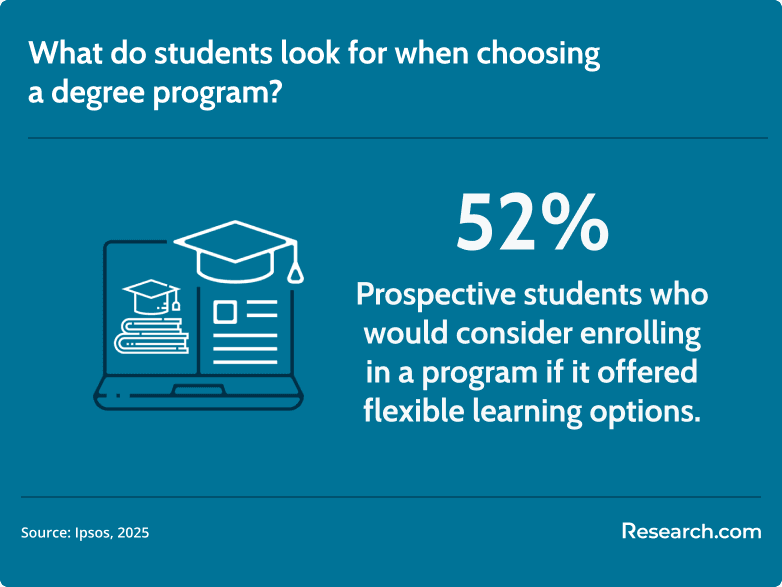
Flexible learning matters to many prospective students. A 2024 survey conducted by Google in partnership with Ipsos found that 52% of prospective students and current non-degree students said they would consider enrolling in a degree program if it offered flexible learning options, including online and accelerated formats.
| Factor | Accelerated Online Program | Traditional Four-Year Program |
| Best fit | Working adults, transfer students, military students, first responders, and career changers with clear goals | Students who want a campus experience, a slower pace, or broader elective exploration |
| Course pace | Condensed terms, often with heavier weekly workload | Longer semesters with more time between major assignments |
| Flexibility | Often online, asynchronous, and year-round | May require scheduled class times, campus attendance, and traditional academic calendars |
| Speed advantage | Strongest for students with transfer credits or prior learning credit | Usually follows a standard four-year structure |
| Main risk | Burnout from taking too many fast courses at once | Longer time to completion and more scheduling constraints |
What is the estimated tuition cost for the fastest online Bachelor's in Emergency Management programs?
Tuition varies by school, residency status, transfer credit, fees, and the number of credits you still need. As with an accelerated master's in educational counseling online, the sticker price is only one part of the cost calculation.
- Based on the research my team and I conducted for this guide, accelerated online emergency management bachelor’s programs often range from $250 to over $500 per credit hour. For a full 120-credit bachelor’s degree, that equals an estimated tuition range of approximately $30,000 to over $60,000.
- Lower-cost options may be available, especially at public universities with in-state tuition rates under $300 per credit. Some of the fastest formats may charge more per credit than the lowest-cost traditional online choices.
- The programs included in this guide list rates from about $175 to $459 per credit, showing that some affordable emergency management bachelor's degree online options also offer accelerated pathways.
Remember that tuition is not the full price. Online learning fees, technology fees, textbooks, course materials, graduation fees, and assessment fees can increase the total cost.
The fastest program is not always the cheapest per credit, but it may still be cost-effective if it accepts more transfer credit or awards credit for prior learning. Paying for fewer credits can reduce total out-of-pocket expenses.
For example, Columbia College offers a tuition discount for current members of the South Carolina State Firefighters' Association. Several schools in this guide also have generous transfer-credit policies, which may help reduce the total number of credits you must pay for.
Can I get financial aid for an online emergency management bachelor’s program?
Yes. Students in accredited online bachelor’s programs in emergency management may be eligible for financial aid, much like students in other online degrees such as an accelerated online master's in legal studies.
- Accredited online programs commonly qualify for federal student aid through the Free Application for Federal Student Aid (FAFSA), including grants, loans, and work-study options.
- Schools may provide financial aid advising to help students compare scholarships, grants, loans, payment plans, and employer benefits.
- Some universities offer scholarships for emergency management students or tuition discounts for first responders and public safety professionals.
- Bellevue University, for example, offers institutional scholarships for new, transfer, or continuing students.
- Employer tuition assistance may be available when the degree relates to your current role or advancement plan.
- Professional organizations such as the International Association of Emergency Managers (IAEM) may offer scholarships and networking opportunities for students.
Financial aid can be a deciding factor as tuition rises. Ipsos reported in 2024 that 35% of students identify financial support options as a top factor when choosing a higher education institution.
Before enrolling, ask the school for a full cost estimate after transfer evaluation, not just a per-credit rate. Also ask whether aid applies during accelerated terms, summer enrollment, part-time study, and any required internship or capstone period.
Do accelerated online emergency management programs include practical simulations or capstone projects?
Yes. Many accelerated online bachelor’s in emergency management programs include simulations, capstones, case studies, exercises, internships, or applied planning projects. These requirements help students practice professional judgment before entering higher-stakes roles.
Practical simulations
Simulations let students apply concepts such as the Incident Command System (ICS), National Incident Management System (NIMS), emergency communication protocols, and multi-agency coordination in a structured learning environment.
- Tabletop Exercises (TTX). Students work through a hypothetical emergency and discuss decisions related to response, communication, coordination, and resource allocation.
- Functional Exercises (FSE). Students may use online tools to manage information, allocate resources, coordinate with simulated agencies, or respond to changing incident conditions.
- Computer-based Modeling. Some programs use software or scenario tools to examine disaster impacts, flood plains, hazard spread, or resource allocation problems.
Capstone projects
A capstone is often the final applied requirement in an emergency management bachelor’s program. It gives students a chance to show that they can analyze a problem, use evidence, and create a professional emergency management product.
- Developing a comprehensive emergency plan. Students may design a plan for a community, organization, facility, or hazard type.
- Designing a disaster exercise. Students may apply exercise design and evaluation principles, including FEMA's Homeland Security Exercise and Evaluation Program (HSEEP).
- Conducting a risk or vulnerability assessment. Projects may focus on a facility, region, organization, or critical system.
- Solving a real emergency management problem. Students may produce research-based recommendations that an agency or organization could use.
Some programs may allow or require an internship or practicum, especially for students who do not already work in emergency management or public safety. If you are employed full time, ask whether the practical requirement can be completed at your workplace or in your local community.
What are the typical admission requirements for the fastest online Bachelor's in Emergency Management programs?
Admission requirements vary by school, but accelerated online bachelor’s programs are often designed for transfer students and working adults. Common requirements include:
- A high school diploma or GED; some degree-completion programs prefer or require an associate degree or at least 30 transferable college credits.
- A minimum GPA, often between 2.0 and 2.5 on a 4.0 scale, depending on the institution.
- Official transcripts from every college or school previously attended.
- A personal statement or essay at some institutions, especially when the program evaluates motivation, readiness, or professional goals.
- SAT or ACT scores may not be required, particularly for adult learners and transfer applicants.
- English language proficiency scores may be required for international students.
- Some schools offer rolling admissions, multiple start dates, or pre-admission advising sessions to help students enter an accelerated sequence.
Accessibility does not mean automatic admission. Prepare early, especially if you need transcripts from multiple institutions or want a transfer-credit evaluation before deciding.
The most recent available data from the National Association for College Admissions Counseling (NACAC) shows that acceptance rates at four-year colleges have shown positive growth in recent years. Even so, applicants should still organize materials carefully and ask advisors how transfer credits, prerequisites, and prior learning may affect the graduation timeline.
The chart below provides additional context on factors that institutions may consider when evaluating incoming freshmen.
Are online emergency management programs accredited and recognized by industry leaders?
Accreditation is one of the most important checks before choosing an online emergency management degree. At minimum, the institution should hold recognized institutional accreditation. Programmatic accreditation, when available, can provide additional assurance that the curriculum aligns with emergency management and homeland security education standards.
Students should verify accreditation directly with the school and through the relevant accreditor’s public database. Do not rely only on marketing language such as “recognized,” “career-ready,” or “industry-aligned.” Ask whether the degree is accepted for graduate admission, employer tuition reimbursement, public-sector hiring, and professional certification preparation.
Industry recognition may also come from curriculum alignment with professional frameworks, faculty experience, internships, capstones, simulations, or preparation for emergency management credentials. Some students later pair emergency management expertise with business training, including options such as the most affordable MBA programs, if they want to move into operations, budgeting, consulting, or executive leadership.
How does expertise in construction management support emergency management strategies?
Construction management knowledge can strengthen emergency management work, especially in mitigation, infrastructure recovery, damage assessment, rebuilding, and resilience planning. After disasters, communities need professionals who understand not only response coordination but also safe reconstruction, project scheduling, contractor coordination, structural risk, and resource constraints.
Emergency managers who understand construction processes may be better prepared to coordinate recovery timelines, communicate with engineers and contractors, and evaluate rebuilding strategies after storms, floods, fires, or infrastructure disruptions. Students interested in this interdisciplinary path may compare emergency management training with the fastest construction management programs online to determine whether a second credential or related coursework would support their goals.
Are there alternative academic pathways to speed up your accelerated online bachelor's in emergency management degree?
Yes. The fastest path is often not just choosing an accelerated program. It is choosing a program that gives appropriate credit for what you already know and then building a realistic enrollment plan around that credit.
- Portfolio Assessment. Students with emergency services, military, public safety, healthcare, logistics, or security experience may submit evidence such as résumés, job descriptions, work samples, training certificates, and recommendation letters to demonstrate college-level learning.
- Standardized Exams. Exams such as the College-Level Examination Program (CLEP) or DANTES Subject Standardized Tests (DSST) may help students earn credit for general education requirements.
- Departmental Challenge Exams. Some institutions allow students to test out of specific courses if they can demonstrate mastery of the course outcomes.
- Credit for Professional Certifications/Licensure. Relevant credentials, including Certified Emergency Manager (CEM), Associate Emergency Manager (AEM), fire service certifications, or medical certifications such as Paramedic licensure, may qualify for credit at some schools.
- Leveraging FEMA Independent Study (IS) Courses. FEMA does not grant college credit directly, but some universities have articulation policies that convert eligible FEMA IS coursework into emergency management credit, sometimes for a fee. Always confirm the receiving school’s policy before assuming these credits will apply.
- Taking More Courses per Term. If allowed, taking two to three accelerated courses in a term can increase speed, but this is only advisable if your work and family schedule can support it.
- Minimizing Breaks. Continuous enrollment, including summer sessions, can shorten the overall calendar time to graduation.
- Maximizing Transfer Credits. Ask the school to evaluate all prior college work, even if the credits are old or came from multiple institutions.
Policies differ widely. Before you enroll, request a written transfer-credit evaluation and ask an advisor how each credit source will apply to major, general education, elective, and residency requirements.
What factors should I consider when choosing the best fast online Bachelor's in Emergency Management program?
The best fast online emergency management degree is the one that gets you to a recognized credential efficiently without creating avoidable debt, accreditation problems, or career misalignment. Use the following criteria before committing.
- Accreditation. Confirm that the institution is regionally accredited or otherwise institutionally accredited by a recognized accreditor, and check whether the program has additional emergency management-related accreditation.
- Program Length and Flexibility. Compare term length, start dates, asynchronous access, full-time and part-time options, and whether the school offers year-round enrollment.
- Transfer Credit Policies. Ask how many credits you can transfer, whether prior learning assessment is available, and whether military or professional training can count.
- Curriculum and Specializations. Review courses carefully if you want to focus on homeland security, disaster response, cybersecurity, public health emergencies, or a path related to a US marshal career path.
- Career Support and Outcomes. Look for internship support, capstone relevance, employer partnerships, alumni networks, and career advising.
- Total Cost After Credit Evaluation. Compare the number of credits you must still complete, not just the advertised tuition rate.
- Practical Requirements. If the program requires an internship, practicum, simulation, or capstone, confirm whether it can be completed remotely or near where you live.
Cost and financial aid should be part of the decision, but they should not be the only factors. A lower-cost program that accepts fewer transfer credits may end up taking longer and costing more than a higher per-credit program that applies more of your prior learning.
Data from EducationDynamics shows that many online college students take one to three weeks to decide where to apply. That may be enough time to compare websites, but it may not be enough time to obtain transcripts, confirm accreditation, evaluate transfer credits, and understand the real cost. Give yourself enough time to ask detailed questions.
Questions to ask before enrolling
| Question | Why It Matters |
| How many of my credits will transfer into the degree? | This directly affects completion time and total cost. |
| Is the school accredited by a recognized accreditor? | Accreditation affects employer recognition, graduate school eligibility, and financial aid access. |
| Are courses asynchronous, synchronous, or both? | Students with shifts or irregular schedules need to know whether live attendance is required. |
| Does the program include simulations, internships, or a capstone? | Applied experience can help you demonstrate readiness for emergency management work. |
| What fees are charged beyond tuition? | Technology, online, textbook, and graduation fees can change the real cost. |
| Can I use employer tuition assistance or public safety discounts? | These benefits may reduce out-of-pocket expenses. |
| What career services are available to online students? | Online learners should receive support with résumés, internships, networking, and job searches. |
Common mistakes to avoid
| Mistake | Better Approach |
| Choosing the shortest advertised timeline without a transfer review | Ask for a written estimate showing exactly how long the degree will take based on your credits. |
| Looking only at tuition per credit | Compare total program cost after transfer credits, fees, aid, and required materials. |
| Assuming online means self-paced | Confirm weekly deadlines, live sessions, group work, and exam requirements. |
| Ignoring accreditation | Verify institutional and, when relevant, programmatic accreditation before applying. |
| Taking too many accelerated courses at once | Start with a manageable load, especially if you work full time or have shift-based responsibilities. |
| Assuming salary outcomes are guaranteed | Use salary data as a benchmark, but evaluate local demand, experience requirements, and employer expectations. |
Is emergency management a good career field?
Emergency management can be a strong career field for people who want mission-driven work, complex problem-solving, public service, and leadership responsibilities. It is not limited to disaster response; many roles focus on planning, training, risk reduction, communication, continuity, and recovery.
The field can also support mobility across sectors. A professional may begin in public safety, healthcare preparedness, military operations, logistics, security, or local government and later move into emergency management leadership, consulting, business continuity, or public administration.
- Emergency Management Director. Leads planning, response, recovery, training, and coordination for governments, hospitals, campuses, or large organizations.
- Disaster Recovery Manager. Builds and implements recovery strategies after major incidents.
- Emergency Management Specialist. Coordinates preparedness activities, supports training, and helps develop response plans.
- Homeland Security Specialist. Works on preparedness and protection strategies related to terrorism, cyberattacks, and national security threats.
- First Responder Roles. EMTs, firefighters, and police officers may move into emergency management after gaining field experience. Students considering this route can review EMT, firefighter, and police officer qualifications.
- Crisis Communications Manager. Coordinates public information, media messaging, and stakeholder communication during emergencies.
- Training Coordinator. Designs and delivers training for responders, employees, volunteers, and community members.
- Public Health Emergency Planner. Prepares health systems and communities for pandemics, bioterrorism, and other public health threats.
- Business Continuity Planner. Helps organizations maintain critical operations during and after disruptions.
- Logistics Manager. Plans for supply chain disruptions caused by disasters, geopolitical events, transportation failures, or other operational risks. Students interested in this option can learn more about what logistics managers do.
Using current BLS and O*NET OnLine salary data, these are average annual wages for selected roles connected to emergency management work:
- Emergency Management Directors - $86,130
- Business Continuity Planner - $81,270
- Public Relations Managers - $138,520
- First-Line Supervisors of Police and Detectives - $105,980
- First-Line Supervisors of Firefighting and Prevention Workers - $92,430
- Logistics Managers - $102,010
What is the job market for graduates with an online Bachelor’s in Emergency Management?
The job market for emergency management graduates is steady rather than explosive, but the work is essential. Communities, hospitals, government agencies, schools, nonprofits, and private companies all need people who can assess risk, plan for disruption, coordinate resources, communicate clearly, and support recovery.
- Natural disasters, public health crises, and security threats continue to reinforce the need for skilled and capable emergency management professionals. FEMA’s 2050 Strategic Foresight Initiative report notes that the agency’s staffing gap fluctuated between approximately 19% and 38% from 2019 to 2022.
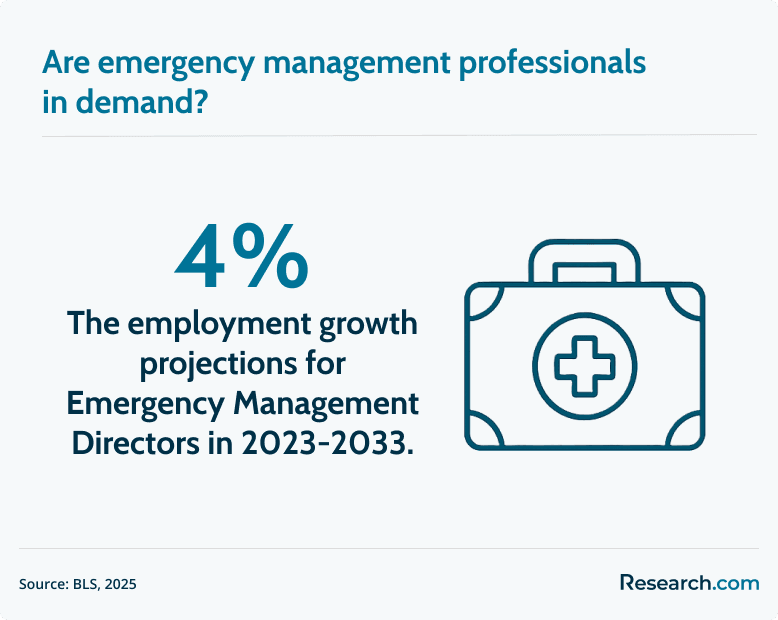
- BLS projects employment of Emergency Management Directors to grow 4% from 2023 to 2033.
- Graduates may find opportunities across federal, state, local, nonprofit, healthcare, education, consulting, and private-sector settings.
- Emergency management training can also support adjacent paths, including steps to becoming a park ranger, environmental health and safety specialist roles, security leadership, business continuity, and law enforcement careers.
According to the latest BLS and O*NET OnLine employment data, these are projected annual job openings for selected emergency management-related occupations in 2023-2033:
- Emergency Management Directors - 1,000 jobs
- Business Continuity Planner - 107,400 jobs
- Public Relations Managers - 6,000 jobs
- First-Line Supervisors of Police and Detectives - 10,000 jobs
- First-Line Supervisors of Firefighting and Prevention Workers - 5,800 jobs
- Logistics Managers - 19,700 jobs
- Occupational Health and Safety Specialists - 15,100 jobs
Current trends affecting emergency management careers
- More complex disaster environments. FEMA’s reporting on billion-dollar disasters underscores the growing need for planning, mitigation, coordination, and recovery expertise.
- Greater demand for cross-sector coordination. Emergency management increasingly involves hospitals, utilities, transportation systems, schools, nonprofits, public health departments, and private employers.
- Technology-driven preparedness. Programs that include virtual simulations, modeling, data tools, and communication platforms can help students prepare for modern emergency operations.
- Employer interest in flexible credentials. Online and accelerated formats are increasingly important for working adults who cannot pause their careers to study full time on campus.
- Business continuity and resilience roles. Private-sector employers need professionals who can keep operations running during disruptions, especially in critical infrastructure and supply chain-dependent industries.
Can an MBA Enhance Your Emergency Management Career?
An MBA can be useful for emergency management professionals who want to move beyond operational response into budgeting, executive leadership, consulting, strategic planning, or organizational resilience. Emergency managers often make decisions involving personnel, finance, procurement, logistics, compliance, and stakeholder communication. Business training can strengthen those areas.
This path is most relevant for professionals aiming for senior roles in hospitals, universities, government agencies, large nonprofits, utilities, corporations, or consulting firms. It may be less urgent for students who are still trying to enter the field and need practical emergency management experience first. If you want to combine business leadership with emergency planning expertise, compare options such as online MBA programs after you understand your career direction and budget.
References:
- Aslanian, C.B. and Fischer, S. (2024). Online College Students Report 2024. EducationDynamics. https://insights.educationdynamics.com/rs/183-YME-928/images/EDDY-Online-College-Students-2024.pdf
- Daiany, R., Bartoszewicz, A., Chou, L., & Anum, A. (February 2025). Emerging Trends Shaping Higher Education: A Look Back on Insights from 2024. Ipsos News & Events: News. https://www.ipsos.com/en-us/emerging-trends-shaping-higher-education-look-back-insights-2024
- Federal Emergency Management Agency (November 2024). Strategic Foresight 2050 Final Report. https://www.fema.gov/sites/default/files/documents/fema_strategic-foresight-2050-final-report.pdf
- Federal Emergency Management Agency (December 2024). 024 National Preparedness Report. https://www.govinfo.gov/content/pkg/CMR-HS5_100-00193235/pdf/CMR-HS5_100-00193235.pdf
- National Association for College Admission Counseling (August 2023). Factors in the Admission Decision. https://www.nacacnet.org/factors-in-the-admission-decision
- O*NET OnLine (n.d.). O*NET OnLine Help. https://www.onetonline.org/help/online/find_occ Data retrieved June 2025
- U.S. Bureau of Labor Statistics (n.d.). Occupational Employment and Wage Statistics, Industry: Cross-industry, Private, Federal, State, and Local Government, Period: May 2024. https://data.bls.gov/oes/#/industry/000000 Data retrieved June 2025
- U.S. Bureau of Labor Statistics (April 2025). Emergency Management Directors. https://www.bls.gov/ooh/management/emergency-management-directors.htm
Key Insights
- The fastest path depends on credits, not just the school’s advertised timeline. Students with transfer credits, military learning, public safety training, or prior learning credit may finish much faster than first-time college students.
- Accreditation should be non-negotiable. An accelerated online degree is only useful if employers, graduate schools, and financial aid systems recognize the institution and credential.
- Compare total cost after transfer evaluation. Per-credit tuition does not show the full price. Fees, remaining credits, transfer policies, and prior learning credit can change the true cost significantly.
- Applied learning matters in emergency management. Simulations, capstones, internships, and case-based projects help students practice the planning, communication, and coordination skills employers expect.
- Emergency management offers several career directions. Graduates may work in government, healthcare, education, nonprofits, consulting, business continuity, logistics, homeland security, or public safety leadership.
- Speed comes with workload trade-offs. Five- to eight-week courses can help students graduate faster, but they require disciplined weekly study and careful course-load planning.
- The best program is the one that fits your real situation. Choose based on accreditation, accepted credits, cost, schedule flexibility, practical requirements, and alignment with your target role—not ranking alone.
Other Things You Need to Know About the Fastest Online Bachelor’s in Emergency Management Degrees
Applicants typically need a high school diploma or GED for the fastest online bachelor's in emergency management programs in 2027. Some programs may also require prerequisite courses in public safety or related fields, alongside a minimum GPA of 2.5.
The fastest online bachelor's in emergency management programs in 2027 typically require completing around 120 credit hours. These programs may offer accelerated course formats and allow transfer credits, facilitating quicker completion while maintaining the comprehensive curriculum necessary for the field.
Yes. Most accelerated programs accept transfer credits, and many require at least 30 prior semester credits to qualify for junior standing. Schools usually cap transfer credit at 90 semester credits, with final degree requirements totaling about 120 credits.


