
2027 Best Online Crime Analysis Degree Programs

Co-Founder and Chief Data Scientist
Many people want to become crime analysts, but busy schedules often make traditional on-campus programs difficult. They frequently ask if an online degree is a worthwhile option for their careers. This article answers that key question directly by exploring the top online crime analysis degree programs for 2027.
The U.S. Bureau of Labor Statistics (BLS) predicts a 5% job growth for private detectives and investigators, a category that includes crime analysts, through 2033. This consistent demand highlights the need for skilled professionals in this field. Our team, with over ten years of career planning experience, thoroughly researched and compiled this information from reliable sources. Read on to make informed decisions about your education and seize these career opportunities.
What are the benefits of getting an online crime analysis degree program?
- Qualify for in-demand roles such as crime analyst, intelligence analyst, and public safety strategist in law enforcement, government, or private security, helping make communities safer with your data-driven skills.
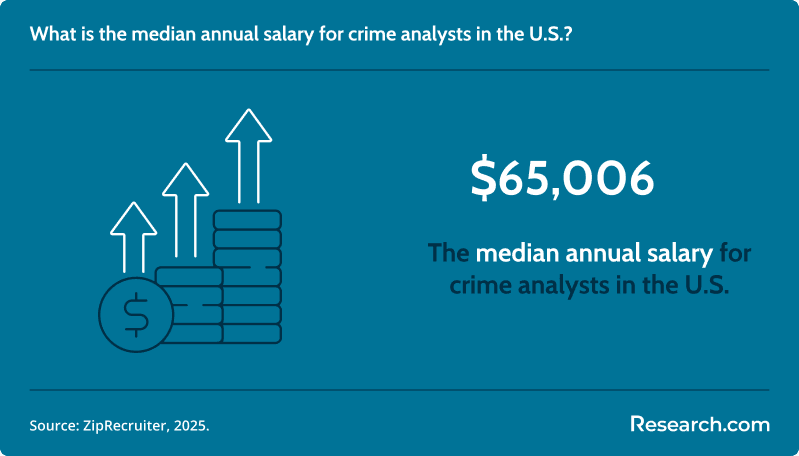
- Median salaries for crime analysts in the U.S. are strong, with most professionals earning about $65,006 per year.
- Online crime analysis degree programs offer maximum flexibility. You can study from anywhere, balance coursework with work or personal commitments, and access high-quality education without relocating or pausing your career.
What can I expect from an online crime analysis degree program?
An online crime analysis degree program prepares you with vital skills in criminal justice, data analysis, and investigative techniques. The core curriculum covers topics like criminology, crime mapping, law enforcement technology, and statistical analysis.
Programs often require a capstone project and may include internship hours with partner agencies to provide practical, real-world experience. Tuition typically ranges from $8,000 to $22,000, varying by institution and residency status.
Online classes are delivered through interactive platforms, allowing you to access recorded lectures, participate in live sessions, and collaborate with classmates virtually. This flexible structure helps students balance their studies with work or personal commitments while gaining the specialized knowledge needed for a career in crime analysis.
Where can I work with an online crime analysis degree?
Graduates with an online crime analysis degree have a wide range of career options. You can work in government agencies as a crime or intelligence analyst, special agent, or policy consultant. Many join law enforcement, corrections, or homeland security, while others move into roles with private companies, such as insurance, security firms, or tech enterprises, analyzing risks and preventing fraud.
Nonprofits, research groups, or educational institutions also hire crime analysts for research, management, and education roles. Some become consultants or start their businesses.
Crime analysts find employment across various sectors, including public safety, corporate security, healthcare, and technology. While career opportunities span many states, Montana ($73,042), Maryland ($75,093), and Virginia ($70,179) offer some of the highest salaries for these professionals.
Successful analysts possess highly transferable skills such as problem-solving, communication, and data analysis. These abilities allow graduates to pursue diverse roles in fields like creative industries, research, management, or consulting.
How much can I make with an online crime analysis degree program?
Professionals with an online crime analysis degree can expect an average salary of around $65,006 per year in the United States as of 2025. Salary varies by industry, location, and experience. Entry-level crime analysts typically earn around $55,000, while experienced and senior analysts can make upwards of $80,000 to $149,000 annually.
Working in the private sector or specialized government roles can also increase pay. Additionally, obtaining advanced degrees or certifications tends to boost earning potential and open doors to senior positions with higher salaries.
- List of the Best Online Crime Analysis Degree Programs for 2027 List of Programs
- How long does it take to complete an online crime analysis degree program? Completion Time
- How does an online crime analysis degree program compare to an on-campus program? How does an online crime analysis degree program compare to an on-campus program?
- What is the average cost of an online crime analysis degree program? Average Cost
- What are the financial aid options for students enrolling in an online crime analysis degree program? Financial Aid
- What are the prerequisites for enrolling in an online crime analysis degree program? Requirements
- What courses are typically in an online crime analysis degree program? What courses are typically in an online crime analysis degree program?
- What types of specializations are available in an online crime analysis degree program? What types of specializations are available in an online crime analysis degree program?
- How to Choose the Best Online Crime Analysis Degree Programs How to Choose the Best Online Crime Analysis Degree Programs
- What career paths are available for graduates of an online crime analysis degree program? Career Paths
- How Do Online Crime Analysis Programs Integrate Advanced Forensic Science Techniques? How Do Online Crime Analysis Programs Integrate Advanced Forensic Science Techniques?
- What Are the Accreditation and Quality Assurance Standards for Online Crime Analysis Programs? What Are the Accreditation and Quality Assurance Standards for Online Crime Analysis Programs?
- What is the job market for graduates with an online crime analysis degree? Job Market
Best Online Crime Analysis Degree Programs for 2027
Choosing an online crime analysis degree is not just a question of finding a criminal justice program that fits your schedule. The better question is whether the program teaches the analytical, technical, and investigative skills employers expect from crime analysts, intelligence analysts, public safety researchers, and related roles. This guide is designed for students comparing bachelor’s and master’s options, working law enforcement professionals looking to move into analysis, and career changers who want a structured path into data-informed public safety work.
You will find a ranked program list, cost and length comparisons, common admission requirements, typical courses, specializations, career options, and practical questions to ask before enrolling. If you are still exploring adjacent social science pathways, comparing this field with a short online social sciences degree can also help you decide whether you want a broader behavioral science foundation or a more specialized crime analysis curriculum.
Quick answer: What is the best online crime analysis degree?
The best online crime analysis degree depends on your current education level and career goal. A bachelor’s program can prepare new students for entry-level criminal justice, intelligence, or public safety roles, while a master’s program is usually better suited for professionals who already have a degree and want advanced training in crime mapping, intelligence analysis, data interpretation, and policy-focused decision-making. Before choosing a program, verify accreditation, compare total cost rather than tuition alone, review the software and GIS training offered, and confirm whether internships or applied projects are included.
How Research.com evaluates online crime analysis programs
Because a degree can affect your finances, time, and career options, program comparisons should be based on transparent information rather than marketing claims. Research.com reviews institutional and program data from sources such as the IPEDS database, Peterson's database, the College Scorecard database, and the National Center for Education Statistics.
These sources help support comparisons involving tuition, program structure, institutional characteristics, and student outcomes where available. To understand how Research.com builds and reviews education rankings, see the Research.com methodology page.
Online crime analysis programs compared
| Rank | School and Program | Degree Level | Program Length | Cost per Credit | Total Credits | Accreditation |
| 1 | Boston University — Master of Criminal Justice with a specialization in Crime Analysis | Master’s | 8-16 months | $685 - $740 | 32 | New England Commission of Higher Education (NECHE) |
| 2 | Tiffin University — Master of Science in Criminal Justice with a specialization in Crime Analysis | Master’s | 12 months (online) | $750 | 30 | Higher Learning Commission (HLC) |
| 3 | California State University, San Bernardino — Bachelor of Science in Intelligence & Crime Analysis | Bachelor’s | 4 years | Approximately $420 (based on a 3-semester unit course costing $1,260) | 120 | WASC Senior College and University Commission (WSCUC) |
| 4 | ECPI University — Criminal Justice Program | Bachelor’s | 30 months or 120 weeks of instruction | $523.20 (Military tuition assistance program rate) | 121 | Southern Association of Colleges and Schools Commission on Colleges (SACSCOC). |
| 5 | Arizona State University — Master of Science in Crime Analysis | Master’s | 1.5 - 2 years | $557 | 30 | HLC |
| 6 | Southern New Hampshire University — Master of Science in Criminal Justice | Master’s | Approximately 1.5 - 2 years | $659 | 36 | New England Commission of Higher Education (NECHE) |
| 7 | Michigan State University — Master of Science in Law Enforcement Intelligence and Analysis | Master’s | As little as 2 years | $857 | 30 | HLC |
| 8 | Saint Joseph’s University — Master of Science in Criminal Justice | Master’s | 1.5-2 years | Starts at $879 | 30 | MSCHE |
| 9 | Indiana State University — Bachelor of Science in Intelligence Analysis | Bachelor’s | 4 years | $361 | 51 | HLC |
| 10 | University of North Carolina Wilmington — Bachelor of Arts in Criminology | Bachelor’s | Typically 4 years | Approximately $185.13 (in-state resident) to $888.25 (non-resident) | 120 | SACSCOC |
1. Boston University — Master of Criminal Justice with a specialization in Crime Analysis
Boston University’s online Master of Criminal Justice with a specialization in Crime Analysis is built for students who want to use criminal justice data to support investigations, operational planning, and policy decisions. The program emphasizes analytical reasoning, mapping, and spatial analysis, making it a strong fit for current public safety professionals or graduate students seeking a focused crime analysis credential.
- Program length: 8-16 months
- Cost per credit: $685 - $740
- Total credits: 32
- Accreditation: New England Commission of Higher Education (NECHE)
2. Tiffin University — Master of Science in Criminal Justice with a specialization in Crime Analysis
Tiffin University’s online Master of Science in Criminal Justice with a crime analysis specialization focuses on preparing students to interpret data, recognize patterns, support investigations, and contribute to safer communities and organizations. The curriculum combines theory, applied analysis, mapping, and a capstone project, which can be useful for students who want a portfolio-style academic experience.
- Program length: 12 months (online)
- Cost per credit: $750
- Total credits: 30
- Accreditation: Higher Learning Commission (HLC)
3. California State University, San Bernardino — Bachelor of Science in Intelligence & Crime Analysis
CSUSB’s Bachelor of Science in Intelligence & Crime Analysis offers undergraduate training in research, analytics, data management, and investigative support. Students can select concentrations in Geographic Information Systems, Cybersecurity, or Homeland Security, which makes the program especially relevant for learners who want a bachelor’s pathway tied to intelligence, public safety, or security analysis.
- Program length: 4 years
- Cost per credit: Approximately $420 (based on a 3-semester unit course costing $1,260)
- Total credits: 120
- Accreditation: WASC Senior College and University Commission (WSCUC)
4. ECPI University — Criminal Justice Program
ECPI University’s online Bachelor of Science in Criminal Justice uses an accelerated, year-round format for students who want to move through a criminal justice curriculum on a structured timeline. The program covers law enforcement, courts, corrections, private security, and applied criminal justice practices, making it broader than a dedicated crime analysis degree but still relevant for students who want analytical exposure within the justice system.
- Program length: 30 months or 120 weeks of instruction
- Cost per credit: $523.20 (Military tuition assistance program rate)
- Total credits: 121
- Accreditation: Southern Association of Colleges and Schools Commission on Colleges (SACSCOC).
5. Arizona State University — Master of Science in Crime Analysis
Arizona State University’s online Master of Science in Crime Analysis is a 100% online program delivered through 7.5-week courses. It is designed for students who want advanced quantitative training connected to crime reduction, criminal apprehension, and prevention strategies. Its structure may appeal to working professionals who prefer shorter course sessions while completing graduate-level analytical training.
- Program length: 1.5 - 2 years
- Cost per credit: $557
- Total credits: 30
- Accreditation: HLC
6. Southern New Hampshire University — Master of Science in Criminal Justice
Southern New Hampshire University’s fully online Master of Science in Criminal Justice is designed for students seeking leadership preparation in public safety and justice-related organizations. The asynchronous format can support working adults, while the curriculum emphasizes ethical leadership, data-informed analysis, and threat management across the criminal justice system.
- Program length: Approximately 1.5 - 2 years
- Cost per credit: $659
- Total credits: 36
- Accreditation: New England Commission of Higher Education (NECHE)
7. Michigan State University — Master of Science in Law Enforcement Intelligence and Analysis
Michigan State University’s 100% online Master of Science in Law Enforcement Intelligence and Analysis is a 30-credit program that can be completed in two years. The curriculum is informed by the Department of Justice and focuses on intelligence collection, analytical practices, ethical field research, and data-driven decision-making for public safety settings.
- Program length: As little as 2 years
- Cost per credit: $857
- Total credits: 30
- Accreditation: HLC
8. Saint Joseph’s University — Master of Science in Criminal Justice
Saint Joseph’s University offers a fully online Master of Science in Criminal Justice for students pursuing advancement in law enforcement, intelligence, management, and forensic behavioral health. The program combines criminal justice theory with decision-making and leadership preparation. A 4+1 option also allows eligible current undergraduates to complete a master’s degree in five years.
- Program length: 1.5-2 years
- Cost per credit: Starts at $879
- Total credits: 30
- Accreditation: MSCHE
9. Indiana State University — Bachelor of Science in Intelligence Analysis
Indiana State University’s Bachelor of Science in Intelligence Analysis prepares students for analysis-focused work in government, military, and private-sector environments. The curriculum emphasizes critical thinking, research, data analysis, national security, counterterrorism, and risk assessment. An internship component gives students a chance to connect classroom learning with field experience.
- Program length: 4 years
- Cost per credit: $361
- Total credits: 51
- Accreditation: HLC
10. University of North Carolina Wilmington — Bachelor of Arts in Criminology
The University of North Carolina Wilmington’s Bachelor of Arts in Criminology gives students a social science framework for understanding crime, lawmaking, lawbreaking, and institutional responses to crime. It is not as narrowly technical as a dedicated crime analysis degree, but its emphasis on theory and research methods can support careers in corrections, policing, public service, graduate study, or analytical criminal justice roles.
- Program length: Typically 4 years
- Cost per credit: Approximately $185.13 (in-state resident) to $888.25 (non-resident)
- Total credits: 120
- Accreditation: SACSCOC
How Long Does It Take to Complete an Online Crime Analysis Degree?
Completion time depends mainly on degree level, transfer credits, enrollment pace, and whether the program uses accelerated sessions. A master’s degree in crime analysis commonly requires about 30 credit hours and may be completed in about 12 months to 2 years. A bachelor’s degree related to crime analysis usually takes about four years for a full-time online student.
| Program Type | Typical Time to Finish | Best For | What Can Change the Timeline |
| Bachelor’s degree | About four years | Students starting college or completing an undergraduate credential | Transfer credits, full-time or part-time enrollment, accelerated terms, internship requirements |
| Master’s degree | About 12 months to 2 years | Professionals or graduates seeking advanced analytical and leadership skills | Course load, 7.5-week sessions, capstone requirements, employer or family obligations |
If speed is a major factor, compare whether the program offers year-round enrollment, short sessions, transfer-friendly policies, or prior learning options. The same decision logic applies when students compare other accelerated fields, such as the shortest online geosciences degree: faster is helpful only if the format still gives you enough time to master technical material.
Online vs. On-Campus Crime Analysis Degrees: Which Format Should You Choose?
Online and campus-based crime analysis programs can both be academically credible when they are properly accredited and well designed. The better choice depends on your schedule, learning style, access to local agencies, and need for in-person networking or hands-on support.
| Factor | Online Crime Analysis Degree | On-Campus Crime Analysis Degree | Decision Tip |
| Flexibility | Often better for working adults because coursework may be asynchronous or scheduled around employment. | Usually requires set class times and physical attendance. | Choose online if your work schedule or location limits campus attendance. |
| Academic expectations | Can match campus rigor when the same faculty, accreditation, and curriculum standards are used. | May offer more immediate access to faculty, labs, and campus services. | Do not assume online is easier; review workload and assessment methods. |
| Technology and delivery | Uses learning platforms, virtual collaboration, recorded lectures, discussion boards, and sometimes live sessions. | Relies more heavily on in-person lectures, seminars, and campus-based interaction. | Ask for a sample course or technology requirements before enrolling. |
| Networking | Can connect students across regions, agencies, and professional backgrounds. | May offer stronger local relationships with nearby law enforcement or public agencies. | Online students should ask about virtual career events and internship placement support. |
| Applied experience | May use local internships, simulations, applied projects, or scheduled residencies. | May provide easier access to local fieldwork or in-person practical activities. | Confirm how the program handles internships for distance learners. |
Online study works best for self-directed students who can manage deadlines, use digital tools comfortably, and participate actively without daily in-person reminders. Campus learning may be better if you prefer face-to-face discussion, immediate access to physical resources, or local agency networking. Similar format trade-offs apply to other professional graduate programs, including the online master’s degree in human resource management.
How Much Does an Online Crime Analysis Degree Cost?
The cost of an online crime analysis degree varies by school, residency status, degree level, credit requirements, fees, and financial aid. Published tuition is only one part of the total price; students should also check technology fees, textbooks, software, background check costs, graduation fees, and any required travel or residency expenses.
- For a bachelor’s degree in criminology or criminal justice with a crime analysis focus, the average tuition is around $12,815 per year or approximately $385 per credit hour, with total credit requirements of around 120 credits. This can bring the total cost to roughly $30,000 to $50,000, depending on the institution and financial aid options available.
- For a master’s degree in criminal justice with a crime analysis concentration, the total cost ranges from about $21,900 to $23,700 for part-time enrollment or can go up to around $70,000 to $79,000 for full-time study, depending on credits and course fees.
| Cost Factor | Why It Matters | Question to Ask |
| Per-credit tuition | Small differences add up quickly across 30, 36, 120, or 121 credits. | Is the quoted tuition the same for online students, out-of-state students, and military students? |
| Fees | Online programs may charge technology, course, graduation, or student service fees. | What is the total program cost including all mandatory fees? |
| Transfer credits | Accepted credits can reduce both time and cost, especially for bachelor’s students. | How many credits can I transfer, and will they apply to major requirements or only electives? |
| Software and materials | Crime analysis courses may require access to mapping, statistics, database, or visualization tools. | Are software licenses included in tuition or paid separately? |
| Financial aid | Grants, loans, scholarships, employer reimbursement, and military benefits can change net cost. | What is my estimated out-of-pocket cost after aid? |
Cost differences can be substantial across online professional programs. Students comparing high-technology graduate options, such as the accelerated online master’s in health informatics, should use the same approach: compare total cost, not only advertised tuition.
Financial Aid Options for Online Crime Analysis Students
Many online crime analysis students use a mix of federal aid, institutional aid, employer support, payment plans, and military benefits. Eligibility depends on the school, program level, enrollment status, citizenship or residency requirements, and whether the institution participates in aid programs.
- Federal financial aid: Eligible students in qualifying programs may be able to use federal grants and loans. Bachelor’s students may want to review Pell Grants, Direct Loans, and other federal options.
- Scholarships and grants: Criminal justice departments, universities, public safety associations, and local organizations may offer awards for students in justice-related fields. Availability varies widely, so ask the school’s financial aid office for current options.
- Military education benefits: Veterans, active-duty service members, and eligible military-affiliated students should ask whether the school accepts military tuition assistance or related benefits.
- Payment plans: Some schools allow students to divide tuition into scheduled payments, while others require payment before each term. Confirm this before enrolling.
- Institution-specific discounts: Schools may offer transfer credit reviews, partnership discounts, military rates, or advising that helps estimate net cost.
- Employer reimbursement: Working professionals in law enforcement, public safety, intelligence, compliance, or security should ask whether their employer reimburses job-related education.
Admission Requirements for Online Crime Analysis Degree Programs
Admission standards differ by degree level. Bachelor’s programs usually focus on high school completion and college readiness, while master’s programs often expect a completed bachelor’s degree, writing ability, professional goals, and sometimes criminal justice or related coursework.
| Requirement Area | Bachelor’s Programs | Master’s Programs |
| Prior education | High school diploma or equivalent is typically required. | A bachelor’s degree is generally required, often in criminal justice, criminology, or a related field. |
| Academic record | Some programs may require a minimum Grade Point Average (GPA) and readiness in intermediate algebra and English composition. | Applicants usually submit transcripts and may need to meet general graduate admission standards. |
| Application materials | May include an application, transcripts, and placement or transfer credit documentation. | Often includes transcripts, application fees, personal statements, resumes, and other graduate application materials. |
| Technology readiness | Students should be comfortable with online learning platforms and basic productivity software. | Basic computer skills and proficiency with Microsoft Excel, Word, and PowerPoint are commonly expected. |
| Background fit | Useful for students interested in criminal justice, criminology, intelligence, policing, or security. | Some programs may consider applicants from unrelated majors through provisional admission. |
Before applying, think about whether the degree aligns with your expected return. Reviewing a criminology salary guide can help you compare possible criminal justice roles, but remember that salary varies by employer, location, experience, credentials, and job responsibilities.
Common Courses in an Online Crime Analysis Degree
Crime analysis programs combine criminal justice knowledge with research, data, mapping, and investigative reasoning. The strongest programs do more than teach theory; they require students to apply analytical methods to crime patterns, intelligence products, public safety problems, and policy decisions.
- Fundamentals of crime analysis: Introduces crime patterns, criminal behavior, investigative analysis, offender profiling, and applied case interpretation.
- Data management systems for crime analysis: Covers how crime data is collected, organized, cleaned, stored, and prepared for analysis.
- Crime mapping and Geographic Information Systems (GIS): Teaches students to use location-based data to identify spatial patterns, hot spots, and geographic trends.
- Advanced crime mapping and spatial analysis: Builds on GIS skills with more complex spatial methods and forecasting approaches tied to crime patterns.
- Applied data analysis and statistics in criminal justice: Focuses on quantitative reasoning, statistical interpretation, and analytical tools used to evaluate justice-related data.
Specializations Available in Online Crime Analysis Programs
Specializations allow students to shape a crime analysis degree around a narrower career direction. The right choice depends on whether you want to support local policing, intelligence work, cyber investigations, private security, homeland security, or broader criminal justice research.
| Specialization | What It Emphasizes | Best Fit |
| Crime Analytics / Data Analytics | Data visualization, pattern recognition, predictive analytics, and tools such as Power BI, ArcGIS, and ShotSpotter. | Students who want to turn raw public safety data into reports, maps, dashboards, and decision support. |
| Criminal Intelligence Analysis | Intelligence-led policing, crime linkage, investigative analysis, and intelligence report writing. | Students interested in analytical support for investigations, agencies, or intelligence units. |
| Digital Forensics | Identification, preservation, analysis, and presentation of digital evidence. | Students who want exposure to technology-related investigations and evidence handling. |
| Law Enforcement Intelligence and Analysis | Tactical and strategic intelligence practices for local, state, or national public safety operations. | Current or aspiring law enforcement professionals seeking intelligence-focused training. |
| Cybercrime Investigation & Cybersecurity | Technology-enabled crime, digital evidence, cyber threats, and information security concepts. | Students interested in cybercrime, fraud, digital investigations, or security analysis. |
How to Choose the Best Online Crime Analysis Degree Program
A good crime analysis program should match your career goal, schedule, budget, and technical skill needs. Use the ranking as a starting point, but make the final decision by comparing program design, student support, and employer relevance.
1. Verify accreditation first
Choose a school with recognized accreditation so your degree is more likely to be accepted by employers, graduate schools, and financial aid systems. Accreditation also indicates that the institution has gone through a formal quality review process.
2. Match the curriculum to the job you want
Review whether the program includes criminology, criminal justice policy, statistics, GIS, research methods, intelligence analysis, database work, and applied projects. If the program is mostly general criminal justice, it may still be useful, but it may not provide as much technical crime analysis preparation.
3. Compare online format details
Ask whether courses are asynchronous, synchronous, accelerated, part-time, or cohort-based. A flexible format can be valuable, but shorter courses may require more weekly discipline.
4. Look for faculty and practitioner experience
Programs taught by faculty with criminal justice research, intelligence, public safety, law enforcement, or analytical backgrounds may provide more relevant examples and stronger professional context.
5. Confirm software and technical training
Crime analysts often work with spreadsheets, databases, mapping tools, visualization platforms, and statistical methods. Ask whether the program teaches GIS, statistical software, crime mapping, data cleaning, and analytical reporting.
6. Ask about career services and applied experience
Internships, capstones, local agency projects, virtual career events, resume support, and portfolio-building assignments can help students translate coursework into job applications. Students researching how to become a crime analyst should pay close attention to whether a program offers practical evidence of analytical skill development.
Questions to ask before enrolling
- Is the institution accredited, and by which accreditor?
- Does the curriculum include GIS, statistics, crime mapping, data management, and intelligence writing?
- Are courses taught by full-time faculty, practitioners, or a mix of both?
- What software will I learn, and will I pay extra for access?
- Can online students complete internships locally?
- What career services are available to distance learners?
- How many transfer credits can I apply?
- What is the total cost after tuition, fees, books, software, and financial aid?
- Does the program prepare for the roles I actually want, or is it a broader criminal justice degree?
Common mistakes to avoid
| Mistake | Why It Can Hurt You | Better Approach |
| Choosing only by ranking | A high-ranked program may not fit your schedule, budget, or career target. | Use rankings as a shortlist, then compare curriculum, cost, format, and outcomes. |
| Ignoring accreditation | Unrecognized accreditation can limit financial aid, transfer, employment, or graduate school options. | Verify accreditation before applying. |
| Looking only at tuition | Fees, books, software, and required credits can significantly change the total cost. | Request a full cost estimate from the school. |
| Assuming every criminal justice degree teaches crime analysis | Some programs focus more on courts, corrections, or policing than analytics. | Check for GIS, statistics, data systems, intelligence analysis, and applied projects. |
| Underestimating online workload | Accelerated online courses can be demanding, especially for working adults. | Ask about weekly time expectations before selecting a course load. |
| Skipping career support questions | Online students may need extra help finding internships, agency contacts, or portfolio opportunities. | Ask how the program supports distance learners specifically. |
Career Paths for Online Crime Analysis Degree Graduates
Graduates with crime analysis, intelligence analysis, criminology, or related criminal justice training can pursue roles in public agencies, law enforcement support units, homeland security, private security, investigations, courts, corrections, and data management. Exact eligibility depends on the employer, job duties, degree level, experience, location, background checks, and any licensing requirements.
| Career Path | Typical Focus | Important Notes |
| Crime or Intelligence Analyst | Reviews crime data, identifies patterns, prepares reports, and supports investigations or prevention strategies. | GIS, statistics, database, and report-writing skills are especially valuable. |
| Criminologist | Studies crime trends, criminal behavior, and policy responses. | Research methods and theory are central; advanced education may be useful for research-heavy roles. |
| Forensic Scientist or Forensic Technician | Examines physical evidence such as DNA, toxicology, or fingerprints in laboratory settings. | Students should understand the difference between forensic science and criminal justice; lab-focused forensic science roles usually require stronger natural science preparation. |
| Private Investigator | Conducts investigations, interviews, records searches, and case research for clients or organizations. | Students exploring how to become a private investigator should check state-specific licensing, experience, and background requirements. |
| Police Detective or Criminal Investigator | Investigates crimes, gathers evidence, interviews witnesses, and helps identify suspects. | Many positions require law enforcement experience or agency-specific hiring steps. |
| Crime Scene Specialist or Investigator | Documents crime scenes and supports evidence collection and analysis. | May require specialized training beyond a crime analysis curriculum. |
| Homeland Security or Border Security Analyst | Assesses risks, monitors threats, and supports national or regional security operations. | Intelligence, data analysis, and risk assessment coursework can be relevant. |
| Data and Database Roles | Manages crime data systems, dashboards, records, and technology-supported analysis. | Technical skills may matter as much as criminal justice coursework. |
| Court, Corrections, and Juvenile Justice Roles | Supports probation, corrections, victim advocacy, juvenile justice, or court operations. | A juvenile probation officer career path may require risk assessment, case planning, and local hiring requirements. |
The chart below shows the highest-paying states for crime analysts.
How Online Crime Analysis Programs Use Forensic Science Concepts
Online crime analysis programs may include forensic science topics when those topics support investigative interpretation, evidence awareness, digital evidence handling, or analytical validation. These courses usually do not replace laboratory-based forensic science training, but they can help students understand how evidence, case data, digital records, and investigative timelines connect. Programs may use simulations, case reviews, and applied assignments to help students evaluate information carefully and communicate findings clearly.
Students who want laboratory forensic science careers should compare crime analysis programs with more science-intensive options. A useful starting point is Research.com’s guide to the best colleges for forensic science programs.
Accreditation and Quality Standards for Online Crime Analysis Programs
Accreditation is one of the most important quality checks for any online degree. A credible program should be offered by an institution with recognized regional or national accreditation, and students should verify the accreditor directly rather than relying only on promotional language. Accreditation can affect financial aid access, transfer credit, employer acceptance, and graduate school eligibility.
Quality also depends on curriculum review, faculty qualifications, student support, secure technology systems, and whether the program updates coursework to reflect current public safety and analytical practices. Students interested in intelligence-focused graduate pathways can also compare related options such as the top online master’s degree in intelligence programs.
Job Market for Graduates With an Online Crime Analysis Degree
The market for crime analysis graduates is tied to law enforcement, public safety, private investigation, security, intelligence, and data-driven decision-making. Agencies and organizations increasingly rely on data to identify patterns, allocate resources, assess risks, and support investigations. A degree alone does not guarantee employment, but training in statistics, GIS, databases, intelligence writing, and analytical communication can make graduates more competitive for relevant roles.
The U.S. Bureau of Labor Statistics (BLS) projects a 5% job growth for private detectives and investigators, including crime analysts, by 2033. The chart below shows the percent change in employment among these professionals from 2023 to 2033.
What Graduates Say About Online Crime Analysis Degrees
- KC: "Studying crime analysis online made it possible for me to keep working full time while building new analytical skills. I could connect coursework to active cases and better understand how crime patterns appear in real operational data."
- Eunice: "The online format helped me slow down and revisit difficult concepts in data interpretation until I understood them. Those skills later supported new responsibilities at my agency and gave me more confidence in analytical assignments."
- Sam: "My program introduced me to private security opportunities I had not seriously considered before. The focus on risk assessment and predictive analysis gave me language and tools that translated well outside traditional law enforcement settings."
Current Trends Affecting Crime Analysis Education
Crime analysis programs are becoming more technical because employers increasingly expect analysts to work with large datasets, mapping tools, dashboards, and intelligence products. Students should look for coursework that combines criminal justice knowledge with practical data skills rather than programs that rely only on broad theory.
- Data-informed policing: Agencies use analysts to support resource allocation, pattern recognition, strategic planning, and investigation support.
- GIS and spatial analysis: Mapping skills remain central because crime analysis often depends on location, time, and repeat-pattern data.
- Cybercrime and digital evidence awareness: Even non-forensic analysts may need to understand digital records, online activity, and technology-related crime patterns.
- Ethics and privacy: Analytical work can affect communities and individuals, so programs should address responsible data use, bias, privacy, and transparency.
- AI-assisted analysis: Automation and analytical tools may help process information faster, but human judgment remains important for context, validation, and ethical decision-making.
References
- Crime Analyst salary. (2025). ZipRecruiter. Retrieved July 30, 2025, from https://www.ziprecruiter.com/Salaries/Crime-Analyst-Salary
- Crime Analyst salary in 2025 | PayScale. (n.d.). https://www.payscale.com/research/US/Job=Crime_Analyst/Salary
- Crime Analyst Salary (July 2025) - Zippia. (2025, January 8). https://www.zippia.com/salaries/crime-analyst
- How much does a senior crime analyst make? (2025). Glassdoor. Retrieved July 30, 2025, from https://www.glassdoor.com/Salaries/senior-crime-analyst-salary-SRCH_KO0,20.htm
- How to become a crime Analyst: What it is and career path - Zippia. (2025, January 8). https://www.zippia.com/crime-analyst-jobs
- Private detectives and investigators. (2025, August 28). Bureau of Labor Statistics. https://www.bls.gov/ooh/protective-service/private-detectives-and-investigators.htm#tab-6
Key Insights
- The best online crime analysis degree is the one that fits your career stage: bachelor’s programs are better for building an undergraduate foundation, while master’s programs are usually better for advanced analytical or leadership-focused roles.
- Accreditation should be checked before cost, format, or ranking. It can affect financial aid, transfer credit, employer recognition, and future graduate study.
- Look for technical coursework, not just general criminal justice classes. GIS, statistics, data management, crime mapping, intelligence analysis, and applied projects are especially important.
- Program cost should be evaluated as a total price, including tuition, fees, software, books, transfer credit policies, and financial aid—not just the advertised per-credit rate.
- Online programs can be rigorous and career-relevant, but students should confirm internship access, career support, faculty experience, and technology requirements before enrolling.
- Career outcomes are not guaranteed by the degree alone. Experience, location, agency requirements, analytical portfolio work, and technical skills all influence employment options.
Other Things You Should Know About Online Crime Analysis Degree Programs
Graduates in 2027 can expect diverse job opportunities, such as crime analyst, criminal investigator, and intelligence analyst. The Bureau of Labor Statistics projects growth in law enforcement and cybersecurity fields, indicating a strong demand for skilled professionals in crime analysis roles.
The best online crime analysis degree programs in 2027 offer flexible scheduling, advanced data analytics courses, and partnerships with local law enforcement for practical experience. They prioritize technological integration and provide opportunities for certifications in relevant tools such as GIS and crime mapping software.
Many 2027 online crime analysis programs require a supervised capstone or practicum, usually worth 3 to 6 credits. Students often complete 120 to 180 hours with a police agency, fusion center, or public safety office, and some schools use proctored final projects instead of an internship.


