2027 Best Colleges for Forensic Science Programs

Co-Founder and Chief Data Scientist
Forensic science colleges are designed for students who want to apply biology, chemistry, crime scene methods, digital evidence techniques, and legal procedures to criminal investigations. The right program matters because forensic careers are technical, evidence-driven, and often tied to government hiring standards, laboratory competencies, internship access, and accreditation. A strong forensic science degree should not only teach theory; it should help you build lab accuracy, documentation habits, ethical judgment, and courtroom-ready communication.
This guide explains what to expect from forensic science colleges in 2027, how to compare programs, which schools stand out, what costs and financial aid options to review, and how the degree connects to careers in law enforcement, government agencies, medical and diagnostic laboratories, consulting, and related forensic fields.
Quick Answer: Are forensic science colleges worth considering?
Forensic science colleges can be worth it for students who are strong in science, comfortable with detailed lab work, and interested in evidence analysis or crime scene investigation. According to the BLS, forensic science technicians earn an average annual wage of $71,540, and the top 10% earn more than $107,490 per year. Employment for forensic science technicians is projected to grow 13% from 2022 to 2032. However, outcomes depend on the program’s laboratory training, internship access, accreditation, location, specialization, and the student’s willingness to build technical experience.
What are the main benefits of earning a forensic science degree?
- Practical evidence training: Many forensic science colleges include laboratory work, crime scene exercises, evidence documentation, and scientific analysis.
- Multiple employment settings: Graduates may pursue roles in law enforcement, government agencies, forensic laboratories, colleges and universities, medical laboratories, consulting, and related justice fields.
- Competitive salary potential: Forensic science technicians earn an average annual wage of $71,540, with top earners making over $107,490.
- Clear specialization options: Students can focus on areas such as forensic biology, forensic chemistry, toxicology, DNA analysis, digital forensics, or crime scene investigation.
- Preparation for legal environments: Strong programs train students to document findings, preserve chain of custody, communicate results, and understand how evidence is used in court.
What can I expect from forensic science colleges?
Forensic science colleges combine science coursework, legal context, laboratory methods, and investigative procedures. Students typically study biology, chemistry, physics, mathematics, criminal justice, evidence handling, crime scene processing, and forensic analysis. Depending on the school, you may also work with mock crime scenes, instrumentation, microscopy, DNA methods, toxicology procedures, photography, and case documentation.
The best programs are structured around applied learning. That means you should look for access to modern laboratories, supervised research, internship partnerships, fieldwork, faculty with forensic experience, and coursework that teaches both scientific precision and professional ethics. Forensic science is not only about solving crimes; it is also about producing reliable, defensible, and unbiased evidence.
Who is a forensic science degree best for?
| Student profile | Why forensic science may fit | What to check before enrolling |
| Science-focused students | The major relies heavily on chemistry, biology, lab analysis, and quantitative reasoning. | Review required science labs, math requirements, and available concentrations. |
| Students interested in law enforcement support roles | Forensic professionals often work with police departments, courts, and government labs. | Ask whether the program includes criminal law, evidence procedures, and internship options. |
| Detail-oriented learners | Evidence work requires careful documentation, patience, accuracy, and strict protocols. | Look for hands-on crime scene processing and chain-of-custody training. |
| Students interested in digital evidence | Digital forensics is relevant to cybercrime, fraud, device analysis, and data recovery. | Confirm whether the school offers digital forensics coursework or a related specialization. |
Where can I work with a forensic science degree?
A forensic science degree can lead to work in public agencies, private laboratories, consulting firms, educational institutions, medical laboratories, and law enforcement-related settings. State and local government roles employ the largest number of forensic science technicians.
According to the Bureau of Labor Statistics (BLS), these industries have the highest employment levels for forensic scientists:
- Local Government, excluding Schools and Hospitals (OEWS Designation): 10,770 employed
- State Government, excluding Schools and Hospitals (OEWS Designation): 10,770 employed
- Architectural, Engineering, and Related Services: 630 employed
- Colleges, Universities, and Professional Schools: 490 employed
- Medical and Diagnostic Laboratories: 300 employed
The states with the highest employment levels for forensic scientists are:
- California: 2,390 employed
- Texas: 2,220 employed
- Florida: 2,030 employed
- Arizona: 860 jobs employed
- Virginia: 700 employed
Large metropolitan areas such as Los Angeles, Houston, Phoenix, and Washington, D.C., also report high employment levels for forensic science professionals.
How much can I make with a forensic science degree?
Forensic science salary varies by employer, location, experience, specialization, and whether the position is in a public agency, private laboratory, consulting environment, or advanced technical role. The BLS reports an average annual wage of $71,540 for forensic science technicians, while professionals in the top 10% earn more than $107,490 per year.
The top-paying industries for forensic scientists include:
- Federal, State, and Local Government: $119,630 per year
- Management, Scientific, and Technical Consulting Services: $97,040 per year
- Insurance Agencies and Brokerages: $76,440 per year
- Local Government: $73,860 per year
- State Government: $69,540 per year
The top-paying states are:
- California: $98,400 per year
- Illinois: $95,750 per year
- Connecticut: $82,620 per year
- New York: $82,610 per year
- Massachusetts: $82,520 per year
Metropolitan areas such as Los Angeles, San Jose, and San Francisco may also offer strong pay for forensic science professionals because of their concentration of jobs and competitive labor markets.
- 2027 Best Forensic Science Colleges
- Graduate Perspectives on Forensic Science Colleges
- Key Findings
- How long does it take to complete a forensic science degree?
- Can you pursue forensic science through online education?
- How do online forensic science colleges compare to on-campus programs?
- What is the average cost of forensic science colleges?
- What financial aid options are available?
- What are the prerequisites for forensic science colleges?
- What courses are common in forensic science programs?
- What forensic science specializations are available?
- How to choose the best forensic science college
- Is accreditation important for forensic science colleges?
- What technologies are changing forensic science?
- How do colleges support forensic science careers?
- How do forensic science and criminology work together?
- How is forensic psychology included in forensic science programs?
- How do certifications and interdisciplinary courses help?
- How do colleges build industry collaboration?
- What career paths are available?
- What is the job market for forensic science graduates?
- What ethical issues affect forensic science?
- How does the degree prepare students to work with law enforcement?
- How do mental health considerations affect forensic analysis?
- Why pursue a master’s in forensic science?
- Questions to ask before choosing a forensic science college
2027 Best Forensic Science Colleges
The best forensic science colleges offer more than a list of science courses. They provide laboratory access, applied investigation training, specialization choices, internship pathways, faculty expertise, and career support. The schools below stand out because their programs connect forensic theory with practical scientific and investigative preparation.
When reviewing this list, compare each school’s cost, location, admission profile, facilities, curriculum, and fit with your preferred specialization. A high-ranking school is not automatically the best choice if it does not offer the concentration, hands-on training, or affordability you need.
How do we rank schools?
Our rankings are based on research and data analysis by our team of experts. For more information, review our ranking methodology. Sources used in the ranking process include:
- IPEDS database
- Peterson’s database
- Distance Learning Licensed Data Set, College Scorecard database
- National Center for Education Statistics
1. Pennsylvania State University
Penn State offers a forensic science program built on biological, physical, mathematical, criminalistics, and crime scene investigation coursework. Students may choose Biology or Chemistry emphases and train in advanced crime laboratories and related facilities. The College of Engineering accounts for 15% of degrees, and the Smeal College of Business is also well-regarded. In addition, 61% of classes have fewer than thirty students.
- Enrollment: 41,745 (undergraduate); 7,020 (graduate)
- Median ACT: 29
- Median SAT: 1300
- Cost of Attendance: $32,656 (in-state); $52,610 (out-of-state)
- Acceptance Rate: 55%
- Graduation Rate: 85%
2. Saint Louis University
SLU approaches forensic science through biology, chemistry, anthropology, sociology, physics, mathematics, medicine, law, and scientific inquiry. Students can gain experience through fieldwork internships, independent research, forensic laboratories in St. Louis, a crime scene investigation course, and the Forensic Science Club.
- Enrollment: 8,502 (undergraduate); 6,702 (graduate)
- Median ACT: 29
- Median SAT: 1290
- Cost of Attendance: $73,884
- Acceptance Rate: 85%
- Graduation Rate: 80%
3. George Mason University
George Mason offers a Bachelor of Science in Forensic Science with coursework in crime scene investigation, forensic DNA, forensic chemistry, firearms examination, fingerprints, arson, and drug analysis. Students may focus on Forensic Biology or Forensic Chemistry. The program also includes applied learning and agency partnerships, including connections with the FBI.
- Enrollment: 27,014
- Median ACT: 28
- Median SAT: 1240
- Cost of Attendance: $28,963 (In-State); $53,127 (Out-of-state)
- Acceptance Rate: 90%
- Graduation Rate: 70%
4. University of Central Florida
UCF offers forensic science tracks in biochemistry and chemistry. Students study scientific writing, investigative methods, and the role of forensic evidence in the judiciary system. The program also emphasizes practical laboratory experience in a state-of-the-art laboratory.
- Enrollment: 58,749
- Median ACT: 27
- Median SAT: 1270
- Cost of Attendance: $24,244 (In-State); $39,269 (Out-of-State)
- Acceptance Rate: 41%
- Graduation Rate: 76%
5. Hofstra University
Hofstra offers a forensic science curriculum that spans chemistry, biology, physics, mathematics, law, psychology, and photography. Students can use advanced laboratory equipment and may pursue research, internships, and peer teaching opportunities.
- Enrollment: 6,110
- Median ACT: 28
- Median SAT: 1280
- Cost of Attendance: $73,202
- Acceptance Rate: 69%
- Graduation Rate: 68%
Graduate Perspectives on Forensic Science Colleges
- My forensics program helped me connect lab techniques with real investigative problems. The internships and laboratory assignments gave me the confidence to start my career with practical experience. Alex
- The online format made it possible for me to keep working while completing my degree. The simulations and virtual lab activities kept the coursework engaging, and the flexibility helped me stay on track. Jordan
- The program was demanding, but the mix of biology, chemistry, criminal law, and evidence analysis gave me a broader view of the field. Support from professors and classmates made a major difference. Taylor
Key Findings
- Forensic science technicians earn an average annual wage of $71,540, and the top 10% earn more than $107,490 per year.
- Employment for forensic science technicians is projected to grow 13% from 2022 to 2032.
- State and local governments employ the highest number of forensic science technicians, with over 10,000 positions in each sector.
- Government roles can be especially competitive for pay, with salaries reaching up to $119,630 per year.
- A master’s degree may help students pursue more specialized or leadership-oriented forensic science roles, but the return on investment depends on cost, experience, location, and career goals.
How long does it take to complete a forensic science degree?
A bachelor’s degree in forensic science typically takes four years to complete. During that time, students usually take courses in chemistry, biology, physics, mathematics, criminal justice, forensic chemistry, DNA analysis, evidence procedures, and crime scene investigation.
Students who continue into graduate study should plan for additional time. A master’s degree can take an additional two years, while a doctoral degree might take four to eight years depending on the research requirements. Graduate education can support more advanced roles, specialized lab work, research positions, or leadership paths such as crime lab director. Students interested in a related behavioral science pathway can also review what it takes to become a forensic psychologist.
| Education level | Typical time | Best fit |
| Bachelor’s degree | Four years | Students seeking entry-level forensic science, crime scene, laboratory, or government roles. |
| Master’s degree | Additional two years | Students who want deeper technical specialization, research experience, or stronger preparation for advanced roles. |
| Doctoral degree | Four to eight years | Students interested in advanced research, academic work, or highly specialized forensic science expertise. |
Can you pursue forensic science through online education?
Yes, students can pursue forensic science through online education, especially if they need a flexible schedule. An online forensic science degree may include asynchronous coursework, interactive assignments, virtual labs, simulations, and remote instruction in scientific and investigative concepts.
The key limitation is hands-on training. Forensic science is a laboratory-heavy field, so online students should confirm whether the program includes in-person labs, internship requirements, local practicum options, or partnerships with agencies and laboratories. A program that is flexible but lacks practical evidence training may be less useful for students seeking lab-based or crime scene roles.
Online programs may be a strong option for working adults, transfer students, military students, and learners who live far from campus-based forensic science programs. Before enrolling, verify accreditation, required campus visits, lab format, internship expectations, and whether the program supports your target career path.
How do online forensic science colleges compare to on-campus programs?
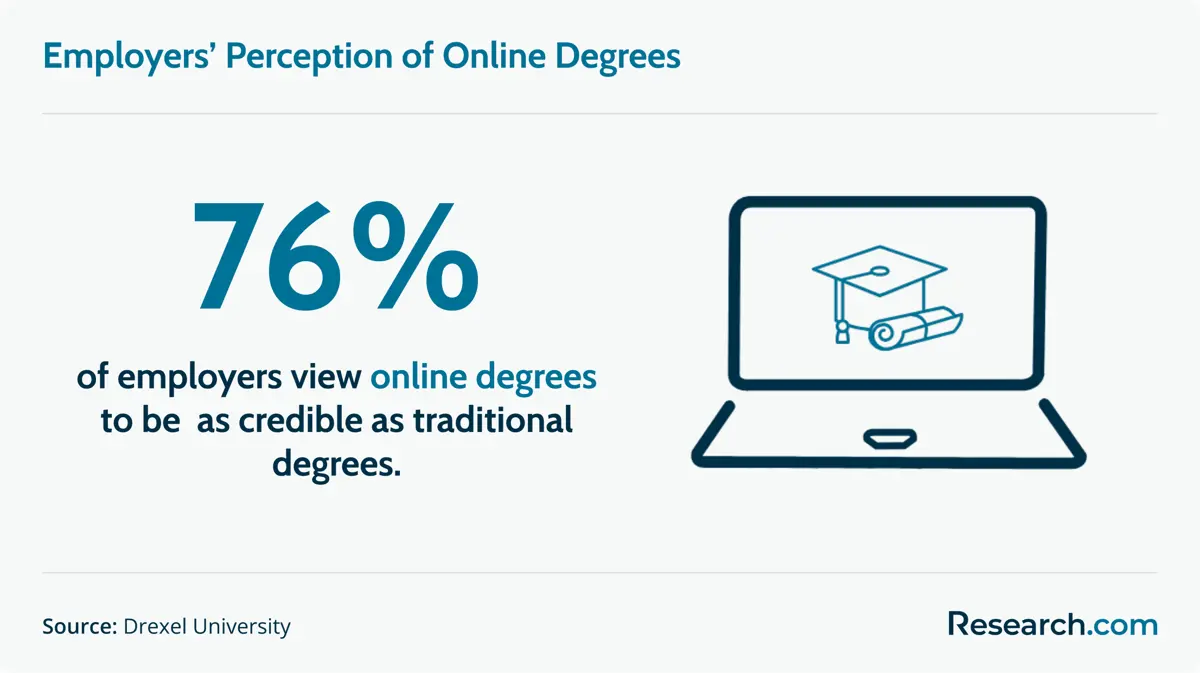
Online forensic science colleges can provide comparable academic value when they are accredited, well-designed, and transparent about laboratory expectations. According to Drexel University, 76% of academic leaders believe accredited online degrees hold the same value as traditional ones, rising to 89% for institutions with established reputations. Online learning can be especially useful for students balancing education with work, family, or location constraints.
Online programs may also strengthen technology use, independent learning, written communication, and critical thinking. The Online Journal of Distance Learning Administration found that online programs are viewed as better for developing technology and critical thinking skills. Still, students should be cautious about programs that rely only on virtual labs if their career goals require in-person evidence handling. Students interested in financial investigations may also compare this path with a forensic accounting degree.
| Factor | Online forensic science program | On-campus forensic science program |
| Flexibility | Usually better for working students or those with scheduling constraints. | Requires more fixed attendance and campus access. |
| Laboratory experience | May use virtual labs, simulations, local placements, or limited residencies. | Often provides direct access to campus labs and in-person equipment. |
| Networking | Depends heavily on online advising, internships, alumni support, and employer partnerships. | May offer more frequent face-to-face interaction with faculty, peers, and local agencies. |
| Best for | Students who need flexibility and can verify practical training options. | Students who want regular hands-on lab access and campus-based mentoring. |
What is the average cost of forensic science colleges?
According to College Tuition Compare, the average tuition for forensic science colleges is around $9,724 per year for in-state undergraduate program and $29,664 for out-of-state. Graduate programs for in-state students cost around $12,145, only about half that for out-of-state students.
Program costs vary widely by institution. Pennsylvania State University lists an in-state tuition of $32,656 and an out-of-state tuition of $52,610 for its forensic science program. Saint Louis University’s program is $73,884 annually. George Mason University lists $28,963 for in-state students and $53,127 for out-of-state students. The University of Central Florida lists $24,244 for in-state students and $39,269 for out-of-state students. Students comparing forensic science with related health and justice roles may also want to review how to become a forensic nurse.
Cost factors students often overlook
- Laboratory fees: Science-heavy programs may carry additional costs for lab materials, equipment, or specialized courses.
- Internship travel: Students may need to commute to agencies, laboratories, or field sites.
- Out-of-state tuition: Public universities may be much more expensive for nonresidents.
- Online residency requirements: Some online programs may require campus visits or in-person laboratory sessions.
- Total cost of attendance: Tuition is only one part of the price; housing, transportation, fees, and books can change affordability.
What financial aid options are available for students enrolling in forensic science colleges?
Students in forensic science colleges may use scholarships, grants, federal aid, work-study, and loans to reduce out-of-pocket costs. These options may also be available through some online universities, depending on eligibility and accreditation status.
Scholarships related to forensic science, science, and fraud investigation include:
- Barry M. Goldwater Scholarship: $7,500 per year for research in natural sciences.
- Ritchie-Jennings Memorial Scholarship: Up to $10,000 for students pursuing careers in fraud examination.
- AFTE Scholarship Program: Up to $2,000 for students seeking a career in forensic science.
Education Data Initiative reports that more than 1.7 million scholarships are awarded annually, but only 7% of college students will receive a scholarship. Because scholarship competition can be high, students should also complete federal aid applications, ask schools about department awards, compare net price instead of sticker price, and review whether internship requirements affect their ability to work while enrolled.
What are the prerequisites for enrolling in forensic science colleges?
Forensic science colleges generally expect applicants to have a strong high school foundation in science, mathematics, and writing. Requirements vary by institution, but common prerequisites include:
- High School Diploma or GED: The baseline requirement for admission.
- Science Courses: Biology, chemistry, and physics.
- Math Courses: Algebra, geometry, and possibly calculus.
- Standardized Tests: SAT or ACT scores may be required.
Some colleges may also request a minimum GPA, recommendation letters, a personal statement, or evidence of interest in science, criminal justice, research, or public service. Because forensic science coursework can be demanding, students should review each school’s admission requirements and be honest about their readiness for chemistry, biology, and lab-intensive study.
What courses are common in forensic science programs?
Forensic science is usually more science-intensive than many general degree paths. Unlike the easiest online degrees, forensic science programs often require laboratory work, technical writing, quantitative analysis, and applied evidence procedures.
Common forensic science courses include:
- Critical Analysis in Science: Builds skill in evaluating scientific studies, evidence, and data quality.
- Forensic Photography and Reconstruction: Covers methods for documenting, imaging, and reconstructing scenes.
- Crime Scene Processing: Teaches students how to identify, collect, document, and preserve evidence.
- Instrumental Analysis: Introduces scientific instruments used to analyze physical and chemical evidence.
- Toxicology: Examines drugs, poisons, chemicals, and their effects on the body.
- Body Fluid and DNA Analysis: Focuses on biological sample testing and interpretation.
- Forensic Microscopy and Spectroscopy: Uses microscopes and spectroscopes for detailed evidence examination.
- Forensic Biology: Applies biological concepts to forensic investigation and laboratory analysis.
Students may also complete general education and supporting coursework in:
- Math Courses: Algebra, calculus, statistics, and computer science.
- Natural Sciences Courses: Biology, chemistry, physics, and environmental science.
- Social Sciences Courses: Psychology, anthropology, government, and economics.
- Arts Courses: Art, history, languages, literature, and music.
What forensic science specializations are available?
Forensic science colleges often allow students to narrow their studies based on career interests. Specialization matters because laboratory roles, crime scene positions, digital evidence careers, and behavioral science pathways may require different technical skills.
- DNA Analysis: Focuses on using genetic material to help identify individuals or connect biological evidence to investigations.
- Toxicology: Trains students to detect drugs, poisons, and chemicals in biological samples.
- Digital Forensics: Concentrates on recovering, preserving, and analyzing material from computers, phones, networks, and other digital devices.
Students considering graduate study after a bachelor’s degree may compare forensic science options with the cheapest online masters programs if affordability is a major factor.
How to Choose the Best Forensic Science Colleges
The best forensic science college for you is the one that matches your career goal, budget, learning format, and specialization needs. Use rankings as a starting point, not the final answer.
- Check accreditation: Look for institutional accreditation and, when relevant, programmatic recognition such as Forensic Science Education Programs Accreditation Commission (FEPAC). Students comparing distance programs can begin with accredited online bachelor degree programs.
- Match the specialization to the job: Forensic biology, forensic chemistry, toxicology, digital forensics, and crime scene investigation prepare students for different responsibilities.
- Evaluate lab access: Ask whether students use professional-grade equipment and whether online students receive in-person training.
- Review internship pathways: Strong agency, laboratory, and law enforcement connections can help students build applied experience.
- Study faculty backgrounds: Faculty with forensic laboratory, law enforcement, research, or court testimony experience can add practical depth.
- Compare total cost: Look at tuition, fees, housing, transportation, equipment, and internship-related expenses.
- Ask about career outcomes: Request information about job placement support, graduate school preparation, and alumni pathways.
Common mistakes to avoid when choosing a forensic science college
| Mistake | Why it can hurt your outcome | Better approach |
| Choosing only by ranking | A highly ranked school may not offer your preferred specialization or internship access. | Compare curriculum, lab training, cost, location, and career support. |
| Ignoring accreditation | Accreditation can affect credit transfer, financial aid, employer confidence, and graduate school options. | Verify institutional and program-level accreditation before applying. |
| Looking only at tuition | Fees, housing, transportation, lab supplies, and internship costs can change affordability. | Compare total cost of attendance and net price after aid. |
| Assuming online means fully remote | Some online forensic science programs may still require labs, residencies, or local placements. | Ask exactly how lab and field requirements are completed. |
| Choosing a broad program without a career target | Forensic science roles can require different skills depending on the setting. | Identify whether you want lab analysis, crime scene work, digital evidence, toxicology, or graduate study. |
Is accreditation important for forensic science colleges?
Yes. Accreditation is one of the most important quality checks when comparing forensic science colleges. Institutional accreditation can affect federal financial aid eligibility, credit transfer, graduate school admission, and employer confidence. Programmatic accreditation, when available, can also signal that a forensic science curriculum meets field-specific expectations for faculty, facilities, coursework, and student preparation.
Students considering a forensic science degree should confirm the school’s accreditation status directly through the institution and relevant accrediting bodies. Do not rely only on marketing language. Ask whether the program is aligned with industry expectations, whether graduates qualify for relevant certifications, and whether coursework matches your intended forensic career path.
What technologies are changing forensic science?
Forensic science is increasingly shaped by digital forensics, artificial intelligence, data analytics, rapid DNA sequencing, and machine learning tools for pattern recognition. These technologies can improve speed, organization, and investigative efficiency, but they also require careful validation, transparent methods, and ethical use.
Programs that prepare students for the current field should expose them to evolving tools while still emphasizing scientific reliability, documentation, peer review, and courtroom defensibility. Students comparing cost-conscious options can also review affordable forensic science colleges.
How do forensic science colleges support careers and job placement?
Career support can make a major difference in forensic science because many roles require applied experience, strong references, and familiarity with agency or laboratory hiring processes. Useful services include resume reviews, mock interviews, internship coordination, alumni mentoring, employer panels, research opportunities, and networking with forensic laboratories or law enforcement agencies.
Students should ask whether career support is tailored to forensic science or offered only as general university advising. If you are comparing costs across justice-related programs, this guide on how much it costs to get a criminal justice degree may also help with financial planning.
How do forensic science and criminology work together?
Forensic science and criminology complement each other by combining evidence analysis with the study of crime, behavior, systems, and social patterns. Forensic science answers questions about physical, biological, chemical, or digital evidence. Criminology helps explain broader criminal behavior, prevention, policy, and justice system trends.
Students who want a broader view of investigations may benefit from coursework in both areas. Those more interested in policy, corrections, research, victim services, or public safety analysis can explore jobs you can get with a criminology degree.
How is forensic psychology included in forensic science programs?
Some forensic science colleges include forensic psychology through electives, interdisciplinary projects, behavioral science courses, or collaboration with psychology departments. This can help students understand criminal behavior, victimology, witness reliability, and psychological factors that may affect investigations.
Forensic psychology does not replace laboratory science, but it can add valuable context for students interested in behavioral evidence, expert consultation, or future graduate study. Students who want to expand in this direction can compare affordable online master's degrees in forensic psychology.
How do certifications and interdisciplinary courses help forensic science careers?
Professional certifications can strengthen credibility by showing technical competence, ethical awareness, and commitment to continuing professional standards. The right certification depends on the forensic specialty, employer expectations, and career stage.
Interdisciplinary coursework can also help. For example, students who add psychology, computer science, statistics, criminal justice, or legal studies may be better prepared to interpret evidence in context. Students interested in behavioral science alongside forensic work may compare accelerated online psychology degree programs.
How do forensic science colleges build industry collaboration?
Strong forensic science colleges often work with laboratories, legal agencies, law enforcement departments, research institutions, and industry partners. These relationships may support internships, guest lectures, research projects, access to specialized equipment, and applied case-based learning.
Interdisciplinary collaboration can also broaden a student’s perspective. For example, psychology coursework may help students think more carefully about behavior, witness statements, and investigative interpretation. Students considering advanced interdisciplinary study can also review options for an affordable doctorate degree in psychology online.
What career paths are available for graduates of forensic science colleges?
Forensic science graduates can pursue laboratory, investigative, digital, behavioral, and legal-support roles. The right path depends on specialization, degree level, location, internship experience, and employer requirements.
- Forensic Biology: Focuses on biological evidence such as DNA, blood, and other bodily fluids. Salary is $89,403 per year.
- Forensic Chemistry: Involves chemical analysis of substances found at crime scenes, including drugs and toxic materials. Salary is $68,182 per year.
- Crime Scene Investigation: Centers on collecting, preserving, documenting, and analyzing evidence from crime scenes. Salary is $59,636 per year.
- Forensic Toxicology: Studies chemicals, drugs, toxins, and their effects on the human body. Salary is $61,011 per year.
- Digital Forensics Specialist: Focuses on recovering and investigating material found in digital devices. Salary is $78,520 per year.
- Forensic Psychology: Examines psychological dimensions of criminal behavior and legal processes. The forensic psychologist salary is $87,877 per year.
If you are interested in legal work but prefer a role outside the forensic laboratory, you may want to learn what a paralegal does and how that career compares with forensic science.
The chart below provides a salary comparison across several forensic and forensic-adjacent roles.
What is the job market for graduates of forensic science colleges?
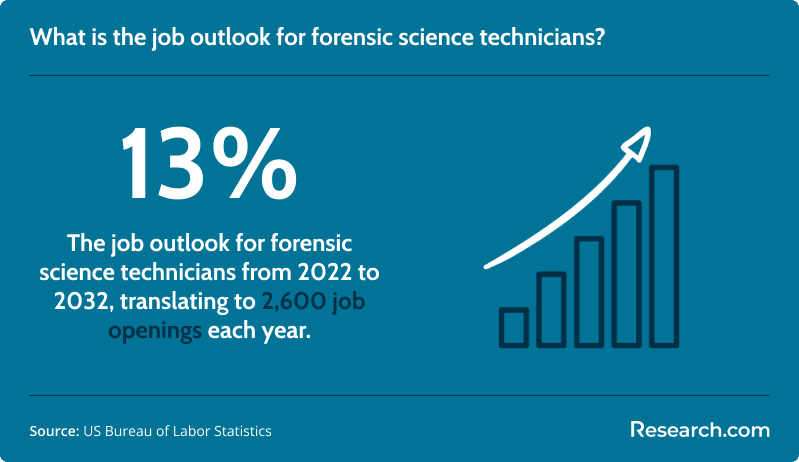
The job market for forensic science graduates is tied closely to public-sector hiring, laboratory demand, crime scene unit staffing, digital evidence needs, and regional budgets. The BLS projects employment for forensic science technicians to grow 13% from 2022 to 2032, which indicates continued demand for trained professionals. Still, competition can vary by location and specialization.
Students can improve their employment prospects by completing internships, developing strong laboratory skills, learning proper documentation and chain-of-custody procedures, gaining experience with relevant instruments or software, and building professional references. Location also matters: California, Texas, Florida, Arizona, and Virginia employ large numbers of forensic scientists.
What ethical issues affect forensic science?
Ethics is central to forensic science because evidence can influence arrests, trials, sentencing, appeals, and public trust in the justice system. Forensic professionals must remain accurate, objective, transparent, and careful with sensitive evidence.
- Integrity and objectivity: Forensic scientists must avoid bias, pressure from investigators, and personal assumptions. Their conclusions should be based on evidence and validated methods.
- Confidentiality: Case information, victim details, and investigative records must be protected to avoid harm, legal consequences, or compromised investigations.
- Proper evidence handling: Errors in collection, storage, testing, or documentation can weaken cases or contribute to unjust outcomes.
- Responsible use of technology: AI, genetic analysis, and digital tools create privacy, consent, validation, and transparency concerns.
- Accurate court testimony: Forensic scientists must explain findings clearly, stay within their expertise, and avoid overstating what evidence proves.
How does a forensic science degree prepare students to work with law enforcement agencies?
A forensic science degree prepares students to support law enforcement by teaching scientific evidence analysis, crime scene procedures, legal context, documentation, communication, and ethical responsibility. Graduates often work alongside investigators, attorneys, judges, forensic analysts, and laboratory personnel.
- Criminal law and procedure: Students learn how the justice system uses forensic evidence and why admissibility, documentation, and procedure matter.
- Crime scene training: Programs may include mock scenes, evidence collection, photography, sketching, preservation, and reporting.
- Forensic techniques: Coursework may cover DNA analysis, fingerprinting, toxicology, ballistics, microscopy, and chemical testing.
- Professional collaboration: Internships and fieldwork can help students learn how to communicate with officers, analysts, attorneys, and other professionals.
- Critical thinking: Students learn to evaluate evidence systematically and avoid jumping to conclusions.
- Ethical and legal practice: Programs emphasize chain of custody, evidence integrity, confidentiality, and accurate reporting.
Students interested in criminal behavior or law enforcement consulting may also compare forensic science with the easiest psychology degree options, especially if they are considering psychology-related forensic roles.
How do mental health considerations affect forensic analysis?
Mental health considerations can influence how forensic professionals interpret behavior, statements, competency issues, trauma responses, and case context. While forensic scientists must avoid making unsupported psychological conclusions outside their expertise, awareness of mental health factors can improve collaboration with psychologists, attorneys, investigators, and courts.
Students who want to connect forensic science with mental health practice can explore the best clinical mental health counseling master's programs to understand how counseling, assessment, and behavioral health training may complement forensic work.
Why pursue a master’s in forensic science?
A master’s in forensic science can help students build advanced technical knowledge, specialize in areas such as forensic biology or toxicology, prepare for research-oriented work, and compete for more specialized roles. It is not necessary for every entry-level job, so students should weigh the cost against their career goals, current experience, and target employers.
Potential benefits of a master’s in forensic science
- Higher salary potential: Professionals in advanced, specialized, or leadership roles may qualify for stronger pay. Forensic scientists in the top 10% of the field earn more than $107,490 annually.
- Advanced specialization: Graduate programs may offer deeper study in forensic biology, digital forensics, toxicology, or related areas. Students interested in behavioral science can also explore forensic psychology master's programs online.
- Research opportunities: Graduate study can expose students to emerging methods, technical validation, and applied research.
- Career differentiation: A master’s degree may help applicants stand out for roles requiring advanced laboratory skill or specialized knowledge.
Questions to ask before choosing a forensic science college
- Is the institution accredited, and does the forensic science program have any field-specific accreditation or recognition?
- Which specialization does the program support: forensic biology, forensic chemistry, toxicology, digital forensics, or crime scene investigation?
- How much hands-on laboratory work is required?
- Do online students complete in-person labs, residencies, or local internships?
- Which agencies, laboratories, or employers partner with the program?
- What is the total cost of attendance after scholarships, grants, and other aid?
- Are faculty members experienced in forensic science, laboratory work, research, law enforcement, or court testimony?
- Does the curriculum teach chain of custody, courtroom communication, ethics, and evidence documentation?
- What career services are available specifically for forensic science students?
- How do graduates typically use the degree after completing the program?
References
- CollegeTuitionCompare (n.d.) 2024 Forensic Science and Technology Program tuition
- Crime Scene Investigator (2024) ZipRecruiter.
- Digital Forensics Specialist (2024) ZipRecruiter.
- Forensic Biologist (2024) ZipRecruiter.
- Forensic Chemist (2024) ZipRecruiter.
- Forensic Psychologist (2024) ZipRecruiter.
- Forensic Toxicologist (2024) ZipRecruiter.
- Hanson, M. (2024, January 14). College Scholarship Statistics [2023]: Yearly Total + analysis. Education Data Initiative.
- How to become a forensic scientist How long does IT take to become a forensic scientist? (n.d.) Higher Edu
- Online Degree vs On-Campus Degrees (2024) Drexel University Online
- Online versus Face-to-Face Nursing Degrees: A Study of Recruiters’ Perceptions - OJDLA (n.d.-b) OJDLA
Key Insights
- Forensic science colleges are best for students who enjoy science, lab work, evidence analysis, and careful documentation.
- The strongest programs combine chemistry, biology, criminal justice, hands-on labs, internships, and ethics training.
- Salary potential is real but not guaranteed: forensic science technicians earn an average annual wage of $71,540, while top earners make over $107,490.
- Program fit matters more than prestige alone. Compare accreditation, specialization, facilities, cost, internship access, and career support.
- Online forensic science degrees can work well for flexible learners, but students must verify how laboratory and field training are completed.
- Students targeting advanced lab, research, or leadership roles may benefit from a master’s degree, but they should compare the cost with realistic career goals.
Other Things You Should Know About Forensic Science Colleges
In 2027, forensic science programs are ranked based on criteria such as program accreditation, faculty expertise, laboratory facilities, internship opportunities, and graduate success rates. Evaluators often look for programs with hands-on training, strong industry connections, and updated curriculum reflecting current forensic technologies and methodologies.
Admission requirements for top forensic science colleges in 2027 typically include a high school diploma with coursework in biology and chemistry, a minimum GPA of 3.0, SAT/ACT scores, and completion of an application essay. Some programs may also require relevant extracurricular activities.
Students should look for programs accredited by the Forensic Science Education Programs Accreditation Commission, or FEPAC. FEPAC accredits undergraduate and graduate forensic science programs and reviews curriculum, laboratory training, faculty qualifications, and institutional support.