2027 Forensic Psychology Careers: Guide to Career Paths, Job Outlook, & Salary

Co-Founder and Chief Data Scientist
Forensic psychology offers diverse exciting opportunities, from criminal profiling and threat assessment to working with victims and perpetrators. However, navigating the path to becoming a forensic psychologist can be challenging. Students often grapple with the question, "What jobs are actually available?" and the specific steps needed to qualify.
The good news? The demand for qualified forensic psychologists is on the rise. Data from the Bureau of Labor Statistics projects a 6% growth rate for psychologists through 2034, faster than average for all occupations. To help students take advantage of this, I created a guide about forensic psychology careers. It also touches on the average salary, specializations, and career alternatives of forensic psychologists.
Key Benefits of Forensic Psychology Careers
- The average annual salary of a forensic psychologist is $95,647.
- Data project a 6% growth rate for psychologists, including forensic psychologists, through 2034.
- All psychologists in the United States earn a median annual salary of $94,310.
- The highest-paying work settings for forensic psychologists include manufacturing industries ($101,586) and professional services ($86,786).
- From the completion of bachelor's, master's, and doctorate degrees to achieving sufficient postdoctoral experience and licensure, becoming a forensic psychologist may take anywhere from 10 to 13 years.
- Why pursue a career in forensic psychology? Why pursue a career in forensic psychology?
- What is the average salary of forensic psychologists? Average Salary
- What is the job outlook for forensic psychologists? Career Outlook
- What are the essential skills of forensic psychologists? Essential Skills
- What are the specializations of forensic psychologists? Specializations
- How can I start my career in forensic psychology? Starting a Career
- What are the ideal certifications in forensic psychology? What are the ideal certifications in forensic psychology?
- How can I advance my career in forensic psychology? Career Advancement
- What are the alternative career options for forensic psychologists? What are the alternative career options for forensic psychologists?
- What are the challenges forensic psychologists face in their careers? What are the challenges forensic psychologists face in their careers?
- How can forensic psychology and social work collaborate to improve client outcomes? How can forensic psychology and social work collaborate to improve client outcomes?
- How can continuing education boost forensic psychology careers? How can continuing education boost forensic psychology careers?
- Can accelerated master's programs boost forensic psychology careers? Can accelerated master's programs boost forensic psychology careers?
- How does a forensic psychologist's work differ from clinical psychology? How does a forensic psychologist's work differ from clinical psychology?
- How is technology transforming forensic psychology? How is technology transforming forensic psychology?
- The Interdisciplinary Applications of Forensic Psychology The Interdisciplinary Applications of Forensic Psychology
- What opportunities are available for advanced education in forensic psychology? What opportunities are available for advanced education in forensic psychology?
- Is a traditional psychology degree essential for forensic psychology success? Is a traditional psychology degree essential for forensic psychology success?
- How Can Professional Networking Propel Forensic Psychology Careers? How Can Professional Networking Propel Forensic Psychology Careers?
- Can Integrating Clinical Mental Health Counseling Enhance Forensic Psychology Practice? Can Integrating Clinical Mental Health Counseling Enhance Forensic Psychology Practice?
If you are considering forensic psychology, you are probably trying to answer a bigger question than “Do I like crime and the courts?” You need to know whether the field fits your interests, how long the training takes, what kind of work you would actually do, how licensure changes your options, and whether another psychology-adjacent path might be a better fit for your goals.
This guide breaks down forensic psychology as a career choice in practical terms. You will learn what forensic psychologists do, how much they may earn, what education is usually required, which skills matter most, what specializations exist, how technology is changing the field, and what to compare before choosing a program.
Quick answer: Is forensic psychology a good career path?
Forensic psychology can be a strong career path for people who want to apply psychology in legal, correctional, public safety, victim-service, and research settings. It is best suited to students who are comfortable with difficult subject matter, careful documentation, ethical gray areas, and long graduate training. According to ZipRecruiter, the average annual salary for forensic psychologists is $95,647. The U.S. Bureau of Labor Statistics (BLS) projects 6% growth for psychologists through 2034. The main trade-off is that independent practice usually requires a doctorate, supervised experience, and state licensure.
What forensic psychology is and why it matters
Forensic psychology applies psychological science to legal questions and justice-related decisions. That can include criminal cases, civil disputes, custody matters, correctional treatment, public safety evaluations, and victim support. The work is not limited to therapy. In many settings, the psychologist is helping a court, attorney, agency, or institution understand behavior and risk.
This is one reason forensic psychology differs from many clinical psychology career paths. Clinical work usually centers on treating a client. Forensic work often centers on answering a legal or institutional referral question. That difference affects confidentiality, documentation, and the professional relationship. It also means forensic psychologists must be prepared for their opinions to be challenged in court or in formal review settings.
Common responsibilities may include:
- Evaluating competency, risk, trauma, or behavioral patterns in legal cases
- Reviewing records, interviews, test results, and collateral information
- Writing reports for courts, agencies, attorneys, correctional institutions, or treatment teams
- Providing treatment in correctional, forensic hospital, or community settings
- Consulting with attorneys, judges, law enforcement, or public agencies
- Testifying as expert witnesses when psychological findings are relevant to a case
- Researching violence, victimization, rehabilitation, assessment tools, and justice system behavior
Forensic psychologists may work in courts, jails, prisons, forensic hospitals, government agencies, universities, private practice, community programs, and rehabilitation settings. Some also move into research, policy, consulting, or related specialties such as cognitive psychology careers.
If you are still early in your planning, it helps to understand how long it may take to earn a psychology degree and how graduate school affects your timeline.
What is the average salary for forensic psychologists?
ZipRecruiter reports an average annual salary of $95,647 for forensic psychologists. That is in the same general range as the average salary for clinical psychologists and above the national average salary of $49,500 reported by the BLS.
Actual pay varies widely. Education level, licensure status, geographic location, employer type, specialization, years of experience, and whether the role is in private practice, academia, corrections, healthcare, consulting, or public service can all affect earnings. The salary data also shows stronger reported earnings in some sectors, including manufacturing industries ($101,586) and professional services ($86,786).
For the broader psychology field, the BLS reports a median annual salary of $94,310 for psychologists in the United States. Industrial-organizational psychologists are among the highest-paid psychology professionals at $109,840. Forensic psychologists may increase their earning potential through advanced assessment training, courtroom experience, consulting, private practice, or specialized credentials, but no salary outcome is guaranteed.
The chart below highlights U.S. cities with some of the highest reported average annual salaries for forensic psychologists.
What is the job outlook for forensic psychology?
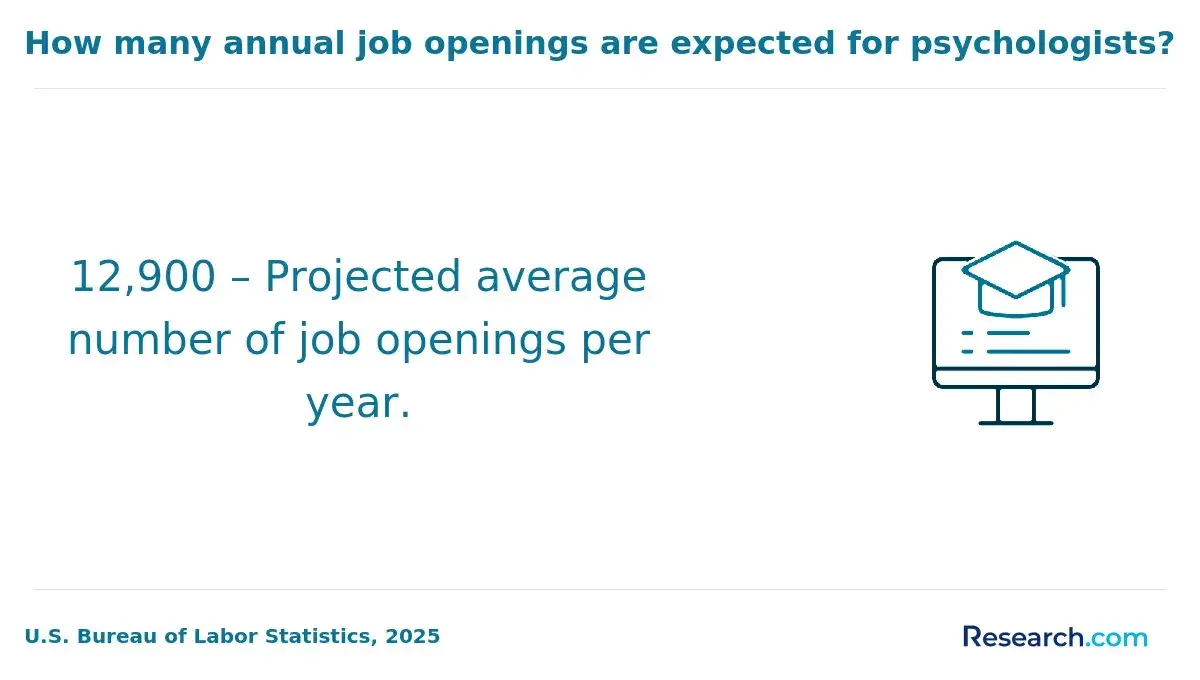
The BLS projects 6% employment growth for psychologists through 2034, which is faster than the projected 3% growth rate for all U.S. occupations. The agency also expects about 12,900 openings each year during that period.
Several trends support demand in this area: continued attention to mental health, court and correctional caseloads, trauma-informed services, public safety needs, and the use of psychological expertise in legal decisions. Even so, forensic psychology is a specialized field. Hiring usually depends on licensure, doctoral preparation, experience with assessment, and the ability to communicate clearly with legal professionals.
What skills do forensic psychologists need?
Interest in crime or court proceedings is not enough to succeed in forensic psychology. Professionals need strong evidence-based reasoning, careful writing, emotional steadiness, and the ability to explain complex findings to people without psychology training. These abilities are developed through undergraduate study, graduate education, supervised practice, and licensure preparation.
If you are exploring what you can do with a forensic psychology degree, it helps to know which skills matter most.
Core professional skills
- Research skills. Forensic conclusions should rest on scientific evidence, not assumptions. Practitioners use literature, validated measures, interviews, records, and legal standards to form opinions.
- Scientific literacy. Understanding research design, statistics, assessment validity, and the limits of the evidence helps prevent overstatements and weak conclusions.
- Assessment and report-writing skills. Many forensic roles depend on evaluation. Reports must be clear, precise, and useful in legal or institutional settings.
- Technology competence. Digital records, secure communication tools, assessment systems, and remote proceedings are now common. The legal system’s shift toward technology, including the use of remote court proceedings, makes digital fluency increasingly important.
Interpersonal and legal-setting skills
- Analytical thinking. Forensic psychologists compare records, statements, test data, histories, and observed behavior while separating facts from speculation.
- Communication skills. The work may involve defendants, victims, attorneys, judges, correctional staff, families, and treatment teams. Clear communication helps preserve trust and credibility.
- Presentation skills. Findings may need to be explained in court, conferences, consultations, or meetings with agency staff.
- Emotional resilience and boundaries. The field can involve trauma, violence, conflict, and deception. Boundaries and self-awareness are essential.
What are the main specializations in forensic psychology?
Forensic psychology is not one single job. It includes several specialty areas, and the training path can differ depending on whether you want to do evaluation, treatment, research, consultation, or advocacy.
| Specialization | Primary focus | Best suited for students who want |
| Criminal forensic assessment | Competency, criminal responsibility, risk, sentencing, and court-related evaluation | Legal standards, expert testimony, and psychological testing |
| Correctional psychology | Assessment and treatment in jails, prisons, and forensic hospitals | Crisis intervention, rehabilitation, and justice-involved populations |
| Victim and trauma services | Victim support, trauma assessment, crisis response, and recovery planning | Advocacy, counseling, and community-based care |
| Juvenile and family court psychology | Cases involving youth, custody, abuse, delinquency, and family functioning | Child development, family systems, and court-connected work |
| Police and public safety psychology | Fitness-for-duty evaluations, officer wellness, and agency consultation | Law enforcement, occupational assessment, and public safety support |
| Forensic research and teaching | Research on violence, risk, legal behavior, and assessment methods | Universities, data analysis, policy work, and graduate education |
How do you become a forensic psychologist?
The most common route is long and highly structured. Students usually complete a bachelor’s degree, then a graduate program, then a doctorate in psychology or a closely related field, followed by supervised experience and state licensure. Research.com explains this pathway in more detail in its guide on how to become a forensic psychologist.
Some students move directly from a bachelor’s degree into doctoral study. Others earn a master’s degree first to strengthen their academic record, build research experience, or confirm that forensic work is the right fit. In some cases, doctoral programs may value prior graduate work, including a master’s in forensic psychology.
If flexibility matters, you can compare online bachelor’s degrees in psychology and online master’s degrees in psychology. Just be sure to verify accreditation, practicum or internship rules, transfer policies, and whether the program aligns with your target job or licensure path.
Doctoral programs often take five to seven years because they may include advanced coursework, exams, dissertation work, supervised experience, and a one-year internship. Students who are not ready for doctoral study can still find related work in victim services, corrections, advocacy, research, behavioral health, and human services. Those interested in criminal behavior may also compare options offered by criminal psychology schools.
Because cost affects long-term value, students should estimate the cost of a bachelor’s degree and compare aid, public versus private tuition, and possible employer support before enrolling.
| Career direction | Legal path | Clinical path | Teaching and research path |
| Main goal | Apply psychology in court, legal, and justice-related settings | Diagnose, treat, and support mental health | Teach, research, publish, and mentor future professionals |
| Entry-level jobs | Victim Advocate ($65,807) | Mental Health Counselor ($59,190) | Survey Researcher ($63,380) |
| Associate-level jobs | Social Worker ($61,330) | Marriage and Family Therapist ($63,780) | Psychology Teachers ($80,330) |
| Higher-level jobs | Forensic Psychologist ($95,647) | Clinical Psychologist ($95,830) | School Psychologist ($86,930) |
What jobs can I pursue with an associate degree in forensic psychology?
Social and human service assistants
These professionals help connect individuals to community services and support work across psychology, social work, and human services. In settings related to the justice system, they may help victims, families, or justice-involved people with referrals, paperwork, case coordination, and follow-up.
Median Annual Salary: $45,120
Childcare workers
Childcare workers manage daily care, routines, learning activities, and safety for children. This is not a forensic psychology role, but it can build observation skills and an understanding of child development that may be useful later in juvenile justice, child advocacy, or family court work.
Median Annual Salary: $32,050
What jobs can I pursue with a bachelor’s degree in forensic psychology?
Substance abuse, behavioral disorder, and mental health counselor
These counselors support people dealing with addiction, behavioral concerns, and mental health conditions. Depending on the state and employer, additional credentials or supervised hours may be required.
Median Annual Salary: $59,190
Victim advocate
Victim advocates help people affected by crime navigate legal, medical, financial, and community systems. Their work may include explaining options, helping with compensation applications, and supporting survivors of domestic violence, sexual assault, abuse, or other crimes.
Median Annual Salary: $65,807
Jury consultants
Jury consultants assist legal teams with jury selection, mock trials, trial strategy, survey analysis, and case presentation. The role draws on psychology, communication, statistics, and legal knowledge.
Median Annual Salary: $90,571
Which certifications are useful in forensic psychology?
Certifications can show specialized training, but they do not replace a license when licensure is required. Students should distinguish between academic certificates, optional professional credentials, and state licensing requirements.
- Specialty Board Certification in Forensic Psychology (SBCFP). The SBCFP credential is offered through the American Board of Professional Psychology and signals advanced forensic competence.
- American Board of Forensic Psychology (ABFP) certifications. The ABFP is associated with specialty recognition in forensic psychology and may strengthen professional standing.
- Specialized continuing training. Depending on the role, professionals may also pursue education in trauma, child assessment, risk assessment, correctional mental health, police psychology, malingering, substance use, or expert testimony.
How can you advance in forensic psychology?
Career growth usually comes from more education, licensure, supervised experience, specialized assessment training, research involvement, and professional reputation. A master’s degree may support work in counseling, corrections, advocacy, social services, research, or doctoral preparation. A doctorate and license are usually required for independent psychologist practice, forensic evaluations, and private practice.
Students comparing graduate options can review online graduate psychology programs, but they should confirm that the program includes the practicum, internship, or licensure preparation they need.
What can I do with a master’s in forensic psychology?
Social worker
Social workers support people dealing with housing instability, unemployment, disability, trauma, family conflict, and healthcare barriers. They may work in schools, hospitals, clinics, correctional institutions, community agencies, and nonprofit organizations. About 74,000 social work positions are expected to open annually through 2034.
Median Annual Salary: $61,330
Marriage and family therapist (MFT)
MFTs work with individuals, couples, and families to address emotional, behavioral, and relationship concerns. Their practice may include therapy, assessment, and treatment planning for stress, conflict, anxiety, and depression.
Median Annual Salary: $63,780
What can I do with a doctorate in forensic psychology?
Forensic psychologist
Forensic psychologists use psychological expertise to answer legal questions. Work may include assessments, record review, consultation, treatment recommendations, risk evaluation, and testimony. Private practitioners may be retained by courts, attorneys, institutions, or organizations.
Median Annual Salary: $95,647
Clinical psychologist
Clinical psychologists evaluate, diagnose, treat, and study mental, emotional, and behavioral disorders. Some work with forensic populations, while others practice in hospitals, clinics, schools, private practice, or research settings.
Median Annual Salary: $95,830
What alternative careers should you consider?
A psychology background can support many careers outside of forensic evaluation. If you are still deciding, it may help to review what you can do with a psychology degree and compare paths that use assessment, counseling, research, and public-service skills.
Police and public safety psychology
Police and public safety psychologists work with law enforcement and emergency response organizations. Their responsibilities may include applicant screening, fitness-for-duty evaluations, officer wellness, crisis response, operational consultation, and training.
- Assessment work for public safety applicants
- Clinical support after critical incidents
- Consultation on behavioral issues in investigations or operations
- Training and wellness programs for agencies
Students interested in this area may benefit from broader study of policing and corrections. An affordable online criminal justice degree may be useful for building that foundation. This area also matters because a cited Journal of Police and Criminal Psychology study by Lawrence et al. (2025) from the Police Executive Research Forum reports a PTSD rate of 18% for law enforcement officers.
Rehabilitation psychology
Rehabilitation psychologists help people living with disabilities, injuries, chronic illness, or functional limitations improve daily functioning and quality of life. Their work may include assessment, treatment planning, advocacy, adjustment support, and research. Students considering advanced clinical work can compare flexible doctoral options such as 3 year PsyD programs online, while checking accreditation and supervised training requirements carefully.
What challenges do forensic psychologists face?
Forensic psychology can be meaningful, but it is not easy work. Cases are often adversarial, emotionally heavy, and time sensitive. Anyone considering the field should understand those demands before committing to years of graduate education.
Emotional strain
- Repeated exposure to trauma. Cases may involve abuse, neglect, homicide, sexual assault, violence, or severe mental illness. Over time, that exposure can contribute to burnout or secondary trauma.
- Low cooperation from examinees. People involved in legal cases may be guarded, angry, frightened, or deceptive. Evaluators must judge reliability and motivation carefully.
Ethical complexity
- Objectivity under pressure. Forensic psychologists are expected to stay neutral even when a case is disturbing or highly public. Their task is to provide evidence-based opinions, not to become advocates disguised as evaluators.
- Different confidentiality expectations. Forensic evaluations are not therapy. The person being assessed must understand how information will be used and who may see it.
Courtroom demands
- Expert testimony. Psychologists may need to explain methods, defend conclusions, and respond to cross-examination. Weak communication can undermine strong analysis.
- High-stakes outcomes. Findings may influence competency rulings, sentencing, custody, risk management, placement decisions, or institutional policy.
Workload pressure
- Large caseloads. Demand for mental health and forensic services can create tight schedules and heavy workloads.
- Time-intensive evaluations. Some cases require prolonged interviewing, testing, record review, consultation, and report preparation.
How do forensic psychology and social work complement each other?
Forensic psychologists and social workers often work with the same populations but from different angles. A forensic psychologist may focus on evaluation, risk, trauma, or behavioral patterns. A social worker may focus on safety planning, housing, benefits, family support, and access to services.
That combination is useful in courts, hospitals, correctional settings, child welfare agencies, victim-service programs, and reentry organizations. Together, the fields can improve both legal decision-making and practical support. Students comparing related professions can review the master’s in social work salary guide to better understand compensation in social work careers.
How does continuing education support a forensic psychology career?
Forensic psychology changes as laws, assessment methods, court standards, ethical rules, and research findings evolve. Continuing education helps professionals stay current and maintain competence.
Useful topics may include forensic assessment, expert testimony, trauma, violence risk, malingering, correctional mental health, cultural competence, ethics, and legal updates. Some professionals also strengthen their background through options such as affordable psychology master’s programs before doctoral study or a career transition.
Can accelerated master’s programs help?
Accelerated master’s programs may be useful for students who already know their direction and can handle a fast-paced schedule. These programs often cover research methods, assessment, ethics, legal issues, and applied behavioral science in a shorter time frame.
They are not the right fit for everyone. A traditional pace may be better if you need more academic support, more field exposure, or more time to prepare for doctoral admissions. Before choosing a faster option, compare accreditation, faculty background, practicum access, transfer rules, and whether the curriculum supports your next step. Some students look at a 1 year psychology master’s program when speed is a priority.
How is forensic psychology different from clinical psychology?
These two fields overlap, but they are not the same. Clinical psychology focuses on diagnosis, treatment, and mental health improvement. Forensic psychology applies psychological expertise to legal, correctional, or public safety questions.
| Comparison point | Forensic psychology | Clinical psychology |
| Main purpose | Answer legal, court-related, correctional, or public safety questions | Assess, diagnose, treat, and support mental health |
| Common settings | Courts, correctional facilities, forensic hospitals, law enforcement agencies, consulting, and private practice | Hospitals, clinics, schools, community agencies, private practice, and research centers |
| Frequent assessments | Competency, risk, criminal responsibility, legal trauma claims, and fitness for duty | Diagnostic evaluation, treatment planning, psychological testing, and therapy progress |
| Client relationship | Often evaluative; the referring party may be a court, attorney, or agency | Often therapeutic; the client usually seeks care or treatment |
| Training emphasis | Assessment, law, ethics, legal procedure, expert communication, and psychology | Psychopathology, diagnosis, intervention, therapy, assessment, and clinical research |
Students looking for an entry point can compare foundational options such as the easiest psychology degree programs, but forensic practice requires much more advanced preparation.
How is technology changing forensic psychology?
Technology is reshaping forensic psychology through digital records, secure video platforms, remote interviews, digital communication evidence, and electronic assessment tools. Psychologists may now evaluate online behavior or electronic records as part of a case review.
AI and machine learning are also influencing research, data review, and risk analysis. These tools may improve efficiency, but they do not replace validated assessment methods, ethical judgment, or awareness of bias. Forensic psychologists need to understand both the benefits and the limits of new technology.
Students beginning with an early credential can consider a 2-year psychology degree online while building digital literacy and foundational knowledge.
Where else can forensic psychology be applied?
Forensic psychology is not limited to criminal court. Its methods can be useful in civil cases, family disputes, workplace investigations, rehabilitation, healthcare, education, public safety, athletics, and organizational risk management. The common thread is the use of psychological knowledge in situations where behavior has serious legal or institutional consequences.
Sports psychology is one adjacent area. Forensic-informed skills may be useful when athletes deal with trauma, misconduct allegations, substance use, legal issues, or risk management concerns. Students interested in athlete support and performance may want to review the sports psychologist job outlook.
What advanced education options are available?
Advanced pathways include master’s degrees, doctoral programs, PsyD and PhD degrees, postdoctoral training, graduate certificates, and continuing education in forensic specialties. A master’s can support related roles or strengthen doctoral applications, while a doctorate is generally required for independent psychologist licensure and forensic evaluation practice.
Students looking for flexible and budget-conscious options can compare forensic psychology master’s programs. Before enrolling, confirm whether the program is intended for licensure, doctoral preparation, research, or applied non-licensed work.
Is a traditional psychology degree required?
A psychology degree is the most direct route for students who want to become licensed forensic psychologists. That said, backgrounds in criminal justice, counseling, social work, sociology, neuroscience, public policy, or law can also lead to related careers or graduate study if the right psychology prerequisites are completed.
These alternative routes may be a better fit for students who want to work in advocacy, victim services, corrections, research, behavioral health support, or policy without becoming licensed psychologists. If you are considering therapy without a psychology major, review whether you can become a therapist without a psychology degree.
How can networking help your career?
Networking can help you find mentors, research opportunities, practicum sites, internships, and early job leads. Because forensic psychology is specialized, relationships with faculty, supervisors, attorneys, agency leaders, correctional professionals, and licensed psychologists can help you understand what the work is really like.
Good steps include joining professional associations, attending events, asking about research or fieldwork opportunities, and connecting your education choices to your long-term goals. Students who want a faster degree path can compare fast online master’s in psychology programs, but supervised experience still matters no matter how quickly the degree is completed.
Can clinical mental health counseling strengthen forensic work?
Clinical mental health counseling skills can be very useful in trauma services, crisis response, correctional treatment, victim advocacy, substance-use support, and rehabilitation. Counseling training can improve interviewing, empathy, case formulation, and treatment planning.
Even so, counseling and forensic assessment are not the same function. Therapy is meant to help the client, while forensic assessment is meant to answer a legal or institutional question. Professionals need to keep those roles separate to avoid conflicts of interest. Students who want counseling-centered training can review the fastest online master’s programs in clinical mental health counseling.
Common mistakes to avoid when choosing a forensic psychology path
| Mistake | Why it causes problems | Better approach |
| Choosing a program only because it says “forensic” | The title does not guarantee strong faculty, licensure preparation, or meaningful fieldwork | Review the curriculum, accreditation, outcomes, practicum options, and faculty background |
| Ignoring licensure rules | Psychologist licensing is state-based and requirements vary | Check the licensing board rules in the state where you want to practice before enrolling |
| Assuming a master’s degree makes you a forensic psychologist | Independent psychologist practice usually requires a doctorate and licensure | Use a master’s strategically for related work, doctoral preparation, or advancement |
| Comparing schools only by tuition | A low price does not guarantee strong placement, advising, or support | Compare total cost, aid, completion time, placements, and outcomes |
| Underestimating the emotional burden | The work can involve trauma, violence, conflict, and high-stakes decisions | Gain supervised experience early and build consultation and self-management habits |
| Relying only on rankings | Rankings may not reflect licensure needs, location, or specialization | Use rankings as one factor, not the final decision |
Questions to ask before enrolling in a forensic psychology program
- Is the program accredited, and does that accreditation match my licensure or career goal?
- Does the curriculum include forensic assessment, ethics, law, research methods, and applied experience?
- Are practicum, internship, or fieldwork opportunities available in courts, corrections, hospitals, community agencies, or law enforcement settings?
- Do faculty members have real experience in forensic practice, research, assessment, or expert testimony?
- What percentage of graduates move into doctoral programs, licensure-track roles, or relevant employment?
- Will the online format satisfy requirements in the state where I plan to work?
- What will the total cost be after fees, books, travel, residency requirements, and possible lost income?
- Does the program help with licensure exam preparation, internship placement, research experience, or board certification goals?
- Can credits transfer if I change programs or later apply to a doctorate?
- What supervised experiences will help me decide whether forensic work is truly right for me?
What do professionals say about the field?
- : "My training helped me understand how complicated criminal behavior can be. Coursework introduced theories of offending, investigative methods, and risk assessment, but my correctional practicum made the field feel real. Working with incarcerated people taught me to look beyond labels and examine history, context, behavior, and motivation. In court consulting now, I try to produce evaluations that help legal professionals make fairer decisions. — Michael"
- : "Forensic psychology training showed me how closely research and victim support can connect. I studied trauma, forensic interviewing, and victim assessment, but the lesson that stayed with me most was the importance of dignity after harm. In my hospital role, I help people affected by crime begin rebuilding safety, trust, and control. — May"
- : "The interdisciplinary nature of forensic psychology was the most valuable part of my education. Courses in legal procedure, criminal justice, ethics, and psychological assessment prepared me for private practice. I now complete evaluations for criminal defense attorneys with the goal of giving courts careful, accurate psychological information. — Eric"
How to decide whether forensic psychology is right for you
Start by asking a simple question: do you want to do legal-adjacent psychological work, or do you mainly want to provide therapy? If you want courtroom-related assessment, correctional work, expert consultation, or legal decision support, forensic psychology may be a good fit. If you want direct treatment, case management, or counseling, related fields such as clinical psychology, counseling, or social work may fit better.
Next, compare the time, cost, and licensure requirements of each path. Forensic psychology typically offers more specialized work, but it also requires more schooling and greater comfort with legal scrutiny. Students who want faster entry into helping roles may find better value in counseling, social work, victim advocacy, corrections, or human services.
Finally, look at whether you can handle the daily realities of the field. Forensic psychology can be intellectually rewarding, but it also involves emotionally difficult material, high-stakes decisions, and strict ethical boundaries. A realistic understanding of the work is essential before you commit.
Key insights
- Forensic psychology is a specialized career for people who want to apply psychology in legal, correctional, public safety, victim-service, or research settings.
- ZipRecruiter reports an average annual salary of $95,647 for forensic psychologists, but pay depends on education, licensure, location, employer type, and experience.
- The BLS projects 6% growth for psychologists through 2034 and about 12,900 openings per year, yet forensic psychology remains a competitive field.
- Independent forensic psychologist practice usually requires a doctorate, supervised experience, and state licensure.
- Associate, bachelor’s, and master’s degrees can still lead to useful related roles in advocacy, counseling, corrections, research, social work, and behavioral health.
- Choose a program based on accreditation, licensure alignment, practicum access, faculty expertise, cost, and outcomes—not just the word “forensic” in the title.
- Technology, remote proceedings, digital evidence, and AI-supported tools are changing the field, but professional judgment and validated methods still matter most.
- The biggest mistakes are ignoring licensure rules, assuming salary or job outcomes are guaranteed, and underestimating the emotional pressure of forensic work.
References
- College Factual. (2025). 2025 Psychology Degree Guide. College Factual.
- Police Executive Research Forum. (2025). New PERF report on mental health treatment centers for police. PERF.
- U.S. Bureau of Labor Statistics. (2025). Psychologists. BLS.
- Zippia. (2025). Forensic psychologist demographics and statistics in the US. Retrieved March 2026, from Zippia.
- ZipRecruiter. (2026). Forensic psychologist salary. Retrieved March 2026, from ZipRecruiter.
- ZipRecruiter. (2026). What Is the Average Forensic Psychologist Salary by State. Retrieved March 2026, from ZipRecruiter. See also forensic psychologist salary data.
Other Things You Need to Know About Forensic Psychology Careers
Most forensic psychologists need a doctoral degree in psychology, usually a PhD or PsyD, plus supervised clinical training. Many states also require licensure, which often includes an APA-accredited degree, 1,500 to 6,000 supervised hours, and passage of the EPPP exam.
The job outlook for forensic psychology careers in 2027 is promising, with a projected growth rate of 14% according to the Bureau of Labor Statistics. This increase is due to rising demand for psychological expertise in legal and criminal justice settings.