
2027 Clinical Psychology Job Requirements Guide: Educational Path, Licensing, Resume Tips & More

Co-Founder and Chief Data Scientist
Choosing clinical psychology means committing to one of the longest and most regulated career paths in mental health. The payoff can be meaningful: clinical psychologists assess, diagnose, and treat people facing depression, anxiety, trauma, behavioral disorders, and other mental health concerns. But the path is not as simple as earning a psychology degree and applying for therapy jobs. You need the right graduate training, supervised clinical experience, licensure, and a clear understanding of which roles actually require a doctorate.
This guide explains what clinical psychologists do, how the career differs from other psychology roles, what degree and license you need, how long the process can take, what salaries and job growth look like, and how to compare clinical psychology with related mental health careers. It is designed for students, career changers, international applicants, and psychology graduates deciding whether clinical psychology is the right long-term path.
Quick answer: Is clinical psychology a good career path?
Clinical psychology can be a strong career choice for people who want to provide mental health assessment and therapy, are prepared for doctoral-level training, and can meet state licensure requirements. The field offers a projected 11% job growth through 2034, well above the 3% average for other occupations, and clinical psychologists in the US earn a median annual salary of $95,830. However, becoming independently licensed usually requires a PhD or PsyD, supervised experience, passing the EPPP, and ongoing continuing education.
Key facts about clinical psychology jobs
- Clinical psychologists focus on evaluating, diagnosing, and treating mental health disorders, while other psychologists may work primarily in research, education, counseling, business, or organizational settings.
- The occupation has a projected 11% growth rate through 2034, compared with the 3% average for all occupations.
- Clinical psychologists in the US earn a median annual salary of $95,830.
- Among licensed psychologists in the US, the most frequently reported primary specialties include clinical psychology at 44%, clinical child and adolescent psychology at 11%, counseling psychology at 10%, and behavioral and cognitive psychology at 10%.
- Top-paying industries for clinical and counseling psychologists include home health care services, scientific research and development services, and offices of physicians.
- About 27% of licensed psychologists are certified in clinical psychology, making it the second most common certification after clinical neuropsychology at 30%.
- What does a clinical psychologist do?
- Why choose clinical psychology?
- What degree do you need for clinical psychology?
- How does clinical psychology licensure work?
- Why does continuing education matter?
- What skills do clinical psychologists need?
- What belongs on a clinical psychologist resume?
- What jobs can clinical psychologists pursue?
- How much do clinical psychologists earn?
- What is the job outlook for clinical psychology graduates?
- How is technology changing clinical psychology?
- How can students control clinical psychology education costs?
- Can accelerated programs shorten the path?
- Can you become a therapist through a nontraditional route?
- When does a dual degree make sense?
- How should you evaluate online clinical psychology programs?
- What are accelerated online counseling master’s programs good for?
- What challenges affect clinical psychologists in 2026?
- Can international students become clinical psychologists in the US?
- How can clinical psychologists move into forensic psychology?
- What should you understand before choosing this career?
- What alternatives exist for clinical psychology graduates?
What Graduates Say About Studying Clinical Psychology
Earning my bachelor’s degree in clinical psychology online gave me enough flexibility to stay involved in mental health advocacy while managing other responsibilities. The coursework, faculty support, and online discussions helped me grow academically and personally, while the learning format made it easier to stay connected with classmates from different backgrounds. - Jo
I came to clinical psychology from another profession, and the online PhD format made that transition manageable. I could keep working full time while completing advanced research and coursework, and the virtual community gave me access to mentoring and collaboration that strengthened my academic experience. -Chadwick
My online doctoral program in clinical psychology has been more rigorous and interactive than I expected. The program combines coursework, research, and applied learning, and I value the ability to work with faculty and peers whose experiences differ from my own. -Rachel
What is a clinical psychologist?
A clinical psychologist is a licensed mental health professional trained to assess, diagnose, and treat psychological, emotional, and behavioral disorders. Their work may include clinical interviews, psychological testing, treatment planning, individual therapy, group therapy, crisis support, consultation, and research. Many clinical psychologists work in hospitals, outpatient clinics, private practices, community mental health centers, universities, correctional settings, or integrated healthcare teams.
The role is different from general “psychology” work because clinical psychologists are trained for direct mental health care. They do not simply study behavior; they apply psychological science to help clients manage symptoms, improve functioning, and make measurable progress in treatment.
Clinical psychologist vs. psychologist: What is the difference?
The main distinction is scope of practice. Clinical psychologists are trained to evaluate, diagnose, and treat mental health disorders. They commonly work with clients experiencing depression, anxiety, trauma, personality disorders, eating disorders, substance-related concerns, developmental issues, or serious emotional distress.
Other psychologists may work in broader areas such as research, teaching, school psychology, counseling, human factors, industrial-organizational psychology, or program evaluation. Some may provide counseling services, but they may not have the same training or legal authority to diagnose and treat mental health disorders independently unless their education and license allow it.
| Role | Primary focus | Common settings | Licensure issue |
| Clinical psychologist | Assessment, diagnosis, and treatment of mental health disorders | Hospitals, clinics, private practice, universities, integrated care settings | Independent practice generally requires doctoral training and state licensure |
| Counseling psychologist | Therapy, adjustment issues, wellness, life transitions, and mental health support | Colleges, clinics, private practice, community agencies | Requirements depend on state rules and specific license type |
| Research psychologist | Designing studies and analyzing behavior, cognition, development, or mental health | Universities, research organizations, government, industry | May not require a clinical license unless providing services |
| Organizational psychologist | Workplace behavior, leadership, employee assessment, and organizational systems | Businesses, consulting firms, government agencies | Clinical licensure is usually not the central requirement |
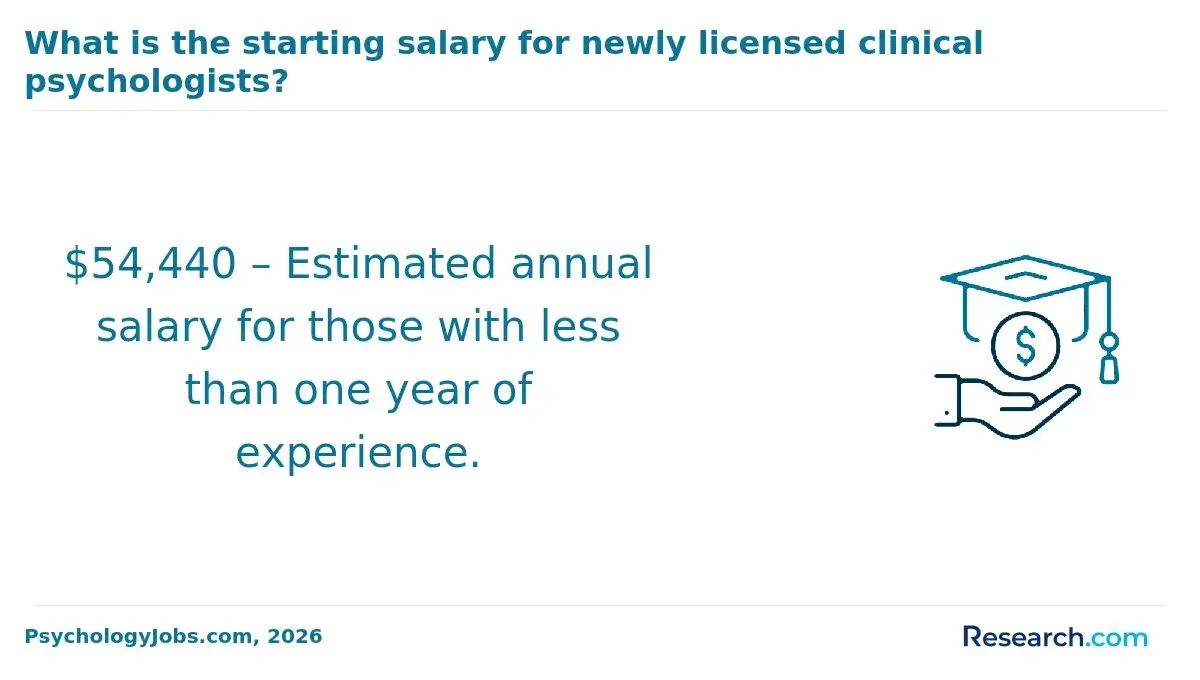
There are around 76,300 clinical and counseling psychologists working in the US. A bachelor’s degree in psychology alone usually does not lead directly to the highest-paying bachelor’s degree jobs, but completing the clinical psychology licensure pathway can produce a stronger long-term return. Current data show a median annual salary of $95,830 for clinical psychologists, while early-career professionals earn $54,440.
Why pursue a career in clinical psychology?
Clinical psychology is a good fit for people who want a career centered on evidence-based mental health care, complex human behavior, and long-term professional development. The work can be demanding, but it offers the chance to help clients understand symptoms, develop coping strategies, improve relationships, and regain functioning.
This path can be especially appealing if you want to specialize in a population or setting. For example, students interested in youth mental health may explore work as an adolescent psychologist, where training focuses on developmental issues, family dynamics, school-related concerns, trauma, anxiety, depression, and behavioral challenges in children and teens.
Who should consider clinical psychology?
- Students who are comfortable with a long graduate school timeline and intensive supervised training.
- People who want to combine science, assessment, and therapy in a licensed healthcare role.
- Professionals who can handle emotionally difficult work while maintaining boundaries and ethical standards.
- Future specialists interested in areas such as child psychology, trauma, neuropsychology, health psychology, forensic psychology, or serious mental illness.
Who may want a different mental health path?
- Students who want to begin counseling clients as quickly as possible may prefer counseling, social work, or marriage and family therapy pathways.
- People who dislike research, testing, documentation, or graduate-level statistics may find doctoral psychology programs frustrating.
- Applicants who need a lower-cost or shorter training route should compare master’s-level licensure options before committing to a doctorate.
Which degree should you get to work in clinical psychology?
Most people who want to become licensed clinical psychologists pursue a doctoral degree, usually a PhD or PsyD in clinical psychology. A master’s degree can be useful for related roles, supervised clinical work, research support, case management, or preparation for doctoral study, but it typically does not qualify someone for independent practice as a clinical psychologist.
Students who are still comparing graduate options can start by reviewing how master’s degree programs differ from doctoral training. The right choice depends on whether your goal is independent clinical practice, research, teaching, supervised counseling work, assessment, or a related mental health role.
| Education path | Typical purpose | Best for | Main limitation |
| Bachelor’s degree in psychology | Builds a foundation in human behavior, research methods, development, and abnormal psychology | Students preparing for graduate school or entry-level human services roles | Does not qualify you to practice as a clinical psychologist |
| Master’s degree in psychology or counseling-related field | Provides advanced coursework and may support supervised practice or related mental health roles | Students seeking faster entry into mental health work or preparation for doctoral study | Clinical psychologist licensure generally requires a doctorate |
| PhD in Clinical Psychology | Combines clinical training with significant research preparation | Students interested in practice, academia, research, or assessment-heavy roles | Competitive admissions and a long training timeline |
| PsyD in Clinical Psychology | Emphasizes clinical practice and applied training | Students focused primarily on therapy, assessment, and service delivery | Still requires licensure steps and supervised experience |
Can you practice as a clinical psychologist without a license?
No. Providing clinical psychology services without the required license is not legally or ethically acceptable. Licensure protects the public by confirming that a psychologist has completed approved education, supervised clinical training, examinations, and professional conduct requirements. Without the appropriate license, a person cannot independently provide services such as diagnosis, psychological assessment, or psychotherapy as a clinical psychologist.
How long does it take to become a clinical psychologist?
The timeline depends on the degree route, program structure, internship requirements, postdoctoral experience, and state licensing rules. Doctoral programs in clinical psychology commonly take about 5 to 7 years, including coursework, research, and supervised clinical experience. Some students also need additional time for a pre-doctoral internship or postdoctoral fellowship. Master’s programs in clinical psychology are often completed in about two to three years.
The key point is that the master’s timeline is not the same as the clinical psychologist timeline. If your goal is independent licensure as a clinical psychologist, you should plan for doctoral education, supervised practice, examinations, and ongoing license maintenance.
What is the licensing process for clinical psychologists?
Licensure is the formal process that allows a psychologist to practice independently within a state or jurisdiction. Requirements vary by location, so students should check the licensing board in the state where they plan to work before choosing a program. In general, the path includes the following steps:
- Earn an accredited doctoral degree. Most candidates complete a doctoral program in clinical psychology or a closely related area from an institution that meets the licensing board’s standards.
- Complete supervised clinical experience. Candidates must accumulate required practicum, internship, and often postdoctoral hours under qualified supervision.
- Pass the Examination for Professional Practice in Psychology (EPPP). The EPPP evaluates psychology knowledge, ethics, and professional practice readiness.
- Submit a state licensure application. Applicants provide transcripts, training verification, exam results, supervised-hour documentation, and other required materials.
- Complete background and ethics checks. Licensing boards may review criminal history, disciplinary history, and professional conduct.
- Meet state-specific requirements. Some states require jurisprudence exams, oral exams, additional coursework, or specific training topics.
- Maintain the license. Licensed psychologists must follow ethical rules and complete continuing education to keep their license active.
How does licensure differ for master’s and doctoral graduates?
Doctoral graduates in clinical psychology are generally trained for independent psychologist licensure after completing supervised experience and examination requirements. Master’s graduates may qualify for other licenses, certifications, or supervised roles, depending on the state and the exact degree. They may work in counseling, case management, behavioral health, research, or human services, but they should not assume that a master’s degree alone leads to the title “clinical psychologist.”
What if you were trained in another state or country?
Psychologists educated or licensed outside the jurisdiction where they want to practice may need to prove that their education, internship, supervised hours, and examinations are equivalent to local standards. Some boards may require additional coursework, documentation reviews, jurisprudence exams, or supervised experience. Anyone relocating should contact the target licensing board early, because small differences in training requirements can delay approval.
Why is continuing education important for clinical psychologists?
Continuing education keeps clinical psychologists current on research, ethics, assessment practices, treatment models, telehealth rules, documentation standards, and population-specific care. It also supports license renewal, since states set their own continuing education requirements.
Continuing education may come from workshops, conferences, graduate courses, online training, or approved professional seminars. Students planning future specialization can also compare online psychology degrees and related coursework, but they should always confirm whether credits meet their state board’s requirements. Continuing education is not just a paperwork requirement; it helps clinicians avoid outdated practices and deliver safer, more effective care.
Do clinical psychologists need certification?
Licensure is required for independent practice, while certification is usually optional. Certification can still be valuable because it signals advanced competence in a specialty area. Examples include board certification through the American Board of Professional Psychology (ABPP) or specialized credentials such as the Certified Clinical Neuropsychologist (CCN) offered by the American Board of Clinical Neuropsychology (ABCN).
APA data show that the most common board certifications among licensed psychologists are clinical neuropsychology at 30%, clinical psychology at 27%, and clinical child and adolescent, clinical health, and forensic psychology at 7% each.
What are the essential skills and competencies needed to succeed as a clinical psychologist?
Successful clinical psychologists need more than strong grades. The role requires clinical judgment, ethical decision-making, communication skill, cultural responsiveness, documentation discipline, and the ability to use research to guide care. These abilities are built gradually through coursework, supervised practice, feedback, and continuing education.
Core clinical knowledge
Clinical psychologists need a strong command of psychopathology, assessment, diagnosis, evidence-based interventions, ethics, human development, research design, and treatment planning. These foundations begin in early psychology coursework and become more advanced in graduate and doctoral training. Students exploring introductory pathways may start with options such as a psychology associate degree online, but independent clinical practice requires much more advanced preparation.
Essential clinical skills
- Psychotherapy: Ability to deliver structured, evidence-informed interventions such as cognitive behavioral therapy, psychodynamic therapy, family-based approaches, or trauma-focused treatment.
- Mental health assessment: Knowledge of diagnostic criteria, symptom presentation, risk factors, and differential diagnosis.
- Psychological evaluation: Skill in clinical interviewing, standardized testing, report writing, and communicating results clearly.
- Cognitive behavioral therapy: Competence in helping clients identify patterns in thoughts, emotions, and behaviors and build healthier coping strategies.
- Leadership: Capacity to coordinate care, supervise trainees, participate in interdisciplinary teams, and advocate for clients.
Professional and technology-related skills
- Research literacy: Clinical psychologists must be able to evaluate evidence, interpret studies, and apply research responsibly in practice.
- Public communication: Many psychologists present findings, educate communities, train staff, or advocate for mental health resources.
- Case management: Strong organization is necessary for treatment plans, records, referrals, supervision notes, and compliance requirements.
- Client-centered communication: Related fields such as organizational psychology also emphasize interpersonal skill, but in clinical work this means building trust, listening carefully, and maintaining appropriate boundaries.
- Teaching: Psychologists often educate clients, supervise students, or teach in academic settings. Some professionals also build teaching experience in adjacent fields, including programs such as the best online paralegal programs, though clinical psychology teaching usually requires relevant graduate credentials.
- Digital tools: Electronic health records, telehealth platforms, secure messaging, spreadsheets, databases, and presentation tools are now part of routine practice. Students who need broader technical preparation may explore options such as affordable computer science degree programs, but most clinicians can build these skills through targeted training.
Zippia’s analysis of psychologist resumes found that psychologists commonly list patient care, rehabilitation therapy, clinical psychology, group therapy, and Veteran-specific therapy among their skills and knowledge areas.
What should you include in your clinical psychologist resume?
A clinical psychologist resume should make your training, supervised experience, licensure status, specialty skills, and populations served easy to verify. Employers and internship sites often scan for specific clinical experiences, assessment tools, treatment models, and compliance qualifications.
- Professional summary: Open with a concise statement of your clinical focus, training level, license status, and target role.
- Education: List degrees, institutions, graduation dates, dissertation or major research focus, and relevant honors. If you completed an online program, you generally do not need to label it as online unless the employer asks or the credential itself specifies the format. For example, graduates from Georgia psychology programs or an online psychology degree in Georgia can usually list the institution and degree awarded.
- Clinical training: Include practicum sites, internships, postdoctoral placements, supervised hours where relevant, client populations, and presenting concerns.
- Specialized training: Note training in CBT, trauma-focused care, psychological testing, child and adolescent treatment, health psychology, substance use, or other areas tied to the job.
- Assessment experience: Identify diagnostic interviews, standardized tests, report writing, and feedback sessions when relevant.
- Treatment planning: Show your ability to create measurable goals, coordinate care, and adjust interventions based on progress.
- Research and publications: Include peer-reviewed articles, conference presentations, research assistantships, grants, posters, and program evaluation projects.
- Technical and language skills: Add electronic health record systems, telehealth platforms, statistical tools, assessment software, and additional languages.
- Licensure and certifications: State your license, license-eligible status, supervision status, certifications, and board-related credentials.
- Professional affiliations: Include memberships in psychology organizations, specialty groups, or state associations.
Resume mistakes to avoid
| Common mistake | Why it hurts your application | Better approach |
| Listing duties without outcomes | It makes your experience sound generic | Describe populations served, interventions used, and measurable responsibilities |
| Leaving out supervision or training details | Employers may not understand your clinical readiness | Clarify practicum, internship, postdoctoral, and supervised experience |
| Using the same resume for every role | Clinical jobs often require specific populations, tools, or modalities | Match your strongest relevant experience to each job description |
| Overstating licensure status | This can create ethical and legal concerns | Use precise wording such as licensed, license-eligible, supervised, or trainee |
| Ignoring proofreading | Errors can raise concerns about documentation quality | Review formatting, grammar, dates, credentials, and contact information carefully |
What are common clinical psychology careers?
Clinical psychology can lead to direct patient care, research, teaching, consultation, administration, or legal-system work. The right option depends on your preferred population, tolerance for documentation, interest in assessment, desire for private practice, and long-term specialization plans.
- Clinical practice: Many clinical psychologists provide therapy and assessment in private practices, hospitals, clinics, community agencies, or integrated health settings.
- Academic and research work: Some psychologists teach, supervise students, conduct studies, publish research, and develop evidence-based interventions.
- Consultation and program development: Psychologists may advise organizations, agencies, or healthcare systems on mental health programs, staff wellness, program evaluation, or service delivery. Students comparing consulting paths can also review consulting psychology salary information.
- Administration and leadership: Experienced psychologists may direct clinical programs, manage teams, oversee compliance, improve quality of care, or advocate for policy and funding changes.
- Forensic psychology: Clinical psychologists with legal-system training may conduct competency evaluations, risk assessments, expert testimony, offender treatment, or custody-related evaluations. Some also teach criminal psychology or related courses in settings connected to the best online criminal justice program options.
How much can you earn as a clinical psychologist?
Clinical psychologist pay varies by location, employer, specialty, experience, credentials, and whether the psychologist works in private practice, healthcare, education, government, or research. As of writing, clinical psychologists in the US earn a median wage of $95,830 and an average wage of $106,850.
Some industries pay more. Clinical psychologists in home health care services and scientific research and development services earn more than $120,000 per year. In industries with high employment, such as offices of other health practitioners, average annual earnings are $110,000.
Salary should not be evaluated in isolation. Students should compare potential earnings with tuition, living costs, years spent in school, internship requirements, postdoctoral training, loan burden, and the time it takes to reach independent practice.
What is the job market for graduates of clinical psychology degree programs?
The labor market for clinical psychology graduates is supported by ongoing demand for mental health services. Clinical psychology is not the most common psychology specialization; only 1% of psychology degree holders specialize in this field. Still, about 11% of psychology graduates work in healthcare practice and technical occupations, showing that psychology training can connect to healthcare roles.
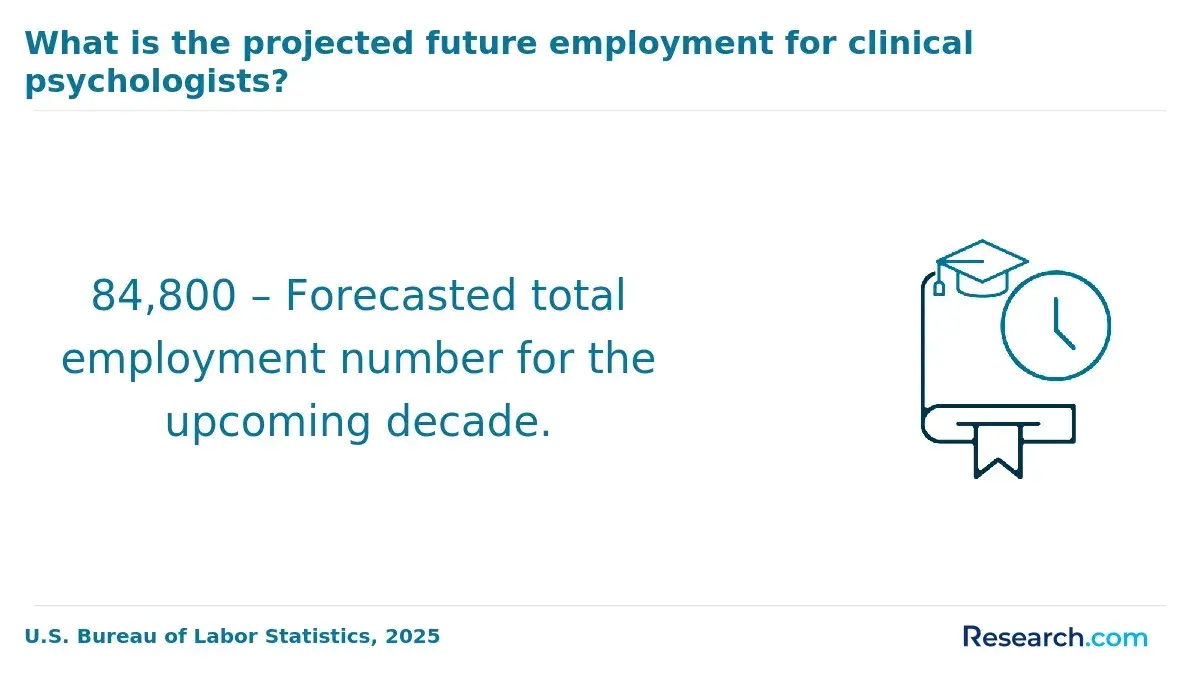
The projected outlook is strong for clinical psychologists. Employment is expected to grow 11% through 2034, compared with the 3% average for all occupations. The projections indicate about 4,800 annual clinical psychologist positions during the decade and estimated total employment of 84,800 by 2034.
How can emerging technologies transform clinical psychology practice?
Technology is changing how clinical psychologists deliver care, document services, monitor symptoms, and collaborate with clients. Telehealth platforms, secure messaging systems, digital intake tools, and AI-supported documentation or screening tools can improve access and efficiency when used ethically.
Technology does not replace clinical judgment. Psychologists still need to verify privacy protections, informed consent procedures, crisis protocols, documentation standards, and state-specific telehealth rules. Students interested in the intersection of behavior, health, and technology may also explore related roles such as health psychologist.
How can clinical psychology students manage education costs effectively?
Clinical psychology training can be expensive because it often involves years of graduate study, clinical placements, application fees, examination fees, and licensing costs. Students should compare total program cost, not just tuition. That means reviewing fees, residency requirements, internship travel, lost income, supervision costs, and whether the program provides assistantships, scholarships, stipends, or paid clinical opportunities.
Online and hybrid options may reduce relocation or commuting costs for some students, but they are not automatically cheaper or easier. Prospective students comparing accredited psychology master’s programs online should verify accreditation, licensure alignment, faculty qualifications, field placement support, and state authorization before enrolling.
Cost-control checklist
- Ask for the full cost of attendance, including fees and required residencies.
- Check whether clinical placements are arranged by the school or left to the student.
- Compare assistantships, scholarships, employer tuition benefits, and payment plans.
- Confirm whether credits transfer if you later pursue a doctorate.
- Evaluate expected salary against the time and cost required to become licensed.
How can clinical psychology students leverage accelerated degree programs to fast-track their careers?
Accelerated programs can help students finish certain coursework faster, but they do not remove licensure requirements. Clinical training, supervised hours, internships, and state board rules still apply. A one-year master’s in psychology may be useful for students who want a faster academic credential, preparation for doctoral study, or entry into related roles, but it should be evaluated carefully if the end goal is clinical psychologist licensure.
Before choosing an accelerated format, ask whether the program includes research preparation, clinical training, faculty mentoring, and credits that doctoral programs or licensing boards will recognize.
Can I succeed as a therapist through non-traditional pathways?
Yes, but the word “therapist” can refer to several licensed professions, and each has its own rules. You may be able to enter mental health practice through counseling, social work, marriage and family therapy, substance abuse counseling, behavioral analysis, or supervised support roles without becoming a clinical psychologist. However, nontraditional routes still require proper credentials, ethical practice, and state authorization.
If you are asking whether you can be a therapist without a psychology degree, the answer depends on the license you are pursuing and your state’s requirements. Always verify the legal title, scope of practice, and education requirements before enrolling in a program.
How can a dual degree elevate clinical psychology careers?
A dual degree can make sense for clinical psychologists who want leadership, healthcare administration, consulting, entrepreneurship, or program management roles. Combining clinical training with business education can help professionals manage practices, lead service lines, evaluate budgets, improve operations, and design scalable mental health programs.
Options such as an MBA and psychology dual degree are best suited for students with clear management or organizational goals. They may not be necessary for someone focused only on direct therapy or assessment.
What should I consider when selecting an accredited online clinical psychology program?
Accreditation and licensure alignment should be the first filters. An online or hybrid program may offer flexibility, but flexibility is not enough if the degree does not meet internship, supervised training, state authorization, or licensing requirements. Students should confirm whether the program supports clinical placements in their state and whether graduates are eligible for the license they want.
When comparing options such as a fast master’s degree in psychology online, ask whether speed comes at the cost of mentoring, research preparation, practicum quality, or transferability into doctoral study.
Questions to ask before enrolling
- Is the program accredited by a recognized accreditor?
- Does the curriculum meet licensing requirements in the state where I plan to practice?
- Who arranges practicum, internship, or field placements?
- What are faculty credentials and areas of expertise?
- What are graduation, internship match, licensure, and employment outcomes?
- Are there in-person residencies, campus visits, or state restrictions?
- What is the total cost, including fees, travel, and supervision-related expenses?
What are the benefits of pursuing an accelerated online masters in clinical mental health counseling?
An accelerated online master’s in clinical mental health counseling may be a practical alternative for students who want a shorter pathway into counseling-related practice than doctoral clinical psychology. These programs can offer flexible coursework, applied counseling training, and preparation for supervised licensure routes, depending on state requirements.
This route is not the same as becoming a clinical psychologist. Students considering an accelerated online master’s in clinical mental health counseling should compare the counseling license it supports with the psychologist license they may have originally considered.
What are the key challenges facing clinical psychologists in 2026?
Clinical psychologists are entering a field with strong demand, but also real operational and ethical pressures. New professionals should understand these challenges before committing to the career.
- High demand for services: Growing public attention to mental health can lead to full caseloads, long waitlists, and burnout risk.
- Changing treatment standards: Research continues to influence best practices, so clinicians must keep updating their methods.
- Regulatory complexity: Licensing rules, insurance requirements, telehealth regulations, and documentation expectations can affect daily practice.
- Technology adoption: Telehealth, apps, digital assessments, and AI-supported tools can improve access but require careful attention to privacy, bias, consent, and clinical appropriateness.
- Workforce sustainability: Psychologists must protect their own mental health through supervision, consultation, boundaries, and realistic workload planning.
Can international students pursue a clinical psychology career in the United States?
International students can pursue clinical psychology in the United States, but they need to plan for both education and immigration requirements. They typically need an appropriate student visa for study and may use Optional Practical Training (OPT) or Curricular Practical Training (CPT) for eligible work experience. Later, they may need internships, postdoctoral fellowships, and work authorization that align with licensure requirements and employment rules.
Licensure can be more complicated for internationally educated applicants because state boards may require detailed documentation, equivalency reviews, supervised experience verification, and examinations. Students considering doctoral study should confirm whether the program supports international students through clinical placements, visa-related timelines, and postgraduation training requirements.
Flexible options such as accredited online PsyD programs may be worth exploring, but international students should verify residency requirements, state authorization, internship eligibility, and whether online coursework will be accepted by the licensing board where they intend to practice.
How can clinical psychologists diversify their expertise into forensic psychology?
Forensic psychology can be a strong specialization for clinical psychologists interested in the legal system. It applies psychological assessment and clinical expertise to issues such as competency, risk, criminal behavior, custody disputes, offender treatment, expert testimony, and legal decision-making.
Moving into this area usually requires additional preparation in legal standards, forensic assessment, report writing, courtroom communication, ethics, and the limits of confidentiality in legal contexts. Clinical psychologists evaluating this path should review the job outlook for forensic psychologists and compare forensic coursework, supervised experience, and certification options.
What do clinical psychologists need to know about their career paths?
Before committing to this profession, students should understand what clinical psychologists actually do each day: interview clients, assess symptoms, write reports, provide therapy, coordinate with other providers, manage risk, document care, and maintain ethical standards. Reviewing what clinical psychologists do can help you decide whether the work matches your interests, temperament, and long-term goals.
The strongest candidates are not only interested in helping people. They are also willing to complete rigorous training, accept supervision, evaluate research, handle complex documentation, and continue learning throughout their careers.
What are the alternative career paths for clinical psychology graduates?
Not every psychology graduate becomes a licensed clinical psychologist. Some choose adjacent careers that use psychological knowledge in schools, healthcare, business, research, policy, or community programs. These alternatives may require different licenses or certifications, but they can offer meaningful work without the same doctoral pathway.
- Board-Certified Behavior Analyst (BCBA): BCBAs design and monitor behavioral interventions, often for individuals with autism spectrum disorder or developmental needs. Students interested in applied behavior analysis can compare flexible BCBA programs.
- Health educator or wellness coach: These professionals apply behavior-change principles to help individuals or groups improve stress management, mental wellness, lifestyle habits, and prevention strategies.
- Program evaluator: Program evaluators use research methods to measure whether mental health services, community initiatives, or interventions are working.
- Organizational psychology consultant: Psychology graduates may advise employers on workplace culture, leadership, employee well-being, conflict, and team performance.
- Forensic psychology specialist: With additional legal and forensic training, graduates may work around courts, corrections, evaluation, and justice-related mental health services.
- Researcher or policy analyst: Graduates with strong research skills may study mental health systems, treatment outcomes, access to care, or public policy.
- Substance abuse counselor: This path focuses on supporting people with substance use disorders and may require additional state-specific credentials.
Common mistakes to avoid when planning a clinical psychology career
- Assuming any psychology degree leads to licensure: Clinical psychologist licensure usually requires doctoral education and supervised experience.
- Choosing a program before checking state requirements: Licensing rules vary, so verify alignment before enrolling.
- Focusing only on tuition: Total cost includes fees, travel, residencies, unpaid placements, exams, supervision, and lost income.
- Ignoring accreditation: Accreditation can affect internship eligibility, licensure, employment, and transferability.
- Assuming online means easier: Quality online programs still require rigorous coursework, clinical training, and supervised experience.
- Overlooking alternative licenses: Counseling, social work, marriage and family therapy, and behavior analysis may better match some students’ goals.
- Expecting salary outcomes to be guaranteed: Pay depends on location, setting, specialization, experience, and employment model.
Key Insights
- Clinical psychology is a licensed healthcare profession focused on assessment, diagnosis, and treatment of mental health disorders.
- Independent practice as a clinical psychologist generally requires a doctoral degree, supervised clinical experience, passing the EPPP, and state licensure.
- The field has strong projected growth, with an 11% job growth outlook through 2034 and about 4,800 annual positions during the decade.
- Clinical psychologists in the US earn a median annual salary of $95,830, but salaries vary by industry, location, experience, and specialization.
- Master’s degrees can support related mental health roles, but they usually do not replace the doctorate required for clinical psychologist licensure.
- Online, accelerated, and dual-degree programs can be useful, but only if they meet accreditation, clinical training, and licensure requirements.
- The best decision is not simply choosing “psychology.” It is choosing the specific license, population, setting, training timeline, and financial plan that match your career goal.
References:
- Page, C., Stamm, K., Assefa, M., & Khaddouma, A. (2024, March 1). Datapoint: The most and least common specialty areas for licensed psychologists. APA. https://www.apa.org/monitor/2024/03/top-psychology-specialties
- PsychologyJobs.com. (2026). Clinical Psychologist Salary Guide 2026. https://psychologyjobs.com/career-advice/clinical-psychologist-salary
- U.S. Bureau of Labor Statistics. (2024). Field of degree: Psychology. https://www.bls.gov/ooh/field-of-degree/psychology/psychology-field-of-degree.htm
- U.S. Bureau of Labor Statistics. (2025, August 28). Occupational projections, 2024–2034, and worker characteristics, 2024. https://www.bls.gov/emp/tables/occupational-projections-and-characteristics.htm
- Zippia. (2025, January 8). What is a clinical psychologist and how to become one. Retrieved February 2026, from https://www.zippia.com/clinical-psychologist-jobs/skills
Other Things You Should Know About Clinical Psychology Job Requirements
Clinical psychology programs in the U.S. typically require students to complete supervised practicum experiences, internships, and sometimes externships. These experiences involve working under the supervision of licensed psychologists to provide therapy, conduct assessments, and engage in research, preparing students for a professional setting.
Clinical psychology programs integrate cultural competence training to prepare students for addressing diverse cultural considerations in therapy. They offer courses that explore cultural diversity in mental health, emphasizing awareness of biases, understanding cultural nuances, and adapting therapeutic approaches accordingly. Students engage in case studies, role-playing exercises, and workshops focused on multicultural counseling techniques. Additionally, they provide opportunities for supervised clinical experiences with diverse client populations, encouraging students to apply their knowledge in real-world settings. Through these comprehensive initiatives, the programs foster a deep understanding of cultural influences on mental health and equip students with the skills needed for effective and sensitive therapeutic practice.


