
2027 What Can You Do With a Doctorate in Psychology

Co-Founder and Chief Data Scientist
A doctorate in psychology is a major career decision, not just another degree. It can qualify you for advanced clinical roles, research and faculty positions, leadership jobs, consulting work, and, in many cases, independent practice after licensure. It also requires years of study, supervised experience, dissertation or doctoral project work, and careful financial planning. This guide explains what you can do with a doctorate in psychology, how Ph.D. and Psy.D. pathways differ, what the degree can cost, which careers may be available, and how to decide whether this path fits your goals.
Quick Answer: What Can You Do With a Doctorate in Psychology?
With a doctorate in psychology, you can pursue careers in clinical practice, school psychology, neuropsychology, forensic psychology, industrial-organizational psychology, research, higher education, consulting, government, healthcare, and private practice. The right path depends on your degree type, specialization, licensure status, supervised training, state requirements, and professional goals.
Key Facts About Doctoral Psychology Pathways
- A doctorate in psychology typically takes around four to seven years to complete, depending on the program structure, dissertation or doctoral project timeline, clinical training requirements, and whether you enroll full time or part time.
- In 2022, 28% of psychologists in the U.S. were self-employed, making private practice the largest employment status category for psychologists.
- In the same year, 27% of psychologists worked in elementary and secondary schools, 21% worked in ambulatory healthcare services, 8% worked in government, and 4% worked in hospitals.
- Industrial-organizational psychologists are among the highest-paid doctoral-level psychology professionals, with an average annual wage of $154,380.
- The employment of psychologists in the United States is projected to grow by 6% from 2022 to 2032.
- About 12,800 psychologist openings are projected each year from 2022 to 2032.
- Doctorate in psychology: meaning, degree types, and purpose
- Career options with a doctorate in psychology
- How long doctoral psychology programs usually take
- Typical cost of a psychology doctorate
- Common doctoral psychology courses
- Psychology doctorate specializations to compare
- Salary potential with a doctorate in psychology
- Job outlook for doctoral-level psychologists
- How to choose the right psychology doctoral program
- Ways to grow your career after earning the doctorate
- Doctoral psychology admission requirements
- Common difficulties doctoral students should expect
- Ph.D. vs. Psy.D.: which path makes more sense?
- How to pay for a doctorate in psychology
- Using counseling credentials alongside a psychology doctorate
- How counseling credentials may broaden career options
- Income diversification for doctoral psychology graduates
- Skills that matter in doctoral-level psychology careers
- Accelerated psychology doctorate options
- Is a doctorate in psychology worth it?
- Nontraditional career options for psychology doctorate holders
- Online doctoral programs in psychology
What is a doctorate in psychology?
A doctorate in psychology is the highest academic credential in the field. It is designed for people who want to move beyond bachelor’s- or master’s-level psychology roles into advanced practice, research, teaching, assessment, supervision, or leadership. Some students enter after a bachelor’s degree, while others first complete a master’s program or consider accelerated psychology degree options to shorten the earlier stages of preparation.
The two most common doctoral degrees are the Ph.D. in Psychology and the Psy.D. They can both lead to advanced careers, but they are built around different priorities.
| Degree | Main focus | Best fit for | Typical culminating work |
| Doctor of Philosophy in Psychology | Research, theory, statistics, scientific inquiry, and academic contribution | Students interested in research careers, university teaching, scientific publication, or research-informed clinical work | Dissertation based on original research |
| Doctor of Psychology | Professional practice, clinical assessment, psychotherapy, and applied training | Students who primarily want to work directly with clients in clinical or counseling settings | Doctoral project, clinical training, or internship-based requirements depending on the program |
- Ph.D. in Psychology. A Ph.D. usually places stronger emphasis on research design, statistics, empirical methods, and scholarly writing. Students often specialize in areas such as cognitive psychology, developmental psychology, clinical psychology, social psychology, or industrial-organizational psychology. The degree is commonly associated with research, academia, and scientific leadership, although many Ph.D. graduates also practice clinically if their program and training meet licensure requirements.
- Psy.D. in Psychology. A Psy.D. is more practice-oriented. Coursework typically emphasizes psychological assessment, diagnosis, psychotherapy, ethics, intervention planning, and supervised clinical work. Students who want to become practicing psychologists often consider this route, but they still need to verify accreditation, internship expectations, state licensure rules, and postdoctoral supervision requirements.
What can I do with a doctorate in psychology?
A doctorate in psychology can lead to several professional tracks, but not every job is available to every graduate automatically. Your options depend on whether your program is clinical, counseling, school-based, research-focused, or organizational; whether it is accredited for your intended licensure; and whether you complete all required supervised experience. For a broader view of the field, compare related psychology career paths before choosing a specialization.
Many doctoral graduates pursue licensed psychologist roles after completing the required education, supervised training, exams, and state approval. Others work in universities, school systems, government agencies, hospitals, consulting firms, corporate offices, research centers, and nonprofit organizations. Self-employment is also common: in 2022, 28% of psychologists in the U.S. were self-employed.
| Career area | What you may do | Who it fits best |
| Clinical and counseling practice | Provide therapy, conduct assessments, diagnose mental health conditions, develop treatment plans, and document care | Students seeking direct client work and licensure as psychologists |
| School psychology | Assess student needs, support academic and behavioral interventions, consult with teachers and families, and help improve student outcomes | Students interested in child development, education systems, and school-based services |
| Clinical neuropsychology | Evaluate cognitive functioning, assess brain-behavior relationships, and support patients with neurological, developmental, or injury-related concerns | Students drawn to assessment, neuroscience, rehabilitation, and medical settings |
| Research psychology | Design studies, analyze data, publish findings, and contribute to evidence-based understanding of behavior and mental processes | Students who enjoy statistics, methodology, theory, and scientific writing |
| Higher education | Teach psychology courses, mentor students, conduct research, publish scholarship, and serve on academic committees | Students aiming for faculty or academic leadership roles |
| Industrial-organizational psychology | Apply psychology to hiring, employee assessment, training, leadership, organizational culture, and workplace performance | Students interested in business, analytics, human resources, and organizational behavior |
| Forensic psychology | Work at the intersection of psychology and legal systems through assessment, consultation, expert testimony, or correctional programming | Students interested in law, courts, criminal justice, and behavioral assessment |
Clinical practice roles
Licensed psychologist. This is one of the most recognized doctoral-level psychology careers. Licensed psychologists may work in hospitals, outpatient clinics, private practices, correctional settings, community mental health centers, or integrated healthcare teams. Duties can include psychotherapy, psychological testing, diagnosis, crisis work, and treatment coordination.
School psychologist. School psychologists focus on students’ learning, behavior, development, and emotional well-being. They may conduct assessments, support individualized education plans, consult with teachers, design interventions, and help schools respond to academic or behavioral concerns.
Clinical neuropsychologist. Neuropsychologists specialize in the connection between brain function and behavior. Their work often includes cognitive testing, diagnostic evaluation, rehabilitation planning, and collaboration with physicians, therapists, and families.
Research and academic roles
Research psychologist. Research psychologists study human behavior, cognition, mental health, social dynamics, learning, development, or workplace behavior. They may work in universities, research institutes, government agencies, health systems, or private organizations.
Professor. Doctoral graduates who enter academia may teach undergraduate and graduate psychology courses, supervise student research, publish scholarly work, and contribute to curriculum and departmental leadership.
Applied specialty roles
Industrial-organizational psychologist. If you are comparing applied business psychology careers, review what it takes to become an I-O specialist through this guide on how to be an industrial organizational psychologist. These professionals use psychological science to improve hiring, training, leadership, engagement, team performance, and organizational systems.
Forensic psychologist. Students drawn to law and behavioral science should first understand what is forensic psychology. Forensic psychologists may perform evaluations, consult with legal professionals, provide expert opinions, or contribute to rehabilitation and risk assessment programs.
How long does it take to complete a doctorate in psychology?
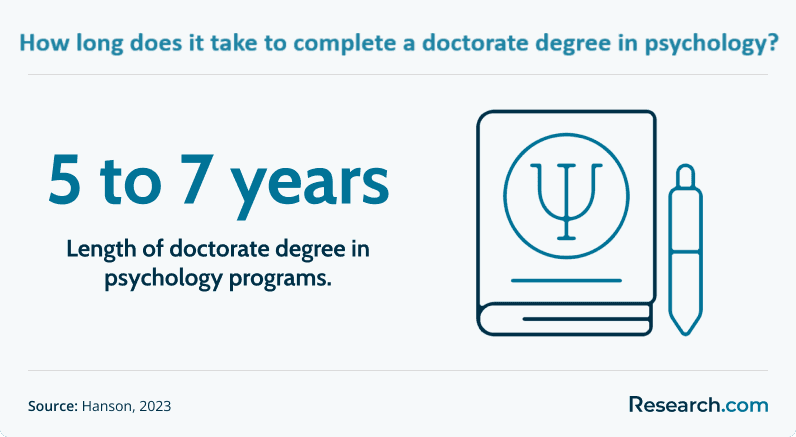
Doctoral psychology degrees generally take around 5 to 7 years, although some pathways may be shorter or longer depending on transfer credits, dissertation progress, internship availability, enrollment status, and clinical placement requirements. Students should expect a demanding mix of coursework, research, assessment training, supervised practice, exams, and a dissertation or doctoral project.
| Stage | Typical timing | What usually happens |
| Foundation and core coursework | Years 1-3 | Students build advanced knowledge in psychological theory, research methods, statistics, ethics, assessment, development, psychopathology, and the bases of behavior. |
| Specialization and applied training | Years 2-5 | Students take advanced seminars, begin practicum work, join research teams, select specializations, and prepare for comprehensive exams. |
| Dissertation, internship, and completion requirements | Years 4-7 | Students complete major research or doctoral project work, finish supervised clinical requirements when applicable, and prepare for licensure or postdoctoral steps. |
The timeline can stretch when students change dissertation topics, struggle to secure placements, study part time, or need additional supervised hours. It can also be shortened when programs accept prior graduate coursework or when students enter with a strong research background. Some students reduce earlier education costs by completing a cheap master's in organizational psychology online before applying to doctoral programs.
What is the average cost of a doctorate degree in psychology?
The cost of a psychology doctorate varies widely by institution type, residency status, program format, credit requirements, funding package, and living expenses. Public institutions report average graduate tuition and fees of $11,554 per year, while private institutions average $20,015. Program expenses often range from $500 to $1,500 per credit hour, not counting books, technology, travel, relocation, housing, campus fees, or lost wages from reducing work hours.
According to the Education Data Initiative, a doctorate degree in the United States usually costs around $133,340. A Doctorate of Philosophy degree, including a PhD in psychology program, is often priced at around $81,900. A Doctorate of Education, including an EdD in psychology, costs about $62,780.
Debt planning matters. Doctorate students have an average loan debt of $80,590, so students should compare total net cost, assistantships, stipends, licensure-related expenses, internship travel, and expected post-graduation income before enrolling.
| Cost item | Amount stated | What to remember |
| Average graduate tuition and fees at public institutions | $11,554 per year | This does not necessarily include living costs, books, or clinical placement expenses. |
| Average graduate tuition and fees at private institutions | $20,015 | Private programs may offer institutional aid, but students should compare net cost rather than sticker price only. |
| Typical per-credit program expense range | $500 to $1,500 per credit hour | Credit requirements can substantially change the final price. |
| Usual doctorate degree cost in the United States | $133,340 | This provides a broad benchmark, not a guarantee for psychology programs. |
| Doctorate student average loan debt | $80,590 | Borrowing should be evaluated alongside realistic career plans and repayment options. |
The chart below shows average graduate degree costs by institution type across the country.
What courses are typically included in a doctorate in psychology program?
Doctoral psychology curricula combine theory, research, ethics, assessment, specialization coursework, and supervised application. Exact requirements differ by Ph.D., Psy.D., clinical, counseling, school, or applied psychology tracks, but many programs include the following subject areas.
- Advanced research methods. Students learn how to design rigorous studies, evaluate evidence, use advanced statistical techniques, analyze data, and interpret results responsibly.
- Psychopathology. This area covers mental health disorders, diagnostic systems, causes, assessment considerations, and evidence-based intervention approaches.
- Psychological assessment. Students study test theory, administration, scoring, interpretation, report writing, and the responsible use of standardized measures in clinical, educational, or research settings.
- Ethics in psychology. Coursework addresses confidentiality, informed consent, boundaries, professional conduct, cultural responsiveness, legal requirements, and ethical decision-making.
- Personality theories. Students compare major approaches to personality, including psychodynamic, humanistic, cognitive-behavioral, and trait-based perspectives.
- Bases of behavior. This coursework examines cognitive, emotional, biological, developmental, and social processes that shape behavior, learning, motivation, memory, perception, and decision-making.
What are the specializations available in a doctorate in psychology program?
Specialization is one of the most important choices in a doctoral psychology program because it shapes your coursework, practicum experiences, internship options, dissertation topic, licensure preparation, and career marketability. If you are still comparing long-term options, this overview of what to do with a psychology degree can help you connect undergraduate or master’s-level interests to doctoral pathways.
| Specialization | Primary focus | Potential work settings |
| Behavioral psychology | Behavior change, learning principles, reinforcement, conditioning, and behavioral intervention | Clinics, schools, behavioral health programs, research centers |
| Clinical psychology | Diagnosis, assessment, psychotherapy, severe mental illness, treatment planning, and clinical research | Hospitals, clinics, private practice, academic medical centers |
| Forensic psychology | Psychological assessment and consultation within legal and criminal justice contexts | Courts, correctional systems, government agencies, consulting practices |
| Counseling psychology | Well-being, adjustment, relationships, identity, career concerns, and psychotherapy across populations | University counseling centers, clinics, private practice, community agencies |
| School psychology | Student assessment, learning supports, behavioral intervention, consultation, and school-based mental health | Elementary and secondary schools, districts, educational agencies |
| Health psychology | Connections between behavior, stress, illness, prevention, and physical health outcomes | Hospitals, integrated care teams, public health programs, research settings |
| Neuropsychology | Brain-behavior relationships, cognitive assessment, neurological conditions, and rehabilitation planning | Hospitals, rehabilitation centers, specialty clinics, academic medical centers |
| Developmental psychology | Human development across the lifespan, including cognitive, emotional, social, and behavioral change | Research institutions, universities, policy organizations, education settings |
| Industrial-organizational psychology | Workplace behavior, personnel selection, leadership, training, organizational development, and performance | Corporations, consulting firms, government, human resources departments |
| Social psychology | Attitudes, group dynamics, prejudice, social influence, relationships, and behavior in social contexts | Universities, research organizations, policy groups, consulting environments |
If you want to compare specializations by popularity, review the chart below.
Students who are interested in advanced mental health work but are not sure a psychology doctorate is the right route may also compare nursing-based mental health careers. For example, the cheapest PMHNP programs online may be relevant for registered nurses considering psychiatric mental health nurse practitioner preparation instead.
How much can you make with a doctorate in psychology?
According to the United States Bureau of Labor Statistics, the annual median pay for psychologists is $92,740, or $44.59 per hour. Earnings vary by specialization, licensure, employer, geographic location, experience, setting, and whether you work as an employee, consultant, faculty member, or private practitioner.
| Psychology role or category | Pay figure stated | Notes for salary planning |
| Psychologists overall | $92,740 annual median pay; $44.59 per hour | This is a broad category and does not represent every specialty or location. |
| Clinical and counseling psychologists | $106,600 per year; $51.25 per hour | Licensure, supervised experience, and clinical setting can affect earnings. |
| Industrial-organizational psychologists | $154,380 average annual wage; $74.22 per hour | This is one of the highest paying psychology jobs, but roles may be competitive and often require strong quantitative and business skills. |
Students often ask about PsyD vs PhD salary. The degree title alone does not determine pay. A clinical Psy.D. graduate in private practice, a Ph.D. researcher in a university, and an industrial-organizational psychologist in consulting may have very different earnings because job function, market demand, employer type, reimbursement environment, and experience all matter.
What is the job market for graduates with a doctorate degree in psychology?
The BLS projects employment of psychologists in the United States to grow by 6% from 2022 to 2032, compared with 3% projected employment growth for all jobs in the country. Clinical and counseling psychologists are projected to see 11% growth during that period.
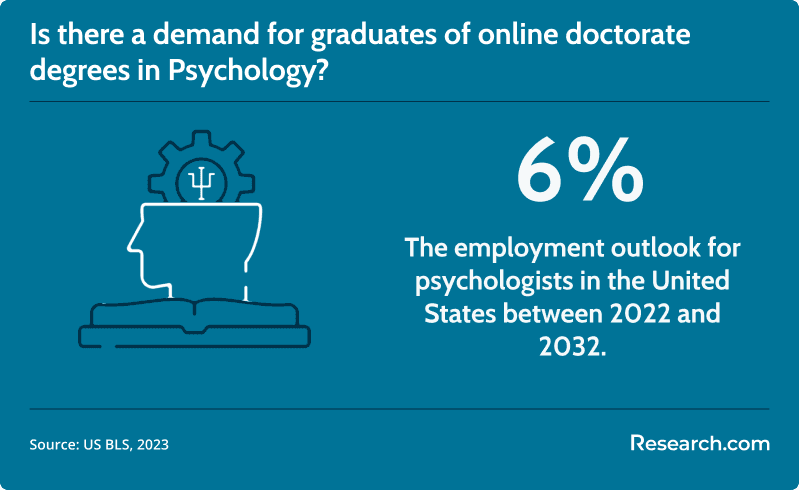
About 12,800 openings for psychologists are projected each year, on average, from 2022 to 2032. Many openings are expected to come from replacement needs as workers change occupations or leave the labor force, including retirement. Graduates of traditional and online doctorate psychology programs should still evaluate local licensing rules, internship availability, employer requirements, and regional demand rather than assuming a degree alone guarantees employment.
| Employment category stated for psychologists in 2022 | Share | What it suggests for career planning |
| Self-employed | 28% | Private practice is common, but it requires business, compliance, billing, marketing, and risk-management skills. |
| Elementary and secondary schools | 27% | School systems remain a major employer for psychologists with school-based expertise. |
| Ambulatory healthcare services | 21% | Outpatient and integrated care settings are important options for clinical and counseling psychologists. |
| Government | 8% | Government work may involve public health, corrections, veterans services, research, or policy-related roles. |
| Hospitals | 4% | Hospital roles often require strong assessment, interdisciplinary collaboration, and specialized clinical training. |
Key Considerations When Choosing the Right Doctorate Program in Psychology
The best psychology doctorate is not necessarily the most famous, fastest, or cheapest program. It is the program that aligns with your target career, meets licensure requirements where you plan to work, offers the right training environment, and provides a realistic financial path.
Accreditation and licensure alignment
For clinical, counseling, and school psychology students, accreditation can affect internship eligibility, licensure, employment, and professional mobility. Check whether the program is accredited by the appropriate recognized body for your intended field and confirm with your state licensing board that the program meets educational requirements.
Program format and flexibility
Compare campus-based, hybrid, and online formats carefully. Online coursework may be convenient, but doctoral psychology programs that prepare students for licensure usually still require in-person practica, internships, assessments, residencies, or supervised clinical experiences.
Specialization fit
Do not choose a program just because it offers a psychology doctorate. Confirm that it has faculty, coursework, clinical sites, research labs, or applied projects in your intended area, such as clinical psychology, industrial-organizational psychology, forensic psychology, neuropsychology, or school psychology.
Faculty expertise and mentorship
Strong faculty alignment matters, especially for Ph.D. students and anyone completing a dissertation. Review faculty publications, clinical interests, supervision style, grants, professional affiliations, and whether faculty are accepting new doctoral students.
Clinical and research opportunities
Look for clear evidence of quality practicum placements, internship preparation, research assistantships, assessment training, and alumni outcomes. If you are pursuing clinical licensure, ask how the program supports students in securing required supervised placements.
Total cost and funding
Compare tuition, fees, stipends, assistantships, health insurance, residency travel, dissertation expenses, internship relocation, and expected loan burden. A program with higher tuition but strong funding may cost less than a lower-tuition program with little support.
Graduation, internship, licensure, and employment outcomes
Ask for completion rates, time-to-degree data, internship match results, exam pass rates where applicable, licensure outcomes, and alumni employment information. These indicators help you evaluate whether students are actually finishing and entering the careers the program advertises.
| Question to ask before applying | Why it matters |
| Does this program meet licensure requirements in the state where I plan to practice? | Licensure rules vary, and a degree that works in one state may not automatically satisfy another state’s requirements. |
| Is the program accredited for my intended career path? | Accreditation may affect internship eligibility, licensure, hiring, and professional credibility. |
| What funding is guaranteed, and for how many years? | Doctoral timelines can be long, so short-term aid may not cover the full program. |
| Where do students complete practica and internships? | Training sites shape clinical competence, professional networks, and job readiness. |
| How many students finish on time? | Time-to-completion affects cost, debt, and career entry. |
| What careers do recent graduates actually enter? | Alumni outcomes reveal whether the program supports your specific goal. |
Some students also need to clarify whether their career goal requires psychology licensure at all. If your real goal is therapy practice, start by asking, Do you need a psychology degree to be a therapist?
How can you advance your career with a doctorate in psychology?
A doctorate can help you qualify for advanced roles, but career growth usually comes from combining the credential with licensure, specialization, measurable experience, leadership, publication, strong supervision, and professional visibility.
Build a clear specialty
- Choose a recognizable area of expertise. Child psychology, forensic psychology, neuropsychology, trauma treatment, health psychology, school psychology, or organizational consulting can each lead to different opportunities. Continuing education, presentations, publications, and supervised experience help establish credibility.
Expand clinical practice strategically
- Add services only when you are properly trained. Licensed psychologists may expand into couples therapy, family therapy, assessment services, consultation, or specific evidence-based treatment models such as cognitive-behavioral therapy.
- Move into supervision. Experienced psychologists may supervise interns, postdoctoral fellows, or early-career clinicians, depending on state rules and workplace requirements.
- Consider private practice with a business plan. Independent practice can offer more control, but it also requires billing knowledge, documentation systems, compliance procedures, referral development, and financial discipline.
Grow through research and academia
- Pursue grants and publications. Research productivity can strengthen academic, healthcare, policy, and consulting careers.
- Prepare for faculty expectations. Tenure-track roles usually require teaching, research, service, advising, and a sustained publication record.
Move into leadership
- Target administrative roles. Doctoral psychologists may become clinical directors, training directors, program managers, department chairs, or service-line leaders.
- Participate in professional organizations. Committee work, editorial service, conference leadership, and advocacy can expand your network and professional reputation.
Career advancement is rarely automatic. It comes from aligning your doctorate with a focused professional identity, updated skills, ethical practice, and opportunities that match your market.
What are the typical admission requirements for a doctorate in psychology?
Admission requirements vary by program, but applicants are commonly asked to submit undergraduate transcripts and, when applicable, graduate transcripts. Programs may also request standardized test scores, a statement of purpose, writing samples, a resume or curriculum vitae, letters of recommendation, research experience, clinical or human services experience, and interviews.
Competitive applicants usually show strong academic preparation, clear research or clinical interests, and a realistic understanding of doctoral training. Some programs may recognize prior graduate coursework, including coursework from a 1 year master's in psychology online, but students should confirm whether credits transfer, whether prerequisites can be waived, and whether time-to-degree is actually shortened.
What are common challenges in pursuing a doctorate in psychology?
Doctoral psychology training is intellectually and emotionally demanding. Students may struggle with heavy reading loads, statistics, research design, dissertation delays, practicum schedules, internship applications, clinical documentation, supervision feedback, funding gaps, and the pressure of balancing school with work or family responsibilities.
Good preparation includes building a realistic weekly schedule, choosing mentors carefully, using writing and research support early, planning finances before enrollment, and confirming that the program has strong student support systems. Students who want a lower-cost stepping stone before doctoral study may compare the cheapest online psychology masters programs, but they should also verify whether a master’s degree is needed for their intended doctoral path.
Should I pursue a Ph.D. or a Psy.D. in psychology?
Choose a Ph.D. if you want a research-intensive doctoral education, expect to publish, are considering academia, or want deep training in scientific methods. Choose a Psy.D. if your primary goal is applied clinical practice and you prefer a program built more heavily around assessment, therapy, and supervised professional training. Both routes can be appropriate for clinical careers if they meet accreditation and licensure requirements.
| Decision factor | Ph.D. may fit better if... | Psy.D. may fit better if... |
| Primary goal | You want research, teaching, scholarship, or research-informed practice. | You want direct clinical work to be the center of your training. |
| Training style | You prefer strong emphasis on statistics, methodology, and original research. | You prefer applied clinical coursework and supervised practice. |
| Career flexibility | You want to keep academic and research roles especially open. | You are mainly focused on becoming a practicing psychologist. |
| Specialization planning | You need a faculty mentor and lab aligned with a research niche. | You need clinical placements aligned with your target population or setting. |
Students interested in brain-behavior assessment should be especially careful when comparing programs. A specialized option such as a neuropsychology degree online may vary in training depth, clinical placement access, and licensure relevance.
How can I finance my doctorate in psychology?
Funding can change the value of a doctoral program dramatically. Compare assistantships, teaching roles, research positions, fellowships, tuition waivers, scholarships, grants, employer benefits, payment plans, and loans. Do not evaluate tuition alone; include fees, living costs, insurance, travel, internship relocation, technology, books, licensing exam preparation, and lost income.
Research assistantships and teaching assistantships can reduce costs while building experience. Fellowships and grants may also help, though availability varies by institution and specialization. Students comparing related counseling pathways can review the best Christian counseling master's programs online to understand how program structures and aid packages may differ across mental health fields.
Can a doctorate in psychology be enhanced by specialized counseling credentials?
Additional counseling-related credentials can strengthen a psychologist’s professional profile when they are legally appropriate, ethically relevant, and aligned with the services offered. For example, training connected to an online substance abuse counseling degree may help clinicians better understand addiction, co-occurring conditions, relapse prevention, and integrated behavioral health care.
Credentials should not be collected randomly. Before enrolling, confirm whether the credential is recognized in your state, whether it changes your scope of practice, whether it supports reimbursement, and whether it complements your doctoral training rather than duplicating it.
How do additional counseling credentials expand your career opportunities?
Targeted counseling credentials may help doctoral psychology graduates serve specific populations, collaborate more effectively with multidisciplinary teams, or qualify for certain program roles. They can be useful in addiction treatment, trauma services, integrated care, college counseling, crisis response, and community mental health leadership.
However, psychology licensure, counseling licensure, social work licensure, and specialty certifications are not interchangeable. Review distinctions such as those explained in What is LPC vs LCSW? before assuming that an additional credential will expand legal authority, insurance reimbursement, or employment options.
Can a doctorate in psychology boost diversified income opportunities?
A psychology doctorate can support income beyond a single salaried role, but diversified income requires planning, ethical boundaries, and marketable expertise. Licensed psychologists may combine employment with assessment work, supervision, consulting, training, expert consultation, workshops, writing, telehealth, or niche private practice services when allowed by law and professional standards.
Doctoral graduates should evaluate time, liability, licensing jurisdiction, documentation, taxes, malpractice coverage, and conflicts of interest before adding income streams. For therapists considering additional revenue options, this guide to ways for therapists to make extra money can help identify practical possibilities and risks.
What skills are essential for success with a doctorate in psychology?
Doctoral-level psychology careers require more than subject knowledge. Whether you work with clients, organizations, students, courts, or research teams, the most useful skills combine scientific thinking, ethical judgment, communication, and adaptability.
- Research proficiency. Psychologists need to evaluate evidence, design studies, interpret data, understand limitations, and apply findings responsibly.
- Critical thinking. Strong judgment is essential for assessment, diagnosis, treatment planning, consultation, and research interpretation.
- Communication skills. Doctoral psychologists must explain complex ideas clearly in reports, therapy sessions, classrooms, consultations, presentations, and publications.
- Empathy and interpersonal skill. Trust, rapport, cultural humility, and careful listening are central to effective clinical, educational, and organizational work.
- Ethical judgment. Psychologists must manage confidentiality, informed consent, boundaries, competence, documentation, dual relationships, and legal responsibilities.
- Adaptability. The field continues to change through telehealth, digital tools, integrated care, workplace analytics, and evolving employer expectations.
- Business and systems thinking. Private practice owners, consultants, supervisors, and administrators need skills in budgeting, operations, compliance, program evaluation, and leadership.
Can I earn my doctorate in psychology faster through an accelerated program?
Some doctoral psychology programs use accelerated formats, year-round coursework, transfer credits, or streamlined scheduling to reduce completion time. These options may appeal to working professionals or students who already have relevant graduate preparation, but faster does not always mean easier or better.
Who should consider an accelerated program?
An accelerated doctorate may make sense if you have strong academic preparation, clear career goals, excellent time-management skills, and the ability to handle intensive coursework or clinical requirements. Students with a relevant master’s degree may be better positioned for these formats, depending on transfer credit policies.
What to check before choosing an accelerated option
- Accreditation. Confirm that the program meets quality standards and supports your intended licensure route.
- Workload. Accelerated schedules may involve fewer breaks, heavier course loads, or longer terms.
- Clinical requirements. Ask whether faster coursework affects practicum, internship, or supervised experience timelines.
- Delivery format. Some programs use online or hybrid coursework. Compare accelerated psychology programs carefully to see whether the format fits your learning style and schedule.
Is faster completion always better?
Not necessarily. If your goal is licensure, your training quality, supervision, assessment experience, internship placement, and state eligibility matter more than speed. A shorter program that weakens your preparation can cost more in the long run.
Is a doctorate in psychology degree worth it?
A doctorate in psychology can be worth it if your career goal requires doctoral training, you understand licensure requirements, you have a realistic funding plan, and you are prepared for years of intensive academic and supervised work. It may not be worth it if your preferred career can be reached through a master’s-level counseling, social work, school counseling, human resources, or research role.
| Potential benefits | Potential drawbacks |
| Access to advanced clinical, research, academic, assessment, consulting, and leadership roles | Long completion timeline, often around 4-7 years of full-time study |
| Greater professional credibility in specialized psychology roles | High tuition, living expenses, and potential debt burden |
| Possibility of independent practice after meeting licensure requirements | Demanding coursework, clinical training, dissertation work, and exams |
| Opportunity to contribute to mental health care, education, organizations, research, or public systems | Stress from deadlines, supervision, funding pressure, and work-life balance challenges |
When the degree is more likely to make sense
- You want to become a licensed psychologist and your state requires doctoral-level preparation.
- You are aiming for a faculty, research, neuropsychology, forensic assessment, or high-level consulting career.
- You have compared program costs, funding, time-to-degree, and expected career outcomes.
- You are comfortable with research, writing, supervision, feedback, and long-term professional development.
When to consider a different path
- Your main goal is to provide therapy and a master’s-level license would legally support that work in your state.
- You are not interested in research, assessment, supervision, or doctoral-level responsibilities.
- You would need to borrow heavily without a clear repayment strategy.
- You are choosing the doctorate mainly for prestige rather than a defined career requirement.
The chart below illustrates projected shortages for selected psychological professions by 2036, according to the Health Resources and Services Administration (HRSA). Workforce needs can make doctoral training strategically valuable, but students should still evaluate location, specialty, licensure, and cost.
What alternative career paths are available for doctorate in psychology graduates?
Doctoral psychology graduates are not limited to therapy, academia, or school-based roles. Depending on specialization and experience, they may work in public policy, program evaluation, behavioral health administration, workforce analytics, user experience research, correctional program development, public health, nonprofit leadership, advocacy, expert consultation, or corporate training.
School psychology professionals who want to move beyond traditional district roles can explore alternative jobs for school psychologists. The key is translating doctoral-level skills—assessment, research, consultation, human behavior expertise, and systems thinking—into the language of the target industry.
Exploring Online Doctoral Programs in Psychology
Online doctoral programs in psychology can be useful for students who need flexibility, but they require careful evaluation. A program may offer online coursework while still requiring in-person residencies, clinical placements, assessment labs, internships, or supervised hours. Students pursuing licensure should never assume that an online format automatically satisfies state requirements.
If you are not ready for doctoral study, an online master’s in clinical psychology may help you explore graduate-level psychology, strengthen your application, or clarify whether clinical training is the right direction. Before enrolling, check accreditation, transfer policies, practicum expectations, and whether the degree leads to any licensure or only prepares you for further study.
Common Mistakes to Avoid When Planning a Psychology Doctorate
| Mistake | Why it can hurt you | Better approach |
| Choosing a program without checking licensure rules | You may graduate and discover the degree does not meet requirements in your intended state. | Contact the state licensing board before applying and confirm requirements in writing when possible. |
| Focusing only on tuition | Fees, living costs, internship relocation, lost income, and loan interest can change the real price. | Compare total cost of attendance and funding over the full expected timeline. |
| Assuming online means fully remote | Doctoral psychology training may still require campus visits, practica, internships, or local supervised placements. | Ask exactly which requirements must be completed in person and where. |
| Choosing a specialization too late | Delayed focus can affect research fit, practicum options, internship competitiveness, and job readiness. | Enter with a flexible but informed direction and refine it with faculty mentorship. |
| Relying only on rankings | A highly ranked program may not match your specialty, funding needs, or licensure goals. | Use rankings as one input, then evaluate outcomes, accreditation, cost, faculty fit, and training quality. |
| Assuming salary outcomes are guaranteed | Pay varies by role, employer, region, experience, licensure, and practice model. | Research salaries for your specific specialty and location before borrowing heavily. |
Current Trends Affecting Doctoral Psychology Careers
- Growing use of telehealth. Remote service delivery has expanded access, but psychologists must understand state licensing rules, privacy standards, documentation, and cross-jurisdiction practice limits.
- Greater demand for integrated care. Psychologists increasingly work alongside physicians, nurses, social workers, educators, and other professionals in team-based settings.
- More attention to assessment and outcomes. Employers, insurers, schools, and healthcare systems often expect psychologists to demonstrate effectiveness through data, documentation, and evidence-based practice.
- AI and digital tools. Technology may support documentation, screening, research, training, and administrative work, but ethical psychologists must protect confidentiality, avoid overreliance on automated outputs, and use tools within professional standards.
- Credential scrutiny. Students are paying closer attention to accreditation, licensure portability, internship outcomes, and net cost because doctoral education is a long and expensive commitment.
Key Insights
- A doctorate in psychology can lead to clinical practice, research, academia, consulting, school psychology, forensic work, neuropsychology, industrial-organizational psychology, and leadership roles, but eligibility depends on specialization, accreditation, supervised training, and licensure.
- The Ph.D. is generally stronger for students who want research, scholarship, and academic options; the Psy.D. is usually more practice-focused for students planning clinical careers.
- Psychology doctoral programs commonly take around 5 to 7 years, and students should plan for coursework, practicum requirements, exams, dissertation or doctoral project work, and internship or postdoctoral steps.
- Costs can be substantial. Public institutions average $11,554 per year in graduate tuition and fees, private institutions average $20,015, and doctorate students have an average loan debt of $80,590.
- The BLS reports $92,740 as the annual median pay for psychologists, while industrial-organizational psychologists have an average annual wage of $154,380.
- Employment of psychologists is projected to grow by 6% from 2022 to 2032, with about 12,800 openings projected each year, but local demand and licensure rules still matter.
- The best program is the one that matches your career goal, meets licensure requirements, offers strong supervision and placements, provides transparent outcomes, and fits your financial limits.
- Before committing, compare the doctorate with master’s-level therapy, counseling, social work, school-based, nursing, organizational psychology, or research pathways to make sure the doctoral route is truly necessary for your goal.
References:
- Cherry, K. (2023, November 7). How Long Does It Take to Get a PhD in Psychology? Verywell Mind.
- Hanson, M. (2024, February 22). Average Cost of a Doctorate Degree. Education Data Initiative.
- Melley, A. (2024). Careers in Psychology. Psychological Science: Key Themes and Applications.
- Stamm, K., Assefa, M., & Page, C. (2023, November 1). Will growth in psychology degrees continue? American Psychological Association.
- U.S. Bureau of Labor Statistics. (2024, April 17). Occupational Outlook Handbook: Psychologists. BLS.
- U.S. Bureau of Labor Statistics. (2024, April 3). Occupational Employment and Wages, May 2023: 19-3033 Clinical and Counseling Psychologists. BLS.
- U.S. Bureau of Labor Statistics. (2024, April 3). Occupational Employment and Wages, May 2023: 19-3032 Industrial-Organizational Psychologists. BLS.
Other Things You Should Know About Having a Doctorate in Psychology
Most U.S. states require 1,500 to 6,000 supervised postdoctoral hours before licensure. The exact total is set by each state board, and applicants must also pass the Examination for Professional Practice in Psychology, or EPPP, administered by the Association of State and Provincial Psychology Boards.
In 2027, the dissertation for a doctorate in psychology typically requires original research contributing to the field. You must defend your findings before a faculty committee. Specific requirements, such as word count and research methodology, can vary slightly between universities, but commonly include empirical studies.


