
2027 Is an MBA Right for Someone Without a Business Degree?

Co-Founder and Chief Data Scientist
Choosing an MBA without a business degree is not unusual anymore; it is a real decision for engineers, healthcare workers, educators, scientists, writers, public-sector professionals, and technical specialists who want stronger business judgment or a path into management. In 2024, first-generation candidates—applicants whose parents had not earned a bachelor’s degree—accounted for 21% of applications to MBA programmes, compared with 13% in the prior year, according to the Graduate Management Admission Council (GMAC). That shift reflects a broader trend: more candidates are using graduate business education to change direction, build leadership credibility, or translate specialized expertise into broader organizational impact.
This guide explains whether an MBA makes sense if your undergraduate degree is not in business. You will learn what MBA programs teach, how admissions work for nonbusiness majors, which formats and specializations fit different goals, what costs and financing options to compare, and what mistakes to avoid before applying.
Quick answer: Can you get an MBA without a business degree?
Yes. Many MBA programs admit students who studied engineering, science, humanities, social sciences, healthcare, technology, education, and other nonbusiness fields. A business bachelor’s degree is usually not required. Instead, schools often evaluate your work experience, academic record, leadership potential, communication skills, test scores or test-waiver eligibility, essays, recommendations, and readiness for quantitative coursework.
The Stanford MBA class of 2024 profile, for example, included 33% of students with undergraduate degrees in engineering, math, and natural sciences, 26% with degrees in humanities and social sciences, and only 19% with business degrees. The key question is not whether your major was business; it is whether an MBA is the right tool for your next career move.
Key things you should know about getting an MBA
- Most MBA programs take approximately two to three years to complete. Full-time MBA programs may take approximately 12 to 24 months, while part-time MBA programs often take 2.5 to 3 years or more.
- Nonbusiness majors are common in MBA classrooms. The Stanford MBA class of 2024 profile included more students from engineering, math, natural sciences, humanities, and social sciences than from business.
- Among MBA graduates, 70% chose an MBA to gain more skills and knowledge about the business world, 67% wanted to expand their area of expertise, and 50% wanted a wider understanding of how business should be managed.
- The most frequently cited goal among MBA students was expanding their area of expertise, named by 69% of students.
- In 2024, nearly 60% of MBA students were enrolled in part-time or other flexible formats, and fully online MBA enrollment reached 38%.
- What is an MBA?
- What can you do with a business degree?
- Can I get an MBA without a business degree?
- What are the benefits of an MBA for nonbusiness majors?
- What should nonbusiness graduates consider before pursuing an MBA?
- What are the requirements for a nonbusiness MBA applicant?
- How long does it take to complete an MBA program?
- What courses are typically in an MBA degree?
- What academic support resources can benefit nonbusiness MBA students?
- What distinguishes an MBA from an executive master's degree?
- What types of specializations are available in MBA degrees?
- What are the options for financing an MBA program?
- How do you choose the best MBA degree program?
- How can an MBA benefit individuals looking to transition into a new industry?
- What is the ROI of affordable MBA programs for career changers?
- What distinguishes business administration from business management in MBA programs?
- How can you bridge the knowledge gap before starting an MBA?
- Can an online MBA program waive the GMAT requirement without compromising quality?
- Is an MBA in Healthcare Management a Strategic Option for Nonbusiness Graduates?
- How can supplementary credentials enhance your MBA career?
- Can an online executive MBA accelerate leadership growth for nonbusiness professionals?
- Should you choose an online or on-campus MBA program?
What is an MBA?
An MBA, or Master of Business Administration, is a graduate degree focused on management, leadership, decision-making, and the major functions that keep organizations running. According to the National Center for Education Statistics, an estimated 233,333 students enrolled in MBA programs in 2024.
MBA coursework usually covers finance, accounting, marketing, operations, strategy, leadership, human resources, entrepreneurship, analytics, and organizational behavior. The goal is not only to teach business vocabulary. A strong MBA program helps students analyze ambiguous problems, work across functions, evaluate trade-offs, communicate recommendations, and make decisions with financial and operational consequences.
Many programs use case studies, consulting projects, simulations, team assignments, internships, and capstone projects. These experiences are especially useful for nonbusiness majors because they connect business theory to practical decisions. GMAC reports that 78% of corporate recruiters cite versatile skill sets as one of the top reasons they feel confident hiring business master’s graduates.
What can you do with a business degree?
A business graduate degree can support several career goals: moving into management, changing industries, shifting from a technical role to a strategic role, launching a company, or gaining credibility for leadership positions. For nonbusiness graduates, the value often comes from combining prior subject-matter expertise with business fluency.
For example, an engineer may use an MBA to move into product management, operations, or technology strategy. A nurse or public health professional may pursue healthcare administration. A teacher may move into education leadership, learning technology, or nonprofit management. A humanities graduate may use the degree to enter marketing, consulting, communications strategy, or general management.
If you are comparing broader graduate options, a master’s degree program can provide a useful frame for understanding how an MBA differs from research-focused or specialized graduate degrees. Students who need schedule flexibility may also compare campus programs with an online MBA program, especially if they plan to keep working while enrolled.
| Nonbusiness background | How an MBA can add value | Potential career direction |
| Engineering, math, or natural sciences | Adds finance, strategy, leadership, and market analysis to technical expertise | Product management, operations, consulting, technology leadership |
| Healthcare or life sciences | Builds knowledge of budgeting, regulation, staffing, and healthcare operations | Healthcare management, hospital administration, biotech strategy |
| Humanities or social sciences | Pairs communication, research, and analysis with business decision-making | Marketing, consulting, nonprofit leadership, organizational strategy |
| Education or public service | Strengthens management, finance, and program evaluation skills | Education administration, nonprofit management, policy operations |
| Technology or data-focused fields | Connects technical execution with customer, revenue, and growth strategy | Business analytics, IT management, digital transformation roles |
Can I get an MBA without a business degree?
Yes. A nonbusiness undergraduate major does not automatically weaken your MBA application. Many schools intentionally build cohorts with varied academic and professional backgrounds because business problems are rarely solved from one discipline alone. Classroom discussions are often stronger when students bring experience from healthcare, government, engineering, arts, education, technology, nonprofit work, science, and entrepreneurship.
If you are wondering whether getting an MBA is hard, the honest answer is that the challenge depends on your preparation, time management, quantitative comfort, and program format. Nonbusiness students may need extra preparation in accounting, economics, statistics, or finance, but they may also bring strengths in writing, research, analysis, technical problem-solving, or stakeholder communication.
GMAC research on diverse academic backgrounds shows why business schools pay attention to more than a candidate’s undergraduate major. Admissions committees typically look for evidence that you can handle graduate-level business work and contribute to a learning community.
For candidates seeking advancement through a business management degree, relevant experience often matters as much as prior coursework. Nonbusiness applicants are commonly expected to show professional experience, often from two to five years depending on the MBA format. Some programs also require the GMAT or GRE, while others offer waivers based on work history, academic performance, or other indicators of readiness.
| Question | Short answer | What to check |
| Do I need a business bachelor’s degree? | Usually no. | Review each school’s prerequisite and admissions policies. |
| Will I need accounting or finance before admission? | Sometimes. | Some schools require prerequisites; others build foundations into the first term. |
| Can work experience offset a nonbusiness major? | Often, yes. | Show leadership, results, progression, and transferable skills. |
| Is the GMAT or GRE always required? | No. | Some programs require tests, some waive them for certain applicants, and some suspend testing. |
What are the benefits of an MBA for nonbusiness majors?
An MBA can be valuable for a nonbusiness graduate when it solves a clear career problem: you need business language, management credibility, cross-functional knowledge, a stronger network, or a structured path into a new role. It is not a guaranteed salary increase or promotion, but it can improve your ability to compete for roles that require business judgment.
Among North American full-time MBA graduates, the median percentage increase in total compensation, including base salaries and other compensation, is 50%, according to the GMAC Enrolled Students Survey. Salary outcomes vary by industry, school, location, prior experience, and role, so applicants should use compensation data carefully. Research.com’s guide to MBA paths linked to employment and high salaries can help you compare outcomes by field.
- Business literacy for nonbusiness professionals. MBA students learn how companies make money, allocate resources, evaluate markets, manage people, and compete. This can help a technical or mission-driven professional speak more effectively with executives, investors, clients, and finance teams.
- Career mobility. The degree can help candidates move from specialist roles into management, strategy, consulting, operations, product, finance-adjacent roles, or entrepreneurship. The credential may be especially useful when your work experience is strong but your resume does not yet signal formal business training.
- Network expansion. MBA programs connect students with classmates, faculty, alumni, employers, speakers, and project partners. For career changers, this network can be as important as the coursework.
- Transferable leadership skills. Team projects, case discussions, presentations, and simulations can strengthen communication, negotiation, decision-making, and conflict-management skills.
- Entrepreneurial preparation. Students interested in starting a business can learn business planning, market validation, financial modeling, funding strategy, and go-to-market execution.
- Earning potential, with caveats. The MBA in finance salary, on average, is $125,000, according to recent GMAC Corporate Recruiters Surveys. That figure should be treated as a benchmark, not a promise, because outcomes depend on role, employer, geography, experience, and economic conditions.
- Personal and professional growth. MBA programs can stretch students who have not previously studied business. Research on personal growth and development opportunities helps explain why some students value the confidence, self-assessment, and leadership development that come with graduate study.
- Global and cross-cultural perspective. Many programs include international business topics, global cases, and diverse cohorts, which can help graduates work across markets and cultures.
The table below shows how to think about potential benefits without assuming every MBA produces the same outcome.
| Benefit | Best fit for | Risk if you do not plan carefully |
| Career change | Professionals moving into consulting, management, analytics, product, finance-adjacent, or operations roles | The degree may not be enough without internships, projects, networking, or targeted recruiting. |
| Promotion | Workers already on a leadership track who need broader business skills | Employer expectations may matter more than the credential alone. |
| Entrepreneurship | Founders who need finance, marketing, strategy, and investor-readiness skills | High tuition can increase pressure before the business produces revenue. |
| Industry specialization | Candidates entering healthcare, analytics, supply chain, accounting, or technology management | A general MBA may be less useful than a specialized concentration or certification. |
The table below shows the starting salaries for MBA graduates, highlighting how an MBA degree improves one's earning potential:
What should nonbusiness graduates consider before pursuing an MBA?
The Association of MBAs reports that 70% of MBA graduates pursued the degree to gain more skills and knowledge about the business world, 67% wanted to expand their area of expertise, and 50% wanted a broader understanding of how business should be managed. Those are practical reasons, but they should be tested against your own goals, finances, and opportunity cost.
1. Clarify the career problem the MBA should solve
Before applying, write down the specific change you want: promotion, career switch, entrepreneurship, leadership credibility, industry pivot, or broader business knowledge. If you cannot connect the MBA to a target role or set of roles, delay your application and research the labor market first.
2. Audit your transferable strengths
Nonbusiness majors often bring strong assets: technical expertise, writing, research, data analysis, project coordination, client communication, teaching, clinical judgment, design thinking, or public-sector experience. Identify which strengths will differentiate you in MBA admissions and recruiting.
3. Identify the business gaps you need to close
If you have never studied accounting, finance, statistics, economics, or operations, do not ignore the gap. You may need pre-MBA coursework, a business boot camp, tutoring, or self-study before the first term.
4. Compare program formats against your life constraints
In 2024, 72% of U.S. two-year MBA programs reported full-time formats, 64% reported one-year full-time formats, and 59% reported part-time formats. Full-time programs may support career switching through internships and campus recruiting, while part-time, executive, hybrid, and online formats may suit working professionals who cannot pause employment.
5. Consider whether a specialized master’s degree would be better
An MBA is broad. If your goal is narrowly focused—such as accounting, finance, analytics, or supply chain—a specialized master’s degree or concentration may be more efficient. Candidates interested in accounting leadership, for example, may compare general MBA options with online accounting MBA programs.
6. Evaluate opportunity cost, not just tuition
For full-time students, the biggest cost may be lost income. For part-time and online students, the cost may be time, workload, and slower completion. Include tuition, fees, books, travel, residencies, technology fees, interest on loans, and any reduction in work hours.
The image below shows that a majority of MBA students opted to pursue an MBA program to level up their skills.
What are the requirements for a nonbusiness MBA applicant?
Admissions requirements differ by school, format, and selectivity. Among schools offering MBA programs in 2025, 22% suspended the testing requirement for all applicants, while 33% waived this requirement for some students. Nonbusiness applicants should read each program’s admissions page carefully instead of assuming requirements are identical.
| Requirement | What it usually shows | Advice for nonbusiness applicants |
| Undergraduate transcript | Academic readiness and quantitative preparation | If your transcript lacks quantitative courses, consider statistics, accounting, or finance preparation. |
| Work experience | Professional maturity, leadership potential, and career progression | Use your resume to show measurable results, not only job duties. |
| GMAT or GRE | Verbal, quantitative, analytical, and writing skills | Check whether the program requires a test, offers waivers, or has suspended testing. |
| Essays or statement of purpose | Career clarity and program fit | Explain why an MBA is necessary and how your nonbusiness background adds value. |
| Recommendations | Leadership, judgment, work ethic, and growth potential | Choose recommenders who can discuss impact, initiative, and readiness for graduate work. |
| Interview | Communication skills and motivation | Prepare concise examples of leadership, problem-solving, teamwork, and career goals. |
| Prerequisite courses | Baseline knowledge in business fundamentals | Ask whether prerequisites are required before admission or embedded in the MBA curriculum. |
Applicants without business coursework should pay special attention to prerequisite policies. Some programs require finance, accounting, economics, statistics, or quantitative methods before enrollment. Others let admitted students complete foundation modules during the first term.
How long does it take to complete an MBA program?
Most MBA programs take approximately two to three years, but the timeline depends on format, credit load, transfer policies, prerequisites, and whether you enroll full time or part time. Nonbusiness students should also account for any foundation courses that may add time before or during the program.
| MBA format | Typical completion time | Best for | Trade-off |
| Full-time MBA | Approximately 12 to 24 months | Career changers who can pause work and use internships or campus recruiting | Higher opportunity cost if you leave the workforce |
| Part-time MBA | 2.5 to 3 years or more | Working professionals who want to keep earning while studying | Longer timeline and demanding work-school balance |
| Accelerated MBA | As little as 12 months | Students with clear goals and capacity for an intensive schedule | Less time for internships, exploration, or slower skill-building |
| Self-paced MBA | Highly variable | Students who need maximum schedule control | Requires strong discipline and careful planning |
| Flexible or hybrid MBA | Varies by program | Professionals who want a mix of online work and in-person connection | May include travel, residencies, or synchronous sessions |
Transfer credits, waived foundation courses, prior graduate coursework, and professional experience may shorten the path in some programs. Always ask how the school evaluates transfer credit and whether waivers reduce both time and cost or only replace certain course requirements.
What courses are typically in an MBA degree?
MBA curricula vary, but most programs combine required core courses with electives, a concentration, and an applied project. Nonbusiness majors should examine the first-year or foundation sequence carefully because that is where many students build the business base they did not receive as undergraduates.
- Core Business Foundations: accounting, economics, statistics, business communication, and managerial decision-making.
- Management and Leadership: organizational behavior, team leadership, negotiation, ethics, and change management.
- Marketing: customer analysis, brand strategy, digital marketing, pricing, and market research.
- Finance: corporate finance, financial reporting, valuation, budgeting, and investment decision-making.
- Operations and Supply Chain Management: process improvement, logistics, quality management, procurement, and production systems.
- Human Resources: talent management, employee relations, compensation, performance systems, and organizational design.
- Information Technology: information systems, digital transformation, cybersecurity awareness, and data-driven operations.
- Entrepreneurship: new venture creation, innovation, business models, funding, and scaling.
- International Business: global strategy, cross-cultural management, trade, and international market entry.
- Electives and Specializations: courses that let students align the MBA with a target industry or function.
- Capstone or Final Project: a consulting project, strategic plan, simulation, case analysis, or applied business challenge.
What academic support resources can benefit nonbusiness MBA students?
Nonbusiness MBA students should look for programs that do more than admit them; the school should help them succeed once classes begin. Useful support may include accounting refreshers, statistics labs, finance boot camps, writing support, quantitative tutoring, peer study groups, faculty office hours, career coaching, and mentorship from alumni or second-year students.
If you are not ready for a full MBA but want to build confidence in introductory business topics first, it may help to review options such as an accessible business degree path. This does not replace an MBA, but it can help you understand the foundational subjects that often challenge students from nonbusiness backgrounds.
What distinguishes an MBA from an executive master's degree?
A traditional MBA is usually designed for professionals at different stages who want broad management training. An executive master's degree is often aimed at more experienced professionals who need advanced, practice-based leadership development in a narrower field or executive context.
| Program type | Typical focus | Who it may fit |
| MBA | Broad business foundations, management, strategy, finance, marketing, operations, and leadership | Career changers, future managers, entrepreneurs, and professionals seeking cross-functional business knowledge |
| Executive master’s degree | Advanced leadership, specialized decision-making, and applied executive practice | Experienced professionals already operating in senior or specialized leadership roles |
| Executive MBA | MBA-style business education designed for working leaders | Managers and professionals who want leadership growth without leaving their jobs |
What types of specializations are available in MBA degrees?
MBA specializations help students connect broad business training to a specific function or industry. Nonbusiness majors should choose a concentration based on target roles, not simply on what sounds interesting.
- Finance: financial management, investment analysis, valuation, risk, and corporate finance strategy.
- Marketing: brand strategy, customer insights, digital marketing, pricing, and growth planning.
- Information Technology Management: technology strategy, data systems, digital transformation, and IT leadership.
- Healthcare Management: healthcare administration, policy, finance, quality improvement, and operations.
- Entrepreneurship: venture creation, innovation, startup finance, and business model development.
- Supply Chain Management: logistics, procurement, operations optimization, and supplier strategy.
- Human Resource Management: talent development, organizational behavior, employee relations, and workforce strategy.
- International Business: global markets, cross-cultural management, international strategy, and trade dynamics.
- Sustainability: environmental, social, ethical, and governance considerations in business strategy.
- Project Management: planning, execution, risk control, stakeholder communication, and project leadership.
- Data Analytics/Business Analytics: data interpretation, modeling, dashboards, and evidence-based decision-making.
- Strategy: competitive analysis, corporate planning, market positioning, and long-term growth.
- Operations Management: process design, productivity, quality, capacity, and systems improvement.
- Risk Management: identifying, measuring, and managing operational, financial, and strategic risk.
- Real Estate: real estate finance, development, investment, and market analysis.
Some schools also offer a general MBA without a formal concentration. That can work well for students who want broad management training, but career changers may benefit from a concentration that signals direction to employers.
Knowing the top sectors that hire MBA graduates should help you figure out which track to follow, as this chart shows:
What are the options for financing an MBA program?
Financing an MBA requires more than comparing posted tuition. Applicants should calculate the full cost of attendance and then compare that cost with likely career benefits, risk tolerance, and repayment timeline.
- Scholarships and fellowships: Some schools offer merit-based, need-based, diversity-focused, military, leadership, or industry-specific awards.
- Employer sponsorship or tuition assistance: Working professionals should ask whether their employer funds graduate study and whether repayment obligations apply if they leave the company.
- Federal or private loans: Loans can expand access, but interest and repayment terms should be reviewed carefully.
- Assistantships or campus employment: These may be more common in some full-time programs than in executive or online formats.
- Personal savings and payment plans: Monthly payment plans may reduce borrowing, but students should confirm fees and deadlines.
- Lower-cost program selection: Affordable programs, including a lower-cost executive MBA option, can reduce financial risk if the school still meets your quality, accreditation, and career-support requirements.
| Cost factor | Why it matters | Question to ask |
| Tuition and mandatory fees | Posted tuition may not include all required charges. | What is the total program cost from enrollment to graduation? |
| Residencies or travel | Hybrid and executive programs may require in-person sessions. | Are travel, lodging, meals, or campus visits required? |
| Books, software, and technology | Online and analytics-heavy courses may require tools or subscriptions. | Which materials are included, and which must students buy separately? |
| Lost income | Full-time study may require leaving or reducing work. | How much income will I forgo while enrolled? |
| Loan interest | The repayment cost can exceed the amount borrowed. | What will monthly repayment look like after graduation? |
How do you choose the best MBA degree program?
The best MBA program is not always the highest-ranked or most expensive option. It is the program that matches your career goal, budget, learning style, schedule, support needs, and target employer market.
- Define your target outcome. Identify the roles, industries, and employers you want after graduation. Then check whether the program has coursework, alumni, projects, and recruiting connections in those areas.
- Verify accreditation. Accreditation helps signal that a program meets recognized academic standards. It also matters for employer perception and, in some cases, transferability or financial aid eligibility.
- Study the curriculum. Nonbusiness students should look closely at foundation courses, quantitative support, experiential learning, and concentration options.
- Compare formats honestly. Full-time, part-time, online, hybrid, accelerated, and executive formats serve different students. Choose the structure you can sustain.
- Review faculty and industry engagement. Faculty expertise, practitioner involvement, guest speakers, consulting projects, and employer partnerships can affect the practical value of the degree.
- Evaluate career services. Ask about coaching, resume support, mock interviews, internship access, employer events, alumni mentoring, and outcomes for students with backgrounds like yours.
- Check admissions requirements. Confirm prerequisites, test policies, work experience expectations, essays, interviews, and recommendation requirements.
- Calculate total cost and ROI. Include direct costs, lost income, travel, borrowing, and time. Compare those costs with realistic career outcomes, not best-case salary stories.
- Assess the online learning platform if applicable. For online programs, review whether classes are live, asynchronous, discussion-based, project-based, or self-paced.
- Ask about alumni engagement. A responsive alumni network can help with informational interviews, referrals, mentorship, and industry insight.
| Common mistake | Why it can hurt you | Better approach |
| Choosing only by ranking | Rankings may not reflect your industry, location, budget, or learning needs. | Compare outcomes for your target role and student profile. |
| Ignoring accreditation | A weakly recognized degree may limit employer confidence. | Verify accreditation before applying or paying deposits. |
| Looking only at tuition | Fees, travel, lost income, and interest can change the real cost. | Calculate total cost of attendance and repayment impact. |
| Assuming online programs are all the same | Online quality, support, networking, and rigor vary widely. | Ask about live interaction, faculty access, career services, and student outcomes. |
| Choosing a concentration too early | You may lock into a track that does not match your job market. | Research target roles before selecting electives or specializations. |
| Assuming the MBA guarantees a salary increase | Salary depends on prior experience, industry, school, geography, and market conditions. | Use outcome data as one input, not a guarantee. |
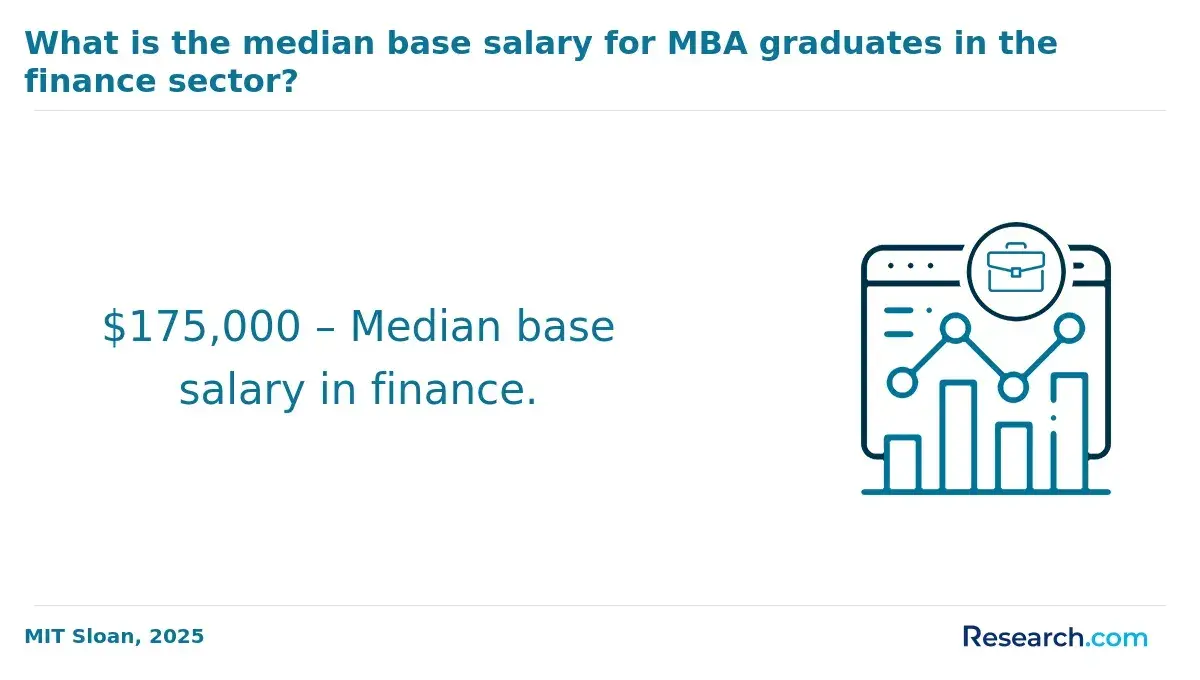
The image below shows how much MBA graduates earn on average. This will help you evaluate the cost of the program and the potential ROI.
How can an MBA benefit individuals looking to transition into a new industry?
An MBA can help career changers because it provides business language, structured recruiting opportunities, peer and alumni networks, and applied projects that may be difficult to access independently. For nonbusiness majors, the degree can help translate prior experience into a new employer’s vocabulary.
- Broader business acumen: Courses in finance, marketing, operations, strategy, and leadership help students understand how organizations make decisions across functions.
- Targeted skill-building: Specializations such as technology management, healthcare administration, business analytics, and supply chain management can support transitions into specific sectors.
- Network access: Classmates, alumni, faculty, career coaches, and employers can provide information, referrals, and mentorship in the target industry.
- Experiential learning: Internships, consulting projects, case competitions, capstones, and simulations give career changers practical examples to discuss in interviews.
Understanding and navigating MBA costs for nonbusiness majors
Nonbusiness candidates should be especially careful about cost because they may also need preparatory coursework, career coaching, certifications, or a longer job search during a career pivot. Tuition, fees, technology charges, books, travel, residencies, and financing costs should all be included in the decision.
One cost-conscious route is an affordable online MBA in business analytics, particularly for students who want to add data-driven business skills while continuing to work. However, affordability should not be evaluated alone. Confirm accreditation, curriculum rigor, analytics tools used, faculty qualifications, career support, and employer relevance.
What is the ROI of affordable MBA programs for career changers?
ROI depends on how much you pay, how much income you give up, how long it takes to finish, how the degree changes your job options, and whether the program supports your specific transition. Affordable MBA programs can improve ROI by lowering upfront cost, but low tuition does not automatically mean strong value.
Career changers who need flexibility may compare MBA programs with low-cost online business administration degree programs if they are still deciding whether they need graduate-level management training or a broader business education pathway. The right choice depends on career level, target role, and whether employers in your field expect an MBA.
| ROI factor | Positive signal | Warning sign |
| Program cost | Total cost is manageable without excessive borrowing. | The degree requires large debt without clear career upside. |
| Career services | The school supports internships, career switching, networking, and employer access. | Career help is limited to generic resume reviews. |
| Student outcomes | The program shares relevant outcomes for students with similar goals. | Only broad or promotional salary claims are available. |
| Format | The schedule lets you maintain income or access recruiting opportunities. | The format conflicts with your work, family, or job-search needs. |
| Employer recognition | Graduates work in your target roles or industries. | Few alumni appear in the field you want to enter. |
What distinguishes business administration from business management in MBA programs?
Business administration and business management overlap, but they are not identical. Business administration usually emphasizes organizational strategy, financial oversight, planning, policy, and cross-functional decision-making. Business management often focuses more directly on coordinating people, resources, teams, and day-to-day operations.
This distinction matters when you compare curricula. A student aiming for corporate strategy or finance-heavy leadership may prefer administration-oriented coursework, while a student moving into operations, team leadership, or department management may value management-focused training. Research.com’s comparison of business administration versus business management can help you decide which emphasis fits your goals.
How can you bridge the knowledge gap before starting an MBA?
Nonbusiness graduates can reduce first-term stress by preparing before enrollment. The most useful preparation usually targets accounting, finance, statistics, Excel or spreadsheet modeling, economics, and business writing.
- Take short courses in accounting, finance, and statistics before classes begin.
- Review basic Excel functions, charts, formulas, and financial modeling concepts.
- Read business cases and practice writing concise recommendations.
- Join admitted-student study groups or pre-term boot camps if available.
- Ask the program whether tutoring, bridge modules, or quantitative support are included.
If cost is a major concern, comparing options such as the least expensive online MBA programs can help you balance preparation, affordability, and credential value. Do not choose only by price; confirm the program provides enough academic support for students without a business background.
Can an online MBA program waive the GMAT requirement without compromising quality?
Yes, but a GMAT waiver should be evaluated carefully. A program can waive the GMAT and still be rigorous if it uses other evidence of readiness, such as professional experience, undergraduate performance, quantitative coursework, certifications, managerial responsibility, or prior graduate study. The absence of a test should not mean the absence of standards.
Applicants considering test-optional or waiver-based admission should examine accreditation, faculty credentials, course expectations, student support, graduation requirements, and career outcomes. Candidates comparing cost-conscious options may review the cheapest AACSB accredited online MBA no GMAT programs, but they should still verify whether each program’s waiver policy, curriculum, and student services match their needs.
Is an MBA in Healthcare Management a Strategic Option for Nonbusiness Graduates?
An MBA in Healthcare Management can be a strong fit for clinicians, public health workers, life science professionals, administrators, and other nonbusiness graduates who want leadership roles in healthcare settings. This specialization connects core business training with healthcare regulation, budgeting, quality improvement, operations, staffing, and organizational strategy.
Students considering this path should check whether the curriculum includes healthcare finance, policy, compliance, data use, population health, and operational improvement. They should also compare cost and flexibility. A cost-conscious online MBA degree in healthcare management may be practical for working professionals, but accreditation, faculty expertise, and healthcare-specific career support remain essential.
How can supplementary credentials enhance your MBA career?
Supplementary credentials can help nonbusiness MBA students signal specific skills that a general MBA may not fully demonstrate. Certifications or additional coursework in project management, analytics, accounting, finance, human resources, cybersecurity, or healthcare quality can strengthen a career pivot when chosen strategically.
For example, a project management credential can support roles involving cross-functional teams, timelines, budgets, and operational execution. Students comparing academic credentials in this area may review the most affordable online project management degree options. The best supplementary credential is the one that fills a real gap for your target job, not the one that simply adds another line to your resume.
Can an online executive MBA accelerate leadership growth for nonbusiness professionals?
An online executive MBA can help experienced nonbusiness professionals move into broader leadership roles while staying employed. These programs are usually designed for people with substantial work experience who want advanced management training, peer learning, and immediate application to current workplace problems.
Because executive MBA programs can be intensive and expensive, applicants should verify that the cohort profile, schedule, leadership curriculum, faculty access, and employer recognition fit their goals. A flexible online executive MBA may be useful for professionals who cannot relocate or pause work, but the program should still offer rigorous coursework, meaningful interaction, and strong support.
Should you choose an online or on-campus MBA program?
The choice between online and on-campus MBA study depends on your career goal, learning style, schedule, budget, and need for networking. Nonbusiness majors should be especially thoughtful because they may need more academic support, peer interaction, and career guidance than students who already have business training.
| Factor | Online MBA | On-campus MBA |
| Flexibility | Often better for working adults, caregivers, and students outside major business-school markets | More structured schedule and campus-based expectations |
| Networking | May include virtual events, group projects, online communities, and optional residencies | Usually stronger for in-person networking, clubs, recruiting events, and informal connections |
| Career switching | Can work well if the program has strong career support and you actively network | May offer more access to internships, campus recruiting, and immersive career-change support |
| Cost | May reduce commuting, relocation, and housing costs | May involve relocation, campus fees, and higher opportunity costs for full-time students |
| Learning style | Best for disciplined, self-directed students comfortable with digital tools | Best for students who prefer face-to-face discussion and campus resources |
| Speed | Some programs offer accelerated options, including accredited 1 year MBA programs online | Full-time campus programs may also be accelerated, but often require relocation or career interruption |
Online programs can be a strong fit when you need flexibility and can learn independently. On-campus programs may be better if you are making a major career switch and want deeper immersion, in-person recruiting, and frequent interaction with classmates and faculty. Hybrid programs can offer a middle ground.
Questions to ask before applying to an MBA without a business degree
- What exact job or industry do I want after the MBA?
- Does this program place graduates into that role or industry?
- How does the school support students without business coursework?
- Are accounting, finance, statistics, or economics prerequisites required?
- Is the GMAT or GRE required, optional, waived, or suspended?
- What is the total cost, including fees, travel, books, technology, and loan interest?
- Will I need to leave work, reduce hours, or relocate?
- Does the program offer internships, consulting projects, capstones, or experiential learning?
- How active is the alumni network in my target field?
- What career outcomes are available for students with backgrounds like mine?
Key Insights
- You can get an MBA without a business degree. Admissions committees commonly consider work experience, leadership potential, academic readiness, essays, recommendations, and test scores or waiver eligibility.
- The MBA is most valuable when it solves a defined career problem, such as moving into management, changing industries, launching a company, or adding business fluency to technical expertise.
- Nonbusiness students should prepare for quantitative and foundational subjects, especially accounting, finance, statistics, economics, and analytics.
- Program format matters. Full-time MBAs can support career switching; part-time, online, hybrid, and executive formats may suit working professionals who need flexibility.
- Cost should be evaluated through total ROI, not tuition alone. Include fees, travel, lost income, interest, career support, employer recognition, and realistic salary outcomes.
- Accreditation, career services, curriculum fit, alumni network, and student support are more important than rankings alone.
- A specialized master’s degree, certificate, or focused concentration may be a better choice than a general MBA if your goal is narrow and technical.
References:
- Bureau of Labor Statistics (2025). Financial Managers. BLS.
- Ethier, M. (2025, December 17). Report: Business Education Is ‘Transforming, Not Declining’ – As MBA Enrollment Slips & Specialized Programs Surge. Poets & Quants.
- Graduate Management Admission Council (2024). Application Trends Survey 2024 Report. GMAC.
- Graduate Management Admission Council (2024). GMAT Geographic Trend Report: Testing Year 2024. GMAC.
- Graduate Management Admission Council. Corporate Recruiters Survey Summary Report. GMAC.
- Graduate Management Admission Council. Prospective Students Summary. GMAC.
- Stanford Graduate School of Business (n.d.). School Profile.
- Thomas-Oxtoby, S. (2024, O). MBA grads reliably earn a six-figure salary in these 6 industries. Fortune Education.
- Validated Insights (2025, January). The MBA Market (updated January 2025). Validated Insights.
- Walker, A. (2024, November 7). Four unexpected findings from GMAC’s 2024 Business School Application Trends Survey. EFMD Global.
Other Things You Should Know About MBA for Nonbusiness Degree Holders
In 2027, most MBA programs require a bachelor's degree, standardized test scores like the GRE or GMAT, and recommendation letters. Non-business majors may need to complete foundational courses in accounting or economics before enrolling in core MBA classes.
Yes, many MBA programs in 2027 offer specializations such as technology management, healthcare administration, or sustainability that cater to non-business undergraduates, allowing them to leverage their unique backgrounds and skills in these growing fields.


