2027 What is an Executive Master’s Degree Guide

Co-Founder and Chief Data Scientist
An executive master’s degree is built for professionals who already have substantial work experience and want graduate-level preparation without stepping away from their careers. The decision is usually not “Should I go to graduate school?” but “Will this specific degree help me move into a larger leadership role, change sectors, or strengthen my authority in a specialized field?”
This guide explains what executive master’s programs are, how they differ from traditional master’s degrees, what they cost, how long they take, and which factors matter most when comparing programs. It is written for mid-career managers, senior specialists, entrepreneurs, public-sector leaders, healthcare professionals, technology professionals, and others who need a flexible but rigorous path to advanced credentials.
Quick answer: Is an executive master’s degree worth it?
An executive master’s degree can be worth it if you already have meaningful professional experience, need a graduate credential for senior leadership opportunities, and can connect the program directly to a promotion, role change, salary growth, or stronger professional network. It is usually less suitable for early-career students who need foundational training or people who want the least expensive route to any master’s credential.
The strongest candidates compare programs by accreditation, total cost, employer support, schedule fit, alumni network, faculty expertise, and whether the curriculum solves a real career problem they are facing now.
What are the benefits of getting an executive master’s degree?
- An executive master’s degree can help experienced professionals qualify for senior management, specialized executive, and C-suite-track roles.
- Payscale reports that graduates of an executive MBA degree earn an average annual salary of $127,000.
- Many executive master’s programs use part-time, online, hybrid, weekend, or modular formats, making them more practical for students who plan to keep working while studying.
What can I expect from an executive master’s degree?
An executive master’s degree is a graduate program designed around the realities of experienced professionals. Instead of starting with basic career preparation, these programs usually assume that students have workplace knowledge, leadership exposure, and industry context they can bring into class discussions and projects.
- Applied coursework: Classes often focus on leadership, strategy, finance, analytics, operations, policy, technology, healthcare, law, or another professional field, depending on the degree.
- Intensive learning format: Many programs compress learning into weekend sessions, online modules, short residencies, or monthly in-person meetings.
- Peer-based learning: Students typically learn alongside other mid-career professionals, which can make discussions more practical and industry-specific.
- Career-focused projects: Capstones, consulting projects, simulations, and case studies are often designed so students can apply new ideas directly to their current organizations.
Where can I work with an executive master’s degree?
Executive master’s degrees exist across many professional fields, so career options depend heavily on the discipline you choose. Graduates may move into leadership or advanced specialist roles in business, finance, healthcare, technology, manufacturing, real estate, marketing, public administration, hospitality, law, data science, and other sectors.
For example, someone who completes an executive MBA may use the degree to pursue business management or strategic leadership roles in a corporate office. A healthcare professional who completes an executive master’s in health management may pursue administrative, policy, or operational leadership roles in hospitals, health systems, public health agencies, or consulting organizations.
The value of the degree usually comes from combining advanced coursework with existing experience. Students learn how to lead teams, evaluate performance through KPIs and other metrics, assess strategic initiatives, and make decisions that create measurable organizational value.
How much can I make with an executive master’s degree?
According to Payscale, graduates of an executive master’s of business administration degree have an average annual salary of $127,000. Payscale also lists an average annual salary of $97,000 for MBA holders and $83,000 for master’s degree holders.
These numbers should not be read as a guarantee that an executive master’s degree automatically pays more than a traditional master’s degree. Executive programs often enroll students who are already established professionals and may already be close to senior roles. In other words, the salary difference may reflect both the credential and the experience level of the students who choose it.
Before enrolling, compare the degree cost with realistic career outcomes in your current field, your employer’s promotion practices, and your willingness to change roles or organizations after graduation.
- Best Executive Master’s Degrees for 2027
- How long does it take to complete an executive master’s degree?
- How does an online executive master’s degree compare with a traditional program?
- What is the average cost of an executive master’s degree?
- What financial aid options are available for students pursuing executive master’s degrees?
- What are the prerequisites for enrolling in an executive master’s degree?
- What are the most common types of executive master’s degrees?
- What are the skill requirements for executive master’s degrees?
- How does one choose the best executive master’s degree?
- What are the networking opportunities for executive master’s degrees?
- What is the typical structure of an executive master’s degree program?
- What Return on Investment (ROI) Can I Expect from an Executive Master’s Degree?
- Do employers value an executive master’s degree?
- What Are the Emerging Trends in Executive Master’s Education?
- What are the most common careers for individuals with an executive master’s degree?
- What Should I Know About the Application Process for an Executive Master’s Degree?
- Is a fast track approach a viable alternative for executive education?
- How can additional academic credentials complement your executive master’s degree?
- How to balance work, life, and an executive master’s degree
- How to Choose the Right Executive Master's Degree for Your Career Goals
- What Challenges Should You Anticipate with an Executive Master’s Degree?
- How Does an Executive Master's Degree Compare to Accelerated Programs?
- The Impact of an Executive Master's Degree on Work-Life Integration
Best Executive Master’s Degrees for 2027
How do we rank schools?
Executive master’s programs require a major investment of time, money, and professional energy. To help readers compare options more clearly, our research team reviewed program information and relevant data from sources such as the National Center for Education Statistics (NCES), the IPEDS database, Peterson’s Data, and College Scorecard. You can learn more about the ranking process on our methodology page.
| Program | Best fit | Length | Cost information |
| University of Pennsylvania Executive MBA | Managers pursuing upper-level business leadership | 2 years | $223,500 total cost |
| Northwestern University Executive MBA Program | Professionals who want a customizable executive MBA curriculum | 2 years | $231,174 total cost |
| University of Chicago Executive MBA | Students seeking a global or online executive MBA option | 21 months | $204,450 total cost |
| University of Houston Executive Master of Hospitality Management | Hospitality professionals seeking a short executive graduate program | 1 year | $535.65 in-state per credit; $1,055.65 out-of-state per credit |
| Ohio University Executive Master of Public Administration | Public service professionals seeking a hybrid leadership program | 2 years | $613 per credit |
1. University of Pennsylvania Executive MBA
The Wharton Executive MBA at the University of Pennsylvania is designed for managers preparing for senior leadership and upper-level management responsibilities. The curriculum emphasizes management decision-making, strategic leadership, and advanced business skills, while electives allow students to shape part of the program around their professional interests.
- Program Length: 2 years
- Total Cost: $223,500
- Required Credits to Graduate: 19
- Accreditation: Association to Advance Collegiate Schools of Business
2. Northwestern University Executive MBA Program
The Executive MBA program at Northwestern University helps students develop frameworks for handling complex business problems. Its curriculum includes room for electives, allowing students to create concentrations that align with their leadership goals. The format is designed with working professionals in mind, including the option to take a selection of classes once a month.
- Program Length: 2 years
- Total Cost: $231,174
- Required Credits to Graduate: 28
- Accreditation: Association to Advance Collegiate Schools of Business
3. University of Chicago Executive MBA
The Executive MBA program at the University of Chicago uses a schedule of four ThursdaySaturday class sessions each quarter, giving working students predictable time blocks for study. The program includes 18 core curriculum courses and can be completed in less than two years. Students may study in Chicago, London, Hong Kong, or online.
- Program Length: 21 months
- Total Cost: $204,450
- Required Credits to Graduate: Not available
- Accreditation: Association to Advance Collegiate Schools of Business
4. University of Houston Executive Master of Hospitality Management
The Executive Master of Hospitality Management at the University of Houston focuses on modern hospitality leadership, including technology, marketing, negotiation, human resources, and financial asset planning. The program requires 30 graduate coursework hours and can be completed in one year. Students also complete projects involving industry experts.
- Program Length: 1 year
- Cost per Credit: $535.65 (in-state); $1,055.65 (out-of-state)
- Required Credits to Graduate: 30
- Accreditation: Southern Association of Colleges and Schools Commission on Colleges
5. Ohio University Executive Master of Public Administration
The Executive Master of Public Administration program at Ohio University is built for professionals interested in public affairs, organizational leadership, and social justice. Its hybrid format combines coursework with workshops, instructor collaboration, professional coaching, and campus residencies. Students can complete the program in two years.
- Program Length: 2 years
- Cost per Credit: $613
- Required Credits to Graduate: 36
- Accreditation: Higher Learning Commission
6. Columbia University Executive Master of Science in Technology Management
The Executive Master of Science in Technology Management program at Columbia University offers six concentration areas and gives students access to dedicated mentors. The program is designed to help professionals connect technology leadership with business transformation, strategic planning, operations management, and product or service realization.
- Program Length: 16 months
- Tracks/concentrations: C-Level Management; New Business Ventures; Data Management and Analytics; Media & Entertainment Technology; Cybersecurity; Digital and Business Transformation.
- Cost per Credit: $2,536
- Required Credits to Graduate: 36
- Accreditation: Middle States Commission on Higher Education
7. University of Michigan Executive Master’s Program in Health Management and Policy
The Executive Master’s Program in Health Management and Policy at the University of Michigan is intended for healthcare professionals who want to lead, manage, analyze, or influence health systems. The curriculum includes healthcare business, administration, management, and policy topics. The program features four three-day weekend classes.
- Program Length: 20 months
- Cost per Credit: $2,228 (in-state); $3,447 (out-of-state)
- Required Credits to Graduate: 30
- Accreditation: Commission on Accreditation of Healthcare Management Education, Council on Education for Public Health
8. Columbia University Executive LL.M. in Global Business Law
Columbia University’s Columbia Law School offers an Executive LL.M. in Global Business Law for experienced lawyers. This six-month accelerated program focuses on U.S. business law, business acumen, and global legal practice skills. Students complete online coursework and a 12-week residency at Columbia Law School’s New York City campus.
- Program Length: 6 months
- Annual tuition: $80,792
- Required Credits to Graduate: 24
- Accreditation: Accredited by the State of New York to approve in-house Continuing Legal Education (CLE)
9. University of the Cumberlands Executive Master’s in Data Science
The University of the Cumberlands offers an Executive Master of Data Science for students who want to strengthen applied data skills and prepare for leadership opportunities. The program covers data science concepts such as extracting knowledge from large datasets, algorithms, information visualization, data processing, data integration, graphic design, and communication. It is also among the cheapest executive master’s programs of any kind in the U.S.
- Program Length: 12 months full-time or longer
- Annual tuition: $9,875
- Required Credits to Graduate: 31
- Accreditation: Southern Association of Colleges and Schools Commission on Colleges (SACSCOC)
10. Pennsylvania State University Master’s in Strategic Management and Executive Leadership
Pennsylvania State University offers an Executive Master in Strategic Management and Executive Leadership. The curriculum teaches students how to design strategy, implement plans, build buy-in, evaluate macro trends, assess competitive positioning, and create long-term strategies for changing environments. Its online format supports asynchronous learning.
- Program Length: 20 months
- Tuition cost per semester: $14,832
- Required Credits to Graduate: 30
- Accreditation: Middle States Commission on Higher Education (MSCHE)
What graduates say about executive master’s programs
My executive master’s program gave me a broader understanding of business and connected me with professionals from different backgrounds. Because the program was online, I could move through coursework while continuing to apply the material in my current role. Lucas
The degree pushed me to think more strategically and strengthened the way I approach problems at work. The flexible format helped me keep up with professional and family responsibilities while completing graduate study. Hana
The online executive master’s program helped me balance work, personal commitments, and career development. I was able to use new concepts immediately on the job and saw clear professional growth. Rani
Key findings
- An executive master’s degree can normally be completed in two years.
- An executive MBA typically costs around $55,000 to $133,000.
- Programs from top schools can reach or exceed $200,000.
- Executive master’s degrees often require at least 10 years of experience, with some years in a managerial capacity.
- 26% of US executives are business majors.
- The most in-demand executive master’s degree in the US is the EMBA.
How long does it take to complete an executive master’s degree?
An executive master’s degree can normally be completed in two years, although some programs allow students to extend their timeline because of work, travel, or family commitments. The length is similar to many traditional master’s programs, but executive formats are usually scheduled more intentionally for full-time professionals.
The flexible structure can also make the learning more immediately useful. Students may study leadership, strategy, analytics, finance, operations, or policy while applying those ideas to live workplace challenges. For students already in supervisory or managerial roles, this can make the degree more practical than a program designed for students with limited work experience.
The chart below summarizes outcomes associated with earning an executive MBA, one of the most common forms of executive master’s degree.
How does an online executive master’s degree compare with a traditional program?
Online and traditional executive master’s programs may cover similar academic material, but the experience, schedule, and cost structure can differ substantially. The better choice depends on how much flexibility you need, how important campus networking is to you, and whether your field requires in-person learning experiences.
| Factor | Traditional executive master’s program | Online executive master’s program |
| Learning environment | Students use campus classrooms, labs, libraries, and in-person study spaces. | Students learn through virtual classrooms, digital lectures, online exams, discussion boards, video meetings, and collaboration tools. |
| Schedule | Programs usually follow a fixed academic calendar, often over about two years. | Programs may offer asynchronous modules, live online classes, accelerated schedules, or part-time pacing. |
| Costs beyond tuition | Students may need to budget for commuting, lodging, meals, parking, or relocation. | Students may avoid travel costs but still need to account for technology, platform, support, or maintenance fees. |
| Technology expectations | Technology supports learning but may not define the entire academic experience. | Students need reliable internet access, appropriate hardware, and comfort using learning management systems and communication platforms. |
| Best for | Professionals who want in-person networking, campus access, and structured class meetings. | Professionals who need geographic flexibility or cannot regularly travel to campus. |
What is the average cost of an executive master’s degree?
According to the Education Data Initiative, the cost of a master’s degree in the United States ranges from around $54,000 to $73,000, with an average of $65,134. This broader category includes executive master’s degrees. The same source reports an average cost of $71,880 for an MBA, around $78,930 for a Master of Arts, about $67,590 for a Master of Science, and $59,840 for a Master of Education.
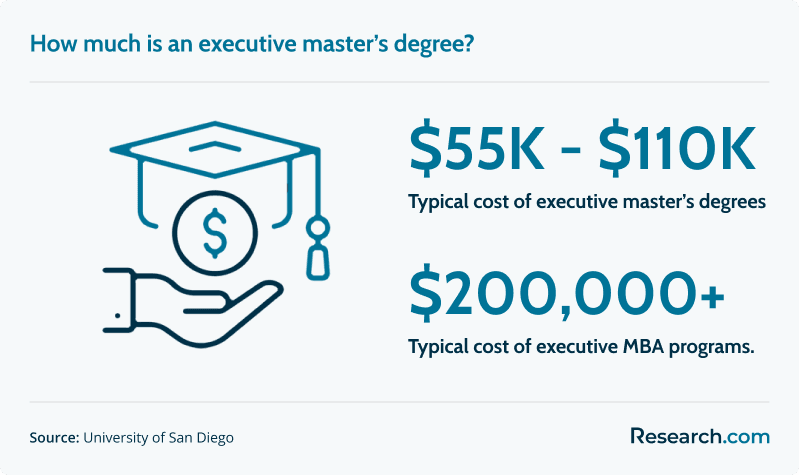
For business programs specifically, University of San Diego data shows that an executive MBA costs around $55,000 to $133,000. That range is above the $40,000 to $100,000 cost range for an MBA, although both MBA and executive MBA programs from top schools can reach or exceed $200,000.
When comparing programs, do not look only at tuition. Include fees, travel, residencies, lost income from reduced work hours, financing costs, employer reimbursement rules, books, technology, and the time required for projects or residencies.
What financial aid options are available for students pursuing executive master’s degrees?
Executive master’s students may be able to combine several funding sources, much like students exploring master’s degrees for teachers. Eligibility varies by school, employer, program type, citizenship status, enrollment level, and financial need.
- Employer assistance: Some organizations help fund graduate education through tuition reimbursement, direct payment, professional development budgets, or negotiated sponsorship. Ask HR whether the benefit requires a minimum grade, continued employment after graduation, or repayment if you leave the company.
- Grants and scholarships: Schools, professional associations, foundations, and industry groups may offer awards for graduate students, executives, veterans, women in leadership, public service professionals, or students in specific fields.
- Federal aid: Eligible students can submit the Free Application for Federal Student Aid (FAFSA) to determine whether they qualify for federal aid options.
- Federal and private loans: Loans can help cover remaining costs, but students should compare interest rates, repayment terms, fees, deferment options, and long-term affordability before borrowing.
What are the prerequisites for enrolling in an executive master’s degree?
Admissions requirements vary by institution and discipline, especially for specialized programs in healthcare, law, data science, technology, public administration, or business. Most executive master’s programs review both academic readiness and professional leadership experience.
Common admission requirements
- Bachelor’s degree from a regionally accredited university
- Minimum GPA requirement, often above 3.0 on a 4.0 scale, depending on the university
- Official transcripts for completed undergraduate and graduate work
- Professional license or certification documents when required by the program
- Employment verification or professional experience documentation
- English proficiency test scores, such as TOEFL, TOEIC, or IELTS, for international students when required
- Relevant work experience in the field
- Specified number of years of professional experience
Accreditation should be part of your admissions review. AACSB accreditation, for example, is difficult to obtain; only 874 global institutions are AACSB-accredited, including around 15% of business schools worldwide.
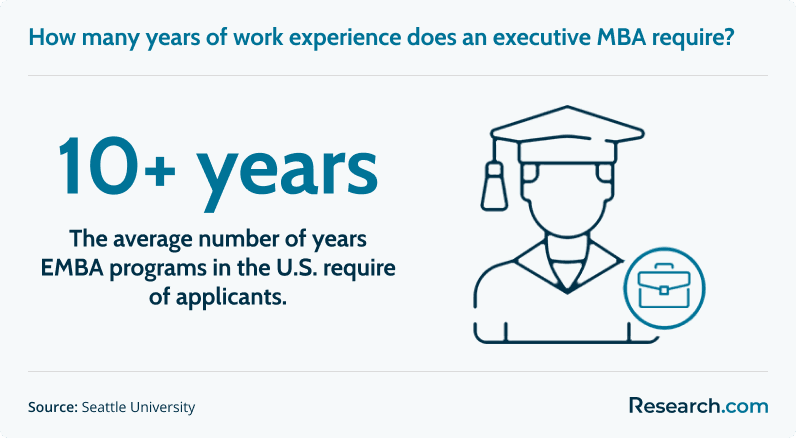
Executive master’s programs often expect more experience than many professional master’s degrees. While professional degrees may require five to seven years of experience, executive master’s degrees often require at least 10 years of experience, with some of that experience in a managerial capacity.
What are the most common types of executive master’s degrees?
The Executive Master of Business Administration (EMBA) and Executive Master of Science (EMS) are among the most common executive master’s degrees. Related Master of Advanced Studies programs may serve similar audiences, especially in areas such as finance, data science, human resources, engineering, and communication.
| Degree type | Typical audience | Common career direction |
| Executive Master of Business Administration (EMBA) | Experienced managers and business professionals | General management, strategy, operations, executive leadership |
| Executive Master of Science in Management (EMSM) | Professionals seeking specialized management training | Department leadership, operations, organizational management |
| Executive Master of Public Administration (EMPA) | Government, nonprofit, and public-sector professionals | Public leadership, policy, program administration |
| Executive Master of Healthcare Administration (EMHA) | Healthcare professionals moving into administrative leadership | Health system management, operations, healthcare policy |
| Executive Master of Information Technology (EMIT) | Technology professionals preparing for leadership roles | IT strategy, technology management, digital transformation |
Examples of Master of Advanced Studies programs
- Master of Advanced Studies in Data Science
- Master of Advanced Studies in Finance
- Master of Advanced Studies in Human Resources
- Master of Advanced Studies in Engineering
- Master of Advanced Studies in Communication
Executive-format options can exist in many disciplines, including business programs such as easy MBA programs. Business-focused executive degrees tend to receive the most attention because leadership, finance, operations, and strategy skills are transferable across many industries. Students comparing options can also review the broader landscape of business masters degrees.
What are the skill requirements for executive master’s degrees?
Required skills depend on the program, but executive master’s students generally need enough academic, analytical, and professional maturity to handle fast-paced graduate work while managing their jobs.
Quantitative analysis skills
Many executive programs expect comfort with statistics, data analysis, accounting, economics, finance, management science, analytics, data science, organizational management, and operations research. Students should be able to interpret graphs, tables, and figures because these skills support research, decision-making, capstone work, and applied projects. Quantitative skills are especially important in programs such as an online masters degree in health informatics.
Problem-solving skills
Executive students must be able to define problems clearly, identify root causes, compare possible solutions, and explain why one approach is stronger than another. Programs often expect students to bring real organizational problems into class discussions and projects.
Research skills
Graduate-level work often requires students to gather data, evaluate evidence, test assumptions, and make recommendations. Students may need to understand research design frameworks, measurement tools, objective analysis, and reproducible methods.
Communication skills
Executive master’s students must write clearly, present persuasively, lead discussions, defend recommendations, and communicate findings to technical and nontechnical audiences. These skills matter in capstone presentations, thesis defenses, surveys, interviews, team projects, and workplace leadership.
How does one choose the best executive master’s degree?
The best executive master’s degree is the one that fits your career goal, schedule, budget, and industry—not simply the one with the most recognizable brand. Start by identifying the specific role, promotion, sector shift, or leadership challenge the degree should help you address.
Faculty background and professional expertise
Faculty quality matters because executive students need instructors who can connect theory with high-level professional practice. Review faculty biographies, research areas, consulting experience, publications, and industry partnerships. If you plan to complete a capstone or thesis, look for faculty whose work aligns with your professional interests.
Program specializations or concentrations
Executive master’s programs may offer concentrations in public administration, finance, international business, healthcare, data science, AI, blockchain technology, hospitality management, technology leadership, or other fields. Compare the available electives and capstone options with your target role. Students considering business-focused paths can also examine the best online executive MBA programs.
Research output and publications
Research output can indicate whether a school contributes meaningfully to its field. Review peer-reviewed publications by faculty and students, ask programs about active research projects, and request examples of capstone work if available. This is especially important if you want the degree to support consulting, policy work, doctoral study, or technical leadership.
Questions to ask before enrolling
- Is the institution regionally accredited, and is the program accredited by the relevant professional body when applicable?
- Does the program require residencies, travel, synchronous sessions, or weekend attendance?
- What is the full cost after tuition, fees, travel, books, and technology expenses?
- What percentage of students receive employer support or scholarships?
- How experienced are the students in the cohort?
- Can you use your current workplace for projects, research, or a capstone?
- What career services are available for executive students and alumni?
- Does the curriculum match the role you want next?
Common mistakes to avoid
- Choosing by brand alone: A prestigious name does not help if the curriculum, schedule, or network does not match your goals.
- Ignoring accreditation: Accreditation affects credibility, employer recognition, transferability, and sometimes financial aid eligibility.
- Comparing tuition only: Total cost includes fees, travel, residencies, time away from work, and interest on borrowed funds.
- Assuming online always means easier: Online executive programs can be rigorous and may require disciplined weekly participation.
- Expecting automatic salary growth: Outcomes depend on your experience, industry, employer, location, performance, and job market conditions.
What are the networking opportunities for executive master’s degrees?
Networking is one of the main reasons professionals choose executive programs. Because cohorts often include managers, senior specialists, founders, public-sector leaders, and professionals from multiple industries, students can build relationships that go beyond ordinary classroom interaction.
Networking usually happens through team projects, peer discussions, alumni events, residencies, workshops, guest lectures, executive seminars, and industry panels. Some programs also include global residencies or immersive learning experiences, allowing students to meet professionals working in international markets.
Professionals who need a shorter graduate pathway may also compare executive master’s programs with an online masters degree 1 year. Some shorter programs still include networking, although the depth of cohort relationships may differ from longer executive formats.
To get the most value, students should be intentional. Join discussions, follow up after events, contribute meaningfully to group projects, meet faculty during office hours, and stay active in the alumni network after graduation.
What is the typical structure of an executive master’s degree program?
Executive master’s programs are typically designed for students who work full time. Many programs meet several days per month over two or three years, while others use online courses, evening classes, weekend sessions, short residencies, or hybrid formats. Similar flexibility is common in online executive MBA programs.
The academic content may resemble a traditional master’s curriculum, but executive programs usually emphasize applied leadership, specialized topics, and workplace-based learning. Students may complete a thesis, consulting project, or capstone, which typically takes 350500 hours. The format is best suited for professionals who need advanced credentials tied to a clear next step in their field.
What Return on Investment (ROI) Can I Expect from an Executive Master’s Degree?
The ROI of an executive master’s degree depends on total cost, employer funding, time to completion, debt, current salary, career stage, and whether the degree helps you move into a higher-value role. Executive programs can create value through salary growth, stronger leadership skills, job security, industry credibility, and access to a more senior network.
Quantitative studies suggest a typical payback period ranging from three to five years, but that should be treated as a general benchmark rather than a guaranteed outcome. Students comparing multiple graduate options can review broader choices among the best online masters degrees.
Do employers value an executive master’s degree?
Employers may value an executive master’s degree when it signals practical leadership ability, advanced analytical skill, commitment to professional development, and readiness for larger responsibilities. The credential is strongest when paired with measurable achievements, relevant experience, and a clear connection to organizational needs.
However, employer value varies. Some organizations prioritize graduate education for promotions, while others focus more on performance, industry certifications, technical expertise, or internal leadership experience. Professionals considering deeper academic or research preparation may also explore accelerated PhD programs online.
What Are the Emerging Trends in Executive Master’s Education?
Executive master’s education is becoming more flexible, more technology-focused, and more modular. Programs are increasingly integrating artificial intelligence, analytics, digital collaboration tools, and business simulations so students can practice decision-making in realistic scenarios.
Some institutions are also adding micro-credentials, specialized certificates, sustainability content, global residencies, and cross-sector partnerships. These options help professionals update specific skills without waiting for an entire degree redesign. For students still building toward graduate study, an accelerated bachelor's degree online accredited may provide an earlier step toward executive-level education.
What are the most common careers for individuals with an executive master’s degree?
Executive master’s graduates often pursue roles that require advanced judgment, leadership, strategy, and cross-functional decision-making. The exact career path depends on the degree field and the student’s prior experience.
- C-suite roles: CEO, COO, CFO, managing director, president, or comparable executive positions.
- Specialized executive roles: Director, vice president, general manager, department head, or senior functional leader.
- Consulting and advisory roles: Management consultant, business analyst, strategy consultant, or executive coach.
- Public and nonprofit leadership roles: Government official, executive director, program director, policy analyst, or board member.
Among US executives, the largest group are business majors, which is more than double marketing and communicating majors combined, as shown in the chart below.
What Should I Know About the Application Process for an Executive Master’s Degree?
A strong executive master’s application should show academic readiness, leadership potential, and a clear career direction. Admissions teams often look for evidence that applicants can contribute meaningfully to a cohort of experienced professionals.
- Resume: Highlight leadership responsibilities, measurable outcomes, promotions, team management, budgets, projects, and industry impact.
- Statement of purpose: Explain why this program fits your next career step and how your experience will contribute to the cohort.
- Recommendations: Choose supervisors, executives, clients, or senior colleagues who can speak to your judgment, leadership, and professional growth.
- Transcripts and credentials: Submit all required academic records, licenses, certifications, and test scores when applicable.
- Deadlines: Executive programs may have cohort-based admissions, so missing a deadline can delay enrollment by a full term or year.
Applicants who are still planning their academic path may also find it useful to compare lower-cost undergraduate preparation through resources such as the cheapest college to get a bachelor's degree.
Is a fast track approach a viable alternative for executive education?
Fast track programs can be useful when your main goal is to build a specific credential or technical skill quickly. Executive master’s programs, by contrast, are usually broader and deeper, with more emphasis on strategic leadership, applied projects, and professional networking.
A fast track degree pathway may make sense if you need rapid preparation for a near-term opportunity or technical transition. An executive master’s degree may be the better fit if you are preparing for long-term leadership, cross-functional authority, or a senior role that requires broader business, policy, healthcare, technology, or organizational judgment.
How can additional academic credentials complement your executive master’s degree?
Additional credentials can strengthen an executive master’s degree when they fill a targeted skill gap. For example, a leader in operations may add analytics training, a healthcare administrator may pursue informatics coursework, or a business executive may add a focused certificate in cybersecurity, finance, or sustainability.
Shorter programs may be useful if they align with a clear market need. Some professionals also consider options such as the best associate degree in 6 months online when they need a concise credential in a complementary area. The key is to avoid collecting credentials without a strategy; each one should support a specific role, industry shift, or skill requirement.
How to balance work, life, and an executive master’s degree
Balancing a full-time job, graduate study, and personal responsibilities is one of the hardest parts of an executive master’s program. Success depends less on motivation and more on planning, communication, and realistic workload management.
- Map your calendar before enrolling: Review work travel, budget cycles, family obligations, and major program deadlines before choosing a start date.
- Set weekly study blocks: Treat coursework like a recurring executive meeting rather than something to fit in after everything else.
- Talk to your employer early: Ask whether flexible scheduling, reduced travel, project alignment, or tuition support may be available.
- Prepare your support system: Family members and close contacts should understand when your busiest academic periods will occur.
- Use workplace projects strategically: When allowed, connect assignments to real organizational challenges so schoolwork and job responsibilities reinforce each other.
How to Choose the Right Executive Master’s Degree for Your Career Goals
Choosing the right executive master’s degree starts with a clear career target. If you want general senior business leadership, an EMBA may fit. If you want to lead in healthcare, technology, public service, law, hospitality, or data science, a specialized executive program may offer stronger relevance.
Program difficulty and accessibility also matter, but they should not be the only criteria. Students comparing options such as the easiest master’s degree should still review accreditation, curriculum depth, employer recognition, faculty expertise, and career outcomes.
| If your goal is... | Consider... | Be careful about... |
| Move into senior business leadership | Executive MBA or executive management program | Choosing a program without strong leadership, finance, and strategy coursework |
| Advance in a technical field | Executive master’s in technology, data science, analytics, or IT | Enrolling in a general program that lacks technical depth |
| Lead in healthcare | Executive healthcare administration, health management, or health policy program | Ignoring accreditation or industry-specific requirements |
| Work in public service or nonprofits | Executive MPA or public leadership program | Choosing a corporate-focused curriculum that does not match public-sector work |
| Gain a fast credential | Certificate, accelerated degree, or short-format program | Assuming speed provides the same network and depth as an executive master’s degree |
What Challenges Should You Anticipate with an Executive Master’s Degree?
Executive master’s students should expect pressure from three directions: workload, cost, and adjustment. Coursework can be demanding, especially when combined with full-time work. Online platforms and digital collaboration tools may also create a learning curve for students who have been out of school for years.
Financial planning is another challenge. Even when employer support is available, students may need to pay upfront, meet grade requirements, or remain employed for a certain period after reimbursement. Students who need maximum access and flexibility may also compare options from online colleges with open enrollment.
How Does an Executive Master's Degree Compare to Accelerated Programs?
Executive master’s degrees and accelerated programs both help students build credentials, but they serve different needs. Executive programs generally emphasize senior-level leadership, strategic thinking, applied projects, and peer networking. Accelerated programs usually focus on faster completion and may prioritize technical or job-specific skills.
Students researching the shortest degree with highest pay may benefit from rapid entry or advancement in certain fields. However, those aiming for senior leadership may need the broader curriculum, cohort relationships, and executive-level learning environment that a full executive master’s program provides.
The Impact of an Executive Master's Degree on Work-Life Integration
An executive master’s degree changes how students manage time, priorities, and professional identity. The format is designed for working adults, but flexibility does not eliminate the need for discipline. Students still need to protect study time, communicate clearly, and make trade-offs during demanding periods.
- Stronger time management: Students often become better at prioritizing, planning, delegating, and managing deadlines because they must balance coursework with professional responsibilities.
- Flexible learning formats: Evening, weekend, hybrid, and fully online formats can reduce disruption, especially for students who cannot pause their careers.
- Career-building relationships: Connections with peers, alumni, faculty, and industry speakers can support career development and provide practical advice.
- Employer and family support: Students are more likely to persist when employers and family members understand the schedule and expectations.
- Long-term habits: The planning skills developed during the program can continue to support work-life integration after graduation.
- Cost-conscious options: Professionals seeking flexibility and value can compare affordable masters degrees that fit their schedule without creating unnecessary financial strain.
Key Insights
- An executive master’s degree is best for experienced professionals who need advanced leadership, strategy, or specialized graduate training while continuing to work.
- The credential is most valuable when it connects directly to a promotion path, sector change, senior leadership goal, or measurable workplace need.
- Cost varies widely: executive MBA programs typically cost around $55,000 to $133,000, while top programs can reach or exceed $200,000.
- Admissions are experience-driven. Many executive master’s degrees expect at least 10 years of experience, often including managerial responsibility.
- Online and hybrid formats can improve access, but students should still verify accreditation, residency requirements, technology expectations, and total cost.
- Do not assume salary outcomes are automatic. ROI depends on your field, employer, prior experience, financing, and ability to use the degree strategically.
- The best program is not always the most famous one. Choose the degree with the right curriculum, network, faculty expertise, schedule, and career fit.
References:
- Hanson, M. (2024). Average Cost of a Master’s Degree. Education Data Initiative
- Filson, N. (n.d.). What to Study to Become a CEO & Where to Go to College. Preply
- NCES (2024). Graduate Degree Fields. NCES
- O’Neal, C. (2024, January 8). MBA vs EMBA: 8 Key Differences [+Comparison Table]. University of San Diego
- Seattle University (n.d.). PROFESSIONAL MBA VS. EXECUTIVE MBA: WHICH ONE IS RIGHT FOR YOU? Seattle University
- The Art of Applying (n.d.). Executive Masters vs. EMBA. The Art of Applying
- Zippia (2025). BEST COLLEGES AND MAJORS FOR EXECUTIVES. Zippia
Other Things You Should Know About Executive Master’s Degrees
Admission requirements for an executive master’s degree in 2027 often include a bachelor's degree, a minimum of five years of professional experience, and, in some cases, a GMAT or GRE score. Professional recommendations and a statement of purpose are typically required as well.
An executive master’s degree should be accredited by a recognized national or regional accreditor, and business programs often also hold AACSB, EQUIS, or AMBA accreditation. Accreditation confirms academic standards, degree recognition, and employer acceptance, especially for programs designed around part-time study and professional experience.
The typical curriculum for an executive master's degree in 2027 includes core courses in leadership, strategic management, and finance, along with electives targeting industry-specific skills. Programs often consist of 30 to 45 credit hours and incorporate weekend or evening classes to suit professionals.
In 2027, executive master's degree programs are designed with flexibility in mind, offering online and weekend classes to fit busy schedules. These programs focus on practical, real-world skills, allowing mid-career professionals to integrate learning with their current roles, enhancing both leadership and strategic thinking abilities.