
2027 Benefits of a Graduate Certificate

Co-Founder and Chief Data Scientist
When professionals think about advancing their careers, they often imagine enrolling in a full master’s program. But there’s another path that is shorter, cheaper, and sometimes just as impactful: the graduate certificate.
Graduate certificate holders can see a 13% to 25% salary increase after completion. Unlike traditional degrees, these programs are designed to fill skill gaps quickly. They're especially valuable in industries where technology and market demands change fast. If you want to know more about what graduate certificates can offer, here’s a closer look. This article breaks down the key benefits and highlights where they make the most impact.
Key Things to Know About Getting a Graduate Certificate for 2027
- Most programs finish in under a year, offering a fast track to career advancement without long study commitments.
- Globally recognized certificates like PMP or CISSP open doors to international job opportunities.
- Graduate certificates are significantly cheaper than full graduate degrees.
- What are the benefits of pursuing a graduate certificate? Certificate Benefits
- How can a graduate certificate enhance career prospects for 2027? Career Prospects
- In which industries do graduate certificates provide the most measurable career benefits? Top Industries
- What types of roles or positions typically become accessible after completing a graduate certificate program? Typical Jobs
- What specific skills can I gain from a graduate certificate for 2027? Core Skills
- How do employers view candidates with graduate certificates during career transitions? How do employers view candidates with graduate certificates during career transitions?
- Can a graduate certificate lead to a significant salary increase? Salary Potential
- How quickly can I expect to see financial benefits after earning a graduate certificate? How quickly can I expect to see financial benefits after earning a graduate certificate?
- Are there any challenges in leveraging a graduate certificate for career advancement? Are there any challenges in leveraging a graduate certificate for career advancement?
- Can a graduate certificate open doors to international job opportunities? International Work
- Which accrediting organizations should students consider when choosing a graduate certificate program? Accreditation
What are the benefits of pursuing a graduate certificate?
A graduate certificate is best suited for professionals who need focused graduate-level training without committing to a full master’s degree. It can help you build job-specific skills, prepare for a promotion, support a career change, or test whether a graduate field is worth deeper study.
This guide explains when a graduate certificate can improve your career prospects, where it tends to deliver the clearest value, what employers look for, how salary gains may happen, and what to check before enrolling. It is written for working adults, career changers, educators, healthcare professionals, technology workers, and students comparing certificates with master’s programs, bootcamps, and other credentials.
Quick answer: Is a graduate certificate worth it?
A graduate certificate can be worth it when it is accredited, aligned with a specific job goal, recognized in your industry, and affordable enough that the expected career benefit justifies the cost. It is usually strongest for targeted fields such as cybersecurity, data analytics, healthcare administration, project management, education, business, counseling, and technology. It is less useful when the program is poorly recognized, too general, not connected to employer demand, or does not meet licensure or certification requirements.
| Graduate certificate advantage | Why it matters | Best-fit learner |
| Focused skill building | You study a narrow area instead of completing broad graduate coursework that may not match your immediate career goal. | Professionals who need targeted expertise for a current or desired role. |
| Shorter completion time | Many programs can be completed in less than a year, and some are structured to finish in just a few months. | Working adults who want a faster credential than a master’s degree. |
| Lower upfront cost | Many certificates cost only a few thousand dollars, compared with full graduate degrees that can cost tens of thousands. | Students who want graduate-level training while limiting debt. |
| Career repositioning | A certificate can show employers that you have recent, relevant preparation in a specialized area. | Career changers, promotion seekers, and professionals returning to the workforce. |
| Pathway to further study | Some certificates may apply toward a master’s degree, though transfer policies vary by institution. | Students who may later pursue a full graduate degree. |
Specialized skill development
Graduate certificates are designed around concentrated expertise. Instead of covering an entire graduate discipline, they usually focus on a defined area such as cybersecurity, digital marketing, healthcare administration, project management, data analytics, education, or applied statistics. For example, students considering healthcare data careers may compare certificate options with CAHIIM-accredited online health information management degree programs to understand which credential better supports long-term goals.
Shorter duration
Speed is one of the main reasons professionals choose certificates. Most programs take less than a year, and some can be completed in just a few months. That makes them a practical option for people who cannot spend the 2–3 years often required for a master’s degree.
Lower cost
A certificate usually requires fewer courses than a graduate degree, so the total price is often lower. Many programs cost only a few thousand dollars, while full graduate degrees can cost tens of thousands. However, students should compare total program cost, fees, books, required software, travel, exam costs, and whether employer tuition assistance applies.
Potential for higher earnings
Salary outcomes are not guaranteed, but a well-chosen certificate can strengthen your case for a raise, promotion, or higher-paying job. Some studies report that professionals who add a graduate certificate may see a 13% to 25% salary increase, particularly when the credential is tied to an in-demand field and the worker can demonstrate the new skills on the job.
Networking and professional credibility
Certificate programs can also connect students with instructors, classmates, alumni, and industry practitioners. This network can matter when looking for job leads, references, project collaborators, mentors, or insight into hiring expectations. The credential itself can also signal that you are investing in current skills rather than relying only on past education.
Stronger competitiveness for specialized roles
A graduate certificate can make a resume more specific. Instead of simply stating that you are interested in cybersecurity, analytics, healthcare leadership, or project management, the certificate shows formal preparation in that area. That can be helpful when applying for internal promotions, moving into a new department, or competing with candidates who already have field-specific experience.
How can a graduate certificate enhance career prospects for 2027?
For 2027, a graduate certificate can improve career prospects by helping workers document specialized, current, and job-relevant skills. This matters as more employers screen for practical competencies, portfolio evidence, technical fluency, regulatory knowledge, and role-specific training.
The strongest career benefit usually comes when the certificate supports a clear next step: moving from analyst to manager, shifting from general IT to cybersecurity, adding data skills to a business role, preparing for healthcare administration responsibilities, or qualifying for a specialized education or counseling pathway.
Certificates can also be more flexible than full master’s programs. They allow professionals to study areas such as data analytics, project management, cybersecurity, healthcare administration, and education without enrolling in a complete graduate degree. Some pathways, such as combined master’s and teaching credential programs, may also help educators build advanced instructional skills while pursuing credentials connected to specialized teaching or leadership roles.
One reported outcome is that 75% of individuals with data analytics certifications report career advancement within six months of completion. This type of result is most meaningful when the certificate includes hands-on tools, employer-recognized skills, and projects that can be shown during interviews or performance reviews.
| Career goal | How a certificate can help | What to verify before enrolling |
| Promotion in current field | Provides evidence of advanced preparation in leadership, analytics, compliance, operations, or management. | Whether your employer recognizes the certificate for advancement or salary review. |
| Career change | Helps bridge skill gaps and shows commitment to a new professional direction. | Whether entry-level roles in the target field require experience, exams, licenses, or a degree. |
| Technical upskilling | Builds competency in tools, methods, and workflows used in fast-changing fields. | Whether the curriculum includes current software, labs, projects, or applied assignments. |
| Graduate degree exploration | Lets students test a field before committing to a full master’s program. | Whether credits can transfer into a related graduate degree later. |
| Licensure or certification preparation | May support exam readiness or required academic preparation in regulated fields. | Whether the program satisfies state, board, or professional requirements. |
In which industries do graduate certificates provide the most measurable career benefits?
Graduate certificates tend to produce the clearest value in fields where employers can directly connect the credential to job duties, technical tools, regulatory knowledge, or professional standards. The benefit is usually easier to measure when the certificate prepares students for specific roles rather than offering broad, general coursework.
- Cybersecurity – Certificates can demonstrate preparation in threat detection, incident response, network defense, vulnerability assessment, and compliance. Certified cybersecurity workers earn a median weekly wage of $1,463, compared with $1,024 for non-certified workers.
- Project Management – Project management certificates can strengthen skills in scheduling, budgeting, stakeholder communication, risk planning, Agile methods, and team leadership. Credentials such as PMP are often associated with a salary increase potential of around 16%.
- Data Analytics – Analytics certificates often cover SQL, Python, dashboards, data cleaning, visualization, and statistical decision-making. Students comparing accelerated options can review fast online graduate certificate programs in data analytics. The U.S. Bureau of Labor Statistics projects a 36% growth rate for data analyst jobs through 2031.
- Healthcare – Certificates in nursing, radiology, healthcare management, health information, or administration can support career mobility in regulated, data-heavy, and management-oriented healthcare environments. Such credentials have been shown to increase annual earnings by an average of $5,000.
| Industry | Typical certificate focus | Career value |
| Cybersecurity | Security operations, incident response, risk, compliance, network defense. | Useful for IT professionals moving into security-focused roles. |
| Data analytics | SQL, Python, data visualization, statistics, dashboards, business intelligence. | Helpful for workers who need to turn data into decisions. |
| Project management | Agile, Scrum, budgeting, scheduling, team coordination, risk management. | Strong fit for professionals managing cross-functional work. |
| Healthcare administration | Policy, finance, operations, compliance, health systems management. | Relevant for clinical and nonclinical workers seeking administrative responsibility. |
| Education | Curriculum design, online instruction, ESL, assessment, instructional technology. | Useful for teachers pursuing specialized instructional or leadership roles. |
| Counseling and behavioral fields | Applied practice, ethics, fieldwork preparation, specialized populations. | Important when aligned with board, licensure, or supervised-practice requirements. |
What types of roles or positions typically become accessible after completing a graduate certificate program?
A graduate certificate does not automatically qualify someone for every advanced role, but it can make a candidate more credible for positions that require specialized preparation. The strongest outcomes occur when the certificate fills a specific gap between your current experience and the job you want next.
- Project Manager – Coordinates people, deadlines, budgets, deliverables, and stakeholder expectations. A project management certificate can help professionals transition from individual contributor roles into team or program oversight.
- Data or Business Analyst – Uses data to identify patterns, explain performance, and support decisions. Analytics certificates are especially useful when they include SQL, Python, dashboards, and applied business problems.
- Talent Specialist – Supports hiring, training, workforce planning, employee development, and organizational improvement. HR or organizational management certificates can help candidates move into people-focused roles.
- Operations Manager – Improves workflows, processes, staffing models, quality systems, and program execution. Business administration or operations certificates can prepare workers for management responsibilities in private, public, or nonprofit settings.
- Financial Analyst – Reviews budgets, financial performance, risk, forecasting, and investment or operational data. Certificates in finance, accounting, or risk management can strengthen analytical credibility.
Data from the National Center for Education Statistics shows that 57% of certificate holders received a promotion or new job opportunity within two years. In specialized fields, the certificate must often match formal requirements. For example, professionals in applied behavior analysis should understand how coursework and supervised experience relate to BCBA fieldwork hours before assuming a program will support certification eligibility.
What specific skills can I gain from a graduate certificate for 2027?
Graduate certificates for 2027 are most valuable when they teach skills that employers can see in your work, portfolio, projects, or credentials. The exact skill set depends on the field, but strong programs usually combine theory with applied assignments.
- Cybersecurity – Common skills include threat detection, incident response, network security configuration, vulnerability assessment, security monitoring, and cybersecurity compliance.
- Data Analytics – Students may learn SQL querying, Python programming, data cleaning, data transformation, visualization, statistical analysis, Tableau, and Power BI. Shorter alternatives can be compared with accelerated online data analytics bootcamps.
- Project Management – Coursework often includes scheduling, budgeting, stakeholder communication, Agile and Scrum methods, resource planning, risk assessment, and project documentation.
- Applied Statistics – Programs may cover regression analysis, probability modeling, hypothesis testing, survey design, data interpretation, and research-based decision support.
- Healthcare Administration – Students commonly study health policy, workflow improvement, healthcare finance, compliance, operations, quality management, and strategic planning.
- Education – Certificate coursework may build skills in curriculum design, assessment, education technology, classroom management, online teaching, and language instruction. Teachers seeking ESL-focused options can explore fast online ESL graduate certificate programs.
How do employers view candidates with graduate certificates during career transitions?
Employers may view a graduate certificate favorably when it closes a real skills gap and comes from a credible institution. During a career transition, it can show that the candidate has taken structured steps to prepare for a new role instead of relying only on interest or self-study.
That said, a certificate rarely replaces all experience. Hiring managers still look for evidence: projects, internships, portfolios, performance results, supervised practice, technical assessments, leadership examples, and references. The certificate is strongest when it helps you explain a clear career story: what you learned, how you applied it, and why it prepares you for the target role.
Skill-based hiring also affects how certificates are evaluated. In fields such as cybersecurity, employers often value industry-relevant credentials and demonstrable ability. For example, accelerated online cybersecurity bootcamps and certificate programs may appeal to workers who need practical security training. A study by ISC2 found that 47% of security managers considered IT and cybersecurity certifications critical when evaluating candidates, while 44% considered IT experience critical.
| What employers may like | What employers may still question | How to strengthen your candidacy |
| Recent, structured training in a relevant field. | Whether you can perform the work without much supervision. | Build a portfolio, case study, lab record, or applied project list. |
| Evidence that you are serious about a career shift. | Whether the certificate is recognized in the industry. | Choose an accredited institution or a program tied to respected professional standards. |
| Specific tools, methods, or compliance knowledge. | Whether the coursework is current enough for today’s workplace. | Review syllabi, software requirements, faculty background, and employer partnerships. |
| Potential to move into specialized responsibilities. | Whether you meet licensure, exam, or experience requirements. | Confirm requirements with state boards, certifying bodies, or employers before enrolling. |
Can a graduate certificate lead to a significant salary increase?
A graduate certificate can contribute to higher earnings, but the increase depends on your field, employer, experience level, location, negotiation ability, and whether the credential qualifies you for a higher-level role. It should be treated as a career tool, not a salary guarantee.
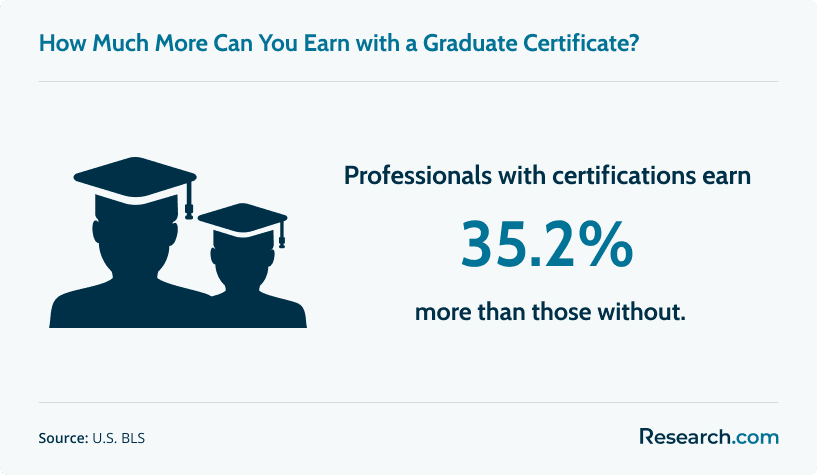
According to the U.S. Bureau of Labor Statistics, full-time wage and salary workers with a certification or license had median weekly earnings of $1,422 in 2024, while those without such credentials earned $1,081. This comparison does not mean every certificate causes a pay increase, but it does show that recognized credentials and licenses are often associated with higher earnings.
The salary value is usually strongest in fields where specialized knowledge can be applied immediately, such as cybersecurity, data analytics, healthcare, project management, and business operations. Career changers who are comparing lower-cost pathways may also want to examine options such as affordable online colleges with open admissions before choosing a higher-cost graduate option.
How quickly can I expect to see financial benefits after earning a graduate certificate?
Some professionals may see financial benefits soon after completing a graduate certificate, especially if the credential helps them qualify for a promotion, switch to a higher-demand field, or negotiate a stronger offer. Individuals can expect a salary increase ranging from 13% to 25% after earning a graduate certificate, and Northeastern University reports that graduates of its certificate programs often see a return on investment within a year.
The timing depends heavily on labor market demand. Cybersecurity, data analytics, and healthcare administration may reward specialized skills more quickly when employers have urgent hiring needs. In education, social services, and other structured pay environments, salary movement may take longer because raises are often tied to contracts, licensure steps, public pay scales, or years of service.
To estimate your likely return, compare the total cost of the program with realistic job postings, salary bands in your area, employer tuition support, promotion timelines, and whether credits can later count toward a degree.
Are there any challenges in leveraging a graduate certificate for career advancement?
Yes. A graduate certificate can be useful, but only when the credential matches your career target and is understood by employers. The biggest risk is enrolling in a program because it sounds impressive without confirming that it leads to the skills, eligibility, network, or hiring advantage you need.
| Common mistake | Why it can hurt your ROI | Better approach |
| Choosing a program without checking accreditation. | Employers, graduate schools, licensing boards, or certification bodies may not recognize it. | Verify institutional and, when relevant, programmatic accreditation before applying. |
| Focusing only on tuition. | Fees, books, software, exams, travel, and lost work time can change the real cost. | Calculate total attendance cost and ask about payment plans, aid, and employer reimbursement. |
| Assuming credits will transfer. | Some certificates do not apply toward a master’s degree, even at the same university. | Get transfer and stackability policies in writing. |
| Ignoring licensure rules. | A certificate may not meet state board or professional certification requirements. | Check requirements directly with the relevant licensing or certifying organization. |
| Choosing a broad certificate with no clear job target. | Employers may not see how the coursework connects to the role. | Select a program tied to specific job postings, tools, exams, or advancement criteria. |
| Relying only on rankings or brand name. | A highly visible school may still offer a program that does not fit your goals. | Review curriculum, outcomes, faculty, student support, career services, and employer relevance. |
Students who want to control cost while comparing program quality can start with affordable online graduate certificate programs, then narrow options based on accreditation, curriculum, faculty expertise, schedule, and career alignment.
Can a graduate certificate open doors to international job opportunities?
A graduate certificate can support international career opportunities when the skills are globally relevant and the credential is understandable across borders. Technology, analytics, business, project management, healthcare administration, and cybersecurity are examples of fields where skills may transfer more easily between employers and countries.
Certificates connected to digital skills can be especially useful because employers around the world use similar tools, platforms, and workflows. Students comparing technology-focused routes may review online IT training bootcamps alongside graduate certificates to decide whether they need academic credit, rapid skills training, or both.
For example, the global big data market was valued at $84 billion in 2024 and is projected to increase to $103 billion by 2027. In addition, a study of over 800,000 learners from developing countries found that sharing technology or business-related credentials on LinkedIn increased the chance of employment within a year by 6%, with an 8% rise in jobs related to their certificates.
Before relying on a certificate for international mobility, check whether employers in your target country recognize the institution, whether the credential translates clearly, whether work authorization is required, and whether the role has local licensing or professional registration rules.
Which accrediting organizations should students consider when choosing a graduate certificate program?
Accreditation is one of the most important quality checks for a graduate certificate. It helps confirm that the institution or program has gone through external review and meets recognized academic or professional standards. Accreditation can affect employer recognition, credit transfer, financial aid eligibility, licensure pathways, and admission into future graduate programs.
Students should first confirm institutional accreditation, then check whether the field requires programmatic accreditation. This is especially important in counseling, education, engineering, health information, business, and regulated healthcare fields.
- Western Association of Schools and Colleges (WASC) – Reviews institutional quality and effectiveness, primarily for higher education institutions in the western U.S.
- Middle States Commission on Higher Education (MSCHE) – Accredits degree-granting institutions in the Mid-Atlantic region and focuses on academic quality and institutional improvement.
- New England Commission of Higher Education (NECHE) – Evaluates colleges and universities in New England for institutional standards and educational quality.
- Southern Association of Colleges and Schools Commission on Colleges (SACSCOC) – Accredits higher education institutions in the southern U.S. and reviews accountability, quality, and institutional effectiveness.
- Higher Learning Commission (HLC) – Accredits degree-granting institutions in the central U.S. and emphasizes continuous improvement and educational effectiveness.
- Accreditation Council for Business Schools and Programs (ACBSP) – Reviews business-related programs, including management, finance, marketing, and related professional fields.
- Accreditation Board for Engineering and Technology (ABET) – Accredits programs in applied science, computing, engineering, and engineering technology.
- Council for Accreditation of Counseling and Related Educational Programs (CACREP) – Sets recognized standards for counseling education. Students seeking a lower-cost counseling pathway may compare affordable CACREP-accredited online master’s programs with certificate options.
Questions to ask before enrolling
- Is the institution accredited by a recognized accreditor?
- Does this field require programmatic accreditation, licensure approval, supervised practice, or a certification exam?
- Can the certificate credits transfer into a master’s degree later?
- What jobs do graduates typically pursue after completing the program?
- Does the curriculum include current tools, case studies, labs, fieldwork, or applied projects?
- Are faculty members active in the field they teach?
- What career services, employer partnerships, or alumni networks are available to certificate students?
- What is the total cost, including fees, books, software, exams, and travel?
- Will your employer reimburse part of the cost or recognize the credential for advancement?
What professionals say about their graduate certificates
-
: "The cybersecurity certificate pushed me to analyze systems from an attacker’s perspective. The work was demanding, but I was able to use vulnerability assessment techniques during a company network audit soon after. It gave me practical confidence in protecting our systems.
Milly"
-
: "The graduate certificate in project management helped me connect leadership concepts with real project execution. Applying Agile and Scrum methods improved our team’s workflow and supported my move into a management role within nine months.
Elaine"
-
: "The data analytics certificate changed how I solve workplace problems. I used SQL and Python on active projects, and my team recognized the impact during our quarterly review. The applied assignments made the learning immediately useful.
Miranda"
Key Insights
- A graduate certificate is most valuable when it is tied to a specific career outcome, not when it is chosen as a vague resume booster.
- The strongest fields for measurable benefits include cybersecurity, data analytics, project management, healthcare, business, education, and regulated professional areas where credentials matter.
- Cost and speed are major advantages. Many certificates take less than a year, and some take only a few months, often at a lower cost than a master’s degree.
- Salary gains are possible but not automatic. Outcomes depend on field demand, employer recognition, experience, location, and whether the credential qualifies you for higher-level work.
- Accreditation matters. Always verify institutional accreditation and any required programmatic accreditation before enrolling.
- Career changers should pair the certificate with proof of ability, such as projects, portfolios, supervised experience, labs, or measurable workplace results.
- Before choosing a program, confirm total cost, credit transfer rules, licensure alignment, employer recognition, and whether the curriculum reflects current industry tools and expectations.
References
- AIM Business School. Why a graduate certificate may be worth it. https://www.aimbusinessschool.edu.au/why-abs/blog/why-a-graduate-certificate-may-be-worth-it
- Arxiv. The impact of certifications on employment outcomes. https://arxiv.org/abs/2405.00247
- Coursera. Certified data professional: What it means and why it matters. https://www.coursera.org/articles/certified-data-professional
- Coursera. Cybersecurity salary and career insights. https://coursera.org/articles/cybersecurity-salary
- Harvard Extension School. The value of a graduate certificate. https://extension.harvard.edu/blog/the-value-of-a-graduate-certificate/#Why-Harvard-Extension-Students-Pursue-Certificates
- ISC2. Cybersecurity hiring trends study. https://www.isc2.org/Insights/2025/06/cybersecurity-hiring-trends-study
- LinkedIn Business. Are certificates taking students away from graduate-level programs? https://www.linkedin.com/business/marketing/blog/education/are-certificates-taking-students-away-from-graduate-level-program
- Northeastern University Graduate Programs. Graduate certificate value. https://graduate.northeastern.edu/knowledge-hub/graduate-certificate-value/
- U.S. Bureau of Labor Statistics. Professional certifications and occupational licenses. https://www.bls.gov/opub/mlr/2019/article/professional-certifications-and-occupational-licenses.htm
- U.S. Bureau of Labor Statistics. Data scientists. https://www.bls.gov/ooh/math/data-scientists.htm
- VerifyEd. Best professional certifications 2025. https://www.verifyed.io/blog/best-professional-certifications-2025
- The Wall Street Journal. More workers are getting job-skill certificates—they often don’t pay off. https://www.wsj.com/lifestyle/careers/more-workers-are-getting-job-skill-certificates-they-often-dont-pay-off-be49236f
Other Things You Should Know About Pursuing a Graduate Certificate for CURRENT_YEAR
In 2027, obtaining a graduate certificate can offer financial benefits by potentially increasing earning potential and providing a cost-effective alternative to a full degree. Many employers value specialized skills, which can lead to promotions and higher salaries, offering a return on investment for the certificate holder.
In 2027, a graduate certificate can boost professional growth by equipping individuals with specialized skills that enhance their expertise and appeal to employers. It often serves as a stepping-stone to advanced roles, providing industry-relevant knowledge and credentials that are increasingly valued in competitive job markets.
In 2027, obtaining a graduate certificate enhances career prospects by offering focused skill sets that align with industry demands. This credential validates specialized knowledge, making professionals more competitive in the job market. Moreover, the flexibility and speed of these programs allow for a swift adjustment to evolving career trends.








