
2027 What is the Difference Between a Major and a Degree (and Minors & Electives)?

Co-Founder and Chief Data Scientist
Choosing a college program usually starts with two terms that sound similar but do different jobs: degree and major. A degree is the credential a college awards, such as a Bachelor of Arts or Bachelor of Science. A major is the subject area you specialize in while earning that credential, such as biology, accounting, civil engineering, or psychology.
This distinction matters because it affects your course plan, graduation timeline, transfer options, financial aid eligibility, graduate school preparation, and career direction. If you are comparing types of college degrees, deciding whether to enter college undeclared, or trying to connect academics with your career exploration, this guide explains how degrees and majors work together and how to make a more informed choice.
- Key Differences Between a Major and a Degree for 2027
- What is a major in college?
- Example of a Degree Plan for Bachelor of Science
- Can you have a degree without a major?
- Why is it important to declare a major?
- How can choosing a double major or dual degree program benefit your career?
- How do minors and electives complement your major and degree?
- Could a one year masters program accelerate your career advancement?
- How can an accelerated bachelor's degree online enhance career outcomes?
- How do tuition affordability and financial aid options support your accelerated academic journey?
- How do internships and experiential learning opportunities shape your career success?
- How do accelerated online degree programs impact long-term career success?
- Exploring Alternative Pathways: Fast-Track and Online Degree Options
- How do military-friendly support systems enhance online education?
- How does accreditation influence your educational and career success?
- What role do short-term online programs play in enhancing career opportunities?
- How do online colleges impact your choice of major?
Quick Answer: Degree vs. Major
A degree is the academic credential you earn after completing a required program of study. A major is the main subject you study within that degree program. For example, a student may earn a Bachelor of Science degree with a major in biology, or a Bachelor of Arts degree with a major in English.
In most bachelor’s programs, students complete general education courses, major courses, electives, and sometimes a minor. The major shapes the specialized coursework, while the degree represents the completed credential awarded by the institution.
| Question | Direct Answer |
| Is a major the same as a degree? | No. The degree is the credential; the major is the area of specialization inside that credential. |
| Can two students have the same major but different degrees? | Yes. One student may earn a B.A. in psychology while another earns a B.S. in psychology, depending on the curriculum. |
| When do students usually declare a major? | Many students declare before the start of the junior year or by the end of the sophomore year, though policies vary by institution. |
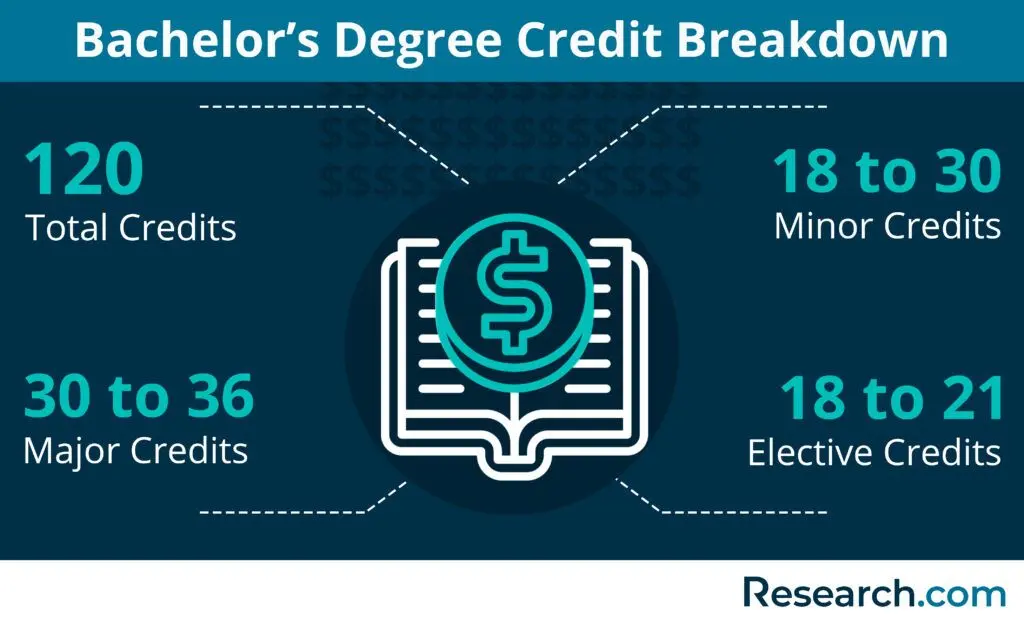
| How many credits are usually required for a bachelor’s degree? | It usually takes 120 credits to earn a bachelor's degree. |
| How many credits are usually in the major? | Major coursework credit requirements are 30 to 36 credit hours of the 120 total credits required to graduate. |
Key Differences Between a Major and a Degree for 2027
The simplest way to understand the relationship is this: your degree is the qualification printed on your diploma, while your major explains what you concentrated on academically. If you are asking what is bachelor’s degree, the answer is that it is an undergraduate academic credential awarded after a student completes a structured program of college-level coursework.
A major gives that degree its subject focus. For example, a student may complete a Bachelor of Science in Engineering with a major in civil engineering. In that title, “Bachelor of Science” identifies the degree type, “engineering” identifies the broad academic field, and “civil engineering” identifies the specialization.
Common undergraduate degree titles include:
- Bachelor of Fine Arts (B.F.A.)
- Bachelor of Engineering (B.Eng.)
- Bachelor of Philosophy (B.Phil.)
- Bachelor of Science in Nursing (B.S.N.)
- Bachelor of Science in Business Administration (B.S.B.A.)
- Bachelor of Architecture (B.Arch.)
- Bachelor of Science in Public Affairs (B.S.P.A.)
- Bachelor of Social Work (B.S.W.)
Major vs. Degree: Practical Comparison
| Aspect | Degree | Major |
| Status | An academic rank or credential awarded by a college or university after degree requirements are completed. | The student’s primary field of concentration within the broader degree program. |
| Credits | It usually takes 120 credits to earn a bachelor's degree. These include general education, elective, and non-major requirements. | Major coursework credit requirements are 30 to 36 credit hours of the 120 total credits required to graduate. |
| Types | Degree levels include associate's, bachelor's, master's, and a Ph.D., among others. | Majors are subject areas inside a degree. Some institutions also allow students to design individualized majors. |
| Focus | The degree includes the full academic package: general education, major courses, electives, and, in some programs, a minor or secondary specialization. | The major is the focused course sequence that builds knowledge and skills in one academic discipline or professional area. |
| Time of Completion | A bachelor's degree usually takes four to five years to complete. The first two years are normally spent taking general education and preparatory classes. | One often declares a major during the junior or senior year. It is during this stage that coursework becomes more specialized. |
| Dependency | The degree title is shaped by the student’s approved program and major requirements. | Completing the major is one of the central requirements for earning the degree. |
Degree titles vary by institution. A field such as engineering, psychology, economics, or computer science may be offered as a B.A., B.S., or another degree type depending on the curriculum. In general, programs with more liberal arts coursework often lead to a Bachelor of Arts, while programs with more science, laboratory, mathematics, or technical coursework often lead to a Bachelor of Science. Specialized fields may award specialized degrees.
The Formal Structure of a Bachelor’s Degree
A bachelor’s degree is usually built from several requirement categories. In the United States, full-time students commonly take 12 to 18 credits each semester, while part-time students take fewer than 12. A typical bachelor’s plan includes general education, major courses, electives, and sometimes a minor.
Associate degrees are shorter. For example, students asking how many years is cosmetology school may find that associate-level programs often take two years, about half the time commonly associated with a four-year bachelor’s degree.
General Education: 60 Credits
General education courses often account for about half of a bachelor’s curriculum, or 60 credits. These courses introduce students to the natural sciences, social sciences, humanities, writing, quantitative reasoning, and civic or global issues. They are designed to build skills that apply across majors, including research, communication, analysis, and critical thinking.
General education can also help students test possible majors before committing. A biology course may point a student toward health sciences, while an introductory economics or writing course may reveal interest in business, policy, journalism, or communication.
The mix of general education courses depends on the institution and degree. Liberal arts programs may spread credits broadly across disciplines, while engineering, nursing, and other structured programs may require more mathematics, laboratory science, or prerequisite coursework. Online courses are also commonly delivered through platforms and learning management systems for education, so students comparing online and campus programs should understand how courses are taught as well as what they cover.
Major Requirements: 30 to 36 Credits
The major is the core academic specialization. A business student may complete courses in marketing, business communications, accounting, and business ethics. A student reviewing economics degree requirements may find coursework in microeconomics, macroeconomics, statistics, and econometrics. A computer science major may study artificial intelligence, data management, operating systems, programming, and theory. Students comparing technical fields may also ask, is computer science harder than engineering? The answer depends on the student’s strengths, interests, and the specific curriculum.
Major courses move students from introductory understanding to deeper disciplinary knowledge. They are usually more sequenced than electives, meaning prerequisites matter. Skipping or delaying an early required course can postpone later courses and affect graduation timing.
To earn a major, one typically has to complete 12 specialized classes, with most earning them three credit hours. This sums up to 36 credit hours.
Most students choose a major by their junior year, after finishing general coursework requirements. During the senior year, requirements may include advanced seminars, internships, capstone projects, research assignments, or a thesis.
Minor Requirements: 18 to 30 Credits
A minor is a secondary academic focus. Some colleges require one; others make it optional. A minor usually requires fewer courses than a major and can either support the major directly or broaden the student’s preparation.
For example, a student might earn a Bachelor of Science in Business Administration with a major in marketing management and a minor in economics. That combination signals primary preparation in marketing with additional coursework in economic analysis.
To complete a minor, one has to take 18 to 30 credit hours of classes.
Electives: 18 to 21 Credits
Electives are courses that count toward graduation but are not always tied to the major. They give students room to explore interests, build practical skills, complete prerequisites for graduate study, or add career-relevant knowledge.
Examples may include physical education, art history, foreign languages, writing, business, statistics, or technology courses. Used strategically, electives can strengthen a resume rather than simply fill remaining credits.
What is a major in college?
A college major is the main subject area an undergraduate student formally chooses as their academic focus. The major determines the required upper-level coursework, the department that advises the student, and often the academic preparation expected for certain careers or graduate programs.
Students may enter college as undeclared, but most institutions expect them to select an approved major within a specific timeframe. In the U.S., majors are often declared before the start of the junior year or the end of the sophomore year, after students complete many general education requirements.
A major is essentially a planned sequence of courses in one field. An accounting major may take financial accounting, tax accounting, managerial accounting, and business information systems. A biology major may take general biology, insect biology, biochemistry, computational biology, and related laboratory courses. These requirements are not random; they are designed to build competence step by step.
Some colleges offer broad majors such as liberal arts or general studies. Others allow students to create individualized majors, usually with faculty approval and a clear academic rationale. These options can be useful for interdisciplinary goals, but students should ask how the major will be understood by graduate schools, licensing bodies, and employers.
Difference Between a Major and a Minor
A major and a minor are both organized areas of study, but they serve different purposes. The major is the primary specialization and usually requires 30 to 36 credits. The minor is secondary and usually requires around 18 to 30 credits.
A minor can deepen the major, such as pairing biology with chemistry, or broaden it, such as pairing engineering with business management. The best choice depends on the student’s goals. A minor should not delay graduation unless the added time and cost are clearly justified.
| Choice | Best Used For | Watch Out For |
| Related minor | Strengthening the major with complementary skills, such as psychology with marketing or statistics with economics. | Repeating similar content without adding a distinct advantage. |
| Unrelated minor | Showing range, pursuing a serious interest, or preparing for interdisciplinary work. | Taking extra courses that do not support academic, career, or personal goals. |
| No minor | Graduating on time, focusing on major depth, or using electives for prerequisites and practical skills. | Missing a chance to organize electives into a recognizable secondary credential. |
How College Courses Are Numbered
Course numbers often signal difficulty, sequencing, and student level. Numbering systems differ by college, but many institutions follow a pattern similar to the one below.
100-level. These are introductory courses. They often include words such as “general,” “basic,” or “fundamental.” Examples include CHEM101 for General Chemistry, English 100 for Basic Writing, and ART-101 for Fundamentals of Art. Many first-year students take these courses, and they often have no prerequisites.
200-level. These courses usually move beyond basic survey material and may require prerequisites. Biology 202, for example, may focus on Human Anatomy and Physiology after a general biology course. These classes often prepare students for upper-division study.
300-level. These are typically advanced undergraduate courses taken by juniors and seniors. They often require previous coursework and may expect more independent reading, research, writing, or applied work.
400-level. These courses are usually highly specialized and may include seminars, tutorials, capstones, senior projects, or advanced research assignments. They are commonly taken near the end of the major.
What kinds of majors are there?
Majors are offered across many academic areas, including natural sciences, formal sciences, social sciences, applied sciences, humanities, and the arts. Categories overlap, and different colleges may classify the same major differently. The examples below show how broad the range can be.
Natural Sciences
Natural science majors study the physical world and living systems through observation, measurement, experimentation, and theory-building. These fields often involve laboratory work, quantitative reasoning, and preparation for research, health, environmental, or technical careers.
- Physics (B.A./B.S.)
- Philosophy and Physics (B.A.)
- Earth Sciences (B.S.)
- Astronomy (B.S.)
- Chemistry (B.A./B.S.)
- Biophysics (B.S.)
- Biological Sciences (B.A./B.S.)
- Human Biology (B.A./B.S.)
- Neuroscience (B.A./B.S.)
Formal Sciences
Formal science majors study abstract systems, logic, computation, mathematical structures, and statistical reasoning. These fields support modeling and analysis in science, technology, business, social research, and public policy.
- Mathematics (B.A./B.S.)
- Statistics (B.A./B.S.)
- Logic and Computation (B.S.)
- Computer Science (B.A./B.S.)
Social Sciences
Social science majors examine human behavior, institutions, communication, economies, communities, and societies. Many combine theory with quantitative or qualitative research methods.
- Psychology (B.A./B.S.)
- Sociology (B.A./B.S.)
- Economics (B.A./B.S.)
- Global Studies (B.S.)
- Communication (B.A./B.S.)
- Journalism (B.A.)
- Linguistics (B.A.)
- Cognitive Science (B.A./B.S.)
Applied Sciences
Applied science majors use scientific, technical, business, or professional knowledge to solve practical problems. These programs may lead to roles in engineering, healthcare, data, technology, education, business, or operations.
- Agriculture (B.S.)
- Health and Medical Sciences (B.S.)
- Medical Laboratory Sciences (B.A./B.S.)
- Medicine (B.S.)
- Civil Engineering (B.S.)
- Chemical Engineering (B.S.)
- Mechanical Engineering (B.S.)
- Electrical Engineering (B.S.)
- Industrial Engineering (B.S.)
- Computer Engineering (B.S.)
- Biomedical Engineering (B.S.)
- Environmental Engineering (B.S.)
- Aerospace Engineering (B.S.)
- Computer Engineering and Computer Science (B.S.)
- Data Science (B.A./B.S.)
- Information Technology (B.S.)
- Information and Communications Technology (B.S.)
- Accounting (B.A./B.S.)
- Marketing Management (B.S.)
- Marketing and Sales (B.S.)
- Professional Sales (B.S.)
- Finance (B.A./B.S.)
- Hospitality Management (B.S.)
- Sports Management (B.S.)
- Business Administration (B.A./B.S.)
- Business Analytics (B.S.)
- Elementary Education (B.A./B.S.)
Humanities
Humanities majors study culture, language, history, interpretation, values, texts, and human meaning. Many emphasize writing, argument, research, ethics, and close analysis.
- Anthropology (B.A./B.S.)
- Archaeology (B.A./B.S.)
- Ethnic Studies (B.A.)
- English (B.A.)
- Literature (B.A.)
- Linguistics (B.A.)
- Philosophy (B.A.)
- History (B.A.)
- Religious Studies (B.A.)
Arts
Arts majors combine creative production, technique, critique, technology, and aesthetic theory. Depending on the program, students may build portfolios, perform, produce films or media, or complete studio-based projects.
- Art (B.A.)
- Fine Arts (B.F.A.)
- Painting (B.F.A.)
- Music Composition (B.M.)
- Music Instrumental Performance (B.M.)
- Game Art (B.F.A.)
- Film (B.F.A)
- Dance (B.F.A.)
- Animation (B.F.A.)
- Photography (B.F.A./B.A.)
- Screenwriting (B.F.A.)
Why Students Choose Certain Majors
Students choose majors for many reasons: career plans, expected earnings, family expectations, academic strengths, cultural background, personal identity, and interest in a subject. A United States survey showed that 30% of college students considering the debt that they will have significantly affected the choice of their major. A very significant 88% believed that their majors will get them a job, while 87% planned to get a job in the field that they were majoring in.
Research by Keshishian and colleagues in the American Journal of Pharmaceutical Education also found that students’ “self-reported racial/ethnic backgrounds influence their decision of whether to choose pharmacy as their academic major.” They reported that “African-American and Hispanic students were less likely to choose pharmacy as a major than Caucasians, whereas Asian-Americans were more likely to choose pharmacy as a major. Pharmacy students were more likely to be interested in science and math than nonpharmacy students.”
The practical lesson is that choosing a major is rarely based on one factor. A strong decision usually balances interest, ability, cost, time to completion, job preparation, family realities, and long-term flexibility.
Example of a Degree Plan for Bachelor of Science
A degree plan shows how all requirements fit together. The example below uses a Bachelor of Science in Biology program at the University of Houston-Victoria. It illustrates how general education, major requirements, labs, electives, and upper-division coursework combine into a full bachelor’s pathway.
General Education / Core Curriculum Requirements
Core curriculum courses introduce students to essential college-level skills and disciplines. In some cases, a core course also satisfies part of a major requirement, which can help students use credits efficiently.
| Area | Courses | Credits |
| Communication | ENGL 1301 ENGL 1302 | 6 credits |
| Mathematics | MATH 1314 - College Math or Higher | 3 credits |
| Life and Physical Sciences | Natural Science - May take BIOL 1306/1106 to meet Program Requirements Natural Science - May take BIOL 1307/1107 to meet Program Requirements | 6 credits |
| Language, Philosophy, & Culture | Humanities, Literature, PHIL, Modern or Classical Lit. | 3 credits |
| Creative Arts | ARTS, MUSI, or DRAM | 3 credits |
| American History | HIST 1301 HIST 1302 | 6 credits |
| Political Science | PSCI 2305 PSCI 2306 | 6 credits |
| Social/Behavioral Sciences | Anthropology, Criminal Justice, Economics, Geography, Political Science, Psychology or Sociology | 3 credits |
| Institutionally Designated Option | SPCH 1311, 1315, 1318, or 1321 COSC or BCIS | 6 credits |
Major Requirements
Major requirements are the courses most directly tied to the student’s field. Lower-division courses are generally taken earlier and often serve as prerequisites. Upper-division courses are more advanced and usually taken by juniors and seniors.
| Levels | Courses | Credits |
| BS General Program Requirements | ENGL 3430 - Professional Writing SPCH 1311, 1315, 1318, or 1321 (CORE) COSC 1301 or 1401, or BCIS 1305 (CORE) | 4 credits |
| Major Program Requirements - (Lower Division) | BIOL 1306/1106 - Biology I for Science Majors w/ lab (CORE) BIOL 1307/1107 - Biology II for Science Majors w/ lab (CORE) CHEM 1311/1111 - General Inorganic Chemistry I w/ lab CHEM 1312/1112 - General Inorganic Chemistry II w/ lab BIOL 2320/2120 - Microbiology w/ lab PHYS 1301/1101 - College Physics (must include lab MATH 2312 - Pre-Calculus MATH 2413 Calculus I CHEM 2323/2123 - Organic Chemistry I (must include lab) CHEM 2325/2125 or PHYS 1302/1102 - Organic Chemistry II or College Physics II (must include labs) | 31 credits |
| Major Program Requirements (Upper Division) | MATH 3391 - Probability & Statistics BIOL 4310 - Biochemistry BIOL 4313 - Genetics BIOL 3332 Research Methods (Fall Only) BIOL 4203 Biology Seminar (Spring Only) May select 4 courses from the Human concentration OR 4 courses from the Environmental concentration Human, select 4 from: BIOL 3330, 3322, 3343, 4303, 4337 OR Environment, select 4 from: BIOL 4335, 3326, 4337, 3340, 3300 BIOL Lecture BIOL Lecture BIOL Lecture BIOL Lecture | 26 credits |
| BIOL UD Laboratory Requirement | BIOL Lab BIOL Lab BIOL Lab BIOL Lab Students must complete a minimum of 4 credits of UD BIOL 31XX or 41XX Labs. Concurrent enrollment in the lecture is required. Deviation requires advisement. | 4 credits |
Electives/Minor Requirements
Electives help students complete credit requirements and customize their education. Some students use them for a minor, while others use them for prerequisites, technical skills, writing, research, or career exploration.
| Level | Courses | Credits |
| Upper Division Free Electives | Upper Division Electives | 2 credits |
| Lower Division / Upper Division Free Electives | Lower Division / Uppder Division Electives Lower Division / Uppder Division Electives Lower Division / Uppder Division Electives Lower Division / Uppder Division Electives | 12 credits |
Can you have a degree without a major?
In most traditional bachelor’s programs, no. A student usually cannot earn a bachelor’s degree without completing an approved major or an approved equivalent such as general studies, liberal studies, or an individualized program. The major is one of the main structures that tells the institution which advanced courses must be completed before graduation.
Policies vary. Some colleges allow students to declare early, while others allow exploration before requiring a decision. Common declaration points include after the third semester, the first semester of the sophomore year, the end of the sophomore year, or before the junior year.
In the United States, before the COVID-19 pandemic, the most popular bachelor’s degree by field of research is in business with 391,375 degrees awarded 4 years ago (National Center for Education Statistics, 2024). The second is the health professions and related program field with 263,820 conferred degrees. The least popular degrees are in precision production (38), library science (119), and military technologies and applied sciences.
Why is it important to declare a major?
Declaring a major matters because it moves a student from general exploration into an official academic plan. Without a declared major, students may not be able to register for upper-division courses, receive department advising, stay on track for graduation, or maintain certain forms of financial aid.
Some institutions impose academic consequences when students miss declaration deadlines. For example, the University of Rochester reclassifies juniors who remain undeclared to sophomore standing. That kind of delay can affect course access and graduation timing.
Financial aid can also be affected. Students who accumulate credits without progressing toward an approved program may face aid limits or additional debt. For this reason, undeclared students should meet with advisors early and use first-year and sophomore-year courses to test realistic options.
Major choice can also influence career options and earnings, although it does not guarantee a specific salary or job. Patnaik and colleagues showed that when it comes to the mean and median salaries of people aged 25 to 34, those who have STEM-related majors earn more than their counterparts. Those who have social sciences, humanities, and education degrees have the lowest in this regard. STEM degree holders earn 25% to 30% more than those who have degrees in the social sciences, humanities, and education. Those who graduated with degrees related to economics and business are in the middle of the pack. Those who did not graduate or just had some college education earned 40% to 45% lower than graduates with social sciences, humanities, and education degrees.
Earnings and Employment Status by Major Categories
| Major Category | Labor Force Participation | Unemployment Rate | Mean Earnings | Median Earnings |
| Business / Economics | 91.51% | 2.65% | $6,650 | $5,840 |
| STEM | 89.69% | 2.47% | $7,150 | $6,490 |
| Humanities / Social Sciences / Education | 89.89% | 2.86% | $5,620 | $4,810 |
| Some College (No Grad) | 84.29% | 5.48% | $4,020 | $3,510 |
How can choosing a double major or dual degree program benefit your career?
A double major or dual degree can be valuable when the two fields support a clear academic or career goal. The terms are not identical. A double major usually means one degree with two approved majors. A dual degree usually means completing requirements for two separate degrees, which can require more credits and more planning.
| Option | What It Usually Means | When It Makes Sense | Main Risk |
| Double major | One degree program with two major fields. | You want a combined skill set, such as business and computer science, economics and statistics, or biology and psychology. | Extra requirements may limit electives or delay graduation. |
| Dual degree | Two degree programs completed together or in sequence. | You need two distinct credentials for academic, professional, or interdisciplinary goals. | More credits, scheduling complexity, and higher total cost. |
| Major plus minor | One major with a smaller secondary specialization. | You want breadth without the heavier load of a second major. | The minor may be too small to substitute for deeper preparation. |
The strongest reasons to choose a double major or dual degree include broader skill development, access to more than one academic network, flexibility across related career paths, and stronger preparation for interdisciplinary work. The weakest reason is simply wanting the credential to look impressive. Before committing, ask whether the added credits improve your goals enough to justify the time and cost.
How do minors and electives complement your major and degree?
Minors and electives help shape the degree beyond the major. A student majoring in marketing might add a psychology minor to better understand consumer behavior. An engineering student might use electives in business management to prepare for team leadership. A future graduate student might use electives to complete prerequisites.
Students trying to finish efficiently should map these choices early. If speed is a priority, compare how many elective credits are available and whether transfer credits can apply. Some students may also consider fastest bachelor’s degree programs, especially when they already have prior credits.
Could a one year masters program accelerate your career advancement?
A one-year master’s program may help students who already know their career target and need advanced coursework quickly. These programs are often intensive, so they work best for learners who can handle a compressed schedule and who have confirmed that the credential is valued in their field. If graduate study is part of your long-term plan, compare curriculum, accreditation, admissions requirements, employer relevance, and cost before choosing a one year masters option.
How can an accelerated bachelor's degree online enhance career outcomes?
Accelerated online bachelor’s programs can help students finish sooner when they have transfer credits, strong time management, or a clear professional goal. The benefit is not automatic. The program still needs to be accredited, appropriately rigorous, affordable, and aligned with the student’s target field. Students comparing an accelerated bachelors degree online accredited should confirm credit transfer rules, weekly workload, faculty support, and whether the major has in-person labs, clinicals, fieldwork, or proctored exams.
How do tuition affordability and financial aid options support your accelerated academic journey?
Accelerated study can reduce time in school, but it does not always reduce total cost. Students should compare tuition, fees, transfer credit acceptance, book and technology costs, required campus visits, and financial aid eligibility. An accelerated associates degree may be a practical starting point for students who want a shorter, lower-cost credential before transferring into a bachelor’s program or entering the workforce.
How do internships and experiential learning opportunities shape your career success?
Internships, clinicals, labs, practicums, portfolios, capstones, and project-based courses help students connect classroom learning with workplace expectations. These experiences can clarify whether a major fits and can also provide material for resumes, interviews, and graduate school applications.
Students with cost concerns may compare options that combine foundational coursework with practical preparation, including a cheap associates degree online. The key is to verify that the program’s credits, support services, and experiential requirements match the student’s next step.
How do accelerated online degree programs impact long-term career success?
Accelerated online degree programs can support long-term career goals when they help students earn a respected credential without unnecessary delay. However, students should not choose speed alone. Review accreditation, curriculum quality, faculty access, career services, graduate outcomes, transfer policies, and whether the format fits your learning style. A comparison of accelerated online degree programs can help identify options, but students should still verify details with each school.
Choosing the Right Major: Important Considerations
Choosing a major is not only an academic decision. It is also a cost, time, career, and lifestyle decision. The best major for one student may be a poor fit for another, even if both programs are respected.
Start with your interests and strengths, but do not stop there. A major should also be tested against course requirements, job pathways, graduate school expectations, licensure rules, and the amount of debt you may need to take on. Students comparing what degree to take should connect the degree title, major requirements, and realistic post-graduation options.
International students and students considering work across borders should also check where the major is recognized and where job demand exists. Given the large number of foreign students working in the US, employment rules, visa limitations, and country-specific labor markets may affect the value of a major.
Major choice also shapes how you contribute to organizations, communities, and fields of knowledge. That does not mean every student must choose the highest-paying field. It means students should understand the trade-offs before committing.
Questions to Ask Before Choosing a Major
| Question | Why It Matters |
| Which courses are required, and in what sequence? | Some majors have strict prerequisites that can delay graduation if taken out of order. |
| Does the major require labs, clinicals, fieldwork, internships, or a portfolio? | These requirements affect scheduling, location, transportation, and time commitment. |
| What careers or graduate programs commonly follow this major? | A major may be broad, career-specific, or mainly preparatory for graduate study. |
| Will this major meet licensure or certification requirements? | Some careers require specific accredited programs, exams, or supervised experience. |
| How much will the full degree cost after transfer credits and financial aid? | Tuition alone does not show the total investment. |
| Can I change majors without losing too many credits? | Switching from one structured major to another can add time if requirements do not overlap. |
Exploring Alternative Pathways: Fast-Track and Online Degree Options
Not every student follows a traditional four-year, campus-based route. Online, hybrid, accelerated, transfer-friendly, and short-term programs can be useful for working adults, parents, military learners, career changers, and students trying to reduce time to completion.
- Accelerated learning opportunities. Fast-track programs compress coursework or allow year-round study. They are best for students with clear goals, strong study habits, and, often, prior college credits.
- Cost-conscious planning. Online programs may reduce costs related to commuting or housing, but students still need to compare tuition, fees, books, technology, and credit-transfer policies. If career return is a priority, reviewing easiest online degrees that pay well can help students think about both workload and outcomes.
- Flexibility for nontraditional learners. Asynchronous online courses can help students balance school with work or family responsibilities, but they require discipline and reliable technology.
- Broader program access. Online study may give students access to majors not available locally, but some fields still require in-person labs, clinicals, student teaching, or field placements.
How do military-friendly support systems enhance online education?
Military-connected students often need flexible scheduling, transfer credit review, benefits guidance, deployment-related support, and career services that understand military experience. Programs at military friendly online colleges may help service members and veterans connect prior learning, leadership skills, and academic goals. Students should still verify accreditation, benefit eligibility, and how military credits apply to the chosen major.
How does accreditation influence your educational and career success?
Accreditation is one of the most important checks when comparing colleges and majors. It can affect credit transfer, federal financial aid eligibility, graduate school admission, employer recognition, and licensure pathways. Specialized accreditation may also matter in fields such as nursing, education, engineering, business, and health professions.
Students comparing an online college for military learners should confirm both institutional accreditation and any program-specific accreditation required for their career goal.
What role do short-term online programs play in enhancing career opportunities?
Short-term online programs can be useful for targeted skill-building, career entry, or completing a stepping-stone credential. They are not always substitutes for a full bachelor’s degree, but they may help students test a field, qualify for entry-level roles, or build momentum toward a longer program. Students considering 6-month associate degree programs online should verify the schedule, accreditation, credit transferability, employer relevance, and whether the timeline is realistic for their circumstances.
How do online colleges impact your choice of major?
Online accredited colleges can expand the range of majors available to students who cannot relocate or attend campus full time. They may also make it easier to study while working. However, the right online major depends on more than convenience.
- Program availability. Online colleges may offer majors in business, computer science, health, education, and other fields, but not every specialization is available online.
- Learning format. Some majors fit online delivery better than others. Lab-heavy, clinical, studio, or licensure programs may require in-person components.
- Support services. Academic advising, tutoring, career counseling, library access, and technical support can strongly affect online student success.
- Cost and transfer credits. Online students should compare total cost, not just tuition, and ask how prior credits apply to the major.
- Licensure and location rules. Students entering regulated fields should confirm that the program meets requirements in the state where they plan to work.
Common Mistakes When Comparing Degrees and Majors
- Assuming the degree title tells the whole story. A B.A. and B.S. in the same major may have different math, science, language, or research requirements.
- Choosing a major only by salary expectations. Earnings data can be useful, but outcomes vary by school, location, experience, internships, graduate education, and industry.
- Ignoring accreditation. An unaccredited or poorly matched program can create problems for transfer, financial aid, licensure, and employment.
- Waiting too long to declare. Delayed declaration can limit access to major courses and slow progress toward graduation.
- Overloading on majors, minors, and certificates. Extra credentials are helpful only when they support a clear goal and do not add unnecessary cost or time.
- Focusing only on tuition. Fees, books, housing, commuting, technology, lost work time, and delayed graduation can change the real cost.
- Assuming all online programs work for all careers. Some online degrees require in-person components or may not satisfy licensure requirements in every state.
How to Choose a Major Step by Step
- List your strongest interests and skills. Include subjects you enjoy, tasks you do well, and problems you want to solve.
- Review required courses. Do not choose a major based only on its title. Look at the actual degree plan.
- Check career and graduate school pathways. Identify common roles, required credentials, and whether further education is expected.
- Compare total cost and time to completion. Include transfer credits, prerequisites, course sequencing, and financial aid rules.
- Talk with advisors and faculty. Ask which courses students struggle with, when to declare, and how to stay on track.
- Use electives strategically. Explore possible majors early, then use later electives for career skills, prerequisites, or a minor.
- Test the field outside class. Seek internships, job shadowing, undergraduate research, volunteer work, or project-based experience.
- Reassess before switching. If you change majors, ask how many credits will still count and whether the new path affects aid or graduation timing.
Key Insights
- A degree and a major are related but not the same. The degree is the credential awarded by the institution; the major is the main field of study within that credential.
- Most bachelor’s degrees require several parts. A typical plan includes 120 credits, with general education, 30 to 36 credits in the major, electives, and sometimes a minor.
- Declaring a major affects progress. Students who wait too long may face advising problems, course access limits, financial aid complications, or delayed graduation.
- The right major balances interest and practicality. Students should consider strengths, required courses, career pathways, cost, time to completion, and graduate or licensure requirements.
- Minors and electives should be intentional. They work best when they add useful skills, support the major, complete prerequisites, or broaden career options without unnecessary delay.
- Double majors and dual degrees require careful planning. They can expand opportunities, but only when the added workload and cost serve a clear academic or professional purpose.
- Online and accelerated options can help, but speed is not enough. Accreditation, transferability, support services, and career alignment matter as much as convenience.
- Always read the degree plan. The most reliable way to understand a major is to examine the required courses, prerequisites, credit totals, and experiential requirements before enrolling.
References:
- CollegeData. (2025). Transition to College: 13 thihngs students say about it. https://www.collegedata.com/resources/transition-to-college/transition-to-college-survey-results
- Eisenberg, D., Lipson, S. K., Heinze, J., & Zhou, S. (2025). The Healthy Minds Study 2024-2025. The Healthy Minds Network. https://healthymindsnetwork.org/wp-content/uploads/2025/09/2024-2025_HMS-National-Data-Report_Student.pdf
- Ma, J., Pender, M., & Hu, X. (2025). Trends in College Pricing and Student Aid 2025. College Board. https://research.collegeboard.org/media/pdf/Trends-in-College-Pricing-and-Student-Aid-2025-final_1.pdf
- National Society of High School Scholars. (2025, July). Teen Trends Survey. https://www.nshss.org/media/iwwdrktq/nshss-2025-teen-trends-survey-final.pdf
- U.S. Bureau of Labor Statistics. (2025, August 28). Fastest Growing Occupations. Occupational Outlook Handbook. https://www.bls.gov/ooh/fastest-growing.htm
Other Things You Should Know About Majors, Degrees, Minors, and Electives
No, earning a degree without declaring a major is generally not possible, as a major is required to complete the degree requirements.
In 2027, a major represents a student's primary field of study, requiring an in-depth focus on specific courses within a discipline. A degree, however, is the credential granted upon completion of general and major-specific requirements, reflecting a broad educational accomplishment across various subjects, including electives and potential minors.
Most universities in 2027 require students to declare their major by the end of their sophomore year. This timeline allows students to explore various courses and fields of study before committing to a specific academic path. It ensures that they can meet all coursework requirements for timely graduation.
Choosing the right major is important as it influences future career opportunities, financial stability, and personal satisfaction in one's professional life.
Minors are secondary areas of specialization requiring fewer credits than majors. While a major is the primary focus of study, a minor complements the major and broadens a student's knowledge and skills.
Students should consider their intellectual interests, career prospects, financial stability, and work-life balance when choosing a major.
Course levels, indicated by numbers, range from introductory (100-level) to advanced (400-level). Higher-level courses are more specialized and often require prerequisites.
Some institutions allow students to create their own majors, offering greater academic freedom to study a specific field in depth or a broad range of topics across disciplines.


