
2027 Fastest Accelerated Associate Degrees

Co-Founder and Chief Data Scientist
Accelerated associate degrees are built for students who want a recognized college credential without spending the usual two years in school. They can be useful if you need to qualify for an entry-level job, change careers quickly, transfer into a bachelor’s program, or improve your earning potential while keeping tuition and time in school under control.
The decision is not simply “fast or traditional.” The right program depends on your career goal, transfer plans, budget, schedule, accreditation needs, and whether the field requires licensing or supervised clinical experience. This guide explains how accelerated associate degrees work, which fast-track fields are worth considering for 2027, what they cost, how employers view them, and how to choose a program that will actually help you move forward.
Quick Answer: Are Accelerated Associate Degrees Worth It?
An accelerated associate degree can be worth it if the program is accredited, fits your career goal, and allows you to complete required coursework in 12 to 18 months without sacrificing licensing, transferability, or hands-on training. These programs are most useful for motivated students who can handle compressed terms, year-round coursework, and a heavier weekly workload.
| Key question | Direct answer |
| How long does it take? | Accelerated associate degrees typically take 12 to 18 months to complete. |
| How much can it cost? | The average cost of these programs ranges from $5,000 to $30,000. |
| Do associate degree graduates earn more? | The BLS reported that workers with associate degrees earned $1,058 per week compared with $899 for workers with only a high school diploma. |
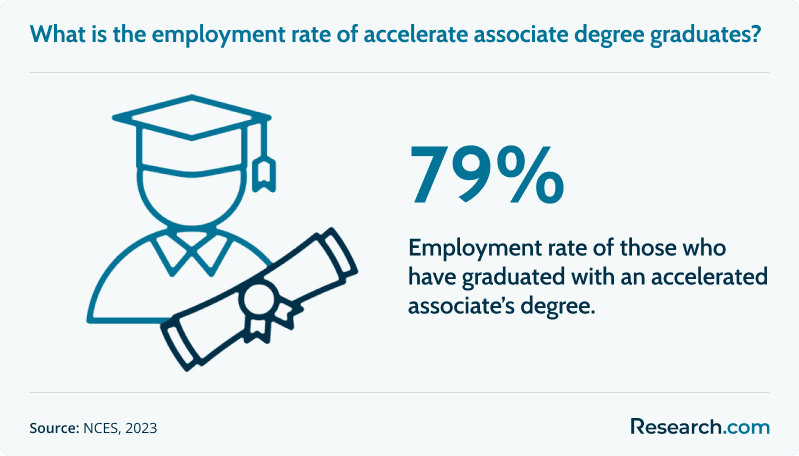
| Do employers accept accelerated degrees? | Yes, when the school is properly accredited and the program teaches job-relevant skills. Graduates with accelerated associate degrees have an employment rate of 79%. |
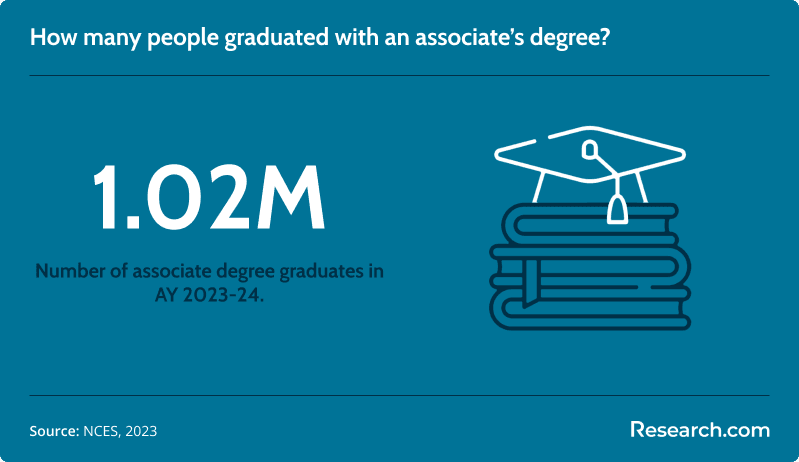
| How common are associate degrees? | In the 2023-24 academic year, 1.02 million associate degrees were granted. |
| Which field accounts for the largest share? | Liberal Arts and Sciences, General Studies, and Humanities accounted for 39% of all associate degrees granted. |
- Best fastest accelerated associate degrees for 2027
- What an accelerated associate degree is
- Benefits of choosing an accelerated associate degree
- Online vs. on-campus accelerated associate degrees
- Employer respect and degree credibility
- Career paths for accelerated associate degree graduates
- Program costs and cost factors
- Financial aid options
- Admission requirements
- How to choose the right program
- How to verify accreditation and quality
- Using an associate degree as a bachelor’s pathway
- High-demand accelerated associate degree fields
- Challenges to consider before enrolling
- Employability skills you can build
- Ways to finish an associate degree faster
- How to manage an accelerated workload
- Long-term return on investment
- Pathways from associate degree to master’s study
- Pairing certifications with an associate degree
- Career support and networking resources
- Using accelerated online programs for career advancement
- Next steps after choosing a fast-track degree
Best Fastest Accelerated Associate Degrees for 2027
The fastest associate degrees are not all equal. Some lead directly to job preparation, some are better for transfer into a bachelor’s program, and others can require licensing, clinical placements, background checks, or industry exams. Use the list below as a starting point, then compare each option against your career goal and the requirements in your state or industry.
| Degree field | Best fit for | Common next step |
| Criminal Justice | Students interested in public safety, corrections, security, or law enforcement support roles | Entry-level justice roles or transfer into a bachelor’s program |
| Psychology | Students interested in behavior, social services, and human support roles | Human services work or continued study |
| Marketing | Creative students who want business, communication, and digital promotion skills | Marketing assistant, sales, or social media roles |
| Accounting | Detail-oriented students who enjoy numbers, records, payroll, and financial processes | Bookkeeping, accounting support, or further business education |
| Information Technology | Problem-solvers interested in systems, networks, troubleshooting, and cybersecurity basics | IT support, help desk, or technical certification pathways |
| Paralegal Studies | Students interested in legal research, documentation, and law office procedures | Legal assistant, paralegal support, or court-related roles |
| General Studies | Students who want broad transfer credits or flexibility before choosing a major | Bachelor’s transfer or general entry-level roles |
| Nursing | Students pursuing direct patient care and registered nursing pathways | Licensure preparation and healthcare employment |
| Healthcare Administration | Students interested in medical office operations, billing, compliance, and healthcare management support | Medical office, health services coordination, or further healthcare study |
| Business Administration | Students seeking broad business, management, finance, and operations skills | Administrative, sales, management support, or bachelor’s transfer |
Criminal Justice
An accelerated associate degree in criminal justice introduces the structure of the legal system, the role of law enforcement, corrections practices, and public safety operations. Students usually study topics such as criminal law, criminology, investigations, and police procedures. Applied learning may include case reviews, scenario-based exercises, mock trials, and visits or observations connected to local justice agencies. Graduates often pursue roles in policing, corrections, private security, or public safety support. This path is a practical option for students who want a faster route into justice-related work or a foundation for further study.
- Average Salary: $62,281 per year
- Average Undergraduate Cost: $24,931
Psychology
An accelerated associate degree in psychology gives students a broad introduction to behavior, development, mental processes, and social interaction. Typical courses include introductory psychology, developmental psychology, abnormal psychology, and research basics. Coursework may involve observation assignments, discussion-based analysis, small research projects, and experiments designed to connect theory with real-world behavior. Graduates may qualify for support roles such as mental health technician, case management assistant, or human services aide. Students should note that many counseling, clinical, and psychology roles require further education beyond the associate level.
- Average Salary: $39,549 per year
- Average Undergraduate Cost: $31,200
Marketing
An accelerated associate degree in marketing focuses on how organizations understand customers, communicate value, and promote products or services. Students commonly take courses in advertising, consumer behavior, digital marketing, sales, and branding. Assignments often include building sample campaigns, reviewing market data, writing promotional content, and developing social media or brand strategies. Graduates may pursue entry-level roles such as marketing coordinator, sales representative, social media assistant, or advertising support specialist. This degree is especially useful for students who combine creativity with writing, analytics, and communication skills.
- Average Salary: $50,705 per year
- Average Undergraduate Cost: $30,008
Accounting
An accelerated associate degree in accounting teaches the core processes used to record, organize, interpret, and report financial information. Common courses include financial accounting, managerial accounting, taxation, payroll, spreadsheets, and accounting software. Students may practice preparing financial statements, reconciling accounts, analyzing budgets, and reviewing tax-related records. Graduates can pursue jobs such as bookkeeper, payroll clerk, accounts payable or receivable assistant, or accounting assistant. This option is best for students who are organized, accurate, and comfortable working with detailed financial information.
- Average Salary: $54,749 per year
- Average Undergraduate Cost: $29,073
Information Technology
An accelerated associate degree in information technology builds practical skills in computer systems, technical support, networking, programming basics, and cybersecurity fundamentals. Students often complete hands-on labs, troubleshooting exercises, scripting or coding assignments, and network configuration projects. Graduates may pursue IT support, help desk, junior network administration, or cybersecurity technician roles. This degree can also pair well with vendor certifications, especially for students who want to prove specific technical competencies to employers.
- Average Salary: $37,322 per year
- Average Undergraduate Cost: $25,229
Paralegal Studies
An accelerated associate degree in paralegal studies prepares students to support attorneys through legal research, document preparation, case organization, and procedural knowledge. Courses often cover legal terminology, contracts, litigation, ethics, legal writing, and court systems. Students may draft memos, prepare sample pleadings, conduct legal database searches, and participate in mock legal exercises. Graduates commonly seek paralegal, legal assistant, legal secretary, or court clerk positions. This path is a strong fit for students who enjoy reading, writing, research, deadlines, and detail-heavy work.
- Average Salary: $49,343 per year
- Average Undergraduate Cost: $24,908
General Studies
An accelerated associate degree in general studies provides a flexible mix of humanities, social sciences, natural sciences, communication, and elective coursework. It is often chosen by students who want to complete transferable credits quickly or keep multiple academic options open. Because the curriculum is broad, classroom work may include writing, presentations, research, quantitative reasoning, and critical analysis across several subjects. Graduates may use the degree for entry-level roles or as a lower-cost path into a bachelor’s program. It is best for students who need flexibility, but less ideal for those seeking direct preparation for a licensed occupation.
- Average Salary: $96,229 per year
- Average Undergraduate Cost: $28,174
Nursing
An accelerated associate degree in nursing is designed for students preparing for registered nursing careers and typically includes classroom instruction, skills labs, simulations, and clinical rotations. Courses may include anatomy, physiology, pharmacology, nursing fundamentals, and patient care. Because nursing is a regulated profession, students should confirm that the program meets licensure requirements in the state where they plan to work. Graduates may pursue roles in hospitals, clinics, long-term care facilities, and other healthcare settings after completing required licensing steps. Students comparing costs and associates in nursing salary outcomes should evaluate both tuition and clinical placement quality.
- Average Salary: $64,108 per year
- Average Undergraduate Cost: $26,401
Healthcare Administration
An accelerated associate degree in healthcare administration focuses on the operational side of healthcare rather than direct clinical care. Students may study medical office procedures, healthcare law, billing, coding concepts, health records, customer service, and management basics. Learning activities often include case studies, office workflow simulations, policy review, and internship-style assignments when available. Graduates may pursue medical office assistant, healthcare coordinator, billing support, or office management support roles. This degree is a good choice for students who want to work in healthcare but prefer administration, organization, and compliance-focused responsibilities.
- Average Salary: $41,474 per year
- Average Undergraduate Cost: $25,636
Business Administration
An accelerated associate degree in business administration covers the fundamentals of management, finance, marketing, operations, communication, and organizational behavior. Coursework often includes business case analysis, presentations, group projects, budgeting exercises, and introductory leadership topics. Graduates may pursue roles such as administrative assistant, sales associate, office coordinator, customer service lead, or management trainee. This degree is flexible and can also serve as a transfer pathway for students planning to complete a bachelor’s degree in business later.
- Average Salary: $69,117 per year
- Average Undergraduate Cost: $26,918
What Is an Accelerated Associate Degree?
An accelerated associate degree is a compressed college program that allows students to complete the credits required for an associate degree faster than the traditional schedule. A standard associate degree is commonly planned around two years of full-time study, while accelerated formats often use shorter terms, year-round enrollment, heavier course loads, online delivery, transfer credits, or prior learning credit to shorten completion time to 12 to 18 months.
The credential may be career-focused, transfer-focused, or a mix of both. Career-oriented associate degrees prepare students for specific entry-level roles, such as accounting support, IT support, nursing, paralegal work, or medical office administration. Transfer-oriented associate degrees, such as general studies or liberal arts, are often designed to help students complete lower-division college credits before moving into a bachelor’s program.
An associate degree is different from a bachelor’s degree in depth, length, and specialization. A bachelor’s degree usually requires a broader and more advanced course sequence, while an associate degree focuses on foundational knowledge, general education, and practical skills. For students who need a faster credential, an associate degree can be a more accessible first step, but it may not be enough for careers that require advanced licensing, graduate study, or professional certification.
What Are the Benefits of Choosing an Accelerated Associate Degree?
The main advantage of an accelerated associate degree is speed, but the real value comes from what that faster timeline allows you to do: enter the workforce sooner, reduce time away from earnings, complete transfer credits earlier, or qualify for a new role without committing to a four-year program immediately.
- Shorter time to completion: Many accelerated associate programs are structured so students can finish in 12 to 18 months, especially if they study full time, take courses year-round, or bring in transfer credits.
- Potential cost control: Finishing faster may reduce some expenses, but students should compare total cost of attendance rather than tuition alone. Fees, books, technology, commuting, clinical supplies, and exam costs can change the final price.
- Earlier workforce entry: A shorter degree timeline can help students begin earning sooner and gain job experience earlier than they would in a traditional schedule.
- Flexible delivery formats: Many accelerated programs are online or hybrid, which can help working adults, parents, military-connected students, and students in rural areas access coursework more easily.
- Focused skill development: Fast-track programs often emphasize required courses and job-related skills. This can be helpful for students who already know their career direction.
- Foundation for additional education: Some students use an associate degree as a starting point for bachelor’s study and later graduate education, including options such as the cheapest online accounting masters degree when their long-term goal requires advanced credentials.
| Choose an accelerated associate degree if... | Consider another option if... |
| You can study consistently in shorter, more demanding terms. | You need a slower pace because of work, caregiving, health, or military obligations. |
| Your target career accepts an associate-level credential. | Your desired job requires a bachelor’s degree, graduate degree, or state-specific licensure not covered by the program. |
| You have transfer credits, AP credits, dual enrollment credits, certifications, or prior learning experience. | You are starting from scratch and cannot take a heavy course load. |
| You have confirmed accreditation and transfer policies. | You are unsure whether credits will transfer or whether employers will recognize the school. |
How Does an Online Accelerated Associate Degree Compare to an On-Campus Program?
Online and on-campus accelerated associate degrees can both be legitimate, but they serve different students. Online programs usually offer more scheduling flexibility and less commuting, while campus programs can provide more direct access to labs, instructors, peer interaction, and in-person support. The better option depends on the field, your learning style, and whether the program requires hands-on training.
| Factor | Online accelerated associate degree | On-campus accelerated associate degree |
| Schedule flexibility | Often better for students balancing school with work, family, or location limits. | Usually follows set class times and campus attendance requirements. |
| Pacing | May offer asynchronous lessons or self-paced components, depending on the school. | Usually follows a fixed cohort or term schedule. |
| Hands-on learning | Works well for fields that can be taught through digital labs, projects, or virtual simulations, but some programs still require local placements. | Often stronger for lab-heavy, clinical, or equipment-based programs. |
| Student interaction | Relies on discussion boards, video meetings, email, messaging, and virtual groups. | Offers face-to-face access to classmates, instructors, campus events, and physical resources. |
| Best fit | Independent learners who are organized and comfortable using technology. | Students who learn better with structure, direct supervision, and in-person support. |
Students considering an online path should verify whether the program is fully online or hybrid. For example, programs in nursing, dental hygiene, medical assisting, and some technical fields may require in-person labs, clinical rotations, or supervised fieldwork. Students comparing online education pathways, including options such as an elementary education online degree, should confirm whether local placement, state authorization, or licensure rules apply.
Are Accelerated Associate Degrees Respected by Employers?
Employers can respect accelerated associate degrees when the credential comes from an accredited institution and the graduate can demonstrate relevant skills. The “accelerated” format is usually less important than the school’s credibility, the program’s curriculum, the student’s performance, and whether the degree aligns with the job.
Available education and employment data support the value of associate-level education. Graduates with accelerated associate degrees have an employment rate of 79%, compared with the 73% employment rate of high school graduates. The BLS also reported higher weekly earnings for associate degree holders than for workers with only a high school diploma.
That said, students should avoid assuming every fast program carries the same value. Employers may be skeptical of schools with unclear accreditation, weak career outcomes, little hands-on training, or vague curriculum descriptions. In regulated fields such as nursing, dental hygiene, and some legal or healthcare support roles, meeting state or industry requirements is essential.
What Careers Can You Pursue With an Accelerated Associate Degree?
An accelerated associate degree can lead to career options in healthcare, business, technology, law, public safety, education support, and administration. The exact roles available depend on the degree field, local employer expectations, licensure rules, certifications, and prior work experience.
- Registered Nurse (RN): An accelerated nursing associate program can prepare students for direct patient care roles, but graduates must meet licensing requirements before practicing as registered nurses.
- Web Developer: Students with web development, IT, or computer science training can build skills in website design, coding, testing, and maintenance for employers or freelance clients.
- Paralegal: Students interested in legal support should first understand what a paralegal does and how to become one. A paralegal degree or a cheap paralegal certificate online can help prepare graduates for law firms, corporate legal teams, government offices, and court-related settings.
- Medical Assistant: Medical assistants support healthcare teams through administrative and clinical tasks. Students may later build related credentials through the cheapest medical coding certification online, learn what's medical billing and coding, or explore advancement paths such as MA to LPN bridge programs online.
- Computer Support Specialist: IT and computer science associate programs can prepare students to troubleshoot software, hardware, network, and user support problems.
- Dental Hygienist: Dental hygiene programs can prepare students for preventive oral care roles, but students should verify state requirements and clinical training expectations.
- Accounting Assistant: Accounting associate graduates may assist with payroll, bookkeeping, reconciliations, tax support, and financial recordkeeping.
- Early Childhood Educator: Early childhood education programs can prepare students for work in daycare centers, preschools, and education support settings, depending on state and employer requirements.
The chart below lists the top occupations that do not require a four-year degree and were most in demand in 2023 based on job openings by 2031.
How Much Do Accelerated Associate Degree Programs Cost?
Tuition for accelerated associate degree programs averages from $5,000 to $30,000 per year, but the final cost varies by school type, residency status, delivery format, program length, fees, and required materials. Community colleges often offer lower tuition than private colleges, while specialized programs may include extra expenses for labs, uniforms, background checks, software, technology, equipment, testing, clinical requirements, or certification exams.
Students should calculate total cost of attendance, not just advertised tuition. A program that looks inexpensive may cost more if credits do not transfer, required courses are unavailable when needed, or students must pay for repeated courses. Conversely, a higher-tuition program may be a better value if it has strong transfer agreements, reliable advising, high-quality clinical placements, or employer connections.
| Cost factor | Why it matters | Question to ask |
| Tuition and mandatory fees | This is the base price, but it rarely reflects the full cost. | What is the total cost for the full degree, not just one term? |
| Books, software, and supplies | Fast programs may require multiple materials at once. | Are books, digital platforms, lab kits, or software included? |
| Clinical, lab, or fieldwork expenses | Healthcare and technical programs may require in-person components. | Will I pay extra for uniforms, screenings, equipment, travel, or placements? |
| Transfer credit policies | Accepted credits can shorten time and reduce cost. | How many credits can I transfer, and which requirements will they satisfy? |
| Program pacing | Accelerated terms can make retaking a course costly and disruptive. | What happens if I fail or withdraw from a required course? |
What Types of Financial Aid Are Available for Students in Accelerated Associate Degree Programs?
Students in eligible accelerated associate degree programs may be able to use federal, state, institutional, employer, and private funding sources. Aid availability depends on the school, accreditation status, enrollment intensity, program eligibility, financial need, academic progress, and other requirements.
- Federal Pell Grants: Pell Grants are need-based grants that do not have to be repaid when students meet program rules and eligibility requirements.
- Federal Direct Subsidized Loans: These federal loans are available to eligible undergraduate students with financial need. For subsidized loans, the U.S. Department of Education pays interest during qualifying periods, including while the student is enrolled at least half time.
- Federal Work-Study Program: Work-study allows eligible students to earn money through part-time jobs that may be on campus or off campus.
- Scholarships: Scholarships may be based on academics, financial need, identity, community involvement, employer sponsorship, talent, field of study, or other criteria.
- State Grants and Scholarships: Many states provide aid for residents attending eligible in-state colleges, often based on need, merit, workforce priorities, or residency rules.
- Institutional Aid: Colleges may offer their own grants, scholarships, tuition discounts, or payment plans, though availability varies by program.
- Private Loans: Private education loans can help cover gaps, but they often have different interest rates, repayment rules, and borrower protections than federal loans.
- Employer Tuition Assistance: Some employers reimburse or prepay part of an employee’s education costs, especially when the degree supports the employee’s current or future role.
What Are the Admission Requirements for Accelerated Associate Degrees?
Admission requirements vary by college and major, but accelerated associate degree programs commonly require proof of previous education, transcripts, and placement readiness. Selective or regulated programs may add GPA standards, prerequisite courses, background checks, health documentation, entrance exams, or interviews.
- High school diploma or equivalent: Most programs require a high school diploma, GED certificate, homeschool documentation, or another approved credential.
- Minimum GPA: Some programs set a minimum GPA, often ranging from 2.0 to 3.0 on a 4.0 scale.
- Official transcripts: Applicants usually submit high school, GED, and any prior college transcripts so the school can evaluate eligibility and transfer credits.
- Entrance or placement exams: Some colleges use SAT, ACT, placement tests, or program-specific assessments, though many associate programs do not require national entrance exams.
- Letters of recommendation: Competitive programs may ask teachers, supervisors, or professionals to comment on a student’s readiness and character.
- Personal statement or essay: Some schools request a written explanation of the applicant’s goals, experience, and reasons for pursuing the program.
- Interview: Programs with limited seats, clinical components, or cohort-based formats may interview applicants before admission.
- Field-specific requirements: Nursing, dental hygiene, education, criminal justice, and healthcare programs may require prerequisites, background checks, immunizations, drug screening, CPR certification, or technical standards.
How to Choose the Best Accelerated Associate Degree Program
The best accelerated associate degree is the one that matches your career objective, budget, learning style, transfer plan, and timeline. A fast program is only valuable if the credential is recognized and the coursework prepares you for the next step you actually want.
- Start with the outcome: Identify the job, license, certification, or bachelor’s program you want after graduation. Then work backward to see which associate degree is the right fit.
- Verify accreditation: Choose an institution accredited by a recognized accrediting agency. Programmatic accreditation may also matter in fields such as nursing, business, paralegal studies, and healthcare.
- Review the curriculum: Compare required courses, labs, internships, clinical hours, capstone projects, and software or equipment used in the program.
- Check transfer agreements: If you plan to earn a bachelor’s degree later, ask whether the school has articulation agreements and whether credits transfer as major requirements or only electives.
- Compare the total cost: Include tuition, fees, books, technology, supplies, exams, commuting, childcare, and lost work time.
- Evaluate student support: Look for tutoring, advising, career counseling, technical support, library access, disability services, and clear communication from faculty.
- Ask about course availability: Accelerated programs can fall apart if a required course is not offered when you need it.
- Review outcomes carefully: Ask for graduation rates, job placement information, transfer outcomes, licensing pass rates when relevant, and alumni feedback.
- Test the format before committing: Attend an information session, speak with an advisor, ask for a sample schedule, and confirm how many hours per week students typically spend on coursework.
Students comparing business options should also check field-specific recognition. For example, when searching for the cheapest online accounting degree, students may want to consider whether the program is accredited by the Association to Advance Collegiate Schools of Business (AACSB), especially if they plan to continue in business education.
| Before enrolling, ask... | Why the answer matters |
| Is the institution accredited? | Accreditation affects financial aid eligibility, employer recognition, and credit transfer. |
| Will this program meet licensing or certification requirements? | Fast completion is not helpful if the degree does not qualify you for required exams or licenses. |
| How many credits can I transfer in? | Transfer credits can reduce both cost and time to completion. |
| Are classes asynchronous, synchronous, hybrid, or in person? | The format determines whether the program fits your schedule and learning style. |
| What support exists for accelerated students? | Compressed courses leave less room for falling behind. |
| What happens if I need to stop out? | You should understand withdrawal, refund, reentry, and course sequencing policies. |
How Can I Verify the Accreditation and Quality of Accelerated Associate Degree Programs?
To verify quality, start with institutional accreditation, then look for program-level recognition when the field requires it. Accreditation helps confirm that a school meets academic standards and can affect financial aid, transfer credit, employer acceptance, and eligibility for licensing or certification exams.
Students should confirm accreditation through official school pages and recognized accreditation databases rather than relying only on advertisements. After that, review course descriptions, faculty qualifications, student services, graduation outcomes, transfer pathways, and employer or clinical partnerships. If a program promises unusually fast completion, ask exactly how that timeline is achieved and whether it depends on transfer credits, year-round study, prior learning assessment, or unusually heavy course loads.
For more help identifying expedited and reputable options, see Research.com’s guide to the fastest associates degree online.
Can an Accelerated Associate Degree Lead to a Bachelor’s Degree?
Yes, an accelerated associate degree can be an efficient starting point for a bachelor’s degree if the credits transfer cleanly. This is especially common at community colleges that maintain articulation agreements with four-year institutions. These agreements can reduce repeated coursework and help students enter a bachelor’s program with lower-division requirements already completed.
The key is planning before enrollment. Students should ask whether credits transfer to the specific bachelor’s program they want, whether the associate degree satisfies general education requirements, and whether major prerequisites are included. A general studies or liberal arts degree may transfer broadly, while a career-focused associate degree may include more technical credits that do not always apply toward a bachelor’s major.
Students still exploring academic fit may also want to compare transfer-friendly majors and read about the easiest degree to get, while remembering that “easy” should never be the only deciding factor.
Which Accelerated Associate Degrees Are in High Demand for 2027?
High-demand accelerated associate degree fields for 2027 include programs that support healthcare, business, technology, public safety, and transfer-oriented education. Demand can vary by region, employer, and industry, so students should compare national trends with local job postings and state requirements.
- Liberal Arts and Sciences, General Studies, and Humanities: These programs offer broad academic preparation and are often used for transfer into bachelor’s programs or entry-level roles requiring communication, analysis, and general college-level skills.
- Health Professions and Related Programs: This category includes nursing, medical assisting, healthcare administration, and related programs that support patient care and healthcare operations.
- Business: Business associate degrees introduce management, accounting, marketing, finance, and operations. Graduates may pursue administrative, sales, accounting support, or management-support roles and later consider additional credentials, including an MBA or the cheapest online DBA.
- Engineering Technologies: These programs focus on applied technical skills related to manufacturing, systems, quality control, and engineering support.
- Homeland Security, Law Enforcement, and Firefighting: These degrees prepare students for public safety, emergency response, corrections, security, and law enforcement support pathways.
- Computer and Information Sciences and Support Services: These programs develop skills in programming, IT support, networking, and cybersecurity. Students may also add focused training through online cybersecurity classes.
The chart below illustrates the share of associate degrees granted by field of study, as published by NCES in 2023.
What Potential Challenges Should You Consider With Accelerated Associate Degrees?
Accelerated associate degrees can save time, but the pace can be demanding. Shorter terms often mean more weekly reading, faster assignment deadlines, less recovery time after exams, and less flexibility if work or family responsibilities interfere. Students who underestimate the workload may struggle even in programs that are academically appropriate for them.
| Challenge | Why it matters | How to reduce the risk |
| Heavy weekly workload | Compressed courses can require steady daily effort. | Ask for a sample weekly schedule before enrolling. |
| Limited room for setbacks | Falling behind in a short term can be difficult to recover from. | Use tutoring and advising early, not after grades drop. |
| Burnout risk | Year-round study can create fatigue, especially for working adults. | Plan breaks, protect sleep, and avoid overloading terms. |
| Reduced networking time | Fast online formats may offer fewer informal connections. | Attend virtual events, connect with faculty, and use career services. |
| Transfer or licensing surprises | Not all credits or programs meet future requirements. | Confirm transfer and licensure details in writing. |
Students who want a quicker credential but need more flexibility may want to compare accelerated associate programs with other online degrees that are worth it.
What Skills Can You Gain From an Accelerated Associate Degree That Boost Employability?
A strong accelerated associate degree should help students build both technical abilities and workplace habits. Because the pace is compressed, graduates may also develop discipline and organization that can transfer well to professional settings.
- Time management: Completing short terms successfully requires planning, prioritization, and consistent follow-through.
- Technical proficiency: Programs in IT, healthcare, accounting, engineering technology, and business often include software, systems, lab tools, or job-specific procedures.
- Communication: Writing assignments, presentations, discussions, and group projects can strengthen professional communication.
- Problem-solving: Applied associate programs often use cases, labs, simulations, and workplace scenarios that require practical judgment.
- Industry knowledge: Students can gain field-specific vocabulary, regulations, workflows, and expectations in areas such as criminal justice, accounting, healthcare, and paralegal studies.
- Adaptability: Fast programs require students to learn quickly, respond to feedback, and adjust their study habits under pressure.
What Is the Best Way to Finish Your Associate Degree Faster?
The fastest way to complete an associate degree is to combine an accelerated program format with smart credit planning. Students who enter with transfer credits, take year-round courses, and choose a school with clear course sequencing usually have the best chance of graduating quickly.
- Choose a true accelerated format: Look for shortened terms, multiple start dates, year-round enrollment, and degree plans designed for 12 to 18 months. Students can compare fast associate degree programs online to see how different schools structure speed.
- Transfer prior credits: Previous college coursework, AP credits, dual enrollment, and approved military or professional training may reduce the number of courses you need.
- Use prior learning assessment when available: Some institutions award credit for documented work experience, certifications, exams, or military learning.
- Follow a strict degree plan: Meet with an advisor before registering each term so you do not take unnecessary courses.
- Study year-round only if sustainable: Summer and winter terms can speed completion, but overloading every term can increase burnout risk.
- Avoid switching majors late: Changing programs can add credits and delay graduation.
How Can Students Manage the Fast Pace of Accelerated Associate Degrees?
Students succeed in accelerated associate programs when they treat school like a structured commitment rather than a flexible side task. The workload can be manageable, but it requires planning before classes begin and early action when problems appear.
- Build a weekly schedule: Block time for reading, lectures, assignments, discussion posts, exam review, and group work. Short courses move quickly, so waiting until the weekend can create problems.
- Break assignments into smaller deadlines: Divide papers, projects, labs, and exam preparation into daily tasks instead of relying on last-minute work.
- Use support services early: Tutoring, academic advising, writing centers, library support, and instructor office hours are most helpful before a course becomes difficult to recover.
- Create a communication plan: Tell employers, family members, or caregivers when major deadlines occur so you can protect study time.
- Choose the right delivery format: Online programs can help students manage work and family responsibilities, but they require strong self-direction. Students exploring flexible options can compare associates degrees online accredited programs.
- Protect basic self-care: Sleep, exercise, meals, and short breaks matter in accelerated learning. Burnout can damage grades and delay completion.
What Is the Long-Term Return on Investment of an Accelerated Associate Degree?
The long-term return on investment of an accelerated associate degree depends on total cost, completion speed, transferability, job relevance, and whether the credential helps you qualify for a better role or continued education. A lower-cost program that transfers smoothly or leads to a stable job can produce strong value. A fast program with poor recognition, weak support, or nontransferable credits can be a costly mistake.
Students should compare tuition savings, reduced opportunity cost, likely earnings, employer demand, and future education plans. Some graduates use early workforce entry to fund additional credentials later, including bachelor’s or graduate pathways that may lead to high-paying jobs that require a master's degree. The strongest ROI usually comes from aligning the associate degree with a clear next step rather than enrolling because the program is fast.
Can an Accelerated Associate Degree Be a Stepping Stone to a Master’s Program?
An associate degree does not lead directly to a master’s program by itself, but it can be the first step in a longer pathway. Students may complete an accelerated associate degree, transfer into a bachelor’s program, and then apply to graduate school after meeting bachelor’s-level requirements.
This strategy works best when each stage is planned in advance. Students should choose transfer-friendly courses, confirm articulation agreements, maintain strong grades, and understand prerequisites for the bachelor’s major that will eventually support graduate study. Those who want a faster graduate path later can research options such as one year masters programs online, but admission will still depend on meeting each school’s requirements.
Can Combining Professional Certifications With an Accelerated Associate Degree Boost Career Growth?
Yes, pairing an accelerated associate degree with relevant professional certifications can strengthen a student’s resume, especially in fields where employers value demonstrable skills. Certifications can be particularly useful in information technology, healthcare administration, medical coding, bookkeeping, project coordination, cybersecurity, and other skill-based fields.
The best certification is the one employers in your target role actually request. Students should review job postings, speak with advisors, and ask local employers which credentials carry weight. A certification should complement the degree, not distract from required coursework. For students planning a much longer academic path, an associate degree and certifications may also become part of a broader education strategy that eventually includes bachelor’s, master’s, or even affordable doctorate programs.
What Career Support and Networking Resources Are Available Through Accelerated Associate Degree Programs?
Career support can be especially important in accelerated programs because students have less time to build relationships and prepare job materials. Strong programs may offer resume reviews, interview coaching, career counseling, internship guidance, employer events, alumni connections, job boards, tutoring, and academic advising.
Students should ask whether career services are available to online learners, evening students, and graduates after completion. They should also ask whether the program has employer partnerships, clinical placement support, transfer advising, or career-specific workshops. Students comparing program difficulty and support may find it useful to review Research.com’s guide to the easiest associates degree to obtain, while still focusing on career fit and quality.
How Can You Leverage Accelerated Degree Programs Online for Career Advancement?
Accelerated online associate degrees can support career advancement when students use them strategically. The degree should either help you qualify for a target role, strengthen your current job performance, support a promotion, or create a transfer pathway into a higher credential.
- Build job-relevant skills quickly: Accelerated degree programs online can help students develop practical knowledge in business, healthcare, technology, legal support, and other fields.
- Show discipline and follow-through: Completing an accelerated online program can signal that you can manage deadlines, learn independently, and handle a demanding workload.
- Prepare for a role change: A focused associate degree can help workers move into a new department, qualify for entry-level work in another field, or prepare for industry certifications.
- Support promotion conversations: Students already employed should connect coursework to measurable workplace contributions, such as improved processes, stronger technical skills, or better customer support.
- Keep transfer options open: If long-term advancement requires a bachelor’s degree, choose an online associate program with clear transfer policies.
Common Mistakes to Avoid Before Enrolling
Fast-track degrees can be valuable, but students often make avoidable mistakes when they focus only on speed. Before committing, check the details that affect recognition, cost, workload, and future options.
- Choosing speed over accreditation: A short completion timeline does not matter if the school is not properly recognized.
- Looking only at tuition: Fees, supplies, software, transportation, exams, and lost work hours can change the real cost.
- Assuming online means fully flexible: Some online courses still have live meetings, proctored exams, group deadlines, labs, or clinical placements.
- Ignoring transfer policies: Credits may not transfer the way students expect, especially from career-focused programs.
- Overloading every term: Taking too many accelerated courses at once can lead to poor grades, withdrawals, or burnout.
- Not checking licensing rules: Nursing, dental hygiene, education, and some healthcare or public safety roles may have state-specific requirements.
- Relying only on rankings: Rankings can help with discovery, but they cannot replace checking curriculum, support, cost, accreditation, and outcomes.
- Assuming salary outcomes are guaranteed: Earnings vary by location, experience, employer, industry, and continued education.
Key Insights
- Accelerated associate degrees can shorten completion time to 12 to 18 months, but the workload is more intense than a traditional schedule.
- The strongest programs are accredited, affordable, transfer-friendly, and aligned with a specific career or education goal.
- Program cost should be judged by total cost of attendance, not advertised tuition alone. The average cost of these programs ranges from $5,000 to $30,000.
- Associate degree holders can see stronger labor-market outcomes than high school graduates; the BLS reported weekly earnings of $1,058 for associate degree holders compared with $899 for workers with only a high school diploma.
- Healthcare, business, technology, public safety, and general studies pathways are common accelerated associate degree options, but licensing and transfer rules vary by field.
- Online accelerated programs can be flexible, but students should confirm whether labs, clinicals, synchronous meetings, or local placements are required.
- The best decision is not the fastest degree overall. It is the fastest credible degree that supports your next job, transfer plan, budget, and ability to handle the pace.
References:
- Bureau of Labor Statistics (BLS). (2023). Education pays, 2023. Career Outlook. BLS.
- Census Bureau. (2023). Census Bureau Releases New Educational Attainment Data. Newsroom. Census.gov.
- National Center for Education Statistics (NCES). (2023a). Employment and Unemployment Rates by Educational Attainment. The Condition of Education 2023. NCES.
- National Center for Education Statistics (NCES). (2023b). Undergraduate Degree Fields. Postsecondary Education. NCES.
- Statista. (2023). Leading jobs that do not require a four-year degree in the United States in 2023, by projected number of new job openings by 2031. Economy. Statista.
Other Things You Should Know About Accelerated Associate Degrees
Many accelerated associate degree programs require at least a 2.0 GPA for admission, while some selective programs ask for a 2.5 or higher. Applicants may also need official transcripts and placement scores in math and English before starting classes.
Yes, credits from previous studies can often be transferred to accelerated associate degree programs in 2027, potentially reducing the time to completion. Schools evaluate transcripts on a case-by-case basis to determine eligible credits, usually up to a maximum of 50% of the required credits.
Admission requirements for accelerated associate degree programs in 2027 generally include a high school diploma or GED. Some programs may also require standardized test scores, letters of recommendation, or a personal statement. Specific criteria can vary by institution, so checking individual program requirements is crucial.


