2027 Best Accelerated Online Associate Degree Programs

Co-Founder and Chief Data Scientist
An accelerated online associate degree can be a practical way to earn a college credential faster, especially if you are working, caring for family, trying to reduce costs, or planning to transfer into a bachelor’s program. The main decision is not simply whether online learning is convenient. You need to know whether the program is accredited, whether credits will transfer, whether the schedule is realistic, whether the total cost is manageable, and whether the degree supports your career or academic goal.
This guide explains how accelerated online associate degree programs work, when they make sense, what to check before enrolling, and how to compare programs without relying only on speed or tuition. It also covers accreditation, admissions, financial aid, technology requirements, employer perceptions, career outcomes, common misconceptions, and practical ways to lower your cost.
Quick Answer: Are Accelerated Online Associate Degrees Worth Considering?
Accelerated online associate degrees can be worth considering if the school is properly accredited, the program fits your schedule, and the curriculum connects clearly to your next step—employment, transfer to a bachelor’s degree, or career advancement. They are usually best for disciplined students who can manage compressed coursework and do not need the structure of a traditional campus schedule.
They are not automatically cheaper, easier, or better than traditional programs. Before enrolling, compare total program cost, transfer policies, student support, clinical or in-person requirements, and employer or licensure expectations in your field.
What are the main benefits of an accelerated online associate degree?
- Shorter time to completion. Accelerated formats can help students finish faster than a standard associate degree schedule, which may allow them to enter the workforce or move into a bachelor’s program sooner.
- More schedule control. Online delivery can make college more accessible for students who need to study around work, caregiving, military service, or other obligations.
- Potential cost advantages. A faster program may reduce some education-related expenses, especially if students can transfer credits, use financial aid, avoid commuting, or continue working while enrolled.
- Career-focused learning. Many accelerated associate programs are designed around practical skills in fields such as business, healthcare, information technology, criminal justice, accounting, and marketing.
- What is an accelerated online associate degree program?
- Are accelerated online associate degrees credible?
- What accreditation should I look for in an online associate degree program?
- What are the general admission requirements for an accelerated online associate degree?
- How flexible are accelerated online associate degree programs?
- Are private universities better than public ones for online accelerated degrees?
- What technology requirements are needed for an accelerated online associate degree program?
- How do online students interact with instructors and peers in accelerated associate degree programs?
- What are the long-term career outcomes of accelerated online associate degrees?
- What challenges might arise during accelerated online associate degree programs?
- How can an accelerated online associate degree open doors to further academic opportunities?
- Can you get financial aid for accelerated online associate degrees?
- What advanced online degree options complement an accelerated online associate degree?
- How do career support services impact accelerated online associate degrees?
- How can I reduce the cost of an accelerated online associate degree?
- Is an accelerated online associate degree a worthwhile investment?
- What are common misconceptions about accelerated online associate degree programs?
- What essential skills do accelerated online associate degree programs develop?
- Can an accelerated online associate degree pave the way toward advanced research degrees?
- Are employers receptive to accelerated online degrees?
- Do accelerated online associate degrees boost earning potential?
- How to choose the best accelerated online associate degree program for your needs?
Most Popular Online Associate Programs With High Acceptance Rates
Accelerated online associate degrees are available in many fields, but the best option depends on your goal. Some programs are designed for fast workforce entry, while others are better used as a transfer pathway into a bachelor’s degree. The following program areas are commonly offered online and can support different academic and career plans.
| Program area | Best fit | Common next step |
| Accounting or finance | Students who are detail-oriented and comfortable with numbers, records, budgets, and business processes | Bookkeeping, financial clerk roles, accounts payable work, or transfer into a bachelor’s program |
| Business administration or marketing | Students who want broad business skills that apply across industries | Administrative, sales, retail, operations, or marketing support roles |
| Computer science or information systems | Students seeking a technical foundation in programming, databases, networking, or IT support | IT support, junior technical roles, certifications, or continued study |
| Healthcare or nursing | Students interested in patient care, healthcare operations, or medical office environments | Clinical pathways, healthcare coordination, billing, administration, or licensure-focused study where applicable |
| Psychology, criminal justice, or human services-related fields | Students interested in behavior, public service, community support, or legal systems | Entry-level support roles or transfer into a bachelor’s degree for broader career options |
1. Online AS in Accounting
An Online Associate of Science in Accounting introduces students to financial records, budgeting, taxation basics, and the preparation and interpretation of financial statements. It can be a good fit for students who want a business-focused credential that may lead to bookkeeping, accounting support, or further study in accounting or finance.
2. Online AS in Business Administration
An Online Associate of Science in Business Administration gives students a broad overview of how organizations operate. Coursework commonly covers management, marketing, finance, and introductory business concepts. This degree can be useful for students seeking flexible career options in retail, operations, sales, administrative support, entrepreneurship, or transfer-oriented business study.
3. Online AS in Computer Science
An Online Associate of Science in Computer Science can help students build an entry-level foundation in programming, algorithms, problem-solving, and software development concepts. Graduates may pursue junior technical or computer support roles, while many students use the degree as a stepping stone toward a bachelor’s degree in computer science or a related technology field.
4. Online AS in Criminal Justice
An Online Associate of Science in Criminal Justice examines law enforcement, courts, corrections, public safety, and the broader legal system. It may suit students interested in policing, security, corrections support, or public service. Students should check whether their intended career requires additional academy training, background checks, licensing, or a bachelor’s degree.
5. Associate's Degree: Nursing (ADN/RN)
An Associate Degree in Nursing can prepare students for registered nursing pathways, but nursing programs often include in-person clinical requirements even when some coursework is delivered online. Students typically study anatomy, nursing fundamentals, patient care, and clinical decision-making. Anyone considering an ADN/RN pathway should verify state board requirements, clinical placements, program approval, and eligibility for RN licensure before enrolling.
6. Online AS in Psychology
An Online Associate of Science in Psychology introduces students to human behavior, mental health concepts, research methods, and social science foundations. It can support entry-level helping-profession roles such as case aide or psychiatric technician where available, but many psychology-related careers require at least a bachelor’s or graduate degree.
7. Online AS in Healthcare
An Online Associate of Science in Healthcare focuses on the administrative and operational side of healthcare. Students may study healthcare law, medical billing, healthcare systems, and office management. This option can be useful for students interested in medical office coordination, healthcare support roles, or later study in healthcare administration.
8. Online AS in Creative Writing
An Online Associate of Science in Creative Writing develops foundational skills in storytelling, poetry, editing, and written communication. It may support freelance writing, content creation, editorial assistance, or transfer into a bachelor’s program in creative writing, English, communications, or a related field. Students should review portfolio-building opportunities before choosing a program.
9. Online AS in Finance
An Online Associate of Science in Finance provides a starting point for students interested in financial accounting, investments, business law, and financial decision-making. Graduates may pursue roles such as financial clerk or accounts payable specialist, while students seeking analyst, investment, or management roles often continue into a bachelor’s degree.
10. Online AS in Information Systems
An Online Associate of Science in Information Systems blends business and technology topics, including databases, networking, computer programming, and systems support. It can prepare students for entry-level IT support or systems-related roles and may transfer into a bachelor’s degree in information systems, information technology, or business technology.
11. Online AS in Marketing
An Online Associate of Science in Marketing introduces students to consumer behavior, digital marketing, market research, sales, and campaign basics. It can support entry-level roles such as sales assistant or marketing coordinator, while students seeking brand strategy, analytics, or management positions often benefit from continuing into a bachelor’s degree.
What is an accelerated online associate degree program?
An accelerated online associate degree is a college program delivered primarily or fully online and organized on a faster schedule than a standard associate degree. Like some online certificate programs, these programs are built for students who need a more flexible path than traditional campus attendance. Some can be completed in 1 year, depending on transfer credits, course load, term structure, and program requirements.
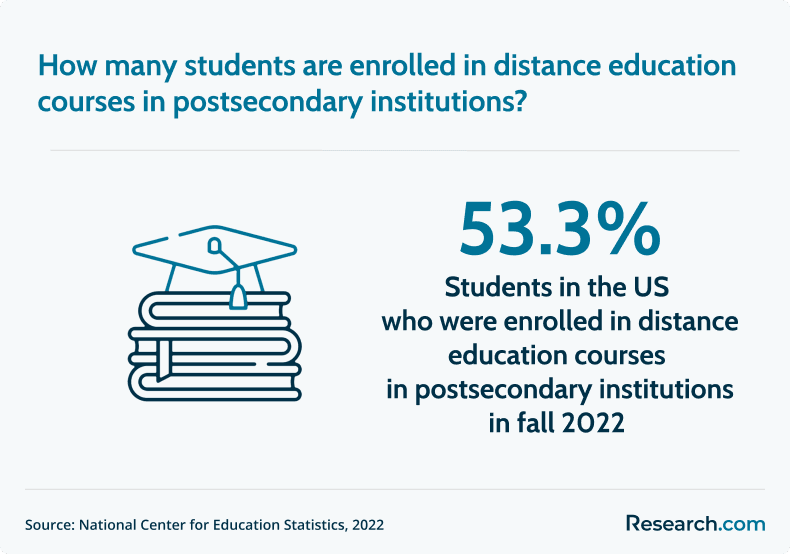
Most associate degrees require general education courses plus major-specific coursework. The accelerated format does not mean the work disappears; it usually means students complete courses in shorter terms, enroll year-round, take heavier course loads, or apply prior college credit. In fall 2022, 53.3% of students in the United States (US) were enrolled in distance education courses in postsecondary institutions (National Center for Education Statistics, 2022), showing how common online learning has become in higher education.
| Feature | What it means for students | What to verify before enrolling |
| Accelerated schedule | Courses may move quickly, with shorter deadlines and less downtime between terms | Weekly time expectations, term length, and whether breaks are built into the calendar |
| Online delivery | Students complete coursework remotely through a learning platform | Whether classes are asynchronous, live, hybrid, or include campus visits |
| Associate-level credential | The degree can support entry-level employment or transfer into a bachelor’s program | Transfer agreements, career outcomes, and whether the degree matches your goal |
| Career-focused curriculum | Many programs emphasize applied skills in business, healthcare, IT, criminal justice, or similar fields | Whether the curriculum includes labs, projects, clinicals, internships, or exam preparation |
Are accelerated online associate degrees credible?
An accelerated online associate degree is credible when it comes from an accredited institution and the program is appropriate for the student’s intended career or transfer path. The word “accelerated” alone does not determine quality. Accreditation, curriculum design, faculty qualifications, student support, outcomes, and transfer recognition matter more.
Accreditation means an institution or program has been evaluated against established quality standards by a recognized accrediting body. For example, institutions reviewed by the Higher Learning Commission (HLC) are assessed using criteria that include:
- Institutional Mission
- Integrity: Ethical and Responsible Conduct
- Teaching and Learning for Student Success
- Sustainability: Institutional Effectiveness, Resources, and Planning
Examples of institutions with online degree programs accredited by the HLC include:
- Purdue University Global
- University of Phoenix
- Southern Illinois University Carbondale
Students should also remember that institutional credibility and career fit are not the same thing. A school may be accredited, but a specific program may still not meet licensure requirements, transfer goals, or employer expectations in a student’s state or industry.
What accreditation should I look for in an online associate degree program?
For most students, the first priority is institutional accreditation from an accreditor recognized by the appropriate higher education authorities. Depending on the field, programmatic accreditation or state approval may also be important. This is especially true in fields with licensure, certification, clinical training, or technical standards.
National accrediting agencies discussed in this guide include:
- Distance Education Accrediting Commission (DEAC). DEAC is a private, nonprofit accrediting organization focused on distance education institutions. It evaluates distance learning activity from secondary education through doctoral education across US states and foreign locations.
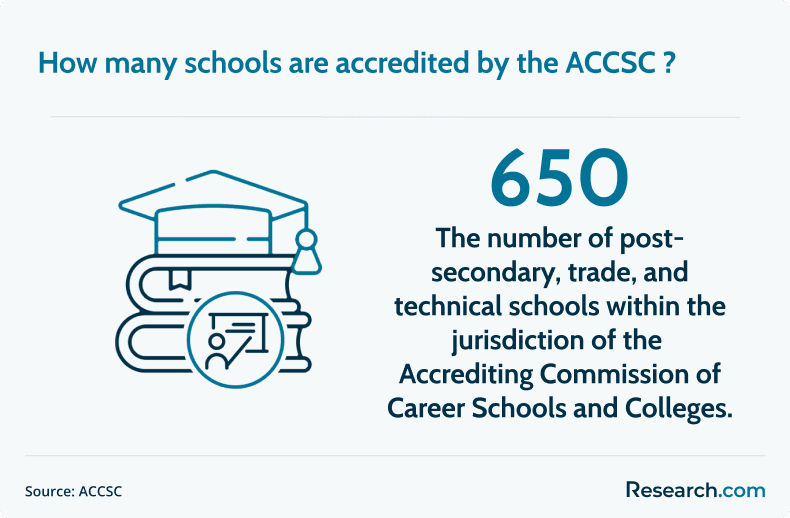
- Accrediting Commission of Career Schools and Colleges (ACCSC). ACCSC is an institutional accrediting body for more than 650 post-secondary, trade, and technical schools in the US, as designated by the Department of Education.
Regional accrediting agencies discussed in this guide include:
- Higher Learning Commission (HLC). Founded in 1895, HLC, formerly the North Central Association, accredits colleges and universities in the US.
- Southern Association of Colleges and Schools Commission on Colleges (SACSCOC). SACSCOC accredits post-secondary institutions in the US, including institutions that award associate, baccalaureate, master’s, and doctoral degrees.
| Accreditation question | Why it matters | What to ask the school |
| Is the institution accredited? | Institutional accreditation affects credibility, transferability, and financial aid eligibility | Which accreditor recognizes the institution, and where can I verify it? |
| Does the program need programmatic accreditation? | Some fields expect specialized approval or accreditation | Does this associate degree meet industry, licensure, or certification expectations? |
| Will credits transfer? | Not all credits move smoothly into a bachelor’s program | Do you have articulation agreements with four-year institutions? |
| Is the program approved in my state? | State rules may affect clinical, teaching, healthcare, or licensure-related programs | Will this program meet requirements where I plan to work? |
What are the general admission requirements for an accelerated online associate degree?
Admission requirements for accelerated online associate programs are often similar to traditional associate degree requirements, although details vary by college and major. Selective healthcare, nursing, technical, or cohort-based programs may require additional steps.
- High school diploma or equivalent. Colleges usually require proof that the applicant has completed secondary education or an accepted equivalent.
- Official transcripts. Schools use transcripts to confirm academic history, evaluate transfer credits, and determine placement needs.
- Standardized test scores. Some institutions may ask for standardized test scores, although many colleges and some institutions with the easiest bachelor degree programs have reduced or removed this requirement.
- Personal statement. A statement may help admissions teams understand an applicant’s goals, motivation, and readiness for a faster online format.
Depending on the program, applicants may also need placement assessments, prerequisite courses, background checks, immunization records, or technology readiness checks. The chart below shows the percent of students enrolled in distance education courses in selected US states using 2022 data from the National Center for Education Statistics.
How flexible are accelerated online associate degree programs?
Accelerated online associate programs and 6-month certificate programs are often designed for flexibility, but flexibility does not mean unlimited freedom. Many programs use asynchronous coursework, which lets students watch lectures, complete readings, and submit assignments at different times during the week. Others include live sessions, proctored exams, scheduled group work, labs, or short campus visits.
Lorain County Community College in Ohio offers one example. The college is accredited by the Higher Learning Commission (HLC) and offers 15-month accelerated online associate degree programs in fields such as accounting, entrepreneurship, and business forensics investigations. Some of its accelerated online programs are fully online, while others may require limited campus attendance.
Georgia Piedmont Technical College, accredited by the Southern Association of Colleges and Schools Commission on Colleges (SACSCOC), also offers accelerated online associate degree options, including an accelerated business management degree and an accelerated interdisciplinary studies degree with a management specialization.
Students interested in business, project coordination, or management should compare degree level, program outcomes, and field fit. For example, some readers may also want to review cheapest online construction management degree options, while healthcare management-focused students may find affordable MHA programs useful later in their academic planning.
| Format | Best for | Possible drawback |
| Fully asynchronous online | Students who need maximum schedule control | Requires strong self-direction and time management |
| Live online classes | Students who prefer real-time instructor interaction | Less flexible for shift workers or caregivers |
| Hybrid or limited-campus format | Programs with labs, clinicals, or hands-on requirements | May not work for students who live far from campus |
| Competency-based or self-paced options | Students with prior knowledge who can move quickly | Can be difficult for students who need frequent deadlines |
Are private universities better than public ones for online accelerated degrees?
Private universities are not automatically better than public colleges for accelerated online associate degrees. The better choice depends on accreditation, total cost, transfer pathways, available majors, support services, schedule structure, and whether the program fits your goal.
It is also important to distinguish institutional accreditation from programmatic accreditation. Lorain County Community College, for instance, is accredited by the Higher Learning Commission (HLC), while its associate degree program in computer maintenance and networking has been accredited by the Engineering Technology Accreditation Commission.
Private institutions may offer smaller classes, specialized student support, or programs not available locally. Public colleges, especially community colleges, may offer lower tuition and stronger local transfer agreements. Students comparing programs such as the cheapest teaching degree options or accredited Christian counseling programs online should focus on program fit, accreditation, and licensing relevance rather than institutional label alone.
| Factor | Public college or university | Private college or university |
| Cost | Often attractive for students seeking lower tuition, especially at community colleges | May cost more, though aid packages and transfer credit can affect the final price |
| Program availability | May offer strong local workforce and transfer pathways | May offer niche programs or flexible national online options |
| Class size and support | Varies widely by institution and program | May provide more personalized advising in some programs |
| Transfer planning | Often connected to state university transfer systems | Transferability depends on agreements and receiving institutions |
The chart below shows the number of online associate degree programs offered by the featured US academic institutions.
What technology requirements are needed for an accelerated online associate degree program?
Online associate degree students need reliable technology because coursework, exams, advising, class discussions, and instructor communication are usually handled through digital platforms. Requirements vary by major. A writing, counseling, business, or human services program may need basic software, while computer science, design, healthcare, or technical programs may require specialized tools.
- A laptop, desktop, or other device that meets the school’s specifications
- A stable internet connection suitable for video, uploads, and learning platforms
- Program-required software, such as word processing tools, video-conferencing platforms, learning management systems, coding tools, or field-specific applications
- Headphones or earbuds for online lectures, meetings, and multimedia assignments
- A webcam and microphone if the program uses live classes, recorded presentations, or proctored exams
Students in programs that generally require less advanced equipment, such as the most affordable online counseling degrees or the cheapest online degree in human services, may be able to complete most coursework with standard technology. Still, students should confirm requirements with the school before classes begin to avoid unexpected costs.
How do online students interact with instructors and peers in accelerated associate degree programs?
Interaction in accelerated online associate programs happens through learning management systems, discussion boards, video meetings, group assignments, email, chat tools, recorded lectures, peer review, and virtual office hours. Similar to many accelerated online bachelor’s options, including fast-track communications degree programs, the strongest online associate programs build regular communication into the course design instead of leaving students isolated.
Before enrolling, ask whether faculty offer weekly office hours, how quickly instructors respond to messages, whether group work is required, and whether tutoring is available outside normal business hours. These details matter more in accelerated courses because students have less time to recover if they fall behind.
What are the long-term career outcomes of accelerated online associate degrees?
Long-term outcomes depend heavily on the field, the student’s prior experience, local labor market conditions, and whether the associate degree is used for employment or transfer. Some graduates use the credential to qualify for entry-level roles. Others use it to shorten the path to a bachelor’s degree. In fields such as nursing, healthcare support, IT, accounting, and business operations, the degree may provide practical skills that employers can recognize, but outcomes are never guaranteed.
When comparing programs, look beyond general claims. Ask for program-level data on graduation, transfer, licensure exam performance where relevant, job placement support, and alumni pathways. Students seeking the fastest possible associate options may also compare structures on the best associate degree in 6 months online resource, while still verifying accreditation and transfer value.
What challenges might arise during accelerated online associate degree programs?
The main challenge is pace. Accelerated programs compress deadlines, reading, exams, projects, and discussions into shorter terms. This can be efficient for prepared students, but stressful for students who underestimate the weekly workload.
- Time pressure. Missing one assignment in a short course can quickly affect your grade.
- Limited recovery time. Students have fewer weeks to adjust study habits or ask for help.
- Technology dependence. Internet problems, software issues, or unfamiliar platforms can interrupt progress.
- Reduced live contact. Some asynchronous programs require students to be proactive about asking questions.
- Work-life conflict. Full-time work, caregiving, and accelerated coursework can compete for the same hours.
Students who need a slower ramp into college may want to begin with a lighter course load, an online certificate, or a school with strong advising. Those comparing flexible aid-eligible options may also review FAFSA-approved online certificate programs as part of a broader education plan.
How can an accelerated online associate degree open doors to further academic opportunities?
An accelerated online associate degree can be a useful transfer credential if the school is accredited and the courses align with a bachelor’s program. Many students begin at the associate level to reduce costs, build academic confidence, complete general education requirements, or explore a field before committing to a four-year degree.
The key is transfer planning before enrollment. Students should ask whether the associate degree is designed for transfer, whether the school has articulation agreements, and whether credits will apply to the major—not only as electives. Those who want to continue quickly may later compare accelerated bachelors degree options that build on prior college credit.
Can you get financial aid for accelerated online associate degrees?
Students enrolled in accredited eligible institutions may be able to apply for federal and private financial aid, including grants, scholarships, loans, and employer education benefits. For federal aid, students complete the Free Application for Federal Student Aid (FAFSA) each academic year.
FAFSA eligibility requirements include:
- Financial need
- US citizenship or eligible noncitizenship
- Social security number
- Acceptance into a qualified degree or certificate program
- High school diploma or equivalent
Private aid may come from employers, professional associations, community organizations, foundations, or field-specific scholarship providers. Working students should ask their employer about tuition assistance, reimbursement requirements, grade minimums, and whether the benefit applies to online accelerated programs.
What advanced online degree options complement an accelerated online associate degree?
The most common next academic step after an associate degree is a bachelor’s degree. After that, students may consider graduate study if it matches their profession. The right sequence depends on the field: business students may move into management or accounting programs, IT students may pursue computer science or information systems pathways, and healthcare students may continue into healthcare administration, nursing, or allied health routes where applicable.
Some working adults later consider shorter graduate formats, including a one year masters degree online. However, master’s programs typically require a bachelor’s degree first. An associate degree can help start the pathway, but students should plan each credential in the correct order and confirm transfer requirements along the way.
How do career support services impact accelerated online associate degrees?
Career services can make a major difference in how useful an accelerated online associate degree feels after graduation. Because accelerated students move quickly, they need early access to advising, resume support, interview preparation, internship guidance, transfer advising, and employer connections—not just help at the end of the program.
When comparing schools, ask whether online students receive the same career support as campus students. Also ask whether the program offers virtual career fairs, alumni networking, job boards, portfolio reviews, mock interviews, or help identifying transfer programs. Students looking for low-barrier application options may also compare colleges with free online applications.
How can I reduce the cost of an accelerated online associate degree?
Reducing cost starts with calculating the full price, not just tuition. Fees, books, proctoring, technology, labs, clinical travel, graduation fees, and transcript costs can affect the final amount. Students should compare accredited programs, apply for aid early, and maximize transfer credits when appropriate.
- Choose an accredited public community college if it offers the program you need at a lower cost.
- Submit the FAFSA and search for grants, scholarships, and employer tuition assistance.
- Ask whether prior college credits, military training, exams, or industry certifications can reduce required coursework.
- Compare total program cost, not only cost per credit.
- Avoid retaking courses that would transfer into a better-matched program.
- Check whether textbooks, software, exam fees, and supplies are included.
Students focused on affordability can also review cheapest online colleges that accept FAFSA while confirming each school’s accreditation and program fit.
Is an accelerated online associate degree a worthwhile investment?
An accelerated online associate degree is a worthwhile investment when it helps you reach a specific goal at a reasonable cost and within a schedule you can realistically manage. It may be a strong option if it reduces time to employment, helps you qualify for advancement, or transfers efficiently into a bachelor’s degree. It may be a poor investment if credits do not transfer, the field requires a different credential, or the fast pace causes you to withdraw and lose money.
| Choose an accelerated online associate degree if... | Consider another path if... |
| You can dedicate consistent weekly study time | You need a slower academic pace or frequent in-person help |
| The school is accredited and the program matches your goal | You cannot verify accreditation, licensure relevance, or transfer value |
| You have transfer credits or prior learning that can shorten the timeline | The program requires you to repeat credits you have already earned |
| You want a faster route into entry-level work or bachelor’s completion | Your target career requires a bachelor’s, graduate degree, license, or clinical training not provided by the program |
Students comparing price and flexibility may also find value in reviewing the most affordable online colleges, especially if they need programs designed for adult learners.
What are common misconceptions about accelerated online associate degree programs?
Accelerated online associate programs are often misunderstood. Some students assume they are easier because they are online; others assume they are lower quality because they move faster. Neither assumption is reliable. Program quality depends on accreditation, curriculum, faculty, support, assessment standards, and outcomes.
| Misconception | Reality | Better way to evaluate the program |
| “Accelerated means easier.” | Accelerated courses often require the same learning outcomes in less time. | Ask for weekly workload estimates and sample course schedules. |
| “Online degrees are not respected.” | Employer views vary, but accredited online education is now common. | Focus on accreditation, skills, projects, internships, and field relevance. |
| “All credits will transfer.” | Transfer depends on the receiving school and how courses apply to the new major. | Get transfer guidance in writing before enrolling. |
| “The cheapest program is the best value.” | Low tuition can be undermined by poor transfer fit, weak support, or hidden fees. | Compare total cost, outcomes, support, and completion likelihood. |
For a broader comparison of program formats, students can review accelerated associates degree options and then verify details directly with each institution.
What essential skills do accelerated online associate degree programs develop?
Beyond major-specific knowledge, accelerated online associate programs can help students build habits that employers and four-year colleges often value. The faster format requires planning, communication, digital literacy, and independent problem-solving.
- Time management. Students learn to work within compressed deadlines and prioritize assignments.
- Digital communication. Online coursework requires clear writing, discussion participation, video communication, and professional email habits.
- Self-directed learning. Students must monitor deadlines, ask questions early, and use resources without constant reminders.
- Technical confidence. Learning platforms, software tools, research databases, and virtual collaboration tools become part of the academic routine.
- Applied problem-solving. Career-focused programs often use case studies, projects, simulations, or practical assignments.
Students who want a lower-barrier starting point may compare program difficulty, format, and career fit through resources such as easiest degree pathways, while remembering that “easy” should never be the only selection criterion.
Can an accelerated online associate degree pave the way toward advanced research degrees?
An accelerated online associate degree can be the first step in a longer academic path, but it does not usually lead directly into research degrees. Students interested in research careers typically need to complete a bachelor’s degree first, then a master’s or doctoral program depending on the field.
The associate degree can still be useful if it helps students complete general education courses, develop academic discipline, and transfer efficiently into a research-oriented bachelor’s program. Students with long-term doctoral goals should look for strong transfer pathways, research-focused bachelor’s options, faculty mentorship, and later graduate preparation. Resources on advanced pathways, such as a 2 year PhD program, should be reviewed only after understanding the bachelor’s and graduate prerequisites required for the intended field.
Are employers receptive to accelerated online degrees?
Many employers are more open to online degrees than in the past, especially when the school is accredited and the candidate can demonstrate relevant skills. Hiring practices also vary by industry, employer, role, and local labor market.
One reason employer attitudes are changing is the growth of skills-based hiring. Some industries have adopted a skills-based hiring approach to reach candidates who may have been overlooked because they lacked a traditional degree. In recent years, some companies have removed degree requirements for middle-skill and high-skill roles to emphasize demonstrated ability.
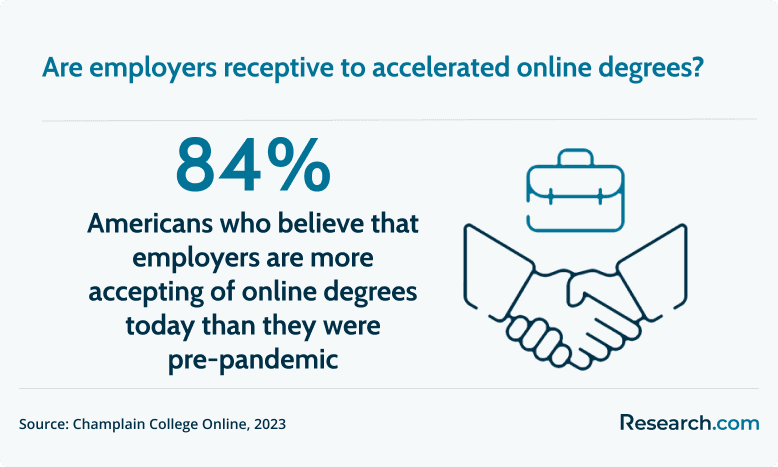
Perceptions of online learning also shifted after widespread remote education during the COVID-19 pandemic. In a 2023 Champlain College Online survey about online education, 84% of participants believed employers are more receptive to online degrees today than before the pandemic.
Do accelerated online associate degrees boost earning potential?
An accelerated online associate degree can improve earning potential in some cases, but it depends on the field, credential quality, local demand, prior experience, and whether the degree leads to a role with higher pay. A degree alone does not guarantee a salary increase.
The strongest earning outcomes are usually tied to programs that teach marketable skills, support licensure or certification where relevant, or transfer into higher-level credentials. Students comparing financial outcomes should review reliable labor market data for their chosen field and consider resources such as degrees you can get online that pay well to understand which programs may align with stronger career opportunities.
How to choose the best accelerated online associate degree program for your needs?
The best accelerated online associate degree is the one that matches your goal, not necessarily the fastest one. Use the following checklist before applying.
- Verify accreditation and credibility. Confirm that the institution is accredited by a recognized accrediting body, such as the Distance Education Accrediting Commission (DEAC) or the Higher Learning Commission (HLC). If you want a curated starting point, compare fast associate degree programs online while still checking each program independently.
- Review the curriculum. Make sure required courses align with your intended job, transfer major, licensure pathway, or certification goal.
- Understand the delivery format. Ask whether courses are asynchronous, live, hybrid, self-paced, or cohort-based.
- Check the completion timeline. Accelerated online associate degrees can range from 12 to 24 months, but your timeline may change based on transfer credits, course availability, and workload.
- Calculate total cost. Include tuition, fees, books, software, exam costs, travel, clinical expenses, and lost work hours if relevant.
- Evaluate student support. Look for tutoring, advising, library access, technology help, disability services, and career services for online students.
- Confirm transfer policies. If you have prior credits or plan to earn a bachelor’s degree, ask how credits will apply before enrolling.
- Ask for outcomes data. Request information about graduation rates, transfer rates, job placement support, licensure exam outcomes where applicable, and alumni paths.
Questions to ask before enrolling
| Question | Why it matters |
| Is the institution accredited, and by whom? | Accreditation affects credibility, aid eligibility, and transfer options. |
| Will this program meet requirements in my state or field? | Licensure, clinical, and certification rules may vary. |
| How many hours per week should I expect to study? | Accelerated courses can become overwhelming without realistic planning. |
| Are classes fully online, or are campus visits required? | Hybrid requirements can affect travel, work schedules, and cost. |
| What credits can I transfer in? | Transfer credit can reduce time and cost. |
| Where do graduates transfer or work after completing the program? | Outcomes help you judge whether the program supports your goal. |
| What support is available after business hours? | Online students often study at night or on weekends. |
Common Mistakes to Avoid
- Choosing only by speed. A faster program is not better if it lacks accreditation, support, or transfer value.
- Looking only at tuition. Fees, books, software, transportation for clinicals, and repeated credits can change the real cost.
- Assuming online means self-paced. Many online courses still have weekly deadlines, group work, exams, and scheduled meetings.
- Ignoring licensure requirements. Nursing, healthcare, education, counseling-related, and technical fields may have rules beyond the degree itself.
- Waiting too long to ask for help. In accelerated courses, small problems can become major setbacks quickly.
- Assuming transfer is automatic. Always confirm whether credits apply to the intended bachelor’s major.
- Relying only on rankings or advertisements. Rankings can be a starting point, but your final choice should be based on accreditation, cost, fit, support, and outcomes.
Key Insights
- An accelerated online associate degree is a virtual, fast-paced college pathway designed for students who need more flexibility than a traditional campus schedule.
- In fall 2022, 53.3% of students in the United States (US) were enrolled in distance education courses in postsecondary institutions (National Center for Education Statistics, 2022).
- Credibility depends on accreditation. Accrediting bodies discussed in this guide include the Distance Education Accrediting Commission (DEAC), the Accrediting Commission of Career Schools and Colleges (ACCSC), Higher Learning Commission (HLC), and the Southern Association of Colleges and Schools Commission on Colleges (SACSCOC).
- The fastest program is not always the best choice. Students should compare accreditation, total cost, transfer policies, technology requirements, student support, career services, and field-specific requirements.
- Employer acceptance of online degrees has improved in many settings, especially as some industries use skills-based hiring. A 2023 Champlain College Online survey found that 84% of participants believed employers are more accepting of online degrees today than before the pandemic.
- Accelerated programs work best for students who can manage compressed deadlines, study independently, and ask for help early.
- Students planning to continue their education should confirm transfer agreements before enrolling so the associate degree saves time instead of creating repeated coursework.
References:
- Champlain College Online. (2023, November 9). Data Reveals New Insights on Online Higher Education Post-Pandemic. https://online.champlain.edu/blog/data-reveals-new-insights-online-higher-education-post-pandemic
- National Center for Education Statistics. (2022). Student Enrollment: What is the percent of students enrolled in distance education courses in postsecondary institutions in the fall? https://nces.ed.gov/ipeds/TrendGenerator/app/build-table/2/42?rid=6&cid=85
Other Things You Should Know About Accelerated Online Associate Degree Programs
Typical admission requirements for accelerated online associate degree programs in 2027 include a high school diploma or GED, proof of residency for tuition purposes, and possibly a minimum GPA. Some programs may also require standardized test scores like the SAT or ACT.
Yes, but transfer usually depends on regional accreditation and the receiving university’s policy. Many public colleges accept up to 60 semester credits from an accredited associate degree, including general education courses. Check for articulation agreements before enrolling, because technical or career-specific credits may transfer more narrowly.