2027 Best Accounting Schools in Nevada – How to Become a CPA in NV

Co-Founder and Chief Data Scientist
Choosing an accounting school in Nevada is not just about finding a business program with accounting courses. If your goal is to become a CPA, move into corporate finance, work in government auditing, or build a career in Nevada’s gaming, hospitality, tourism, nonprofit, or public-sector economy, the program you choose needs to match your timeline, budget, credential goals, and long-term career plan.
This guide explains how accounting programs in Nevada compare, what CPA-minded students should know before enrolling, how long common degree paths take, what tuition data suggests about affordability, and which schools offer accounting programs for 2027. You will also learn how to evaluate accreditation, career outcomes, technology training, certifications, networking opportunities, and alternatives such as forensic accounting, teaching, legal support, and related finance careers. If you are still comparing credentials, Research.com’s overview of the different accounting degree types can help you understand how associate, bachelor’s, master’s, and certificate options differ.
Best Accounting Schools in Nevada Table of Contents
- Is CPA a good job in Nevada?
- Career Prospects for a CPA in Nevada
- Accounting Program Length in Nevada
- Tuition and Costs of Accounting Programs in Nevada
- Nevada Schools Offering Accounting Programs for 2027
- What to Look for in an Accounting Program in Nevada
- Key Skills Needed to Succeed in Accounting in Nevada
- How Can Interdisciplinary Learning Expand Your Career Horizons in Nevada?
- The Role of Technology in Accounting in Nevada
- How can online forensic accounting degrees boost your career?
- Can an Accounting Certificate Accelerate Your Career Path in Nevada?
- How Can Industry-Specific Certifications Expand Your Career Opportunities in Nevada?
- What Are the Essential CPA Requirements in Nevada?
- Can Accounting Professionals Transition into Teaching Roles in Nevada?
- How Can Urban Planning Influence Financial Decision-Making in Nevada?
- Can Accounting Professionals Transition to High School Mathematics Teaching in Nevada?
- Can Accounting Expertise Open Doors to Legal Careers in Nevada?
- Is a Forensic Science Degree Advantageous for Accountants in Nevada?
- Networking and Professional Development Opportunities for Accounting Students in Nevada
- What Other Career Paths Are Available to Individuals Interested in Numbers and Education?
- Is a Master's Degree in Accounting Worth the Investment in Nevada?
Quick Answer: What Is the Best Accounting Path in Nevada?
For students who want the broadest accounting career options in Nevada, a bachelor’s degree in accounting from an accredited institution is usually the most practical starting point. Students aiming for CPA licensure should pay close attention to required accounting coursework, credit-hour rules, exam preparation support, and whether the program helps them move toward Nevada’s CPA requirements. Community college programs can be a cost-conscious entry point, while master’s programs may make sense for students who need advanced coursework, stronger CPA preparation, or a path toward management roles.
| Student goal | Best-fit accounting path | Why it may fit |
| Enter bookkeeping or accounting support roles quickly | Certificate or associate degree | Shorter programs can build practical skills in bookkeeping, payroll, tax basics, and accounting software. |
| Qualify for broader accountant and auditor roles | Bachelor’s degree in accounting | A four-year degree is the standard preparation for many professional accounting roles and CPA-oriented pathways. |
| Strengthen CPA preparation or move into leadership | Master’s degree in accounting | Graduate study can add advanced tax, audit, analytics, advisory, and research training. |
| Specialize in fraud, investigations, or litigation support | Forensic accounting coursework or degree | Focused study can help accountants develop fraud detection, investigative, and legal documentation skills. |
Is CPA a good job in Nevada?
Yes. CPA work can be a strong career choice in Nevada for students who want a credentialed profession with applications in public accounting, corporate finance, government, gaming, hospitality, nonprofits, and consulting. The Bureau of Labor Statistics reports that Nevada has over 7,600 accountants and auditors, which equals approximately 5.45 accounting and auditing positions for every 1,000 jobs in the state.
The opportunity is not limited to traditional tax preparation. Nevada organizations need accounting professionals who can close books accurately, prepare financial reports, support audits, evaluate internal controls, manage compliance, interpret data, and advise leaders on financial decisions. CPA licensure can also improve mobility because it signals a verified level of accounting education, exam performance, ethics, and supervised experience.
How much can CPAs earn in Nevada?
The Nevada Society of Certified Public Accountants states that becoming a CPA may boost lifetime earnings by $1 million compared with a non-CPA working in the same position. That does not mean every CPA earns the same amount or receives guaranteed salary gains. Pay depends on experience, industry, employer size, specialty, location, and whether the accountant moves into supervisory or advisory roles.
According to the Nevada Department of Employment, Training, and Rehabilitation, accountant jobs are projected to grow by approximately 16.5% from 2023 to 2033. This projection, combined with Nevada’s mix of public agencies, private employers, casinos, hospitality companies, small businesses, and growing service sectors, points to a favorable long-term environment for qualified accounting professionals.
The Bureau of Labor Statistics also provides role-specific wage data for accountants, auditors, clerks, managers, and controllers in Nevada. The figures below should be used as planning benchmarks rather than promised outcomes.
Accountants and Auditors
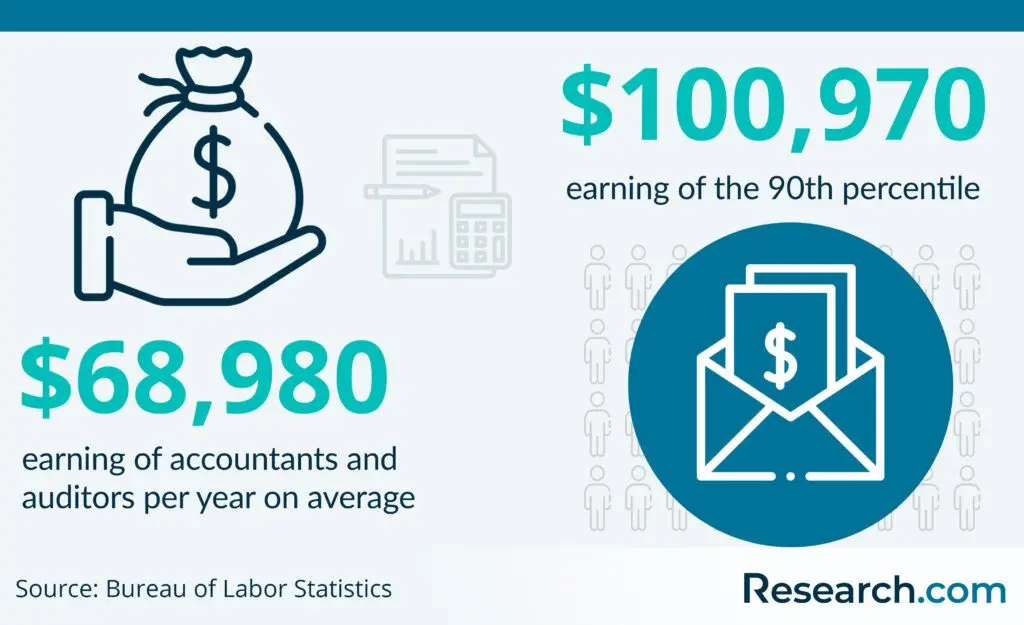
Accountants and auditors review accounting records, prepare and analyze financial statements, evaluate reporting accuracy, and help organizations understand financial performance. In Nevada, accountants and auditors earn $68,980 per year, while those in the 90th percentile earn up to $100,970.
Corporate Staff Accountants, Bookkeepers, and Accounting Clerks
Many accounting graduates begin in private-sector roles such as staff accountant, bookkeeper, accounting clerk, payroll assistant, or accounts payable and receivable specialist. A corporate staff role connected to accounting and finance pays around $34,430. Professionals with more experience earn about $41,010, while senior-level positions in this area earn somewhere between $50,230 to $60,290. Students comparing business majors may also want to review how an accounting path differs from finance using Research.com’s guide to finance degree salary and career outcomes.
Financial Managers and Controllers
Financial managers and controllers usually sit above entry-level accounting roles. They may oversee accounting teams, internal reporting, budgets, cash flow, controls, audits, and executive-level financial planning. The Bureau of Labor Statistics records a median salary of $103,930 for these roles in Nevada, with more experienced and credentialed professionals earning $142,800.
| Role group | Typical work | Nevada wage information stated in this guide |
| Accountants and auditors | Financial reporting, audits, accounting analysis, compliance support | $68,980 per year; 90th percentile up to $100,970 |
| Corporate staff accountants, bookkeepers, accounting clerks | Transaction recording, reconciliations, payroll, accounts payable and receivable | Around $34,430; about $41,010 with experience; senior-level range of $50,230 to $60,290 |
| Financial managers and controllers | Financial leadership, controls, budgeting, reporting oversight, strategic planning | Median salary of $103,930; higher reported level of $142,800 |
Career Prospects for a CPA in Nevada
Graduates from Nevada accounting programs can pursue several different professional tracks. The American Institute of Certified Public Accountants describes CPA career paths that commonly fall into public accounting, business and industry, education, government, and specialized advisory work. The right path depends on whether you prefer client service, internal business operations, public service, teaching, investigation, or executive finance.
Public Accounting
Public accounting firms serve clients rather than operating as one internal accounting department. CPAs in this setting may work in audit, tax, advisory, consulting, or specialized compliance services. Nevada students pursuing internships should look for firms that offer exposure to industries common in the state, including hospitality, gaming, tourism, construction, real estate, and small business services.
- Staff Auditor: This entry-level audit role often requires 1 to 3 years of experience. Staff auditors perform audit procedures, test records, document findings, and work under the direction of senior auditors.
- Tax Staff: This early-career role also often requires 1 to 3 years of experience. Tax staff prepare returns, research tax questions, organize client information, and work under a senior tax professional.
With experience, public accountants may move into senior auditor, tax senior, manager, partner-track, advisory, risk, or consulting roles.
Corporate Accounting
Corporate accounting places graduates inside one organization rather than a public accounting firm. A Nevada company may need accountants for monthly close, reconciliations, payroll, internal controls, revenue accounting, budgeting, financial analysis, or compliance. Entry-level roles often include staff accountant, accounting clerk, bookkeeper, or internal auditor. Advancement may lead to senior accountant, accounting manager, controller, finance manager, or executive finance roles.
Accounting Education and Academic Roles
Experienced accountants may eventually teach accounting at community colleges, business schools, or professional training programs. This path is especially relevant for CPAs who enjoy explaining tax, audit, bookkeeping, accounting systems, and professional ethics to future practitioners. Students who want a full overview of accountant preparation can also review Research.com’s guide on how to become a CPA.
Government Accounting
Government accounting roles involve public funds, audits, grants, budgeting, reporting, and financial oversight at the federal, state, and local levels. Accountants in this setting help agencies document spending, comply with reporting rules, evaluate financial controls, and use resources responsibly.
| Career setting | Good fit for students who want... | Possible starting roles |
| Public accounting | Client-facing audit, tax, advisory, and consulting experience | Staff auditor, tax staff, assurance associate |
| Corporate accounting | Stable internal finance work and advancement into management | Staff accountant, bookkeeper, accounting clerk |
| Government | Public-sector accountability, audits, budgeting, and compliance | Government accountant, auditor, budget analyst support role |
| Academe | Teaching, mentoring, curriculum development, and professional training | Instructor, adjunct faculty member, accounting trainer |
Accounting Program Length in Nevada
The time required to finish an accounting program in Nevada depends on the credential, enrollment status, transfer credits, course sequencing, and whether the student attends full time or part time. For CPA-minded students, program length should be evaluated alongside Nevada’s coursework expectations, not just the number of semesters until graduation.
Students who plan to become practicing CPAs in Nevada need a 120-credit-hour accounting degree or a bachelor’s degree that includes 21-semester credits in accounting or more. Because licensure rules can change and individual academic records vary, students should confirm their course plan with the school and the Nevada licensing authority before assuming a program satisfies CPA requirements.
| Credential | Typical length stated in this guide | Best use case |
| Accounting certificate | Nine to 45 credits | Targeted skill building, bookkeeping preparation, tax basics, software training, or prerequisite completion |
| Associate degree in accounting | Two years for full-time students | Entry-level accounting support roles or transfer preparation |
| Bachelor’s degree in accounting | Generally four years | Professional accounting roles and CPA-oriented preparation |
| Master’s degree in accounting | Varies by school and prior coursework | Advanced accounting study, CPA preparation support, specialization, or leadership development |
Tuition and Costs of Accounting Programs in Nevada
Accounting program costs in Nevada vary by institution type, residency status, credential level, delivery format, fees, books, technology requirements, commuting, housing, and how many credits transfer into the program. Tuition should be compared with graduation requirements, career services, CPA exam support, internship access, and accreditation rather than viewed in isolation.
At the graduate level, a master’s degree in accounting from the University of Nevada Las Vegas costs around $30,000 per year, while the same degree program at the University of Nevada Reno has a base tuition of approximately $40,000. These figures are useful for comparison, but students should request current cost sheets from each school before enrolling.
The National Center for Education Statistics lists the average in-state tuition and fees for Nevada. For a four-year course at a public institution, the state average is 6,023 a year compared with the national average of $9,349. For private institutions, Nevada’s state average is $26,284, while the national average is $32,764.
Students should also look for scholarships and professional association support. The Nevada CPA Foundation for Education and Research is one example of an organization connected to accounting education support in the state.
| Cost item | Why it matters | Question to ask before enrolling |
| Tuition and mandatory fees | This is the most visible cost, but not the only one. | What is the total cost for the full credential, not just one term? |
| Books, software, and technology | Accounting courses may require platforms, calculators, databases, or online homework systems. | Which tools are required, and are they included in tuition? |
| Transfer credits | Accepted credits can reduce time and cost. | How many credits will transfer into the accounting major specifically? |
| CPA preparation resources | Exam-focused support can affect readiness after graduation. | Does the program include review courses, exam advising, or CPA-aligned electives? |
| Internship access | Relevant work experience can improve employability. | Which employers recruit accounting students from this program? |
Nevada Schools Offering Accounting Programs for 2027
Students comparing accounting schools in Nevada should look beyond name recognition. The strongest fit is usually the school that offers the right credential level, respected accreditation, course delivery that matches your schedule, affordable net cost, and practical support for internships, transfer, CPA preparation, or advancement.
Research.com reviewed Nevada institutions offering accounting programs from associate-level study through graduate education. The universities included below also had CPA exam pass rates, based on the latest available data, that were around the national average pass rate. The cumulative pass rate historically has been around 50%.
1. University of Nevada, Reno
The University of Nevada, Reno is a major option for students seeking undergraduate or graduate accounting study in the state. Its business department lists five accounting programs, including online graduate study, making it a strong choice for students who want multiple pathways within one institution. As the flagship campus of the University of Nevada system, it may appeal to students who want a public research university setting with access to business faculty, campus resources, and graduate-level accounting options.
Classification: Public land-grant research university
Programs: Minor in Accounting, BS Accounting, BS Accounting and Information Systems, Master of Accounting, Online Master of Accounting.
Accreditation: The Association to Advance Collegiate Schools of Business (AACSB)
2. University of Nevada, Las Vegas
The University of Nevada, Las Vegas is well positioned for students who want to study accounting in a large metropolitan economy with direct exposure to hospitality, gaming, entertainment, real estate, and service-sector employers. Its accounting offerings include undergraduate and graduate pathways. Graduates reportedly receive an earnings boost of about $2,669 compared with the average income.
Classification: Public land-grant research university
Programs: Minor in Accounting, BS Business Administration, Accounting; Master of; Science Accounting
Accreditation: AACSB
3. College of Southern Nevada
The College of Southern Nevada accounting program can be a practical option for students who want a community college pathway into accounting, bookkeeping, or transfer-oriented study. Its programs are especially relevant for learners who want a lower-cost starting point, career-focused coursework, or a credential that can be completed before deciding whether to pursue a bachelor’s degree.
Classification: Public community college
Programs: Associate of Applied Science Degree in Accounting; Certificate of Achievement, Bookkeeping; Skills Certification, Bookkeeping
Accreditation: Northwest Commission on Colleges and Universities
4. Great Basin College
Located in Elko, Great Basin College offers accounting education through a public college setting. Students who prefer a less urban environment or need online learning options may find it worth comparing with larger institutions in Reno and Las Vegas.
Classification: Public college
Programs: Associate of Applied Science Degree in Accounting
Accreditation: Northwest Commission on Colleges and Universities
5. Truckee Meadows Community College
Truckee Meadows Community College offers accounting coursework and certificate study that can serve students seeking a flexible and affordable entry into the field. It may be especially useful for students who want to build practical accounting skills before transferring, seeking bookkeeping work, or deciding whether to pursue a longer degree. Students comparing online affordability can also review Research.com’s guide to the cheapest online accounting degree program.
Classification: Public community college
Programs: Certificate of Achievement, Accounting; Accounting (ACC) Courses
Accreditation: Northwest Commission on Colleges and Universities
| School | Institution type | Accounting options listed | Accreditation listed |
| University of Nevada, Reno | Public land-grant research university | Minor in Accounting, BS Accounting, BS Accounting and Information Systems, Master of Accounting, Online Master of Accounting | The Association to Advance Collegiate Schools of Business (AACSB) |
| University of Nevada, Las Vegas | Public land-grant research university | Minor in Accounting, BS Business Administration, Accounting; Master of; Science Accounting | AACSB |
| College of Southern Nevada | Public community college | Associate of Applied Science Degree in Accounting; Certificate of Achievement, Bookkeeping; Skills Certification, Bookkeeping | Northwest Commission on Colleges and Universities |
| Great Basin College | Public college | Associate of Applied Science Degree in Accounting | Northwest Commission on Colleges and Universities |
| Truckee Meadows Community College | Public community college | Certificate of Achievement, Accounting; Accounting (ACC) Courses | Northwest Commission on Colleges and Universities |
What to Look for in an Accounting Program in Nevada
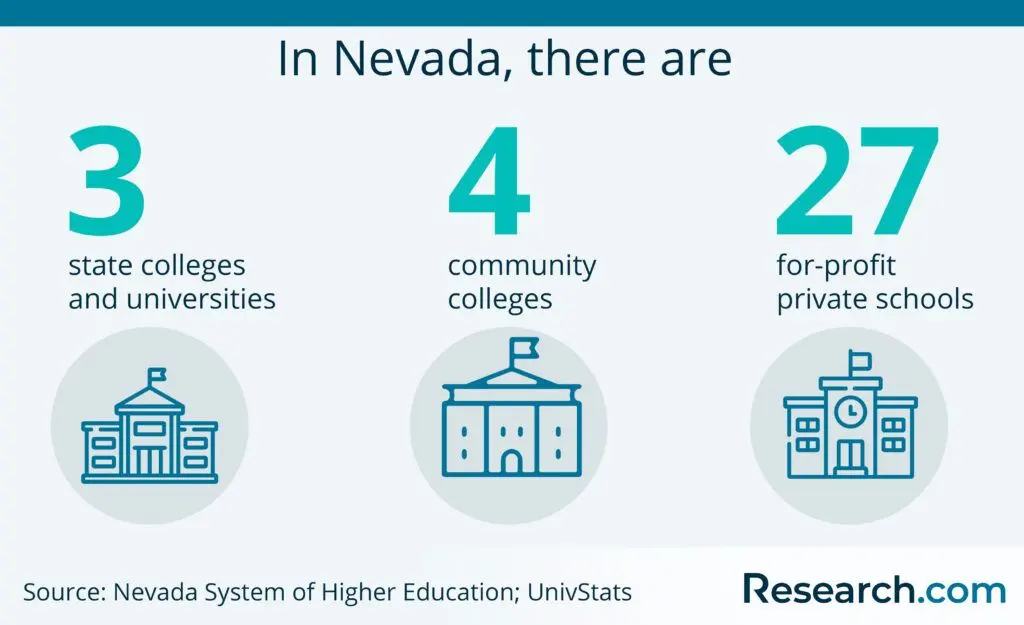
Nevada has three state colleges and universities, four community colleges, and 27 for-profit private schools. That gives students several choices, but it also increases the risk of comparing programs on the wrong criteria. A good accounting program should fit your target role, budget, schedule, transfer plan, and CPA ambitions.
- Accreditation first: Confirm that the institution is properly accredited and that the business or accounting program has the recognition you need. AACSB accreditation can be especially relevant for business schools, while regional institutional accreditation is important for transfer, financial aid, and degree recognition.
- CPA alignment: If you want CPA licensure, ask whether the curriculum helps satisfy Nevada’s coursework expectations, including the 21-semester credits in accounting or more referenced in this guide.
- Program length and flexibility: Decide whether a certificate, associate degree, bachelor’s degree, or master’s degree is the right level for your goals. Part-time and online options may help working adults, but course sequencing can extend completion time.
- Total cost, not sticker tuition: Compare tuition, fees, books, required software, commuting, housing, and lost work hours. A lower tuition rate may not be the best value if the program has limited transfer options or weak career support.
- Employer connections: Look for internships, career fairs, alumni networks, accounting clubs, mentorship, and recruiting relationships with public accounting firms, corporations, agencies, and local businesses.
- Location and delivery: Reno, Las Vegas, Elko, and online programs can offer very different student experiences. Choose based on your career market, commute, housing needs, and access to internships.
- Technology training: Accounting work increasingly requires comfort with accounting systems, cloud platforms, spreadsheets, analytics, and data controls. Review syllabi for applied technology content.
| Common mistake | Why it can hurt you | Better approach |
| Choosing only by tuition | The cheapest option may not have the CPA coursework, transfer agreements, or career services you need. | Compare total cost, completion time, accreditation, and job support together. |
| Assuming every accounting degree leads to CPA eligibility | Degree title alone does not guarantee that your coursework meets licensing expectations. | Ask the program advisor to map required accounting credits before you enroll. |
| Ignoring accreditation | Unrecognized credits can create transfer, aid, employment, or licensing problems. | Verify institutional and programmatic accreditation directly with the school. |
| Waiting too long to seek internships | Accounting recruiting can happen early, especially for public accounting roles. | Contact career services and accounting faculty during your first year in the program. |
| Overlooking software and analytics | Manual accounting skills are no longer enough for many employers. | Choose electives or projects that build spreadsheet, ERP, cloud accounting, and data analysis skills. |
Key Skills Needed to succeed in Accounting in Nevada
Successful accountants in Nevada need more than arithmetic ability. Employers often look for professionals who can interpret rules, communicate clearly, protect data, work under deadlines, and understand the industries that drive the state’s economy.
- Gaming and hospitality accounting knowledge: Nevada’s economy includes major gaming, tourism, and hospitality employers. Accountants who understand industry revenue patterns, controls, compliance issues, and reporting needs can be better prepared for specialized roles.
- Regulatory compliance and ethics: Accountants handle sensitive financial information and must follow state, federal, and industry-specific rules. Ethical judgment is essential because errors or misconduct can damage organizations, clients, and professional credibility.
- Analytical thinking: Modern accounting involves explaining what the numbers mean, not just recording them. Professionals must identify trends, investigate variances, assess risk, and translate data into usable recommendations.
- Accounting technology proficiency: Tools such as QuickBooks, Sage, ERP systems, spreadsheets, and reporting platforms help accountants automate routine work and improve accuracy. Students should seek hands-on practice rather than only textbook exposure.
- Adaptability: Nevada employers in tourism, entertainment, and hospitality can be affected by economic cycles and changing consumer behavior. Accountants who can adjust budgets, monitor costs, and support contingency planning bring practical value.
- Communication and relationship building: Accountants often explain financial information to non-accountants. Clear writing, concise presentations, and professional networking can influence internship access, promotions, and client trust.
How Can Interdisciplinary Learning Expand Your Career Horizons in Nevada?
Accounting careers often intersect with healthcare, law, technology, public policy, real estate, education, and government operations. Students who understand how money flows through different sectors can make stronger recommendations and communicate better with specialized teams. For example, healthcare organizations rely on cost controls, billing rules, compliance reporting, and reimbursement processes that require both financial and regulatory understanding. Exploring a guide such as how to become a nurse practitioner in Nevada can help accounting students see how another regulated profession connects education, licensing, operations, and financial decision-making.
The Role of Technology in Accounting in Nevada
Technology is changing accounting work in Nevada and everywhere else. Routine data entry is increasingly supported by automation, cloud systems, integrated platforms, and analytics tools. That does not eliminate the need for accountants; it changes what employers expect them to do. The strongest candidates can use software efficiently, check data quality, protect confidential information, and explain financial results in plain language.
- Digital accounting tools: Accountants should be comfortable with systems used for financial reporting, reconciliations, tax preparation, billing, payroll, and analysis. QuickBooks, Sage, ERP systems, and spreadsheet tools remain useful across many employer types.
- Cloud-based accounting: Cloud platforms allow accounting teams and clients to review updated records from different locations. This can be especially useful for businesses with multiple sites or remote teams.
- Data security: Financial records are sensitive. Accountants need basic cybersecurity awareness, strong access-control habits, and respect for confidentiality, especially in industries with heavy compliance expectations.
- Analytics and forecasting: Employers increasingly expect accountants to help interpret results, monitor risks, identify anomalies, and support better planning. Data skills can help accountants move beyond recordkeeping into advisory work.
- Continuous learning: Software, reporting tools, and employer expectations keep changing. Students who want flexible training may compare the best accredited online accounting programs, especially if they need coursework that combines accounting fundamentals with technology-focused instruction.
How can online forensic accounting degrees boost your career?
Forensic accounting may be a strong specialization for students who are interested in fraud detection, financial investigations, litigation support, compliance reviews, or internal controls. An online forensic accounting degrees program can help students build investigative accounting skills while maintaining work or family commitments.
Forensic accounting coursework commonly emphasizes fraud examination, financial crime analysis, evidence documentation, investigative methods, and the legal environment surrounding accounting disputes. These skills can be useful in public accounting firms, corporations, government agencies, law enforcement-related settings, insurance, and compliance departments.
Online study can be especially helpful for working accounting professionals who already have general accounting experience and want to move into a more specialized role. Before enrolling, students should check whether the program includes applied projects, case-based learning, career support, and courses that align with their target industry.
Can an Accounting Certificate Accelerate Your Career Path in Nevada?
An accounting certificate can be useful when you need targeted skills faster than a full degree allows. It may help students prepare for bookkeeping, payroll, tax support, accounting software, or prerequisite coursework before entering a degree program. Working professionals may also use certificates to refresh technical skills or demonstrate commitment to professional development. Research.com’s guide to an accounting certificate explains how certificate programs can fit into broader accounting career planning.
A certificate is not a substitute for every accounting career goal. If you want CPA licensure or higher-level accountant and auditor roles, you may still need a bachelor’s degree or graduate coursework. The best use of a certificate is strategic: choose one that fills a clear skills gap, transfers into a larger program if needed, and is recognized by employers in your target area.
How Can Industry-Specific Certifications Expand Your Career Opportunities in Nevada?
Industry-specific credentials can help accountants move into roles where financial knowledge overlaps with specialized compliance, billing, operations, or reporting systems. Healthcare is one example. Accountants who understand medical billing, coding workflows, reimbursement, and documentation can be better prepared for finance roles in clinics, hospitals, insurers, or healthcare administration. Students curious about this intersection can review how to how to be a medical coder in Nevada.
The same decision logic applies in gaming, hospitality, government, legal services, and technology. A certification is most useful when it supports a specific job target, not when it is collected simply to add another line to a resume.
What Are the Essential CPA Requirements in Nevada?
CPA preparation in Nevada requires careful planning. Candidates generally need the right education, qualifying accounting coursework, successful completion of the Uniform CPA Examination, supervised experience, and continuing education after licensure. Because requirements can change and individual academic histories differ, students should verify details before choosing courses or graduation timelines.
Before enrolling in a program, ask an advisor to show how the curriculum maps to Nevada’s CPA expectations, including the 120-credit-hour accounting degree or bachelor’s degree with 21-semester credits in accounting or more referenced earlier in this guide. For a focused explanation of the state pathway, review Research.com’s guide to CPA requirements in Nevada.
Can Accounting Professionals Transition into Teaching Roles in Nevada?
Yes, accounting professionals may be able to move into teaching, training, or instructional roles, especially at community colleges, business programs, workforce training providers, or vocational settings. This path can be attractive for CPAs and experienced accountants who enjoy mentoring students, developing lessons, and translating workplace experience into practical instruction.
Teaching requirements vary by institution and level. Some roles prioritize professional accounting experience, while others require graduate education or state teaching credentials. If you are considering K-12 or formal teacher licensure, Research.com’s guide on what degree do you need to be a teacher in Nevada can help you compare the education route with an accounting career track.
How Can Urban Planning Influence Financial Decision-Making in Nevada?
Urban planning and accounting overlap in areas such as infrastructure budgets, municipal finance, tax revenue, real estate development, public investment, and long-term cost forecasting. Accountants who understand how city growth, transportation projects, zoning, housing, and public resources affect financial planning can contribute to stronger budgeting and risk analysis.
This connection may be useful for accountants who want to work in government, development, utilities, construction, or public consulting. Students interested in the broader planning side of public finance can review how to how to become an urban planner in Nevada.
Can Accounting Professionals Transition to High School Mathematics Teaching in Nevada?
Accounting professionals often have strong numerical reasoning, spreadsheet, budgeting, and problem-solving skills. Those strengths can transfer into high school mathematics teaching, but teaching is not simply a subject-matter change. It requires classroom management, lesson planning, student assessment, pedagogy, and state-specific certification.
If you are considering this pivot, compare the opportunity cost of leaving accounting with the education and licensure steps required for teaching. Research.com’s guide on how to become a high school math teacher in Nevada can help you understand the credentialing path.
Can Accounting Expertise Open Doors to Legal Careers in Nevada?
Accounting knowledge can be valuable in legal environments that involve financial records, contract review, litigation support, fraud claims, regulatory compliance, bankruptcy, estates, or business disputes. Professionals who combine accounting accuracy with legal research and documentation skills may find opportunities in law firms, corporate legal departments, compliance teams, or investigative support roles.
This does not mean an accountant automatically qualifies for legal practice. Instead, accounting can become a complementary skill set. If you want a legal support role, Research.com’s guide on how to become a paralegal in Nevada can help you compare training requirements.
Is a Forensic Science Degree Advantageous for Accountants in Nevada?
A forensic science background can be useful for accountants who want to work in investigations, fraud examination, evidence handling, compliance, or financial crime analysis. The advantage is not the science degree alone; it is the ability to combine disciplined investigative methods with accounting records, audit trails, and financial documentation.
Students should compare forensic science, forensic accounting, criminal justice, and accounting programs carefully before choosing. If your primary goal is financial fraud work, forensic accounting may be more directly aligned. If you want broader investigative training, a forensic science degree in Nevada may be worth exploring.
Networking and Professional Development Opportunities for Accounting Students in Nevada
Networking matters in accounting because many internships, first jobs, and promotion opportunities come through faculty referrals, alumni relationships, professional events, and employer recruiting pipelines. Nevada students should start building professional connections before graduation, not after.
Statewide organizations such as the Nevada Society of Certified Public Accountants offer professional development opportunities, events, mentoring, and exposure to practicing CPAs. Students can use these experiences to learn how public accounting, corporate finance, government accounting, and specialized advisory work differ in daily practice.
Accounting programs connected to the best business schools in Nevada may also provide access to career fairs, employer presentations, alumni panels, accounting clubs, case competitions, and internship channels. Online students should ask whether they can access the same virtual career services, advising, and professional events as campus-based learners.
- Join an accounting club or student business organization early.
- Attend employer information sessions even before you feel ready to apply.
- Ask faculty which firms or agencies regularly recruit from the program.
- Create a resume focused on accounting coursework, software skills, and analytical projects.
- Look for internships in public accounting, corporate accounting, government, or nonprofit finance.
- Use professional associations to learn about CPA licensure, ethics, continuing education, and career paths.
What Other Career Paths Are Available to Individuals Interested in Numbers and Education?
If you enjoy numbers but are not sure accounting is the right long-term fit, education may be another route. Teaching can use organization, communication, assessment, and problem-solving skills, especially for people who enjoy helping others understand structured concepts. One alternative is elementary education. Research.com’s guide to elementary school teacher requirements in Nevada explains degree, certification, and preparation steps for that pathway.
The key question is whether you prefer applying numbers to business decisions or helping students build foundational academic skills. Both paths require accuracy and responsibility, but the work environment, daily tasks, credentialing process, and measures of success are very different.
Is a Master's Degree in Accounting Worth the Investment in Nevada?
A master’s degree in accounting can be worth the investment when it clearly supports your CPA plan, specialization, promotion goals, or transition into higher-level accounting work. It may be less useful if you already meet your target employer’s requirements and do not need additional credits, technical depth, or recruiting access.
Before enrolling, compare the total cost, time away from work, employer tuition support, CPA preparation value, faculty expertise, online flexibility, internship access, and alumni outcomes. Research.com’s guide to the cost of masters in accounting can help you think through the return-on-investment question more carefully.
| A master’s may make sense if... | Consider a different option if... |
| You need advanced coursework to support CPA preparation. | A certificate or individual courses would satisfy your immediate skills gap. |
| You want deeper training in audit, tax, analytics, advisory, or accounting research. | You are mainly seeking entry-level bookkeeping or clerical accounting work. |
| Your employer values graduate education for promotion. | The program cost is high and the career benefit is unclear. |
| You want access to graduate recruiting, faculty mentorship, and a stronger professional network. | You already have strong work experience and do not need another credential right now. |
How to Choose the Right Nevada Accounting School
The best accounting school in Nevada is the one that gets you to your intended career outcome with the least unnecessary cost, delay, and credential risk. Use a decision process rather than relying only on rankings, reputation, or convenience.
- Define your target role: Decide whether you want bookkeeping, staff accounting, public accounting, CPA licensure, government work, forensic accounting, teaching, or management.
- Match the credential to the goal: Choose a certificate, associate degree, bachelor’s degree, or master’s degree based on the minimum education normally expected for your target role.
- Verify accreditation: Confirm institutional accreditation and, for business schools, relevant program accreditation such as AACSB when applicable.
- Map CPA coursework: If CPA licensure is your goal, ask for written advising on whether required accounting credits are built into the program.
- Compare total cost: Include tuition, fees, books, software, commuting, housing, and the value of transfer credits.
- Review career support: Ask which accounting employers recruit from the school and how students secure internships.
- Check technology exposure: Look for applied work with accounting software, spreadsheets, ERP concepts, analytics, and cloud-based tools.
- Ask about flexibility: Working adults should confirm course schedules, online options, part-time pacing, and how often required courses are offered.
If online affordability is a priority, compare Nevada options with broader lists of the best online accounting degree programs before committing.
Key Insights
- A bachelor’s degree is the strongest general starting point: Students seeking broad accounting opportunities or CPA-oriented preparation usually benefit most from a four-year accounting pathway.
- Nevada’s CPA outlook is favorable but not automatic: The state has over 7,600 accountants and auditors, and accountant jobs are projected to grow by approximately 16.5% from 2023 to 2033. Individual outcomes still depend on skills, credentials, employer demand, and experience.
- Salary varies sharply by role: Accountants and auditors earn $68,980 per year in Nevada, while financial managers and controllers have a median salary of $103,930. Entry-level support roles pay less, so students should plan for advancement.
- Accreditation and CPA coursework are nonnegotiable: Do not assume that every accounting program satisfies licensure expectations. Confirm accreditation and required accounting credits before enrolling.
- Community colleges can lower risk and cost: Certificates and associate degrees can be practical for bookkeeping, accounting support, or transfer preparation, especially for students who are not ready to commit to a full bachelor’s program.
- Technology skills now matter in every accounting path: Employers increasingly expect competence with accounting systems, spreadsheets, ERP concepts, cloud tools, data security, and analysis.
- Specialization can improve career focus: Forensic accounting, healthcare finance, legal support, government accounting, and teaching can all build on accounting knowledge when matched to the right credential.
- Do not choose a school based only on tuition: The better question is whether the program’s cost, accreditation, transfer policy, career support, CPA alignment, and employer connections support your specific goal.
Related Articles for Nearby States
- 2027 Best Accounting Schools in Oregon – How to Become a CPA in OR
- 2027 Best Accounting Schools in Idaho – How to Become a CPA in ID
- 2027 Best Accounting Schools in Arizona – How to Become a CPA in AZ
- 2027 Best Accounting Schools in Utah – How to Become a CPA in UT
- 2027 Best Accounting Schools in Washington – How to Become a CPA in WA
- 2027 Best Accounting Schools in Montana – How to Become a CPA in MT
- 2027 Best Accounting Schools in Wyoming – How to Become a CPA in WY
- 2027 Best Accounting Schools in Colorado – How to Become a CPA in CO
- 2027 Best Accounting Schools in New Mexico – How to Become a CPA in NM
- 2027 Accounting Schools in Texas: How to Become a CPA in TX
References:
- AICPA. (2025). AICPA 2025 Trends Report. AICPA.
- Demchuk, O. (n.d.). Accounting trends in the modern world. CORE.
- BLS. (2025, April 25). Accountants and auditors. Bureau of Labor Statistics.
- Online Master of Accountancy (MACC) program tuition. (n.d.). University of Nevada, Reno.
- CPA career paths. (n.d.). AICPA.
- NSHE. (n.d.). Nevada.edu. Our Institutions.
- Hood, D. (2026. January 2). Accounting in 2026: The year ahead in numbers. Accounting Today.
- National Association of State Boards of Accountancy. (2025). How many CPAs are there? National Association of State Boards of Accountancy.
Other Things You Should Know About the Best Accounting Schools in Nevada
To become a CPA in Nevada, follow these steps:
- Obtain a bachelor's degree in accounting or a related field from an accredited institution.
- Optionally, pursue a master's degree in accounting or a related field to enhance your qualifications.
- Gain relevant work experience, typically under the supervision of a licensed CPA.
- Pass the Uniform CPA Examination.
- Apply for a CPA license from the Nevada State Board of Accountancy.
- Maintain your CPA license by fulfilling continuing professional education (CPE) requirements.
CPAs in Nevada must complete 80 hours of continuing professional education (CPE) every two years, including 4 hours in professional ethics. The Nevada State Board of Accountancy mandates this to ensure CPAs stay informed on changes and developments in the field.
The Nevada State Board of Accountancy regulates CPA licensure, CPA exams, and renewal rules in the state. It sets the education, experience, and ethics standards candidates must meet before obtaining and keeping an active Nevada CPA license.
To sit for the CPA Exam in Nevada, candidates must complete a bachelor's degree with at least 150 semester hours of post-secondary education, including 30 credit hours in accounting courses. This is regulated by the Nevada State Board of Accountancy.