2027 Is a Master of Accounting Worth It? Costs & Job Opportunities

Co-Founder and Chief Data Scientist
While the median annual wage for accountants with a bachelor’s degree hovers around $56,183, it’s noteworthy that a substantial portion of them still earn less than $48,560. On the other hand, graduates holding a master’s in accounting can command salaries significantly higher than the national average.
In this article, I delve into the question of whether pursuing a Master of Accounting is a worthwhile investment beyond its salary benefits. Drawing on academic and government studies, I present the valuable impact of a master’s degree on career prospects. I hope it assists individuals in making informed decisions regarding the pursuit of graduate education.
What are the key benefits of getting an accounting degree?
- A master’s degree in accounting provides access to high-level positions such as controller, tax manager, investment banker, and consultant, while also enabling specialization in areas like forensic accounting, data analytics, or international taxation for unique career trajectories.
- The median annual salary for professionals with a master’s in accounting in the U.S. is $60,892 as of 2025.
- Pursuing an online master’s in accounting provides greater flexibility, enabling working professionals to effectively balance their work and studies.
- What is the average cost of a master of accounting program? Program Cost
- What are the potential financial aid options available for master of accounting students? Financial Aid
- What jobs can you get with a master’s in accounting degree? Job Opportunities
- How is an online master of accounting viewed by employers in the accounting industry? How is an online master of accounting viewed by employers in the accounting industry?
- What types of companies or organizations offer internships to master of accounting students? What types of companies or organizations offer internships to master of accounting students?
- What specializations are offered in a master of accounting programs? Specializations
- Are there particular accounting skills in high demand in the current job market? High Demand Skills
- Are there specific considerations for international students pursuing a master of accounting degree in the U.S.? Are there specific considerations for international students pursuing a master of accounting degree in the U.S.?
- How do master of accounting programs address ethical challenges in practice? How do master of accounting programs address ethical challenges in practice?
- What is the return on investment for a master of accounting degree? Return On Investment
- How are emerging technologies integrated into master of accounting programs? How are emerging technologies integrated into master of accounting programs?
- What alternative career paths can a master of accounting unlock? What alternative career paths can a master of accounting unlock?
- How does a master of accounting degree enhance your long-term earning potential? Earning Potential
- What licensing or certifications are typically available for master of accounting graduates? What licensing or certifications are typically available for master of accounting graduates?
- How long does it take to complete a master of accounting program? How long does it take to complete a master of accounting program?
- What are the potential challenges of pursuing a master of accounting degree? What are the potential challenges of pursuing a master of accounting degree?
- Which additional certifications can enhance a master’s in accounting career? Which additional certifications can enhance a master’s in accounting career?
- Are there flexible scheduling options for master of accounting students with work obligations? Are there flexible scheduling options for master of accounting students with work obligations?
- How does CPA certification impact career earnings and advancement? How does CPA certification impact career earnings and advancement?
- How Master of Accounting Programs Are Adapting to Changes in Accounting Regulations How Master of Accounting Programs Are Adapting to Changes in Accounting Regulations
- What are the benefits of accelerated accounting degree programs for career growth? What are the benefits of accelerated accounting degree programs for career growth?
Master of Accounting Degree Guide: Costs, Careers, ROI, and How to Decide
A master of accounting can help you meet advanced accounting requirements, prepare for credentials such as the CPA, and move toward higher-responsibility roles in audit, tax, compliance, financial management, or advisory work. The decision is not simple, though. Tuition can vary widely, online and campus formats differ, and the value of the degree depends on your current education, career goals, state licensing rules, and ability to manage debt.
This guide explains what a master of accounting typically costs, how financial aid works for graduate students, which jobs and certifications the degree can support, how employers view online programs, and what questions to ask before enrolling. It is designed for prospective graduate students, working accountants, career changers with business backgrounds, and international students comparing U.S. accounting programs.
Quick Answer: Is a Master of Accounting Worth It?
A master of accounting may be worth it if you need graduate credits to reach the 150 credit hours often associated with CPA eligibility, want to specialize in tax, audit, forensic accounting, financial reporting, or compliance, or are aiming for management-track accounting roles. It may not be the best first step if you have not completed foundational accounting coursework, are unsure about pursuing accounting long term, or would need to borrow heavily without a clear career plan.
The strongest candidates compare total program cost, accreditation, CPA alignment, employer recruiting access, internship support, and expected career outcomes before enrolling. Online programs can be a practical option, especially for working professionals, but students should confirm that the curriculum, faculty support, and state licensing alignment meet their goals.
What is the average cost of a master of accounting program?
The cost of a master of accounting depends on the institution, residency status, delivery format, program length, and whether the school is public, private nonprofit, or private for-profit. As with bachelor degree cost, tuition is only one part of the expense. Students should also plan for technology fees, books, exam preparation, commuting or relocation, lost work hours, and potential CPA exam-related costs.
According to the latest data, the average public graduate education tuition is $12,033. For private institutions, the figure is $30,446. For-profit private institutions have lower average costs than nonprofit ones, with $13,639 compared to the latter’s $30,446. Students comparing online masters in accounting programs often find that online study can reduce some indirect costs, although tuition policies vary by school.
| Degree Level | In-State | Out-of-State |
| Associate Degree | $4,190 | $9,120 |
| Bachelor's Degree (Public) | $12,220 | $29,360 |
| Bachelor’s Degree (Private) | $42,720 | $42,720 |
| Master’s Degree | $12,394 | $26,621 |
Cost factors to compare before choosing a program
| Cost Factor | Why It Matters | Question to Ask |
| Tuition structure | Some schools charge by credit, while others price the full program. | Is tuition locked for the full program or can it increase while I am enrolled? |
| Residency rules | Public universities may charge different rates for in-state and out-of-state students. | Do online students pay in-state, out-of-state, or separate online tuition? |
| Prerequisite courses | Students without enough accounting coursework may need extra classes before graduate study. | Will I need bridge courses, and are they included in the advertised program cost? |
| CPA preparation | Some programs include CPA-focused coursework, while others require separate exam preparation. | Does the curriculum help satisfy my state’s CPA education expectations? |
| Opportunity cost | Full-time study may reduce work hours or delay income. | Can I complete the degree while staying employed? |
What financial aid options are available for master of accounting students?
Graduate accounting students usually fund their degree through a combination of federal loans, private loans, employer support, scholarships, assistantships, savings, and part-time work. The right option depends on credit history, employment status, borrowing limits, repayment tolerance, and whether the degree is likely to support a specific career move.
Direct Unsubsidized Loans
Direct Unsubsidized Loans are federal loans available to graduate students. They can be useful because they do not require a credit check and may offer several repayment options. The trade-off is that interest accrues while the student is enrolled, so borrowers should estimate the total repayment amount rather than focusing only on the amount borrowed.
Grad PLUS Loans
Grad PLUS Loans are federal loans that can help cover education costs beyond other aid. Unlike Direct Unsubsidized Loans, they require a credit check. Their fixed interest structure can make repayment easier to plan, but the debt load can become substantial. Over 4.1 million individuals have utilized Grad PLUS Loans, with the average graduate student loan debt amounting to $80,450.
Private Loans
Private education loans are offered by banks, credit unions, and online lenders. They may cover tuition, fees, and living expenses, but terms vary significantly by lender. Students should compare interest rates, variable-rate risks, fees, cosigner requirements, repayment flexibility, and protections if income changes after graduation.
Employer Tuition Reimbursement
Employer tuition reimbursement can lower out-of-pocket cost for students already working in accounting, finance, auditing, or business operations. A Wiley study reported that 39% of graduate students receive such reimbursement. Before relying on this benefit, students should ask about annual caps, grade requirements, approved programs, service commitments after graduation, and whether repayment is required if they leave the company.
| Funding Option | Best For | Main Risk |
| Federal graduate loans | Students who need predictable access to financing | Interest accrual and long-term debt |
| Private loans | Borrowers with strong credit or a qualified cosigner | Less flexible terms and possible variable rates |
| Employer reimbursement | Working professionals whose employer supports graduate education | Restrictions, reimbursement caps, or required employment commitments |
| Scholarships or assistantships | Students seeking to reduce borrowing | Limited availability and competitive selection |
What jobs can you get with a master’s in accounting degree?
A master’s in accounting can support advancement into specialized, supervisory, and strategy-oriented finance roles. Graduates may work in public accounting, corporate accounting, government, financial services, consulting, nonprofits, and risk management. Students who are still comparing undergraduate and graduate pathways may want to review the broader process of earning an accounting degree before choosing a master’s program.
The job outlook for accountants and auditors is increasing at a rate of 4% through 2032. During the same period, an estimated 67,400 new jobs will be created. For students focused on leadership, the demand for management positions in finance is stronger: financial managers specifically have a growth rate of 17%.
Common career options for master of accounting graduates include the following:
- Accounting Manager. Accounting managers supervise accounting teams, review financial reports, strengthen internal processes, and help ensure reporting is accurate and delivered on schedule.
- Tax Manager. Tax managers oversee tax preparation, filing, planning, and compliance for organizations or clients. They may also advise on tax strategy and regulatory obligations.
- Forensic Accountant. Forensic accountants examine financial records for fraud, misconduct, disputes, or litigation support. Their work may involve civil cases, criminal investigations, or internal corporate reviews.
- Compliance Risk Manager. Compliance risk managers help organizations follow laws, regulations, and internal standards. They identify potential risk areas, develop policies, and respond when compliance issues arise.
- Director of Accounting. Directors of accounting guide reporting processes, support controllers and finance leaders, review procedures, and help align accounting operations with organizational goals.
- Director of Finance and Accounting. These leaders manage budgeting, forecasting, financial controls, reporting, planning, risk management, hiring, and communication with executive leadership.
- Chief Financial Officer (CFO). CFOs lead financial strategy, assess financial strengths and weaknesses, guide capital decisions, and work with other executives to connect financial planning with business objectives. The following chart shows the salary prospects for these positions.
How is an online master of accounting viewed by employers in the accounting industry?
Employers are generally more comfortable with online degrees than they were in the past, especially when the program is accredited, academically rigorous, and connected to practical accounting skills. A comprehensive study conducted by SHRM found that 71% of organizations had hired applicants with online degrees. The same research reported that 61% of HR leaders believe online learning is on par with or superior in quality to traditional methods.
For accounting candidates, the format of the degree is usually less important than the credibility of the institution, the relevance of the curriculum, internship or work experience, CPA readiness, software skills, communication ability, and evidence of strong analytical judgment. In a survey of 1,688 HR professionals, 56% of employers utilize pre-employment assessments to evaluate job applicants’ knowledge, skills, and abilities. That finding matters for accounting students because hiring increasingly tests what candidates can do, not only what credential appears on a resume.
| Employer Concern | What Students Should Verify |
| Program legitimacy | Confirm institutional accreditation and accounting-related recognition where applicable. |
| Skill development | Look for coursework in audit, tax, financial reporting, analytics, ethics, and accounting technology. |
| Career readiness | Ask about internships, employer partnerships, career coaching, and CPA exam preparation. |
| Online learning quality | Review faculty access, student support, live or asynchronous expectations, and group project structure. |
What types of companies or organizations offer internships to master of accounting students?
Internships help master of accounting students connect classroom concepts to real financial records, deadlines, compliance requirements, and client or stakeholder communication. They also help students test a specialization before committing to a long-term path.
- Private corporations. Corporate accounting internships may involve accounts payable, accounts receivable, payroll, reconciliations, budgeting support, internal reporting, and exposure to how finance teams support business decisions.
- Tax firms. Tax internships allow students to assist with individual or corporate tax work, learn filing procedures, review documentation, and observe specialized areas such as international taxation or estate planning.
- Government. Government internships may involve public budgeting, auditing, program review, compliance testing, or financial reporting for agencies and public programs.
- Nonprofit organizations. Nonprofit internships can introduce students to grant accounting, restricted funds, budgeting, donor reporting, and financial controls tied to mission-driven work.
What specializations are offered in master of accounting programs?
Specializations help students align graduate study with a target role. The best choice depends on whether you prefer client service, investigation, leadership, regulation, tax strategy, financial reporting, or internal controls.
| Specialization | What It Emphasizes | Potential Career Direction |
| Tax Accounting | Tax laws, filing procedures, planning, compliance, and advisory work. | Tax associate, tax manager, tax consultant, corporate tax specialist. |
| Forensic Accounting | Fraud examination, financial investigation, litigation support, auditing, and legal context. | Forensic accountant, fraud examiner, investigative auditor. |
| Financial Accounting | Advanced reporting, financial statement analysis, disclosure, and complex transactions. | Financial reporting analyst, accounting manager, controller-track roles. |
| International Accounting | Cross-border transactions, international tax, global reporting standards, and multinational finance. | International accountant, global compliance analyst, multinational finance roles. |
| Certified Internal Auditing | Internal controls, governance, risk management, process review, and audit planning. | Internal auditor, audit manager, risk and controls specialist. |
Depending on your specialization and the job you get, the salary range for people with a master’s degree in accounting hover around is between $95,000 to $140,200 per year, which is significantly more than those with only a bachelor’s degree.
Are there particular accounting skills in high demand in the current job market?
Accounting employers increasingly expect graduates to combine technical accounting knowledge with technology fluency, judgment, and communication. You do not need an online programming degree to work in accounting, but you should be comfortable using digital tools, interpreting data, and explaining financial information to non-accountants.
- Technology proficiency. Accountants need confidence with accounting platforms, spreadsheets, cloud tools, audit software, reporting systems, and workflow automation.
- Data analysis. Employers value professionals who can evaluate large datasets, detect trends, identify anomalies, and turn financial information into useful business insights.
- Communication. Accounting work often requires explaining complex findings to managers, clients, regulators, or colleagues who do not have the same technical background.
- Critical thinking. Strong accountants question assumptions, evaluate risk, identify inconsistencies, and apply professional judgment when rules do not answer every practical issue.
- Problem-solving. Accounting professionals routinely resolve discrepancies, improve processes, respond to compliance concerns, and design better reporting controls.
What should international students know before pursuing a master of accounting degree in the U.S.?
International students should evaluate admissions requirements, visa-related timelines, English proficiency rules, credential evaluation, cost, work authorization limits, and whether the degree supports the accounting credential they plan to pursue after graduation. Requirements vary by university and program, but many applications include the following:
- Proof of English language proficiency. The TOEFL, available in Internet-based (iBT) and paper-based (pBT) formats, is widely accepted for U.S. study. Prospective students are required to demonstrate English proficiency by achieving a minimum TOEFL score of 78 to 100 or an equivalent examination.
- Academic prerequisites. Applicants usually need a bachelor degree meaning a four-year undergraduate program or its international equivalent. Some schools also require a minimum GPA and prior coursework in accounting, business, economics, or quantitative subjects.
- Proof of professional experience. Some programs prefer or require a CV, resume, or documentation of relevant experience in accounting, finance, business, or a related field.
- Letters of recommendation. Programs often request letters from professors, supervisors, or professional contacts who can evaluate the applicant’s academic preparation, work quality, and potential for graduate study.
- Personal statement. A strong statement explains why the applicant wants the degree, how prior education or work has prepared them, which specialization interests them, and how the program supports their career goals.
How do master of accounting programs address ethical challenges in practice?
Ethics is central to accounting because professionals handle sensitive financial information, influence reporting decisions, and may encounter pressure from clients or executives. Master of accounting programs often address ethics through case studies, audit scenarios, governance coursework, fraud discussions, compliance modules, and professional standards. Students may analyze conflicts of interest, revenue recognition issues, internal control failures, cybersecurity-related financial risks, and the consequences of misleading reporting.
Programs that connect ethical reasoning to technical accounting are usually stronger than those that treat ethics as a standalone theory course. Practical credentials and short programs, such as a bookkeeper certification course, can also reinforce the importance of accurate records and professional conduct at earlier stages of an accounting career.
What is the return on investment for a master of accounting degree?
Return on investment depends on how much you pay, how quickly you finish, whether you keep working while enrolled, and whether the degree helps you qualify for better roles, certifications, or promotions. A strong ROI case is easier to make when the program helps satisfy CPA-related education expectations, provides employer access, builds in-demand skills, and supports a specialization with clear job opportunities.
Students should compare total cost against realistic outcomes rather than assuming the degree automatically produces a salary increase. Important factors include tuition, fees, loan interest, lost income, certification costs, employer reimbursement, transfer or prerequisite credits, and the likely value of the chosen specialization in accounting.
| ROI Factor | Good Sign | Warning Sign |
| CPA alignment | The curriculum clearly maps to state education expectations. | The school gives vague answers about CPA eligibility. |
| Total cost | You understand tuition, fees, books, and financing before enrolling. | You compare programs using tuition only. |
| Career services | The program offers employer connections, internship support, and accounting-specific advising. | Career support is generic or limited to resume templates. |
| Flexibility | The schedule allows you to keep earning income if needed. | The format forces you to reduce work without a financial plan. |
How are emerging technologies integrated into master of accounting programs?
Accounting programs are responding to digital change by adding coursework and assignments involving data analytics, artificial intelligence in audit work, blockchain applications, cloud accounting platforms, cybersecurity awareness, and advanced financial software. These topics matter because accounting professionals increasingly review large datasets, evaluate automated processes, and advise organizations on technology-related risks.
Students comparing programs should look for hands-on software practice rather than broad claims about innovation. If affordability is a priority, compare graduate options against lower-cost accounting pathways as well, including a cheap accounting degree, before committing to a master’s program.
What alternative career paths can a master of accounting unlock?
A master of accounting does not limit graduates to traditional bookkeeping, audit, or tax preparation roles. The degree can also support movement into consulting, risk advisory, corporate strategy, regulatory compliance, forensic investigations, sustainability reporting, internal controls, government accountability, and entrepreneurial finance services.
Students who want broader options should choose electives and internships carefully. For example, someone interested in advisory work may benefit from analytics and risk coursework, while a future forensic accountant should prioritize audit, fraud, and litigation-related learning. For a wider view of possible roles, explore what it means to build a career in accounting.
How does a master of accounting degree enhance long-term earning potential?
A master of accounting can improve long-term earning potential when it helps a graduate qualify for credentials, move into specialized work, or progress into supervisory and executive-track positions. The degree may be especially valuable for students who use it to deepen expertise in tax, audit, reporting, risk, compliance, analytics, or financial leadership.
However, earnings are never guaranteed. Compensation depends on role, industry, location, credentials, experience, employer size, and performance. Students should compare program outcomes with labor market data and role-specific compensation information, including resources on accounting salaries, before deciding how much debt is reasonable.
What licensing or certifications are typically available for master of accounting graduates?
A master’s in accounting is not always required for accounting credentials, but it can help students build the advanced coursework, technical depth, and exam preparation needed for several respected designations. Requirements vary by credential and jurisdiction, so students should confirm details with the official licensing or certification body.
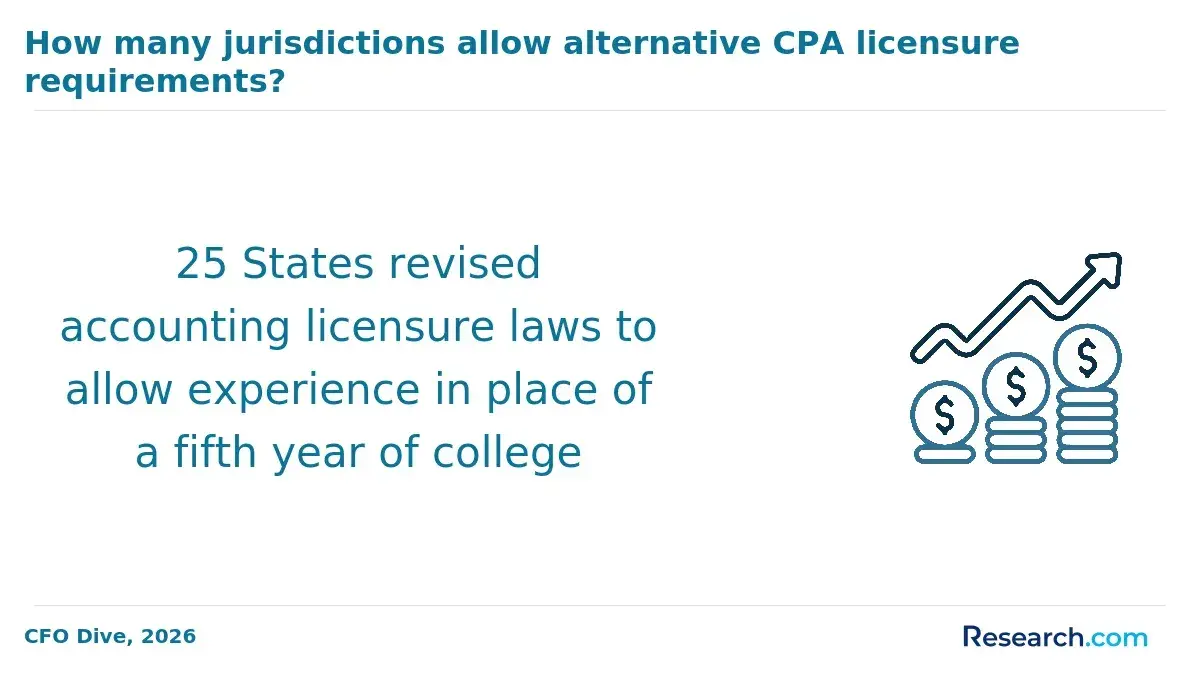
- Certified Public Accountant (CPA). CPA candidates must pass the Uniform CPA Exam. Some states require a master’s degree, although the majority only mandate 150 credit hours in accounting and business courses, along with work experience and ethics courses.
- Certified Management Accountant (CMA). The CMA does not require a master’s degree, but graduate study can strengthen knowledge in financial planning, analysis, performance management, and strategic decision-making.
- Certified Internal Auditor (CIA). A master’s degree can support CIA preparation, although it is not mandatory. The CIA exam focuses on internal audit principles, and certification requires two years of pertinent work experience.
- Chartered Global Management Accountant (CGMA). This international designation emphasizes management accounting. A master’s degree can strengthen preparation for the CIMA Professional Qualification exams.
- Certified Fraud Examiner (CFE). The CFE, offered by the Association of Certified Fraud Examiners (ACFE), is a widely recognized credential for fraud investigation. It requires passing the CFE Exam and following a code of ethics.
How long does it take to complete a master of accounting program?
A Master of Accounting program typically ranges from 12 to 24 months. The exact timeline depends on program format, enrollment intensity, prerequisites, and whether the student studies online, on campus, or in a hybrid format.
Full-time students can often finish in one to one and a half years. Part-time students may take up to two years or more, especially if they are balancing school with full-time work. Some accelerated programs can be completed in as little as 12 months, but the shorter timeline usually means a heavier course load and less room for schedule disruptions.
Students without enough prior accounting coursework may need prerequisite or bridge classes before starting graduate-level courses. Online programs may offer more pacing flexibility, but flexibility varies by school. Before enrolling, students should consider work hours, family responsibilities, internship plans, CPA exam timing, and whether an accelerated schedule is sustainable.
| Program Format | Best For | Trade-Off |
| Full-time | Students who want to finish quickly and can reduce work hours. | Higher short-term workload and possible income disruption. |
| Part-time | Working professionals who need a manageable pace. | Longer time to graduation. |
| Accelerated | Students with strong preparation and a clear career timeline. | Less flexibility and more intensive semesters. |
| Online or hybrid | Students who need location or schedule flexibility. | Requires self-discipline and careful review of support services. |
What are the potential challenges of pursuing a master of accounting degree?
A master’s in accounting can be demanding academically, financially, and professionally. Students often balance advanced technical coursework with work deadlines, family responsibilities, and certification planning. The challenge is not only completing the degree; it is choosing a program that fits your goals without creating unnecessary cost or stress.
- Heavy coursework. Graduate accounting classes may cover advanced reporting, audit, tax, analytics, regulation, and research-intensive assignments.
- Cost pressure. Tuition, fees, loan interest, and lost work time can reduce ROI if students enroll without a financing plan.
- Prerequisite gaps. Career changers may need additional accounting or business courses before taking graduate-level classes.
- Licensing complexity. CPA rules vary by state, so a program that works for one student may not meet another student’s licensing needs.
- Specialization risk. Choosing a narrow track without understanding employer demand can limit flexibility.
Students who are not ready for graduate study may benefit from a lower-cost foundation first, such as a cheap associate's degree in accounting online, before moving toward more advanced credentials.
Which additional certifications can enhance a master’s in accounting career?
Additional certifications can help accounting professionals demonstrate specialized knowledge beyond the graduate degree. The best credential depends on the target role. Audit-focused students may consider internal auditing credentials, tax-focused students may prioritize CPA preparation, and fraud-focused students may look toward investigative credentials.
Shorter credentials can also help professionals strengthen a specific area of practice. For example, a certified bookkeeping professional certification may be useful for those who want to reinforce transaction-level accuracy, small business accounting, or foundational financial recordkeeping while building toward broader accounting roles.
Are there flexible scheduling options for master of accounting students with work obligations?
Many master of accounting programs are designed for working adults, but flexibility varies significantly. Students should check whether classes are live, asynchronous, compressed, weekend-based, or tied to set deadlines before assuming the program will fit their schedule.
- Part-time programs. These allow students to take fewer courses each term and may include evening, weekend, or online options.
- Accelerated programs. These shorten the timeline but usually require intensive study and careful time management.
- Modular programs. Courses may run in blocks rather than traditional semesters, which can help students focus on one subject at a time.
- Online programs. Remote coursework can reduce commuting and allow students to study from different locations.
- Hybrid programs. These combine online coursework with selected campus meetings, giving students some face-to-face interaction without requiring full-time campus attendance.
- Evening and weekend classes. These are built around standard work hours and can be useful for students employed during the day.
- Asynchronous learning. Students complete coursework within deadlines without attending every class at a fixed time.
- Independent study options. Some schools allow supervised projects that align with a student’s professional interests or schedule constraints.
How does CPA certification impact career earnings and advancement?
CPA certification can strengthen a master of accounting graduate’s career profile because it signals technical competence, ethical responsibility, and readiness for regulated accounting work. The combination can be especially valuable for roles in audit, tax, financial reporting, controllership, public accounting, and advisory services.
Career impact depends on the role, state requirements, employer expectations, and experience level. Students considering CPA preparation should compare education requirements, exam timing, work experience rules, and compensation patterns using resources such as CPA highest salary data.
How are master of accounting programs adapting to changes in accounting regulations?
Accounting regulations, tax rules, reporting standards, and compliance expectations continue to evolve. Strong master of accounting programs update coursework so students can interpret current standards, apply professional judgment, and understand how regulation affects real organizations.
- Updated accounting standards. Programs may revise coursework to reflect changes related to GAAP and IFRS.
- Tax law and compliance focus. Many curricula emphasize tax regulation, compliance planning, and international tax considerations.
- Technology in compliance. Courses may cover blockchain, AI, analytics, and other tools that affect audit trails, controls, and regulatory reporting.
- Ethics and professional standards. Programs often include ethical decision-making tied to reporting, audit independence, fraud risk, and governance.
- Flexible formats for working professionals. Some schools offer accelerated career programs for students who need to update skills while remaining employed.
- Certification preparation. Coursework may support preparation for CPA, CMA, CIA, and related credentials that require current regulatory knowledge.
- Real-world case analysis. Case studies can help students understand how companies respond to new rules, enforcement actions, and complex compliance situations.
Students should ask how often the curriculum is reviewed, whether practitioners contribute to course design, and how the program teaches regulatory research rather than relying only on memorization.
What are the benefits of accelerated accounting degree programs for career growth?
Accelerated accounting programs can help motivated students finish faster, meet education milestones sooner, and move more quickly toward certification or promotion. They may be especially useful for students who already have strong accounting preparation and a clear plan for CPA eligibility or advancement.
Many professionals use accelerated programs to work toward the 150-credit hour requirement for CPA certification. Some programs also include advanced financial reporting, audit, tax, and data analytics coursework that supports roles such as auditor, financial analyst, forensic accountant, or international tax specialist.
For working professionals, online accelerated accounting degree programs may provide shorter terms and asynchronous coursework. The advantage is speed; the risk is workload. Students should be realistic about weekly study time, busy seasons, family obligations, and exam preparation before choosing the fastest option.
Common Mistakes to Avoid When Choosing a Master of Accounting Program
- Choosing a program without checking accreditation. Accreditation affects credit transfer, employer confidence, financial aid eligibility, and graduate school credibility.
- Assuming every accounting master’s program meets CPA requirements. CPA rules vary by state, and students must verify education requirements before enrolling.
- Comparing tuition only. Fees, books, software, exam preparation, travel, and lost work time can change the real cost.
- Ignoring prerequisite courses. Students without an accounting background may need extra classes that add time and expense.
- Relying only on rankings. Rankings can be useful, but fit, cost, curriculum, faculty access, employer connections, and CPA alignment matter more.
- Assuming an online degree is automatically easier. Online programs require self-management, strong writing skills, and consistent participation.
- Borrowing without a career plan. Graduate debt should be tied to a realistic path toward advancement, specialization, or credential eligibility.
Questions to Ask Before Enrolling
- Is the institution accredited, and does the accounting program have any additional recognition that matters to employers or licensing boards?
- Will the program help me meet CPA education requirements in the state where I plan to practice?
- How many prerequisite courses will I need, and what will they cost?
- What is the total estimated cost, including fees, books, software, and exam preparation?
- Can I complete the program while working, or will I need to reduce my hours?
- What internship, recruiting, or career support is available specifically for accounting students?
- Which specializations are offered, and how do they connect to real job roles?
- How does the program teach data analytics, accounting technology, ethics, and regulatory research?
- What are the graduation requirements, and how long do students in my situation usually take to finish?
- What support is available for online students, international students, or students preparing for certification exams?
Here’s What Graduates Have to Say about Their Master of Accounting Degree
- Hannah: "Completing my Master of Accounting online helped me keep my full-time job while moving forward professionally. The virtual classes were engaging, the schedule worked with my responsibilities, and the mix of classmates made discussions more useful. I later became a CPA, and the online format was an important part of making that possible."
- Jade: "My online Master of Accounting made difficult accounting topics easier to apply because the courses used practical case studies, interactive discussions, and clear faculty guidance. I could study from anywhere without feeling disconnected from the program. The degree gave me confidence and helped me grow in my accounting career."
- Daniel: "Choosing an online Master of Accounting gave me control over my study routine while still giving me access to strong resources and a broad professional network. The asynchronous format fit my life, and the classmates came from many backgrounds. The program expanded both my accounting knowledge and my career perspective."
References:
- Aslanian, C. B., Clinefelter, D. L., & Magda, A. J. (n.d.). Online college students: Comprehensive data on demands and preferences. Wiley University Services.
- Bureau of Labor Statistics. (n.d.). Accountants and auditors. U.S. Bureau of Labor Statistics.
- Bureau of Labor Statistics. (n.d.). Financial managers. U.S. Bureau of Labor Statistics.
- EducationDynamics. (n.d.). Online College Students Report: 12th annual report on the demands and preferences of online college students today. EducationDynamics.com.
- Franklin University. (n.d.). What can you do with a master’s in accounting: Top jobs & pay. Franklin University.
- SHRM. (n.d.). New SHRM research makes the case for skills-based hiring. Society for Human Resource Management.
- Accountant demographics and statistics in the US. (2025, January 8). In Zippia. https://www.zippia.com/accountant-jobs/demographics/
Key Insights
- A master of accounting is most valuable when it supports a defined goal: CPA eligibility, specialization, promotion, career change, or movement into leadership.
- Cost varies widely, so students should compare total program expense rather than tuition alone. Public graduate education tuition averages $12,033, while private institutions average $30,446.
- Online accounting master’s degrees can be credible with employers when they come from accredited schools and build measurable skills in accounting, analytics, ethics, and technology.
- Career outcomes are strongest when students pair the degree with internships, relevant work experience, certifications, and a specialization matched to employer demand.
- CPA rules, prerequisite requirements, and licensing expectations differ by state. Confirm requirements before enrolling, especially if your main reason for graduate study is certification.
- Accelerated programs can shorten the path to advancement, but they require strong preparation and realistic time management.
- The best program is not simply the cheapest, fastest, or highest ranked. It is the one that fits your budget, schedule, licensing needs, and career direction with the least unnecessary risk.
Other Things You Should Know About Master of Accounting Cost and Job Opportunities
Yes. In most U.S. states, CPA candidates need 150 semester hours, plus specific accounting and business credits set by the state board of accountancy. A Master of Accounting often adds the extra graduate hours needed, but candidates must still pass the Uniform CPA Examination.
The average cost for a Master’s in Accounting program in 2027 is approximately $30,000 to $50,000. This range depends on factors such as institution type, location, and whether it's an online or on-campus program. Scholarships and financial aid can help reduce expenses.