
2027 Best Accredited Online Medical Billing and Coding Schools With Financial Aid

Co-Founder and Chief Data Scientist
After more than 10 years working in career planning and education analysis, I’ve seen why medical billing and coding appeals to students looking for a faster entry into healthcare without the time and cost demands of longer clinical programs. Based on our evaluation of online medical billing and coding schools, some of the best programs came with moderate, not lowest, tuition rates. Employers increasingly prioritize certification-aligned training, coding accuracy, EHR familiarity, and practical revenue-cycle knowledge over low tuition alone.
Online programs have also expanded access for working adults, caregivers, and career changers who need flexible scheduling while building healthcare credentials. However, affordability is only one part of the decision. Accreditation, certification preparation, software training, and employer recognition often have a greater impact on long-term employability and career advancement. The programs below were selected to help students evaluate both educational cost and real workforce value.
What are the benefits of getting a medical billing and coding degree?
A degree from medical billing and coding schools opens up numerous avenues of opportunity. These benefits span various dimensions, making it an attractive choice for prospective students:
- Access to diverse roles in numerous industries like healthcare providers, insurance companies, government agencies, and IT firms, specifically specializing in medical data management.
- Employment opportunities primarily lie within the Healthcare and IT industry, with nearly 2023 data indicating these fields have the majority % share for employing medical billing and coding specialists.
- The flexibility of an online degree provides an invaluable advantage. The ability to study anytime, from anywhere, aligns perfectly with demanding lifestyles.
- As per data, around 70% of online medical billing and coding students complete their course within a 2-year period.
- Moreover, nearly 80% of graduates secure employment within just 6 months post-graduation, underscoring the high job demand in this field.
What can I expect from a medical billing and coding online degree?
A typical curriculum in medical billing and coding schools will cover important areas such as medical insurance, coding of diagnoses and procedures, as well as claim form completion. The ultimate goal is to equip you with the necessary skills to work successfully in various healthcare positions.
In an online environment, classes typically utilize learning management systems. These platforms facilitate the sharing of resources, interactive discussions, assignments, and exams. All you'll need is a reliable internet connection and you can learn at your own pace, whenever and wherever you find it most convenient.
Where can I work with a medical billing and coding online degree?
A degree in medical billing and coding opens various doors for work across various industries.
- Healthcare Institutions: As a medical coder and biller, most opportunities come in hospitals, clinics, and other healthcare facilities. Here, you'll be responsible for processing patient data, such as diagnosis, treatment records, and related insurance information.
- Insurance Companies: With your skills, you can work at insurance firms, handling claims, deciphering codes for accuracy, and communicating with healthcare providers.
- Freelance Medical Billing and Coding: If a flexible work schedule appeals to you, freelancing offers the opportunity to work on a contract basis for various healthcare providers or companies.
- Government Departments: Public health departments and federal agencies like Medicare and Medicaid hire medical billers and coders to process and manage healthcare data.
- Education and Training Companies: As an experienced medical biller and coder, you could educate others in this field in a traditional classroom setting or via online platforms.
How much can I make with a medical billing and coding degree?
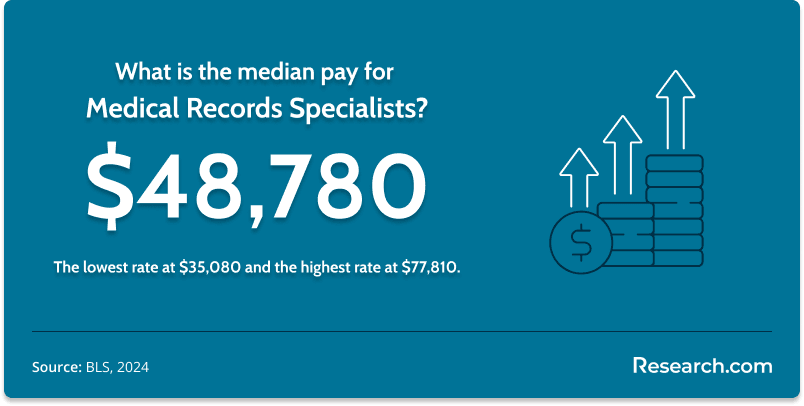
You can earn a sizable income with a degree in medical billing and coding. The Bureau of Labor Statistics' 2023 data reveals that the median annual wage for medical records specialists, which includes medical billers and coders, was $48,780. This wage is the midpoint in the earnings spectrum - half of the workers earned more, while half earned less. Looking at the extremes, the wages ranged from below $35,080 (the earnings of the lowest 10 percent) to above $77,810 (the earnings of the highest 10 percent).
- Those in the management of companies and enterprises earn the highest mean salary of $53,320 annually.
- Hospitals (both state and private) offer an annual mean wage of $52,350.
- Administrative support services provide an annual salary of $50,120.
- Professional scientific and technical services offer a pay of $47,500 per year.
- On the other hand, the offices of physicians pay a slightly lower annual salary of $43,710.
- Best Medical Billing And Coding Schools Online With Financial Aid Programs for 2027 List of Schools
- How long does it take to complete a medical billing and coding online degree? Program Length
- How does a medical billing and coding online degree compare to an on-campus program? Online vs. On-Campus
- What is the average cost of a medical billing and coding online degree? Average Cost
- What are the prerequisites for enrolling in medical billing and coding online degree? Enrollment Prerequisites
- What courses are typically in a medical billing and coding online degree? What courses are typically in a medical billing and coding online degree?
- What specializations are available in medical billing and coding? Specializations
- How to choose the best medical billing and coding online degree? Program Selection Criteria
- What are the accreditation standards for medical billing and coding online programs? What are the accreditation standards for medical billing and coding online programs?
- What career paths are available for graduates of medical billing and coding online degrees? Career Paths
- What is the job market for graduates with a medical billing and coding schools online degree? What is the job market for graduates with a medical billing and coding schools online degree?
- Can advanced healthcare education boost your medical billing and coding career? Can advanced healthcare education boost your medical billing and coding career?
- Can Complementary Accelerated Healthcare Programs Boost Your Career Advancement? Can Complementary Accelerated Healthcare Programs Boost Your Career Advancement?
- How Will Digital Transformation Shape Your Medical Billing and Coding Career? How Will Digital Transformation Shape Your Medical Billing and Coding Career?
Best Online Medical Billing and Coding Schools With Financial Aid Options for 2027
Choosing an online medical billing and coding program is not just a question of which school is cheapest or fastest. The better question is whether the program can help you become certification-ready, understand real claims workflows, and enter healthcare administration without taking on unnecessary cost. Medical billing and coding appeals to working adults, career changers, and healthcare support workers because many programs are online, relatively short, and connected to credentials such as CPC, CCA, CBCS, and CCS.
This guide explains how online medical billing and coding programs work, what they cost, how long they take, which schools offer notable options, what financial aid can and cannot cover, and how to compare programs before enrolling. It also covers accreditation, certification pathways, career outcomes, technology trends, and common mistakes that can delay employment after graduation.
Quick Answer: What Is the Best Online Medical Billing and Coding Program?
The best online medical billing and coding program is the one that matches your timeline, budget, certification goal, and preferred learning format. A short certificate or diploma may be best if you want faster entry into billing or coding support roles, while an associate degree or health information management pathway may be better if you want broader advancement in healthcare administration. Before choosing, confirm that the curriculum prepares you for recognized certification exams, includes ICD-10, CPT, HCPCS, medical terminology, insurance billing, and claims processing, and offers transparent information about tuition, fees, financial aid, and exam preparation.
How We Ranked These Online Medical Billing and Coding Programs
Because tuition, certification preparation, and program length can vary widely, Research.com evaluates schools using transparent education and workforce data where available. Our ranking process draws from sources such as the IPEDS database, Peterson's database, the College Scorecard database, and The National Center for Education Statistics. These sources help support comparisons of online medical billing and coding programs, institutional characteristics, and student-facing cost information. You can read more about Research.com's process on our methodology page.
Best Online Medical Billing and Coding Schools With Financial Aid Options
The schools below offer online or online-accessible medical billing, coding, health information, or related programs. Costs, course lengths, and course examples are listed exactly as provided, but students should verify current tuition, fees, aid eligibility, certification exam coverage, and state-specific requirements directly with each school before enrolling.
| School | Program Cost | Course Length | Best Fit |
| Purdue Global | $371 per credit | Average completion in 11 months | Learners seeking a structured online certificate with a practicum and certification preparation |
| Southern New Hampshire University | $990 ($330/credit) | 8 weeks | Students interested in coding coursework within a CAHIIM-accredited BS in Health Information Management |
| Penn Foster | $1,099. | Up to 15 months | Self-paced learners preparing for the Certified Billing & Coding Specialist (CBCS) exam |
| Wake Technical Community College | $2,076 | 376 hours | Students seeking CPC and CBCS preparation through a community college pathway |
| Southern Careers Institute | $18,450 | 36 weeks | Learners who want billing, coding, software, office protocol, and certification-focused training |
| Ultimate Medical Academy | $475 per credit hour | 18 months | Students comparing diploma and associate degree tracks for entry-level preparation |
| North-West College | $18,491 | 40 weeks | Learners who want a module-based program with a clinical externship component |
| Cambridge College of Healthcare & Technology | $13,300 (est.) | 38 weeks | Students seeking a fully online certificate aligned with entry-level billing and coding roles |
| Everett Community College | $122.76 per credit (est.) | not specified | Students interested in an AHIMA-endorsed medical coding pathway and CCA exam eligibility |
| University of Maryland Global Campus | $324 per credit | 18 credits | Learners who want health information management and healthcare data analytics rather than a narrow coding-only program |
1. Purdue Global
Purdue Global offers an online medical billing and coding certificate designed for students who want a structured route into healthcare revenue-cycle work. The program combines core billing and coding coursework with practical experience and preparation for industry-recognized credentials.
- Program cost: $371 per credit
- Key courses: Anatomy, Physiology, Pharmacology, Data Information Processing, Medical Billing, Coding, and Terminology, Insurance Billing, Medical Office Management
- Course length: Average completion in 11 months
2. Southern New Hampshire University
SNHU offers a Coding and Classification Systems course as part of its CAHIIM-accredited BS in Health Information Management. This option is best for students who want coding knowledge within a broader health information management degree rather than a standalone billing and coding certificate.
- Program cost: $990 ($330/credit)
- Key courses: Patient Health Record Identification, Coding Classification Systems, Code Validation, and Applying Healthcare Guidelines
- Course length: 8 weeks
3. Penn Foster
Penn Foster provides an online Medical Billing and Coding Career Diploma that prepares students for the Certified Billing & Coding Specialist (CBCS) exam. Its self-paced format may appeal to learners who need flexibility, but students should still build a study schedule for coding practice and exam review.
- Program cost: $1,099.
- Key courses: Learn to apply CPT, ICD-10, HCPCS coding rules, identify record retrieval and reimbursement procedures, understand a medical coder's role, and use electronic health records software.
- Course length: Up to 15 months
4. Wake Technical Community College
Wake Technical Community College offers an online Medical Billing and Coding program focused on documentation, medical insurance claims, diagnosis and procedure coding, and submitting charges to insurance companies. The program also supports preparation for the Certified Professional Coder and Certified Billing and Coding Specialist exams.
- Program cost: $2,076
- Key courses: documentation, insurance processing, CPC and CBCS preparations
- Course length: 376 hours
5. Southern Careers Institute
Southern Careers Institute offers an online medical billing and coding program built around practical administrative healthcare skills, including insurance billing, coding, billing software, office procedures, and professional communication.
- Program cost: $18,450
- Key courses: Students can pursue certifications like CBCS, CMAA, EHRS, and Microsoft Word Certification, enhancing career prospects.
- Course length: 36 weeks
6. Ultimate Medical Academy
Ultimate Medical Academy offers both diploma and associate degree options in medical billing and coding. The diploma route is designed for quicker entry-level preparation, while the associate degree adds broader general education and healthcare coursework that may support longer-term advancement.
- Program cost: $475 per credit hour
- Key courses: diagnostic coding for MBC, billing and coding application with simulation, medical law, ethics, and records management, healthcare settings, claim cycle, and claims processing
- Course length: 18 months
7. North-West College
North-West College offers an online medical billing and coding program that covers medical insurance processes, billing, pre-authorization follow-up, insurance payment posting, and applied administrative tasks. The curriculum includes eight-course modules and a clinical externship for real-world practice.
- Program cost: $18,491
- Key courses: scheduling patient appointments, organizing and maintaining data for clinical databases and registries, using classification software to assign clinical codes for reimbursement and data analysis
- Course length: 40 weeks
8. Cambridge College of Healthcare & Technology
Cambridge College of Healthcare & Technology offers a fully online Certificate in Medical Billing and Coding. The program is designed for students who want entry-level billing and coding preparation through coursework that covers coding systems, insurance procedures, medical terminology, and professional development.
- Program cost: $13,300 (est.)
- Key courses: Advanced CPT and ICD10, Anatomy & Physiology Labs, Certification Review, Computer in Healthcare, CPT-4, Fundamentals of ICD Coding, HCPCS, Insurance Procedures, Medical Terminology, and Professional Development.
- Course length: 38 weeks
9. Everett Community College
EvCC offers a medical coding program endorsed by AHIMA that allows students to sit for the Certified Coding Associate (CCA) exam. Students may complete the 65-credit Certificate in Medical Coding and can add credits toward a Medical Billing Specialist Certificate or an ATA in Medical Billing and Coding.
- Program cost: $122.76 per credit (est.)
- Key courses: pathopharmacology, principles of med insurance, procedural coding, structure/function body
- Course length: not specified
10. University of Maryland Global Campus
University of Maryland Global Campus offers an online certificate in health information management and data analytics. This is a stronger fit for students interested in healthcare data, information systems, and management concepts than for those looking only for a short medical coding exam-prep program.
- Program cost: $324 per credit
- Key courses: introduction to the U.S. healthcare, introuction to statistics, management in healthcare organizations, research and data analysis in healthcare
- Course length: 18 credits
What Students Say About Online Medical Billing and Coding Programs
- Jordan: "Online study gave me the flexibility to keep working and manage family responsibilities while learning the billing and coding material. The program required discipline, but it helped me feel more confident about entering a healthcare office environment."
- Sophia: "Completing a medical billing and coding certification program online helped me study coding systems at a pace I could manage. It strengthened my understanding of the field and gave me a clearer foundation for healthcare support roles."
- Antonio: "I was surprised by how interactive the online format could be. The insurance, claims, and coding discussions helped me understand how billing connects to patient records and reimbursement in real healthcare settings."
Key Findings for Comparing Online Medical Billing and Coding Programs
- Program length is only one part of the decision. A fast program is useful only if it also prepares you for certification exams and practical coding work.
- Financial aid can reduce upfront cost, but students should compare total cost, fees, exam expenses, software requirements, and repayment obligations.
- Employers tend to focus more on certification readiness, coding accuracy, and claims software familiarity than on whether a program was online or campus-based.
- Accreditation, certification alignment, and hands-on coding practice are more important than marketing claims about speed or convenience.
- Remote entry-level roles may attract more applicants, so candidates should build evidence of coding practice, EHR familiarity, and exam preparation before applying.
How Long Does an Online Medical Billing and Coding Program Take?
Online medical billing and coding programs can take anywhere from a short course to several years, depending on whether the credential is a certificate, diploma, certification-prep course, or associate degree. The key issue is not only when coursework ends, but when you are prepared to pass a certification exam and perform accurate coding or billing work.
| Program Type | Typical Timeline | What It Means for Students |
| Certificate or diploma programs | 4 weeks–6 months | These are fast routes into basic billing and coding concepts, but some students may still need additional certification exam preparation. |
| Accelerated online courses | around 4 months | These programs compress ICD-10, CPT, insurance, and claims topics into a shorter schedule, which can be demanding for beginners. |
| Certification-focused programs | up to 1 year | These programs are often built around exam preparation and may reduce the gap between completion and job eligibility. |
| Associate degrees | 2–3 years | These take longer but usually include broader healthcare, general education, and administrative coursework that may support future advancement. |
Students comparing program speed should also consider weekly workload, exam dates, practicum or externship requirements, and whether certification review is included. In our database of best private colleges in the U.S., short programs can be attractive for quick entry, but accelerated learners may need extra practice if the course does not include enough structured coding exercises. Longer programs delay entry into paid work but may reduce early skill gaps.
The best timeline depends on your financial pressure, current work schedule, certification goal, and how quickly you need to move into healthcare employment.
Online vs. On-Campus Medical Billing and Coding Programs: Which Is Better?
Online and on-campus medical billing and coding programs can both lead to entry-level healthcare administration roles when the curriculum is credible and certification-aligned. The real difference is learning structure. Online students get flexibility but need stronger self-discipline, while campus students receive more scheduled accountability and in-person interaction.
| Factor | Online Program | On-Campus Program |
| Schedule | Better for working adults, caregivers, and students who need flexible study times | Better for students who benefit from fixed class meetings and routine |
| Accountability | Requires self-management and consistent independent practice | Provides scheduled pacing, classroom reminders, and more direct oversight |
| Costs | May reduce commuting and housing expenses but can still include exam, software, and technology costs | May include more campus-based resources but often comes with higher attendance-related expenses |
| Learning tools | Often uses online modules, virtual simulations, coding exercises, and digital claims practice | Often uses classroom instruction, labs, and immediate instructor feedback |
| Employer perception | Usually acceptable if the program is credible and the graduate is certification-ready | Also acceptable, especially when paired with recognized certification and applied experience |
Employers generally care more about whether you can assign codes accurately, understand claims workflows, use EHR or billing software, and prepare for credentials such as CPC, CCA, CBCS, or CCS. Delivery format matters less than proof of competence.
Technology is also changing the field. A 2026 peer-reviewed study trained on 5.8 million electronic health records from 1.8 million patients found that automated ICD-10 coding systems reached a micro F1 score of 71.8% coding accuracy. That result shows why human review, documentation judgment, and consistent coding training remain important even as automated tools improve.
Medical billing jobs can serve as an entry point across healthcare settings, as shown below:
What Is the Average Cost of an Online Medical Billing and Coding Program?
Students often ask how much online classes for medical billing and coding cost. Based on the information provided, students spend around $234 per credit hour on average, although actual prices vary by school, credential type, residency status, and included services. Some learners choose cheap online medical billing and coding courses, while others pay more for programs with broader support, certification review, externships, or institutional recognition.
- Many medical billing and coding programs require between 20 to 30 credit hours, which places the estimated tuition range from $4,680 to $7,020 before added fees.
- Additional expenses may include virtual classroom technology, lab fees, background checks, coding manuals, certification preparation, and professional exam fees from organizations such as AHIMA or AAPC.
- In-state and out-of-state tuition policies can change the total price, especially at public institutions.
- Financial aid can cover up to 60% of tuition costs for eligible students enrolled in online medical billing and coding programs, but students should confirm eligibility directly with the school and avoid assuming this applies automatically.
Do not evaluate affordability by tuition alone. Ask whether the program includes certification exam preparation, practice tools, textbooks, coding resources, career services, and fees. A lower-priced course may still be a good choice, but only if it gives you the skills and exam preparation you need.
What Are the Prerequisites for Online Medical Billing and Coding Programs?
Admission requirements vary by school and credential level. Short career programs may have simple entry requirements, while degree programs can require more formal admissions documents. Common prerequisites include:
- High school diploma or GED: Most programs require proof that you completed secondary education before beginning postsecondary training.
- Application and fee: Schools usually require an application, and some charge an application fee. Students trying to reduce upfront costs may also compare online universities with no application fee.
- Official high school transcript: This document helps admissions staff verify academic history and eligibility.
- Resume or CV: Some programs request work history, especially if healthcare, office, insurance, or administrative experience is relevant.
- Letters of recommendation: These may be requested to support your application and describe your work habits or academic readiness.
- SAT or ACT scores: Some institutions use standardized test scores, although many career-focused programs do not require them.
Before applying, also ask whether the program requires a background check, technology requirements, keyboarding skills, prior healthcare experience, or placement assessments.
What Courses Are Included in an Online Medical Billing and Coding Program?
A strong curriculum should teach the language of healthcare, the structure of medical records, insurance reimbursement, coding systems, and claims submission. Common courses include:
- Medical Terminology: Students learn the vocabulary used to describe diseases, injuries, procedures, tests, body systems, and clinical documentation.
- Anatomy and Physiology: This course explains body structures and functions so students can connect diagnoses and procedures to accurate codes.
- Medical Insurance: Students study insurance plans, claims rules, payer requirements, reimbursement procedures, and common billing processes.
- Claim Form Completion: This course teaches students how to complete healthcare claim forms used to request payment from insurers.
- ICD-10-CM Coding: Students learn the International Classification of Diseases, 10th Revision, Clinical Modification system used to classify diagnoses in healthcare settings.
- Medical Records: This course covers how patient information is created, organized, protected, retrieved, and used for coding and billing.
Better programs go beyond definitions and require students to practice coding from sample records, correct errors, understand denials, and apply official guidelines.
What Medical Billing and Coding Specializations Are Available?
Medical billing and coding professionals can specialize by care setting, coding system, reimbursement model, or clinical specialty. These credentials can help professionals move beyond general entry-level roles.
- Certified Professional Coder (CPC): A widely recognized credential focused on procedure and diagnosis coding across medical settings.
- Certified Outpatient Coder (COC): A credential for coders working with outpatient hospital and ambulatory surgical center services.
- Certified Inpatient Coder (CIC): A credential for professionals who code inpatient hospital diagnoses and procedures.
- Certified Risk Adjustment Coder (CRC): A certification focused on coding for risk adjustment models used to estimate healthcare costs and patient risk.
- Specialty Certifications: Coders can pursue focused credentials in areas such as Pediatrics, Orthopedics, and Cardiology, among others.
Some professionals later move into healthcare administration, compliance, health information management, or clinical-adjacent leadership. Depending on your long-term goals, you may eventually compare broader graduate options such as affordable online masters in healthcare administration or even a different people-centered path such as online masters degree programs in counseling.
How to Choose the Best Online Medical Billing and Coding Program
The strongest programs connect three essentials: certification readiness, employer-relevant skills, and realistic cost. A program should not simply promise flexibility; it should show how students learn ICD-10, CPT, HCPCS, medical documentation, insurance rules, and claims workflows.
| What to Check | Why It Matters | Question to Ask |
| Certification alignment | Employers often value credentials such as CPC, CCA, CBCS, and CCS. | Which certification exam does the curriculum prepare me for? |
| Accreditation and institutional credibility | Accreditation affects trust, transfer options, aid eligibility, and employer confidence. | Is the school accredited, and is the program connected to AAPC, AHIMA, CAHIIM, or another recognized pathway? |
| Hands-on practice | Coding is learned through repetition, not memorization alone. | Will I practice ICD-10, CPT, HCPCS, claims forms, denials, and EHR workflows? |
| Total cost | Tuition may not include exam fees, books, software, or background checks. | What is the full cost from enrollment through certification testing? |
| Program length | Fast programs can be efficient, but they may require intense independent study. | How many hours per week should I expect to study? |
| Career support | Entry-level remote roles can be competitive. | Does the school provide resume help, mock interviews, externships, or employer connections? |
If your goal is rapid workforce entry, a certificate or diploma may make sense. If your goal is advancement into supervision, revenue cycle management, health information, or administrative leadership, an associate degree or later graduate study may offer a stronger long-term route. Some professionals eventually pursue broader business or workplace leadership paths, including an affordable online master's degree in human resources, depending on career direction.
What Accreditation Standards Matter for Online Medical Billing and Coding Programs?
Accreditation helps students determine whether a school meets recognized educational standards. For medical billing and coding, accreditation and professional alignment are especially important because employers and certification bodies may look for evidence that your training followed accepted healthcare information, coding, and compliance expectations.
Programs may reference organizations such as the Commission on Accreditation for Health Informatics and Information Management Education (CAHIIM), the American Academy of Professional Coders (AAPC), or AHIMA-related certification pathways. These signals can help you judge whether the curriculum reflects current healthcare documentation, coding, reimbursement, and regulatory practices.
Before enrolling, confirm both institutional accreditation and program-level relevance. A school may be accredited, but the specific program still needs to prepare you for the certification and job setting you want. Students comparing accredited distance-learning options can also review Research.com's guide to online universities accredited by recognized agencies.
Accreditation does not guarantee employment or certification exam success, but choosing a credible program can reduce the risk of paying for training that employers or certification organizations do not value.
What Jobs Can You Get With an Online Medical Billing and Coding Credential?
Graduates may qualify for healthcare administration, records, billing, coding, reimbursement, or health information support roles depending on the program completed, certification earned, and employer requirements. Common paths include:
- Medical Records Specialist: Organizes, updates, protects, and checks patient records for accuracy and accessibility.
- Health Information Technologist: Works with healthcare data systems, patient information, and record-management processes.
- Medical Registrar: Maintains health records, coordinates patient data, and helps protect confidentiality in clinical settings.
- Pharmacy Technician: A medical coding background may support certain pharmacy-related administrative functions, although pharmacy technician roles have their own training and employer requirements.
There are also over 20 specialty certification programs for professionals who want to focus on particular coding settings or medical specialties. Some students later move into different technical or business fields through programs such as cheap masters in computer science online or affordable online master's in accounting, but those paths require separate planning and should not be treated as automatic extensions of coding training.
What Is the Job Market Like for Medical Billing and Coding Graduates?
The medical billing and coding job market is steady but selective. Bureau of Labor Statistics projections show roughly 8% growth over the next decade, but that does not mean every graduate will find an entry-level job immediately. Employers are increasingly attentive to certification, software experience, coding accuracy, productivity expectations, and familiarity with real claims workflows.
Where Employers Hire
Hospitals, clinics, physician offices, insurance companies, outsourced revenue cycle management firms, and healthcare vendors all hire billing and coding talent. Hospitals and clinics may prioritize certification signals such as CPC or CCA. Insurance companies and revenue cycle management employers may have more frequent hiring needs, but they can also expect new hires to become productive quickly.
Why Entry-Level Remote Roles Are Competitive
Remote billing and coding jobs attract a large applicant pool because they combine healthcare work with location flexibility. Graduates who stand out usually have more than a completion certificate. They can show certification progress, coding practice, EHR or claims software familiarity, and a clear understanding of payer rules and documentation requirements.
What Employers Expect
ICD-10-CM is required across U.S. healthcare settings for diagnosis reporting and reimbursement under CMS 2024–2025 coding guidelines. That makes coding-system fluency a baseline requirement, not a bonus skill. Graduates who can apply ICD-10, CPT, and HCPCS accurately are better positioned than those who only understand coding terms in theory.
Can Advanced Healthcare Education Improve a Medical Billing and Coding Career?
Advanced healthcare education can help medical billing and coding professionals move into broader roles involving compliance, revenue cycle management, health information management, operations, or leadership. Additional education can also deepen understanding of clinical terminology, healthcare systems, documentation standards, and regulatory expectations.
However, advanced degrees are not required for every billing or coding role. They make the most sense when your goal extends beyond entry-level coding into supervision, analytics, compliance, administration, or clinical-adjacent leadership. For professionals interested in deeper clinical knowledge, programs such as the best online Pharm D programs show how advanced healthcare education can broaden understanding of patient care, medication systems, and healthcare operations.
What Technology Tools Do Medical Billing and Coding Professionals Use?
Technology is central to modern billing and coding work. Students should choose programs that include exposure to digital systems rather than relying only on textbook definitions.
- Electronic Health Records (EHR) Systems: EHR platforms store patient information and allow coders to review diagnoses, procedures, provider notes, and treatment details.
- Practice Management Software: These tools support scheduling, billing, patient account tracking, insurance claims, and office workflow.
- Coding Software (ICD-10, CPT, and HCPCS): Coders use digital references and coding tools to assign standardized diagnosis and procedure codes accurately.
- Claims Management Systems: These systems help submit claims, monitor claim status, manage denials, and support reimbursement follow-up.
- Compliance Software: Healthcare organizations use compliance tools to reduce risk related to billing rules, coding guidelines, HIPAA requirements, audits, and documentation errors.
- Revenue Cycle Management (RCM) Tools: RCM platforms connect coding, billing, collections, payments, and reporting so healthcare organizations can track financial performance.
What Are the Cheapest Online Medical Coding Certification Programs?
Low-cost programs can be a smart option if they cover the essentials: ICD-10, CPT, HCPCS, medical terminology, insurance billing, claims processing, compliance, and certification exam preparation. Students comparing the cheapest medical coding certification online programs should avoid choosing on tuition alone.
Ask whether the program includes textbooks, coding manuals, exam vouchers, practice exams, instructor support, software access, and career services. A budget-friendly program is worthwhile when it prepares you for a recognized credential and entry-level expectations without shifting too many hidden costs to the end of the program.
What Factors Influence Medical Coder Salary?
Medical coder pay can vary based on certification, specialty, experience, employer type, location, productivity expectations, and familiarity with coding and claims technology. Credentials, specialty coding knowledge, and experience with revenue cycle systems may improve earning potential over time. For a detailed salary guide, review Research.com's overview of medical coder salary.
How Do Medical Billing and Coding Earnings Compare With Medical Assistant Pay?
Medical billing and coding and medical assisting are both healthcare support paths, but they involve different work. Billing and coding is more administrative, records-focused, and reimbursement-driven, while medical assisting often includes direct patient interaction and clinical office support. Pay also varies by state, employer, and credential. For a state-by-state comparison, see Research.com's medical assistant salary guide.
How Do Medical Billing and Coding Careers Compare With Pharmacy Careers?
Medical billing and coding is primarily an administrative and technical healthcare path centered on records, claims, coding accuracy, and compliance. Pharmacy careers usually require more clinical training, specific licensure steps, and direct involvement with medications and patient care. If you prefer documentation, data, and insurance processes, billing and coding may fit better. If you want a clinical medication-focused career, pharmacy may be more appropriate. To compare requirements, review Research.com's guide on how to become pharmacist.
Can Supplemental Certifications Help You Advance Faster?
Additional certifications can improve career mobility when they complement your role. For example, a coding professional may benefit from credentials in billing, reimbursement, compliance, EHR systems, office administration, or specialty coding. Supplemental healthcare training may also make sense if you want broader patient-facing or administrative responsibilities. Research.com's guide on How long does it take to get a medical assistant certificate? can help you compare accelerated healthcare support training options.
How to Get Started With an Online Medical Billing and Coding Program
Before enrolling, make sure the program supports your actual career goal. A program that is fast, cheap, or fully online is not automatically the best choice if it does not prepare you for certification or entry-level workflows.
- Decide whether you want the fastest route into billing and coding or a longer credential that may support advancement later.
- Match the program to a recognized certification pathway, such as AAPC or AHIMA-aligned preparation.
- Confirm that the curriculum includes practical work with ICD-10, CPT, HCPCS, claims forms, medical records, and billing software.
- Compare the total cost, including tuition, fees, books, software, exam preparation, and certification exams.
- Ask whether the school offers structured exam review, instructor support, tutoring, career services, or externship opportunities.
- Choose a pace you can realistically manage based on your weekly work, family, and study schedule.
If you want to test the field before committing to a longer program, you may want to compare a focused option such as this 4-week online course for medical coding and billing, which introduces core concepts in a condensed format.
Can Complementary Accelerated Healthcare Programs Support Career Growth?
Accelerated healthcare programs can broaden your understanding of clinical operations, patient workflows, and administrative coordination. They are most useful when they support a clear career plan rather than distract from your primary coding or billing goal. For example, students interested in understanding a more advanced clinical pathway can review the best accelerated PharmD programs to see how pharmacy education differs from administrative healthcare training.
How Will Digital Transformation Affect Medical Billing and Coding Careers?
Digital transformation is changing healthcare administration through automated claims processing, AI-assisted coding tools, electronic health record systems, analytics dashboards, and integrated revenue cycle platforms. These tools can improve efficiency, but they also raise expectations for accuracy, compliance, and technology fluency.
Future-ready billing and coding professionals should understand coding systems, documentation rules, payer requirements, data privacy, and software workflows. Those who want broader clinical and technical context may also explore related healthcare education options such as PharmD programs online, although pharmacy education serves a different career goal than billing and coding.
What Certifications Are Available for Medical Billing and Coding Professionals?
Certifications can help demonstrate job-ready knowledge and may improve competitiveness for entry-level and advancement roles. Common credentials include:
- Certified Professional Coder (CPC): Offered by the American Academy of Professional Coders (AAPC), this credential validates knowledge of coding guidelines, medical terminology, and procedure and diagnosis coding.
- Certified Coding Specialist (CCS): Offered by the American Health Information Management Association (AHIMA), this credential is designed for coders working with hospital and outpatient records.
- Certified Coding Specialist – Physician-based (CCS-P): Also offered by AHIMA, this certification focuses on coding in physician office and outpatient care settings.
- Certified Inpatient Coder (CIC): This AAPC credential is intended for coders who work with inpatient hospital diagnoses and procedures.
- Certified Outpatient Coder (COC): Formerly known as CPC-H, this AAPC credential focuses on hospital outpatient facility coding.
- Certified Billing and Coding Specialist (CBCS): Offered by the National Healthcareer Association (NHA), this credential covers both billing and coding, including claims and reimbursement concepts.
- Certified Medical Reimbursement Specialist (CMRS): Offered by the American Medical Billing Association (AMBA), this credential emphasizes reimbursement, insurance claims, coding, and billing compliance.
- Registered Health Information Technician (RHIT): Offered by AHIMA, this broader credential includes health information management and can support advancement beyond coding-only roles.
Common Mistakes to Avoid When Choosing a Program
| Mistake | Why It Can Hurt You | Better Approach |
| Choosing only by lowest tuition | A cheap program may exclude exam preparation, books, coding tools, or career support. | Compare total cost through certification, not just tuition. |
| Ignoring accreditation | Employers and certification pathways may not recognize weak or unclear training. | Verify institutional accreditation and program relevance before enrolling. |
| Assuming online means easy | Self-paced study requires discipline, especially when learning ICD-10, CPT, and claims rules. | Choose a schedule and support level that match your study habits. |
| Skipping certification planning | Completing coursework may not be enough to compete for jobs. | Know which exam you plan to take before starting the program. |
| Overlooking software practice | Employers expect familiarity with EHR, claims, billing, and coding tools. | Prioritize programs with applied simulations or workflow practice. |
| Relying only on rankings | A highly ranked school may not be the best fit for your budget, timeline, or credential goal. | Use rankings as a starting point, then compare outcomes, support, and certification fit. |
References
- A learning experience designed for student success. (n.d.). [Video]. Penn Foster Medical Billing and Coding Career Diploma
- Design Admin. (2024, April 24). Financial aid for online medical billing and coding studies. Cambridge College of Healthcare & Technology. Cambridge College of Healthcare & Technology financial aid resource
- Medical Billing and Coding | Alamo Colleges. (n.d.). Alamo Colleges medical billing and coding program page
- Occupational Outlook Handbook - Medical Records Specialists. (2024, April). U.S. Bureau of Labor Statistics. Retrieved April 24, 2024, from BLS Occupational Outlook Handbook for medical records specialists
Key Insights
- The best online medical billing and coding program is the one that prepares you for certification, not just course completion.
- Short programs can help you enter the field faster, but they may require more independent study before you are exam-ready.
- Accreditation, certification alignment, practical coding exercises, and software exposure are stronger decision factors than marketing claims about flexibility.
- Financial aid can help reduce cost, but students should calculate the full price of tuition, fees, books, software, and certification exams.
- Online programs can be just as credible as campus programs when they include strong instruction, applied practice, and recognized credential preparation.
- Technology and AI are changing billing and coding workflows, but human judgment remains essential for documentation review, compliance, and accurate reimbursement.
Other Things You Should Know About Medical Billing And Coding Schools Online With Financial Aid
In 2027, several online medical billing and coding programs offer financial aid options, including Penn Foster, Ultimate Medical Academy, and Purdue University Global. Each institution provides access to various financial aid resources, such as scholarships, grants, and federal aid programs, to support students in managing their educational expenses efficiently.
Typically, an accredited online medical billing and coding program can be completed in 12-24 months in 2027, depending on whether students choose a full-time or part-time schedule. These programs often require between 18-40 credit hours to graduate.
Enrolling in top online programs requires a high school diploma or GED. Specific prerequisites may vary, but most schools emphasize foundational courses in biology and computer skills. Check individual program requirements for any additional prerequisites needed for admission in 2027.


