2027 Medical Assistant Salary By State

Co-Founder and Chief Data Scientist
If you are considering medical assisting, salary is probably one of your first questions—but the better question is where and how medical assistants earn more. Pay can differ sharply by state, city, employer, certification, specialty, and career path. The Bureau of Labor Statistics (BLS) reported 763,040 medical assistants employed in the U.S. in 2023, making this one of the larger entry-level healthcare occupations. For people who want patient-facing healthcare work without spending years in school before entering the workforce, medical assisting can be a practical starting point.
This guide breaks down medical assistant salary data by state, high-paying locations, industries, certifications, specialties, and related healthcare careers. It also explains how to judge whether a higher salary is actually worth it after considering cost of living, benefits, training costs, and long-term advancement options.
Quick answer: How much do medical assistants make?
The national medical assistant salary was $43,350 in 2023, according to BLS data cited in this guide. Earnings vary widely: the BLS percentile estimates range from $33,500 at the 10th percentile to $56,480 at the 90th percentile. Washington State reported the highest average salary at $53,780, while Louisiana reported the lowest average salary at $33,610.
For most medical assistants, the best salary strategy is not simply moving to the highest-paying state. A stronger approach is to compare local wages with living costs, pursue employer-preferred certifications, build clinical and administrative skills, and target settings such as outpatient care centers, specialty clinics, research organizations, or large health systems when those align with your career goals.
Why medical assisting can be a practical healthcare career
- Relatively quick entry into healthcare: Medical assisting can allow workers to begin in clinical or administrative healthcare roles faster than many licensed nursing or advanced practice careers.
- Broad employment options: Medical assistants work in physician offices, hospitals, outpatient centers, urgent care clinics, specialty practices, laboratories, and other healthcare settings.
- Useful foundation for advancement: Experience in patient care, medical records, scheduling, billing, and clinical workflow can support later moves into nursing, health information, medical office management, coding, public health, or other allied health paths.
What does a medical assistant do?
Medical assistants support physicians, nurses, and other healthcare professionals by helping clinics and healthcare offices run smoothly. The role often combines direct patient support with front-office administration, which makes it different from jobs that are strictly clinical or strictly clerical.
- Clinical responsibilities: Medical assistants may take patient histories, record vital signs, prepare patients for exams, assist during procedures, prepare patients for tests, and sterilize equipment.
- Administrative responsibilities: They may schedule visits, update patient files, process insurance paperwork, support billing, answer phones, and coordinate office communication.
- Patient support: Medical assistants often explain basic procedure steps, answer routine questions within their scope, help patients feel comfortable, and relay information to the care team.
- Basic laboratory support: Depending on the setting and state rules, they may collect or prepare specimens, assist with simple lab procedures, and document results correctly.
Medical assistants should not be confused with physician assistants. Physician assistants are advanced clinicians with a different education pathway, scope of practice, and salary profile. If you are comparing both careers, review Research.com’s guide on how to become a physician assistant.
Where do medical assistants work?
Medical assistants are hired across many healthcare environments. The right setting depends on whether you prefer a predictable office schedule, fast-paced urgent care work, specialty medicine, hospital-based care, or administrative healthcare operations.
- Physician offices
- Hospitals
- Outpatient care centers
- Offices of other health practitioners
- Ambulatory surgical centers
- Nursing homes
- Urgent care clinics
- Diagnostic laboratories
- Public health departments
- Rehabilitation centers
Each workplace can affect pay, hours, stress level, patient volume, and advancement options. For example, a small private practice may offer close team relationships and steady routines, while a large outpatient center may offer stronger benefits, more specialized duties, or clearer promotion pathways.
How much can you earn as a medical assistant?
BLS percentile estimates show how wages are distributed across the profession:
- 10th percentile: $33,500
- 25th percentile: $36,780
- 50th percentile: $42,000
- 75th percentile: $47,220
- 90th percentile: $56,480
These figures are useful benchmarks, but they do not guarantee what a specific worker will earn. Your actual pay will depend on your location, employer type, experience, certifications, specialty skills, schedule, and whether your job includes benefits such as health insurance, retirement contributions, tuition support, or paid time off.
- What factors influence the medical assistant salary?
- What is the average medical assistant salary by state in the U.S.?
- Which states pay the highest and lowest salaries for medical assistants?
- What are the highest-paying cities for medical assistants?
- What are the top-paying industries for medical assistants?
- What is the average salary for various types of medical assistants?
- How can supplemental education and financial aid boost career advancement?
- Can additional specialized training elevate a medical assistant's salary?
- Should Medical Assistants Consider Transitioning to Medical Coding?
- What short-term training programs can rapidly enhance a medical assistant’s skill set?
- What additional benefits complement a medical assistant's salary?
- Can further academic education enhance a medical assistant’s career growth?
- What challenges impact work-life balance and job satisfaction for medical assistants?
- Can a background in biology enhance clinical expertise and career opportunities?
- How do economic trends and policy changes influence salary growth for medical assistants?
- Can embracing telehealth and remote work boost my earnings as a medical assistant?
- How do medical assistant salaries compare to other healthcare professions?
- What certifications can increase a medical assistant’s salary?
- What career advancement opportunities are available for medical assistants?
- What is the job outlook for medical assistants in the U.S.?Additional job outlook notes
What factors influence the medical assistant salary?
Medical assistant pay is shaped by several practical factors. Understanding these variables can help you decide whether to pursue certification, relocate, specialize, negotiate with an employer, or use medical assisting as a bridge into another healthcare career.
- Location and cost of living: State and city matter. High-wage areas often have higher housing, transportation, and tax costs, so a bigger paycheck may not always mean more disposable income. Urban areas may pay more because of patient volume and competition for healthcare workers, while some rural or underserved areas may offer other incentives to attract staff.
- Education and credentials: Employers may prefer or require certification, especially for roles involving clinical tasks. Additional education can also support transitions into higher-paying healthcare paths. For example, medical assistants who plan to move into nursing may compare options such as online accelerated BSN programs.
- Experience and specialty skills: Entry-level workers often start near the lower end of the wage range. Pay can improve with experience, reliability, stronger clinical skills, specialty practice knowledge, and the ability to handle both front-office and back-office responsibilities.
- Employer type: Large health systems, hospitals, specialty clinics, outpatient care centers, and research-related settings may offer different compensation structures than small practices. Benefits, paid training, tuition reimbursement, and promotion pathways can make one employer’s total compensation stronger even if the hourly wage is similar.
| Salary factor | Why it matters | Question to ask before choosing |
| State or metro area | Pay can vary significantly by local labor market and living costs. | Will higher wages still leave you better off after rent, transportation, taxes, and commuting? |
| Certification | Credentials can signal job readiness and may be required or encouraged by employers. | Which certifications do employers in your area list most often in job postings? |
| Specialty setting | Cardiology, dermatology, ophthalmology, podiatry, and other specialties may require more focused skills. | Does the specialty offer training, advancement, and a work pace you can sustain? |
| Employer benefits | Health insurance, paid leave, retirement contributions, and tuition support affect total compensation. | Is a slightly lower wage offset by stronger benefits or paid education support? |
| Long-term pathway | Medical assisting can be a destination career or a stepping stone. | Do you want to remain in medical assisting, move into management, or continue into nursing, coding, or another field? |
What is the average medical assistant salary by state in the U.S.?
The national medical assistant salary was $43,350 in 2023 (BLS, 2024). State averages vary widely, which is why location should be part of any salary comparison. The table below lists the average annual salary by state using the figures cited in this guide.
| State | Average Annual Salary |
| National Average | $43,350 |
| Alabama | $34,160 |
| Alaska | $52,530 |
| Arizona | $43,140 |
| Arkansas | $35,560 |
| California | $50,900 |
| Colorado | $46,270 |
| Connecticut | $46,630 |
| Delaware | $41,340 |
| District of Columbia | $50,110 |
| Florida | $40,530 |
| Georgia | $39,640 |
| Hawaii | $47,840 |
| Idaho | $42,110 |
| Illinois | $42,790 |
| Indiana | $42,260 |
| Iowa | $42,660 |
| Kansas | $39,020 |
| Kentucky | $37,090 |
| Louisiana | $33,610 |
| Maine | $44,580 |
| Maryland | $44,100 |
| Massachusetts | $48,570 |
| Michigan | $39,840 |
| Minnesota | $49,740 |
| Mississippi | $34,630 |
| Missouri | $39,230 |
| Montana | $43,230 |
| Nebraska | $42,280 |
| Nevada | $41,390 |
| New Hampshire | $45,490 |
| New Jersey | $45,190 |
| New Mexico | $39,020 |
| New York | $47,350 |
| North Carolina | $40,880 |
| North Dakota | $40,320 |
| Ohio | $39,620 |
| Oklahoma | $37,480 |
| Oregon | $49,390 |
| Pennsylvania | $42,090 |
| Rhode Island | $43,580 |
| South Carolina | $38,520 |
| South Dakota | $37,760 |
| Tennessee | $38,860 |
| Texas | $38,870 |
| Utah | $41,290 |
| Vermont | $44,710 |
| Virginia | $42,010 |
| Washington | $53,780 |
| West Virginia | $34,660 |
| Wisconsin | $45,160 |
| Wyoming | $40,810 |
If you are open to relocating, compare the salary number with housing, commuting, childcare, and healthcare costs in the specific city—not just the state average. If you want to expand into administrative healthcare work, researching affordable options such as the cheapest medical billing and coding program can help you weigh training cost against future flexibility.
Which states pay the highest and lowest salaries for medical assistants?
As of 2024, Washington State has the highest average medical assistant salary listed in this guide: $53,780 per year. In urban hubs such as Seattle, Tacoma, and Bellevue, medical assistants earn up to $58,070 annually. Washington healthcare leaders have also discussed recommendations to support medical assistants, including apprenticeship opportunities, financial incentives, expansive loan repayment programs, more faculty hiring, targeted student recruitment, and childcare benefits (Washington State Medical Association, 2023).
Other higher-paying areas include Alaska, California, Washington, D.C., and Minnesota, where medical assistant salaries exceed $45,000 annually. These locations may reflect stronger healthcare demand, higher operating costs, larger health systems, and more competitive labor markets.
However, high pay does not automatically equal high financial advantage. In Washington, smaller cities such as Wenatchee or Lewiston typically report salaries within the $42,000 to $46,000 range. In California, metropolitan areas such as San Francisco and Los Angeles can involve some of the country’s highest living expenses. Before moving, compare likely take-home pay with rent, insurance, transportation, and schedule flexibility.
The 10 lowest-paying states for medical assistants in the data cited here are:
- Louisiana: $33,610
- Alabama: $34,160
- Mississippi: $34,630
- West Virginia: $34,660
- Arkansas: $35,560
- Kentucky: $37,090
- Oklahoma: $37,480
- South Dakota: $37,760
- Tennessee: $38,860
- Texas: $38,870
Lower salaries may be partly offset by lower living expenses. These states can still be reasonable choices for workers who value affordability, family proximity, lower housing costs, or entry-level experience. The key is to evaluate total quality of life, not salary alone.
This chart shows the top-paying states for medical assistants.
What are the highest-paying cities for medical assistants?
Medical assistant pay can vary even more by city than by state. California metro areas dominate several of the highest-paying locations in the BLS data cited in this guide. Notable metropolitan areas include:
- Vallejo-Fairfield
- San Francisco-Oakland-Hayward
- San Jose-Sunnyvale-Santa Clara
- Sacramento–Roseville–Arden-Arcade
- Santa Rosa
In these areas, medical assistant salaries reach as high as $66,500 annually. These wages often reflect a combination of high patient demand, large healthcare systems, staffing competition, and elevated living costs.
Some nonmetropolitan areas also report strong pay because employers may need to attract qualified workers to less densely populated regions. The highest-paying nonmetropolitan locations cited here are:
- Alaska: $51,910
- Western Washington: $48,910
- Hawaii/Kauai: $48,790
- Northwest Colorado: $47,880
- Eastern Washington: $47,150
When comparing city-level salaries, also ask whether the role requires evenings, weekends, float assignments, longer commutes, or higher patient loads. A job that pays more but creates burnout may not be the best long-term choice.
The chart below compares medical assistant wages across metropolitan cities.
What are the top-paying industries for medical assistants?
Employer industry can influence medical assistant salaries because responsibilities, patient volume, technical requirements, and funding models differ. While many medical assistants work in physician offices and outpatient care, some industries pay more because they require specialized support, research coordination, or advanced administrative skills.
- Scientific Research and Development Services: This is the highest-paying industry listed here, with an average salary of $55,130. Medical assistants in this setting may help support clinical trials, research documentation, specimen coordination, or study-related patient workflows. Some workers who enjoy advanced clinical pathways later compare options such as RN to FNP programs.
- Junior Colleges: Medical assistants in this industry earn an average of $53,890. Roles may involve campus health services, simulation labs, student training support, or administrative coordination in healthcare education settings.
- Grantmaking and Giving Services: This setting reports an average salary of $50,990. Work may support nonprofit, philanthropic, community health, or wellness initiatives.
- Outpatient Care Centers: Medical assistants in outpatient care centers earn an average salary of $50,250. These facilities may provide diagnostic services, minor procedures, specialty care, and treatments that do not require overnight stays.
- Management, Scientific, and Technical Consulting Services: This industry reports an average salary of $49,090. Medical assistants may support healthcare consulting teams with data collection, workflow documentation, implementation support, or operational tasks.
Medical assisting can also lead into revenue cycle, coding, and health information roles. If you are considering that route, Research.com explains whether medical billing and coding is hard and what skills the field requires.
National Center for Health Workforce Analysis data from 2024 show that 63% of medical assistants work in ambulatory care services, 25% in hospitals, 2% in residential and long-term care facilities, and 11% in other healthcare settings. This distribution suggests that ambulatory care remains the largest employment base, but higher-paying opportunities may also exist in specialized or less common settings.
What is the average salary for various types of medical assistants?
Specialization can affect earnings because different practices require different clinical knowledge, procedures, patient populations, and documentation skills. The figures below show salary examples for several common medical assistant focus areas.
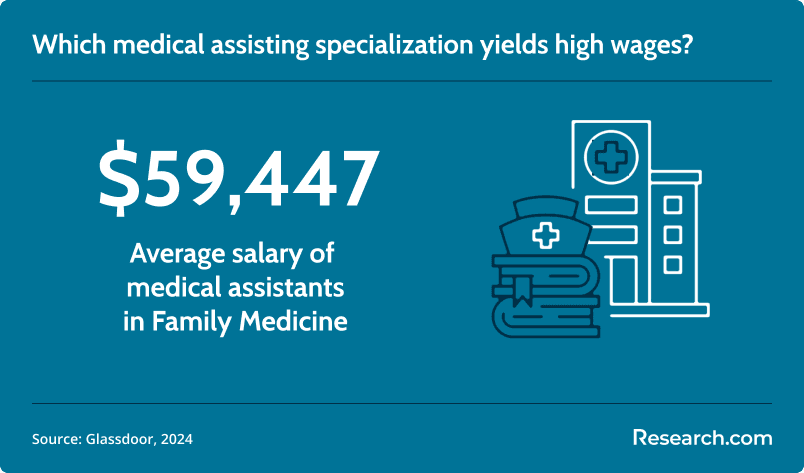
- Family Medicine Medical Assistants: These professionals work with patients across age groups, support preventive care, update histories, and assist in general practice workflows. They typically earn around $59,000, with reported pay ranging from $45,000 to $83,000 (Glassdoor, 2024).
- Podiatry Medical Assistants: Podiatry assistants support care for foot and ankle concerns, including fractures, bunions, and diabetic foot care. Their average annual salary is $54,000.
- Cardiology Medical Assistants: Cardiology assistants may help with heart-focused patient intake, electrocardiograms (EKGs), symptom tracking, and procedure preparation. Their average salary is around $52,000 annually.
- Dermatology Medical Assistants: These assistants support skin exams, biopsies, patient education, procedure preparation, and cosmetic treatments such as chemical peels or laser therapy. They earn around $48,000 annually.
- Ophthalmology Medical Assistants: Ophthalmology assistants support eye exams, minor procedures, and patient education related to vision care. Their average salary is $47,000 annually.
- Geriatrics Medical Assistants: Geriatrics assistants work with older adults who may have chronic conditions, mobility concerns, and long-term care needs. Their average salary is $44,000 annually.
Choosing a specialty should not be based on salary alone. Consider whether you enjoy the patient population, pace, procedures, and emotional demands of the specialty. A slightly lower-paying specialty that fits your strengths may lead to better performance, stronger references, and more sustainable career growth.
How can supplemental education and financial aid boost career advancement?
Additional training can help medical assistants qualify for specialized duties, administrative healthcare roles, or future degree pathways. The most useful programs are those that connect directly to a career goal: coding, billing, phlebotomy, EKG support, medical office administration, nursing prerequisites, or health information.
Cost matters. Before enrolling, compare tuition, fees, books, exam costs, payment plans, employer tuition support, and financial aid eligibility. If coding or revenue cycle work interests you, it may be useful to compare medical billing and coding schools online with financial aid to reduce out-of-pocket training expenses.
Can additional specialized training elevate a medical assistant's salary?
Specialized training can improve employability when it teaches skills employers are actively seeking. Medical assistants who can handle accurate documentation, billing support, coding basics, electronic health record workflows, EKG procedures, injections, lab coordination, or specialty-specific patient care may have a stronger case for better roles or raises.
For those leaning toward administrative healthcare, comparing top medical billing and coding programs can be a practical next step. The goal is not to collect credentials randomly; it is to build a skill set that matches real job postings in your target market.
Should medical assistants consider transitioning to medical coding?
Medical coding can be a strong alternative for medical assistants who enjoy documentation, anatomy, billing systems, insurance rules, and detail-heavy work more than direct patient care. It may also appeal to workers seeking less physically demanding healthcare roles or more administrative specialization.
Before switching, compare training requirements, certification expectations, local job openings, remote-work competition, and the average medical coder salary. A coding transition makes the most sense when you are prepared for the accuracy demands and ongoing learning required in reimbursement-focused roles.
What short-term training programs can rapidly enhance a medical assistant’s skill set?
Short-term programs can be useful when they fill a clear skills gap. Good examples include focused training in coding, billing, EHR systems, EKG procedures, phlebotomy support, clinical documentation, infection control, or specialty practice workflows. Short programs are less useful when they are expensive, unrecognized by employers, or disconnected from local hiring needs.
If you want a faster route into revenue cycle skills, a fast track medical billing and coding course may help you test whether the field fits before committing to a longer program.
What additional benefits complement a medical assistant's salary?
Base pay is only one part of compensation. Medical assistants may also receive health insurance, retirement contributions, paid time off, performance bonuses, continuing education funds, certification exam support, uniforms, shift differentials, or tuition reimbursement.
When comparing offers, calculate total value. A job with slightly lower pay but strong insurance, predictable scheduling, paid training, and tuition support may be better than a higher hourly wage with weak benefits. Workers who need a faster entry point into the field can also compare accelerated medical assistant programs, but should verify quality, cost, and employer recognition before enrolling.
Can further academic education enhance a medical assistant’s career growth?
Further education can help if it supports a specific next step. A certificate may be enough for skill-building, while an associate or bachelor’s degree may be more useful for long-term transitions into nursing, healthcare administration, rehabilitation support, public health, or allied health fields.
For example, an online kinesiology bachelor's degree may be relevant for medical assistants interested in rehabilitation, wellness, exercise science, patient mobility, or future graduate study. The right education choice depends on your target role—not simply on earning another credential.
What challenges impact work-life balance and job satisfaction for medical assistants?
Medical assisting can be rewarding, but the work can also be demanding. Common stressors include high patient volume, short appointment times, administrative backlog, emotional patient interactions, staffing shortages, changing technology, and unclear role boundaries.
Before accepting a role, ask about patient load, training, supervision, lunch breaks, overtime expectations, weekend schedules, float requirements, and how tasks are divided between clinical and front-office staff. Some medical assistants also use their healthcare background to move into adjacent wellness careers; for example, those interested in diet, prevention, and patient education may explore requirements for certification to become a nutritionist.
Can a background in biology enhance clinical expertise and career opportunities?
A stronger science foundation can help medical assistants understand anatomy, physiology, disease processes, lab results, medications, and patient education more deeply. Biology coursework may also support future applications to nursing, physician assistant, laboratory science, public health, or other allied health programs.
If you are considering a longer academic pathway, compare costs, transfer policies, course format, and prerequisites for affordable online biology bachelor's degree programs. Biology can be valuable, but it should connect to a realistic career plan.
How do economic trends and policy changes influence salary growth for medical assistants?
Medical assistant salaries can be affected by healthcare demand, inflation, insurance reimbursement pressure, staffing shortages, state workforce policies, clinic budgets, and competition from other employers. These forces do not raise wages equally everywhere. A large health system in a competitive metro area may adjust wages differently than a small rural practice.
Technology is also changing the role. Employers increasingly value staff who can work confidently with electronic health records, digital scheduling, patient portals, remote intake, and documentation workflows. Targeted healthcare certification programs online may help workers strengthen marketable skills, as long as the credential is relevant to local employer needs.
Can embracing telehealth and remote work boost my earnings as a medical assistant?
Telehealth has expanded the administrative and coordination side of medical assisting. Some medical assistants support virtual appointment scheduling, patient portal communication, remote intake, digital records, follow-up coordination, and documentation. These skills may improve flexibility and make candidates more competitive for hybrid or administrative healthcare roles.
However, remote roles can be competitive and may require strong EHR experience, privacy compliance knowledge, communication skills, and comfort with digital tools. Advanced academic pathways, including options such as cheap doctor of pharmacy online programs, are a much larger commitment and should only be considered when they match a defined professional goal.
How do medical assistant salaries compare to other healthcare professions?
Medical assisting pays less than many licensed or advanced healthcare roles, but it typically offers a faster entry route. This makes it attractive for people who want to start working in healthcare, gain patient-care exposure, and later decide whether to pursue a higher credential.
- Licensed Practical/Vocational Nurses: LPNs/LVNs provide basic nursing care under the supervision of registered nurses and physicians. Their annual salary is $60,790.
- Certified Nursing Assistants: CNAs help patients with daily activities such as bathing, feeding, and mobility, often in hospitals or long-term care facilities. Their average annual salary is $39,610.
- Phlebotomists: Phlebotomists draw blood for testing, transfusion, or donation and help ensure proper sample handling. Their annual salary is $43,130.
- Dental Assistants: Dental assistants support dentists during procedures, manage records, and help with basic office and lab tasks. Their annual salary is around $47,350.
- Medical Records Specialists: These professionals manage health records, billing information, insurance documentation, and related administrative data. Their annual income is $53,690. If you are comparing this route, Research.com discusses whether medical billing and coding is a good career.
- Health Information Technologists and Medical Registrars: These workers manage patient data and help healthcare organizations maintain accurate, compliant records. They earn as much as $70,260 yearly.
- Radiologic Technicians: Radiology technicians operate imaging equipment such as X-rays and MRIs to support diagnosis. If you are weighing salary and training time, read about whether radiology tech is a good career. In 2023, the average wage for this profession was $75,250.
- Registered Nurses: RNs provide direct patient care, administer medications, coordinate care plans, and often serve as key patient contacts. They earn as much as $94,480 each year.
- Physician Assistants: Physician assistants diagnose illnesses, prescribe treatments, and assist in surgeries under physician supervision. They make as much as $112,410 per year.
If you enjoy healthcare operations more than clinical care, medical assisting can also support a move into administration, training, recruiting, or management. For example, an online master in human resources may fit workers who want to combine healthcare experience with staff development or organizational leadership.
This chart compares wage differences between medical assistants and related healthcare roles.
What certifications can increase a medical assistant’s salary?
Certification can improve a medical assistant’s job prospects by showing that the worker has met an external standard for knowledge and skills. It may also matter because some employers require or strongly prefer certified candidates.
- Certified Medical Assistant: The CMA credential is offered by the American Association of Medical Assistants (AAMA). It covers both clinical and administrative competencies and is widely recognized by employers.
- National Certified Medical Assistant: The NCMA credential is offered by the National Center for Competency Testing (NCCT). It is designed for medical assistants with clinical and administrative experience and may be useful in outpatient or private practice settings.
- Certified Clinical Medical Assistant: The CCMA credential is offered by the National Healthcareer Association (NHA). It emphasizes patient-facing clinical skills such as histories, exams, injections, and laboratory procedures.
- Certified Medical Administrative Assistant: The CMAA credential, also offered by the NHA, focuses on front-office skills such as scheduling, records management, insurance processing, billing, and coding support.
- Registered Medical Assistant: The RMA credential is awarded by American Medical Technologists (AMT). It recognizes a broad skill set that may include vitals, medications, procedure assistance, and office management duties.
A survey from the NHA reports that 78% of healthcare employers require medical assistants to be certified, and 87% of medical institutions actively encourage certification. Before choosing a credential, check job postings in your area to see which certifications employers name most often.
What career advancement opportunities are available for medical assistants?
Medical assisting can lead to several advancement routes. The best option depends on whether you prefer clinical care, administration, supervision, teaching, technology, policy, or another healthcare niche.
- Specialized medical assistant roles: Medical assistants may move into focused areas such as cardiology, women’s health, endocrinology, ophthalmology, dermatology, podiatry, or geriatrics.
- Medical office management: Workers with strong scheduling, billing, compliance, and team coordination skills may become office managers or practice managers.
- Higher education: Degrees in nursing, healthcare administration, public health, human resources, or related fields can open new roles. For example, healthcare workers interested in HR leadership can learn how to become a human resources manager.
- Supervisory or teaching roles: Experienced medical assistants may train new staff, supervise teams, or teach in academic or clinical training environments.
- Public policy or community health: Medical assistants who want broader system-level impact may pursue community health, advocacy, or policy work. Those interested in this path can compare online masters in public policy options.
- Non-traditional healthcare roles: Experience in patient care and clinic operations can also transfer into healthcare technology, medical sales, insurance, scheduling operations, patient navigation, or revenue cycle support.
| If your goal is... | Consider this next step | Why it may fit |
| Higher clinical responsibility | Nursing prerequisites or an accredited nursing pathway | Useful for workers who want direct care, licensure, and broader clinical scope. |
| Administrative healthcare work | Billing, coding, health information, or office management training | Fits workers who enjoy records, systems, insurance, and workflow accuracy. |
| Specialty practice growth | On-the-job specialty training and relevant certification | Builds expertise in a focused patient population or procedure area. |
| Leadership | Healthcare administration, HR, or management education | Supports promotion into supervision, staffing, operations, or practice management. |
| Public service impact | Public health or public policy education | Fits workers interested in access, prevention, outreach, and healthcare systems. |
Common mistakes to avoid when comparing medical assistant salaries
- Looking only at the state average: Salaries can differ by city, employer, and specialty, so a statewide number may not represent your actual job market.
- Ignoring cost of living: A higher salary in an expensive metro area may leave you with less disposable income than a lower salary in a more affordable area.
- Choosing a program without checking recognition: Before paying for training, confirm that local employers accept the credential or program.
- Assuming certification guarantees a raise: Certification can help, but pay increases depend on employer policies, labor demand, role responsibilities, and negotiation.
- Forgetting benefits: Health insurance, paid time off, retirement contributions, and tuition reimbursement can significantly change the value of an offer.
- Taking on education debt without a career plan: Additional training should connect to a specific job target, promotion path, or licensure goal.
- Overlooking schedule demands: Evening, weekend, urgent care, or high-volume roles may pay more but can affect burnout and work-life balance.
What is the job outlook for medical assistants in the U.S.?
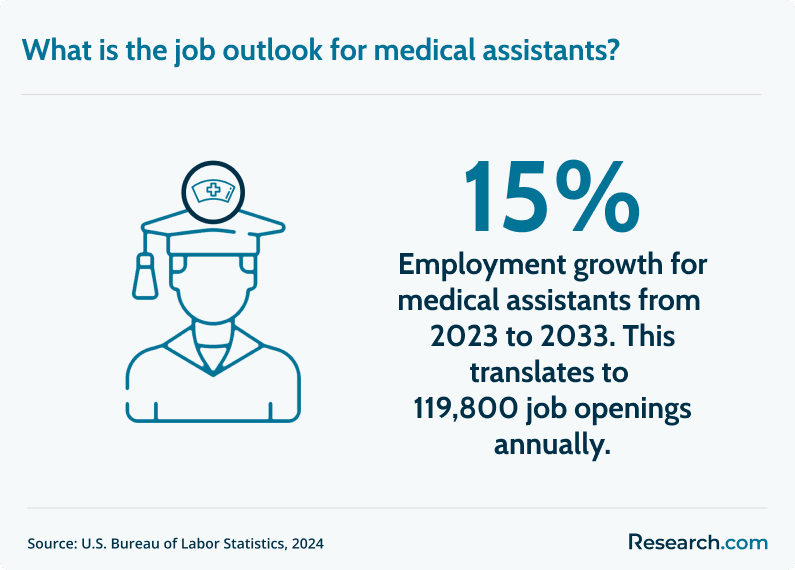
The job outlook for medical assistants is strong based on the BLS projections cited here. Employment of medical assistants is expected to increase by 15% from 2023 to 2033, which equals around 119,800 annual job openings throughout the decade.
BLS attributes this growth to factors such as an aging population, greater demand for healthcare services, and the continued expansion of medical facilities and healthcare providers.
The NHA also notes that new treatments and more patients with chronic diseases, particularly obesity, contribute to demand for healthcare support workers. Medical assistants help care teams manage ongoing patient needs, documentation, scheduling, and clinical support.
For workers who want to move beyond medical assisting into advanced practice nursing, additional education is required. Research.com’s guide to the shortest online nurse practitioner program can help readers understand one possible advanced pathway, though that route involves a much different level of training and responsibility.
Key Insights
- The national medical assistant salary was $43,350 in 2023, but the BLS percentile range shows substantial variation from $33,500 to $56,480.
- Washington State reports the highest average medical assistant salary at $53,780. Alaska, California, Washington, D.C., and Minnesota also report competitive pay, but cost of living should be part of the decision.
- Louisiana, Alabama, Mississippi, West Virginia, and Arkansas are among the lowest-paying states in the cited data, with annual incomes ranging from $33,000 to $35,000.
- The scientific research and development services industry reports the highest medical assistant salary among listed industries at $55,130.
- Certification matters in many hiring markets. The NHA survey cited here reports that 78% of healthcare employers require medical assistants to be certified and 87% of medical institutions actively encourage certification.
- The strongest salary strategy is targeted: compare local pay, benefits, and living costs; earn credentials employers actually value; build specialty or administrative skills; and choose advancement paths that match your long-term healthcare goals.
- Employment of medical assistants is expected to increase by 15% from 2023 to 2033, with around 119,800 annual job openings throughout the decade.
References:
- Glassdoor. (2024, June 6). How much does a Medical Assistant Family Medicine make? Retrieved December 27, 2024, from https://www.glassdoor.com/Salaries/united-states-medical-assistant-family-medicine-salary-SRCH_IL.0,13_IN1_KO14,47.htm
- National Center for Health Workforce Analysis. (2024, November). State of the U.S. Health Care Workforce, 2024. https://bhw.hrsa.gov/sites/default/files/bureau-health-workforce/state-of-the-health-workforce-report-2024.pdf
- U.S. Bureau of Labor Statistics. (2024, April 3). Occupational employment and wages, May 2023 - Medical Assistants. Occupational Employment and Wage Statistics. https://www.bls.gov/oes/current/oes319092.htm
- U.S. Bureau of Labor Statistics. (2024, August 29). Medical Assistants. Occupational Outlook Handbook. https://www.bls.gov/ooh/healthcare/medical-assistants.htm
Other Things You Should Know About Medical Assistant Salary
The U.S. Bureau of Labor Statistics publishes the main state-by-state wage estimates for medical assistants through its Occupational Employment and Wage Statistics program. Some state labor departments also post local wage tables, but the BLS is the standard federal source used for comparisons across states.
Experience levels significantly impact medical assistant salaries in 2027. Typically, entry-level medical assistants earn lower wages, while those with several years of experience can command higher salaries. Additionally, states with higher living costs may offer increased pay to retain more experienced professionals.
In 2027, certification requirements by bodies like the AAMA or AMT can affect salaries, with certified medical assistants often earning more. Some states may require additional credentials, impacting potential earnings. Certification can lead to higher pay and better job prospects.