
2027 Do You Need a License to Become a Medical Assistant? Certification Requirements by State

Co-Founder and Chief Data Scientist
If you want to become a medical assistant, the first question is not just “Which program should I choose?” It is “What does my state and future employer actually require?” Medical assistant rules can vary by state, by workplace, and by the clinical tasks you are expected to perform, such as injections, blood draws, EKGs, or medication support.
This guide explains how medical assistant licensure, registration, certification, and training requirements work in 2026 using the available 2025 data and state-level information provided below. You will learn which states generally do not require a medical assistant license, where extra rules may apply, which national certifications employers recognize, what the process costs, and how to choose a program without overpaying or selecting the wrong credential.
The goal is practical: help you avoid wasted tuition, prepare for the jobs you actually want, and understand how certification can improve your hiring options even when your state does not require a formal license.
Quick Answer: Do Medical Assistants Need a License?
- Most states do not require a separate medical assistant license, but employers may still require national certification or completion of an approved training program.
- Licensure is issued by a state government. Certification is usually awarded by a national credentialing organization after you meet eligibility rules and pass an exam.
- Some states allow medical assistants to work without licensure but restrict specific clinical duties, including injections, blood draws, or other technical procedures.
- Common national credentials include CMA (AAMA), CCMA, RMA, NCMA, and CMAC. The best option depends on your program, employer expectations, and career goals.
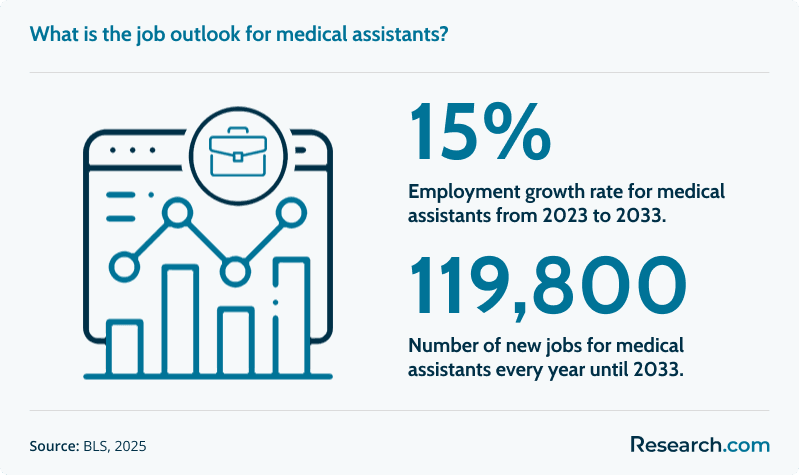
- Medical assistants are in a strong labor market: employment is projected to grow 15% from 2023 to 2033, with about 119,800 openings expected each year over the decade.
- Do you need a license to be a medical assistant in every state?
- What is the difference between certification and licensure for medical assistants?
- How can you verify your state’s medical assistant license rules?
- What national medical assistant certifications are available in 2026?
- What steps do you follow to become a certified medical assistant?
- How much does medical assistant certification cost?
- Can you get financial aid for medical assistant training or certification?
- What jobs can you get with a medical assistant certification in 2026?
- How much do medical assistants make in 2026?
- What is the job outlook for certified medical assistants?
- Can administrative training help a medical assistant move up?
- How should you choose an affordable medical assistant program?
- What career advancement options do certified medical assistants have?
- Can additional academic credentials expand your medical assistant career?
- How can management training support medical assistant career growth?
Do you need a license to be a medical assistant in every state?
No. A medical assistant license is not required in every state. In many states, you can work as a medical assistant without a state-issued license, but that does not mean the job has no rules. Employers, healthcare systems, insurers, and state scope-of-practice laws may still determine what you are allowed to do.
This matters most when a job includes hands-on clinical duties. For example, the answer to “Can a medical assistant do blood draws?” depends on the state, the employer’s policies, the provider supervising you, and whether you have completed required training or certification.
There are 698,384 medical assistants in the U.S., and many work in states that do not require a medical assistant license. However, a license is different from permission to perform every possible clinical task. States may allow general medical assisting work while setting additional expectations for injections, phlebotomy, medication administration, or other technical procedures.
The following 2025 breakdown summarizes the medical assistant license or certification requirements by state as provided in the source article.
States That Do Not Require a Medical Assistant License or Certification
The states below generally allow people to work as medical assistants without a state-issued license or mandatory certification. Even so, many employers still prefer certified applicants because certification gives them evidence of formal training and exam-tested skills.
- Alabama
- Alaska
- Arizona
- Arkansas
- California
- Colorado
- Connecticut
- Delaware
- Georgia
- Hawaii
- Idaho
- Illinois
- Indiana
- Iowa
- Kansas
- Kentucky
- Louisiana
- Maine
- Maryland
- Massachusetts
- Michigan
- Minnesota
- Mississippi
- Missouri
- Montana
- Nebraska
- Nevada
- New Hampshire
- New Jersey
- New Mexico
- New York
- North Carolina
- North Dakota
- Ohio
- Oklahoma
- Oregon
- Pennsylvania
- South Carolina
- South Dakota
- Tennessee
- Texas
- Vermont
- Virginia
- Washington
- West Virginia
- Wisconsin
- Wyoming
States With Additional Medical Assistant Rules
These states may not issue a traditional “medical assistant license,” but they have rules that can affect your training, job duties, registration status, or employer requirements.
- California: A license is not required for general medical assisting, but medical assistants who perform injections or certain technical tasks must complete a state-approved program.
- Washington: Medical assistants must register with the state, and additional certification may be required depending on the duties performed.
- Arizona: Medical assistants must be trained, and an exam may be required for certain procedures.
- New Jersey: Certification is often expected for specific duties, especially in hospital settings.
- South Dakota: The state does not mandate formal education, but employers often require it.
- Rhode Island: Certification is strongly recommended and commonly required by healthcare facilities.
States Where Registration or Certification May Depend on Job Duties
Some states do not require a broad medical assistant license but may require registration, certification, or additional training when a role includes tasks such as injections or blood draws.
- Washington
- Idaho
- Florida
- Arizona
- Montana
The practical takeaway is simple: do not choose a program based only on a school’s marketing page. Check your state rules and compare them with job postings in your area. If employers near you consistently ask for CMA, CCMA, RMA, or phlebotomy training, certification may be functionally necessary even if the state does not require it.
The same duty-based logic applies to injections. If you are wondering, “Can a medical assistant give shots?” the answer depends on state law, supervision requirements, the type of injection, and whether the medical assistant has completed required training or certification.
| Requirement Type | What It Means | Why It Matters |
| No state license required | You may be able to work as a medical assistant without a state-issued credential. | Employers can still require certification, experience, or completion of a training program. |
| Registration required | You may need to register with a state agency before performing certain work. | This can affect hiring timelines and the duties you are allowed to perform. |
| Certification preferred or required by employer | A national credential may be needed for hiring or advancement. | Certification can make you more competitive for clinic, hospital, and specialty practice roles. |
| Task-specific training required | Certain duties may require documented training even when general medical assisting does not require licensure. | This is especially important for injections, blood draws, EKGs, and other technical tasks. |
What is the difference between certification and licensure for medical assistants?
Licensure and certification are often confused, but they are not the same thing. A license is issued by a state and gives legal permission to work in a regulated role. Certification is usually awarded by a national organization after you meet eligibility requirements and pass an exam.
Most medical assistants do not need a state-issued license to begin working. However, certification is widely used by employers to screen applicants, confirm job readiness, and reduce training risk. In competitive markets, a certified applicant may have an advantage over someone with no formal credential.
| Category | Medical Assistant Licensure | Medical Assistant Certification |
| Issued by | A state agency or board | A national credentialing organization |
| Purpose | Grants legal authorization when a state requires it | Shows that you completed training or met eligibility rules and passed an exam |
| Required everywhere? | No | No, but many employers prefer or require it |
| Common impact | Can determine whether you may work or perform specific duties in a state | Can improve hiring options and qualify you for more clinical responsibilities |
| Best question to ask | “Does my state require registration, licensure, or special authorization for this role?” | “Which credential do employers in my area ask for most often?” |
To become certified, students usually complete a postsecondary medical assistant program. These programs are commonly offered by community colleges, career schools, technical colleges, and online providers. Depending on the option, the credential may be a certificate, diploma, or associate degree.
Most programs take one to two years. That makes medical assisting a shorter healthcare training path than many degree-based clinical careers. Students comparing fast healthcare routes sometimes also explore a 1 year nursing program online degree, but nursing and medical assisting have different licensure rules, scopes of practice, and long-term career outcomes.
Certification can also affect what you are trusted to do at work. Some employers require a credential before assigning clinical duties such as injections, blood draws, lab support, medication-related tasks, or EKG work. Other employers may train uncertified medical assistants internally, but that varies widely.
The chart below lists the states with the highest pay for medical assistants, as reported by the BLS in 2025.
How can you verify your state’s medical assistant license rules?
The safest way to confirm medical assistant rules is to rely on official state sources first, then compare those rules with employer requirements in your local job market. School admissions representatives can be helpful, but they should not be your only source.
- Check the state medical board, health board, or department of health: These agencies publish rules on medical assistant duties, supervision, training, registration, and restricted procedures.
- Search for allied health or unlicensed assistive personnel rules: Medical assistants are often discussed under broader rules for unlicensed healthcare workers rather than in a dedicated licensing section.
- Review state scope-of-practice language: Look for details on injections, medication administration, phlebotomy, EKGs, laboratory work, and documentation responsibilities.
- Use national association resources for comparison: The American Association of Medical Assistants provides state information that can help you identify questions to ask your state agency.
- Call or email the state agency if rules are unclear: Ask directly whether medical assistants must be registered, whether certification is required for specific procedures, and what supervision is required.
- Compare job postings in your area: If most local clinics require CCMA, CMA, or RMA, plan around that expectation even if the state does not mandate certification.
- Do not assume CNA and medical assistant rules are the same: If you are comparing paths, confirm CNA certification nursing assistant requirements separately through the proper nursing or health board.
| Question to Ask | Why It Matters |
| Does my state require registration for medical assistants? | Registration can be required even when a full license is not. |
| Are injections, blood draws, or EKGs regulated separately? | Task-specific rules can affect what jobs you qualify for. |
| Which certification do local employers list most often? | The most valuable credential is usually the one employers in your market recognize. |
| Does the program qualify me for the certification exam I want? | Not every program meets every exam sponsor’s eligibility rules. |
| Will online coursework include required hands-on practice or externship hours? | Clinical skills cannot be learned fully through lecture-only instruction. |
What national medical assistant certifications are available in 2026?
Medical assistants can choose from several national certifications in 2026. The most common options include CMA, CCMA, RMA, NCMA, and CMAC. Each credential has different eligibility rules, exam structure, employer recognition, and best-fit use cases.
Before choosing a certification, start with three questions: Which exams does your program prepare you for? Which credentials do employers in your area request? Do you want a role focused more on clinical work, administrative work, or a mix of both?
| Certification | Organization | Best Fit | Important Detail |
| CMA (AAMA) | American Association of Medical Assistants | Students completing an accredited medical assistant program who want a highly recognized credential | First-time test taker pass rate is about 76%. |
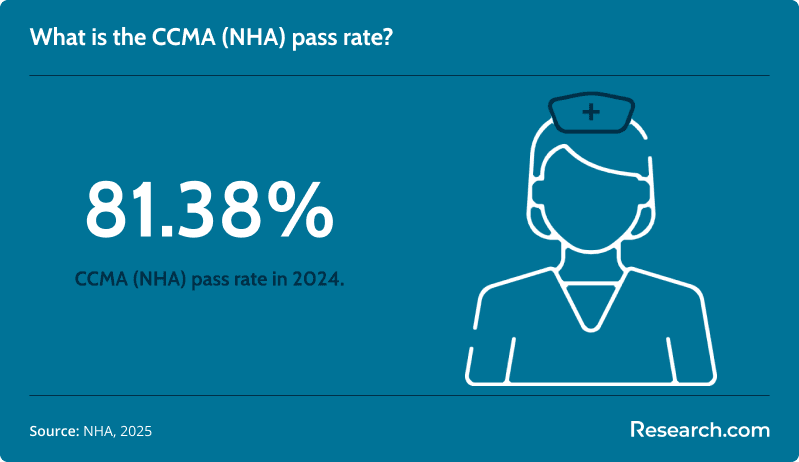
| CCMA | National Healthcareer Association | Students aiming for clinical medical assistant roles in hospitals, outpatient centers, or large practices | The overall pass rate in 2024 was 81.38%. |
| RMA | American Medical Technologists | Applicants with qualifying education, work experience, or nontraditional training backgrounds | Often considered by candidates seeking outpatient or private practice roles. |
| NCMA | National Center for Competency Testing | Students from eligible programs, candidates with healthcare experience, or those with military healthcare backgrounds | Can be useful for applicants whose training path is less traditional. |
| CMAC | American Medical Certification Association | Students in programs that emphasize both clinical and administrative medical assisting skills | Often used by schools that offer faster training pathways. |
- CMA (AAMA): This credential is one of the best-known medical assistant certifications. It generally fits students who complete an accredited medical assisting program and want broad employer recognition.
- CCMA: This certification is popular among students preparing for patient-facing clinical roles, especially in larger healthcare settings.
- RMA: This option may work well for candidates who qualify through work experience or a nontraditional training route.
- NCMA: This credential can be a practical choice for candidates with eligible training, experience, or military healthcare preparation.
- CMAC: This certification is commonly aligned with programs that cover both front-office and clinical support responsibilities.
No single certification is automatically best for everyone. The right choice depends on your state rules, your school’s eligibility pathway, and the credential that appears most often in local job postings.
What steps do you follow to become a certified medical assistant?
You can usually become a certified medical assistant in one to two years, depending on whether you choose a certificate, diploma, or associate degree. The process is shorter than many licensed clinical professions, but you still need to choose carefully because certification eligibility depends on your training path.
| Step | Typical Timeline | What to Do |
| 1. Finish high school or earn a GED | 0–1 month | Gather proof of graduation or GED completion before applying to a program. |
| 2. Complete a medical assistant program | 9–24 months | Choose a certificate, diploma, or associate degree program that prepares you for the certification exam you plan to take. |
| 3. Apply for a certification exam | 1–2 months | Submit required documents, such as transcripts and any externship verification required by the certifying organization. |
| 4. Prepare for and take the exam | 1–3 months | Use exam outlines, practice questions, and school review resources to study clinical and administrative topics. |
| 5. Apply for medical assistant jobs | 1–3 months | Target clinics, hospitals, urgent care centers, specialty practices, and outpatient facilities that match your training. |
Program length varies by credential type. Certificate and diploma programs often take about 9–12 months, while associate degree programs usually take closer to 18–24 months. Students comparing healthcare programs by speed and flexibility often review medical assisting alongside options such as the best online LPN programs, but LPN programs lead to a different licensed nursing role.
Before enrolling, confirm whether the program includes hands-on labs, an externship, exam preparation, and eligibility for the certification you want. Online coursework can be convenient, but medical assisting is not purely an online skill set. You need supervised practice for patient care tasks.
The chart below lists the most common education levels of medical assistants, as published by Zippia in 2025.
How much does medical assistant certification cost?
The cost of becoming a certified medical assistant includes more than tuition. You may also pay for an exam, application fees, study materials, uniforms, background checks, immunizations, externship requirements, and recertification later. The exam fees below are the certification-related costs provided in the source material.
Medical Assistant Certification Exam Fees
| Certification | Exam Fee | Notes |
| CMA (AAMA) | AAMA members: $125; non-members: $250 | Membership can be obtained for $75 annually. |
| CCMA (NHA) | $165 | Some programs may include the exam fee in tuition. |
| RMA (AMT) | $150 | The fee includes the application, exam, and first annual fee. |
| NCMA (NCCT) | $119 | Optional review courses may cost extra. |
| CMAC (AMCA) | Track 1: $239; Track 2: $439 | Track 2 includes additional resources and support. |
Other Costs to Plan For
- Study materials: Some programs include books and review tools in tuition, while others require separate purchases.
- Recertification: Credentials must be maintained after you earn them. CMA (AAMA) recertification costs $125 for members and $250 for non-members every five years. CCMA (NHA) recertification costs $179 every two years. NCMA (NCCT) recertification costs $77 annually.
- Program-related expenses: Depending on the school, you may need to budget for uniforms, health screenings, background checks, technology fees, lab supplies, or externship travel.
When comparing programs, do not look only at the advertised tuition. Ask for the total cost of attendance and whether the certification exam, books, supplies, and externship requirements are included.
Can you get financial aid for medical assistant training or certification?
Yes. Financial aid may be available for medical assistant training or certification, especially if you enroll in an eligible accredited program. Availability depends on the school, program length, enrollment status, and funding source.
Common Funding Options
| Funding Source | How It Can Help | What to Check |
| Federal financial aid | Students in eligible accredited programs may qualify for Pell Grants or Federal Student Loans through the FAFSA. | Confirm that the school and program qualify for federal aid before enrolling. |
| Scholarships | Scholarships may reduce tuition, exam fees, or training costs. | Check eligibility rules, deadlines, membership requirements, and whether funds are paid to you or the school. |
| Employer reimbursement | Healthcare employers may pay for certification, exam fees, or continuing education. | Ask HR whether you must stay employed for a certain period after receiving reimbursement. |
| State workforce programs | Workforce development funding may support students entering healthcare occupations. | Ask about Workforce Innovation and Opportunity Act (WIOA) options and state-specific health career grants. |
| Nonprofit or service-based programs | Some organizations support healthcare training in exchange for service commitments. | Understand any work location, service, or repayment obligations before accepting funds. |
Specific Aid Sources Mentioned
- FAFSA: Students enrolled in accredited programs may qualify for federal aid, including Pell Grants and Federal Student Loans.
- AAMA scholarships: The American Association of Medical Assistants offers scholarships to members pursuing certification. Awards range from $500 to $1,000.
- NHA scholarships: The National Healthcareer Association provides scholarships for students pursuing certifications such as the CCMA, and these may help with exam fees or related expenses.
- Health Professions Scholarship Program: The U.S. Army-funded HPSP supports students in health-related career paths, including medical assisting, in exchange for military service as healthcare professionals.
- Workplace reimbursement: Some healthcare employers help employees pay for tuition, exams, or study materials.
- State workforce agencies: Some states support healthcare training through workforce development programs such as WIOA and state health career grants.
- Nonprofit organizations: Organizations such as the National Health Service Corps may offer scholarship or loan repayment support for students who commit to serving underserved areas after certification.
What jobs can you get with a medical assistant certification in 2026?
A medical assistant certification can qualify you for several entry-level healthcare support roles in 2026. The most common settings include physician offices, specialty clinics, hospitals, outpatient centers, urgent care facilities, and diagnostic service providers.
| Job Title | Typical Duties | Best Fit |
| Medical Assistant | Record patient histories, take vital signs, prepare rooms, assist clinicians, schedule visits, or support billing and documentation. | Students who want a balanced clinical and administrative healthcare role. |
| Clinical Office Assistant | Check in patients, update records, coordinate visits, and assist with basic clinical support. | Applicants who want both front-desk and patient-facing responsibilities. |
| Phlebotomy Technician | Draw blood and prepare specimens when properly trained and permitted by state and employer rules. | Medical assistants who complete additional phlebotomy preparation. |
| EKG Technician | Set up and perform EKG testing when trained to do so. | Students whose programs include cardiac monitoring or EKG instruction. |
| Medical Records Specialist | Organize patient records, support billing or coding workflows, and help manage health information. | Medical assistants who prefer administrative or health information work. |
The standard medical assistant role can be clinical, administrative, or mixed. If you are comparing front-office and patient-care responsibilities, review the difference between a medical administrative assistant vs medical assistant before choosing a program.
Medical assistants who enjoy records, billing, and compliance work may later pursue health information roles. With additional experience and training, this path can lead toward management positions; reviewing a medical records manager salary guide can help you understand that longer-term direction.
Some medical assistants also use the role as a first step toward nursing or another licensed healthcare profession. If that is your plan, compare the education, scope of practice, and career differences between a licensed practical nurse vs registered nurse before committing to your next credential.
How much do medical assistants make in 2026?
Using the latest BLS data cited in this article, medical assistants earned a median annual wage of $44,200 in 2025. Pay varies by setting, state, experience, certification, specialty skills, and the complexity of the role.
National Medical Assistant Pay Range
- Lowest 10%: Around $35,020 per year
- Median 50%: $44,200 per year
- Top 10%: $57,830 or more per year
What Can Affect Your Pay?
- Work setting: Hospitals and outpatient care centers often pay more than smaller private offices.
- Location: Urban areas and states with higher costs of living may offer higher wages.
- Certification: Certified medical assistants may be more competitive for better-paying positions.
- Additional skills: Training in phlebotomy, EKG, billing, coding, or specialty clinic procedures can improve your options.
- Experience: Entry-level pay is usually lower, while experienced medical assistants may qualify for lead, specialty, or supervisory roles.
Salary data should be used as a planning tool, not a guarantee. Two medical assistants with the same certification can earn different wages depending on employer type, shift, geography, duties, and local demand.
The chart below lists the industries with the highest pay for medical assistants, as reported by the BLS in 2025.
What is the job outlook for certified medical assistants?
The employment outlook for certified medical assistants remains strong. Medical assistant employment is projected to grow 15% from 2023 to 2033, which is much faster than the average for all occupations.
About 119,800 job openings are expected each year over the decade. These openings are expected to come from both employment growth and the need to replace workers who retire, transfer to other occupations, or leave the labor force.
Why Demand Is Growing
- The aging population is increasing the need for healthcare services.
- Outpatient care centers, clinics, and physician practices continue to need support staff.
- Providers rely on medical assistants to handle routine clinical and administrative tasks so clinicians can focus on patient care.
Medical assisting can be attractive to students who want patient contact but prefer clinic or office-based settings. If you are also considering nursing assistant work, compare the CNA job outlook with the medical assistant labor market. CNAs often work in long-term care settings, while medical assistants are commonly employed in clinics, physician offices, urgent care centers, and outpatient environments.
Current Trends Affecting Medical Assistants
- More outpatient care: As healthcare shifts toward clinics and ambulatory settings, medical assistants are often used to support patient intake, documentation, testing, and follow-up workflows.
- Higher employer expectations: Even where certification is not legally required, employers may prefer certified candidates to reduce onboarding time.
- Digital health records: Medical assistants increasingly need comfort with electronic health records, portals, scheduling platforms, and documentation procedures.
- Team-based care: Medical assistants often coordinate with physicians, nurses, front-office teams, billing staff, and patients, making communication skills essential.
- Automation and AI tools: AI may support scheduling, documentation, reminders, and administrative workflows, but medical assistants still need patient interaction, clinical judgment within their role, and hands-on procedural skills.
Can administrative training help a medical assistant move up?
Yes. Administrative training can make a certified medical assistant more versatile, especially in practices that expect staff to support both patient care and office operations. Skills in billing, coding, scheduling, insurance documentation, referrals, and records management can help you move toward lead medical assistant, office coordinator, or healthcare administration roles.
This path is most useful if you enjoy workflow organization, patient communication, and the business side of healthcare. If you want to strengthen those skills without committing immediately to a full degree, comparing cheap medical billing and coding classes online can help you explore lower-cost administrative training options.
| Additional Skill | How It Helps | Possible Career Benefit |
| Medical billing and coding | Helps you understand claims, documentation, and reimbursement workflows. | Can support movement into billing, coding, or revenue cycle roles. |
| Electronic health records | Improves accuracy in documentation, scheduling, and patient communication. | Can make you more effective in clinics with complex patient volumes. |
| Patient coordination | Builds skills in referrals, follow-ups, and care navigation. | Can prepare you for care coordinator or lead support roles. |
| Office operations | Strengthens scheduling, inventory, compliance, and staff coordination skills. | Can support advancement into supervisory or practice support positions. |
What do graduates say about becoming a certified medical assistant?
Student experiences vary, but many people choose medical assisting because it offers a relatively short training path into healthcare and combines patient contact with practical workplace skills. The testimonials below reflect individual experiences and should not be read as guaranteed outcomes.
-
: "
I was nervous to switch careers at 34, but certification gave me structure and confidence. Now, I have steady hours and benefits, and I actually like what I do every day. – Sheryl
"
-
: "
I never thought I’d enjoy science, but the training made it all click. Getting certified opened doors I didn’t know were there—and I’m the first in my family to work in healthcare. – Mateo
"
-
: "
My favorite part of this job is helping patients feel at ease. Becoming a certified medical assistant gave me the skills to do that—and it feels good to finally have a job that matters. – Irene
"
How should you choose an affordable medical assistant program?
The best affordable medical assistant program is not simply the cheapest one. It is the program that meets certification eligibility rules, includes adequate hands-on training, fits your schedule, and has a total cost you can realistically manage.
Start by checking accreditation, certification exam alignment, externship support, graduate outcomes, and the full cost of attendance. If you need flexibility, compare online or hybrid options carefully through resources such as affordable medical assistant programs online, but make sure any online program still provides the required clinical practice.
| Program Factor | What to Look For | Red Flag |
| Accreditation and eligibility | The program should prepare you for the certification exam you want to take. | The school cannot clearly explain which certification exams graduates qualify for. |
| Hands-on training | Look for lab practice, externship placement, and supervised clinical skill development. | The program is lecture-heavy with little or no practical training. |
| Total cost | Ask whether books, supplies, uniforms, background checks, and exam fees are included. | The advertised tuition excludes several required expenses. |
| Schedule format | Choose full-time, part-time, hybrid, or online coursework based on your work and family needs. | The format is convenient but does not meet clinical or certification requirements. |
| Career support | Ask about externship sites, resume help, interview preparation, and employer connections. | The school makes broad job promises without clear placement support. |
Questions to Ask Before Enrolling
- Which national certification exams will I be eligible to take after graduation?
- Does the program include an externship or clinical placement?
- Are certification exam fees included in tuition?
- What is the total cost after books, supplies, uniforms, screenings, and fees?
- Does the program meet requirements for my state and the duties I want to perform?
- What support is available if I need help finding my first medical assistant job?
What career advancement options do certified medical assistants have?
Certified medical assistants can advance by building experience, adding specialized skills, pursuing supervisory training, or using the role as a stepping stone into another healthcare profession. The right path depends on whether you want to stay in medical assisting, move into administration, or continue into a licensed clinical career.
| Advancement Path | What It Involves | Best For |
| Lead medical assistant | Training new staff, coordinating rooming workflows, managing supplies, and supporting clinic operations. | Experienced MAs who enjoy mentoring and daily clinic coordination. |
| Specialty clinic roles | Building experience in cardiology, dermatology, pediatrics, orthopedics, or other specialty settings. | MAs who want deeper clinical exposure without immediately changing professions. |
| Administrative or billing roles | Adding skills in coding, insurance, records, scheduling, or practice operations. | MAs who prefer office systems and healthcare business processes. |
| Nursing or allied health education | Completing additional education for a licensed clinical role. | Students who want a broader scope of practice and longer-term clinical advancement. |
| Pharmacy or advanced health studies | Using healthcare experience as part of a longer academic plan, such as exploring a fast track PharmD program. | Highly motivated students planning a significant step into another healthcare profession. |
Do not assume every advancement path requires a degree immediately. Sometimes the most practical next step is targeted training in phlebotomy, EKG, billing, coding, or leadership. In other cases, a degree may be necessary for a major role change.
Can additional academic credentials expand your medical assistant career?
Additional academic credentials can broaden your options, especially if you want to move beyond standard medical assisting duties. The value depends on the field you choose and how clearly it connects to your career goal.
For example, medical assistants interested in movement science, rehabilitation support, wellness, or exercise-related healthcare may explore a kinesiology online degree. This type of education may be useful for students who want a stronger foundation in body mechanics and patient movement, but it should be evaluated against your desired job title and required credentials.
Before adding another credential, ask whether it leads to a defined role, improves your earning potential, satisfies admission requirements for a future program, or simply adds debt without a clear payoff.
How can management training support medical assistant career growth?
Management training can help medical assistants move from task-based support roles into coordination, supervision, and practice operations. This path is most relevant if you already understand clinical workflows and want to lead teams, improve scheduling processes, support compliance, or manage office systems.
For medical assistants planning a long-term move into healthcare leadership, an accelerated healthcare administration degree online may be worth comparing. The key is to choose management training that matches your goal: clinic supervisor, practice coordinator, health office manager, billing manager, or another operational role.
Common Mistakes to Avoid
| Mistake | Why It Can Hurt You | Better Approach |
| Assuming no license means no requirements | You may still need registration, task-specific training, or employer-required certification. | Check state rules and local job postings before enrolling. |
| Choosing the cheapest program without checking certification eligibility | You could finish training and discover you do not qualify for the exam you wanted. | Ask which certifications graduates are eligible to take. |
| Ignoring hands-on training | Employers need medical assistants who can safely perform real patient-care tasks. | Choose a program with labs, clinical practice, or externship support. |
| Looking only at tuition | Books, uniforms, screenings, exam fees, and recertification can raise your total cost. | Request a full cost breakdown in writing. |
| Assuming online programs meet every state’s expectations | Online coursework may not satisfy hands-on or state-specific requirements. | Confirm clinical placement and state alignment before enrolling. |
| Expecting certification to guarantee a salary | Pay depends on employer, location, experience, and duties. | Use salary data as a benchmark and compare real job postings in your area. |
Key Insights
- Most medical assistants do not need a state-issued license, but state rules, employer policies, and task-specific requirements still matter.
- Certification is often the practical hiring standard even when it is not legally required. CMA, CCMA, RMA, NCMA, and CMAC are the main national options to compare.
- There are 698,384 medical assistants working in the U.S., and demand remains strong across clinics, outpatient centers, hospitals, and physician offices.
- Medical assistants earned a median annual salary of $44,200 in 2025, with the lowest 10% earning around $35,020 and the top 10% earning $57,830 or more.
- Employment is projected to grow 15% from 2023 to 2033, with about 119,800 openings expected each year over the decade.
- Certification programs typically take 1 to 2 years, but program quality, exam eligibility, externship access, and total cost matter more than speed alone.
- The smartest next step is to verify your state rules, review local job postings, choose the certification employers recognize, and select a program that clearly prepares you for that credential.
References:
- American Medical Certification Association (AMCA). (n.d.). CMAC Certification Exam. AMCA.
- American Medical Technologies (AMT). (n.d.). Medical Assistant (RMA). AMT.
- Bureau of Labor Statistics (BLS). (2025a). Medical Assistants. Occupational Outlook Handbook. BLS.
- Bureau of Labor Statistics (BLS). (2025b). May 2024 OEWS Profiles. Occupational Employment and Wage Statistics (OEWS) Profiles. BLS.
- National Healthcareer Association (NHA). (2025). Pass Rates for NHA Examinations Administered in 2024. NHA.
- Zippia. (2025a). Medical Assistant Demographics and Statistics in the US. Zippia.
- Zippia. (2025b). Medical Assistant Salary. Zippia.
Other Things You Should Know About Becoming a Certified Medical Assistant
The main national credentials are the CMA from the American Association of Medical Assistants, the RMA from American Medical Technologists, and the CCMA from the National Healthcareer Association. Employers and state rules may recognize different credentials, but these are the best-known certification bodies for medical assistants.
In 2027, states like California and Texas require medical assistants to complete Continuing Education Units (CEUs) to maintain their certification. These CEUs are essential to ensure that medical assistants stay current with medical practices and regulations.
In 2027, medical assistants typically need to renew their certification every 2–3 years. The process often includes completing required Continuing Education Units (CEUs) and submitting renewal applications to certifying bodies like the AAMA or AMT.


