
2027 Can Medical Assistants Give Injections or Shots?

Co-Founder and Chief Data Scientist
Medical assistant students often want a clear answer before they enroll: will I be expected to give injections, and if so, what rules, training, and risks come with that responsibility? The short answer is that many medical assistants can administer certain shots, but the scope of practice is not the same in every state or workplace.
This guide explains whether medical assistants can give injections or shots in 2027, which injection types are usually allowed, what training is commonly required, who must supervise the procedure, and how injection-related skills can affect employability. It is designed for prospective medical assistant students, current MAs, career changers, and healthcare workers comparing clinical advancement options.
Quick Answer: Can Medical Assistants Give Injections?
Yes. In many states, medical assistants may give certain injections, such as vaccines or prescribed medications, when they are properly trained and supervised by a licensed healthcare provider. However, state law, employer policy, the type of injection, and the supervising provider’s delegation rules determine what a medical assistant can legally do.
- Medical assistants are commonly allowed to administer intramuscular and subcutaneous injections when state rules and workplace policies permit it.
- Intravenous injections are generally outside the medical assistant role and are usually performed by nurses or other licensed professionals.
- Supervision is required, but the level of supervision may range from direct physical presence to provider availability, depending on state law and the clinical setting.
- Students should verify scope-of-practice rules through their state medical board, department of health, or official regulatory agency before assuming injection duties are allowed.
- Can medical assistants legally give injections in 2027?
- What types of injections can medical assistants give?
- What training do medical assistants need to give injections?
- What skills help medical assistants succeed at giving injections?
- Who supervises medical assistants when they give injections?
- Does giving injections affect a medical assistant's salary?
- Are there cost-effective online education options to advance your career?
- Can advanced degree programs enhance injection expertise and career progression?
- How can medical assistants alleviate patient anxiety about injections?
- How can medical assistants ensure thorough documentation and follow-up after injections?
- Should medical assistants pursue advanced education to enhance injection expertise?
- How do injection duties differ by work setting?
- What are the risks and safety protocols for medical assistants giving injections?
- What is the job outlook for medical assistants who give injections?
- Key insights and next steps
Can medical assistants legally give injections in 2027?
Medical assistants can legally give injections in many parts of the United States in 2027, but there is no single national rule that applies everywhere. A medical assistant’s authority depends on state law, delegated authority from a licensed provider, required training, and the policies of the facility where the MA works.
In many outpatient settings, trained MAs help administer vaccines and other prescribed injections under supervision. California, for example, allows medical assistants to administer injections under the supervision of a physician or podiatrist after meeting specific training requirements. Florida also allows certain injections when a licensed physician directly supervises the task.
State laws continue to evolve. New York, for instance, recently updated its rules to permit trained medical assistants to administer vaccines under appropriate supervision. This is why students should avoid relying on general internet advice alone. A rule that applies in one state may not apply in another.
Employer policy can be even stricter than state law. A state may allow an MA to give a particular injection, but a hospital, urgent care clinic, or private practice may limit that duty to nurses or other licensed staff. Before accepting a role, medical assistants should ask whether injection duties are part of the job description and what documentation of training is required.
| Decision factor | Why it matters | What to verify |
| State scope-of-practice rules | These determine whether medical assistants may administer injections at all. | Check the state medical board, department of health, or other official regulator. |
| Type of injection | Some injection routes are commonly delegated, while others are usually restricted. | Confirm whether IM, SC, ID, vaccine, allergy, or medication injections are allowed. |
| Training documentation | Employers may require proof of coursework, competency checkoffs, or supervised practice. | Ask whether your certificate, transcript, externship record, or employer training log is accepted. |
| Supervision level | Delegated procedures usually require oversight from a licensed provider. | Clarify whether direct, onsite, or general supervision is required. |
| Facility policy | Workplace rules may be more restrictive than state law. | Review the job description, clinical protocol, and delegation policy before performing injections. |
Students comparing clinical duties may also want to understand related tasks. For example, can medical assistants draw blood? The answer also depends on training, employer policy, and state-specific rules.
What types of injections can medical assistants give?
Medical assistants are most commonly associated with intramuscular and subcutaneous injections when state law and employer policy allow them to perform the task. These injections are common in primary care offices, pediatric clinics, urgent care centers, and specialty practices.
Common Injection Types in Medical Assistant Practice
| Injection type | Where the medication is delivered | Common examples | Typical MA involvement |
| Intramuscular injection | Into muscle tissue | Flu shots, tetanus vaccines, and some prescribed medications | Often delegated to trained MAs under supervision where permitted |
| Subcutaneous injection | Into the fatty layer beneath the skin | Insulin and some vaccines | Often included in MA clinical training and may be delegated under policy |
| Intradermal injection | Into the skin layer | Some testing procedures | May be covered in training, but permission varies by state and employer |
| Intravenous injection | Directly into a vein | IV medications and fluids | Generally not permitted for medical assistants; usually handled by licensed clinicians |
In urgent care and outpatient clinics, injection duties can help practices move patients through preventive care and treatment visits more efficiently. This matters because urgent care centers saw a 60% rise in patient visits between 2019 and 2020.
What Medical Assistants Usually Cannot Do
Medical assistants should be especially cautious with intravenous injections, IV medication administration, and any procedure involving higher clinical risk. These tasks typically require advanced training and licensure and are commonly performed by registered nurses, licensed practical nurses where permitted, physician assistants, nurse practitioners, physicians, or other licensed professionals.
The safest rule is simple: do not perform an injection unless it is allowed by state law, included in employer policy, ordered by an authorized provider, and delegated to you after documented competency verification.
What training do medical assistants need to give injections?
Medical assistants need structured clinical education, hands-on practice, and employer-verified competency before giving injections. Some states also specify exact training hours or supervised injection requirements.
Most medical assistant programs teach anatomy, medical terminology, pharmacology basics, infection control, medication safety, and clinical procedures. Injection training usually combines classroom instruction with skills-lab practice and supervised experience during an externship.
Training Components to Look For
- Medication and anatomy fundamentals: Students should understand common injection sites, tissue layers, medication routes, contraindications, and basic pharmacology.
- Safe injection technique: Training should cover hand hygiene, site preparation, needle selection, angle of insertion, sharps safety, and disposal.
- Supervised practice: A clinical externship typically involves around 200 hours of supervised practice, which may include intramuscular, subcutaneous, and intradermal injections depending on the program and site.
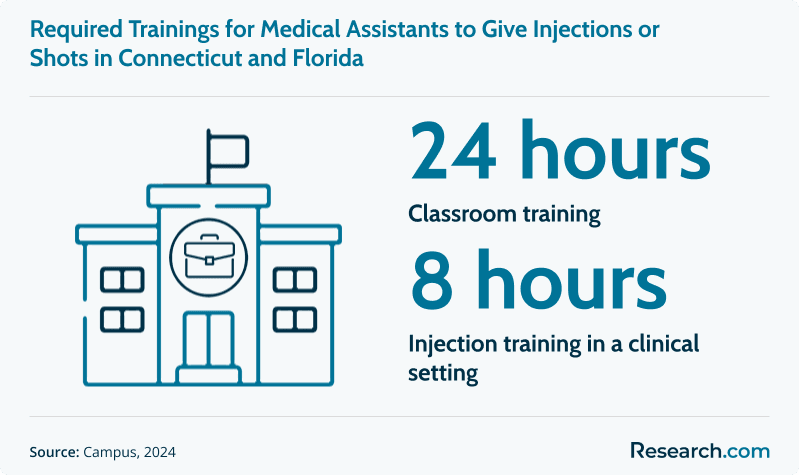
- State-specific requirements: Some states define exact training expectations. California, for example, mandates 10 hours of injection training and at least 10 supervised injections of each type.
- Competency documentation: Employers often want proof that the MA has been observed performing the procedure correctly before assigning injection duties independently under supervision.
Medical assistants generally do not need a state license in the same way nurses do, but the details matter. If you are comparing requirements, see Research.com’s guide on whether medical assistants need a license.
Certification can also strengthen a candidate’s profile. The Certified Clinical Medical Assistant exam from the National Healthcareer Association has a pass rate of 77%, which reflects the level of preparation expected for many clinical MA roles. Certification does not automatically override state scope-of-practice rules, but it can help employers verify baseline knowledge and professionalism.
Students who eventually want to move from assisting into nursing may compare future pathways such as ADN to MSN bridge programs. Those programs are not required for medical assistant injection duties, but they may fit long-term goals for people planning to become registered nurses or advanced practice clinicians.

What skills help medical assistants succeed at giving injections?
Successful injection administration requires more than knowing where to place a needle. Medical assistants need technical precision, calm communication, attention to safety, and the judgment to recognize when they should stop and ask a licensed provider for help.
Core Skills for Safe and Confident Injection Duties
| Skill area | What it involves | Why it matters for injections |
| Technical accuracy | Choosing the correct site, route, angle, needle, and technique | Reduces discomfort, dosing errors, and preventable complications |
| Infection control | Hand hygiene, skin preparation, PPE use, and sterile handling of supplies | Protects patients and staff from avoidable exposure and infection |
| Medication awareness | Verifying the order, dose, route, expiration date, and patient identity | Helps prevent wrong-medication, wrong-dose, and wrong-patient errors |
| Patient communication | Explaining the procedure clearly and checking for questions | Reduces fear and improves patient cooperation |
| Documentation discipline | Recording the medication, dose, route, site, lot number when applicable, and patient response | Creates a reliable clinical record and supports follow-up care |
| Professional boundaries | Knowing which tasks are outside the MA role | Prevents unsafe practice and reduces legal risk |
Experience matters, but it should be interpreted carefully. One cited medication-administration study found that with each year of experience, the risk of injection errors decreases by 11%, and the rate of serious errors drops by 18.5%. That evidence is not a blanket guarantee for every medical assistant setting, but it reinforces a practical point: repeated supervised practice and consistent procedure checks improve safety.
Medical assistants who want to broaden their administrative skill set may also consider healthcare office credentials. For example, a cost-effective medical billing and coding program may support career flexibility, although it does not replace clinical injection training.
For longer-term clinical advancement, some MAs eventually pursue nursing. If you are comparing advanced nursing roles, Research.com explains the difference between an advanced practice registered nurse and a nurse practitioner.
Who supervises medical assistants when they give injections?
Medical assistants administer injections only when the task is delegated by an authorized licensed healthcare provider. Depending on the state and facility, the supervising professional may be a physician, nurse practitioner, physician assistant, or another provider authorized to delegate clinical tasks.
Supervision is not just a formality. It determines whether the MA is legally allowed to perform the procedure, who is accountable for delegation, and what happens if a complication or error occurs.
Common Supervision Models
| Supervision type | What it usually means | What medical assistants should ask |
| Direct supervision | The provider is physically present or immediately available in the facility. | Must the provider be in the same room, same building, or simply onsite? |
| General supervision | The provider may not be in the room but remains responsible and available under policy. | How quickly can the provider respond if the patient has a reaction? |
| Task-specific delegation | The provider delegates only certain injections or patient scenarios. | Which medications, vaccines, age groups, or sites are included? |
| Facility protocol supervision | The employer uses written protocols that define how injections are ordered, administered, documented, and escalated. | Where is the written policy, and how is competency documented? |
Anyone considering the nurse practitioner path should also understand degree expectations. Research.com discusses whether a DNP is required for nurse practitioners.
Delegation and Legal Responsibility
Supervisors should confirm that the medical assistant is trained and competent before delegating injections. Medical assistants, in turn, should refuse tasks that are outside their authorized scope, outside employer policy, or beyond their current skill level.
- Never assume a task is allowed because another MA performs it.
- Ask for written policy when duties involve medications, vaccines, allergy shots, or injections for children.
- Document training and competency checkoffs, especially when changing employers or states.
- Escalate unusual patient reactions, medication discrepancies, or unclear orders before proceeding.
Hospitals often apply stricter policies because of higher-acuity patients and more complex medication systems. Outpatient offices may allow broader MA participation, but only within state delegation rules and the supervising provider’s authority.
Does giving injections affect a medical assistant's salary?
Injection skills can improve a medical assistant’s value in clinical settings, but they do not guarantee a specific salary. Pay depends on certification, experience, location, employer type, specialty, and the mix of clinical and administrative duties.
Certified clinical medical assistants typically earn an average annual salary of $42,918, while non-certified medical assistants earn approximately $38,040 per year. The difference is not caused by injection skills alone, but clinical competence, certification, and broader patient-care responsibilities can make a candidate more competitive.
Experience also matters. Medical assistants with over 10 years of experience can see a pay increase of up to 20% compared to those just starting in the field. Again, this should be viewed as a general labor-market pattern rather than a promise of individual earnings.
| Career factor | How it may influence pay | What to do before accepting a role |
| Certification | May signal stronger clinical preparation and professionalism. | Ask whether certification affects starting pay or promotion eligibility. |
| Injection competency | Can make an MA more useful in primary care, pediatrics, urgent care, and specialty clinics. | Confirm which injection duties are included and whether training time is paid. |
| Experience | More years in clinical practice may support higher pay or lead MA roles. | Track competencies, procedures, EHR experience, and patient-care responsibilities. |
| Work setting | Urgent care, specialty practices, and larger systems may structure duties differently. | Compare job descriptions rather than relying only on job titles. |
| Location | Local wages vary by labor demand, cost of living, and employer competition. | Review salary ranges for your city or region before negotiating. |
If you are considering nonclinical education routes connected to healthcare information, a library science degree may support roles in health information, medical libraries, research support, or information management, but it is not a direct path to expanded injection duties.
Are there cost-effective online education options to advance your career?
Yes, but students should separate online coursework from hands-on clinical competency. Online medical assistant courses can be useful for theory, terminology, pharmacology basics, documentation, and professional development. Injection technique, however, requires supervised in-person practice and employer or program verification.
When comparing online medical assistant programs, look for accreditation or recognized institutional approval, externship support, clinical skills requirements, and clear disclosure of whether the program meets your state’s expectations. A low tuition price is not enough if the program does not help you qualify for the clinical tasks employers expect.
Questions to Ask Before Choosing an Online MA Program
- Does the program include an in-person clinical skills lab, externship, or supervised practice component?
- Does it teach intramuscular, subcutaneous, and intradermal injection procedures?
- Will the school provide documentation of injection training and competency?
- Does the curriculum align with certification exam preparation?
- Does the program explain state scope-of-practice limits before students enroll?
- Are externship placements available near your location?
- What additional costs apply for supplies, background checks, immunizations, uniforms, certification exams, or externship requirements?
Can advanced degree programs enhance injection expertise and career progression?
Advanced education can support healthcare career growth, but it is important to choose a credential that matches the role you actually want. Medical assistants do not need a pharmacy doctorate or nursing graduate degree simply to give routine injections within the MA scope. Those programs are for different career goals.
If your goal is medication expertise, pharmacy education may be relevant. A fast track online PharmD program may support progression toward pharmacist-level medication management, but it is not a shortcut for medical assistants to expand their scope without meeting the licensure and practice requirements of that profession.
| Goal | Best-fit education path | Important caution |
| Perform MA clinical duties more confidently | Accredited MA program, supervised externship, certification preparation, employer training | State law and employer policy still define what you may do. |
| Move into nursing | Nursing prerequisites, ADN, BSN, or bridge pathway depending on prior education | Nursing licensure is required for RN-level practice. |
| Work in medication management as a pharmacist | PharmD pathway | Pharmacist licensure and program requirements are separate from MA training. |
| Shift toward administrative healthcare work | Billing, coding, health information, or office administration credentials | Administrative credentials do not authorize clinical injections. |
How can medical assistants alleviate patient anxiety about injections?
Medical assistants often spend more face-to-face time with patients than many people realize. That makes communication an important part of safe injection practice, especially with children, anxious adults, needle-phobic patients, and people receiving vaccines or allergy shots.
Practical Ways to Reduce Fear Before a Shot
- Explain the steps briefly: Tell the patient what you are going to do, where the injection will be given, and about how long it will take.
- Use plain language: Avoid technical terms unless the patient asks for more detail.
- Offer control where appropriate: Ask whether the patient prefers to look away, take a breath first, or sit in a certain position.
- Watch body language: Pale skin, sweating, shaking, or dizziness may signal the need to pause and alert the provider.
- Avoid minimizing fear: Saying “it is nothing” may make an anxious patient feel dismissed. A better response is, “Many people feel nervous. I’ll walk you through it.”
- Reinforce safety: Let the patient know that the medication, dose, and route are being checked according to office policy.
Broader science coursework can help some healthcare workers feel more comfortable explaining basic body systems and patient concerns. For students comparing academic options, Research.com also reviews the most affordable online biology degree accredited pathways.
How can medical assistants ensure thorough documentation and follow-up after injections?
Documentation is part of patient safety. A correctly administered injection can still create problems if the record is incomplete, entered on the wrong patient, missing a lot number, or lacking follow-up notes after a reaction.
What to Document After an Injection
- Patient identity verification according to facility policy
- Medication or vaccine name
- Dose and route
- Injection site
- Date and time of administration
- Lot number and expiration date when required, especially for vaccines
- Name or initials of the person administering the injection
- Patient education provided
- Immediate reaction, refusal, adverse symptom, or follow-up instruction
Electronic health records can reduce documentation gaps when templates are well designed, but they do not replace professional attention. Medical assistants should follow HIPAA requirements, employer protocols, and any vaccine registry or reporting rules that apply in their state.
For workers who want additional training in documentation, patient follow-up, or healthcare support skills, online medical certificate programs may be worth comparing.
Should medical assistants pursue advanced education to enhance injection expertise?
Advanced education is useful when it supports a defined career goal. If your goal is to become a stronger medical assistant, prioritize accredited MA education, certification preparation, continuing education, and supervised clinical practice. If your goal is to become a nurse, pharmacist, physician assistant, or another licensed clinician, you will need a different educational pathway.
A low-cost online Pharm.D. program may be relevant for people pursuing pharmacy careers, but it should not be treated as a simple add-on for MA injection duties. Scope of practice follows the credential and license, not just the amount of education completed.
When More Education Makes Sense
- You want to qualify for more competitive clinical MA roles.
- You need certification preparation to meet employer expectations.
- You plan to transition into nursing, pharmacy, physician assistant studies, or another licensed profession.
- You want to move into healthcare administration, billing, coding, or health information.
- Your employer requires continuing education for expanded delegated tasks.
How do injection duties differ by work setting?
Medical assistant injection duties vary widely by work setting. A pediatric office, urgent care center, allergy clinic, hospital outpatient department, and family practice may all use MAs differently, even within the same state.
| Work setting | Common injection-related duties | What to clarify before starting |
| Pediatric office | Routine childhood immunizations, vaccine preparation support, comfort measures for children and parents | Age-specific policies, vaccine documentation rules, and supervision requirements |
| Urgent care center | Flu shots, vaccines, prescribed injections, and fast-paced clinical support | Which injections MAs may give during high-volume shifts and who supervises |
| Private practice | Primary care vaccines, specialty injections, allergy shots, or medication administration depending on specialty | Practice-specific protocols and whether state law permits the delegated task |
| Hospital or health system clinic | More standardized procedures, strict documentation, and potentially narrower MA duties | System policy, competency requirements, and whether injections are limited to licensed nurses |
| Allergy or specialty clinic | Allergy injections or specialty medication support where permitted | Emergency response protocol and provider availability for adverse reactions |
Pediatric Offices
In pediatric clinics, medical assistants may support routine immunization workflows, help prepare patients and parents, and document vaccine details. Because children may be fearful or unable to describe symptoms clearly, communication, positioning, and post-injection observation are especially important.
Urgent Care Centers
Urgent care clinics often rely on MAs for efficient patient flow. Injection duties may include vaccines or prescribed medications, but the exact scope depends on state law and facility protocol. The fast pace makes verification, documentation, and clear supervision especially important.
Private Practices
Private practices may give medical assistants broad hands-on responsibilities, particularly in primary care, allergy, and some specialty offices. However, the duties can change based on the physician’s specialty, the patient population, and local delegation rules. Medical assistants planning a larger clinical role may eventually compare options such as the easiest PA schools to get into, although physician assistant practice requires a separate graduate-level pathway and licensure.
Hospitals
Hospitals and large health systems often use stricter protocols because they serve patients with more complex needs. MAs may help with clinical tasks, but injections may be limited or require additional competency review. Anyone asking whether medical assistants can give injections in a hospital should check the facility policy first, not just the state rule.
What are the risks and safety protocols for medical assistants giving injections?
Injection administration carries real risks for both patients and healthcare workers. The most important safety issues include needlestick injuries, infection transmission, wrong-dose or wrong-route errors, allergic reactions, and incomplete documentation.
Major Risks and How to Reduce Them
| Risk | What can happen | Safety protocol |
| Needlestick injury | A healthcare worker may be exposed to bloodborne pathogens. | Use safety-engineered devices when available, avoid recapping needles, dispose of sharps immediately, wash the area, report the injury, and follow post-exposure procedures. |
| Infection transmission | Unsafe injection technique can spread infection between patients or staff. | Perform hand hygiene, use clean supplies, prepare the site correctly, and never reuse needles or syringes. |
| Wrong medication, dose, patient, or route | The patient may receive the wrong treatment or experience preventable harm. | Verify the order, patient identity, medication, dose, route, expiration date, and allergies before administration. |
| Injection site reaction | Pain, redness, swelling, or other symptoms may occur after the injection. | Use correct technique, educate the patient, document the reaction, and escalate concerning symptoms. |
| Severe adverse reaction | Rare but serious reactions can require immediate clinical response. | Know emergency protocols, alert the supervising provider, and ensure required supplies are accessible under facility policy. |
Needlestick Injuries
Approximately 385,000 needlestick and sharps-related injuries occur annually among hospital-based healthcare personnel in the United States. Medical assistants should know the facility’s exposure-control plan before they ever administer injections. After an exposure, the usual steps include washing the area with soap and water, reporting the incident, and following post-exposure protocols.
Infection Control
Infection control starts before the needle reaches the patient. Medical assistants must follow hand hygiene rules, use personal protective equipment when required, maintain clean preparation areas, and dispose of sharps correctly. Reported hand hygiene compliance among medical assistants has been 91%, showing strong adherence to infection control protocols in the cited context.
Injection Site Reactions
Pain, redness, and swelling at the injection site are common and occur in over 70% of cases. Severe adverse events are rare, but medical assistants must still know how to identify concerning symptoms and when to involve the supervising provider immediately.
Safe Injection Checklist
- Confirm the provider order and verify that the task is within your delegated scope.
- Identify the patient using the facility’s required identifiers.
- Check medication name, dose, route, expiration date, and allergies.
- Prepare supplies using infection control procedures.
- Select the correct injection site and technique.
- Administer the injection calmly and safely.
- Dispose of the needle and syringe immediately in an approved sharps container.
- Document all required details in the patient record.
- Monitor and report any adverse reaction according to protocol.
What is the job outlook for medical assistants who give injections?
The job outlook for medical assistants is strong, especially in outpatient care settings where preventive services, vaccinations, chronic care support, and high patient volume create steady demand for trained clinical support staff.
According to the U.S. Bureau of Labor Statistics, employment for medical assistants is projected to grow 15% from 2023 to 2033, much faster than the average for all occupations. Demand is connected to an aging population and the need for preventive medical services, including vaccinations.
Medical assistants with documented injection skills may be especially useful in outpatient care centers, private practices, pediatric offices, and urgent care clinics. In urgent care, 99% of centers employ medical assistants, showing how central the role is to day-to-day patient flow.
Still, job growth does not mean every MA will perform injections or earn the same wage. Employers hire based on scope-of-practice rules, certification, patient population, EHR experience, communication skills, and whether the applicant can work safely under supervision.
Students who enjoy hands-on patient care but want a different allied health route may also compare online PTA programs, which lead toward physical therapist assistant preparation rather than medical assistant injection duties.

Common Mistakes to Avoid Before Performing Injection Duties
| Mistake | Why it is risky | Better approach |
| Assuming all medical assistants can give shots | Scope of practice changes by state and employer. | Check official state rules and written facility policy. |
| Choosing a program based only on price | A cheap program may not include supervised clinical practice. | Compare externship support, skills training, certification preparation, and state alignment. |
| Relying only on certification | Certification does not automatically authorize every clinical task. | Use certification as one part of readiness, not a substitute for legal scope review. |
| Performing injections without clear delegation | The MA and supervising provider may face legal and patient-safety consequences. | Wait for an authorized order, proper supervision, and documented competency. |
| Skipping documentation details | Incomplete records can harm continuity of care and create compliance issues. | Record medication, dose, route, site, lot number when required, timing, and patient response. |
| Ignoring patient anxiety | A fearful patient may move suddenly, faint, or avoid future care. | Explain the process, offer reassurance, and watch for distress. |
How to Prepare for Injection Duties as a Medical Assistant
- Check your state’s scope-of-practice rules. Use official agencies, not only school marketing pages or job posts.
- Choose a program with hands-on clinical training. Injection technique cannot be mastered through reading alone.
- Document every competency. Keep copies of transcripts, skills checkoffs, externship evaluations, and certification results.
- Ask employers about delegation policies. Before performing injections, know who supervises you and what procedures are allowed.
- Practice patient communication. Safe technique includes helping patients understand what is happening.
- Stay current on infection control. Follow CDC, OSHA, employer, and state requirements that apply to your setting.
- Know when to stop. If an order, dose, patient condition, or supervision arrangement is unclear, pause and escalate.
References
- Florida Health Care Academy. Can a medical assistant give shots? State-by-State guide. https://www.fhcaorlando.com/blog/can-medical-assistants-give-shots
- American Career College. How Long is a Medical Assistant Program? Complete Training Guide. https://americancareercollege.edu/blog/how-long-is-medical-assistant-program
- Medical Assistant Scope of practice by state. https://www.stepful.com/post/medical-assistant-scope-of-practice-by-state
- A learning experience designed for student success. https://www.pennfoster.edu/programs/healthcare/medical-assistant-career-diploma
- NHA Certified Clinical Medical Assistant Guide. https://www.stepful.com/post/certified-clinical-medical-assistant
- Medical Assistant Training. https://immunize.utah.gov/medical-assistant-training
- American CPR Care Association. Essential Soft Skills for Healthcare Assistants: a guide. https://cprcare.com/blog/soft-skills-you-need-for-patient-care-as-a-healthcare-assistant
- Case Western Reserve University MBA. Why are Soft Skills in Healthcare Important? https://onlineprograms.case.edu/mba/blog/why-soft-skills-are-important-in-healthcare
- Sancho-Cantus, D., Cubero-Plazas, L., Navas, M. B., Castellano-Rioja, E., & Ros, M. C. Importance of Soft Skills in Health Sciences Students and Their Repercussion after the COVID-19 Epidemic: Scoping Review. https://doi.org/10.3390/ijerph20064901
- The importance of soft skills in healthcare careers. https://cetweb.edu/blog/the-importance-of-soft-skills-in-healthcare-careers
- AAMA. https://www.aama-ntl.org/
- The Guardian. Gen Z students in Manchester to learn soft skills such as empathy and time management. https://www.theguardian.com/society/2025/apr/21/gen-z-students-in-manchester-to-learn-soft-skills-such-as-empathy-and-time-management
- Westbrook, J. I., Rob, M. I., Woods, A., & Parry, D. Errors in the administration of intravenous medications in hospital and the role of correct procedures and nurse experience. https://doi.org/10.1136/bmjqs-2011-000089
- AMA EdHub. Health Care Workforce: Medical Assistant Professional Development. https://edhub.ama-assn.org/steps-forward/module/2702558
- Payerchin, R. What duties can medical assistants take on? Some principles for delegating. https://www.physicianspractice.com/view/what-duties-can-medical-assistants-take-on-some-principles-for-delegating
- Payerchin, R. What duties can medical assistants take on? Some principles for delegating. https://www.contemporaryobgyn.net/view/what-duties-can-medical-assistants-take-on-some-principles-for-delegating
- Texas Board of Nursing. Frequently Asked Questions - Delegation. https://www.bon.texas.gov/faq_delegation.asp
- The Doctors Company. The role of the medical assistant in your office practice. https://www.thedoctors.com/articles/the-role-of-the-medical-assistant-in-your-office-practice
- RCMA News & Information. Vicarious liability for medical assistant negligence. https://www.rcmadocs.org/news-events/news/vicarious-liability-for-medical-assistant-negligence2.aspx
- MedPro Group. Understanding vicarious liability and implementing strategies to reduce risks. https://www.medpro.com/understanding-vicarious-liability
- Salary.com. Certified Clinical Medical Assistant Salary. https://www.salary.com/research/salary/position/certified-clinical-medical-assistant-hourly-wages
- Salary.com. Certified Clinical Medical Assistant Salary. https://www.salary.com/research/salary/position/certified-clinical-medical-assistant-salary
- Average medical assistant salary in United States. https://www.stepful.com/medical-assistant-salaries/united-states
- Alshehri, S., Kayal, M., Almshhad, H. A., Dirar, Q., AlKattan, W., Shibl, A., & Ouban, A. The incidence of needlestick and sharps injuries among healthcare workers in a tertiary care hospital: a Cross-Sectional study. https://doi.org/10.7759/cureus.38097
- Occupational Safety and Health Administration. Needlestick/Sharps Injuries. https://www.osha.gov/etools/hospitals/patient-care-unit/needlestick-sharps-injuries
- Ashinyo, M. E., Dubik, S. D., Duti, V., Amegah, K. E., Ashinyo, A., Asare, B.A., Ackon, A. A., Akoriyea, S. K., & Kuma-Aboagye, P. Infection prevention and control compliance among exposed healthcare workers in COVID-19 treatment centers in Ghana. https://doi.org/10.1371/journal.pone.0248282
- Siju, J., Anagboso, U., Vernet, E., Moss, M., Javaid, W., & Cassano, K. Implementation of a quality improvement project using the patient as the observer to improve hand hygiene compliance in ambulatory care practices. https://doi.org/10.1016/j.jhin.2023.08.001
- Yamazaki, S., Watanabe, K., Okuda, Y., Urushihara, M., Koshikawa, H., Chiba, H., Yahaba, M., Taniguchi, T., Nakada, T., Nakajima, H., Ishii, I., & Igari, H. Adverse effect investigation using application software after vaccination against SARS-CoV-2 for healthcare workers. https://doi.org/10.1016/j.jiac.2022.02.020
- CDC. Safe injection practices and your health. https://www.cdc.gov/injection-safety/about/index.html
- Florida Health Care Academy. Are medical assistants in demand? Job outlook. https://www.fhcaorlando.com/blog/are-medical-assistants-in-demand
- Bureau of Labor Statistics. Medical assistants. https://www.bls.gov/ooh/healthcare/medical-assistants.htm
Key Insights
- Medical assistants can give injections in many states, but only when state law, employer policy, provider delegation, and training requirements all permit it.
- Intramuscular and subcutaneous injections are the most common injection duties for MAs; intravenous injections are generally outside the role.
- Training should include anatomy, medication safety, infection control, supervised practice, and written competency documentation.
- Supervision matters. A physician, nurse practitioner, physician assistant, or another authorized provider must delegate and oversee injection duties according to applicable rules.
- Injection skills may improve employability in outpatient, urgent care, pediatric, and specialty settings, but they do not guarantee a specific salary.
- Before enrolling in a program, students should ask whether it includes hands-on clinical training, externship support, injection competency checks, and alignment with state scope-of-practice rules.
- The safest medical assistants know both how to perform injections and when not to proceed because an order, policy, patient condition, or supervision requirement is unclear.
Other Things You Should Know About Medical Assistants Giving Injections or Shots
Yes. In 2027, medical assistants must give injections under physician or other authorized provider supervision, following state law and clinic policy. They also need documented training in injection technique, infection control, and emergency response before performing the task.
Yes, medical assistants typically need to complete a certified training program that includes injection techniques. In 2027, programs must adhere to state regulations or recommendations by bodies like the American Association of Medical Assistants (AAMA) to ensure competency in administering injections.


