2027 Do You Need a Doctorate (DNP) Degree to be a Nurse Practitioner?

Co-Founder and Chief Data Scientist
If your goal is to become a nurse practitioner, one of the biggest decisions is whether to stop at the MSN or invest more time and money in a Doctor of Nursing Practice. The answer is not the same for every nurse. State licensure rules, certification requirements, employer expectations, specialty choice, career goals, and program cost all matter.
This guide explains when a DNP is useful, when an MSN may still be enough, and how to compare graduate nursing pathways without overpaying or choosing a program that does not support your intended role. It is written for registered nurses planning the next step, career changers researching advanced nursing, and current NPs deciding whether a doctoral degree is worth the investment.
Quick answer: Do you need a DNP to become a nurse practitioner?
No, a DNP is not required in every state for entry-level nurse practitioner practice. In most cases, NPs can qualify for licensure with an accredited MSN or DNP, national certification in their specialty, and approval from the state board of nursing. However, a DNP can be valuable for nurses who want stronger preparation in clinical leadership, healthcare systems, quality improvement, policy, teaching, or advanced specialty practice.
Key points to know before choosing a DNP pathway
- Nurse practitioners are advanced practice registered nurses who diagnose conditions, manage treatment plans, prescribe medications where permitted, and provide primary or specialty care.
- The usual NP education route includes RN licensure, graduate nursing education through an MSN or DNP, national specialty certification, and state NP licensure.
- The labor market is strong: employment for nurse anesthetists, nurse midwives, and nurse practitioners is projected to grow 40% from 2023 to 2033.
- Education requirements for becoming a nurse practitioner
- How long the DNP path usually takes
- Whether every state requires a doctorate for NPs
- DNP vs. PhD in Nursing: which degree fits your goals?
- Nurse practitioner salary expectations in the U.S.
- NP and advanced nursing roles where a DNP may matter most
- DNP career paths and average salaries
- Financial aid and scholarship options for DNP students
- How to evaluate a DNP program before enrolling
- How bridge programs can prepare you for doctoral nursing study
- How to think about DNP return on investment
- Online vs. campus-based DNP programs
- Nurse practitioner job outlook
- Accelerated DNP program advantages job outlook context key insights
What are the education requirements to become a nurse practitioner?
Becoming an NP requires more than earning a graduate degree. You need the right nursing foundation, an accredited advanced practice program, specialty certification, and state authorization to practice. The exact pathway depends on your current education level and whether you enter through a BSN-to-DNP, MSN, post-master’s DNP, or bridge route.
| Step | What it involves | Why it matters |
| Complete a BSN or qualifying nursing pathway | A BSN provides core preparation in patient care, pharmacology, anatomy, assessment, and professional nursing practice. | It prepares graduates for RN licensure and gives future NPs the clinical foundation needed for graduate study. |
| Earn RN licensure | Graduates must pass the NCLEX-RN and meet state requirements to practice as registered nurses. | RN licensure is required before entering most NP-focused graduate programs and before building advanced clinical experience. |
| Choose an accredited MSN or DNP program | NP candidates complete graduate-level coursework, clinical training, and specialty preparation through an MSN or DNP. | An accredited program is essential for certification eligibility, state licensure, and employer recognition. |
| Pass national certification in an NP specialty | Graduates test in areas such as family practice, acute care, psychiatric-mental health, adult-gerontology, pediatrics, or women’s health. | Certification verifies advanced practice competence and is commonly required for state NP licensure. |
| Apply for state NP licensure | Applicants submit education, certification, RN licensure, and other required documentation to the state nursing board. | This step legally authorizes NP practice, including responsibilities such as diagnosis, treatment planning, and prescribing where allowed. |
If you already hold a BSN and want a direct doctoral route, researching the most affordable BSN to DNP programs online can help you compare options that may let you keep working while advancing your credentials.
It also helps to understand how titles fit together. If you are unsure about the difference between APRN and NP, think of APRN as the broader category. Nurse practitioners are one type of APRN, alongside clinical nurse specialists, certified nurse midwives, and certified nurse anesthetists.
How long does it take to become a nurse practitioner with a DNP?
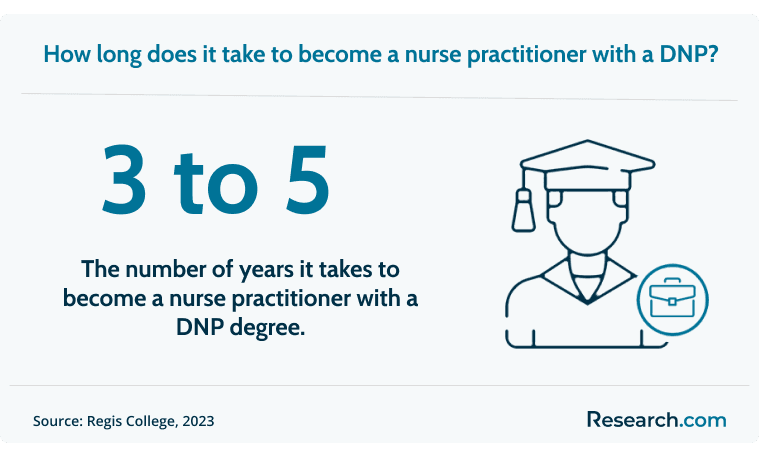
The DNP route usually takes longer than an MSN-only pathway, but the timeline depends on where you start. After a BSN, a BSN-to-DNP program generally takes three to five years of full-time study, with the length affected by specialty, clinical hour requirements, course sequencing, and whether the program is full-time, part-time, online, or hybrid.
Nurses who already have an MSN may be able to complete a post-master’s DNP in as little as one to two years. These programs often focus less on initial NP preparation and more on practice leadership, evidence-based improvement, healthcare systems, and the final scholarly or capstone project.
| Starting point | Typical DNP timeline stated | Best fit |
| BSN-prepared RN | Three to five years of full-time study | RNs who want NP preparation and doctoral-level training in one continuous program. |
| MSN-prepared nurse | As little as one to two years | Current advanced practice nurses or MSN graduates seeking doctoral-level practice, leadership, or systems training. |
| Working nurse in a part-time or online option | May take longer than full-time study | Nurses who need flexibility because of work, family, or clinical scheduling responsibilities. |
Before enrolling, ask whether the program allows NP certification before the full DNP is completed, how clinical placements are arranged, and whether the schedule is realistic for your work obligations.
Do nurse practitioners need a doctoral degree in every state?
No. A doctoral degree is not currently required by every state for nurse practitioner entry into practice. Most states continue to accept an MSN for NP licensure when the graduate has completed an accredited program, earned national certification, and satisfied the state board’s requirements.
- Most state boards still recognize the MSN route. Nurses can become NPs with an MSN in many jurisdictions, although some employers may prefer DNP-prepared applicants for certain roles. Career changers may also explore direct entry MSN programs for non-nurses online if they hold a non-nursing bachelor’s degree and want to enter advanced nursing through a structured pathway.
- The DNP is a professional recommendation, not a universal legal mandate. Organizations such as the American Association of Colleges of Nursing have supported doctoral preparation for advanced nursing practice, but that position does not automatically change state licensure law.
- Employer expectations can be stricter than state minimums. Hospitals, academic medical centers, specialty practices, and leadership roles may give preference to DNP-prepared nurses even when the state allows MSN-prepared NPs to practice.
The safest approach is to verify requirements with the board of nursing in the state where you plan to work and confirm that your intended program meets certification and licensure standards for your NP specialty.
How is a DNP different from a PhD in nursing?
The DNP and the PhD in Nursing are both terminal degrees, but they are built for different professional outcomes. The DNP is practice-focused. The PhD is research-focused. Choosing the wrong one can lead to unnecessary coursework, misaligned career preparation, and a weaker return on your time and tuition investment.
| Degree | Main purpose | Common career direction | Best choice if you want to... |
| DNP | Apply evidence to improve clinical care, systems, leadership, and patient outcomes. | Advanced practice, healthcare leadership, quality improvement, executive nursing, clinical education, or policy implementation. | Stay close to practice, lead care delivery, manage programs, or improve healthcare systems. |
| PhD in Nursing | Generate original research and expand nursing science. | University research, academic scholarship, policy research, and nurse scientist roles. | Design studies, publish research, teach in research-intensive settings, or build an academic research career. |
If your goal is stronger clinical authority, leadership preparation, or advanced systems-level practice, the DNP is usually the more aligned option. Nurses comparing cost should review the cheapest online DNP programs carefully, but affordability should be weighed alongside accreditation, clinical placement support, certification outcomes, and specialty fit.
How much can you earn as a nurse practitioner in the U.S.?
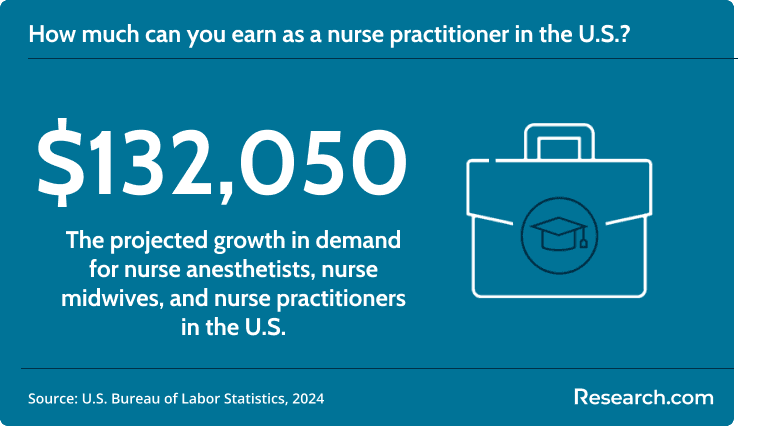
The average annual pay for nurse practitioners in the U.S. is $132,050 per year. Actual earnings can be higher or lower depending on specialty, employer type, location, experience, schedule, and whether the role includes leadership, advanced procedures, or high-demand clinical responsibilities.
Salary should not be evaluated by degree alone. A DNP may improve access to leadership or specialized roles, but it does not guarantee a specific wage. The strongest compensation outcomes usually come from aligning specialty demand, geographic need, clinical experience, certification, and employer setting.
- Location: Pay can differ by state, metro area, rural demand, and local competition for advanced practice clinicians.
- Specialty: Acute care, psychiatric-mental health, neonatal, pediatric, adult-gerontology, and family practice roles can have different compensation patterns. If you are comparing tracks, review the difference between FNP and AGNP before committing to a specialty.
- Experience: NPs with stronger clinical backgrounds, procedural skills, and leadership experience often have more negotiating power.
- Practice setting: Hospitals, private practices, outpatient centers, specialty clinics, academic settings, and health systems may structure pay differently.
- Credentials: A DNP and additional certifications can strengthen a résumé for advanced clinical, leadership, or education roles, but salary outcomes still depend on the job market.
Speaking with a recruiter can help you understand local openings, compensation ranges, and employer preferences. If you are curious about that role, this guide explains what a nurse recruiter does and how recruiters support hiring in hospitals, clinics, and staffing organizations.
What nurse practitioner roles require a DNP degree?
A DNP is not required for every NP job, but it can become important in roles where clinical complexity, organizational leadership, teaching, or specialty scope are central. In some cases, the degree is formally required; in others, it is preferred or used to distinguish candidates.
| Role or setting | How the DNP may help | Decision point for students |
| Nurse Anesthetist (CRNA) | Supports advanced preparation for anesthesia practice, complex clinical decision-making, and leadership responsibilities. | Confirm the current degree requirement for CRNA entry and practice with the relevant accreditor, certifying body, and state board. |
| Certified Nurse Midwife (CNM) | May strengthen preparation in women’s health, population health, quality improvement, and care system leadership. | Check whether employers in your region require, prefer, or financially reward doctoral preparation. |
| Nursing leadership and executive roles | Builds skills in policy, systems improvement, organizational leadership, and evidence-based change. | Consider a DNP if your goal includes Director of Nursing, Chief Nursing Officer, or system-level leadership roles. |
| Academic faculty roles | Can support teaching in practice-focused nursing programs and mentoring advanced clinical students. | Review faculty job postings because some institutions prefer a DNP, while research-intensive roles may prefer a PhD. |
What are the career options and average salaries for those with a DNP degree?
A DNP can lead to more than direct patient care. DNP-prepared nurses may work in advanced practice, clinical leadership, education, policy, consulting, or quality improvement. For a broader look at doctoral nursing responsibilities, see this guide on what a DNP does.
| Career option | Average salary stated | Typical responsibilities |
| Advanced Practice Registered Nurse roles | $132,050 | Provide advanced patient care as nurse practitioners, nurse anesthetists, or nurse midwives; diagnose conditions; prescribe medications where permitted; and manage complex care plans. Nurses interested in women’s health can use this women's health nurse practitioner career guide to understand that specialty path. |
| Clinical Nurse Specialist | $94,545 | Improve clinical outcomes through evidence-based practice, staff consultation, specialty expertise, and quality initiatives. |
| Nurse Executive or Director of Nursing | $108,675 | Lead nursing teams, oversee operations, guide policy implementation, and coordinate patient care strategy across departments or organizations. |
| Nursing Faculty or Educator | $102,263 | Teach nursing students, design curricula, mentor future clinicians, and support practice-focused scholarship. |
| Healthcare Policy Analyst or Consultant | $96,920 | Use clinical expertise to advise organizations, agencies, or nonprofits on healthcare delivery, public health initiatives, and patient care policy. |
Specialization can also shape career direction. Nurses who want to serve aging adults, for example, should review the steps to become a GNP and compare gerontology-focused pathways with family, acute care, psychiatric, pediatric, and women’s health options.
What financial aid or scholarships are available for DNP students?
DNP programs can be expensive, so funding strategy should be part of your school search from the beginning. Do not compare programs by tuition alone. Include fees, travel, clinical placement costs, books, lost work hours, loan interest, and whether your employer will help pay for the degree.
- Federal financial aid: Graduate nursing students can submit the Free Application for Federal Student Aid (FAFSA) to determine eligibility for federal aid. Graduate students may use options such as Direct Unsubsidized Loans and Graduate PLUS Loans.
- School-based scholarships and grants: Universities may offer merit-based, need-based, service-focused, or nursing leadership awards for DNP students. Ask each school whether aid is renewable and whether part-time students qualify.
- Nursing-focused scholarships: Professional and healthcare organizations may support advanced nursing students. The American Association of Colleges of Nursing (AACN) and the National Health Service Corps are examples of organizations connected to scholarship or loan repayment opportunities.
- Employer tuition assistance: Hospitals and healthcare systems may offer tuition reimbursement, tuition assistance, or education benefits for nurses pursuing advanced credentials. Review service commitments and repayment clauses before accepting funds.
- Professional association awards: Nursing organizations, including the American Association of Nurse Practitioners and Sigma Theta Tau International Honor Society of Nursing, may offer scholarships or educational support for advanced nursing students.
Students pursuing specialized practice should look for funding tied to their clinical interests. For example, nurses researching how to become a holistic nurse practitioner may want to ask programs and associations about scholarships connected to integrative, preventive, or whole-person care.
How should I evaluate a DNP program to meet my career goals?
A DNP program should be judged by how well it prepares you for licensure, certification, clinical practice, leadership, and the kind of job you want after graduation. A lower tuition price is helpful, but it is not enough if the program has weak clinical placement support or does not match your specialty.
| Question to ask | Why it matters |
| Is the program accredited by a recognized nursing accreditor? | Accreditation affects certification eligibility, licensure, transferability, employer trust, and access to financial aid. |
| Does the curriculum match my intended NP specialty? | A family, acute care, psychiatric-mental health, adult-gerontology, pediatric, or women’s health track should align with your certification goal. |
| Who arranges clinical placements? | Some programs place students; others require students to find sites and preceptors, which can delay graduation. |
| What are the total costs beyond tuition? | Fees, travel, campus intensives, background checks, technology charges, and reduced work hours can change affordability. |
| What support exists for working nurses? | Flexible schedules, advising, tutoring, virtual office hours, and predictable clinical requirements can make completion more realistic. |
| How does the program report outcomes? | Certification pass rates, graduation rates, employment outcomes, and student support data can reveal program quality. |
If you need to strengthen your nursing foundation before doctoral study, compare completion pathways such as easy RN to BSN online programs and ask whether credits, prerequisites, or prior clinical experience can support later DNP admission.
How can bridge programs enhance my readiness for a DNP degree?
Bridge programs can help nurses move from one credential level to the next without starting over. They are especially useful for LPNs, associate-degree RNs, and working nurses who need a BSN or equivalent preparation before applying to advanced practice programs.
These pathways can build academic writing, evidence-based practice skills, assessment knowledge, and clinical confidence before a demanding DNP curriculum. For nurses at the practical nursing level, reviewing the top 6-month LPN to RN programs online may help clarify the first step toward RN licensure and later graduate study.
Bridge programs are not shortcuts around licensure or certification. They are structured transition routes. Before enrolling, confirm whether the program is approved for your state, whether credits transfer, whether clinical hours are accepted, and how the program positions graduates for BSN, MSN, or DNP admission.
What is the return on investment for a DNP degree?
The ROI of a DNP depends on more than the diploma. It depends on your starting credential, tuition cost, loan amount, expected salary change, employer support, career timeline, and whether the degree helps you qualify for roles you could not access with an MSN alone.
| ROI factor | What to evaluate |
| Program cost | Calculate tuition, fees, books, travel, campus visits, clinical expenses, and interest on borrowed funds. |
| Time away from work | Consider whether you must reduce hours, change shifts, or take unpaid time for clinical requirements. |
| Career mobility | Determine whether the DNP is preferred for leadership, specialty, faculty, policy, or executive roles in your target market. |
| Salary potential | Compare local NP, leadership, and specialty pay rather than relying only on national averages. |
| Geographic demand | Review regional hiring trends and pay differences, including resources on the highest-paid nurses by state. |
| Nonfinancial value | Factor in professional autonomy, leadership influence, teaching opportunities, and long-term career resilience. |
A DNP may be worth it if it directly supports your target role, your employer helps fund it, your state or specialty market values doctoral preparation, or you want leadership responsibilities beyond routine clinical practice. It may be less compelling if your goal is entry-level NP practice in a market where an MSN is accepted and you would need to take on substantial debt without clear career benefit.
How do online DNP programs compare to on-campus options?
Online and campus DNP programs can lead to the same credential when they are properly accredited and meet certification and licensure requirements. The difference is not the degree title. The difference is how coursework, clinical learning, faculty access, scheduling, and support are delivered.
| Factor | Online DNP programs | On-campus DNP programs |
| Flexibility | Often better for working nurses because didactic coursework may be completed remotely or on a more flexible schedule. | Usually more structured, with set class times and more frequent in-person expectations. |
| Clinical requirements | Still required; students may need approved local placements and preceptors. | May have established relationships with nearby clinical sites, depending on the school. |
| Cost considerations | May reduce commuting, relocation, or housing costs, but technology fees and travel for intensives may still apply. | May require commuting, relocation, parking, housing, or more time away from work. |
| Faculty and peer interaction | Often delivered through virtual meetings, online discussions, synchronous sessions, and remote advising. | Provides more face-to-face interaction, campus networking, and immediate access to some school resources. |
| Best fit | Self-directed nurses who need flexibility and can manage remote learning and clinical planning. | Students who prefer in-person instruction, local networking, and a fixed academic routine. |
Before choosing an online DNP, ask whether the school is authorized to enroll students in your state and whether the program meets your state’s NP licensure requirements. This is especially important for regulated clinical fields.
What is the job outlook for nurse practitioners in the U.S.?
The outlook for nurse practitioners is strong because healthcare systems need advanced practice clinicians for primary care, specialty care, chronic disease management, preventive services, and care in rural or underserved communities. According to the U.S. Bureau of Labor Statistics, employment of nurse anesthetists, nurse midwives, and nurse practitioners is projected to grow 40 percent from 2023 to 2033, which is much faster than the average for all occupations.
The same source projects about 31,900 openings for nurse anesthetists, nurse midwives, and nurse practitioners each year over the decade. Openings are expected to come from both employment growth and the need to replace professionals who retire or leave the field. DNP-prepared nurses may be especially competitive for roles involving leadership, specialty practice, quality improvement, clinical education, and care model redesign.
Current trends affecting DNP and NP career decisions
- Employers are emphasizing advanced clinical judgment. NPs are increasingly used in primary care, specialty clinics, telehealth, and team-based care models, making rigorous specialty preparation important.
- Leadership skills are becoming more valuable. Healthcare organizations need clinicians who can improve workflows, reduce practice variation, lead quality projects, and translate evidence into patient care.
- Online graduate nursing education is now common, but quality varies. Flexibility is useful, yet students must still verify accreditation, state authorization, clinical placement support, and certification alignment.
- Credential expectations differ by role and employer. MSN preparation may meet licensure requirements, while DNP preparation may provide an advantage for executive, academic, or highly specialized positions.
Common mistakes to avoid when choosing a DNP program
- Assuming every online program works in every state. Always confirm state authorization and licensure eligibility before enrolling.
- Choosing based only on tuition. A cheaper program can become costly if clinical placements are weak, credits do not transfer, or graduation is delayed.
- Ignoring specialty fit. Your program track must match the NP certification area you plan to pursue.
- Overestimating salary gains. A DNP can improve career options, but it does not guarantee a specific income or promotion.
- Failing to ask who finds preceptors. Clinical placement responsibility can be one of the biggest practical differences between programs.
- Confusing DNP and PhD outcomes. Choose the DNP for practice leadership and the PhD for research-intensive academic work.
What advantages do accelerated DNP programs offer?
Accelerated DNP programs are designed for qualified nurses who want to complete advanced practice or doctoral-level preparation in a shorter, more concentrated format. They may combine compressed coursework, structured clinical progression, and flexible delivery to help experienced nurses move into advanced roles more efficiently.
The benefit is speed, but speed should not come at the expense of clinical quality. Before choosing an accelerated option, examine the curriculum sequence, clinical placement model, faculty access, certification preparation, and whether the workload is realistic with your job. To compare shorter pathways, review accelerated DNP programs that balance time efficiency with comprehensive training.
Key Insights
- You do not need a DNP in every state to become a nurse practitioner; many NPs still qualify through an accredited MSN, national certification, and state licensure.
- A DNP is most useful when your goals include leadership, advanced specialty practice, healthcare systems improvement, clinical education, policy, or executive nursing roles.
- DNP programs typically require 3 to 5 years of full-time study for BSN-entry students, while MSN-entry students may finish in as little as one to two years.
- The average salary for nurse practitioners in the U.S. is $132,050 per year, but actual pay depends on specialty, location, employer, experience, and role responsibilities.
- Employment for nurse anesthetists, nurse midwives, and nurse practitioners is projected to grow 40% from 2023 to 2033, with about 31,900 openings projected each year.
- The best DNP program is not simply the cheapest or fastest one. It should be accredited, aligned with your specialty, realistic for your schedule, strong in clinical placement support, and worth the cost for your specific career plan.
References:
- Regis College. (2023). Timeline: How Long Is a DNP Program? Regis College
- U.S. Bureau of Labor Statistics. (2024). Occupational Outlook Handbook: Nurse Anesthetists, Nurse Midwives, and Nurse Practitioners. U.S. BLS
- ZipRecruiter. (2025). Clinical Nurse Specialist Salary. ZipRecruiter
Other Things You Should Know About DNP Degrees and Becoming a Nurse Practitioner
As of 2027, to become a nurse practitioner, you need at least a Master of Science in Nursing (MSN). While a Doctor of Nursing Practice (DNP) is beneficial for career advancement and leadership roles, it is not a mandatory requirement for pursuing a nurse practitioner role in most states.
Yes. In 2027, nurse practitioners can practice with an MSN or DNP in most states if they meet state licensure rules, hold national certification from ANCC or AANPCB, and maintain an active RN license. No state requires a DNP for initial NP licensure.
As of 2027, no U.S. states mandate a Doctorate of Nursing Practice (DNP) for nurse practitioner licensure. However, some states may have future plans to adopt this requirement, so it's important to stay updated on individual state regulations.