2027 How To Become a Nurse Recruiter: Salary & Career Paths

Co-Founder and Chief Data Scientist
Becoming a nurse recruiter is a practical career path for people who want to work in healthcare without providing bedside care. The role sits between human resources, staffing strategy, and clinical workforce planning: you help hospitals, clinics, long-term care facilities, and staffing agencies find nurses who are qualified, licensed, and a strong fit for open roles.
This career matters because healthcare employers continue to compete for nursing talent. Healthcare systems are expected to fill over 194,000 nursing roles annually until 2033, and nurse recruiters help keep units staffed, reduce hiring delays, and support patient care indirectly. If you are considering healthcare administration, human resources, nursing, or staffing, this guide explains how to enter the field, what education helps, which certifications are useful, what the job pays, and how to land your first role.
Quick answer: How do you become a nurse recruiter?
To become a nurse recruiter, you usually need education in healthcare administration, human resources, nursing, or a related field, plus experience in recruiting, healthcare staffing, hospital HR, or clinical care. A nursing license is helpful for some roles but is not always required. Employers often value candidates who understand healthcare hiring, can screen nursing credentials, use applicant tracking systems, communicate well with nurses and hiring managers, and follow legal and ethical hiring practices.
Key things to know before choosing this career
- There is no single required major. Nurse recruiters commonly come from healthcare administration, human resources, nursing, staffing, or healthcare support backgrounds.
- Clinical experience can help, but it is not mandatory. A nursing background may make it easier to understand specialties, shifts, certifications, and unit culture, but many nurse recruiters enter through HR or staffing.
- The job is relationship-driven. Recruiters source candidates, screen applicants, coordinate interviews, support offers, and build long-term talent pipelines.
- Hiring pressure is real. The RN vacancy rate remains 9.6% nationwide in 2025, so recruiters often work with urgent timelines and hard-to-fill roles.
- Certifications can strengthen your resume. Credentials such as Certified Health Care Recruiter (CHCR), Certified Nurse Recruiter (CNR), PHR, CIR, LinkedIn Recruiter Certification, and CSP can help show specialized preparation.
- What are the steps to becoming a nurse recruiter?
- What does a nurse recruiter do on the job?
- What skills do nurse recruiters need to succeed?
- What degree or education do you need to become a nurse recruiter?
- What certifications help nurse recruiters stand out?
- How long does it take to become a nurse recruiter?
- How much do nurse recruiters make for 2027?
- How does advanced education support career growth in nurse recruiting?
- How do digital tools and social media shape nurse recruiting?
- Where do nurse recruiters work?
- Why do regional market trends matter in nurse recruiting?
- How do you get your first job as a nurse recruiter?
- What are the pros and cons of being a nurse recruiter?
- What legal and ethical rules should nurse recruiters understand?
What are the steps to becoming a nurse recruiter?
The best route into nurse recruiting is to combine healthcare knowledge with recruiting experience. You do not have to start as a registered nurse, but you do need to understand how nursing roles differ, what credentials employers require, and how healthcare hiring works. In 2025, the RN vacancy rate remains high at 9.6% nationwide, which means employers need recruiters who can move quickly without lowering hiring standards.
Use this step-by-step path to prepare for the role:
- Choose an education path that matches your background. Common options include healthcare administration, human resources, nursing, business, psychology, or healthcare management. If affordability is a major concern, compare options such as the cheapest online healthcare administration degree programs before enrolling.
- Learn the healthcare workforce basics. Study common nursing roles, licensure requirements, shift structures, specialties, patient care settings, and the difference between full-time, per diem, contract, travel, and agency nursing.
- Get experience in HR, staffing, or healthcare operations. Entry-level roles such as recruiting assistant, HR coordinator, staffing coordinator, credentialing assistant, scheduler, or hospital administrative assistant can help you build relevant experience.
- Practice candidate screening. Nurse recruiters must review resumes, confirm licenses and certifications, evaluate specialty experience, ask structured interview questions, and identify whether a candidate fits the job requirements.
- Learn recruiting technology. Applicant tracking systems, job boards, resume databases, video interview platforms, and sourcing tools are part of everyday recruiting work.
- Consider a professional certification. Certifications are usually optional, but they can help if you are new to healthcare recruiting or want to move into a hospital, staffing agency, or senior recruiter role.
| Starting point | Best first move | Why it helps |
| Current college student | Major in healthcare administration, HR, nursing, business, or psychology and complete an HR or healthcare internship | Builds academic knowledge and gives you early exposure to hiring or healthcare operations |
| Current nurse | Use clinical experience to move into nurse staffing, talent acquisition, or workforce planning | Clinical knowledge helps you understand specialty requirements and candidate fit |
| HR professional | Learn nursing credentials, healthcare compliance, and hospital staffing models | Transfers your recruiting skills into a specialized healthcare environment |
| Healthcare support worker | Move into scheduling, credentialing, staffing coordination, or HR support | Provides a bridge from healthcare operations to recruitment |
The chart below shows the RN hospital specialties with the highest turnover, based on NSI Nursing Solutions data from 2025.
What does a nurse recruiter do on the job?
A nurse recruiter identifies, evaluates, and helps hire nurses for healthcare employers. The work includes posting jobs, sourcing applicants, screening candidates, coordinating interviews, supporting offers, and maintaining relationships with nurses who may be a fit for future openings. The role is especially important as more nurses consider leaving the workforce: 17% plan to retire within two years and 19% within five, while the share planning to remain beyond five years declined from 55% to just 38%.
Typical nurse recruiter responsibilities include:
- Writing and posting job openings. Recruiters create listings that explain the unit, shift, schedule, required experience, certifications, benefits, and application process.
- Sourcing qualified nursing candidates. They search resume databases, job boards, social media platforms, referrals, professional networks, and internal talent pools.
- Screening resumes and credentials. Recruiters check whether applicants meet minimum requirements, including licensure, specialty experience, certifications, and work history.
- Conducting phone or video screens. They ask about clinical background, availability, career goals, salary expectations, preferred shifts, and readiness to move forward.
- Coordinating interviews with hiring managers. Recruiters manage scheduling, share candidate notes, prepare applicants, and help keep the hiring process moving.
- Supporting offers and onboarding. Many recruiters help with offer communication, background checks, references, credentialing, and start-date coordination.
- Building a talent pipeline. Strong recruiters stay connected with nurses even when there is not an immediate match, because future openings may fit their skills.
| Task | What it looks like in practice | Why it matters |
| Sourcing | Finding licensed nurses through job boards, databases, referrals, and outreach | Creates a larger pool of qualified candidates |
| Screening | Reviewing resumes, licenses, certifications, specialties, and availability | Prevents unqualified candidates from moving forward |
| Interview coordination | Scheduling candidate interviews with nurse managers and HR teams | Reduces hiring delays and improves candidate experience |
| Candidate communication | Explaining role expectations, timelines, pay ranges, and next steps | Builds trust and keeps strong candidates engaged |
| Compliance support | Following fair hiring practices and protecting candidate information | Reduces legal and ethical risk for the employer |
What skills do nurse recruiters need to succeed?
Nurse recruiting requires both people skills and process discipline. You need to communicate clearly with nurses, understand what hiring managers need, organize multiple open roles, and make careful screening decisions. The best recruiters are persuasive without being misleading, fast without being careless, and empathetic without losing sight of staffing needs.
- Communication. You must explain job requirements, interview steps, shift expectations, and offer details in a way candidates can understand quickly.
- Healthcare literacy. Recruiters should understand nursing specialties, license types, certifications, clinical settings, and common staffing challenges.
- Organization. You may manage several openings, dozens of applicants, interview schedules, and follow-up tasks at the same time.
- Judgment. Screening nurses requires attention to experience level, specialty fit, employment history, credential status, and professionalism.
- Relationship-building. Candidates are more likely to stay engaged when recruiters are responsive, honest, and respectful.
- Problem-solving. Hard-to-fill roles require creative sourcing, flexible outreach, and close collaboration with hiring managers.
- Technology comfort. Recruiters use applicant tracking systems, digital calendars, job boards, email campaigns, video interviews, and social recruiting tools.
If you want structured training without committing to a full degree immediately, compare 6-month certificate programs that pay well. Programs focused on HR, healthcare administration, recruiting, or healthcare support may help you build job-ready skills faster.
| Skill | How to build it | How employers notice it |
| Interviewing | Practice structured phone screens and behavioral questions | You ask consistent, relevant questions and document clear notes |
| Credential awareness | Study nursing licenses, certifications, and specialty requirements | You can identify whether a candidate meets the role requirements |
| Time management | Use task lists, ATS reminders, and scheduling systems | You follow up quickly and keep hiring steps on track |
| Candidate experience | Communicate timelines, expectations, and updates clearly | Candidates respond well and remain engaged |
| Ethical judgment | Learn fair hiring rules and avoid misleading job claims | You protect both candidates and employers from avoidable risk |
What degree or education do you need to become a nurse recruiter?
Most nurse recruiter jobs prefer candidates with a bachelor’s degree, but the major can vary. Healthcare administration, human resources, nursing, business, psychology, and related fields can all lead into recruitment if you build the right experience. According to Zippia data published in 2025, about 37.6% of nurse recruiters have a nursing degree, which means clinical education is common but not the only route.
The best education path depends on whether you want to enter recruiting directly or build a clinical foundation first.
| Education option | Best for | Main advantage | Possible limitation |
| Bachelor’s in healthcare administration | Students who want to work in healthcare operations or hospital HR | Explains healthcare systems, management, policy, and staffing needs | May require extra HR or recruiting experience |
| Bachelor’s in human resources | Students focused on recruiting, employee relations, and workforce planning | Directly relevant to hiring laws, HR processes, and talent acquisition | May require added healthcare-specific training |
| Bachelor’s in nursing | Current or future nurses who may later move away from bedside care | Provides strong clinical insight and credibility with nursing candidates | Can take longer if you do not plan to practice clinically |
| Associate degree plus experience | People already working in healthcare staffing, scheduling, or HR support | Can lead to recruiting through practical experience | Some employers may still prefer a bachelor’s degree |
| Practical nursing certificate | Students who want early clinical exposure before choosing recruiting | Introduces healthcare settings, terminology, and patient care workflows | Does not replace recruiting or HR training |
A healthcare administration or HR degree is often the most direct route for students who want to move into recruiting without becoming nurses. If you are also considering broader HR roles, compare the education and experience expectations in this guide to HR officer requirements.
A BSN can be valuable if you want clinical credibility or want to keep nursing career options open. For example, some nurses later pursue advanced clinical roles and may ask, do you need a DNP to be an NP? Nurse practitioner pathways can involve either a master’s degree in nursing or a doctorate, depending on goals and program requirements.
Some students choose practical nursing first to understand healthcare from the clinical side. Online LPN programs can introduce patient care and medical terminology, but they are different from CNA pathways. If you are comparing entry-level clinical roles, review the difference between LPN vs CNA before choosing a program.
What certifications help nurse recruiters stand out?
Certifications are not usually required to become a nurse recruiter, but they can improve your credibility, especially if your degree is not in nursing or HR. The right credential can show employers that you understand recruiting ethics, employment law, digital sourcing, staffing practices, or healthcare talent acquisition.
| Certification | Best fit | What it signals to employers |
| Certified Health Care Recruiter (CHCR) | Recruiters focused specifically on healthcare hiring | Knowledge of healthcare recruitment, ethics, and industry practices |
| Certified Nurse Recruiter (CNR) | Recruiters who want a nursing-focused hiring credential | Specialized interest in nurse recruitment and candidate evaluation |
| Professional in Human Resources (PHR) | Recruiters who want broader HR knowledge | Understanding of HR operations, workforce planning, and employment rules |
| Certified Internet Recruiter (CIR) | Recruiters who source candidates online | Ability to use digital channels, search methods, and online outreach |
| LinkedIn Recruiter Certification | Recruiters using LinkedIn for sourcing and relationship-building | Platform-specific sourcing and candidate engagement skills |
| Certified Staffing Professional (CSP) | Agency recruiters and staffing professionals | Knowledge of legal and ethical staffing practices through the American Staffing Association |
If you are comparing credentials, look at employer job postings first. A hospital talent acquisition role may value CHCR, while a staffing agency may prefer CSP or digital sourcing credentials. You can also review the Certified Health Care Recruiter (CHCR) pathway if you want a healthcare-specific certification.
The chart below shows the most common education levels for nurse recruiters, according to Zippia data from 2025.
How long does it take to become a nurse recruiter?
The timeline depends on your starting point. A traditional bachelor’s degree route can take about 4 to 6 years when you include education and early work experience. People who already work in healthcare, HR, staffing, or nursing may be able to transition faster, sometimes within 1 to 4 years depending on educational and career experience.
| Stage | Typical time | What to focus on |
| Earn a bachelor’s degree | 4 years | Healthcare administration, HR, nursing, business, psychology, or a related field |
| Gain relevant experience | 1 to 2 years | Recruiting assistant, HR coordinator, staffing coordinator, hospital scheduler, credentialing assistant, or healthcare support work |
| Learn recruiting systems | 3 to 6 months | Applicant tracking systems, job boards, resume searches, interview scheduling, and candidate documentation |
| Earn an optional certification | 3 to 12 months | Healthcare recruiting, HR, staffing, or digital sourcing credentials |
If you already have clinical nursing experience, your transition may be shorter because you bring valuable knowledge of specialties, shifts, patient care settings, and credential requirements. If you are entering from outside healthcare, expect to spend more time learning medical terminology, nursing roles, and healthcare compliance.
How much do nurse recruiters make for 2027?
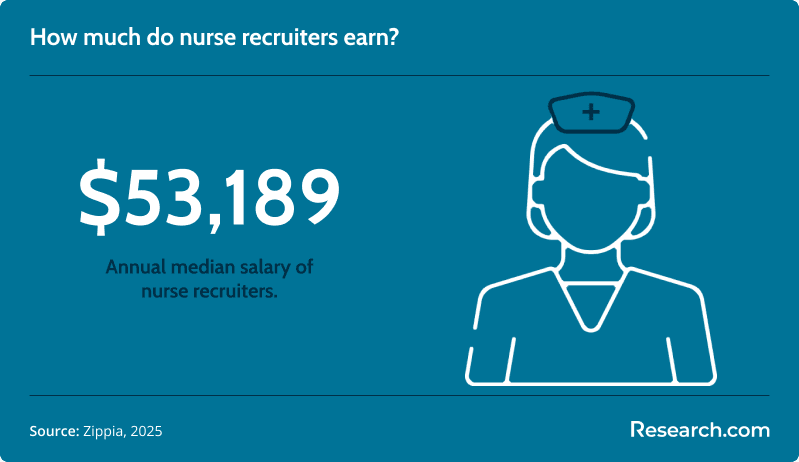
According to Zippia, the average annual salary for a nurse recruiter in 2025 will be $53,189. Actual pay can differ by employer, location, experience, recruiter performance expectations, and whether the role is in a hospital, agency, long-term care organization, or health system.
| Experience level | Salary range stated | What may affect pay |
| Entry-level nurse recruiter | $45,000 to $50,000 per year | Internships, HR support experience, healthcare familiarity, and ATS skills |
| Mid-level nurse recruiter | $50,000 to $58,000 annually | 3–5 years of experience, specialty recruiting knowledge, and hiring volume |
| Experienced nurse recruiter | $58,000 to $65,000 | 5+ years of experience, advanced certifications, leadership duties, or high-demand markets |
Higher pay is not guaranteed by education alone. However, advanced study in healthcare management, HR, analytics, or leadership may help you qualify for senior recruiter, talent acquisition manager, workforce planning, or recruitment operations roles. If your long-term goal is leadership or research, you may eventually compare online PhD programs, but most entry-level nurse recruiter roles do not require a doctorate.
How does advanced education support career growth in nurse recruiting?
Advanced education can help nurse recruiters move from transactional hiring into strategy, leadership, workforce planning, or healthcare operations. A graduate degree is not necessary for every recruiter, but it may be useful if you want to manage a recruitment team, lead retention initiatives, analyze staffing data, or work at the system level in a large healthcare organization.
Choose advanced education only when it fits your career goal. For example, a master’s degree in healthcare administration may make sense for hospital leadership, while HR-focused graduate study may be better for talent acquisition management. Clinically trained nurses considering advanced practice or leadership pathways may also compare options such as short DNP programs, especially if they want to keep a clinical advancement route open.
How do digital tools and social media shape nurse recruiting?
Modern nurse recruiting relies heavily on technology. Recruiters use applicant tracking systems, automated job alerts, candidate databases, email campaigns, text communication, video interviews, LinkedIn, and other social platforms to find and communicate with nurses. These tools can speed up sourcing, but they do not replace sound judgment.
Digital recruiting also creates new responsibilities. Recruiters must keep candidate data secure, avoid biased screening practices, verify credentials carefully, and be transparent when describing schedules, pay, duties, and working conditions. Some recruiters also use digital outreach to point nurses toward education options that may help them qualify for future roles, including pathways such as the easiest RN-BSN programs online.
| Tool or channel | How nurse recruiters use it | Risk to manage |
| Applicant tracking system | Stores applications, tracks stages, and documents communication | Incomplete notes or inconsistent screening can create process problems |
| Job boards | Promotes openings and collects applications | Poorly written postings may attract unqualified candidates |
| LinkedIn and social media | Supports outreach, networking, and employer branding | Messages must be professional, accurate, and non-discriminatory |
| Video interviews | Speeds up screening and scheduling | Recruiters still need structured, fair interview practices |
| Data analytics | Tracks time-to-fill, source quality, and pipeline health | Numbers should guide decisions, not replace human review |
Where do nurse recruiters work?
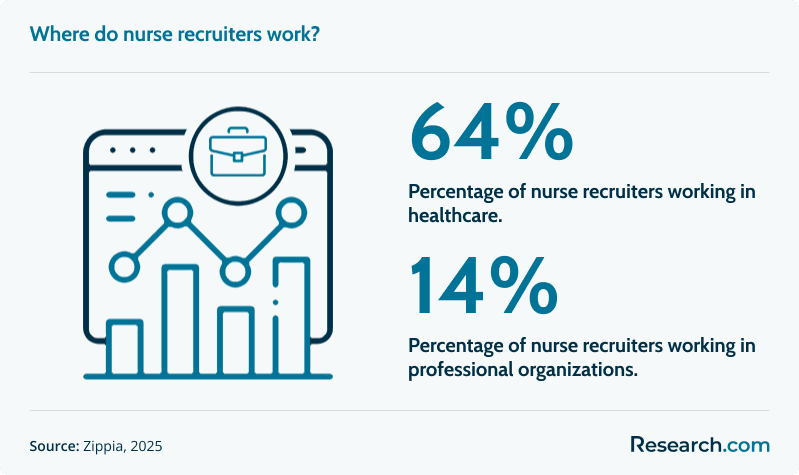
Nurse recruiters work wherever employers need a steady pipeline of nursing talent. Most nurse recruiters, about 64%, work in healthcare organizations such as hospitals, nursing homes, outpatient care centers, and related clinical settings. Others work for staffing agencies, home healthcare companies, or recruitment firms that serve healthcare clients.
| Work setting | Common recruiting focus | What to expect |
| Hospitals and health systems | RNs, specialty nurses, new graduates, float pool nurses, and unit-based roles | High hiring volume, urgent vacancies, and close work with nurse managers |
| Nursing homes and long-term care facilities | LPNs, RNs, CNAs, and charge nurses | Ongoing staffing needs and strong emphasis on compliance and retention |
| Outpatient care centers | Clinic nurses, specialty care nurses, and ambulatory care roles | More predictable schedules than some inpatient environments |
| Healthcare staffing agencies | Temporary, contract, travel, and per diem nurses | Fast-paced recruiting with frequent placement goals |
| Home healthcare agencies | Home health nurses and field-based care staff | Recruiting depends on geography, patient needs, and availability of field clinicians |
Home healthcare recruiting can be especially relationship-driven because nurses often travel to patient homes and need the right mix of independence, clinical judgment, and communication skills. If this setting interests you, learn more about how to become a home health nurse.
Why do regional market trends matter in nurse recruiting?
Nurse recruiting is local as well as national. A role that is easy to fill in one region may be difficult in another because of licensing rules, cost of living, commuting patterns, hospital competition, compensation expectations, and the number of nursing schools nearby. Recruiters who understand local labor markets can set more realistic timelines, advise hiring managers more effectively, and communicate with candidates more persuasively.
Regional knowledge also helps recruiters compare compensation expectations and candidate priorities. For example, nurses may evaluate job opportunities differently depending on workplace culture, pay, schedule flexibility, housing costs, state licensing processes, and career mobility. Recruiters who study resources such as the best states for nurses can better understand how location affects candidate decisions.
How do you get your first job as a nurse recruiter?
Your first nurse recruiter job usually comes from proving that you understand people, hiring processes, and healthcare settings. Employers may not expect you to know everything immediately, but they will want evidence that you can communicate professionally, stay organized, learn quickly, and handle sensitive candidate information.
- Target entry-level healthcare HR roles. Look for titles such as recruiting coordinator, talent acquisition assistant, HR assistant, staffing coordinator, credentialing assistant, or scheduling coordinator.
- Build a healthcare-focused resume. Highlight communication, scheduling, customer service, HR systems, data entry, compliance, interviewing, healthcare exposure, and relationship management.
- Learn nursing terminology. Know the basics of RN, LPN, CNA, BSN, specialty units, shifts, certifications, and common healthcare work settings.
- Network with healthcare HR professionals. Join online HR and healthcare recruiting groups, attend local workforce events, and connect with recruiters who work in hospitals or staffing agencies.
- Practice outreach and screening. Create sample phone-screen questions, learn how to review resumes, and practice explaining job requirements clearly.
- Consider additional study only if it fits your gap. If your background is in psychology or people-focused work, an online master's in psychology may deepen your understanding of human behavior, but it is not required for most entry-level nurse recruiter jobs.
| Common mistake | Better approach |
| Applying only to “nurse recruiter” roles with no HR or healthcare experience | Start with recruiting coordinator, staffing, scheduling, credentialing, or HR assistant roles |
| Assuming you must be an RN to recruit nurses | Check each job posting; many employers accept HR or healthcare administration backgrounds |
| Using a generic HR resume | Customize your resume with healthcare keywords, ATS experience, candidate communication, and compliance awareness |
| Ignoring credentialing and licensure language | Learn how nursing licenses, certifications, and specialty requirements appear in job descriptions |
| Focusing only on salary | Compare workload, hiring volume, support systems, remote options, commission structure, and career path |
The chart below lists the most common majors for nurse recruiters, based on Zippia data from 2025.
What are the pros and cons of being a nurse recruiter?
Nurse recruiting can be rewarding if you enjoy healthcare, relationship-building, and problem-solving. It can also be stressful because open nursing roles may be urgent, candidates may have multiple offers, and hiring managers may expect fast results even when the talent market is tight.
| Pros | Cons |
| Meaningful healthcare impact. You help place nurses in roles where they support patients and care teams. | Hard-to-fill roles can take time. Recruiting an experienced RN takes between 62 and 103 days, depending on the specialty. |
| Multiple entry paths. You can enter from HR, healthcare administration, staffing, or nursing. | Hiring pressure can be intense. Understaffed units may need candidates quickly, even when the market is competitive. |
| Transferable skills. Recruiting, interviewing, sourcing, and workforce planning skills can apply to other HR roles. | Candidate drop-off happens. Nurses may accept other offers, fail credential checks, or change plans late in the process. |
| Varied work settings. Hospitals, agencies, long-term care facilities, outpatient centers, and home healthcare employers all hire recruiters. | Communication demands are high. You must keep candidates, managers, HR teams, and onboarding staff aligned. |
| Room for advancement. Experienced recruiters can move into senior recruiting, talent acquisition management, workforce planning, or HR leadership. | Compliance matters. Mistakes in documentation, screening, or communication can create legal or ethical problems. |
Questions to ask before choosing the nurse recruiter path
- Do I prefer working with people, systems, and hiring processes more than direct patient care?
- Am I comfortable making many calls, sending outreach messages, and following up repeatedly?
- Can I stay organized while managing several open roles and candidates at once?
- Do I want to work for a hospital, staffing agency, long-term care facility, outpatient center, or home healthcare organization?
- Would a healthcare administration, HR, nursing, or staffing background best match my goals?
- Am I prepared to learn employment law basics, candidate privacy practices, and fair hiring standards?
- Do I want a role with hiring goals, deadlines, and performance expectations?
Graduate perspectives on becoming a nurse recruiter
-
: "
I chose nurse recruiting because it let me stay connected to healthcare while focusing on people and career fit. Matching nurses with roles where they can succeed has made me feel connected to patient care in a broader way. – Ben
"
-
: "
At first, I thought the job was mostly about filling openings. I later realized that strong recruiting affects the whole care team. When the right nurse joins the right unit, everyone benefits. – Lendale
"
-
: "
The part that surprised me was how much problem-solving the role requires. Every placement is different, and each successful hire feels like progress for the candidate, the employer, and my own growth. – Miyo
"
What legal and ethical rules should nurse recruiters understand?
Nurse recruiters handle sensitive information and influence hiring decisions, so legal and ethical judgment is essential. Recruiters must follow equal employment opportunity rules, avoid discriminatory screening, protect candidate data, communicate job details accurately, document decisions appropriately, and avoid conflicts of interest.
Ethical recruiting also means being honest about pay, schedules, floating expectations, contract terms, benefits, start dates, and unit conditions. Misleading candidates may fill a role temporarily, but it damages trust and can increase turnover. Recruiters who work with nurses advancing through clinical pathways should also be careful not to overpromise outcomes from education programs, including options such as the best 6-month LPN to RN programs online.
Key Insights
- Nurse recruiting is a healthcare career for people who want to support patient care through staffing rather than bedside practice.
- You do not always need a nursing license. Healthcare administration, HR, staffing, business, psychology, and nursing backgrounds can all lead into the field.
- Zippia reports an average annual nurse recruiter salary of $53,189, with stated ranges from $45,000 to $65,000 depending on experience level.
- The traditional path can take 4 to 6 years, but people with relevant healthcare, HR, staffing, or nursing experience may transition within 1 to 4 years depending on their background.
- Clinical knowledge helps, but recruiting skill matters just as much. Employers look for communication, organization, sourcing ability, credential awareness, and ethical judgment.
- About 37.6% of nurse recruiters hold a nursing degree, according to Zippia data from 2025, which shows that nursing is common but not required for everyone.
- The RN vacancy rate remains 9.6% nationally, and recruiting an experienced RN takes between 62 and 103 days depending on specialty, so patience and persistence are critical.
- Most nurse recruiters, about 64%, work in healthcare organizations such as hospitals, clinics, nursing homes, and outpatient care settings.
- Before choosing this path, compare work settings carefully. Hospital recruiting, staffing agency recruiting, long-term care recruiting, and home healthcare recruiting can feel very different day to day.
- The strongest candidates combine healthcare understanding, recruiting technology skills, fair hiring practices, and a realistic view of the nursing labor market.
References:
- Bureau of Labor Statistics (BLS). (2024). Registered Nurses. Occupational Outlook Handbook. BLS.
- Gilmartin, D.J. & Saver, C. (2025). 2024 nursing trends and salary survey. American Nurse Journal.
- NSI Nursing Solutions. (2025). 2025 NSI National Health Care Retention & RN Staffing Report. NSI Nursing Solutions.
- Zippia. (2025a). Nurse Recruiter Demographics and Statistics in the US. Zippia.
- Zippia. (2025b). Nurse Recruiter Education Requirements. Zippia.
- Zippia. (2025c). Nurse Recruiter Salary. Zippia.
Other Things You Should Know About Becoming a Nurse Recruiter
Most nurse recruiters need a bachelor’s degree in nursing, human resources, or healthcare administration. Many employers also prefer 1–3 years of bedside nursing or recruiting experience. Some hospitals hire registered nurses with active state licensure and strong patient-care knowledge, even without formal recruiting certification.
Effective communication and interpersonal skills are crucial for nurse recruiters in 2027, as they regularly interact with candidates and organizations. Strong organizational abilities and proficiency in recruitment software will help manage multiple job applications and streamline hiring processes.
To transition into a healthcare recruiter role, a nurse typically needs strong communication skills, HR knowledge, and recruitment experience. A background in healthcare, coupled with a human resources degree or certification, can enhance credibility. Being familiar with recruitment software and networking within the industry is beneficial.