
Colleges That Don't Require Standardized Tests for 2027

Co-Founder and Chief Data Scientist
The landscape of college admissions has evolved significantly with the growing number of institutions that no longer require standardized test scores. Many colleges, referred to as test-optional or test-blind, are prioritizing a more holistic review process. This approach allows them to focus on other components of a student's application, such as their high school GPA and the rigor of their coursework.
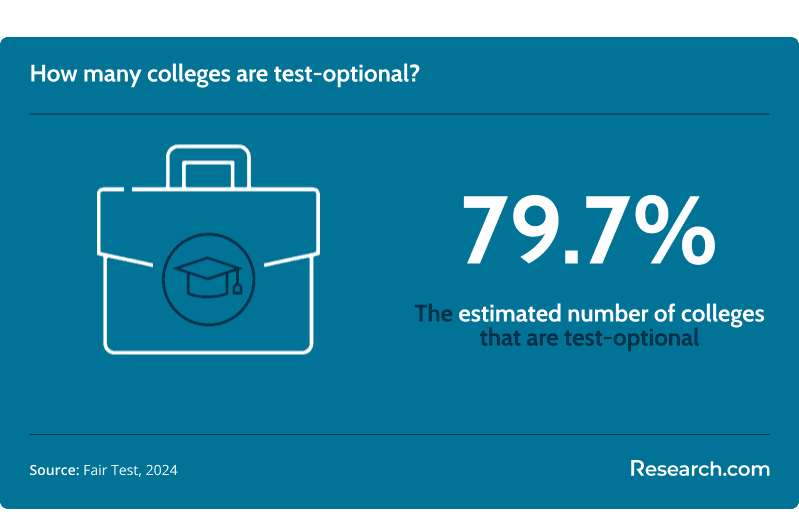
The movement toward test-optional policies aims to make the college application process more equitable and accessible for students from diverse socioeconomic backgrounds. More than 2,000 four-year colleges and universities are now test-optional, with an additional 85 institutions being test-blind, which means they won't even consider scores if submitted.
Key things you should know about colleges that don’t require standardized tests
- Graduating from a test-optional college degree program can qualify students for a wide range of jobs across various fields, such as business, education, and the arts.
- The median salary for graduates from colleges that don’t require standardized tests generally varies by major, ranging from $50,000 to $70,000 annually, depending on the field and location.
- An important benefit of obtaining a degree online from a test-optional college is flexibility; students can balance their studies with work or personal commitments.
Popular College Degrees Worth Considering for 2027
Business Administration
A degree in business administration is a versatile program that provides a broad foundation in key business functions. Students learn about accounting, finance, marketing, human resources, and operations management. The curriculum teaches strategic planning, data analysis, and leadership skills, preparing graduates to manage organizations and solve complex problems.
Psychology
Psychology is the scientific study of the human mind and behavior. The program explores topics like cognitive, developmental, and social psychology, and it teaches students how to conduct research and analyze data. The skills gained—such as critical thinking, communication, and an understanding of human motivation—are valuable in a wide range of fields, including marketing, human resources, law, and education.
Counseling
Counseling focuses on helping individuals, families, and groups navigate mental, emotional, and behavioral challenges. A degree in counseling, often at the master's level, trains students in therapeutic techniques, client assessment, and crisis intervention. This degree is increasingly popular due to a growing societal awareness of mental health issues and a rising demand for qualified professionals.
Nursing
Nursing is a healthcare profession that combines the science of medicine with the art of compassionate care. Nursing programs, typically a Bachelor of Science in Nursing (BSN), prepare students to provide direct patient care, manage illnesses, and promote health and wellness. The curriculum includes a mix of classroom theory and hands-on clinical experience.
Social Work
Social work is a helping profession dedicated to empowering individuals and communities to overcome life's challenges. The degree focuses on understanding human behavior within social, economic, and cultural contexts. Social work education equips students with the skills to advocate for clients, connect them with essential resources, and address systemic injustices.
- List of Colleges with No Standardized Tests List of Colleges
- How do test-optional and test-free admissions differ? Test-optional vs Test-free
- How do colleges evaluate applications without standardized test scores? Evaluation Process
- What advantages do test-optional colleges offer applicants? Test-optional Advantages
- How to apply to test-optional colleges? Application Requirements
- How do I know if my test scores will improve my chances? How do I know if my test scores will improve my chances?
- Is choosing a test-optional college a disadvantage for graduate programs? Is choosing a test-optional college a disadvantage for graduate programs?
- What are the financial aid opportunities for test-optional applicants? Financial Aid
- What should students expect for future college testing requirements? What should students expect for future college testing requirements?
- How is technology changing college admissions beyond standardized tests? How is technology changing college admissions beyond standardized tests?
- How do test-optional colleges influence long-term career prospects? How do test-optional colleges influence long-term career prospects?
Colleges With No Standardized Tests: What Applicants Need to Know
Applying to college without SAT or ACT scores can be a smart strategy, but only if you understand how each school actually uses testing. Some colleges are test-optional, meaning you decide whether scores help your application. Others are test-free or test-blind, meaning scores are not reviewed at all. The difference matters because it affects how you build your college list, write essays, request recommendations, and decide whether to send scores.
This guide is for high school students, transfer applicants, parents, and counselors comparing colleges with no standardized test requirement. It explains how these admissions policies work, which highly selective liberal arts colleges use them, when submitting scores may still help, how financial aid can be affected, and what mistakes to avoid before applying.
Quick answer: Are there good colleges that do not require SAT or ACT scores?
Yes. Many respected colleges do not require SAT or ACT scores for admission. At test-optional schools, applicants may submit scores if they believe the scores strengthen their file. At test-free or test-blind schools, scores are not considered even if submitted. Applicants should confirm each college’s current policy because testing rules can change by application cycle, academic program, scholarship, or enrollment year.
| Policy type | What it means | Best applicant strategy |
| Test-optional | You may submit SAT or ACT scores, but they are not required. | Submit scores only if they are competitive for that college or required for a scholarship or special program. |
| Test-free or test-blind | The college does not use SAT or ACT scores in admissions decisions. | Focus on transcript strength, essays, recommendations, activities, portfolios, and interviews where available. |
| Test-required | SAT or ACT scores must be submitted for admission. | Plan testing early, check score deadlines, and confirm whether superscoring is used. |
Williams College
Williams College is a highly regarded liberal arts college with demanding academics and a residential campus culture. Its admissions policy is described as “truly test-optional,” so applicants can choose whether SAT or ACT results belong in their application.
Students who do not submit scores are reviewed through the same holistic process as students who do. Admissions readers consider the full academic record, writing, personal background, recommendations, and lived experiences. Applicants may also include optional academic evidence, such as AP or IB scores, if those materials add useful context.
Amherst College
Amherst College uses a test-optional admissions approach. Applicants are not required to provide SAT or ACT scores, and the college formally adopted this policy in June 2023 after moving beyond its earlier pilot period.
The review process emphasizes grades, course selection, essays, recommendations, activities, and personal context. Applicants who send scores may benefit from Amherst’s superscoring policy for both the SAT and ACT, which combines the strongest section results across test dates. Students who leave scores out are not penalized for doing so.
Swarthmore College
Swarthmore College allows applicants to decide whether SAT or ACT scores should be included. Choosing not to submit scores does not count against the applicant. Instead, the college reviews academic performance, course rigor, essays, teacher and counselor recommendations, activities, and the circumstances that shaped the student’s opportunities.
If an applicant sends test results, Swarthmore does not use writing section scores. The policy began during the pandemic and has been extended through at least 2025 while the college continues studying outcomes for students admitted without scores.
Bowdoin College
Bowdoin College has long been associated with test-optional admission. Its review process looks at the student’s academic record, writing ability, intellectual qualities, character, recommendations, and contributions beyond the classroom.
Applicants who believe their scores support their academic case may submit them. Bowdoin reviews those scores as one part of the broader file, along with transcripts, essays, and recommendations. Self-reported scores are accepted during the application process, but official verification is required after enrollment. Scores are not required, but they can still be useful for students whose results accurately reflect their readiness.
Pomona College
Pomona College, part of the Claremont Colleges consortium, is a selective liberal arts institution that does not require SAT or ACT scores. Applicants may still send scores if they believe the results provide additional evidence of academic preparation.
Pomona reviews test results, when submitted, together with grades, curriculum strength, recommendations, essays, and personal accomplishments. The test-optional policy began during the pandemic and became permanent after a faculty vote in November 2023.
Wellesley College
Wellesley College, a leading women’s college, evaluates applicants through a test-optional process. Admissions readers consider the complete application, including the high school transcript, essays, recommendations, and evidence of preparation for rigorous college-level work.
The college pays close attention to writing ability and quantitative reasoning because both are important in its academic environment. Students who submit SAT or ACT scores will have those scores reviewed, but applicants who do not send scores are not placed at a disadvantage.
Carleton College
Carleton College offers a rigorous liberal arts education and uses a test-optional admissions process. The college evaluates applicants through their academic record, activities, personal qualities, and contributions to their communities.
Rather than reducing an applicant to one test result, Carleton emphasizes curiosity, intellectual engagement, and the person behind the application. The shift has also expanded access, including increased applications from international students, while supporting the college’s diversity and inclusion goals.
Claremont McKenna College
Claremont McKenna College, known for leadership education and strong social science programs, permits applications without standardized test scores through 2027. Students who opt out of score submission are still evaluated on transcripts, essays, recommendations, extracurricular involvement, and academic fit.
Applicants who submit SAT or ACT results benefit from superscoring for both exams, so the strongest section scores are used. Students admitted without scores are later asked to provide them for institutional research, which helps the college evaluate the long-term effects of the policy.
Harvey Mudd College
Harvey Mudd College is a STEM-focused liberal arts college that has extended its SAT/ACT test-optional policy through the fall 2026 application cycle. Applicants may decide whether scores represent them well, and those who do not submit scores are not penalized.
The admissions office continues to rely on a holistic review of transcripts, essays, recommendations, extracurricular work, and personal context. Harvey Mudd has reported that nearly 42% of admitted students in recent years did not submit SAT or ACT scores and that their outcomes showed no disadvantage. The college also no longer considers SAT Subject Test scores.
Vassar College
Vassar College has made its pilot test-optional policy permanent, so applicants do not need to submit SAT or ACT scores. The college prioritizes high school achievement, course rigor, essays, recommendations, and extracurricular engagement.
Vassar’s decision followed a review showing that high school GPA is a stronger predictor of success than test scores, particularly for Pell-eligible and underrepresented students. College leaders framed the permanent policy as a way to reduce stress, support equity, and evaluate applicants more fully.
How do test-optional and test-free admissions differ?
The main difference is whether standardized test scores can influence the admissions decision. At a test-optional college, SAT or ACT scores are allowed but not required. A strong score can add value, especially if it supports the student’s transcript or demonstrates readiness in a competitive applicant pool.
At a test-free or test-blind college, SAT or ACT scores are not used in admissions decisions. Even if an applicant submits them, the admissions office does not factor them into the review. This distinction is important because it determines whether spending time and money on testing is likely to matter.
| Question | Test-optional college | Test-free or test-blind college |
| Can I apply without SAT or ACT scores? | Yes. | Yes. |
| Will scores be reviewed if I submit them? | Yes, if the college accepts them. | No. |
| Can a high score help? | Possibly, depending on the college and applicant profile. | No, because scores are not considered. |
| What should I emphasize instead? | Transcript, course rigor, essays, recommendations, activities, and context. | Transcript, course rigor, essays, recommendations, activities, portfolios, interviews, and context. |
The same principle applies to many education and career decisions: read the specific requirements before acting. For example, someone researching how to become a court clerk needs to check the exact training and eligibility rules for the jurisdiction they hope to work in. College testing policies require the same level of attention.
How do colleges evaluate applications without standardized test scores?
Colleges that do not require standardized tests usually rely on holistic review. That means admissions officers examine the whole application instead of using one score as a shortcut. The transcript becomes especially important because it shows both academic performance and the level of challenge a student chose.
Applicants should also think carefully about the size and balance of their college list. Students asking how many colleges should you apply to should usually build a mix of reach, match, and safety options rather than applying only to highly selective test-optional schools. A common planning range is often between 5 and 10 applications, but quality and fit matter more than volume.
When test scores are absent, these parts of the application carry more weight:
- High school transcript: Colleges review grades, trends over time, and the difficulty of courses. Strong performance in challenging classes such as AP or IB can help demonstrate readiness.
- Course rigor: Admissions offices want evidence that students used the opportunities available to them. The “right” schedule depends on the high school context, not just the number of advanced classes.
- Essays and personal statements: Essays reveal voice, judgment, motivation, and writing ability. They can also explain obstacles, responsibilities, or experiences that do not appear in a transcript.
- Extracurricular commitment: Depth usually matters more than a long activity list. Sustained involvement in clubs, work, caregiving, athletics, service, arts, or community projects can show initiative and responsibility.
- Letters of recommendation: Teachers and counselors can describe intellectual curiosity, classroom habits, resilience, collaboration, and character in ways scores cannot.
- Interviews, portfolios, or supplements: Some colleges allow optional interviews or creative portfolios. These materials can be valuable for students in the arts, design, architecture, or other talent-based areas.
What a strong no-test application usually shows
| Application area | What admissions readers look for | How to strengthen it |
| Transcript | Consistent achievement, upward trends, and appropriate course challenge. | Take demanding courses you can handle and address any unusual dips with context when appropriate. |
| Essays | Clear writing, self-awareness, purpose, and specific examples. | Avoid generic claims; use concrete moments that show how you think and act. |
| Activities | Commitment, leadership, impact, responsibility, or talent. | Highlight a few meaningful roles rather than padding the list. |
| Recommendations | Academic habits, character, classroom contribution, and growth. | Ask teachers who know your work well and give them enough time and context. |
| Supplemental materials | Evidence of unusual talent, preparation, or fit. | Submit only materials that add meaningful information not already found elsewhere. |
What advantages do test-optional colleges offer applicants?
Test-optional colleges can help students present a fuller picture of their abilities. Applicants who are strong in the classroom but less strong on timed exams can lean on grades, writing, recommendations, activities, and personal context instead of being defined by one test day.
Students trying to move efficiently through college may also want to review how to get a bachelor's degree fast, especially if they have AP credit, IB credit, dual enrollment coursework, or other prior learning. Test-optional admission does not automatically shorten a degree, but it can fit well with a broader strategy focused on academic preparation and credit planning.
These policies may also reduce financial and emotional pressure tied to exam registration, retesting, travel, and test preparation. For students from under-resourced schools or communities where testing access is uneven, a no-score application can make selective college admissions feel more reachable.
The broader shift is similar to hiring and training models that look beyond a single exam. For example, evidence technician job requirements often include training, applied skills, and certifications rather than one universal test score. Test-optional admissions likewise place more emphasis on demonstrated performance and potential.
| Potential benefit | Who may benefit most | Important caution |
| Less pressure around testing | Students whose scores do not reflect their classroom performance. | Other parts of the application must be strong and carefully prepared. |
| More emphasis on grades and rigor | Students with a strong transcript and challenging coursework. | A weak transcript is not solved by simply omitting scores. |
| Greater access | Students with limited testing access or test-prep resources. | Highly selective colleges remain competitive even without testing requirements. |
| More room for personal context | Students with major responsibilities, unusual experiences, or nontraditional strengths. | Context should explain, not excuse, and should be supported by the rest of the file. |
How to apply to test-optional colleges?
Applying to colleges with no standardized test requirement is similar to applying elsewhere, but the strategy is different. Because the application may not include SAT or ACT results, every other component needs to work harder and connect clearly.
The first decision is whether to send your SAT or ACT scores. If your scores are strong for that college, they may support your application. If they do not match your academic record or fall well below the college’s admitted-student range, applying without them may be the better choice.
- Confirm the current policy for each college. Do not assume last year’s rules still apply. Check whether the school is test-optional, test-free, test-blind, or test-required for your application cycle.
- Check program and scholarship exceptions. Some honors programs, departments, or merit awards may handle scores differently from general admission.
- Compare your scores with the college’s published middle 50% range. Use admitted-student data when available, not national averages.
- Strengthen the transcript story. Make sure your course choices and grades demonstrate readiness for the academic environment you are targeting.
- Write specific essays. Explain what you value, how you think, and why the college fits your goals. Avoid essays that could be sent unchanged to every school.
- Choose recommenders strategically. Ask teachers who can speak in detail about your work habits, growth, intellectual curiosity, and classroom impact.
- Use activities to show depth. Admissions offices often value sustained responsibility, leadership, or contribution more than a crowded list.
- Submit optional materials only when useful. A portfolio, interview, or extra recommendation should add real evidence, not repeat information already included.
Questions to ask before applying without scores
- Does this college review test scores if submitted, or is it test-blind?
- Are scores required for any major, honors program, athletic recruitment process, or scholarship?
- Are my scores within or above the school’s middle 50% range?
- Does my transcript show enough rigor to stand on its own?
- Will my essays and recommendations explain my strengths clearly?
- Am I applying to a balanced list, or only to reach schools?
How do I know if my test scores will improve my chances?
The best starting point is the college’s published middle 50% score range for admitted students. If your SAT or ACT score falls within or above that range, submitting it may help reinforce your academic preparation. If the score is below the range, leaving it out may be more strategic at a test-optional school.
Scores are most useful when they add something positive to the application. They may help a student whose grades are strong but whose school offers limited advanced courses, or a student applying to a quantitatively demanding program who has a high math score. Scores are less useful when they contradict an otherwise strong transcript.
Also check whether specific scholarships, majors, or special programs require scores. This is similar to researching how to become a PE teacher: the general path matters, but the exact requirements determine what you should do next.
| Your score position | Possible decision | Why |
| Above the college’s middle 50% range | Usually consider submitting. | The score may strengthen the academic profile. |
| Within the middle 50% range | Often consider submitting. | The score may confirm readiness, especially when aligned with grades. |
| Below the middle 50% range | Consider applying without scores. | A lower score may add less value than the transcript, essays, and recommendations. |
| Required for scholarship or program | Submit if you want to be considered. | Some opportunities may have separate testing rules. |
Is choosing colleges with no standardized tests a disadvantage for graduate programs?
Attending a test-optional college is generally not a disadvantage when applying to graduate school. Graduate programs usually care far more about undergraduate GPA, course selection, faculty recommendations, research, internships, writing samples, portfolios, professional experience, and program fit.
Graduate admissions committees typically do not evaluate whether a student submitted SAT or ACT scores years earlier. They look at what the student accomplished in college and whether the applicant is prepared for advanced study.
This is especially important for students planning research-intensive or high-earning advanced academic paths. Those exploring the highest paying PhD degrees should focus on undergraduate preparation, faculty mentorship, research experience, and strong academic performance.
However, some graduate and professional programs may still require entrance exams such as the LSAT, MCAT, or GMAT. In those cases, the graduate-level exam matters much more than the admissions policy of the undergraduate college. The key is to build a record that proves you can succeed in demanding coursework and professional preparation.
What are the financial aid opportunities for test-optional applicants?
Financial aid rules vary by college, so applicants should separate admissions policy from aid policy. A school may be test-optional for admission but still use scores differently for merit scholarships, honors programs, or departmental awards.
As with career pathways such as how do you qualify as a security guard, the safest approach is to read the official eligibility rules rather than rely on assumptions. For college applicants, that means checking the financial aid website, scholarship pages, and admissions FAQ for each school.
- Need-based aid: Test-optional admission usually has little direct effect on need-based financial aid. Aid based on family finances is primarily determined through forms such as the Free Application for Federal Student Aid (FAFSA), which does not require SAT or ACT scores.
- Merit aid at test-blind schools: Some colleges do not consider scores for scholarships even if applicants submit them. In these cases, GPA, course rigor, leadership, service, talent, and other achievements may matter more.
- Merit aid with testing exceptions: Some institutions may not require scores for admission but may require or strongly encourage them for certain competitive scholarships, honors colleges, or departmental awards.
- Automatic scholarship formulas: Some colleges have historically used GPA and test-score combinations for guaranteed scholarships. As policies change, many schools use other academic indicators, but some may still include test scores.
Financial aid checklist for no-test applicants
- Confirm whether the college is test-optional or test-blind for merit aid.
- Look for separate scholarship deadlines and application forms.
- Ask whether honors programs or departmental awards require scores.
- Submit FAFSA and any institutional aid forms on time.
- Compare net price, not just scholarship amount or sticker tuition.
What should students expect for future college testing requirements?
Students should expect testing policies to keep changing. Many colleges adopted test-optional rules during the COVID-19 pandemic, but some highly selective institutions, including Harvard, Yale, Brown, and Dartmouth, have reinstated standardized testing requirements starting from the 2025-2026 admissions cycle.
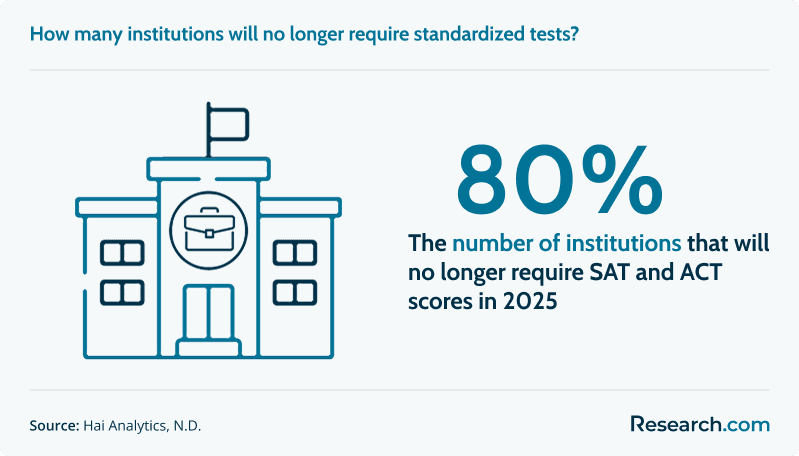
Recent admissions data indicates that over 80% of four-year colleges and universities in the U.S. will not require standardized test scores for fall 2025 admissions, with more than 2,000 institutions currently test-optional or test-blind.
At the same time, the admissions landscape is split. Many U.S. colleges continue to use test-optional policies to support access and diversity, while others are returning to required testing. Applicants should verify each school’s current rules close to the time they apply and avoid assuming that one college’s policy reflects the whole market.
Students should also watch for broader changes in admissions, including flexible academic programs, dual enrollment, and online degree options. Those considering more complex academic plans can review how to apply for a double major so they understand how early planning affects course sequencing and graduation requirements.
| Trend | What it means for applicants | How to respond |
| Policy changes by year | A college may change from test-optional to test-required or extend a temporary policy. | Check the admissions website for your exact entry term. |
| Different rules by program | Scholarships, honors programs, or certain majors may have separate requirements. | Read all program-specific instructions before deciding not to test. |
| Continued use of holistic review | Transcripts, essays, recommendations, and activities remain central. | Build a complete application rather than relying on one strength. |
| More digital application tools | Students can apply to more schools more easily, increasing competition at some colleges. | Prioritize fit and quality instead of sending rushed applications. |
How is technology changing college admissions beyond standardized tests?
Technology is reshaping how colleges manage applications, communicate with students, and analyze admissions data. Application platforms reduce duplicate work by allowing students to send materials to multiple institutions, while digital portals make it easier to track missing documents and deadlines.
Artificial intelligence is also entering admissions operations, especially in workflow management, document review support, communication, and student outreach. Colleges may use AI-supported tools to organize essays, transcripts, recommendations, and applicant data more efficiently, though human admissions officers still make qualitative judgments about context, fit, and potential.
An EAB survey of nearly 5,000 high school graduates found that 15% of Gen Z students applied to colleges specifically because they were test-optional. That finding shows that admissions policy itself can influence where students apply, especially when applicants are trying to reduce stress or avoid submitting scores they do not believe represent them well.
AI chatbots and automated messaging can also answer routine questions at any hour, but students should still verify important information on official college pages. Admissions work now requires balancing data, communication, judgment, and individual student needs, much like the broad operational responsibilities involved in what a hotel manager does.
Student perspectives on applying without standardized tests
- Ilona: "Applying to a college that did not require test scores let my transcript and community service carry more weight. I felt the admissions process recognized my effort over several years instead of judging me by one exam day."
- Ben: "I chose a school that paid close attention to my portfolio and essays. The process felt more personal, and I ended up in a community where students were valued for different strengths, backgrounds, and goals."
- Cecilia: "The test-optional process helped me show my leadership, grades, and classroom commitment more clearly. I could focus on the parts of my application that best reflected how I learn and contribute."
How do test-optional colleges influence long-term career prospects?
Employers generally do not ask whether a college graduate submitted SAT or ACT scores during undergraduate admission. Career outcomes depend much more on the student’s major, skills, internships, projects, work experience, network, communication ability, and performance in college.
A test-optional college can still provide strong career preparation if students use the available opportunities well. That means building relationships with faculty, completing internships or research, using career services, developing technical and professional skills, and documenting achievements through portfolios, resumes, or certifications.
Graduates who want to strengthen their credentials later may consider focused post-baccalaureate learning, including affordable online graduate certificates, when those programs align with a specific career goal or skill gap.
Common mistakes when applying to colleges with no standardized tests
| Mistake | Why it can hurt | Better approach |
| Assuming “test-optional” means “easier to get in” | Selective colleges remain selective, even without required scores. | Build a balanced college list and strengthen every application component. |
| Skipping policy details | Some programs, scholarships, or application cycles may still require scores. | Check the admissions and financial aid pages for each school. |
| Submitting weak scores automatically | Scores below the college’s range may not help a test-optional application. | Compare your scores with the middle 50% range before deciding. |
| Relying only on essays | Strong writing cannot fully offset a weak academic record at rigorous colleges. | Use essays to add context while making the transcript and recommendations as strong as possible. |
| Applying to too many schools with generic materials | Holistic review rewards specificity and fit. | Apply to a manageable list and tailor supplements carefully. |
| Ignoring cost and aid rules | Admission without scores does not guarantee affordability. | Review net price, scholarship criteria, FAFSA deadlines, and test-score rules for aid. |
How to choose the right test-optional college
The best test-optional college is not simply the most famous one. It is the school where your academic record, goals, finances, learning style, and campus preferences fit well. A college’s testing policy should be one factor in the decision, not the entire reason for applying.
- Start with academic fit. Confirm that the college offers the majors, advising, research, internships, or pre-professional pathways you need.
- Evaluate selectivity honestly. If a college is highly selective, applying without scores can still be competitive. Make sure your transcript, essays, and recommendations are strong enough.
- Compare affordability. Look at net price estimates, scholarship rules, and whether scores affect merit aid.
- Check support services. Academic advising, tutoring, writing centers, career services, and mental health resources can affect success after enrollment.
- Review outcomes carefully. Consider graduation rates, career services, graduate school placement, internship access, and alumni networks when available from official sources.
- Ask admissions direct questions. If a policy is unclear, contact the admissions office before submitting your application.
Sources and further reading
- ACT. Comparison of the SAT and ACT: SAT or ACT scores
- ERIC. Research and discussion on test-optional policies
- CollegeHippo. Graduate programs in communication without GMAT requirements: CollegeHippo
- MyDegreeGuide. Graduate schools that do not require GRE scores: My Degree Guide
- EDsmart. Master’s programs without GRE requirements: EDsmart
- Metro MBA. MBA programs without GMAT or GRE requirements: Metro MBA
- Forbes. GRE requirement changes at University of California at Berkeley graduate programs: Forbes
Key Insights
- “Test-optional” and “test-free” are not the same. Test-optional colleges may review scores; test-free or test-blind colleges do not use them.
- Submitting scores is usually worth considering when they fall within or above a college’s published middle 50% range or are required for scholarships or special programs.
- Without SAT or ACT scores, the transcript, course rigor, essays, recommendations, activities, and applicant context become more important.
- Test-optional admission does not make selective colleges easy to enter. It changes what evidence admissions officers use to assess readiness.
- Financial aid rules may differ from admissions rules, so applicants should check whether merit scholarships, honors programs, or departments require test scores.
- Testing policies continue to shift. Students should verify requirements for every college and application cycle before deciding whether to test or submit scores.
Other Things You Should Know About Colleges That Don’t Require Standardized Tests
Prospective transfer students should be aware that many colleges extend test-optional policies to transfer applicants. This can provide flexibility and reduce barriers for students who feel their standardized test scores do not reflect their academic potential. It's important to check individual college policies for specific requirements and guidelines.
Most test-optional colleges still require proof of English ability from international applicants. Common minimum scores are 79 to 100 on TOEFL iBT, 6.5 to 7.0 on IELTS, or 105 to 120 on Duolingo English Test, with exact cutoffs set by each admissions office.
Yes, colleges often consider a holistic review that includes GPAs, extracurricular activities, essays, and letters of recommendation as alternative evaluation methods. This allows students to showcase strengths beyond test scores when applying for admission in 2027.





