
Best Online Colleges that Accept Low GPA for 2027

Co-Founder and Chief Data Scientist
It's a common belief that a low GPA from the past can shut the door on future college plans. However, with over 80% of four-year colleges no longer requiring ACT or SAT scores, it's clear that schools are looking at applicants more holistically than ever before. Your academic record is just one part of your story.
This guide, created by career planning experts with more than a decade of experience, will show you how to find accredited online colleges that accept low GPA and give you a fair chance to succeed.
What are the benefits of earning a bachelor's degree online?
- Earning your degree opens the door to professional roles in high-demand fields like healthcare and business, allowing you to contribute your skills in meaningful ways.
- Graduates with a bachelor's degree earn a median annual salary of $92,260, significantly increasing your lifetime earning potential.
- Studying online provides the flexibility to balance your education with work, family, and other life commitments on your own schedule.
What can I expect from attending an online college that accepts low GPA?
You can expect a legitimate college experience with a more understanding admissions process. These schools focus on your potential, not just your past academic record. Once you're in, the structure is very similar to any other online program. You'll use a digital learning platform to access course materials, submit your work, and communicate with professors.
The curriculum will be just as rigorous as at any other accredited institution. The key difference is that these colleges provide a pathway for students who are ready to prove they can succeed now.
Where can I work with a degree from an online college that accepts low GPA?
You can work in the same professional jobs as graduates from any traditional university. Employers care about whether your degree is from an accredited institution, not what that school's admission requirements were. Accreditation is the standard that validates the quality of your education.
So, whether you pursue a career in business, technology, healthcare, or another field, your degree will be seen as a credible qualification. The door is open to the same opportunities.
How much can I make with a degree from an online college that accepts low GPA?
Your salary potential is tied to the degree you earn, not the admissions policy of your school. With a bachelor's degree, you can position yourself to earn a median annual wage of $92,260. That's the industry benchmark for professionals with that credential.
Earning your degree from an accredited online college puts you on the same playing field. It's the qualification that matters to employers and the key that unlocks your long-term earning power.
Popular College Degrees Worth Considering for 2027
1. Business Administration
Many online colleges that accept low GPA offer business administration programs, making it a practical choice for students seeking flexibility. This degree prepares you for careers in management, marketing, or finance, and remains one of the most in-demand fields.
2. Psychology
Psychology is widely available at transfer-friendly and low GPA–accepting colleges online. It provides a strong foundation in understanding behavior and can lead to careers in mental health, research, or graduate study.
3. Counseling
For students drawn to helping professions, many online colleges with flexible admissions offer counseling pathways. These programs prepare you for roles in schools, clinical settings, and community organizations.
4. Nursing
Nursing is one of the most popular fields at colleges that support low GPA admissions, especially for RNs seeking to advance. Online options allow you to keep working while preparing for higher-paying, in-demand roles.
5. Social Work
Social work degrees are accessible through online colleges with flexible GPA requirements, making them an excellent option for students with varied academic backgrounds. Graduates can work in healthcare, child welfare, or policy advocacy.
6. Artificial Intelligence
Artificial intelligence programs are increasingly offered at online colleges with flexible admissions, appealing to students interested in technology and innovation. This degree equips graduates with skills in machine learning, data analysis, and AI development, opening doors to tech and research careers.
7. Nutrition
Nutrition degrees are available at many low-GPA–friendly online colleges, ideal for students passionate about health and wellness. Graduates can pursue careers in dietetics, public health, or wellness coaching.
8. Sports Management
Sports management programs at transfer-friendly online colleges prepare students for careers in athletic administration, marketing, and event coordination. Flexible admissions allow aspiring professionals to enter the growing sports industry.
9. Kinesiology, Sports Science
Kinesiology and sports science degrees combine physical health, fitness, and scientific study, and are increasingly accessible through online colleges with lenient GPA requirements. Graduates can work in rehabilitation, athletic training, or wellness consulting.
10. Liberal Arts
Liberal arts programs are widely available at online colleges with flexible admissions, offering broad academic exploration and critical thinking skills. This degree supports careers in education, writing, public service, and fields that value adaptable problem-solvers.
- List of the Best Online Colleges that Accept Low GPA for 2027 List of Colleges
- How long does it take to complete a degree program at an online college that accepts low GPA? Completion Time
- How does an online program at a low GPA-accepting college compare to an on-campus program? How does an online program at a low GPA-accepting college compare to an on-campus program?
- What is the average cost of attending an online college that accepts low GPA? Program Cost
- What are the financial aid options for students enrolling in an online college that accepts low GPA? Financial Aid
- What are the prerequisites for enrolling in an online college that accepts low GPA? What are the prerequisites for enrolling in an online college that accepts low GPA?
- What courses are typically offered at online colleges that accept low GPA? What courses are typically offered at online colleges that accept low GPA?
- What degree programs are typically available at online colleges that accept low GPA? What degree programs are typically available at online colleges that accept low GPA?
- How to Choose the Best Online College that Accepts Low GPA How to Choose the Best Online College that Accepts Low GPA
- What career paths are available for graduates of online colleges? Career Paths
- What is the job market outlook for online college graduates? Job Market
- What Postgraduate Options Can Strengthen Your Credentials? What Postgraduate Options Can Strengthen Your Credentials?
Best Online Colleges That Accept Low GPA for 2027
A low GPA can make college admissions feel closed off, but it does not have to end your path to a degree. Many accredited online colleges evaluate applicants more broadly, especially adult learners, transfer students, military learners, and students whose earlier academic records do not reflect their current ability or motivation. These schools often combine flexible admissions, online coursework, transfer-friendly policies, and academic support to help students restart or continue college with a clearer plan.
This guide is for students who want an accredited online degree but are concerned that past grades may limit their options. You will learn which schools to consider, how low-GPA-friendly admissions usually work, what online programs cost, how financial aid applies, how to compare online and campus formats, and what questions to ask before enrolling. If you are also comparing broader flexible education options, Research.com’s guide to colleges for non-traditional students and flexible learning can help you understand additional pathways.
Quick Answer: Can You Get Into an Online College With a Low GPA?
Yes. Many accredited online colleges consider applicants with lower GPAs, especially if they have a high school diploma, GED, transfer credits, military training, professional experience, or a strong personal statement. However, “accepts low GPA” does not mean every applicant is automatically admitted. You still need to confirm each school’s admissions policy, accreditation status, transfer rules, program requirements, and financial aid eligibility before applying.
The best low-GPA-friendly online college is not simply the easiest one to enter. It is the accredited school that offers the right major, realistic costs, useful student support, transfer credit opportunities, and a degree that aligns with your career goal.
How Research.com Ranked These Online Colleges
Because choosing a college is a major financial and academic decision, this list is built around transparent, data-informed evaluation rather than promotional claims. Research.com reviews institutional information using established sources such as the IPEDS database, Peterson's database, the College Scorecard database, and the National Center for Education Statistics.
These sources help evaluate online colleges that may be accessible to students with lower academic records while still emphasizing accreditation, affordability, program availability, and student outcomes. To understand how Research.com evaluates schools and programs, visit the Research.com methodology page.
Best Online Colleges That Accept Low GPA: Comparison Table
| School | Good Fit For | Program Length | Credits or Units Required | Published Cost Detail | Accreditation |
| Southern New Hampshire University | Students who want many online major options and transfer-friendly degree completion | Approximately 4 years | 120 | $342 per credit | New England Commission of Higher Education (NECHE) |
| American Public University | Working adults, military learners, and public service professionals | Approximately 4 years | 120 | $350 per credit | Higher Learning Commission (HLC) |
| Western Governors University | Self-directed students who want competency-based pacing | Self-paced, typically 2-4 years | Approximately 120 competency units | Approximately $4,160 per 6-month term | Northwest Commission on Colleges and Universities (NWCCU) |
| Walden University | Adult learners who want course-based or self-paced online study | Approximately 4 years | 181 quarter credits | $350 per quarter credit | Higher Learning Commission (HLC) |
| SUNY Morrisville | Students seeking an applied public college option within the SUNY system | Approximately 4 years | 120 | $235.67 in-state; $583 out-of-state | Middle States Commission on Higher Education (MSCHE) |
| National Louis University | Students looking for career-focused online programs and structured support | Approximately 4 years | 180 quarter hours | $406.50 per credit | Higher Learning Commission (HLC) |
| Liberty University | Students seeking online programs with a Christian worldview | 1-2 years | Approximately 40 | $580 per credit | Southern Association of Colleges and Schools Commission on Colleges (SACSCOC) |
| University of Maryland Global Campus | Working adults and servicemembers who want a public university online format | 1-2 years | Approximately 40 | $544 in-state; $659 out-of-state | Middle States Commission on Higher Education (MSCHE) |
1. Southern New Hampshire University
Southern New Hampshire University is a large online education provider with more than 200 career-oriented programs. It can be a strong option for students who want broad program choice, flexible online scheduling, and a transfer policy that may help reduce the time and cost required to finish a degree.
- Program Length: Approximately 4 years
- Concentrations: Business Administration; Criminal Justice; Psychology; Computer Science; and more
- Required Credits to Graduate: 120
- Cost per Credit: $342
- Accreditation: New England Commission of Higher Education (NECHE)
2. American Public University
American Public University is designed for adult learners, including students connected to the military, government, emergency services, and public service careers. Its online programs emphasize workforce relevance, and its transfer credit policies may recognize prior college study, professional training, and other approved learning experiences.
- Program Length: Approximately 4 years
- Concentrations: Homeland Security; Business Administration; Criminal Justice; Cybersecurity; and more
- Required Credits to Graduate: 120
- Cost per Credit: $350
- Accreditation: Higher Learning Commission (HLC)
3. Western Governors University
Western Governors University uses a competency-based model, meaning students advance by showing they have mastered required knowledge and skills. This format may benefit disciplined learners who can move quickly through material they already understand and want a tuition model based on a 6-month term rather than a traditional per-credit structure.
- Program Length: Self-paced, typically 2-4 years
- Concentrations: Business Management; Information Technology; Nursing; Elementary Education; and more
- Required Credits to Graduate: Approximately 120 competency units
- Tuition: Approximately $4,160 per 6-month term
- Accreditation: Northwest Commission on Colleges and Universities (NWCCU)
4. Walden University
Walden University serves adult students through online programs in fields such as business, psychology, health, social work, and public service. Its course-based and self-paced options allow students to choose a format that better matches their work schedule, learning habits, and preferred level of structure.
- Program Length: Approximately 4 years
- Required Quarter Credits to Graduate: 181
- Concentrations: Psychology; Business Administration; Social Work; Public Health; and more
- Cost per Quarter Credit: $350
- Accreditation: Higher Learning Commission (HLC)
5. State University of New York (SUNY), Morrisville
SUNY Morrisville offers applied, career-oriented programs through a public university system. Students with previous college experience should pay close attention to its transfer guidelines, especially if they want to complete a bachelor’s degree online while keeping costs manageable.
- Program Length: Approximately 4 years
- Concentrations: Applied Psychology; Business Administration; Information Technology; Nursing; and more
- Required Credits to Graduate: 120
- Cost per Credit: $235.67 (in-state); $583 (out-of-state)
- Accreditation: Middle States Commission on Higher Education (MSCHE)
6. National Louis University
National Louis University focuses on accessible, career-connected education for students who may need additional support, flexibility, or a practical path back into college. Its online programs may appeal to learners seeking degrees tied to business, healthcare, psychology, criminal justice, and related fields.
- Program Length: Approximately 4 years
- Required Quarter Hours to Graduate: 180
- Concentrations: Business Administration; Health Care Leadership; Psychology; Criminal Justice; and more
- Cost per Credit: $406.50
- Accreditation: Higher Learning Commission (HLC)
7. Liberty University
Liberty University offers a large selection of online programs taught from a Christian perspective. Students who want a faith-based learning environment, flexible online coursework, and transfer credit opportunities may find the university worth comparing with other accredited online options.
- Program Length: 1-2 years
- Required Credits to Graduate: Approximately 40
- Cost per Credit: $580
- Accreditation: Southern Association of Colleges and Schools Commission on Colleges (SACSCOC)
8. University of Maryland Global Campus
University of Maryland Global Campus was created to serve working adults and servicemembers through flexible education. Its online model is built around convenience for students with jobs, families, or military responsibilities, including courses with no set login times and the removal of costly textbooks in nearly every course.
- Program Length: 1-2 years
- Required Credits to Graduate: Approximately 40
- Cost per Credit: $544 (in-state); $659 (out-of-state)
- Accreditation: Middle States Commission on Higher Education (MSCHE)
How Long Does It Take to Earn a Degree at an Online College That Accepts Low GPA?
A school’s GPA flexibility does not determine how long the degree takes. A bachelor’s program is normally structured around approximately four years of full-time study, while completion programs, transfer pathways, and accelerated formats may shorten the timeline for students who already have credits.
The main timeline factors are your transfer credits, course load, academic calendar, degree requirements, and whether the program uses semester, term, accelerated, or competency-based pacing. Students with previous community college or university coursework should request a transfer credit evaluation before enrolling, not after. That evaluation can show how many credits apply to the new degree and how many requirements remain.
Students who work full time may prefer a slower part-time pace, while students who can handle heavier workloads may look for shorter terms or accelerated options. For example, some schools offer online colleges with 6-week courses, which can help motivated students complete requirements in a more compressed format.
| Timeline Factor | How It Affects Completion | What to Ask Before Enrolling |
| Transfer credits | Accepted credits can reduce the number of courses you still need. | How many of my prior credits apply to this specific degree? |
| Full-time or part-time enrollment | Full-time study is faster, but part-time study may be more realistic for working adults. | What is the recommended course load for students who work? |
| Accelerated courses | Shorter course terms may allow faster progress but require strong time management. | How many accelerated courses can I safely take at once? |
| Competency-based learning | Students may move faster by proving mastery, but the model requires self-discipline. | What support is available if I fall behind? |
Online vs. On-Campus Programs at Low-GPA-Friendly Colleges
If the institution is properly accredited, an online degree can meet the same academic standards as a campus-based program. The key difference is not whether the degree is “real,” but how you learn, interact with instructors, manage deadlines, and access support services.
Academic Quality and Accreditation
Accreditation should be your first checkpoint. An accredited online program is reviewed for academic standards, curriculum quality, faculty qualifications, and institutional support. In many cases, online courses are taught by faculty who also teach on campus, with the curriculum adapted for digital delivery.
The student experience is different. Online learning offers flexibility for people balancing school with work, caregiving, military service, or location constraints. In exchange, students give up some face-to-face interaction, campus events, and in-person networking. Success in an online program usually depends on self-management, communication, reliable technology, and willingness to ask for help early.
Online education also reflects the way many fields now use digital tools. For example, students exploring health or counseling-related careers may benefit from understanding how teletherapy works, since remote platforms are increasingly part of professional practice.
| Option | Advantages | Trade-Offs | Best For |
| Online program | Flexible scheduling, no relocation, easier to combine with work or family responsibilities | Requires strong self-discipline and less spontaneous in-person interaction | Working adults, parents, military learners, rural students, and transfer students |
| On-campus program | In-person classes, campus resources, easier face-to-face networking | Fixed schedule, commuting or housing costs, less flexibility | Students who want structure, campus life, and direct in-person support |
| Hybrid program | Some flexibility while keeping limited campus interaction | May still require travel and scheduled attendance | Students near campus who want both online convenience and in-person access |
What Is the Average Cost of an Online College That Accepts Low GPA?
Online college costs vary by school type, residency status, transfer credits, fees, books, program format, and whether the institution charges per credit or per term. Public universities may charge different rates for in-state and out-of-state students, while private institutions may use one tuition rate for online learners.
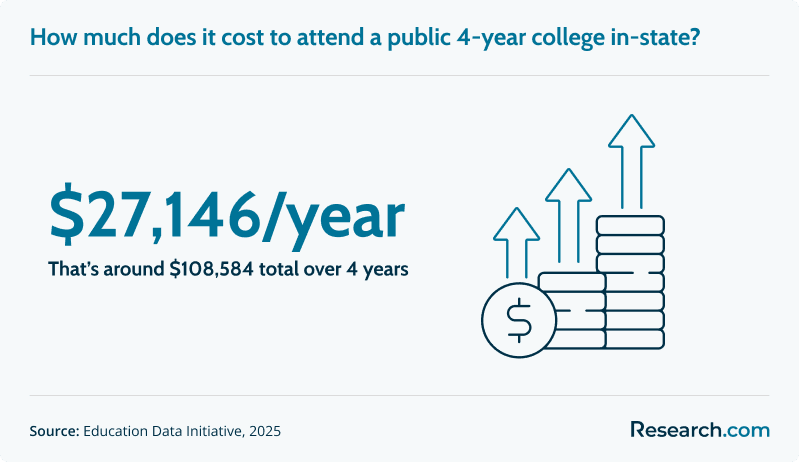
One useful comparison point is the average cost of attendance for an in-state student at a public four-year university, which is about $27,146 per year. That amount includes tuition, fees, housing, and other expenses. Online students may avoid campus housing and meal plan costs, but they still need to budget for tuition, technology, books or digital materials, fees, and time away from work.
Students concerned about affordability should compare total program cost, not just the advertised tuition rate. Low-GPA-friendly admissions are only helpful if the degree is financially sustainable. Research.com’s guide to affordable open admission online colleges can help you compare access-focused schools with cost in mind.
Financial Aid Options for Students With a Low GPA
Students at accredited online colleges generally have access to the same major types of financial aid as students in campus programs. For most federal aid, your eligibility is based primarily on financial need and enrollment status, not your high school GPA. The starting point is the FAFSA, which colleges use to determine federal, state, and institutional aid eligibility.
After you submit the FAFSA, your aid package may include several types of funding:
- Federal Grants: Grants such as the Pell Grant do not have to be repaid and are especially important for undergraduate students with significant financial need.
- Federal Student Loans: Federal loans must be repaid with interest, but they often provide repayment protections and flexibility that private loans may not offer.
- Scholarships: Colleges, employers, nonprofits, and private organizations may offer awards based on need, academic goals, background, career field, or life circumstances.
Borrowing should be approached carefully. With total student loan debt in the U.S. reaching over $1.77 trillion in 2024, students should try to maximize grants, scholarships, employer tuition assistance, military benefits, and transfer credits before relying heavily on loans.
| Aid Type | Does It Need to Be Repaid? | Low-GPA Consideration |
| Federal grants | No | Usually based on financial need and eligibility rules, not past GPA alone |
| Federal student loans | Yes | Available to many eligible students at accredited institutions, but borrowing should be limited when possible |
| Scholarships | No | Some awards consider academic performance, but others focus on background, career goals, service, or financial need |
| Employer or military benefits | Usually no, depending on benefit rules | May help working adults and servicemembers reduce out-of-pocket costs |
Prerequisites for Online Colleges That Accept Low GPA
Most low-GPA-friendly online colleges require a high school diploma or GED. Some may also require transcripts, placement information, transfer credit records, proof of English proficiency for certain applicants, or program-specific materials. Requirements vary, so you should confirm admissions rules for the exact degree you want, not just the university as a whole.
Students looking for additional funding can also research scholarships for online students while applying, since scholarship deadlines may not match admission deadlines.
Typical application steps include:
- Complete the online application. You will usually provide personal details, education history, intended program, and contact information.
- Send official transcripts. Request records from your high school, GED provider, and any colleges you previously attended.
- Submit a statement if requested. A personal statement can explain your goals, academic turnaround, work experience, or reasons your past GPA does not reflect your current readiness.
- Speak with an admissions or transfer advisor. Ask how your GPA will be evaluated and whether conditional admission, placement support, or academic success requirements apply.
The goal is to show that you are prepared to succeed now. If your GPA is weak, strengthen the rest of your application with a clear career goal, updated transcripts, professional experience, and evidence that you understand the time commitment of online study.
Common Courses at Online Colleges That Accept Low GPA
Low-GPA-friendly admissions do not mean watered-down coursework. Accredited bachelor’s programs still include general education requirements, major courses, electives, and often a final project, capstone, practicum, or field-specific requirement depending on the discipline.
General education courses usually build foundational skills in writing, communication, quantitative reasoning, social science, humanities, and natural science. Major coursework then develops field-specific knowledge. A business student may study accounting, management, marketing, and finance, while a student in a fast-track online sustainability bachelor’s degree program may take courses related to environmental policy, science, and systems thinking.
Program choice matters because some majors have clearer occupational pathways than others. National trends can provide context: Business remains the most popular field of study, accounting for 18.6% of all bachelor’s degrees awarded, followed by healthcare-related fields at 13.1%.
Popular Degree Programs at Online Colleges That Accept Low GPA
Many online colleges with flexible admissions focus on practical programs tied to business, technology, healthcare, public service, education, psychology, and human services. Before choosing a major, compare the curriculum with job postings in your target field to see whether the degree teaches skills employers actually request.
- Business Administration: A broad option for students interested in management, operations, marketing, finance, entrepreneurship, or administration. Students who want a more focused business path may compare options such as a fast-track online entrepreneurship bachelor's degree.
- Healthcare Administration and Health Sciences: These programs can prepare students for non-clinical roles in healthcare organizations, insurance companies, public health agencies, and related settings.
- Information Technology and Cybersecurity: Technology programs may lead to roles involving systems, networks, data, security, software, and technical support, depending on the degree focus and student experience.
- Psychology and Human Services: These degrees can support careers in community services, case management, behavioral support, nonprofit work, and preparation for graduate study.
- Criminal Justice: Criminal justice programs may appeal to students interested in law enforcement, corrections, courts, homeland security, policy, or legal support work.
| Major Area | Best For Students Who Want To | Important Caution |
| Business | Build versatile skills for many industries | Choose a concentration or electives that match a specific career goal |
| Healthcare administration | Work in healthcare without becoming a clinical provider | Clinical roles may require separate licenses, degrees, or certifications |
| Information technology | Move into technical support, systems, security, or data-related work | Hands-on skills, certifications, and projects may be important for employment |
| Psychology or human services | Work with people, communities, and support organizations | Counseling and clinical roles often require graduate education and licensure |
| Criminal justice | Explore public safety, legal systems, or corrections careers | Some roles have separate background, fitness, academy, or agency requirements |
How to Choose the Best Online College That Accepts Low GPA
The best school for a student with a low GPA is not always the school with the simplest application. You need a college that gives you access without putting you at risk of wasting time, credits, or money. Accreditation, total cost, credit transfer, student support, and career alignment should drive your decision.
- Confirm institutional accreditation. Look for accreditation from an agency recognized by the U.S. Department of Education or the Council for Higher Education Accreditation (CHEA). This protects degree credibility, transfer options, and financial aid access.
- Ask for a transfer credit review early. If you have prior college credits, military training, or professional learning, find out what applies to your program before committing.
- Evaluate support services. Online tutoring, writing help, academic advising, career services, mental health resources, and technical support can be especially important if you struggled academically in the past.
- Compare the curriculum with your career goal. If you want a specialized path, such as one of the fastest online real estate degree programs, verify that the coursework fits your intended field and any credential requirements.
- Calculate total cost. Include tuition, fees, technology, books, transfer credits, time to completion, and likely borrowing.
- Check program-specific requirements. Nursing, education, counseling, social work, and other regulated fields may have licensure, clinical, practicum, or state authorization rules.
Common Mistakes to Avoid
| Mistake | Why It Can Hurt You | Better Approach |
| Choosing the easiest admission process | Easy entry does not guarantee quality, affordability, or career value. | Start with accreditation, program fit, and student support. |
| Looking only at tuition per credit | Fees, transfer policies, and time to completion can change the true cost. | Ask for a full cost estimate through graduation. |
| Assuming all credits will transfer | Some credits may transfer as electives or not apply to your major. | Request a written transfer evaluation. |
| Ignoring licensure rules | Some online programs may not meet requirements in every state. | Verify state and program requirements before enrolling. |
| Waiting to ask for help | Online students can fall behind quickly if they stay silent. | Use tutoring, advising, and instructor office hours early. |
Career Paths for Graduates of Online Colleges
An accredited online degree from a college with flexible admissions can qualify graduates for the same types of career pathways as other accredited degrees. Employers generally focus on the degree level, field of study, skills, experience, portfolio, certifications, and interview performance rather than the GPA you had before college.
Business and Management Careers
Business graduates may pursue roles in project coordination, marketing, operations, human resources, logistics, sales, entrepreneurship, or administration. Career growth often depends on experience, performance, communication skills, and the ability to solve workplace problems.
Technology Careers
Students who study information technology, computer science, or cybersecurity may work toward roles in technical support, systems administration, software development, data analysis, or security. Because technology changes quickly, graduates often strengthen their employability with projects, labs, portfolios, and industry certifications. Students focused on security may compare the shortest online cybersecurity bachelor's degree programs as part of their planning.
Healthcare and Human Services Careers
Degrees in healthcare administration, psychology, social work, or human services can support careers in healthcare operations, community programs, case management, nonprofit services, and public agencies. Students should be careful with licensed professions: counseling, clinical social work, nursing, teaching, and therapy roles often require additional education, supervised experience, exams, or state approval.
The earnings advantage of education is one reason many students return to college after academic setbacks. As labor data indicates, reaching the bachelor's degree level is associated with median earnings that exceed those of workers with an associate's degree or high school diploma.
Job Market Outlook for Online College Graduates
The job value of an online degree depends on accreditation, field of study, experience, location, skills, and labor market conditions. A low-GPA-friendly admissions policy does not reduce the value of the credential if the school is accredited and the program prepares students for real employer needs.
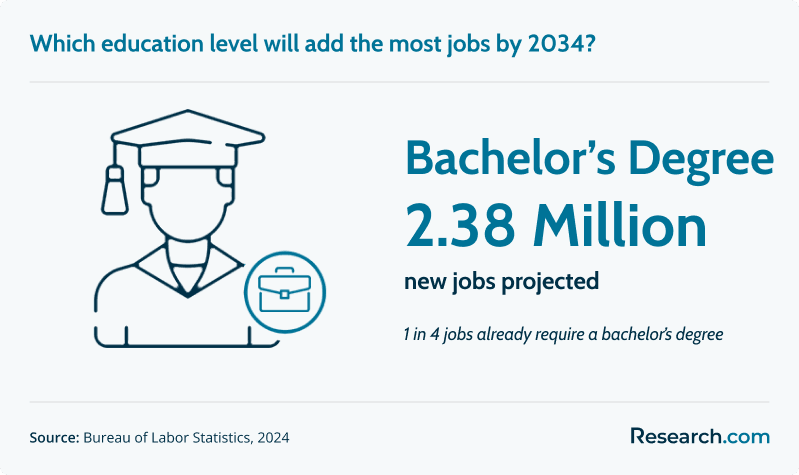
Projections show that nearly 2.4 million new jobs will be created for bachelor's degree holders by 2034, making this education level the category with the highest projected job growth. That does not guarantee a job for every graduate, but it does show that bachelor’s-level education remains important across the long-term labor market.
Some graduates later pursue master’s degrees or graduate certificates to specialize further, qualify for advancement, or enter regulated fields. For example, students interested in education careers may compare the fastest online master's in special education programs if they want to move into a high-need specialization.
What Graduates Say About Low-GPA-Friendly Online Colleges
- : "I worried that employers would dismiss my online degree, but that was not my experience. My advisors helped me stay on track, and the classes focused on skills I could discuss in interviews. Hiring managers asked about projects, data analysis, and teamwork, not my old high school GPA. — Aisha"
- : "My grades from years ago made me feel like college was no longer an option. The online program gave me a way to prove who I am now. The work was demanding, but the structure helped me build confidence, and I was able to move into IT after finishing. — Dwayne"
- : "Because I live far from a university campus, an in-person degree was not realistic. Online classes let me keep my job, stay close to family, and still connect with instructors and classmates. It made finishing college possible without relocating. — Brittany"
Questions to Ask Before Applying
Before you submit an application, contact admissions, financial aid, and the department offering your intended major. The right questions can prevent expensive surprises.
- What GPA range do you consider for regular or conditional admission?
- Is this institution accredited, and is my specific program separately accredited if required?
- How many of my previous credits will apply directly to this degree?
- What is the total estimated cost through graduation after transfer credits?
- Does this program qualify for federal financial aid?
- Are courses asynchronous, synchronous, accelerated, self-paced, or competency-based?
- What academic support is available to online students?
- What happens if I struggle in my first term?
- Does this degree meet licensure or certification requirements in my state, if relevant?
- What career services, internship support, or employer connections are available online?
Postgraduate Options That Can Strengthen Your Credentials
After earning an online degree, some graduates build additional career value through focused certificates, industry credentials, or graduate study. A certificate can be useful when it targets a specific skill area, such as data analytics, project management, cybersecurity, healthcare administration, education, or leadership. It can also be more focused than a full degree, depending on your goal.
One practical option is to compare the most affordable online graduate certificate programs and look for credentials that match your industry, employer expectations, and long-term plan. Before enrolling, verify accreditation, admission requirements, course outcomes, employer relevance, and whether credits can later apply to a graduate degree.
Key Insights
- A low GPA does not automatically prevent you from earning an accredited online degree, but you still need to meet each school’s admissions and program requirements.
- Accreditation is the first non-negotiable factor. It affects degree credibility, financial aid eligibility, transfer options, and employer acceptance.
- The best low-GPA-friendly online college is the one that combines access with strong academic support, reasonable total cost, useful transfer credit policies, and a program aligned with your career goal.
- Online programs can offer the same academic value as campus programs when properly accredited, but they require discipline, time management, and proactive communication.
- Do not choose a school based only on easy admission or low advertised tuition. Compare total cost, transfer credits, graduation requirements, support services, and career outcomes.
- Financial aid begins with the FAFSA, and students should prioritize grants, scholarships, employer benefits, transfer credits, and low-cost options before borrowing heavily.
- Some career paths, especially in healthcare, education, counseling, nursing, and social work, may require licensure or additional supervised training beyond the online degree.
- Students with past academic struggles should look for online colleges that offer tutoring, advising, career support, writing help, and clear early-alert systems.
References:
- FairTest. (2025, February 14). Overwhelming majority of U.S. colleges and universities remain ACT/SAT-optional or test-blind/score-free for fall 2025. National Center for Fair & Open Testing. Retrieved September 4, 2025, from https://fairtest.org/overwhelming-majority-of-u-s-colleges-and-universities-remain-act-sat-optional-or-test-blind-score-free-for-fall-2025/
- Hanson, M. (2024, November 1). Average cost of college & tuition. EducationData.org. Retrieved September 4, 2025, from https://educationdata.org/average-cost-of-college FairTest admissions policy reference
- Hanson, M. (2024, November 1). Financial aid statistics. EducationData.org. Retrieved September 4, 2025, from https://educationdata.org/financial-aid-statistics FairTest admissions policy reference
- Hanson, M. (2024, November 1). Number of college graduates. EducationData.org. Retrieved September 4, 2025, from https://educationdata.org/number-of-college-graduates FairTest admissions policy reference
- Hanson, M. (2024, November 1). Student loan debt statistics. EducationData.org. Retrieved September 4, 2025, from https://educationdata.org/student-loan-debt-statistics FairTest admissions policy reference
- National Center for Education Statistics. (2024, May). Indicator CHA: Undergraduate enrollment. U.S. Department of Education. Retrieved September 4, 2025, from https://nces.ed.gov/programs/coe/indicator/cha
- National Center for Education Statistics. (2023, May). Fast facts: Distance learning. U.S. Department of Education. Retrieved September 4, 2025, from https://nces.ed.gov/fastfacts/display.asp?id=80 NCES undergraduate enrollment reference FairTest admissions policy reference
- U.S. Bureau of Labor Statistics. (2024, September 4). Education pays. U.S. Department of Labor. Retrieved September 4, 2025, from https://www.bls.gov/careeroutlook/2024/data-on-display/education-pays.htm FairTest admissions policy reference
- U.S. Bureau of Labor Statistics. (2024, September 4). Employment by major occupational group and education or training category. U.S. Department of Labor. Retrieved September 4, 2025, from https://www.bls.gov/emp/tables/education-summary.htm
- U.S. Bureau of Labor Statistics. (2025, July 18). Usual weekly earnings of wage and salary workers: Second quarter 2025. U.S. Department of Labor. Retrieved September 4, 2025, from https://www.bls.gov/news.release/pdf/wkyeng.pdf BLS education and employment reference FairTest admissions policy reference
Other Things You Should Know About Online Colleges that Accept Low GPA
Online colleges that accept low GPAs often provide financial aid options such as scholarships, grants, and federal student loans. Some may offer merit-based scholarships specifically for students improving their academic performance while pursuing their degrees in 2027.
Many do not require SAT or ACT scores for adult learners and transfer students. Instead, they review transcripts, prior credits, and work experience. Some schools use test-optional policies, while others ask for placement scores only after enrollment to determine readiness for math or writing courses.
Yes, but it varies by institution. Most traditional universities accept transfer credits if the online college is accredited. Reviewing the transfer policies of the targeted university and consulting with academic advisors ensures a smooth transition.


