
Best Online Colleges with Weekly Start Dates for 2027

Co-Founder and Chief Data Scientist
Feeling stuck waiting for a traditional semester is a common frustration that can kill your momentum just when you're ready to act. You don't have to wait. With 61% of all undergraduates now taking distance education courses, flexible online programs are a respected and mainstream path to a degree. You have the power to start on your timeline.
To help you move forward with confidence, our career planning experts, with over 10 years of experience, built this guide. It’s more than a simple ranking of schools. It’s a strategic plan for finding the best online colleges with weekly start dates so you can take the next step right away.
What are the benefits of attending an online college with weekly start dates?
- Earning a bachelor's degree opens the door to stable, high-demand career fields that allow you to grow professionally.
- You can significantly increase your earning potential, with bachelor's degree holders earning a median of $1,732 per week.
- You gain complete control over your educational timeline, allowing you to start your degree program when you are ready, not when a calendar dictates.
What can I expect from attending an online college with weekly start dates?
You can expect a fast-paced and highly structured learning environment. Most programs deliver courses one or two at a time in concentrated 5-to-8-week terms instead of a traditional 16-week semester. This accelerated model allows you to focus deeply on a single subject before moving to the next.
Take note that while the learning is asynchronous—meaning you can log in and do your work whenever it fits your schedule—it is not self-paced. You will have firm weekly deadlines for assignments, discussions, and exams. Success in this model requires strong time management and self-discipline.
Where can I work with a degree from an online college with weekly start dates?
You can work in the exact same fields and roles as graduates from any traditional university. Your career opportunities are determined by your major and the quality of your program, not by the school’s scheduling format.
Here’s what employers really care about: accreditation. A degree from a regionally accredited online college is a signal of quality and rigor. It tells hiring managers that you received a legitimate education that meets established academic standards.
With the widespread adoption of remote work and online training, any old stigma against online degrees has largely disappeared. Companies are focused on what you know and what you can do, not how you learned it.
How much can I make with a degree from an online college with weekly start dates?
Your earning potential is connected to your degree level and field of study, not the format of your program. A bachelor’s degree from an accredited online college carries the same weight with employers as one earned on campus.
The financial benefit is clear and significant. According to the Bureau of Labor Statistics, the median weekly earnings for someone with a bachelor's degree are $1,732. That's a substantial increase over the $960 median for a worker with only a high school diploma. This investment in your education pays dividends for your entire career.
Popular College Degrees Worth Considering in 2027
1. Business Administration
A business administration degree builds broad skills in management, finance, and operations, making it a popular path for future leaders. Graduates can pursue roles such as managers, analysts, consultants, or entrepreneurs.
2. Psychology
A psychology degree focuses on human behavior, research, and mental processes, preparing students for work in counseling, research, and organizational development. Graduates can become counselors, therapists, researchers, or HR specialists.
3. Counseling
A counseling degree trains students to help individuals and communities with mental health and personal challenges, leading to roles in clinical settings, schools, or community organizations. Graduates can work as counselors, therapists, or school guidance advisors.
4. Nursing
A nursing degree equips students with clinical skills and patient-focused care, preparing them for vital roles in healthcare. Graduates can become registered nurses, nurse practitioners, or healthcare administrators.
5. Social Work
A social work degree emphasizes advocacy, community support, and direct service for people in need. Graduates can work as social workers, case managers, or community outreach coordinators in healthcare, education, or social service agencies.
- List of the Best Online Colleges with Weekly Start Dates for 2027 List of Colleges
- How long does it take to complete a degree program at an online college with weekly start dates? Completion Time
- How does an online program with flexible weekly start dates compare to an on-campus program? How does an online program with flexible weekly start dates compare to an on-campus program?
- What is the average cost of attending an online college with weekly start dates? Program Cost
- What are the financial aid options for students enrolling in an online college with weekly start dates? Financial Aid
- What are the prerequisites for enrolling in an online college with weekly start dates? What are the prerequisites for enrolling in an online college with weekly start dates?
- What courses are typically offered at online colleges with weekly start dates? What courses are typically offered at online colleges with weekly start dates?
- What degree programs are typically available at online colleges with weekly start dates? What degree programs are typically available at online colleges with weekly start dates?
- How to Choose the Best Online College with Weekly Start Dates How to Choose the Best Online College with Weekly Start Dates
- What career paths are available for graduates of online colleges? Career Paths
- What is the job market outlook for online college graduates? Job Market
- Can additional credentials boost your career prospects? Can additional credentials boost your career prospects?
Best Online Colleges with Weekly Start Dates for 2026
Waiting months for the next semester can be a major barrier if you are ready to start college now, changing careers, returning after a break, or trying to finish a degree while working. Online colleges with weekly start dates, rolling starts, or very frequent course launches can shorten that waiting period and give adult learners more control over when they begin.
This guide is designed for students who want a flexible online degree but still need to compare accreditation, cost, program length, support services, and career value before enrolling. It also helps students thinking about longer-term academic moves, such as whether they can apply to graduate school in a field different from their undergraduate major.
You will find a ranked list of online colleges, a comparison of online and campus-based study, cost and financial aid guidance, admissions expectations, common mistakes to avoid, and practical questions to ask before choosing a program.
Quick Answer: Are Online Colleges with Weekly Start Dates Worth Considering?
Online colleges with weekly start dates can be a strong option for students who need flexibility, want to begin quickly, and can manage self-paced or accelerated coursework. The best choices are accredited institutions with transparent tuition, clear transfer credit policies, strong advising, and degree programs aligned with your career goals.
They are not automatically faster or cheaper for every student. Your actual timeline and cost depend on transfer credits, course availability, financial aid, enrollment intensity, and whether you study full time or part time. Before applying, confirm that the specific degree you want offers frequent starts and that the school’s accreditation is recognized by employers, licensing boards, and graduate programs.
What “Weekly Start Dates” Usually Mean
A college with weekly start dates does not necessarily mean every course in every major begins every Monday. In practice, the term often refers to rolling admissions, frequent course launches, short academic terms, or multiple entry points throughout the year. Some programs may allow new students to begin almost immediately, while others may offer starts every few weeks or at the beginning of accelerated sessions.
The key advantage is reduced waiting time. Instead of planning around a traditional fall or spring semester, students may be able to enroll when their finances, work schedule, family responsibilities, and academic records are ready.
| Feature | What It Means for Students | What to Verify Before Enrolling |
| Frequent start dates | You may not need to wait for a traditional semester cycle. | Ask whether your exact major and first required course are available at the next start date. |
| Accelerated terms | Courses may move faster than semester-based classes. | Confirm weekly workload expectations and assignment deadlines. |
| Online delivery | You can complete coursework remotely, often around work or family obligations. | Check whether any labs, residencies, exams, internships, or clinical experiences require in-person attendance. |
| Transfer-friendly policies | Prior credits may reduce time to graduation. | Request an official transfer evaluation before committing. |
How We Ranked the Programs
Because a degree is a major financial and time commitment, this ranking emphasizes transparency, institutional credibility, and student decision-making value. The evaluation draws on established education data sources, including the IPEDS database, Peterson's database, the College Scorecard database, and The National Center for Education Statistics.
These sources help support comparisons across online colleges with frequent or flexible start options. To learn more about how Research.com evaluates schools and programs, see the Research.com methodology page.
Best Online Colleges with Weekly or Frequent Start Dates
The schools below are useful starting points for students looking for flexible online enrollment. Program availability, exact start frequency, and tuition can vary by degree, residency, and academic year, so always confirm the details directly with the institution before applying.
| Rank | School | Typical Program Length | Credits Listed | Cost per Credit | Accreditation |
| 1 | University of North Dakota | ~4 years | ~120 credits | $384.88 | Higher Learning Commission (HLC) |
| 2 | University of Illinois Springfield | ~4 years | ~120 credits | $316.75 (in-state) | Higher Learning Commission (HLC) |
| 3 | Upper Iowa University | ~4 years | ~120 credits | $515 | Higher Learning Commission (HLC) |
| 4 | University of Maryland Global Campus | ~4 years | ~120 credits | $330 (in-state) | Middle States Commission on Higher Education (MSCHE) |
| 5 | University of Massachusetts Global | ~4 years | ~120 credits | $500 | WSCUC Senior College and University Commission (WSCUC) |
| 6 | Walden University | ~4 years | ~120 credits | $1,400 | Higher Learning Commission (HLC) |
| 7 | Western Governors University | ~4 years | ~120 credits | $276.67 (based on average tuition) | Northwest Commission on Colleges and Universities (NWCCU) |
| 8 | Arizona State University Online | ~2 years | 35 | $779 | Higher Learning Commission (HLC) |
1. University of North Dakota
The University of North Dakota is a public research university with a broad online catalog and recognized strengths in areas such as engineering and aviation. Its online programs may appeal to students who want the credibility of an established public institution while studying at a distance.
- Program Length: ~4 years
- Required Credits to Graduate: ~120 credits
- Cost per Credit: $384.88
- Accreditation: Higher Learning Commission (HLC)
2. University of Illinois Springfield
University of Illinois Springfield offers online pathways connected to the University of Illinois system. The school may be a good fit for students who want a public university option with a focus on applied learning, research, and civic engagement.
- Program Length: ~4 years
- Required Credits to Graduate: ~120 credits
- Cost per Credit: $316.75 (in-state)
- Accreditation: Higher Learning Commission (HLC)
3. Upper Iowa University
Upper Iowa University has long served adult and distance learners through flexible academic formats. Its 8-week terms and transfer-oriented structure may benefit students who already have college credits or who need shorter enrollment blocks.
- Program Length: ~4 years
- Required Credits to Graduate: ~120 credits
- Cost per Credit: $515
- Accreditation: Higher Learning Commission (HLC)
4. University of Maryland Global Campus
University of Maryland Global Campus was built around the needs of working adults, military students, and career-focused learners. Its online programs are designed for students who want practical coursework from a state university with experience serving nontraditional learners.
- Program Length: ~4 years
- Required Credits to Graduate: ~120 credits
- Cost per Credit: $330 (in-state)
- Accreditation: Middle States Commission on Higher Education (MSCHE)
5. University of Massachusetts Global
University of Massachusetts Global is a nonprofit institution focused on adult learners and online education. Students who want structured advising and support throughout the enrollment-to-graduation process may find this model appealing.
- Program Length: ~4 years
- Required Credits to Graduate: ~120 credits
- Cost per Credit: $500
- Accreditation: WSCUC Senior College and University Commission (WSCUC)
6. Walden University
Walden University serves adult learners through online programs tied to professional and social impact goals. It may be relevant for working professionals who want flexible study options and programs structured around career advancement.
- Program Length: ~4 years
- Required Credits to Graduate: ~120 credits
- Cost per Credit: $1,400
- Accreditation: Higher Learning Commission (HLC)
7. Western Governors University
Western Governors University uses a competency-based education model, which allows students to progress by demonstrating mastery of material. This format can work well for disciplined students who already have relevant knowledge and want flexibility in how quickly they move through coursework.
- Program Length: ~4 years
- Required Credits to Graduate: ~120 credits
- Cost per Credit: $276.67 (based on average tuition)
- Accreditation: Northwest Commission on Colleges and Universities (NWCCU)
8. Arizona State University Online
Arizona State University Online provides distance learners access to programs from a large public university known for online education and broad academic offerings. Students should verify whether the listed program format, credit requirement, and start schedule match their intended degree.
- Program Length: ~2 years
- Required Credits to Graduate: 35
- Cost per Credit: $779
- Accreditation: Higher Learning Commission (HLC)
How Long Does It Take to Finish a Degree at an Online College with Weekly Start Dates?
Many bachelor’s programs require about 120 credits, and the listed bachelor’s options in this guide use ~120 credits as a typical benchmark. A traditional full-time timeline is about four years, but online students may finish sooner or later depending on transfer credits, course load, term structure, and whether they enroll continuously.
Frequent start dates can reduce the time you spend waiting to begin, but they do not automatically shorten every degree. The biggest accelerators are accepted transfer credits, year-round enrollment, competency-based progress, and choosing a program with courses available when you need them. Nationally, 22.3% of bachelor's degree earners take more than four years to finish, so planning realistically matters.
| Student Situation | Likely Timeline Impact | Best Strategy |
| No prior college credit | Usually closest to the full degree timeline | Ask for a recommended course sequence and confirm whether year-round study is possible. |
| Some transfer credits | May reduce the number of courses required | Request an official transfer credit review before enrolling. |
| Working full time | May require part-time enrollment | Choose a realistic course load instead of overcommitting during the first term. |
| Highly motivated with relevant experience | May benefit from accelerated or competency-based options | Compare course pacing, assessment style, and academic support before choosing. |
When an Accelerated Program Makes Sense
Some online degrees are intentionally designed for faster completion. For example, students comparing the fastest online entertainment business degree programs should look closely at course intensity, term length, and how much time they can dedicate each week. Accelerated programs can be efficient, but they require consistent focus.
Online Programs with Flexible Starts vs. On-Campus Programs
At an accredited institution, the main difference between online and campus study is usually delivery, not the legitimacy of the credential. Students complete academic requirements, meet learning outcomes, and earn a degree from the institution. The best format depends on your schedule, learning preferences, support needs, and career goals.
Campus programs provide face-to-face interaction, physical facilities, structured meeting times, and a traditional student community. Online programs offer flexibility and access, but they require strong time management, reliable technology, and the ability to communicate proactively with instructors and advisors.
Online study is not necessarily easier. Short terms can compress reading, projects, exams, and discussions into a demanding schedule. That flexibility can be especially valuable for students balancing career advancement with future credentials, including those researching combined master's and teaching credential online programs.
| Format | Best For | Potential Drawbacks |
| Online with frequent starts | Working adults, parents, military students, career changers, and students who want to begin quickly | Requires self-discipline; fewer in-person networking opportunities; course availability may vary |
| Traditional on-campus | Students who want face-to-face learning, campus life, labs, and a fixed weekly structure | Less schedule flexibility; commuting or relocation may increase cost |
| Hybrid | Students who need some flexibility but still want in-person components | May still require travel, campus attendance, or local placement arrangements |
Average Cost of Online Colleges with Weekly Start Dates
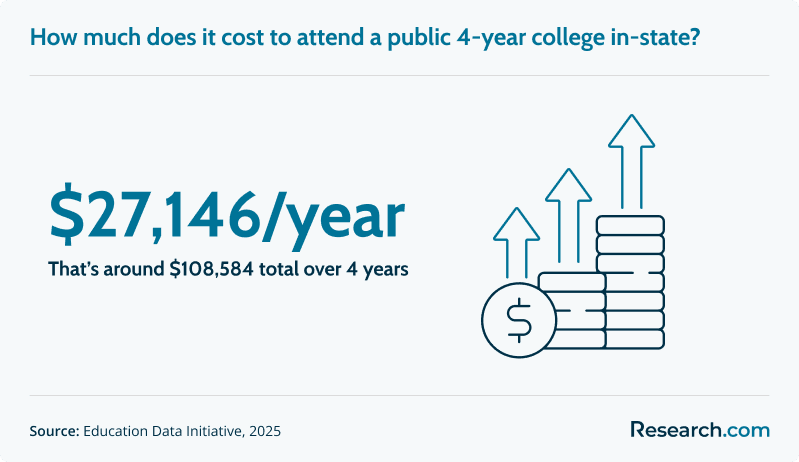
Costs vary significantly by institution, degree level, residency status, and fee structure. Among the programs featured in this list, the average in-state cost per credit is around $563. This figure only reflects the schools included here and should not be treated as a market-wide average.
When comparing schools, do not look at tuition alone. Ask for the full estimated cost of attendance, including technology fees, course materials, graduation fees, transfer credit fees, and any charges tied to online learning platforms.
| Cost Factor | Why It Matters | Question to Ask |
| Per-credit tuition | This is the largest visible cost for most programs. | Is the listed rate different for in-state, out-of-state, military, or online students? |
| Required credits | More required credits can increase total cost. | How many credits will I personally need after transfer evaluation? |
| Fees | Online, technology, assessment, and graduation fees can add up. | Can you provide a written breakdown of all required fees? |
| Course materials | Books, software, and subscriptions may vary by major. | Are digital materials included, discounted, or billed separately? |
| Time to completion | Taking longer may increase living costs, fees, and opportunity cost. | What is the recommended completion plan for someone with my schedule? |
How to Think About Return on Investment
A bachelor’s degree can improve long-term employment prospects, but outcomes are never guaranteed. Field of study, location, experience, internships, networking, and labor market conditions all affect results. One useful national comparison is that the unemployment rate for individuals with a bachelor's degree is just 2.2%, compared to 4.0% for those with only a high school diploma.
Students should evaluate degree value in relation to their target occupation. In some fields, additional credentials can influence earnings and mobility, as seen in profession-specific resources such as FNP salary by state. For any program, compare total cost with realistic career outcomes, not best-case salary examples.
Financial Aid Options for Online Students with Flexible Start Dates
Students enrolled in accredited online colleges may be eligible for many of the same financial aid options as campus-based students. The most important first step is completing the Free Application for Federal Student Aid, or FAFSA.
The FAFSA is used to determine eligibility for federal Pell Grants, federal student loans, and some school-based aid. Grants do not need to be repaid, while loans must be repaid with interest. Because online programs may use nontraditional calendars, ask the financial aid office how aid is disbursed across short terms or frequent starts.
| Aid Type | How It Can Help | Important Caution |
| Federal Pell Grants | Can reduce out-of-pocket cost and do not need repayment | Eligibility depends on FAFSA results and enrollment status. |
| Federal student loans | Can cover tuition and other education costs | Borrow only what you need and understand repayment obligations. |
| Institutional scholarships | May be awarded by the college based on need, merit, program, or student type | Confirm whether scholarships apply to online students and accelerated terms. |
| Employer tuition assistance | Can lower costs for working adults | Ask whether your employer requires minimum grades or continued employment. |
| External scholarships | Can supplement federal and institutional aid | Track deadlines carefully because weekly starts do not always align with scholarship cycles. |
Borrowing Should Be Planned, Not Assumed
Student loans can make college possible, but they should be part of a careful financial plan. Estimate your total borrowing before you enroll, compare monthly repayment scenarios, and consider how your chosen major connects to realistic career opportunities.
Career-specific salary research can help frame the decision. For example, healthcare students comparing graduate pathways may review resources such as gerontology nurse practitioner salary by state to understand how advanced credentials can affect professional options in a specific field.
Admissions Requirements for Online Colleges with Weekly Start Dates
Admissions requirements vary by school and degree level. For many bachelor’s programs, applicants need a high school diploma or GED. Some online colleges use flexible or open admissions policies, while others evaluate GPA, prior college coursework, essays, test scores, professional experience, or program-specific prerequisites.
Students should not assume that “flexible admissions” means no standards. Some programs require placement assessments in math or English, prerequisite coursework, technology readiness, or proof of prior credits. Placement tests are usually used to place students in the right starting course, not simply to deny admission.
Cost planning should begin during admissions, not after acceptance. Students can also research outside funding opportunities such as scholarships for college students in 2025 before their first term begins.
Documents You May Need
- High school transcript or GED record: Often required for first-time undergraduate applicants.
- College transcripts: Needed for transfer credit review, even if you completed only a few courses.
- Government-issued identification: Commonly required for enrollment verification.
- Financial aid records: FAFSA information and any scholarship or employer tuition assistance documentation.
- Program-specific materials: Some majors may require prerequisites, resumes, essays, portfolios, or certifications.
Common Courses in Online Programs with Frequent Starts
Most undergraduate online degrees include general education courses and major-specific coursework. General education requirements build broad skills in writing, quantitative reasoning, science, social science, communication, and humanities. Major courses develop deeper knowledge in the student’s chosen field.
Shorter terms do not mean the curriculum is less rigorous. The same amount of reading, writing, discussion, testing, and project work may be compressed into fewer weeks. That structure can be efficient for focused learners, but it can feel intense for students who underestimate the weekly workload.
| Course Category | Typical Purpose | Student Tip |
| General education | Develops foundational academic and professional skills | Complete these early if they are prerequisites for upper-level courses. |
| Major core | Builds field-specific knowledge required for the degree | Check whether courses must be taken in a fixed sequence. |
| Electives | Allows some customization around interests or career goals | Use electives strategically to build skills employers value. |
| Capstone or final project | Demonstrates integrated learning near the end of the program | Ask whether the capstone can support a portfolio, career transition, or graduate school application. |
How Accelerated Course Pacing Works
In many accelerated online programs, students take one or two courses at a time rather than juggling a full semester schedule. A student in a fast-track online creative writing degree, for example, may complete concentrated writing, reading, and workshop assignments in a shorter academic window.
This format can improve focus, but it leaves little room for falling behind. Before enrolling, ask for a sample syllabus or weekly schedule so you can judge whether the pace fits your work and family responsibilities.
Degree Programs Commonly Available at Online Colleges with Weekly Start Dates
Online colleges with frequent starts often emphasize programs that can be delivered effectively at a distance and that align with professional or career-focused goals. Common areas include business administration, information technology, cybersecurity, healthcare administration, psychology, criminal justice, and related fields.
Programs requiring extensive in-person labs, clinical placements, studio work, or field training may be less common in a fully online weekly-start format. Some may be offered as hybrid programs, but students should verify location requirements before enrolling.
| Degree Area | Why It Fits Online Learning | What to Check |
| Business administration | Coursework often translates well to online case studies, projects, and discussions. | Look for concentrations that match your career goal, such as management, finance, or marketing. |
| Information technology | Many technical skills can be practiced through virtual labs and software tools. | Ask about hands-on platforms, certifications, and portfolio-building assignments. |
| Cybersecurity | Online labs and simulations can support applied skill development. | Confirm whether the curriculum aligns with current employer expectations. |
| Healthcare administration | Administrative and policy coursework can often be completed remotely. | Distinguish administrative programs from clinical programs with licensure requirements. |
| Psychology | Undergraduate psychology coursework is commonly available online. | Understand that clinical practice usually requires graduate education and supervised training. |
| Criminal justice | Many courses focus on law, policy, ethics, and systems analysis. | Ask how the program supports internships, public service careers, or advancement. |
Match the Degree to Your Timeline and Career Goal
The fastest program is not always the best program. Students comparing options such as the shortest online economics degree programs should examine transfer policies, course sequencing, academic workload, and how the degree supports their intended career or graduate study plans.
Top 5 Most Popular Bachelor's Degree Disciplines

How to Choose the Best Online College with Weekly Start Dates
The right school is the one that matches your academic goal, schedule, budget, and career plan while meeting recognized quality standards. Do not choose based only on how quickly you can start. A fast start is useful only if the program is credible and sustainable.
| Selection Factor | Why It Matters | Red Flag |
| Accreditation | Accreditation affects credit transfer, employer recognition, graduate admissions, and financial aid eligibility. | The school is vague about institutional accreditation or only highlights unrecognized approvals. |
| Program fit | The degree should connect directly to your intended job, promotion, or graduate pathway. | The admissions team cannot explain career relevance beyond broad claims. |
| Transfer credit policy | Accepted credits can reduce both time and cost. | You are asked to enroll before receiving a clear transfer evaluation. |
| Student support | Online learners need advising, tutoring, library access, career services, and technical help. | Support is only available during limited hours that do not match your schedule. |
| Tuition transparency | You need to know the full cost before borrowing or paying out of pocket. | The school focuses on monthly payments but avoids total program cost. |
| Course availability | Frequent starts are only helpful if required courses are offered when you need them. | Key courses are offered infrequently, delaying graduation. |
Questions to Ask Before You Enroll
- Is the institution accredited by a recognized accreditor?
- Does my specific degree program offer weekly starts, rolling starts, or fixed term starts?
- How many of my prior credits will transfer into this exact program?
- What is the total estimated cost after tuition, fees, books, and required technology?
- How is financial aid handled for short terms or frequent starts?
- What happens if I need to pause for work, health, military, or family reasons?
- Are courses asynchronous, synchronous, or a mix of both?
- Will this degree meet requirements for my intended employer, graduate school, certification, or licensing pathway?
Common Mistakes to Avoid
- Choosing speed over accreditation: A fast start is not worth much if the credential is not widely recognized.
- Comparing only tuition rates: Fees, required credits, and transfer policies can change the real cost.
- Assuming every online program qualifies for financial aid: Aid eligibility depends on accreditation, enrollment status, and program rules.
- Ignoring licensure requirements: Some careers require state-specific approvals, clinical hours, exams, or supervised experience.
- Overloading the first term: Accelerated online courses can be demanding, especially for students returning after a long break.
- Relying only on rankings: Rankings are a starting point, not a substitute for program-specific research.
Careful evaluation is especially important because online education is heavily used by private, for-profit institutions. Data shows that 88% of students at private, for-profit colleges are enrolled exclusively in distance education. Some online programs can be worthwhile, but students should verify quality, outcomes, cost, and support before committing.
Career Paths After Graduating from an Online College with Frequent Starts
Your career options depend more on your major, skills, experience, internships, portfolio, certifications, and accreditation than on whether you studied online. Employers typically care about what you can do, whether your degree is legitimate, and how well your background fits the role.
For example, business administration graduates may pursue roles in management, operations, finance, sales, or marketing. Information technology graduates may move toward cybersecurity, systems support, network administration, or software-related positions. Healthcare administration graduates may seek nonclinical roles in healthcare organizations, insurance, compliance, or operations.
| Degree Area | Possible Career Direction | How to Strengthen Employability |
| Business administration | Management, operations, finance, marketing, sales | Build project experience, spreadsheet skills, leadership examples, and internships where possible. |
| Information technology | Technical support, systems administration, networking, cybersecurity | Create a portfolio, practice with relevant tools, and consider industry certifications. |
| Healthcare administration | Healthcare operations, compliance, patient services, insurance administration | Learn healthcare systems, data tools, regulations, and workflow management. |
| Psychology | Human services, research support, business, education support, graduate study preparation | Clarify whether your goal requires graduate education or licensure. |
| Criminal justice | Public safety, corrections, investigations support, policy, security administration | Check agency requirements and build communication, ethics, and report-writing skills. |
Using a Bachelor’s Degree as a Career Foundation
A bachelor’s degree can open entry-level and advancement opportunities, but specialization often comes later through graduate study, certificates, licenses, or employer training. For instance, business graduates interested in logistics or operations leadership may later compare options such as the shortest master's program in supply chain management.
Job Market Outlook for Graduates
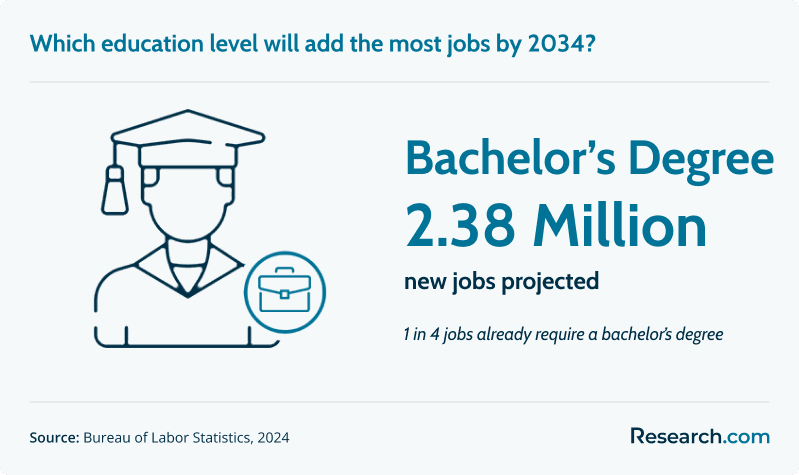
The broader labor market continues to reward education, although outcomes differ by field. The economy is projected to add nearly 2.4 million new jobs for bachelor's degree holders over the next decade. That projection supports the long-term value of completing a degree, especially in fields with sustained employer demand.
Still, students should avoid assuming that any degree will produce the same result. A strong job outlook depends on choosing a relevant major, developing current skills, gaining experience, and understanding hiring expectations in the field you want to enter.
Technology, AI, and Employer Expectations
Online students should pay attention to how artificial intelligence, automation, data tools, and digital collaboration are changing workplace expectations. Employers increasingly value graduates who can use technology responsibly, communicate clearly in remote environments, solve problems, and keep learning as tools evolve.
Some creative and technical fields are changing quickly. Students exploring digital media or interactive entertainment, for example, may want to review career-specific information such as video game designer salary and career paths before choosing a degree concentration.
What Online Students Say About Flexible Start Programs
- Camille: "I worried that employers might question an online degree, but the coursework was much more demanding than I expected. The instructors brought real industry experience, and the shorter terms forced me to stay organized. By the end, I had completed projects I could confidently discuss with hiring managers."
- Shay: "A traditional semester schedule would not have worked for me because I was employed full time and raising two children. Being able to begin when I was ready made a real difference. I studied after work and after bedtime, and the flexibility made college possible without putting my life on hold."
- Ben: "Returning to school after years away was intimidating. What helped most was taking one course at a time and knowing exactly what was due each week. My advisor also helped me plan a course load that was challenging but manageable."
Can Additional Credentials Improve Career Prospects?
Additional credentials can help when they build specific skills that employers recognize. Certificates, graduate certificates, industry certifications, and short professional programs may strengthen a resume when they complement your degree and align with a clear career goal.
They are not a substitute for choosing the right accredited degree program, and they should not be pursued just to collect credentials. Students who want targeted, lower-cost specialization can compare options such as the most affordable online graduate certificate programs after identifying the skills required in their intended field.
References
- EducationData.org. (2024). Average cost of college & tuition. Retrieved September 5, 2025, from https://educationdata.org/average-cost-of-college
- EducationData.org. (2024). Financial aid statistics. Retrieved September 5, 2025, from https://educationdata.org/financial-aid-statistics
- EducationData.org. (2024). Number of college graduates. Retrieved September 5, 2025, from https://educationdata.org/number-of-college-graduates
- EducationData.org. (2024). Student loan debt statistics. Retrieved September 5, 2025, from https://educationdata.org/student-loan-debt-statistics
- National Center for Education Statistics. (2024). Fast facts: College enrollment rates. Retrieved September 5, 2025, from https://nces.ed.gov/fastfacts/display.asp?id=80
- National Center for Education Statistics. (2024). Indicator CHA: College enrollment and graduation rates. Retrieved September 5, 2025, from https://nces.ed.gov/programs/coe/indicator/cha
- U.S. Bureau of Labor Statistics. (2024). Education pays. Retrieved September 5, 2025, from https://www.bls.gov/careeroutlook/2024/data-on-display/education-pays.htm
- U.S. Bureau of Labor Statistics. (2024). Employment projections: Education summary. Retrieved September 5, 2025, from https://www.bls.gov/emp/tables/education-summary.htm
- U.S. Bureau of Labor Statistics. (2025). Usual weekly earnings of wage and salary workers: Second quarter 2025. Retrieved September 5, 2025, from https://www.bls.gov/news.release/pdf/wkyeng.pdf
Key Insights
- Online colleges with weekly or frequent start dates are best for students who are ready to begin quickly and can manage independent, accelerated learning.
- Accreditation should be your first filter. It affects financial aid, transfer credits, graduate school options, and employer recognition.
- The fastest start date is not always the best choice. Confirm that your exact degree, first required course, and financial aid package are ready before enrolling.
- Among the schools listed, the average in-state cost per credit is around $563, but total cost depends on fees, transfer credits, residency, and time to completion.
- A bachelor’s degree can improve labor market position, with unemployment at 2.2% for individuals with a bachelor's degree compared to 4.0% for those with only a high school diploma, but salaries and job outcomes vary by field.
- Transfer credits, year-round enrollment, and competency-based formats can shorten the path to graduation, but only if the program’s course schedule supports your plan.
- Before committing, ask for a written cost estimate, transfer credit review, course sequence, start-date confirmation, and explanation of student support services.
Other Things You Need To Know About Online Colleges with Weekly Start Dates
Students enrolling in online colleges with weekly start dates in 2027 need a reliable internet connection, a computer with updated software, and access to learning management systems like Canvas or Blackboard. Specific hardware requirements may vary by college.
Online colleges with weekly start dates in 2027 typically have streamlined enrollment processes, often requiring a high school diploma or GED, completion of an application form, and sometimes a placement test. This setup allows students to begin classes soon after admission, emphasizing accessibility and flexibility in education.
Yes. Many regionally accredited online colleges accept transfer credits, and some allow up to 90 semester credits toward a 120-credit bachelor’s degree. Schools usually review official transcripts course by course and may require a minimum grade of C or better for transfer.


