
2027 Family Nurse Practitioner (FNP) Salary by State

Co-Founder and Chief Data Scientist
Pursuing a career as a Family Nurse Practitioner (FNP) offers both opportunity and challenge, especially when salaries vary widely across the country. With FNPs earning a median annual salary of $125,900 as of 2023, understanding pay differences by state can help you plan your career path with confidence.
This article goes beyond salary figures. It’s a guide developed by career planning experts with more than ten years of experience, offering insights into trends, growth potential, and workplace realities. Whether you’re just beginning your journey or mapping out your long-term future, the information here will give you the clarity needed to make informed decisions.
What are the benefits of becoming a family nurse practitioner?
- Becoming an FNP opens doors to roles such as primary care provider, urgent care clinician, or community health specialist, allowing you to serve underserved populations while advancing your career.
- FNPs earn a median annual wage of $125,900 (BLS, 2023), significantly higher than the average registered nurse salary of $86,070.
- Many FNP programs are available online, giving working nurses the flexibility to complete coursework while continuing to gain hands-on experience in clinical settings.
What can I expect from a family nurse practitioner career?
Family Nurse Practitioner (FNP) salary is one of the most important factors for nurses considering this career path. On average, FNPs earn significantly more than registered nurses, with the Bureau of Labor Statistics reporting a median annual salary of $125,900 in 2023, compared to $86,070 for RNs. Salary potential varies widely by state, type of employer, and years of experience.
For example, FNPs working in hospitals or specialty clinics often earn more than those in private practice or community health. In addition, state licensing requirements and scope of practice laws can influence how much FNPs are paid, since more autonomy often leads to higher earning power. With projected job growth of 45% through 2030, pursuing an FNP role offers both financial stability and long-term career opportunities, making it a rewarding choice for those ready to advance their nursing careers.
Where can I work with as a family nurse practitioner?
Family Nurse Practitioners (FNPs) work in a wide range of healthcare settings, giving them the flexibility to align their careers with their personal and professional goals. Many are employed in primary care clinics, community health centers, or physician’s offices, where they provide ongoing care to patients of all ages. Hospitals and outpatient care centers also hire FNPs, often for more specialized roles in pediatrics, geriatrics, or women’s health. In rural or underserved areas, FNPs play a critical role in filling provider gaps, offering both preventive care and treatment services where access to physicians may be limited.
FNPs are also found in nontraditional healthcare environments. Many work for schools, urgent care centers, government health agencies, or large corporate employers that offer onsite wellness programs. Some FNPs choose careers in telehealth, which has grown rapidly and allows them to provide virtual care to patients across state lines. Others move into leadership, education, or policy positions, shaping the future of healthcare delivery. This diversity of work settings ensures that FNPs can build careers that match both their financial goals and their passion for patient care.
How much can I make with as a family nurse practitioner?
Graduates of Family Nurse Practitioner (FNP) programs typically earn competitive salaries that reflect both their advanced training and the high demand for their skills. According to the U.S. Bureau of Labor Statistics, nurse practitioners, including FNPs, earned a median annual salary of $129,480 in 2023.
Salaries vary based on factors like location, industry, and years of experience. For instance, those working in hospitals often earn slightly more than those in physician’s offices or outpatient care centers. Entry-level FNPs may start closer to $90,000–$100,000 per year, while highly experienced professionals can make $150,000 or more annually.
Location plays a significant role in determining earning potential. States such as California, New Jersey, and Massachusetts report some of the highest average wages, often exceeding $145,000 per year, while southern and rural states may fall closer to $110,000–$120,000.
Beyond geography, specialization can also boost income, with FNPs focusing on areas like acute care or geriatrics often earning above the national median. These figures highlight that pursuing an FNP degree not only provides career flexibility but also offers strong financial rewards that grow over time with expertise and experience.
- What is the average family nurse practitioner salary in the U.S. by state? Salary by State
- How does the national FNP salary compare to other nurse practitioner specialties? Other Specialties
- What are the highest-paying states for family nurse practitioners? High-Paying States
- Which states have the lowest salaries for FNPs? Which states have the lowest salaries for FNPs?
- What is the starting salary for entry-level family nurse practitioners? Starting Salary
- What is the salary growth potential for FNPs over a 10-year career? Salary Growth
- How do state licensing requirements affect FNP salary potential? How do state licensing requirements affect FNP salary potential?
- How does an FNP salary compare to a registered nurse (RN) salary? FNP vs RN
- Do FNPs earn more in hospitals or private practice? Do FNPs earn more in hospitals or private practice?
- What is the projected employment growth for FNPs through 2030? Job Outlook
- What strategies can FNPs use to optimize their earning potential? What strategies can FNPs use to optimize their earning potential?
Family Nurse Practitioner Salary Guide: State Pay, Career Growth, and Smart Career Decisions
Choosing a family nurse practitioner career is not only a clinical decision; it is also a financial and lifestyle decision. FNP pay can change sharply by state, employer type, scope-of-practice rules, specialty focus, and years of experience. A salary that looks high in one state may not stretch as far after housing, taxes, commuting costs, or required supervision agreements are considered.
This guide explains what family nurse practitioners earn across the U.S., how FNP pay compares with other nurse practitioner specialties and registered nurse salaries, which states offer the strongest compensation, and what practical steps can help FNPs improve long-term earning potential. It is written for RNs considering an FNP program, current FNP students comparing locations, and practicing FNPs deciding whether to negotiate, specialize, relocate, or change settings.
Quick Answer: How Much Do Family Nurse Practitioners Make?
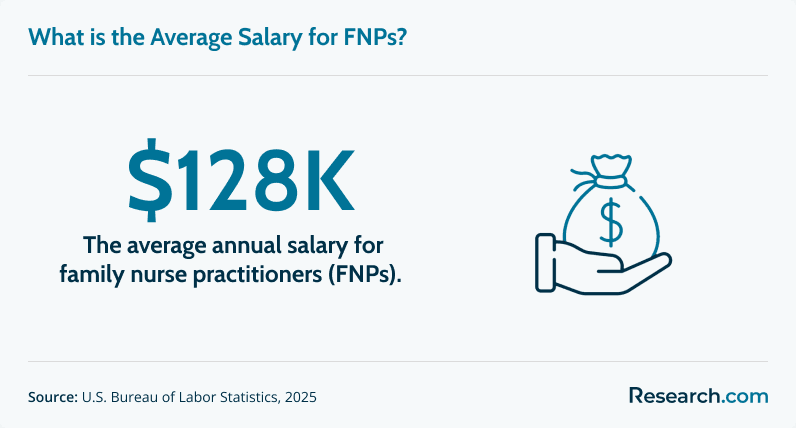
Family nurse practitioners earn about $128,000 per year nationally, but state averages vary widely. California reports the highest average in the state salary table at $173,190, while Tennessee is listed at $108,420. FNPs may earn more in hospitals, high-demand states, specialty clinics, leadership roles, and states with broader practice authority. New FNPs commonly start around $95,000 to $110,000 per year, with higher offers possible in expensive or high-need markets.
| Decision factor | Why it matters for FNP salary |
| State of practice | Pay often reflects local demand, cost of living, employer competition, and scope-of-practice rules. |
| Work setting | Hospitals often pay more than physician offices, but may require more demanding schedules or higher-acuity care. |
| Experience level | FNPs generally see stronger offers as they build clinical confidence, manage larger panels, and take on complex cases. |
| Specialization | Additional expertise in areas such as psychiatry, acute care, pediatrics, cardiology, or women’s health can change earning potential. |
| Total compensation | Benefits, loan repayment, bonuses, relocation support, and continuing education funding can significantly affect the real value of an offer. |
What is the average family nurse practitioner salary in the U.S. by state?
FNP salaries differ from state to state because healthcare labor markets are local. States with higher living costs, larger healthcare systems, provider shortages, or stronger competition for advanced practice clinicians often report higher average pay. Lower-paying states may still offer strong purchasing power if housing and other living expenses are lower.
The table below shows average annual salaries for family nurse practitioners by state using the nurse practitioner salary figures provided in the source data.
| State | Avg Annual Salary |
| Alabama | $109,650 |
| Alaska | $142,340 |
| Arizona | $132,920 |
| Arkansas | $116,030 |
| California | $173,190 |
| Colorado | $121,990 |
| Connecticut | $141,140 |
| Delaware | $130,190 |
| Florida | $128,340 |
| Georgia | $125,490 |
| Hawaii | $135,020 |
| Idaho | $131,380 |
| Illinois | $128,880 |
| Indiana | $126,620 |
| Iowa | $133,020 |
| Kansas | $127,900 |
| Kentucky | $116,930 |
| Louisiana | $124,850 |
| Maine | $127,750 |
| Maryland | $127,100 |
| Massachusetts | $145,140 |
| Michigan | $127,200 |
| Minnesota | $128,120 |
| Mississippi | $122,930 |
| Missouri | $124,600 |
| Montana | $131,560 |
| Nebraska | $127,950 |
| Nevada | $148,670 |
| New Hampshire | $133,660 |
| New Jersey | $140,470 |
| New Mexico | $136,620 |
| New York | $148,410 |
| North Carolina | $124,830 |
| North Dakota | $121,200 |
| Ohio | $121,250 |
| Oklahoma | $127,120 |
| Oregon | $144,600 |
| Pennsylvania | $127,400 |
| Rhode Island | $130,710 |
| South Carolina | $116,240 |
| South Dakota | $122,600 |
| Tennessee | $108,420 |
| Texas | $129,880 |
| Utah | $125,700 |
| Vermont | $129,740 |
| Virginia | $124,210 |
| Washington | $140,220 |
| West Virginia | $121,640 |
| Wisconsin | $128,580 |
| Wyoming | $127,750 |
Use state salary data as a starting point, not a final answer. A high average salary may come with a high cost of living, tougher competition, or heavier workloads. A lower-paying state may still be attractive if it offers lower housing costs, loan repayment options, rural health opportunities, or a better schedule.
It can also help to compare FNP compensation with related advanced nursing roles. For example, reviewing the highest-paying states for gerontology nurse practitioners can show how both location and patient population affect advanced practice pay.
How does the national FNP salary compare to other nurse practitioner specialties?
FNP compensation is strong, but it is not always the highest among nurse practitioner specialties. Family nurse practitioners are trained for broad primary care across the lifespan, which makes the role flexible across clinics, community health, urgent care, retail health, and some hospital-based settings. More specialized tracks may command higher pay when they require narrower expertise, higher acuity, or difficult-to-fill roles.
| Nurse Practitioner Specialty | Average Annual Salary (U.S.) |
| Family Nurse Practitioner (FNP) | $128,000 |
| Psychiatric-Mental Health NP (PMHNP) | $142,000 |
| Acute Care NP | $135,000 |
| Adult-Gerontology NP | $127,000 |
| Pediatric NP | $123,000 |
| Women’s Health NP | $120,00 |
The trade-off is clear: FNPs may earn less than psychiatric-mental health or acute care NPs, but they often have more flexibility in patient populations and employment settings. Nurses who want a broad primary care role may find the FNP pathway more adaptable than a highly specialized track.
For RNs comparing graduate pathways, ADN-to-MSN bridge programs may be relevant if the goal is to move from registered nursing into advanced practice while building toward an FNP role.
| If your priority is... | Consider this path | Why |
| Broad primary care flexibility | Family Nurse Practitioner | FNPs can work with patients across age groups in many outpatient and community settings. |
| Higher specialty compensation | PMHNP or Acute Care NP | These specialties may offer higher average pay, but they require a narrower clinical focus. |
| Children’s health | Pediatric NP | This path is more focused than FNP training and may be better for nurses committed to pediatric populations. |
| Older adult care | Adult-Gerontology NP | This track may fit nurses who want to focus on adult and aging populations rather than the full lifespan. |
What are the highest-paying states for family nurse practitioners?
The highest-paying states for FNPs are often states where living costs are high, healthcare systems are large, demand for providers is strong, or the supply of clinicians is tight. Based on the salary figures in this guide, the top-paying states include California, Nevada, New York, Massachusetts, and Oregon.
High average pay does not automatically mean the best financial outcome. California and New York, for example, may offer stronger salaries, but they also have expensive housing and competitive healthcare labor markets. Nurses who want to enter advanced practice quickly sometimes compare short post-master’s FNP certificate programs, especially if they already hold a graduate nursing degree and need the FNP credential for a new role.
Nevada’s salary profile is shaped by population growth and demand for primary care. Massachusetts and New Jersey benefit from dense healthcare markets, academic medical centers, and specialized clinical networks where advanced practice providers may have more opportunities to move into higher-responsibility positions.
Before relocating for salary alone, compare take-home pay, rent or mortgage costs, commute time, state tax burden, licensure requirements, and whether the employer offers loan repayment or relocation assistance.
Which states have the lowest salaries for FNPs?
The lowest-paying states in the provided salary summary tend to have lower average living costs, more rural markets, and healthcare employers with tighter budgets. That does not mean these states are poor career choices. For some FNPs, they offer lower housing costs, strong community ties, less congestion, and meaningful opportunities to serve areas with limited access to care.
| State | Average Annual Salary |
| Alabama | $109,600 |
| Arkansas | $116,000 |
| Kentucky | $117,000 |
| Mississippi | $123,000 |
| Missouri | $125,000 |
Alabama and Arkansas appear near the bottom of the pay range, but compensation should be weighed against affordability and job fit. Nurses researching 12-month FNP programs should also check whether a program’s clinical placement support, accreditation, and state authorization align with the state where they plan to practice.
Kentucky and Mississippi include many rural communities where healthcare access needs can be substantial, even when salary budgets are more limited. Missouri follows a similar pattern: demand for providers may exist, but salaries may not match those in high-cost coastal states.
The best question is not simply “Which state pays the most?” A better question is “Which state gives me the best mix of salary, cost of living, clinical autonomy, job availability, and quality of life?”
What is the starting salary for entry-level family nurse practitioners?
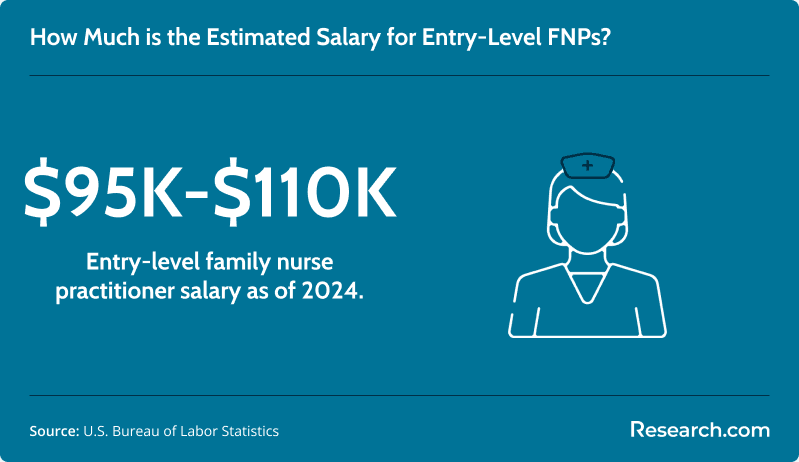
New family nurse practitioners typically start between $95,000 and $110,000 per year, with about $100,000 often used as a national starting point in recent compensation discussions. Entry-level pay depends heavily on geography, employer setting, patient volume, schedule expectations, and whether the organization needs an FNP immediately.
New graduates in higher-cost or high-demand states such as California, New York, or Massachusetts may receive offers closer to the $115,000 family nurse practitioner salary range. In lower-cost or more rural states such as Alabama or Arkansas, starting offers may be closer to $95,000. Outpatient clinics and physician offices may start lower, while hospitals and specialty settings may pay more to fill roles that involve complex care, less predictable schedules, or heavier responsibility.
Entry-level FNPs should evaluate the full compensation package, not just the base salary. Signing bonuses, relocation stipends, health insurance, retirement contributions, continuing education funds, malpractice coverage, paid time off, and student loan repayment assistance can change the real value of an offer. Early-career FNPs who want to increase earning power may also explore a family nurse practitioner specialization once they understand which patient populations and settings fit their goals.
| Offer component | What entry-level FNPs should ask |
| Base salary | Is the offer aligned with local FNP pay, schedule demands, and patient volume? |
| Bonus structure | Are bonuses guaranteed, productivity-based, quality-based, or discretionary? |
| Loan repayment | Does the employer offer repayment support, and what service commitment is required? |
| Clinical support | Will new FNPs receive mentorship, onboarding, and physician or senior NP backup? |
| Malpractice coverage | Is malpractice insurance included, and does it include tail coverage if needed? |
| Continuing education | How much funding and paid time are available for required CE and certification maintenance? |
What is the salary growth potential for FNPs over a 10-year career?
FNP salaries usually increase as clinicians gain experience, build stronger diagnostic judgment, manage more complex patient panels, and become more valuable to employers. New FNPs often begin around $95,000 to $110,000 annually. After several years, many move into the $115,000 to $125,000 range as they become more efficient and clinically independent.
By roughly the 5- to 7-year point, FNPs may see salaries between $125,000 and $135,000, especially if they work in hospitals, specialty clinics, high-demand markets, or roles with leadership expectations. Around the 10-year mark, experienced FNPs may earn $130,000 to $145,000 or more in stronger labor markets or advanced roles.
Salary growth is not automatic. FNPs who stay in the same role without negotiating, adding skills, changing settings, or taking on leadership may see slower increases. Those who pursue specialty expertise, precept students, lead quality-improvement projects, move into management, teach, consult, or practice in high-demand areas may have more ways to grow their income.
Nurses comparing long-term career paths sometimes look beyond FNP roles. For instance, those interested in pediatric primary care may research how to become a CPNP-PC to compare certification requirements, patient populations, and salary trajectories.
The chart below illustrates how FNP earnings may progress across the first decade of practice.
How do state licensing requirements affect FNP salary potential?
Licensing rules matter because they define what FNPs can do and how independently they can practice. In full practice authority states, FNPs can evaluate patients, diagnose conditions, order and interpret tests, and prescribe treatment without physician oversight. Greater autonomy can expand job options, especially in rural clinics, primary care practices, telehealth roles, and independent practice models.
In reduced or restricted practice states, FNPs may need a formal collaborative or supervisory agreement with a physician. These rules can influence employer costs, job structure, negotiation leverage, and the types of roles available. For nurses comparing affordable online FNP programs, state licensing should be part of the ROI calculation because the state where you plan to practice affects both scope and opportunity.
Full practice authority does not guarantee a higher salary for every individual FNP, and restricted authority does not eliminate strong-paying jobs. However, scope-of-practice laws can shape the market in important ways. They affect whether FNPs can own clinics, practice independently, prescribe without extra oversight, and serve areas where physician access is limited.
| Practice environment | Possible salary effect | What to verify |
| Full practice authority | May support broader job options, independent practice, and stronger negotiating power in some markets. | Confirm current state board rules, prescribing authority, and business ownership requirements. |
| Reduced practice | May still offer strong jobs, but collaboration agreements can affect role design and employer costs. | Ask whether the employer provides required physician collaboration and whether any fees apply. |
| Restricted practice | May limit independence and narrow available roles depending on state law and employer policy. | Review supervision requirements before accepting a role or enrolling in a program for that state. |
How does an FNP salary compare to a registered nurse (RN) salary?
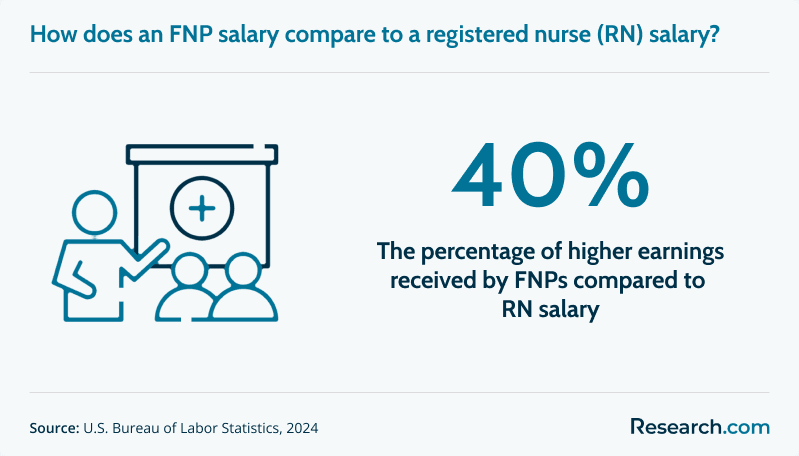
FNPs generally earn more than registered nurses because the role requires graduate-level preparation, national certification, advanced clinical decision-making, and a broader scope of practice. The salary figures in this guide place nurse practitioners, including FNPs, at about $128,000 annually, compared with about $89,000 for registered nurses. That difference is roughly 40% on average.
The pay gap reflects the work. RNs deliver essential bedside and clinical care, coordinate with providers, administer medications, educate patients, and monitor changes in condition. FNPs can assess, diagnose, create treatment plans, and, depending on state law, prescribe medication as nurse practitioners.
In states with full practice authority, FNPs may have greater independence, which can affect career flexibility and earning potential. Still, the move from RN to FNP requires a serious investment: tuition, clinical hours, certification, licensure, and time away from work or family responsibilities.
| Role | Average annual salary noted in this guide | Typical scope difference |
| Registered Nurse | $89,000 | Provides direct nursing care, care coordination, patient education, and clinical monitoring. |
| Family Nurse Practitioner | $128,000 | Assesses, diagnoses, manages treatment plans, and may prescribe depending on state law. |
For many RNs, the FNP path can be financially worthwhile, but only if the program cost, debt level, schedule, clinical placement requirements, and local salary prospects make sense.
Do FNPs earn more in hospitals or private practice?
Hospitals often pay FNPs more than private practices, but the higher salary may come with trade-offs. Salary figures cited in the source content place hospital-employed FNPs at about $130,000–$135,000 annually, while FNPs in physician offices or private practice are closer to $115,000–$120,000. Nurses comparing online RN-to-FNP programs should think ahead about which setting best matches their preferred schedule, stress level, and income goals.
Hospitals may offer higher pay because they involve more complex patients, longer shifts, urgent decision-making, weekends, holidays, or around-the-clock coverage. Private practices and physician offices may pay less at first, but they often provide more predictable hours, stronger continuity with patients, and a more stable work-life rhythm.
| Work setting | Salary pattern | Best fit for FNPs who want... | Possible trade-off |
| Hospital | About $130,000–$135,000 annually | Higher pay, acute care exposure, and complex clinical experience. | Less predictable schedules, heavier workload, and higher stress. |
| Physician office or private practice | About $115,000–$120,000 annually | Continuity of care, regular hours, and closer patient relationships. | Lower base pay in many markets. |
| Independent or ownership path | Varies by state, payer mix, business model, and patient volume. | Autonomy, entrepreneurship, and control over practice design. | Business risk, administrative burden, and regulatory complexity. |
The best setting depends on your priorities. If maximizing early salary is the main goal, hospitals may be attractive. If schedule stability and long-term patient relationships matter more, private practice may be a better fit.
What does the employment outlook mean for FNP salary through 2030?
The employment outlook for nurse practitioners is very strong. The source content cites U.S. Bureau of Labor Statistics data projecting 45% employment growth between 2022 and 2032 for nurse practitioners, nurse anesthetists, and nurse midwives. That growth reflects rising demand for primary care providers, especially as healthcare systems look for ways to expand access in rural, underserved, and high-volume outpatient settings.
Several forces support demand for FNPs: an aging population, chronic disease management needs, preventive care, primary care provider shortages, and growing use of telehealth. The increasing demand for nurse practitioners is especially relevant for FNPs because they are trained to provide broad, front-line care across the lifespan.
Strong job growth can support salary stability, but it does not guarantee high pay in every market. FNPs should still compare local employer demand, state practice authority, payer mix, clinic funding, cost of living, and competition from other advanced practice providers.
What FNPs Say About the Role and Compensation
- : "I chose the FNP path because I wanted long-term relationships with patients, not just brief episodes of care. Taking care of entire families gives the work meaning, and the preventive care side of the role is especially rewarding. The education was demanding, but it prepared me to make decisions with confidence. — Maria"
- : "After years as an RN, becoming an FNP felt like the right professional step. The added independence changed how I practice: I can assess, diagnose, prescribe, and guide the care plan more directly. Patients rely on that judgment, and that responsibility keeps me motivated. — James"
- : "I wanted to stay close to patient care but move away from the physical strain of bedside nursing. The FNP role gave me that option. I still solve clinical problems every day, but I have more autonomy and a broader role in treatment decisions. — Rebecca"
What strategies can FNPs use to optimize their earning potential?
FNPs can improve earning potential by making deliberate choices about education, location, employer type, specialization, and negotiation. The highest salary is not always the best job, but FNPs who understand their market are usually in a stronger position when comparing offers or asking for a raise.
| Strategy | How it can help | What to watch for |
| Negotiate using local salary data | Market-specific evidence can support a stronger offer or raise request. | Do not rely only on national averages; local demand matters. |
| Consider higher-paying settings | Hospitals and specialty clinics may pay more than physician offices. | Higher pay may come with nights, weekends, call, or more complex patients. |
| Add specialty expertise | Focused skills can make an FNP more competitive for higher-paying roles. | Choose specializations that match actual employer demand in your region. |
| Review total compensation | Benefits, bonuses, loan repayment, CME funds, and malpractice coverage add value. | A higher base salary can be less attractive if benefits are weak. |
| Understand state scope-of-practice laws | Practice authority can affect autonomy, role options, and independent practice potential. | Rules vary by state and can change, so verify with the state board of nursing. |
| Keep advancing credentials strategically | Additional education can support advancement when aligned with career goals. | Programs should be accredited, affordable, and relevant to the role you want. |
Some nurses also use bridge or completion programs to strengthen their academic pathway before graduate study. For example, an online RN-to-BSN program may be useful for RNs who need a bachelor’s degree before applying to certain graduate nursing programs.
How to Evaluate Whether Becoming an FNP Is Worth It
The FNP path can offer higher pay, more clinical authority, and broader career options than many RN roles, but it is not the right move for every nurse. The decision should be based on realistic salary expectations, program cost, debt, local job demand, and your preferred type of clinical work.
| Becoming an FNP may make sense if... | You may want another path if... |
| You want to diagnose, manage treatment plans, and take on advanced clinical responsibility. | You prefer bedside nursing and do not want the liability or decision-making burden of provider-level care. |
| Your target market has strong FNP demand and salaries that justify the education cost. | Your local market is saturated or offers salaries that do not support the debt you would take on. |
| You are comfortable with graduate-level coursework and clinical placement requirements. | You cannot currently manage the time, cost, or clinical hour expectations of an FNP program. |
| You want primary care flexibility across age groups. | You already know you want a narrower specialty such as psychiatric-mental health, acute care, or pediatrics. |
| You value more autonomy and long-term career mobility. | You want a role with fewer documentation, diagnostic, and prescribing responsibilities. |
Common Mistakes to Avoid When Comparing FNP Salaries
- Looking only at the highest-paying state. A larger salary may not mean better financial security if housing and living costs are much higher.
- Ignoring scope-of-practice rules. State laws can influence autonomy, job options, prescribing authority, and independent practice opportunities.
- Comparing base salary without benefits. Loan repayment, retirement contributions, paid time off, CME funding, malpractice coverage, and bonuses can change the value of an offer.
- Assuming all FNP programs lead to the same outcomes. Accreditation, clinical placement support, certification pass preparation, and state authorization matter.
- Choosing the fastest or cheapest program without checking fit. A lower-cost program is only a good deal if it prepares you for certification and licensure in the state where you plan to work.
- Not negotiating. Many FNPs accept the first offer without asking about salary range, productivity expectations, onboarding support, or review timelines.
- Overlooking workload. A higher-paying job may involve call, weekends, high patient volume, or complex documentation demands.
Questions to Ask Before Accepting an FNP Job Offer
- What is the base salary, and how was it determined?
- Are there bonuses, productivity incentives, quality incentives, or signing bonuses?
- How many patients will I be expected to see per day?
- Will I have protected administrative time for charting and follow-up?
- Is malpractice insurance included, and does it include tail coverage?
- What onboarding or mentorship is provided for new FNPs?
- Are there call, weekend, holiday, or evening requirements?
- Does the employer pay for continuing education, certification renewal, or professional memberships?
- Is loan repayment or relocation assistance available?
- How soon can compensation be reviewed after hiring?
Key Insights
- Family nurse practitioners earn about $128,000 annually on average, but state-level pay varies substantially.
- California, Nevada, New York, Massachusetts, and Oregon stand out among the highest-paying states in the salary data provided.
- Lower-paying states may still offer strong lifestyle value if cost of living is lower and local demand is steady.
- FNPs often earn more than RNs because they have graduate training, broader clinical authority, and responsibility for diagnosis and treatment planning.
- Hospitals may pay more than private practice, but the trade-off can include higher acuity, less predictable hours, and heavier workloads.
- State practice authority can affect salary potential by shaping autonomy, prescribing rules, collaboration requirements, and independent practice options.
- The strongest salary decisions consider total compensation, not just base pay.
- Before choosing an FNP program or job, verify accreditation, state licensure alignment, clinical placement support, employer expectations, and realistic local salary outcomes.
References:
- American Association of Colleges of Nursing. (n.d.). Nursing fact sheets.
- American Association of Nurse Practitioners Certification Board. (2023). 2023 certification statistics.
- American Association of Nurse Practitioners Certification Board. (2024). AANPCB 2024 certification statistics.
- California Health Care Foundation. (2024). California’s NP workforce: Understanding demographics, education & scope of practice.
- Health Resources and Services Administration, Bureau of Health Workforce. (2024). State of the health workforce report 2024. U.S. Department of Health and Human Services.
- U.S. Bureau of Labor Statistics. (n.d.-a). Nurse anesthetists, nurse midwives, and nurse practitioners. Occupational Outlook Handbook.
- U.S. Bureau of Labor Statistics. (2023). May 2022 national occupational employment and wage estimates, nurse practitioners (SOC 29-1171).
Other Things You Should Know About Family Nurse Practitioner (FNP) Salary by State
In 2027, California offers the highest average salary for family nurse practitioners, with compensation typically exceeding $145,000 annually. This reflects the state's higher cost of living and demand for healthcare services. The competitive salaries are also influenced by California's commitment to attracting and retaining qualified healthcare professionals in a high-demand environment.
Yes. A state with a high gross FNP salary can rank lower after income taxes reduce take-home pay. Comparing state wage data with tax rates and local cost indexes shows whether a larger paycheck actually produces more spending power for family nurse practitioners in 2027.


