
2027 Cheapest Online PsyD Programs

Co-Founder and Chief Data Scientist
Choosing an online PsyD program is not just a question of tuition or convenience. For many students, the bigger decision is whether a program can support licensure goals, provide enough supervised clinical training, fit around work or family responsibilities, and justify the financial commitment. This guide is for prospective doctoral psychology students comparing affordable online and hybrid PsyD options, including programs that are fully clinical, non-licensure, organizational, faith-based, or technically PhD programs rather than PsyD programs.
You will learn how online PsyD programs work, what they typically cost, how long they take, what accreditation means for licensure, which programs are listed as lower-cost options for 2027, and what questions to ask before enrolling. The goal is to help you avoid expensive mistakes and choose a program that matches your career plan.
Quick answer: Are online PsyD programs worth considering?
Online PsyD programs can be worth considering if you need flexibility and can verify that the program meets your state’s clinical training and licensure requirements. However, not every online PsyD is designed for clinical psychologist licensure. Some programs focus on organizational psychology, general psychology, research, ministry, or nonclinical careers. Before applying, confirm the program’s accreditation status, practicum and internship requirements, residency expectations, total cost, and whether graduates are eligible to pursue licensure in your state.
What are the benefits of getting an online PsyD degree?
An online or hybrid PsyD can make doctoral study more realistic for working adults, caregivers, military-connected students, and learners who cannot relocate. The main advantages include:
- Schedule flexibility: Online coursework may allow students to complete lectures, discussions, and assignments around employment or family responsibilities.
- Broader school options: Students are not limited only to programs within commuting distance, although clinical placements may still need to be completed locally.
- Reduced relocation and commuting costs: Even when tuition is high, avoiding a move can lower indirect expenses.
- Technology-supported learning: Many programs use virtual case discussions, online libraries, simulation tools, and telehealth-style training activities.
- Access for nontraditional learners: Students who are returning to school after years in the workforce may find online delivery easier to manage than a fully campus-based schedule.
The trade-off is that online PsyD students must be highly organized. They also need to be proactive about finding clinical placements, building faculty relationships, and checking licensure rules early.
What can I expect from an online PsyD degree?
An online PsyD usually combines remote doctoral coursework with supervised in-person clinical experiences, though the exact structure depends on whether the program is clinical, nonclinical, hybrid, or licensure-oriented. Students should expect demanding coursework, structured assessment of clinical competencies, practicum or internship requirements when applicable, and significant independent study.
- Doctoral-level psychology coursework: Programs commonly cover psychological theory, ethics, research methods, psychopathology, assessment, intervention, and diversity in clinical practice.
- Online course delivery: Classes may use recorded lectures, live seminars, online discussion boards, digital assessments, virtual case studies, and faculty feedback through learning platforms.
- Clinical training requirements: Licensure-focused programs typically require supervised practicum and internship experiences. These may be arranged in the student’s local area, but students should confirm how much support the school provides.
- Residencies or intensives: Many online PsyD programs are not entirely online. Some require face-to-face residencies for skills training, assessment practice, supervision, or professional development.
- Specialized study: Depending on the school, students may focus on areas such as child and adolescent psychology, forensic psychology, health psychology, organizational psychology, trauma, or sport and performance psychology.
- Professional preparation: Strong programs help students prepare for ethical practice, supervised clinical work, documentation, consultation, telehealth, and postdoctoral career planning.
Where can I work with an online PsyD degree?
Career options depend heavily on the program type and licensure outcome. A PsyD designed for clinical licensure can support careers in therapy, assessment, consultation, and behavioral health. A non-licensure PsyD or psychology PhD may be better suited for research, teaching, leadership, organizational consulting, or applied psychology roles.
| Work setting | Typical role fit | Important licensure note |
| Private practice | Therapy, assessment, consultation, and treatment planning for individuals, couples, or families | Usually requires state licensure as a psychologist |
| Hospitals and clinics | Behavioral health assessment, integrated care, crisis intervention, and treatment support | Clinical psychologist roles generally require licensure |
| Community mental health centers | Services for children, adults, families, and underserved populations | Licensure or supervised licensure-track status is commonly required |
| Schools and universities | Student support, teaching, counseling-related services, or academic roles | School-based roles may require separate credentials depending on the state and job title |
| Government agencies | Correctional, veterans, public health, or public safety psychology services | Licensure requirements vary by agency and position |
| Forensic and legal settings | Evaluations, consultation, correctional services, or court-related work | Clinical and forensic practice roles often require licensure and specialized training |
| Business and industry | Organizational development, executive coaching, training, leadership, and workplace behavior analysis | Organizational roles may not require psychologist licensure, but titles are regulated in many states |
How much can I make with an online PsyD degree?
Earnings vary by job title, specialization, location, licensure status, employer, and experience. The original salary data cited in this guide shows these general ranges and examples:
- Early Career Psychologist: $70,000 - $90,000 per year
- Licensed Clinical Psychologist: $80,000 - $120,000 per year
- Experienced Psychologist with Specialization: $100,000 - $150,000+ per year
Salary.com data cited below reports that clinical health psychologists earn an average of $125,893 per year, while clinical licensed psychologists with a Ph.D. earn an average of $132,100 per year. Clinical psychologists earn an average of $101,320 per year. Counseling psychologists also average $101,320 per year. Licensed clinical psychologists earn an average of $95,529 per year, and psychologists with a Ph.D. earn an average of $119,718 per year. Location can change outcomes: clinical psychologists in Los Angeles, CA earn an average of $112,871 per year, while those in Dallas, TX earn an average of $99,751 per year. The highest average salary cited for a psychologist with a Ph.D. is in New York, NY, at $139,831 per year.
These figures should be used as benchmarks, not guarantees. Licensure, supervised hours, specialization, payer mix, employer type, and local demand all affect actual compensation.
- Cheapest Online PsyD Programs for 2027
- How long does it take to complete an online PsyD degree program?
- How does an online PsyD degree compare to an on-campus program?
- What is the average cost of a PsyD degree program?
- What are the financial aid options for students enrolling in a PsyD degree program?
- What are the prerequisites for enrolling in a PsyD degree program?
- What courses are typically in a PsyD degree program?
- What types of specializations are available in PsyD degree programs?
- How does one choose the best PsyD degree program?
- What career paths are available for graduates of PsyD degree programs?
- What is the job market for graduates with a PsyD degree?
- What Should You Know About Accelerated PsyD Programs?
- How can you verify the accreditation and quality of your online PsyD program?
- What student support and digital resources are available in online PsyD programs?
- What challenges do online PsyD programs present and how can they be managed?
- How do online PsyD programs foster professional networking and mentorship?
- How can I maximize career advancement and earnings with an online PsyD?
- Should I pursue complementary credentials alongside my online PsyD degree?
- Can I combine my online PsyD with another degree?
- How do online PsyD programs ensure robust clinical training?
- Can online PsyD programs adequately prepare me for telehealth practice?
Cheapest Online PsyD Programs for 2027
How do we rank schools?
Because doctoral psychology programs can be expensive and licensure-sensitive, affordability alone is not enough. Research.com reviews program and institutional information using established education data sources, including:
- the IPEDS database
- Peterson's database, including its Distance Learning Licensed Data Set
- the College Scorecard database, and
- the National Center for Education Statistics.
The list below highlights lower-cost online or hybrid doctoral psychology options for 2027. Read the program notes carefully: several entries are not traditional licensure-focused online PsyD programs, and some are PhD or nonclinical doctoral psychology programs.
| School | Degree or program type | Stated length | Licensure caution |
| University of Arizona Global Campus | Online PsyD | 4 years (48 months) | Not designed as a licensure track; not APA-accredited |
| Capella University | Online PsyD in Clinical Psychology | 4-5 years | Not APA-accredited or CACREP-accredited; licensure eligibility is not guaranteed |
| Fielding Graduate University | Online PhD in Clinical Psychology, not a PsyD | 5-6 years (minimum 5 years) | Clinical Psychology PhD program is APA-accredited |
| Grand Canyon University | PhD in General Psychology with an Emphasis in Cognition and Instruction | 7-year limit | Not intended to meet licensure, certification, or clinician requirements |
| Keiser University | PhD in Psychology | 3-5 years | Review current program licensure disclosures before enrolling |
| National University | PhD in Psychology | 48 months (4 years) | Research-focused doctoral pathway; check specialization and licensure alignment |
| Saybrook University | Ph.D. in Clinical Psychology | 5-6 years | Program does not have APA programmatic accreditation |
| Sofia University | PsyD in Clinical Psychology | 5-6 years | Coursework supports California Psychology License preparation, but licensure is not guaranteed |
| Southern California Seminary | PsyD | 5-6 years | Program itself is not mentioned as having APA accreditation |
| Touro University Worldwide | PsyD in Human and Organizational Psychology | 2.5 to 3.5 years | Does not lead to any form of licensure or certification |
1. University of Arizona Global Campus
The University of Arizona Global Campus offers an online PsyD that emphasizes psychological theory, research methods, ethics, leadership, and cultural competency. Students can choose from tracks related to Clinical Psychology, Criminology and justice studies, Health and wellness psychology, and Sport and performance psychology. This option may appeal to students seeking advanced psychology knowledge in a flexible format, but it is important to understand the licensure limitation: this PsyD is not designed as a licensure track, and additional steps would be required for students who want to become licensed clinical psychologists in different states.
- Program Length: 4 years (48 months)
- Tracks/Concentrations: Clinical Psychology, Criminology and justice studies, Health and wellness psychology, Sport and performance psychology
- Tuition Cost: $14,616 (Pre-Dissertation/Applied Doctoral Project Phase)
- Required Credits to Graduate: Not specified
- Accreditation: WASC Senior College and University Commission (WSCUC); not APA-accredited
2. Capella University
Capella University offers an online PsyD in Clinical Psychology that includes online coursework, face-to-face residencies, and clinical training requirements. The program uses a scholar-practitioner approach and covers topics such as ethics, multicultural practice, clinical interviewing, psychopathology, assessment, and intervention. Students complete a minimum of 1,000 practicum hours and 2,000 pre-doctoral internship hours, along with 145 quarter credits. However, the program is not accredited by the American Psychological Association (APA) or the Council for Accreditation of Counseling and Related Educational Programs (CACREP), and Capella University cannot guarantee licensure or credentialing after graduation.
- Program Length: 4-5 years
- Tracks/Concentrations: Clinical Psychology, Child and Adolescent Psychology, Forensic Psychology, Health Psychology
- Tuition Cost: Not specified
- Required Credits to Graduate: minimum of 1,000 practicum hours and 2,000 pre-doctoral internship hours; 145 quarter credits
- Accreditation: Higher Learning Commission (HLC)
3. Fielding Graduate University
Fielding Graduate University is included because it offers a distributed-learning PhD in Clinical Psychology, not a PsyD program. This program is designed for working professionals and is accredited by the American Psychological Association (APA). Students study psychology foundations, statistics, research methods, and clinical practice while completing a year-long clinical internship and a minimum of 1,520 hours of clinical practicum. Fielding also requires in-person learning experiences, including a week-long New Student Orientation and professional development seminars. It may be a strong option for students who want an APA-accredited clinical psychology doctorate in a flexible format but are open to a PhD rather than a PsyD.
- Program Length: 5-6 years (minimum 5 years)
- Tracks/Concentrations: Clinical Psychology, Forensic Psychology, Health Psychology, Neuropsychology, Social Justice and Diversity
- Tuition Cost: $10,180 per term
- Required Credits to Graduate: 179; year-long clinical internship and a minimum of 1,520 hours of clinical practicum
- Accreditation: WASC Senior College and University Commission (WSCUC); The Clinical Psychology PhD program is accredited by the American Psychological Association (APA)
4. Grand Canyon University
Grand Canyon University offers a Doctor of Philosophy (PhD) in General Psychology with an Emphasis in Cognition and Instruction. The program focuses on quantitative methodology, cognition, instruction, cognitive science, and social cognition. It is intended for professionals interested in research, education, consulting, or applied psychology rather than clinical practice. Students should note that this doctoral program at GCU is not intended to meet any state requirements for licensure, certification, or work as a clinician.
- Program Length: 7-year limit
- Tracks/Concentrations: General Psychology
- Tuition Cost: $8,880/year
- Required Credits to Graduate: 60 credits
- Accreditation: Higher Learning Commission (HLC)
5. Keiser University
The Keiser University Doctor of Philosophy (PhD) in Psychology is structured for students seeking advanced preparation in research, academia, and applied psychology fields. The program emphasizes scholarship, research design, data analysis, and the study of cognition, learning, behavior, and social psychology. Keiser University offers online and on-campus options, which may help students select a format that fits their schedule. Prospective students should verify current program requirements and career alignment directly with the university.
- Program Length: 3-5 years
- Tracks/Concentrations: Not specified
- Tuition Cost: Not specified
- Required Credits to Graduate: 60 credits; year-long clinical internship and a minimum of 1,520 hours of clinical practicum.
- Accreditation: Southern Association of Colleges and Schools Commission on Colleges (SACSCOC)
6. National University
National University offers a Doctor of Philosophy (PhD) in Psychology for students who want doctoral-level study beyond the master’s level. The program emphasizes theory, research, scholarship, and dissertation development. Students may enter through a Direct Entry option with a master’s degree in psychology or a related field, or through an Evaluation Track with a master’s degree in another discipline. Specialization options include Addictions, Health Psychology, General Psychology, Mental Health Policy & Practice, Gerontology, Trauma & Disaster Relief, Gender Diversity Studies, and Industrial/Organizational Psychology.
- Program Length: 48 months (4 years)
- Tracks/Concentrations: Addictions, Health Psychology, General Psychology, Mental Health Policy & Practice, Gerontology, Trauma & Disaster Relief, Gender Diversity Studies, Industrial/Organizational Psychology
- Tuition Cost: Not specified
- Required Credits to Graduate: 60 credit hours (20 courses)
- Accreditation: WASC Senior College and University Commission (WSCUC)
7. Saybrook University
Saybrook University offers a Ph.D. in Clinical Psychology with a humanistic orientation. The curriculum includes clinical training and integrates approaches such as cognitive behavioral therapy (CBT), mindfulness, and spiritual awareness. The university is accredited by the WASC Senior College and University Commission (WSCUC), but the Ph.D. in Clinical Psychology program does not have programmatic accreditation from the American Psychological Association (APA). This may affect licensure pathways, including possible year-in-residence requirements in some states. Students should contact their state licensing board before enrolling.
- Program Length: 5-6 years
- Tracks/Concentrations: Clinical Psychology, Consciousness, Spirituality, and Integrative Health, Creativity, Innovation, and Leadership, Existential and Humanistic Psychology, Psychophysiology
- Tuition Cost: Not specified
- Required Credits to Graduate: 60-75
- Accreditation: WASC Senior College and University Commission (WSCUC); The Ph.D. in Clinical Psychology program does not have programmatic accreditation by the American Psychological Association (APA)
8. Sofia University
The Sofia University Doctor of Psychology (PsyD) in Clinical Psychology combines clinical psychology theory, practice, research, humanistic psychology, positive psychology, and spiritual concepts. Students study human behavior, psychopathology, psychotherapy, assessment, and research methods while completing clinical practicum experiences and a dissertation. The program provides the necessary coursework for the California Psychology License, but licensure is ultimately determined by the California Board of Psychology and is not guaranteed after graduation.
- Program Length: 5-6 years
- Tracks/Concentrations: Not specified
- Tuition Cost: Not specified
- Required Credits to Graduate: 120; 1,500 hours of Internship; passing the Clinical Competency Exam (CCE)
- Accreditation: WASC Senior College and University Commission (WSCUC)
9. Southern California Seminary
Southern California Seminary offers a Doctor of Psychology program with a biblically based curriculum that integrates psychology and theology. Students may choose from Psychology, Educational Psychology, International / Multicultural Psychology, and Industrial / Organizational Psychology emphases. The program includes advanced psychology courses, biblical integration, research training, and dissertation requirements. It may fit students seeking ministry-related counseling preparation or faith-integrated psychology study, but students pursuing psychologist licensure should verify whether the program meets their state’s requirements.
- Program Length: 5-6 years
- Tracks/Concentrations: Psychology (no emphasis), Educational Psychology, International / Multicultural Psychology, Industrial / Organizational Psychology
- Tuition Cost: $878 per unit (same for in-state and out-of-state)
- Required Credits to Graduate: 78; minimum of 45 units of advanced psychology courses, biblical integration, and dissertation requirements with a minimum 3.0 GPA.
- Accreditation: WASC Senior College and University Commission (WSCUC); The program itself is not mentioned as having APA accreditation.
10. Touro University Worldwide
Touro University Worldwide offers a 100% online Doctor of Psychology (PsyD) in Human and Organizational Psychology. The program focuses on workplace behavior, organizational development, productivity, executive coaching, training, and applied research. It can be a practical option for professionals interested in organizational psychology rather than clinical practice. Students should be clear about one major limitation: the degree does not lead to any form of licensure or certification.
- Program Length: 2.5 to 3.5 years
- Tracks/Concentrations: Human and Organizational Psychology
- Tuition Cost: $700 per semester credit unit
- Required Credits to Graduate: 66 credits
- Accreditation: WASC Senior College and University Commission (WSCUC)
How long does it take to complete an online PsyD degree program?
Most online PsyD programs take between 4 and 6 years to complete, though timelines vary based on enrollment pace, transfer credits, dissertation or applied doctoral project requirements, practicum availability, internship placement, and residency requirements.
| Program pace | Typical timeline | Best for | Trade-off |
| Traditional full-time | 4 to 6 years | Students who can prioritize doctoral study and clinical training | May require reduced work hours |
| Accelerated | As little as 2.5 to 3 years in some programs | Students with strong preparation and availability for an intensive schedule | Less time for electives, networking, and placement flexibility |
| Part-time | Longer than the standard program timeline | Working adults, caregivers, and students balancing multiple obligations | May extend total cost and delay licensure progress |
Students considering licensure should focus not only on speed but also on whether the timeline includes enough supervised clinical training to satisfy state requirements.
How does an online PsyD degree compare to an on-campus program?
Online and campus-based PsyD programs may cover similar academic content, but they differ in how students build clinical relationships, complete supervision, access campus resources, and manage daily learning. The better option depends on your learning style, location, licensure state, and need for flexibility.
| Factor | Online or hybrid PsyD | On-campus PsyD |
| Flexibility | Usually better for students working or managing family responsibilities | More fixed schedules and location-based attendance |
| Clinical training | May require local placements, residencies, and remote coordination | Often has stronger nearby practicum networks tied to the campus |
| Faculty access | Depends on virtual advising, office hours, and responsiveness | More informal face-to-face contact may be available |
| Cost considerations | May reduce commuting or relocation costs; tuition varies widely | May include higher living or relocation costs depending on location |
| Networking | Requires intentional participation in online communities, residencies, and professional groups | Campus events and local clinical networks may be easier to access |
| Best fit | Self-directed learners who need flexibility and can manage placement logistics | Students who prefer in-person instruction, structured community, and local faculty access |
What is the average cost of a PsyD degree program?
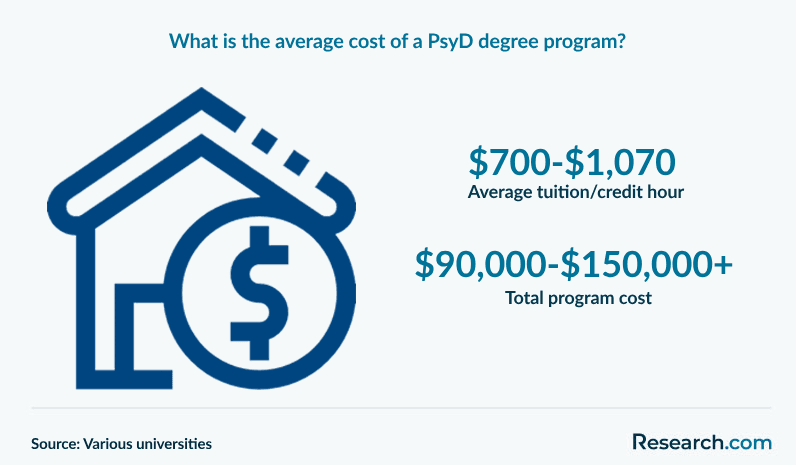
The cost of a PsyD can vary widely. The average tuition for a PsyD program ranges from $700 to $1,070 per credit hour, and the total program cost can range from roughly $90,000 to $150,000 or more. Students comparing PsyD programs with the cheapest online PhD psychology programs should compare the full cost of attendance, not just the listed tuition rate.
- Tuition: Per-credit costs and total required credits are the biggest direct expenses.
- Residency travel: Hybrid programs may require travel, lodging, meals, and time away from work.
- Books and materials: Assessment courses and clinical training may involve specialized resources.
- Technology fees: Online platforms, secure systems, and software may add recurring costs.
- Clinical placement expenses: Background checks, liability insurance, transportation, and documentation fees may apply.
- Opportunity cost: Reduced work hours during practicum or internship can affect your budget.
Online delivery can lower some indirect costs, but it does not automatically make a program inexpensive. Ask each school for a written estimate of total program cost through graduation.
What are the financial aid options for students enrolling in a PsyD degree program?
Graduate psychology students may use several funding sources, but aid availability varies by school, enrollment status, accreditation, and program eligibility. Students should begin with the school’s financial aid office and confirm whether the program participates in federal aid programs.
- Federal Student Loans: Eligible students may borrow through the U.S. Department of Education.
- Private Student Loans: Banks, credit unions, and private lenders may offer graduate loans, often with different credit and repayment terms.
- Scholarships: Psychology associations, community foundations, employers, and universities may offer awards for graduate psychology students.
- Grants: Some grants are need-based and do not require repayment.
- Assistantships: Certain universities offer teaching or research assistantships that may include tuition support and a stipend.
Before borrowing, compare projected monthly payments with realistic post-graduation earnings. A lower-cost program that does not support your licensure goal may be a poor investment, while a more expensive program may still be difficult to justify if debt is too high.
Salary outcomes after a PsyD depend on job responsibilities, licensure, employer, specialization, experience, and location. Salary.com figures cited in this guide include clinical health psychologists at an average of $125,893 per year and clinical licensed psychologists with a Ph.D. at an average of $132,100 per year. Clinical psychologists and counseling psychologists are both cited at an average of $101,320 per year, while licensed clinical psychologists average $95,529 per year. Psychologists with a Ph.D. average $119,718 per year, with the highest average cited in New York, NY, at $139,831 per year.
Use salary data as one part of an ROI calculation. Also consider licensing timelines, local demand, expected loan debt, and whether your chosen program qualifies you for your intended role.
What are the prerequisites for enrolling in a PsyD degree program?
Admissions requirements differ by school, but most PsyD programs look for evidence that applicants can handle doctoral-level psychology study and clinical training.
- Bachelor's Degree: Applicants usually need a bachelor’s degree from an accredited institution.
- Relevant academic background: A psychology major is often preferred, but some programs accept related fields.
- Master's degree: Many programs require or prefer a graduate degree. Students who need this step can compare affordable online Master's programs in Psychology.
- GPA: Many programs list a minimum GPA, commonly around 3.0.
- GRE Scores: Some schools require, recommend, or waive GRE scores depending on policy.
- Letters of Recommendation: Faculty, supervisors, or clinical professionals may be asked to speak to your readiness.
- Personal Statement: Applicants typically explain their clinical interests, career goals, and fit with the program.
- Graduate certificates: Some students use online psychology certificate programs to strengthen academic preparation or demonstrate focus.
What courses are typically in a PsyD degree program?
PsyD curricula usually combine scientific foundations, professional ethics, clinical assessment, intervention methods, supervised practice, and a dissertation or doctoral project. Requirements vary by school, and even the cheapest online doctorate in psychology programs may include capstone, thesis, residency, or clinical practice requirements.
Core psychology foundations
- Biological Bases of Behavior: Study of how brain systems and biological processes relate to behavior.
- Cognitive Psychology: Examination of attention, memory, reasoning, decision-making, and problem-solving.
- Developmental Psychology: Human development from childhood through later adulthood.
- Social Psychology: How social environments influence attitudes, identity, behavior, and relationships.
- Psychopathology: Classification, diagnosis, and treatment concepts for mental disorders.
- Statistics and Research Methods: Research design, data interpretation, and evidence evaluation.
- Ethical and Professional Issues: Professional conduct, confidentiality, boundaries, documentation, and legal responsibilities.
Clinical and applied courses
- Psychological Assessment: Administration, scoring, interpretation, and communication of assessment results.
- Psychotherapy: Major therapy models and intervention techniques.
- Intervention and Treatment Planning: Development of evidence-informed treatment plans and progress monitoring.
- Diversity and Cultural Competence: Practice with clients across cultures, identities, and life experiences.
- Supervision and Consultation: Skills for working with supervisees, teams, schools, agencies, or organizations.
Common electives and focus areas
- Adult Development and Aging: Psychological changes, needs, and challenges in adulthood and later life.
- Group Psychotherapy: Group process, leadership, therapeutic factors, and group interventions.
- Psychopharmacology: How medications relate to mental health treatment and psychotherapy collaboration.
- Community Psychology: Mental health within community, prevention, and social systems contexts.
- Behavioral Medicine: Psychological factors in illness, health behavior, and medical care.
- Cross-Cultural Psychology: Psychological similarities and differences across cultural groups.
- Gender and Sexuality: Gender identity, sexual orientation, relationships, and affirming care.
- Family Therapy: Family systems, communication, conflict, and relational interventions.
- Organizational Development and Leadership: Workplace behavior, leadership, and organizational change.
- Quantitative and Qualitative Research Methods: Advanced research approaches for dissertation or applied scholarship.
- Child and Adolescent Psychology: Assessment and treatment for children and teens.
- Forensic Psychology: Psychology in legal and criminal justice contexts. Students focused on this field may also compare affordable graduate programs in forensic psychology.
- Health Psychology: Mental and behavioral factors affecting physical health and wellness.
- Neuropsychology: Cognitive and behavioral functioning related to brain injury or disease.
- Trauma Psychology: Assessment and treatment of trauma-related symptoms and experiences.
According to the Bureau of Labor Statistics in 2024, the top industries employing clinical and counseling psychologists in 2023 were offices of other health practitioners, with 28,960 positions; outpatient care centers, with 7,430 positions; offices of physicians, with 6,720 positions; individual and family services, with 6,560 positions; and general medical and surgical hospitals, with 4,220 positions.
This employment pattern shows why clinical training in healthcare, outpatient, and community-based settings can be especially valuable for PsyD students.
What types of specializations are available in PsyD degree programs?
Specializations help students align doctoral training with the clients, settings, and problems they want to address. Availability varies by school, and the cheapest online PsyD programs may not offer every specialty.
- Clinical Child and Adolescent Psychology: Assessment and intervention for children, teens, and families.
- Clinical Health Psychology: Psychological care related to illness, health behavior, and medical treatment.
- Clinical Neuropsychology: Evaluation of cognitive and behavioral changes related to neurological conditions.
- Clinical Geropsychology: Mental health services for older adults.
- Forensic Psychology: Psychological assessment and consultation in legal settings.
- Police and Public Safety Psychology: Services involving law enforcement, public safety personnel, and community needs.
- Industrial and Organizational Psychology: Workplace behavior, employee selection, training, motivation, and organizational systems.
- Sport and Performance Psychology: Mental skills and performance enhancement for athletes and performers.
- School Psychology: Academic, behavioral, social, and emotional support in school settings.
- Counseling Psychology: Counseling and psychotherapy for individuals, couples, groups, and families.
- Family Psychology: Relationship and family-system assessment and intervention.
- Rehabilitation Psychology: Support for people adapting to disability, illness, or injury.
- Trauma Psychology: Treatment and assessment for trauma-related concerns.
- Addiction Psychology: Substance use and behavioral addiction assessment and treatment.
- Clinical Psychology: Broad preparation for assessment, diagnosis, treatment, and consultation.
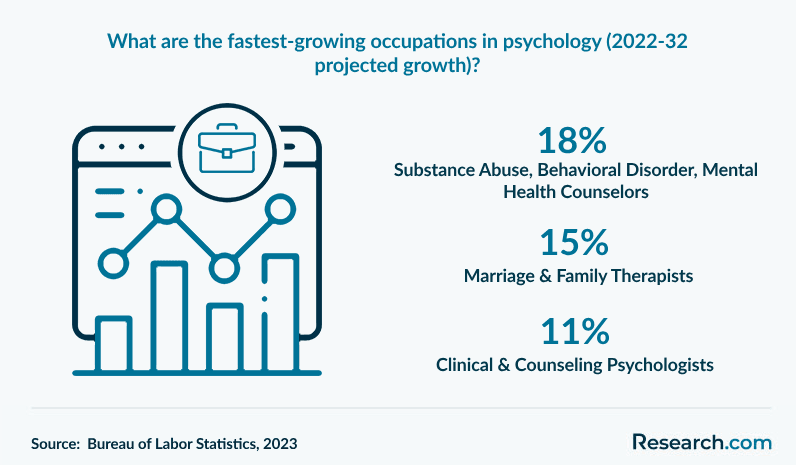
The field includes several growing career paths. Substance Abuse, Behavioral Disorder, and Mental Health Counselors are projected to grow by 18% between 2022 and 2032. Marriage and Family Therapists are projected to grow by 15% during the same period. Clinical and Counseling Psychologists can expect an 11% increase in demand, Industrial-Organizational Psychologists have a projected growth rate of 6%, and Psychiatric Technicians are expected to see a 9.7% increase in employment opportunities.
How does one choose the best PsyD degree program?
The best PsyD program is the one that fits your licensure goal, training needs, budget, learning style, and desired career setting. Rankings can help you begin a search, but they should not replace direct verification with schools and state licensing boards.
| Decision factor | What to verify | Why it matters |
| Accreditation | Institutional accreditation and, for clinical psychology, whether the program is APA-accredited or accredited by the Psychological Clinical Science Accreditation System (PCSAS) | Accreditation can affect licensure, internships, employment, and transferability |
| Licensure alignment | Whether the program meets requirements in the state where you plan to practice | State rules vary, and graduation alone does not guarantee licensure |
| Clinical training | Practicum hours, internship process, placement support, supervision model, and residency requirements | Clinical competence depends on supervised experience, not only coursework |
| Faculty fit | Faculty expertise, research interests, clinical background, and mentorship availability | Strong mentorship can shape placements, dissertation work, and career direction |
| Total cost | Tuition, fees, travel, books, technology, clinical expenses, and lost income | A cheaper tuition rate may not mean a lower total cost |
| Student outcomes | Graduation rates, internship match information, licensure exam results, and alumni roles when available | Outcomes help you assess program quality and risk |
| Online support | Advising, career services, library access, technical support, writing support, and mental health resources | Online doctoral students need strong remote infrastructure |
Questions to ask before enrolling
- Is this program designed to lead to psychologist licensure in my state?
- Is the clinical psychology program APA-accredited, PCSAS-accredited, or neither?
- How many practicum and internship hours are required?
- Does the school place students in clinical sites, or must students find their own?
- How many in-person residencies are required, and what do they cost?
- What percentage of students complete the program?
- What support is available if I cannot secure a practicum or internship placement?
- What is the total estimated cost through graduation?
- Can I speak with current students or recent alumni?
- What careers do graduates actually enter?
What career paths are available for graduates of PsyD degree programs?
PsyD graduates may work in clinical, educational, organizational, forensic, healthcare, research, or consulting roles. The right path depends on specialization, licensure, supervised experience, and state regulations.
- Clinical Psychologist: Assess, diagnose, and treat mental health disorders in private practice, hospitals, clinics, or community settings.
- Counseling Psychologist: Provide psychotherapy and counseling for individuals, couples, families, and groups.
- School Psychologist: Support student learning, behavior, and mental health in educational environments.
- Neuropsychologist: Evaluate cognitive and behavioral functioning related to brain injury, disease, or neurological conditions.
- Health Psychologist: Work with medical teams and patients on behavior, illness management, and health outcomes.
- Forensic Psychologist: Apply psychological expertise in courts, corrections, law enforcement, or legal consultation.
- Industrial/Organizational Psychologist: Improve employee selection, training, leadership, motivation, and workplace systems.
- Sport Psychologist: Help athletes and performers improve mental skills and performance readiness.
- Rehabilitation Psychologist: Support people adapting to disability, injury, or chronic health conditions.
- Military Psychologist: Serve military personnel and families in clinical or operational contexts.
- Professor: Teach psychology courses at colleges or universities.
- Researcher: Conduct studies in academic, healthcare, government, or organizational settings.
- Consultant: Advise organizations, agencies, teams, or individuals on psychology-related issues.
- Program Director: Lead behavioral health, community, educational, or organizational programs.
- Advocate: Support mental health policy, community programs, and access to care.
What is the job market for graduates with a PsyD degree?
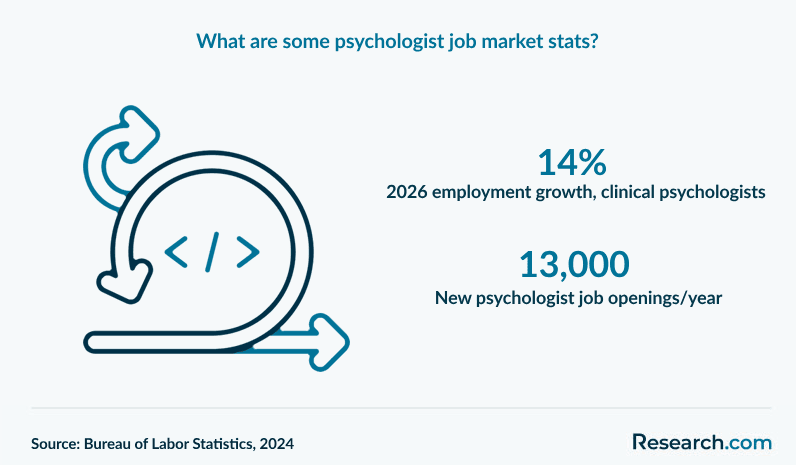
The job market for PsyD graduates is strongest for students who graduate from programs aligned with licensure requirements, complete supervised training successfully, and build skills in settings with demand. The original labor-market data cited in this guide reports that the U.S. Bureau of Labor Statistics projects a 14% increase in employment of clinical, counseling, and school psychologists from 2021 to 2031. It also notes that the Bureau of Labor Statistics predicts a 14% increase in demand for these professionals by 2026. In addition, substance abuse, behavioral disorder, and mental health counseling is anticipated to add 71,500 jobs between 2022 and 2032, ranking it as the 27th fastest-growing occupation in the US.
- Demand drivers: More attention to mental health, integrated healthcare, aging populations, and community-based behavioral services can support demand.
- Competition: Desirable clinical placements, internships, postdoctoral positions, and specialty roles may be competitive.
- Location matters: Hiring conditions differ across states, cities, rural regions, and healthcare systems.
- Specialization can help: Health psychology, neuropsychology, trauma, child and adolescent services, and integrated care may improve positioning when matched with local need.
- Licensure is central: Many clinical psychologist roles require state licensure, and program choice can affect eligibility.
Graduates with strong clinical documentation skills, supervision experience, telehealth familiarity, cultural competence, and specialty training are generally better positioned than those who rely on the degree title alone.
What Should You Know About Accelerated PsyD Programs?
Accelerated PsyD programs compress the doctoral timeline and may appeal to students who want to move through coursework quickly. They can be useful for highly prepared learners with strong time management, stable schedules, and clear career goals. However, faster is not always better in clinical psychology. Students must confirm that the accelerated format still includes appropriate practicum, internship, supervision, residency, and licensure preparation. If you are comparing shorter options, review accelerated PsyD programs with special attention to clinical training quality.
How can you verify the accreditation and quality of your online PsyD program?
Verification should happen before you apply, not after admission. Start by checking institutional accreditation, then confirm whether the specific clinical psychology program has programmatic accreditation when needed. Compare the school’s claims with state licensing board requirements and independent program documentation. Rankings and overviews of PsyD online programs can help you create a shortlist, but final verification should come from official sources.
- Search the accreditor’s website instead of relying only on the school’s marketing page.
- Ask the program for written licensure disclosures for your state.
- Review practicum and internship placement expectations.
- Request student outcome data when available, including graduation and licensure exam information.
- Confirm whether required residencies affect your work schedule and budget.
What student support and digital resources are available in online PsyD programs?
High-quality online doctoral programs should provide more than recorded lectures. Students should look for academic advising, clinical placement guidance, writing support, library access, research databases, technical support, career services, faculty office hours, and peer-learning opportunities. When comparing online psychology doctorate programs, ask whether services are available during evenings or weekends if you work full time.
What challenges do online PsyD programs present and how can they be managed?
Online PsyD students often face three practical challenges: managing doctoral coursework independently, coordinating local clinical training, and staying connected to faculty and peers. Technology problems, time-zone differences, and limited in-person contact can also create friction. Students comparing affordable pathways, including cheap online schools for working adults, should make sure flexibility does not come at the expense of clinical support.
| Common challenge | Why it matters | How to manage it |
| Finding clinical placements | Placements are essential for licensure-focused training | Ask whether the program arranges sites or only approves student-found placements |
| Isolation | Doctoral programs require feedback, mentorship, and professional identity development | Join cohorts, attend residencies, participate in supervision groups, and use faculty office hours |
| Time management | Coursework, clinical hours, and dissertation work can overlap | Create a multi-year plan before enrolling and reduce outside commitments during clinical phases |
| Licensure confusion | State rules vary and can change | Contact the state board directly and save written guidance |
| Hidden costs | Residencies, assessments, travel, and fees can raise total cost | Request a full cost breakdown and budget for unpaid or low-paid clinical time |
How do online PsyD programs foster professional networking and mentorship?
Strong online PsyD programs build networking into the student experience through cohort models, virtual seminars, alumni panels, faculty mentorship, professional development workshops, residency events, and peer consultation groups. Students can also strengthen their professional profile with targeted training or credentials, including carefully selected certifications that pay well, when those credentials support their actual career goals.
How can I maximize career advancement and earnings with an online PsyD?
Career growth after an online PsyD depends on licensure, specialization, supervised experience, reputation, and the ability to meet employer needs. Students can improve their long-term prospects by choosing a program aligned with their state requirements, building a strong clinical portfolio, seeking supervision in high-demand settings, learning telehealth documentation and ethics, and pursuing continuing education in focused areas. Some professionals also compare certifications to make more money, but added credentials should be relevant rather than decorative.
Should I Pursue Complementary Credentials Alongside My Online PsyD Degree?
Complementary credentials can be useful when they expand your clinical competence or open a specific employment path. For example, students interested in behavioral assessment and intervention may explore options such as BCBA master's programs online. Before adding another credential, check whether it requires a separate degree, supervised hours, exam eligibility, or state recognition. Do not assume an extra certificate will automatically raise salary or replace licensure requirements.
Can I Combine My Online PsyD with Another Degree?
Some students combine doctoral psychology training with another discipline to prepare for leadership, research, healthcare administration, business, law, or public policy roles. Dual-degree study can broaden career options, but it also increases time, cost, and workload. If you are considering combined study, review online dual degree programs and ask each school how credits, accreditation, clinical training, and dissertation requirements interact.
How do online PsyD programs ensure robust clinical training?
Online PsyD programs support clinical training through supervised practicum placements, internship requirements, residency sessions, tele-supervision, simulation-based activities, case consultation, and competency evaluations. The strongest programs provide clear placement support, documented clinical milestones, and faculty oversight. Students should verify that clinical requirements align with state licensure rules and that the school has a realistic plan for students outside its immediate region. Cost-conscious students can also review accredited online colleges that accept FAFSA when comparing funding options and institutional eligibility.
Can Online PsyD Programs Adequately Prepare Me for Telehealth Practice?
Online PsyD programs can prepare students for telehealth when they include training in virtual assessment limits, teletherapy ethics, emergency protocols, informed consent, privacy, secure communication, documentation, and cross-jurisdiction practice rules. Students should ask whether telehealth is taught as a clinical competency or only used as a course-delivery method. Some learners also consider short-term study options, such as 1 year masters programs, to strengthen related skills, but any added program should fit a clear professional purpose.
Common mistakes to avoid when choosing an online PsyD
- Assuming “online PsyD” means “licensure-eligible”: Some programs are nonclinical or do not meet state licensure requirements.
- Ignoring APA accreditation: For clinical psychology, lack of programmatic accreditation can affect internships, licensure, and employment options.
- Comparing only tuition: Total cost includes fees, travel, books, technology, assessment materials, and lost wages during clinical training.
- Overlooking practicum logistics: A program may require you to secure your own placements, which can be difficult in competitive regions.
- Choosing speed over training quality: Accelerated formats can be attractive, but clinical competence requires supervised experience.
- Relying only on rankings: Rankings are a starting point. Licensure fit and clinical training quality matter more.
- Waiting to contact the licensing board: State requirements should be checked before enrollment.
- Assuming salary outcomes are guaranteed: Published averages do not account for your market, licensure status, specialization, or debt load.
Key Insights
- Licensure fit is the first filter. Before comparing cost or convenience, confirm whether the program supports psychologist licensure in the state where you plan to practice.
- Not every program on an online PsyD list is a licensure-focused PsyD. Some options are PhD programs, nonclinical doctorates, organizational psychology programs, or programs without APA accreditation.
- Cost varies widely. The average tuition for a PsyD program ranges from $700 to $1,070 per credit hour, and total program cost can range from roughly $90,000 to $150,000 or more.
- Clinical training determines career readiness. Practicum, internship, supervision, residency requirements, and placement support are just as important as online course quality.
- Salary potential is real but not automatic. Cited salary figures include clinical health psychologists at $125,893 per year and psychologists with a Ph.D. at $119,718 per year, but outcomes depend on licensure, specialization, location, and experience.
- Employment data points to strong mental health demand. Clinical and Counseling Psychologists can expect an 11% increase in demand, while Substance Abuse, Behavioral Disorder, and Mental Health Counselors are projected to grow by 18% between 2022 and 2032.
- The best online PsyD is not always the cheapest or fastest. A strong choice balances affordability, accreditation, clinical support, state licensure alignment, and realistic career outcomes.
References:
- American Psychological Association. (2017, May). Where do psychology doctorates work? Monitor on Psychology, 48(5). American Psychological Association.
- Bureau of Labor Statistics. (2023). Occupational employment and wages, May 2023: Clinical and counseling psychologists. U.S. Department of Labor.
- Grand Valley State University. (n.d.). Graduate employment settings and debt. Grand Valley State University.
- Prospects. (n.d.). Psychology graduate outcomes. Prospects.
- Psychology.org. (n.d.). Fastest-growing careers in psychology. Psychology.org.
- Salary.com. (2025). Clinical Health Psychologist Salary. Salary.com.
- Salary.com. (2025). Clinical Licensed Psychologist Ph.D. Salary in California. Salary.com.
- Salary.com. (2025). Clinical Psychologist Salary. Salary.com.
- Salary.com. (2025). Counseling Psychologist Salary. Salary.com.
- Salary.com. (2025). Licensed Clinical Psychologist Salary in the United States. Salary.com.
- Salary.com. (2025). Psychologist - Ph.D. Salary in New York, NY (January, 2025). Salary.com.
- Salary.com. (2025). Psychologist - Ph.D. Salary in the United States. Salary.com.
- Society for the Advancement of Psychotherapy. (n.d.). Career considerations for clinical psychology Psy.D. students. Society for the Advancement of Psychotherapy.
- University of the Cumberlands. (2022, January 7). 14 exciting psychology careers in high demand. University of the Cumberlands.
Other Things You Should Know About Online PsyD Programs
Admission requirements for affordable online PsyD programs typically include a bachelor's degree in psychology or related field, a minimum GPA (often above 3.0), relevant work experience, and completion of prerequisite courses. Some programs may also require GRE scores or a personal statement.
Most low-cost online PsyD programs are hybrid, not fully online. They usually require limited campus residencies, often one to four visits per year, plus supervised field training. A fully online PsyD is rare because doctoral psychology programs must meet practicum, internship, and licensure expectations.
Yes, many affordable online PsyD programs in 2027 offer scholarships or financial aid. Prospective students should check individual program websites for specific eligibility criteria, deadlines, and application processes, as these can vary significantly between institutions.





