
2027 Online Dual-Degree Programs: Everything You Should Know

Co-Founder and Chief Data Scientist
Choosing an online dual-degree program is not just a question of earning two credentials. It is a question of whether combining two fields will help you qualify for roles that one degree alone may not support. For working adults, career changers, and students planning ahead, the appeal is clear: an online format can make it possible to study business and technology, healthcare and administration, public policy and law, or other paired fields without leaving a job or relocating.
This guide explains how online dual-degree programs work, what they typically cost, how long they take, which combinations are common, and when the investment may or may not make sense. It also covers financial aid, accreditation, career paths, job-market considerations, common mistakes, and practical questions to ask before enrolling.
Quick answer: Is an online dual-degree program worth it?
An online dual-degree program can be worth it when the two degrees clearly support a specific career goal, shorten the total time compared with earning each degree separately, and come from an accredited institution with strong student support. It is usually less worthwhile if the second degree does not add a meaningful career advantage, if the program is too expensive relative to likely outcomes, or if the online format does not fit your learning style.
For example, an MBA/MS in Data Science may support roles that require both business strategy and analytics knowledge, while an MBA/MHA may fit professionals aiming for healthcare leadership. However, salary gains are not automatic. Outcomes depend on the degree combination, industry, experience, location, employer demand, and how effectively you use the program to build skills and professional connections.
What are the benefits of getting an online dual-degree program?
- Broader career options: A well-chosen online dual degree can prepare you for roles that sit between two fields. An MBA/MS in Data Science, for instance, may support work in business intelligence, technology consulting, data strategy, or analytics leadership because it combines management training with technical data skills.
- Potential for stronger compensation: Dual-degree graduates may qualify for specialized or leadership roles that pay more than entry-level positions in either field alone. The salary advantage is not guaranteed, but employers may value candidates who can connect technical, operational, clinical, legal, or policy knowledge with business decision-making.
- Flexibility for working adults: Online delivery can make a dual-degree pathway more realistic for students balancing work, caregiving, military service, or geographic limits. Many programs use asynchronous coursework, live online sessions, or hybrid formats, so students should compare scheduling expectations before enrolling.
- Integrated learning: The strongest programs are not simply two separate degrees placed side by side. They use shared electives, cross-listed courses, capstones, or applied projects so students can connect both disciplines in practical ways.
- Time efficiency: Some dual-degree pathways allow courses to count toward both credentials, reducing the total time compared with completing the programs separately.
What can I expect from an online dual-degree program?
An online dual-degree program allows students to work toward two related degrees through one coordinated academic plan. The goal is to reduce duplication, build interdisciplinary expertise, and help students move toward roles that require knowledge from more than one professional area.
Most programs include required courses for each degree, shared or overlapping credits, electives, and a final project, thesis, practicum, internship, or capstone. Common pairings include business and technology, healthcare and business, public health and social work, engineering and management, and public administration and law.
The online format can be convenient, but it is not necessarily easier. Students often manage heavier reading loads, overlapping deadlines, multiple faculty expectations, and intensive projects. Success usually requires disciplined scheduling, strong communication with advisors, and a clear reason for pursuing both degrees.
| What to evaluate | Why it matters | What to ask before enrolling |
| Degree pairing | The combination should match a real career path, not just personal interest. | Which roles specifically require or reward this combination? |
| Shared credits | Shared coursework can reduce time and cost. | How many credits count toward both degrees? |
| Online format | Some programs are asynchronous, while others require live attendance. | Are there required meeting times, residencies, internships, or campus visits? |
| Accreditation | Accreditation affects financial aid eligibility, transferability, licensure, and employer recognition. | Is the institution accredited, and does the specific program have field-specific accreditation if needed? |
| Career support | Dual-degree students often need targeted help positioning their combined skills. | Does the school offer career coaching, employer connections, and alumni networking for online students? |
Where can I work with an online dual-degree program?
Where you can work depends heavily on the two degrees you combine. Business and technology graduates may pursue roles in technology companies, financial institutions, consulting firms, software organizations, data-driven startups, and corporate IT departments. Healthcare and business graduates may work in hospitals, clinics, insurers, public health organizations, pharmaceutical companies, or healthcare consulting.
Students who combine public service, law, public health, or social work may look at government agencies, nonprofits, community organizations, international development groups, advocacy organizations, and policy offices. Engineering and business combinations may support work in engineering firms, construction companies, manufacturing, product development, operations, and technical project management.
Dual-degree graduates are often most competitive for roles that require translation between teams. Examples include professionals who explain data to executives, manage clinical operations, connect legal policy with public administration, or lead technical teams with financial responsibility.
How much can I make with an online dual-degree program?
There is no single salary figure for online dual-degree graduates because earnings vary by degree combination, job title, employer, industry, location, experience, and prior work history. A dual degree can improve access to higher-level or interdisciplinary roles, but it does not guarantee a specific salary.
For example, someone with an MBA/MS in Data Science could see roles with pay potentially ranging from $120,000 to $200,000 annually, depending on location and experience. An MHA/MBA graduate working in healthcare administration could earn upwards of $100,000-$150,000 in management roles.
Public service-focused dual degrees can be highly valuable, but they may not lead to the same compensation levels as some business, technology, or healthcare leadership tracks. Entry-level roles also pay less than senior management, executive, or specialized technical positions.
- How long does an online dual-degree program usually take?
- Should you choose an online or on-campus dual-degree program?
- How much does an online dual-degree program cost?
- What financial aid can online dual-degree students use?
- What do you need to apply to an online dual-degree program?
- Which courses are common in online dual-degree programs?
- What online dual-degree specializations are available?
- How should you compare online dual-degree programs?
- What jobs can online dual-degree graduates pursue?
- What is the employment outlook for online dual-degree graduates?
- How can you build a stronger financial aid plan?
- How can working professionals use an online dual degree for advancement?
- What academic paths are available after a dual degree?
- How do you know if a dual degree fits your goals?
- Can an accelerated associate degree support a dual-degree pathway?
- What trends are shaping online dual-degree programs?
- Can an online dual degree lead to doctoral study?
- How do you verify accreditation and industry alignment?
- What challenges should online dual-degree students expect?
- How should you judge whether the investment is financially worthwhile?
How long does it take to complete an online dual-degree program?
As of 2023, 40% of students were interested in pursuing dual-degree programs. Completion time depends on the type of degrees, the number of shared credits, whether you study full time or part time, and whether the program allows summer enrollment or accelerated terms.
Students who take heavier course loads or enroll year-round may finish faster, but that approach can be difficult for working adults. Programs with internships, clinical hours, residencies, thesis requirements, or licensure-related coursework may also take longer than programs based mainly on classroom credits.
| Dual-degree pathway | Typical online completion estimate | Best fit |
| Two bachelor's degrees | It could take around 5-6 years to complete two bachelor's degrees online. | Students who want broad undergraduate preparation across two fields. |
| Bachelor's and master's degree | A combined bachelor's and master's degree program could take 5-7 years to complete online. | Students who want a faster route from undergraduate study to advanced credentials. |
| Two master's degrees | Completing two master's degrees online could take around 3 years. | Professionals who already hold a bachelor's degree and need specialized graduate training. |
Some online dual-degree programs use compressed courses, flexible pacing, or generous transfer-credit policies to shorten the timeline. Students comparing speed and cost may also want to review cheapest fastest master's degree options, especially if one focused graduate degree would meet their goals more efficiently than two.
How does an online dual-degree compare to an on-campus program?
Online dual-degree programs usually offer more scheduling flexibility than campus-based programs. Students can often study from another city or state, continue working, and avoid relocation. Many best online degrees include asynchronous coursework, which allows students to complete assignments within weekly deadlines rather than attending every class at a fixed time.
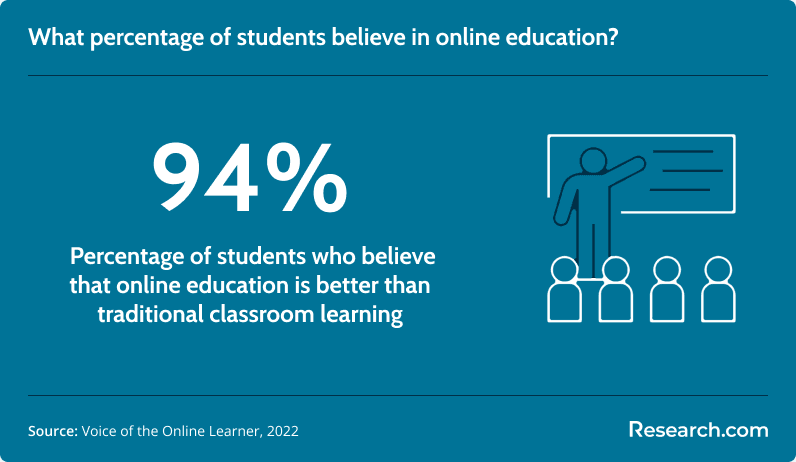
A survey found that 94% of students believe online education is better than traditional classroom learning. Even so, online study is not the best fit for everyone. Students who rely heavily on in-person discussion, campus networking, research labs, or face-to-face advising may prefer an on-campus or hybrid option.
Campus-based dual-degree programs can offer easier access to professors, peer groups, libraries, labs, student organizations, and recruiting events. The trade-off is less flexibility. Students may need to commute, relocate, or follow a fixed class schedule, which can be difficult for professionals or caregivers.
| Format | Advantages | Limitations | Best for |
| Online | Flexible location, easier to combine with work, often more scheduling options. | Requires self-direction and may offer fewer informal networking opportunities. | Working adults, remote learners, military students, and students with family responsibilities. |
| On-campus | Direct interaction, campus resources, in-person networking, structured routine. | May require relocation, commuting, and fixed attendance. | Students who want a traditional academic environment and regular in-person support. |
| Hybrid | Combines online convenience with selected in-person experiences. | Residencies or campus visits may add travel costs. | Students who want flexibility but still value face-to-face learning. |
Program fit matters more than delivery mode. A student in literature, writing, or communication may compare the best online English programs, while a student focused on technology operations may review the best online management information systems degree programs. Students exploring information careers can also ask what jobs can I get with a master's in library science before deciding whether a dual pathway is necessary.
What is the average cost of an online dual-degree program?
Online dual-degree costs vary widely, so the most useful approach is to calculate total program cost rather than comparing tuition alone. Students should include tuition, required fees, books, software, technology requirements, travel for residencies, exam fees, internship expenses, and lost income if they reduce work hours.
- Degree type: A program combining two master's degrees is generally more expensive than a bachelor's/master's pathway.
- Institution type: Public universities often cost less than private institutions, and nonprofit private colleges are usually less expensive than for-profit options.
- Program length: Longer programs can increase total tuition, while accelerated programs may charge higher per-credit rates.
- Residency status: Some public institutions charge lower tuition to in-state students, including some online learners.
- Field and reputation: Business, healthcare, law, and highly selective programs may carry higher tuition and fees.
| Cost level | General total cost range | What may fall into this range |
| Lower End | You might find some online dual bachelor's or a bachelor's/master's at a public university for under $30,000 total. | Public institutions, transfer-friendly programs, and lower-cost undergraduate pathways. |
| Mid-Range | Many online dual master's or more specialized programs fall in the $40,000 - $80,000 total cost range. | Graduate-level programs in business, healthcare, technology, or public service. |
| Higher End | Dual degrees at top-tier private universities or in fields like medicine/law can easily exceed $100,000. | Prestigious private institutions, professional degrees, and programs with extensive requirements. |
What are the financial aid options for students enrolling in an online dual-degree program?
Even students comparing affordable online degrees should build a complete funding plan before applying. Online dual-degree students may be eligible for federal aid, state aid, scholarships, institutional awards, employer benefits, and private funding, depending on the school, enrollment status, degree level, and program eligibility.
Federal Financial Aid
- Grants: Grants are usually need-based and do not require repayment. The Pell Grant is the best-known option, and some students may also qualify for the Federal Supplemental Educational Opportunity Grant (FSEOG).
- Loans: Federal student loans often have borrower protections and repayment options that private loans may not offer. Direct Subsidized Loans are need-based, while Direct Unsubsidized Loans are not need-based.
- Work-Study: Some institutions may offer remote work-study positions for eligible online students, although availability varies.
State Aid Programs
- State-specific support: Many states operate grant or loan programs for residents attending eligible colleges, including some online programs.
- Residency rules: Students should confirm whether state aid requires in-state residency, attendance at an in-state institution, or enrollment in an approved program.
Scholarships
- Merit-based or need-based awards: Scholarships may be awarded for academic achievement, financial need, professional background, field of study, or a combination of factors.
- Online-student scholarships: Some awards are designed specifically for distance learners or adult students.
- Search strategy: Students can use scholarship databases such as Fastweb, Scholarships.com, and Unigo, but they should also ask each school about program-specific awards.
Institutional Aid
- School-funded support: Colleges may offer grants, scholarships, discounts, fellowships, or assistantships for online students.
- Direct confirmation: Applicants should contact the financial aid office before applying, because eligibility can differ between single-degree and dual-degree pathways.
Employer Assistance Programs
- Tuition reimbursement: Employers may help pay for coursework that supports current or future job responsibilities.
- HR review: Working students should ask about annual reimbursement caps, grade requirements, repayment obligations, approved schools, and whether both degrees are covered.
What are the prerequisites for enrolling in an online dual-degree program?
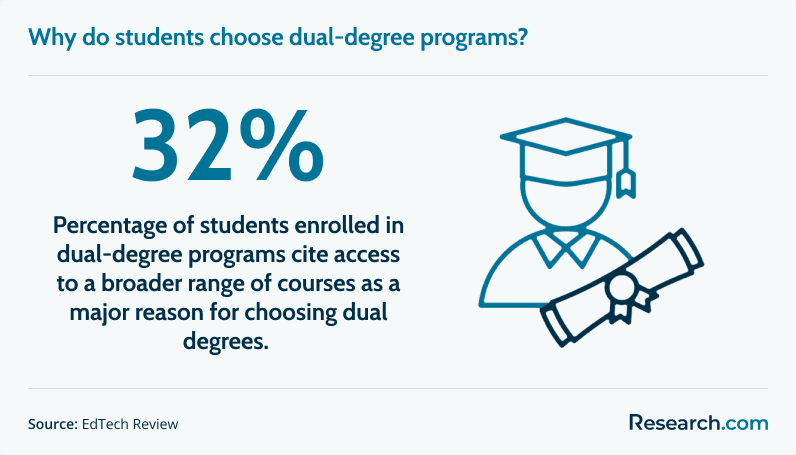
Among students interested in dual-degree programs, 32% cite access to a broader range of courses as a major reason for choosing dual degrees. However, broader course access also means stricter planning. A dual degree usually takes longer than an accelerated bachelor's degree and may require separate admission to two schools, departments, or programs within the same institution.
Common prerequisites include a completed prior degree, minimum GPA, official transcripts, a resume, letters of recommendation, a statement of purpose, and sometimes standardized test scores, prerequisite coursework, professional experience, licensure, or an interview. Graduate healthcare, nursing, law, social work, engineering, and education programs may have additional requirements tied to professional standards.
| Requirement | Why schools ask for it | What to check |
| Prior degree | Graduate dual degrees usually require a bachelor's degree; undergraduate pathways require high school completion or transfer eligibility. | Does the program require a specific major or prerequisite coursework? |
| GPA and transcripts | Schools use academic records to judge readiness for a heavier course load. | Is there a minimum GPA for each degree program? |
| Professional experience | Some MBA, MHA, MSN, MPA, or executive programs prefer applicants with work experience. | Is experience required, recommended, or optional? |
| Licensure or clinical background | Nursing, healthcare, social work, or counseling-related pathways may require field credentials. | Does the online program meet requirements in your state? |
| Separate admissions review | Some dual degrees require acceptance into both programs. | Can you start one degree first and add the second later? |
What courses are typically in an online dual-degree program?
Online dual-degree programs include core requirements from both disciplines and, when designed well, integrated courses that reduce repetition. This structure is one reason 38% of students see enhanced career prospects with dual degrees, especially when the pairing leads to degrees that pay well or supports advancement into specialized roles.
In an MBA/MS in Data Science pathway, students may complete business courses in accounting, finance, marketing, operations, and strategy, along with technical courses in statistics, programming, machine learning, data management, and data visualization. In a Public Health/Social Work pathway, coursework may include epidemiology, community health, human behavior, policy, social services, and program evaluation.
Some courses may count toward both degrees when the content overlaps. For example, a Community Health Assessment course may support both public health and social work requirements, while a Technology Management course may bridge business and engineering. Many programs end with a capstone, thesis, practicum, internship, consulting project, or research requirement that asks students to apply both fields together.
What types of specializations are available in online dual-degree programs?
Online dual-degree programs often focus on complementary fields rather than unrelated subjects. This matters because 42% of students cite broader skill set development as one of the major benefits of dual degrees.
Business and Technology
- MBA/MS in Information Systems: Designed for students interested in IT leadership, systems strategy, cybersecurity management, analytics, and technology operations.
- MBA/MS in Data Science: Built for students who want to combine business decision-making with statistical modeling, machine learning, analytics, and data visualization.
- MBA/MS in Computer Science: Useful for students aiming at software leadership, product management, technical consulting, entrepreneurship, or technology project management.
Healthcare and Business
- MBA/MHA: A common choice for students pursuing management roles in hospitals, clinics, healthcare systems, insurance organizations, and healthcare consulting.
- MBA/MSN: Often designed for nurses who want to move into nurse leadership, administration, clinical direction, education, or healthcare operations.
Public Service and Related Fields
- MPH/MSW: Combines public health and social work for students interested in community health, social services, program management, policy, and population-focused interventions.
- MPA/JD: Supports careers connected to government, law, public administration, regulation, public policy, and legal counsel.
Engineering and Business
- BS in Engineering/MBA: Helps students combine technical engineering knowledge with management, finance, operations, and strategy skills for leadership roles in technical organizations.
How do you choose the best online dual-degree program?
Choosing an online dual-degree program requires more scrutiny than choosing one fast credential. Students comparing the fastest online degree options may prioritize speed, but dual-degree students need to evaluate fit, accreditation, workload, career value, and total cost together.
Start with the career outcome
- Target role: Identify the job titles you want after graduation and confirm whether the dual degree is commonly valued for those roles.
- Skill gap: Decide which skills you lack now and whether both degrees are needed to build them.
- Industry relevance: Review job descriptions, employer expectations, and professional association guidance in your field.
Review the curriculum closely
- Course list: Make sure the required courses match your goals instead of focusing only on the degree names.
- Specializations: Check whether the program offers concentrations, electives, or projects in your intended career area.
- Faculty experience: Look for instructors with relevant academic, industry, clinical, legal, technical, or administrative expertise.
- Program length: Confirm the expected timeline for both full-time and part-time students.
Verify accreditation and reputation
- Institutional accreditation: Confirm that the school is accredited by a recognized accreditor.
- Programmatic accreditation: If your field requires specialized accreditation, verify it directly before enrolling.
- Student outcomes: Ask for graduation rates, employment data, licensure pass rates when applicable, and online student support information.
Evaluate the online experience
- Learning platform: Test whether the system is intuitive and supports discussion, assignments, advising, and collaboration.
- Student support: Ask about tutoring, library access, writing help, technical support, disability services, and academic advising for online learners.
- Schedule: Confirm whether classes are self-paced, asynchronous, synchronous, cohort-based, or residency-based.
Compare cost and return on investment
- Total price: Add tuition, fees, books, software, travel, exams, and time away from work.
- Aid options: Review federal aid, state programs, scholarships, institutional awards, and employer support.
- Career value: Compare the program's cost with realistic salary ranges, promotion potential, and job-market demand in your location and industry.
| Choose a dual degree if... | Consider a different path if... |
| Your target role clearly requires expertise in two fields. | A single degree, certificate, or work experience would meet the same goal. |
| The program allows meaningful shared credits. | The two programs add time and cost without reducing duplication. |
| The school has strong online support and career services. | Online students receive limited advising, networking, or placement help. |
| The credential is accredited and accepted in your profession. | You need licensure and the program does not meet your state's requirements. |
What career paths are available for graduates of online dual-degree programs?
Dual-degree graduates can pursue many types of roles because they bring a combined knowledge base. As modern learners prioritize career-focused degrees, the strongest online dual-degree choices are those tied to identifiable roles, not vague promises of flexibility.
Business and Technology
- MBA/MS in Information Systems: IT Manager, CIO, Cybersecurity Analyst, Business Systems Analyst, Project Manager, Technology Consultant
- MBA/MS in Data Science: Data Scientist, Business Analyst, Data Analytics Manager, Machine Learning Engineer, Business Intelligence Analyst
- MBA/MS in Computer Science: Software Engineer, Project Manager, Product Manager, Technology Consultant, CTO, Entrepreneur
Healthcare and Business
- MBA/MHA: Hospital Administrator, Healthcare Consultant, Clinic Manager, Healthcare System Executive, Pharmaceutical Project Manager
- MBA/MSN: Nurse Manager, Nurse Executive, Clinical Director, Healthcare Administrator, Nurse Educator
Public Service and Related Fields
- MPH/MSW: Community Health Worker, Social Services Manager, Public Health Program Coordinator, Policy Analyst, Nonprofit Director
- MPA/JD: Government Lawyer, Policy Advisor, Public Administrator, Legal Counsel, Lobbyist
Engineering and Business
- BS in Engineering/MBA: Engineering Manager, Project Manager, Operations Manager, Business Development Manager, Technology Consultant
What is the job market for graduates with an online dual-degree?
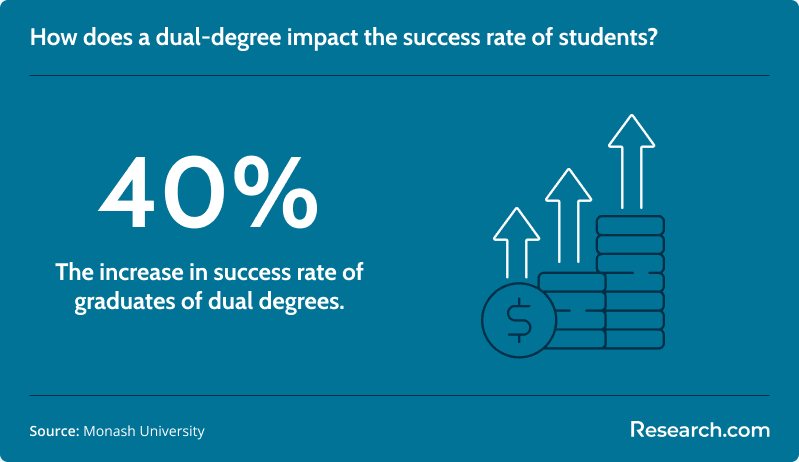
The job market for online dual-degree graduates depends on the discipline combination and the graduate's experience. Research cited in the original article states that dual degrees increases success rate by 40%. Still, students should interpret this as evidence that combined study can help employability, not as a guarantee of a job offer.
Why employers may value dual-degree graduates
- Cross-functional skills: Employers often need professionals who can work across departments, such as technology and management, clinical care and finance, or policy and law.
- Specialized positioning: A dual degree can help candidates explain a focused professional identity when the two fields are clearly connected.
- Adaptability: Graduates may be able to move between functions, industries, or leadership tracks more easily than candidates with narrower preparation.
Sectors where dual expertise can matter
- Business and Technology: Organizations that rely on data, software, cybersecurity, analytics, and digital strategy may value professionals who understand both technical systems and business goals.
- Healthcare: Healthcare employers may seek leaders who understand clinical operations, finance, compliance, administration, and patient-centered systems.
- Public Service: Government agencies, nonprofits, legal offices, and policy organizations may need professionals who can connect community needs, regulation, social programs, and public administration.
How can I optimize my financial aid strategy for an online dual-degree program?
A strong financial aid strategy starts before you apply. Confirm that each program in the dual-degree pathway is eligible for aid, then compare deadlines, enrollment requirements, satisfactory academic progress rules, and whether aid is calculated differently when two degrees are involved. Students may also compare online colleges that accept FAFSA to identify schools that participate in federal aid programs.
To reduce borrowing, ask each school about transfer credits, shared credits, tuition discounts, employer partnerships, graduate assistantships, scholarships for online learners, and payment plans. If you use loans, review interest rates, repayment timelines, and the amount of debt you would carry after both degrees.
How do online dual-degree programs support career advancement for working professionals?
Online dual-degree programs can support career growth when they let working professionals apply coursework directly to current job responsibilities. Career services may include resume help, coaching, mentorship, alumni connections, employer events, internship guidance, and professional development workshops. The value depends on whether these services are available to online students, not only campus students.
Working adults should look for programs that offer part-time pacing, predictable schedules, employer-friendly tuition documentation, and projects connected to real workplace problems. Those comparing flexible options may also review online degree programs for working adults before committing to a more demanding dual-degree route.
What advanced academic opportunities can be pursued after an online dual-degree program?
An online dual degree can prepare graduates for further study when it includes research, applied analysis, advanced writing, methods coursework, or a substantial capstone. Some graduates may pursue doctoral study, professional certifications, post-master's certificates, clinical specialization, research roles, or teaching opportunities.
Students interested in research-intensive academic paths should examine whether the program includes a thesis option, faculty mentorship, research methods, publication opportunities, or preparation for doctoral admissions. Cost-conscious students may compare the cheapest doctorate degree options after completing a dual-degree program.
Is an online dual-degree program right for my career goals?
An online dual-degree program is most appropriate when you can clearly name the roles it prepares you for and explain why both degrees are necessary. If your goal is leadership in healthcare, analytics management, public policy law, technology consulting, or engineering management, a dual pathway may offer a coherent advantage. If your goal is still unclear, a single degree, certificate, or work experience may be a lower-risk starting point.
Before applying, compare the program's curriculum with job postings, employer expectations, and projected career steps. Students still choosing a field can review best college majors to understand which academic areas align with current career interests.
Could an accelerated associate's degree complement a dual-degree program?
An accelerated associate degree may help some students build transferable credits before entering a bachelor's or combined bachelor's/master's pathway. This strategy can be useful for students who want a lower-cost starting point, need foundational coursework, or want an early credential before committing to a longer dual-degree plan.
The key is transferability. Students should confirm that credits from the associate program will apply to the later institution and that the courses match degree requirements. Those exploring this route can review the quickest way to get associate's degree as a possible stepping stone.
What future trends are emerging for online dual-degree programs?
Online dual-degree programs are being shaped by several practical trends: more flexible scheduling for working adults, greater use of digital collaboration tools, stronger emphasis on career-focused curriculum, and rising interest in interdisciplinary skills. Programs in business analytics, healthcare leadership, cybersecurity, public health, and technology management are especially aligned with the need to connect technical knowledge with organizational decision-making.
AI and automation are also changing what students should look for. Strong programs should teach students how to evaluate data, manage technology responsibly, communicate across functions, and adapt to changing tools. Students comparing flexible academic pathways may find it useful to review easy online degrees, while remembering that ease should not outweigh accreditation, rigor, and career fit.
Can online dual-degree programs pave the way for advanced doctoral studies?
Some online dual-degree programs can help students prepare for doctoral study, especially when they include research methods, advanced writing, thesis work, faculty mentorship, or applied research projects. A capstone or thesis that integrates both fields can help students demonstrate readiness for doctoral-level inquiry.
Students considering doctoral study should ask whether faculty supervise research, whether online students can participate in research projects, and whether graduates have gone on to PhD, professional doctorate, or other advanced programs. Those seeking shorter doctoral routes may compare short online doctoral programs after confirming admission and research requirements.
What do graduates have to say about their online dual-degree program?
-
: "
I did not think I could keep working while studying two fields, but the online format made it possible. Combining business and data analytics helped me qualify for opportunities that matched both my technical interests and my management goals. Meryl
"
-
: "
Studying public health and social work together helped me understand community needs from more than one angle. The online structure gave me flexibility, but I still had to stay organized and use advising support often. Denise
"
-
: "
The workload was demanding, but pairing engineering with business administration changed how I approached leadership and project decisions. Being able to continue working while studying helped me connect class concepts to real projects. Sarah
"
Is the online dual-degree program accredited and aligned with industry standards?
Accreditation should be one of the first items you verify. Institutional accreditation supports academic quality, financial aid eligibility, credit transfer, and employer recognition. Some fields also require programmatic accreditation, especially when licensure, certification, clinical practice, or professional exams are involved.
Do not rely only on marketing pages. Check the accreditor's database, ask the program directly, and confirm whether the online version has the same accreditation status as the campus version. Students comparing flexible formats can also review accredited self-paced online colleges to understand how accreditation and online delivery interact.
What challenges do students face in online dual-degree programs?
Online dual-degree students often face a heavier workload than single-degree students. They may juggle two academic calendars, multiple advising offices, different grading expectations, and overlapping deadlines. Networking can also require more effort because online students may not meet classmates or faculty casually on campus.
Common challenges include time management, burnout, limited live interaction, unclear credit-sharing rules, technology fatigue, and difficulty explaining the dual degree to employers. Students who want a shorter graduate option should compare alternatives such as one year graduate programs before choosing a longer dual-degree pathway.
| Common mistake | Why it can hurt you | Better approach |
| Choosing the program because two degrees sound impressive | The second degree may not improve your career prospects enough to justify the cost. | Start with target job titles and work backward to the required credentials. |
| Ignoring accreditation | You may face problems with financial aid, transfer credits, licensure, or employer recognition. | Verify institutional and programmatic accreditation before applying. |
| Looking only at tuition | Fees, books, software, travel, and lost work hours can change the real cost. | Calculate total cost of attendance and expected debt. |
| Assuming online means self-paced | Some programs require live classes, group work, internships, or residencies. | Ask for a sample schedule and all in-person requirements. |
| Assuming salary outcomes are guaranteed | Pay depends on experience, location, industry, and role. | Compare program outcomes with realistic labor-market information and job postings. |
Is investing in an online dual-degree program financially worthwhile?
To judge financial value, compare the total cost of the program with the specific career outcomes it supports. A dual degree may be financially worthwhile if it helps you qualify for higher-responsibility roles sooner, reduces duplicate coursework, and aligns with fields where combined expertise is valued. It may not be worthwhile if it delays career entry, requires heavy debt, or adds a credential employers do not clearly reward.
Students should compare expected outcomes with alternatives such as a single master's degree, a graduate certificate, employer training, or professional certification. For compensation-focused planning, it may also help to review high paying master's degrees and compare whether a dual degree offers a stronger path than one targeted graduate program.
Questions to ask before enrolling in an online dual-degree program
- What exact degrees will I earn, and will both appear on my transcript and diploma?
- How many credits are shared between the two programs?
- Is the institution accredited, and is programmatic accreditation required in my field?
- Does the online format include live classes, residencies, internships, labs, clinical hours, or campus visits?
- What is the total cost, including fees, books, software, travel, and exam expenses?
- Can I use federal aid, employer tuition reimbursement, scholarships, or assistantships?
- What jobs have recent graduates obtained?
- Are career services, alumni networks, and employer events available to online students?
- Can I pause one degree if my schedule changes?
- Will the program meet licensure or certification requirements in my state, if applicable?
Key Insights
- Online dual-degree programs are best for students with a specific interdisciplinary career goal, such as healthcare management, analytics leadership, public policy law, or technology consulting.
- As of 2023, 40% of students were interested in pursuing dual-degree programs, but interest alone should not drive enrollment. Career fit, accreditation, cost, and workload matter more.
- Program length varies by pathway: two bachelor's degrees may take around 5-6 years, a bachelor's/master's combination may take 5-7 years, and two master's degrees may take around 3 years.
- Cost can range from under $30,000 total at the lower end to more than $100,000 for some top-tier private or professional programs.
- Online learning can be flexible, and a survey found that 94% of students believe online education is better than traditional classroom learning, but online dual-degree students still need strong time management and self-direction.
- Among students interested in dual-degree programs, 32% cite access to a broader range of courses, 38% see enhanced career prospects, and 42% cite broader skill set development as a major benefit.
- The strongest programs use shared credits, integrated projects, and career support to help students connect both fields instead of simply completing two unrelated curricula.
- Before enrolling, verify accreditation, total cost, online requirements, transfer-credit policies, licensure alignment, and graduate outcomes.
References:
- Education Dynamics. (n.d.). NCES data: Modern learners prioritizing career-focused degrees.
- Hurst, D. (2021). Want to improve your chances of getting a full-time job? A double degree can do that. The Conversation.
- National Student Clearinghouse Research Center. (n.d.). Current term enrollment estimates – Appendix.
- Sharma, A. (2023). Students feel online education is superior to traditional classrooms: Survey. EdTechReview.
- Zhang, L., and Liu, Y. (2023). Exploring the influencing factors of online learning satisfaction: A meta-analysis. SN Computer Science, 4(3), Article 211.
Other Things You Should Know About Online Dual-Degree Programs
Residency requirements can add one or two in-person terms, even in online dual-degree programs. Many schools require 6 to 12 credits taken directly from the institution before awarding both degrees. Some programs waive residency only by formal approval from the registrar or graduate dean.
Credit transfer policies for online dual-degree programs in 2027 typically allow students to transfer previously earned credits, subject to evaluation by the program's academic advisors. Most programs require that credits be from accredited institutions and relevant to the dual-degree curriculum.


